AtData vs Seamless.AI 2026: B2B Data Accuracy Compared
AtData and Seamless.AI solve different halves of the B2B data problem. Here's how they compare on accuracy, coverage, pricing, and fit — and where a finder like Tomba beats both.
You typed "AtData vs Seamless.AI" into a search bar because two vendors are sitting in your evaluation doc and you need to know which one to cut. The honest answer is that they barely compete — they fix opposite ends of the same pipeline. Pick the wrong one and you either buy contact data you can't trust, or buy validation for a list you don't have yet.
This breakdown gives you the conclusion first, then the evidence: what each tool actually does, where each is strong, what they cost, and the cheaper, more accurate path most outbound teams end up taking.
TL;DR — AtData vs Seamless.AI in five lines#
- AtData (formerly TowerData) is an email intelligence and validation platform. It tells you whether an email is real, active, and safe to send to. It does not build prospect lists from scratch.
- Seamless.AI is a prospecting and contact-discovery engine. It generates emails and phone numbers for people who match your ICP, often by guessing patterns in real time.
- They're complementary, not interchangeable. AtData cleans data; Seamless.AI finds it. Comparing them straight-up is like comparing a spell-checker to a search engine.
- Accuracy is the deciding factor, and both have gaps — AtData can't find what you don't have, and Seamless.AI's real-time guesses produce a well-documented bounce problem.
- A focused email finder + verifier (Tomba) covers the part most teams actually need — verified, ready-to-send addresses — at a fraction of either vendor's price.
What is AtData and who is it for?#
AtData is an email-centric data company that has been in the deliverability and identity business for over two decades. Its core products validate email addresses, score their activity and fraud risk, and append demographic or firmographic attributes to records you already own.
Think of AtData as a quality-control inspector on an assembly line. It doesn't manufacture the product — it stands at the end of the belt and flags the defects before they reach the customer. If you run a large B2C or B2B email program and you're worried about bounce rates, spam traps, and sender reputation, AtData is built for you.
Where AtData shines:
- Email validation at scale — real-time API and batch processing for millions of records.
- Fraud and activity scoring — it predicts whether an address is a likely typo, a trap, or a dormant inbox.
- Demographic append — enrich a known email with age, location, and interest signals (strong for B2C marketers).
- Deliverability consulting — it sells expertise, not just an endpoint.
Where it falls short: AtData assumes you already have the contacts. It is not a prospecting tool. If your rep is staring at a blank list and needs 500 emails for a target account list, AtData has nothing to hand them.
What is Seamless.AI and who is it for?#
Seamless.AI is a sales-prospecting platform that markets itself as a real-time search engine for B2B contacts. You search by title, company, industry, or location, and it returns names with emails and direct dials. Its pitch is volume and speed — fill a sales prospecting pipeline fast.
Seamless.AI is the search engine in the analogy: ask it for "VPs of Marketing at SaaS companies in Texas" and it returns a list. The catch is how it produces contact details. Much of its email output is generated through real-time pattern inference rather than verified-on-file data, which is why bounce complaints follow it across review sites.
)
Where Seamless.AI shines:
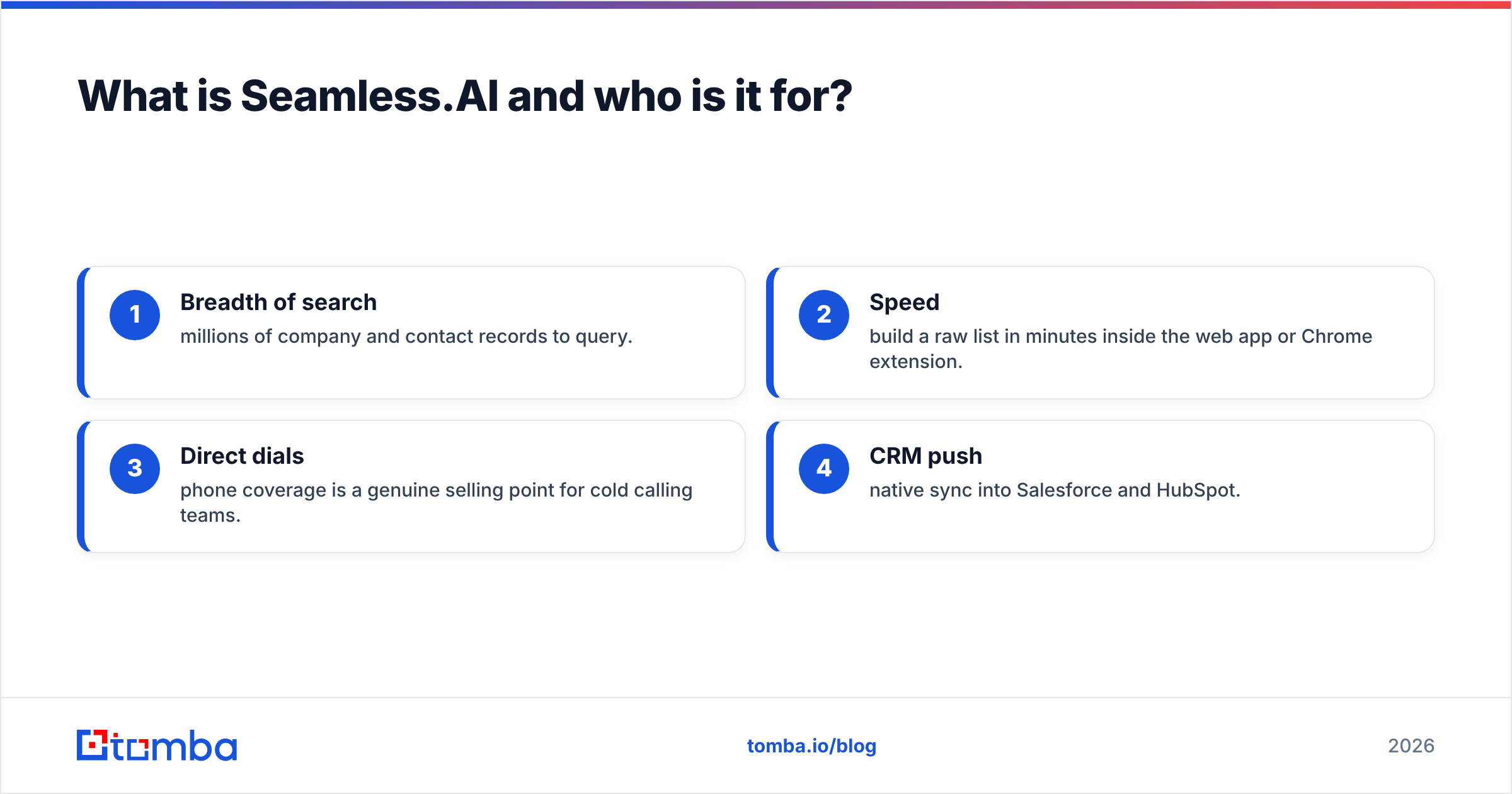
- Breadth of search — millions of company and contact records to query.
- Speed — build a raw list in minutes inside the web app or Chrome extension.
- Direct dials — phone coverage is a genuine selling point for cold calling teams.
- CRM push — native sync into Salesforce and HubSpot.
Where it falls short: data accuracy and aggressive contracts. On G2, recurring themes are inflated credit consumption, hard-to-cancel annual deals, and email guesses that bounce. You often need a separate verification step before you send — which puts you right back at a tool like AtData.
AtData vs Seamless.AI: how do they compare directly?#
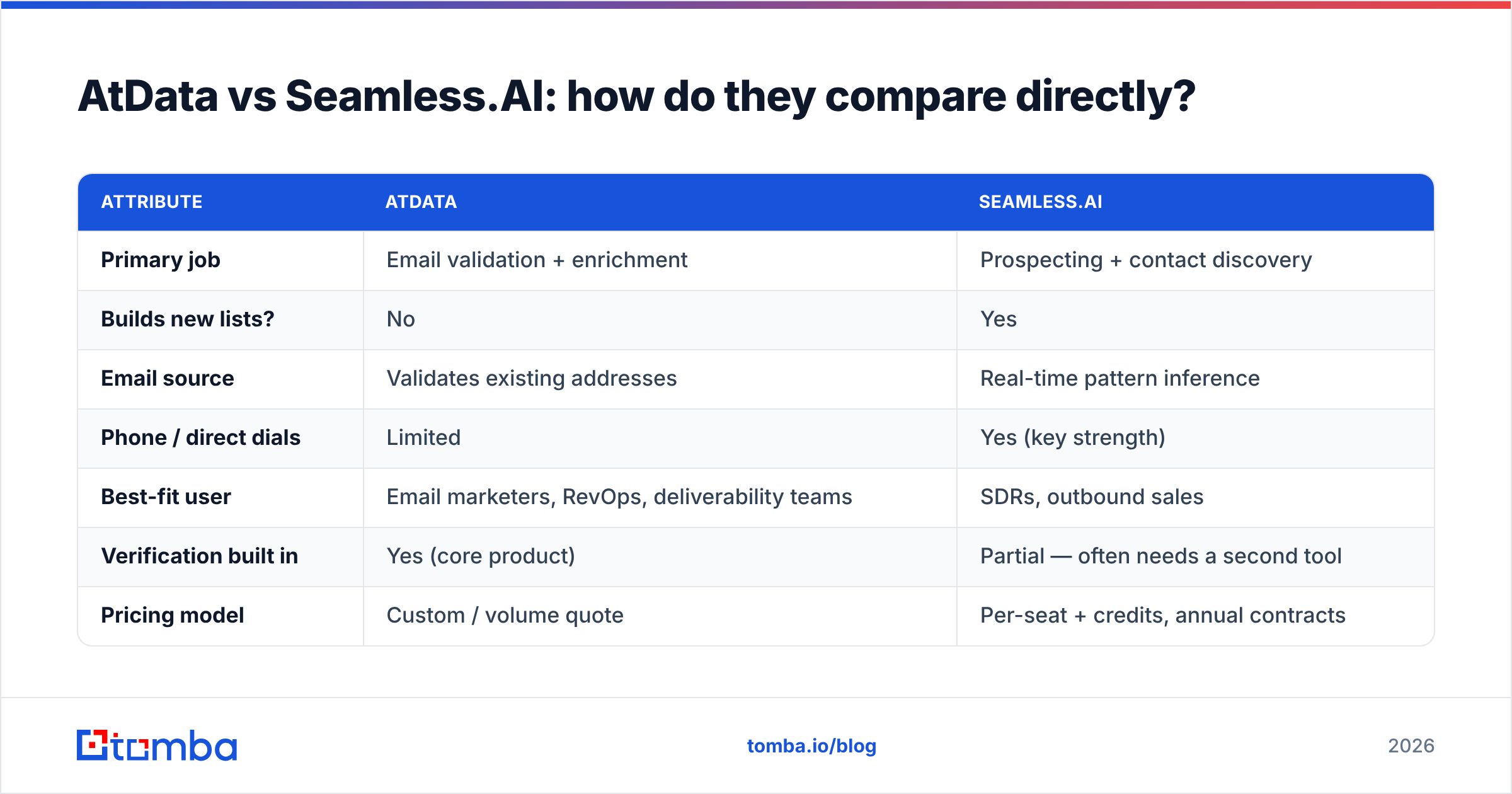
Here's the head-to-head on the attributes that actually drive a buying decision.
| Attribute | AtData | Seamless.AI |
|---|---|---|
| Primary job | Email validation + enrichment | Prospecting + contact discovery |
| Builds new lists? | No | Yes |
| Email source | Validates existing addresses | Real-time pattern inference |
| Phone / direct dials | Limited | Yes (key strength) |
| Best-fit user | Email marketers, RevOps, deliverability teams | SDRs, outbound sales |
| Verification built in | Yes (core product) | Partial — often needs a second tool |
| Pricing model | Custom / volume quote | Per-seat + credits, annual contracts |
| Free tier | No | Limited free credits |
| Common complaint | Not a finder | Bounce rates, credit burn, contracts |
The takeaway: if you put these two in the same evaluation, you've likely mis-scoped the problem. AtData is a fit when your list exists and your bounce rate is the fire. Seamless.AI is a fit when you need raw volume and you'll tolerate cleaning it yourself.
Which one is more accurate?#
Accuracy splits into two questions, and each vendor wins one.
On validating an address you already have, AtData is the stronger tool. That's its entire business. It will tell you, with real confidence scoring, whether jane@company.com is live, risky, or dead.
On finding a correct address in the first place, neither is reliable enough to send blind. Seamless.AI's real-time inference produces a high share of pattern guesses — first.last@, flast@, and so on — that look plausible and bounce. AtData can't help here because it has nothing to validate until you supply the address.

This is the gap that catches teams off guard. You buy Seamless.AI for discovery, watch your bounce rate climb, then buy AtData (or another verifier) to fix it. Two tools, two invoices, and a workflow that still leaks. The cleaner approach is a finder that verifies addresses at the point of discovery — which is exactly how a purpose-built email verifier paired with a finder works.
What does AtData vs Seamless.AI cost in 2026?#
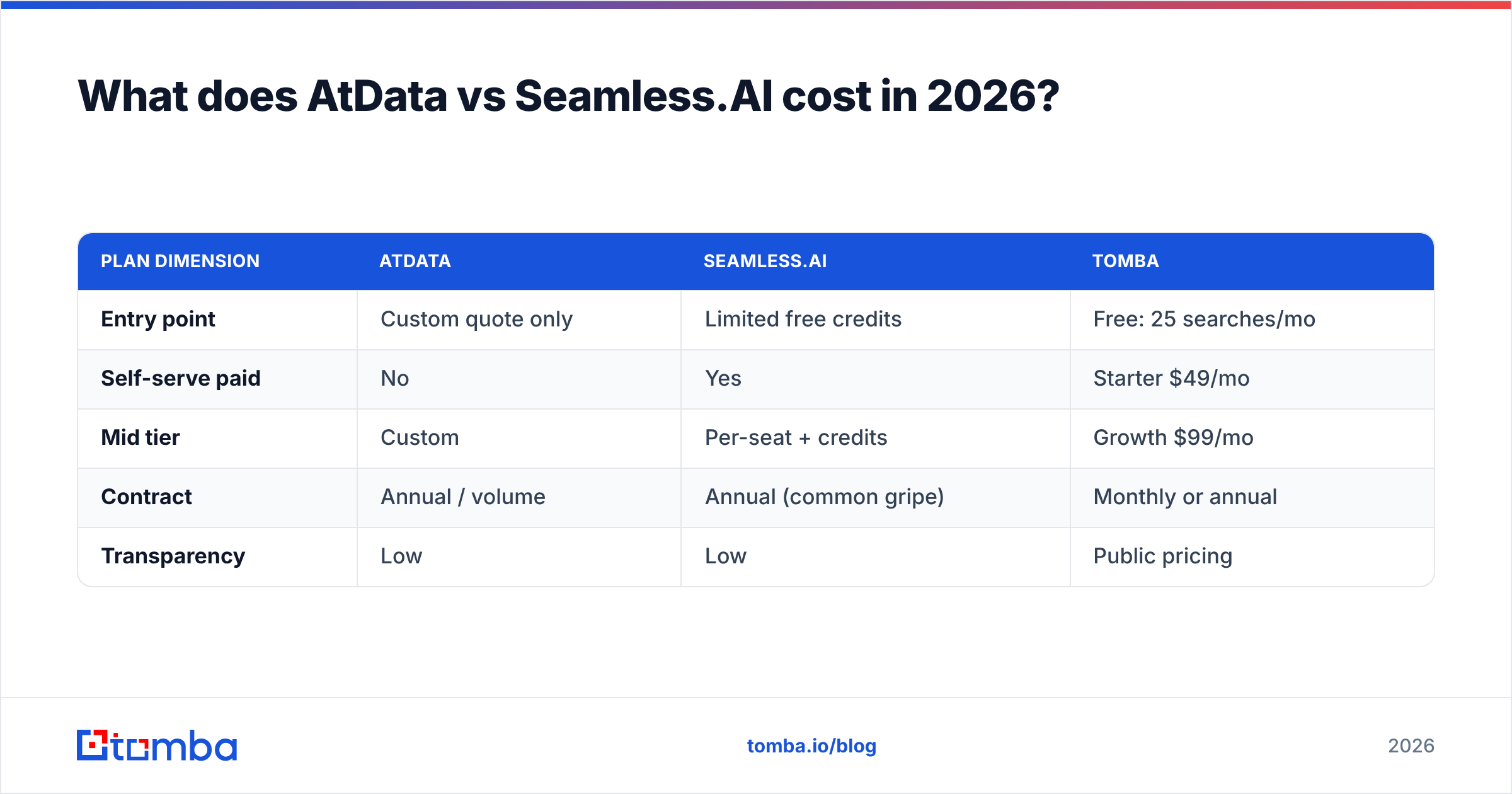
Neither vendor publishes simple, transparent pricing, and that's a signal in itself.
AtData uses custom, volume-based quotes. You'll talk to sales, and pricing scales with record counts and which products (validation, append, scoring) you bundle. Expect enterprise-style commitments rather than a self-serve credit card flow.
Seamless.AI sells per-seat plans plus a credit system, and its annual contracts are the single most common complaint in reviews — buyers report difficulty downgrading or cancelling, and credits that deplete faster than expected. There's a limited free tier to start, but serious usage pushes you into negotiated annual deals.
| Plan dimension | AtData | Seamless.AI | Tomba |
|---|---|---|---|
| Entry point | Custom quote only | Limited free credits | Free: 25 searches/mo |
| Self-serve paid | No | Yes | Starter $49/mo |
| Mid tier | Custom | Per-seat + credits | Growth $99/mo |
| Contract | Annual / volume | Annual (common gripe) | Monthly or annual |
| Transparency | Low | Low | Public pricing |
If predictable, published pricing matters to you, this is where a tool with transparent Tomba pricing — Free, $49, $99, $249, and Enterprise — removes a whole category of procurement friction.
When should you choose AtData?#
Choose AtData when the list already exists and quality is the problem. Specifically:
- You run high-volume email campaigns and bounce rates are hurting email deliverability.
- You need fraud and activity scoring, not just a valid/invalid flag.
- You're a B2C or hybrid marketer who wants demographic append on known emails.
- You have the budget and procurement patience for a custom enterprise contract.
AtData is overkill — and the wrong shape — if your real need is generating new prospects.
When should you choose Seamless.AI?#
Choose Seamless.AI when raw discovery volume and phone numbers outrank email precision. Specifically:
- Your SDR team lives on direct dials and cold calls.
- You need to build large target lists fast and you have a verification step downstream.
- You want native, heavy CRM sync into Salesforce or HubSpot.
- You can negotiate the annual contract terms with eyes open.
Just plan for the cleanup. Budget a verification pass before any send, or your email response rate and reputation will pay for the guesses.
)
Is there a better-fit alternative for most teams?#
For the majority of outbound and growth teams, the honest answer is: you don't need either heavyweight — you need accurate, ready-to-send emails without a two-tool workflow.
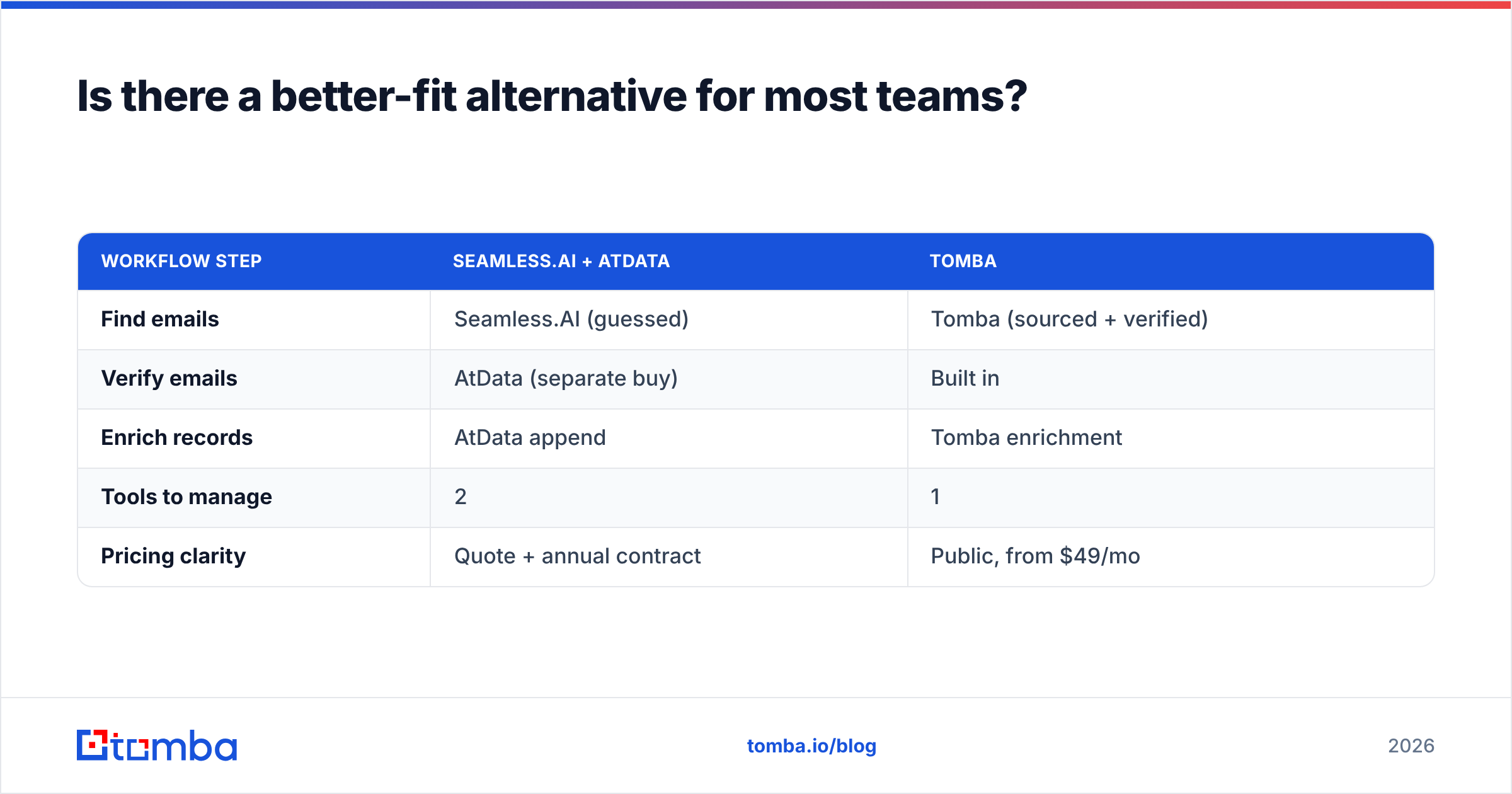
That's the niche a focused email finder fills. Instead of Seamless.AI's pattern-guessing followed by an AtData clean-up, a finder that verifies at discovery hands you addresses you can send to today. Compare the workflows:
| Workflow step | Seamless.AI + AtData | Tomba |
|---|---|---|
| Find emails | Seamless.AI (guessed) | Tomba (sourced + verified) |
| Verify emails | AtData (separate buy) | Built in |
| Enrich records | AtData append | Tomba enrichment |
| Tools to manage | 2 | 1 |
| Pricing clarity | Quote + annual contract | Public, from $49/mo |
Here's the side-by-side that most evaluation docs skip — finder accuracy across the tools teams actually shortlist:

Tomba's core Email Finder sources addresses from public data and verifies them before they reach you, and its data enrichment layer appends the firmographic detail you'd otherwise license separately. If you're specifically shopping to replace Seamless.AI, the Seamless.AI alternative breakdown goes deeper on the migration.
This isn't to say AtData or Seamless.AI are bad tools — they're strong at their specific jobs. It's that most teams describe a problem ("I need correct emails I can send to") that neither solves cleanly on its own.
How to actually decide between AtData and Seamless.AI#
Run your need through three questions:
- Do I already have the contacts? Yes → you're in AtData's lane (validation/enrichment). No → you need discovery, which AtData can't do.
- Is my biggest pain phone-based outbound and volume? Yes → Seamless.AI's dials are a real edge. No → its email accuracy gap may not be worth the contract.
- Do I just need verified emails without juggling two vendors? Yes → a dedicated finder-plus-verifier is the cheaper, simpler win.
Most teams land on question three. They started comparing two enterprise platforms and discovered the job was smaller and more specific than either was built for.
The bottom line#
AtData and Seamless.AI aren't really rivals — AtData validates and enriches data you own, while Seamless.AI discovers new contacts (with an accuracy tax you pay in bounces). Choose AtData for deliverability and clean lists; choose Seamless.AI for volume and direct dials, with a verification budget attached.
But if what you actually need is verified, send-ready B2B emails without stitching two pricey, opaque contracts together, skip the false binary. Start free with the Tomba Email Finder — 25 searches a month at no cost, public pricing from $49/mo, and verification built in so the address you find is the address that lands. Find it, verify it, send it, in one tool.
// get started
Find, verify and enrich your first contacts today
Start on the free plan with 25 searches a month, then scale when your team is ready.
Free plan · No credit card required · GDPR & CCPA
// about the author