AtData vs Tomba: Email Data & Finder Comparison (2026)
AtData is an enterprise email intelligence suite; Tomba is a self-serve email finder and verifier. Here's which one fits your team, budget, and data needs in 2026.
You're weighing AtData vs Tomba because both promise cleaner email data — but they solve different problems for different buyers. One is an enterprise email-intelligence suite built around validation and identity. The other is a self-serve email finder and verifier built around finding and confirming addresses fast. Picking the wrong one means either overpaying for capabilities you won't use or hitting a wall the moment you need to prospect.
This breakdown cuts through the marketing pages and shows you exactly where each tool earns its keep.
TL;DR#
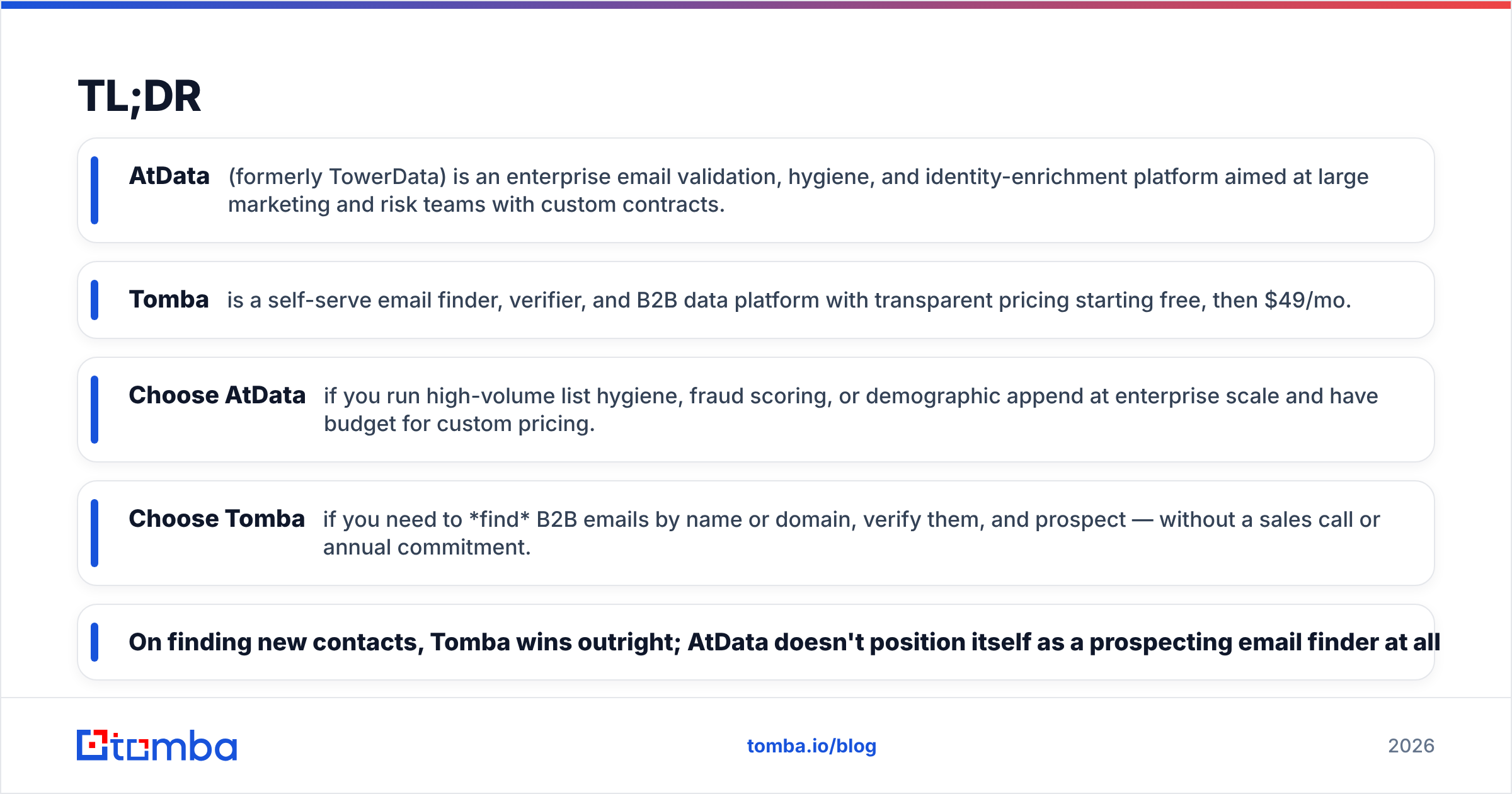
- AtData (formerly TowerData) is an enterprise email validation, hygiene, and identity-enrichment platform aimed at large marketing and risk teams with custom contracts.
- Tomba is a self-serve email finder, verifier, and B2B data platform with transparent pricing starting free, then $49/mo.
- Choose AtData if you run high-volume list hygiene, fraud scoring, or demographic append at enterprise scale and have budget for custom pricing.
- Choose Tomba if you need to find B2B emails by name or domain, verify them, and prospect — without a sales call or annual commitment.
- On finding new contacts, Tomba wins outright; AtData doesn't position itself as a prospecting email finder at all.
What is AtData?#
AtData is a long-running email-intelligence company (it operated as TowerData for years) focused on what happens to email addresses after you already have them. Its core services cluster around three jobs: email validation and hygiene (removing invalid, risky, and spam-trap addresses before you send), fraud and risk scoring (assessing whether an email is tied to legitimate activity), and identity enrichment (appending demographic, interest, and contact attributes to an email you already hold).
That positioning matters. AtData is built for marketers, data teams, and fraud/risk departments at mid-market to enterprise companies that process large volumes of first-party email data. It sells primarily through custom contracts and API integrations rather than a credit-card checkout. If you've collected millions of signups and need to score, clean, and enrich them, AtData is in its element. You can read more about its category on its official site.
What AtData is not is a prospecting tool. It does not advertise a "type a name and company, get the email" workflow. That's the gap Tomba fills.
What is Tomba?#
Tomba is a B2B email finder and verification platform built for the opposite starting point: you know who you want to reach but you don't have their address yet. You give Tomba a name and a company domain, or just a domain, and it returns professional email addresses with a confidence score and the sources it used.
Around that core finder, Tomba bundles an email verifier, domain search for pulling every public address at a company, a catch-all verifier, a phone finder, and data enrichment. It plugs into a Chrome extension, Google Sheets, Excel, and a developer API.
The buyer is different too. Tomba is self-serve: a free tier (25 searches/mo) lets you test before you pay, and paid plans start at $49/mo with public, predictable Tomba pricing. SDRs, founders, recruiters, and growth marketers can sign up and find a verified email in minutes.
How accurate is each on email data?#
Accuracy means two different things here, and conflating them is the most common mistake buyers make.
For validation accuracy — correctly flagging whether an address is deliverable, risky, or a trap — AtData has deep heritage. Its hygiene engine draws on a large activity database and is tuned for catching spam traps and disposable domains at scale. If your only job is cleaning a 5-million-row list before a campaign, that depth is real.
For discovery accuracy — returning the correct email when you only have a name and company — that's Tomba's domain, and AtData largely doesn't compete there. Tomba scores every result, validates it through SMTP-level checks, and is transparent about where its data comes from. The practical test: if your workflow starts with "I have a list of companies and titles but no emails," AtData can't get you there and Tomba can.
The chart below summarizes how email-finding tools stack up on verified-email accuracy, which is the metric that matters for outbound.

The takeaway: validation accuracy and discovery accuracy are separate scores. Don't buy a hygiene-first platform expecting it to prospect, and don't buy a finder expecting enterprise-grade fraud modeling.
AtData vs Tomba: side-by-side comparison#
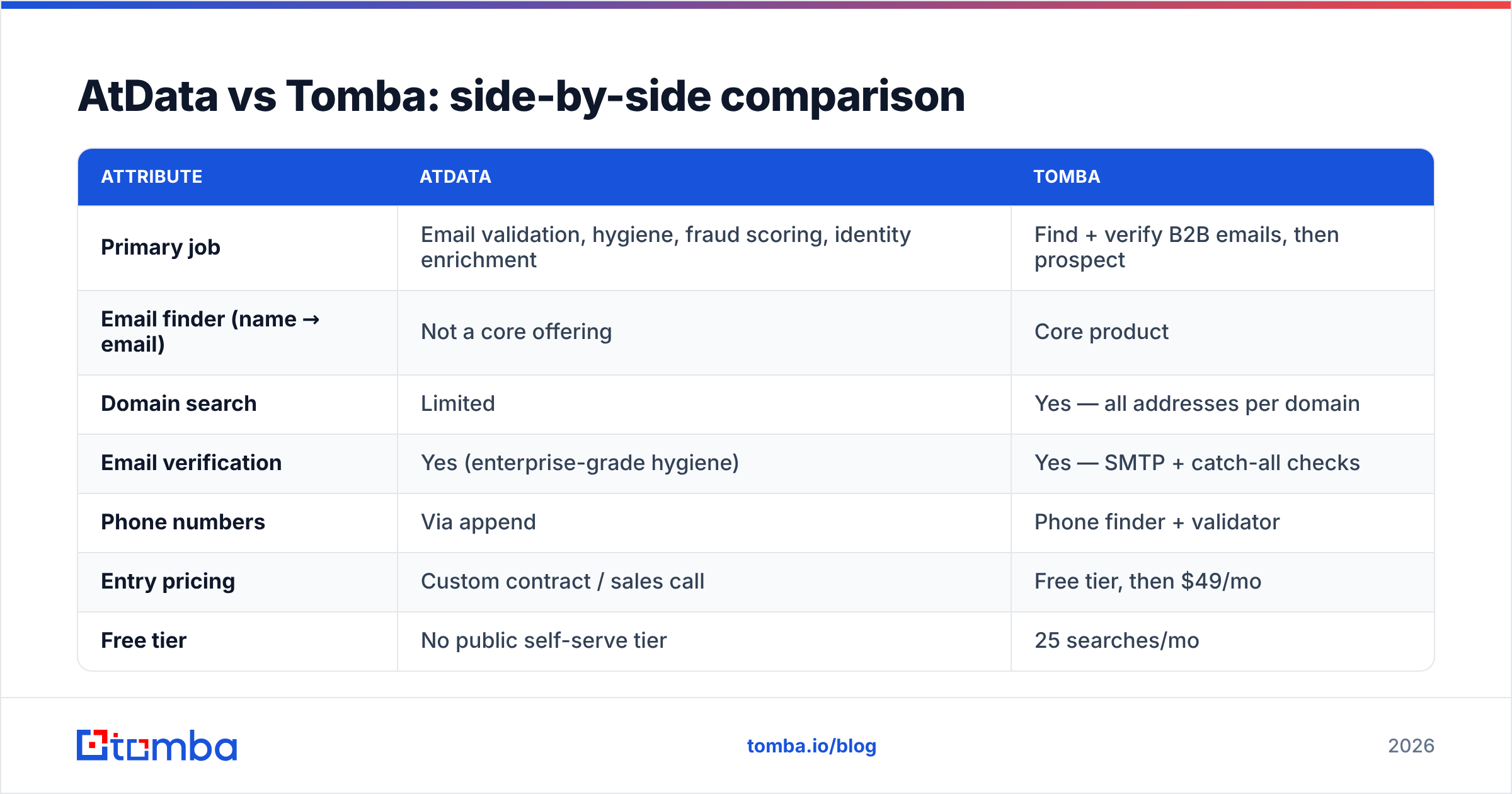
Here is the head-to-head on the attributes that actually drive a buying decision.
| Attribute | AtData | Tomba |
|---|---|---|
| Primary job | Email validation, hygiene, fraud scoring, identity enrichment | Find + verify B2B emails, then prospect |
| Email finder (name → email) | Not a core offering | Core product |
| Domain search | Limited | Yes — all addresses per domain |
| Email verification | Yes (enterprise-grade hygiene) | Yes — SMTP + catch-all checks |
| Phone numbers | Via append | Phone finder + validator |
| Entry pricing | Custom contract / sales call | Free tier, then $49/mo |
| Free tier | No public self-serve tier | 25 searches/mo |
| Buyer | Enterprise marketing, data, risk teams | SDRs, founders, recruiters, agencies |
| API | Yes | Yes (REST API, CLI, MCP) |
| Time to first result | Onboarding + integration | Minutes after signup |
The pattern is clear: these tools overlap on verification but diverge everywhere else. AtData goes deep on enterprise data operations; Tomba goes broad on accessible find-and-verify prospecting.
Which one fits your use case?#
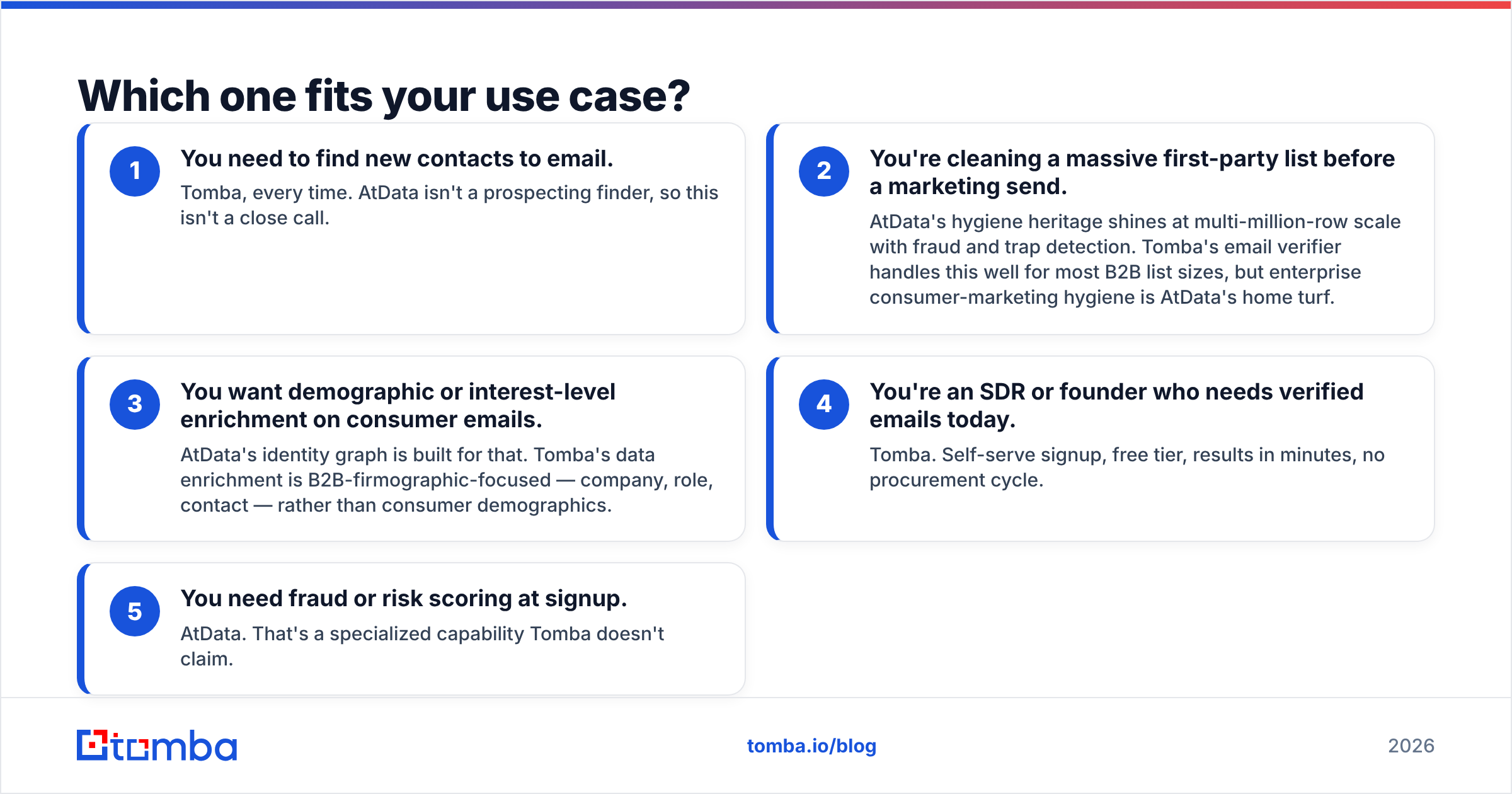
Match the tool to the job rather than the brand. Here are the five scenarios that decide it:
You need to find new contacts to email. Tomba, every time. AtData isn't a prospecting finder, so this isn't a close call.
You're cleaning a massive first-party list before a marketing send. AtData's hygiene heritage shines at multi-million-row scale with fraud and trap detection. Tomba's email verifier handles this well for most B2B list sizes, but enterprise consumer-marketing hygiene is AtData's home turf.
You want demographic or interest-level enrichment on consumer emails. AtData's identity graph is built for that. Tomba's data enrichment is B2B-firmographic-focused — company, role, contact — rather than consumer demographics.
You're an SDR or founder who needs verified emails today. Tomba. Self-serve signup, free tier, results in minutes, no procurement cycle.
You need fraud or risk scoring at signup. AtData. That's a specialized capability Tomba doesn't claim.
If your needs span both — find emails and run heavy hygiene — Tomba covers the prospecting plus solid verification in one self-serve subscription, while AtData would require a contract for the hygiene-only slice.
How does pricing compare?#
Pricing is where the two business models split hardest.
AtData uses custom, contract-based pricing. There's no public self-serve plan; you talk to sales, scope volume, and sign — typically annual. That model suits enterprises that want SLAs, dedicated support, and negotiated per-record rates, but it's friction for a small team that just wants to test.
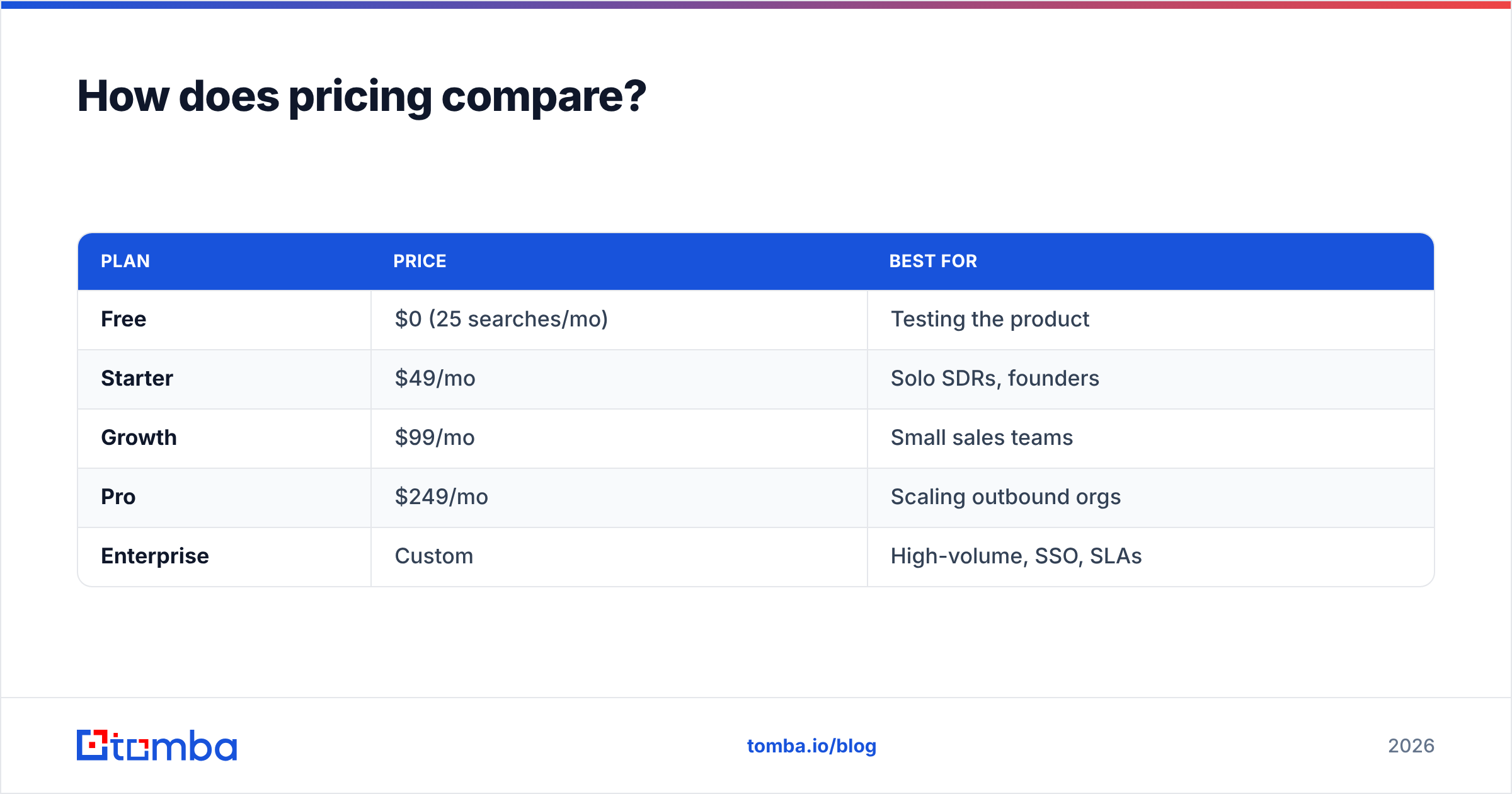
Tomba publishes its plans openly:
| Plan | Price | Best for |
|---|---|---|
| Free | $0 (25 searches/mo) | Testing the product |
| Starter | $49/mo | Solo SDRs, founders |
| Growth | $99/mo | Small sales teams |
| Pro | $249/mo | Scaling outbound orgs |
| Enterprise | Custom | High-volume, SSO, SLAs |
The strategic difference: with Tomba you can validate the tool against your own workflow for free, then scale up a tier at a time. With AtData you commit before you fully know your volume. For teams that want to compare options on platforms like G2 before signing anything, Tomba's free path removes the gatekeeper.
Can you use both together?#
Yes, and for some enterprises that's the smartest answer. The two tools aren't mutually exclusive because they sit at different points in the data lifecycle.
A common stack: use Tomba to discover and verify new B2B contacts — running domain search and the bulk email finder to build prospect lists, then pushing them into your CRM through Tomba's integrations. Then, if you also collect large volumes of first-party consumer signups, route those through AtData for hygiene and identity enrichment before marketing sends.
In that division of labor, Tomba owns acquisition and outbound data; AtData owns retention-marketing hygiene and risk. You're not paying either tool to do the other's job badly.
For most B2B sales and growth teams, though, the AtData layer is overkill. The prospecting and verification Tomba provides is the part that directly drives pipeline, and that's where the budget should go first.
What do reviewers and the market say?#
AtData carries the credibility of a long-established data vendor with enterprise references in marketing and fraud — its reputation is strongest among data-ops and CRM teams who value depth and SLAs. Independent listings on directories like Capterra reflect that enterprise-leaning profile.
Tomba's market position is the accessible, transparent alternative: strong on email-finding accuracy, fast to adopt, and priced for teams that can't or won't run a procurement cycle. Its breadth of free tools and a public API have made it a default for self-serve buyers.
Neither reputation contradicts the other. They describe two different products serving two different buyers — which is exactly why the "which is better" question only makes sense once you've named your use case.
Final verdict: AtData vs Tomba#
Pick Tomba if your job is to find and verify B2B email addresses, prospect, and build pipeline — especially if you want to start free and scale on transparent pricing. Pick AtData if you're an enterprise running high-volume email hygiene, fraud scoring, or consumer identity enrichment and you have the budget and procurement appetite for a custom contract.
For the vast majority of sales, growth, and recruiting teams reading a comparison like this, the need is finding verified emails — and that's not a category AtData competes in. The honest recommendation: if you're not an enterprise data-ops or fraud team, AtData is the wrong shape for the problem.
Start with the Tomba Email Finder — the free tier gives you 25 searches a month to test accuracy against your own target accounts before you spend a dollar. Find the email, verify it, push it to your CRM, and book the meeting. When you're ready to scale, Tomba's plans grow with you one predictable tier at a time — no sales call required.
Ready to find emails that actually work?
Join 150,000+ professionals who stopped guessing and started sending. Free credits on signup — no credit card required.
Get the Tomba newsletter
Practical outbound tactics and product updates — once every two weeks.
About the author