Atompark Software vs Bytemine: 2026 Email Tool Comparison
Atompark Software and Bytemine solve very different email problems. Here's an honest 2026 breakdown of what each does, where each wins, and what to use when you actually need verified B2B contacts.
If you typed "Atompark Software vs Bytemine" into a search bar, you were probably comparing two tools that do not actually compete head-to-head. One is a long-running bulk-email and extraction software vendor. The other is an email infrastructure and security company. Knowing which problem you are solving matters more than the brand names — so this guide separates them clearly, then shows where a modern B2B email-finding workflow fits.
TL;DR#
- Atompark Software is a veteran desktop and SaaS vendor known for bulk email senders (Atomic Mail Sender), email extractors, and list tools. It is built for high-volume sending and scraping, not verified B2B prospecting.
- Bytemine is an email infrastructure and IT-security vendor — think secure mail gateways, hosting, and managed delivery — not a lead-generation or contact-discovery tool.
- They overlap only loosely around the word "email." If you compare them feature-for-feature, you will pick the wrong tool for your actual job.
- For finding and verifying real B2B contacts, neither is the right primary tool in 2026 — a dedicated email finder with live verification is.
- Match the tool to the task: sending, infrastructure, or discovery. This post helps you decide and points you to a cleaner discovery workflow.
What is Atompark Software?#
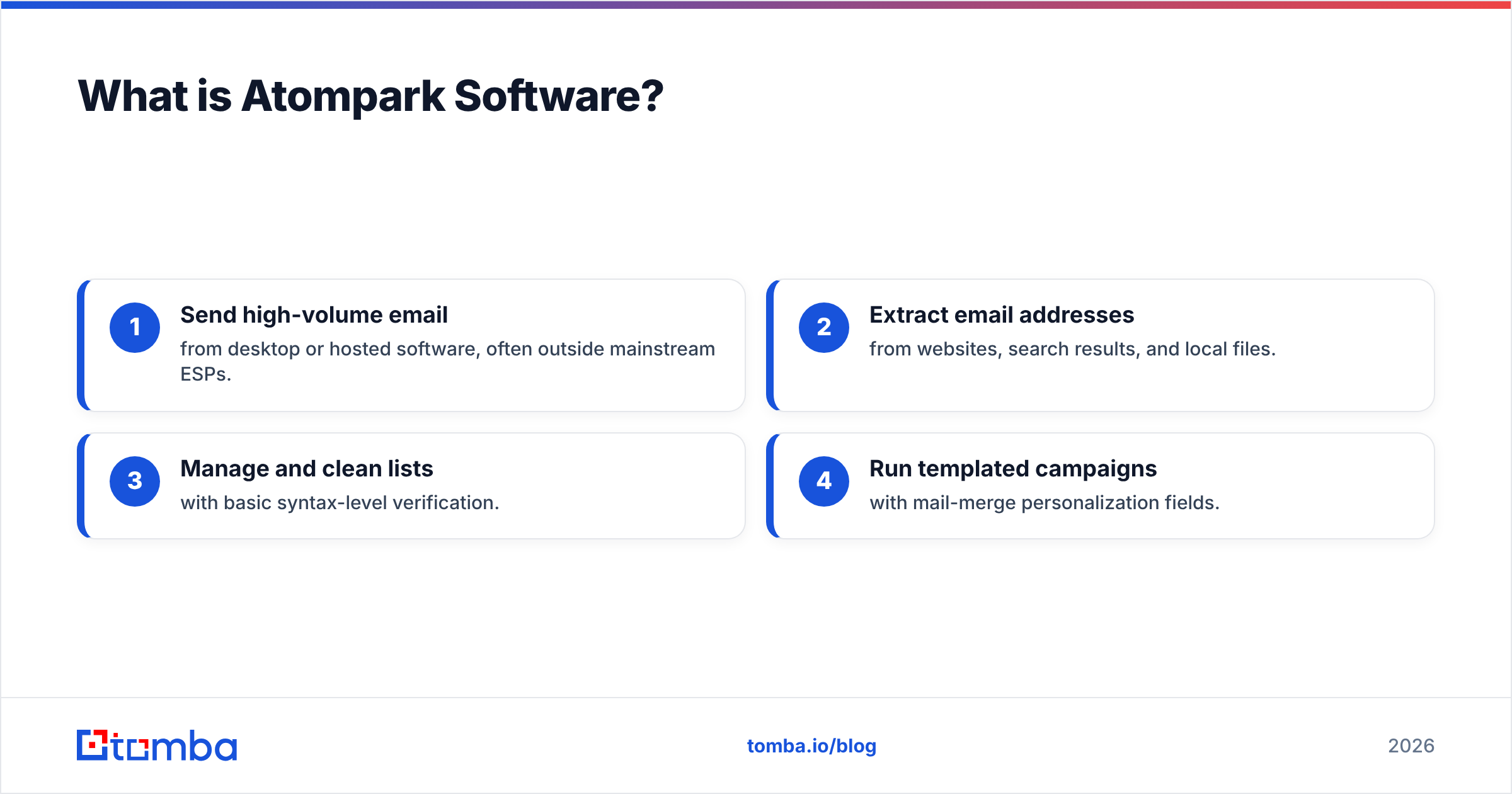
Atompark Software is one of the older names in the bulk-email category. Its product line has long centered on mass email sending and list building — most recognizably Atomic Mail Sender, plus a family of email extractors, verifiers, and subscription managers. Think of it like a power drill from the early DIY era: still works, very direct, but designed for an era when "blast a big list" was an acceptable strategy.
The core jobs Atompark tools are built to do:
- Send high-volume email from desktop or hosted software, often outside mainstream ESPs.
- Extract email addresses from websites, search results, and local files.
- Manage and clean lists with basic syntax-level verification.
- Run templated campaigns with mail-merge personalization fields.
That feature set made sense for bulk marketers. It maps poorly to modern, reputation-sensitive B2B outbound, where deliverability and data accuracy beat raw volume. You can read more about why sender reputation now gates results in this overview of email deliverability.
)
What is Bytemine?#
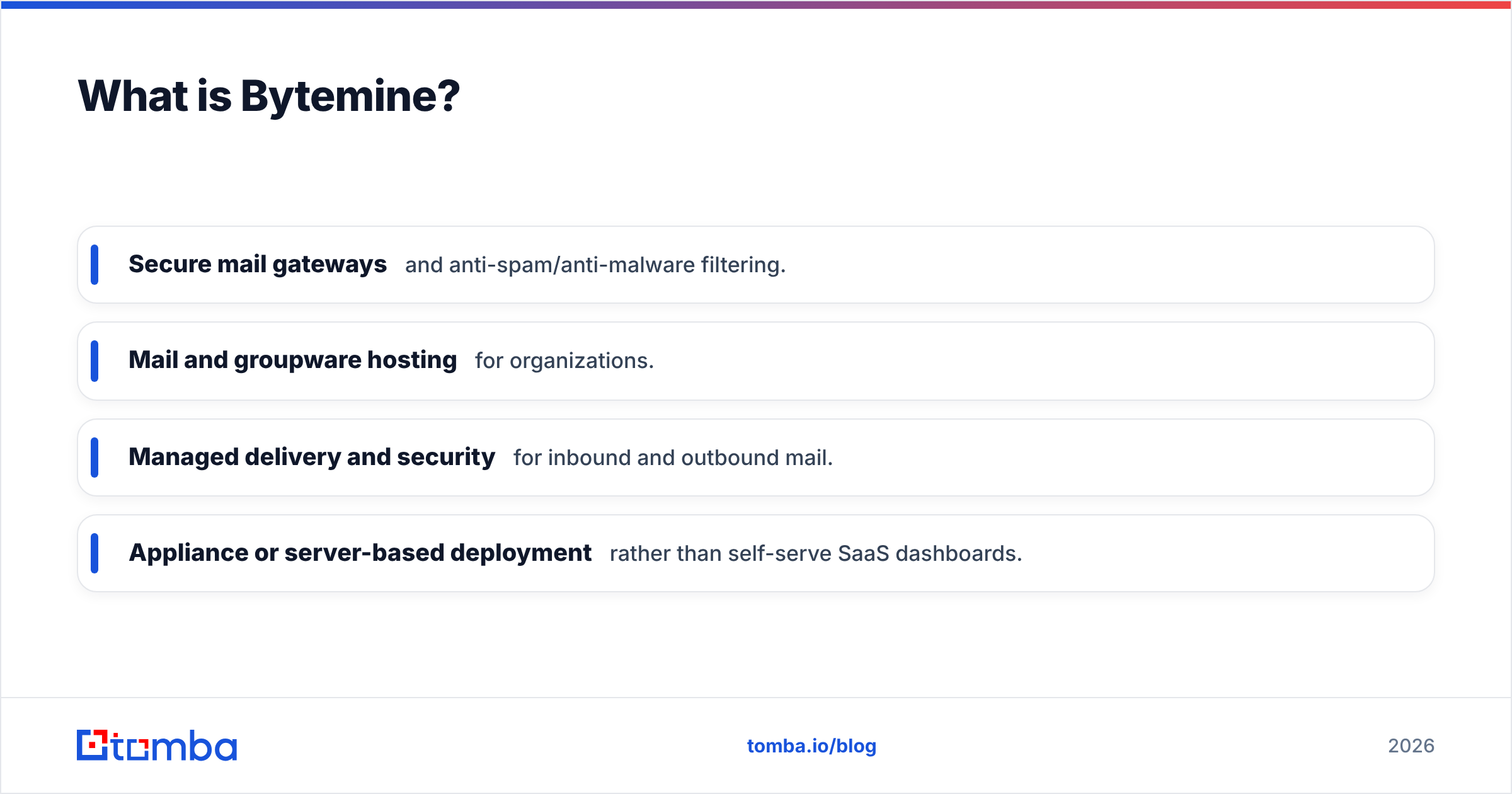
Bytemine is a different animal entirely. It is an IT and email-infrastructure vendor with roots in secure mail gateways, hosting, and managed services — the plumbing layer of email rather than the marketing or prospecting layer. If Atompark is the drill, Bytemine is closer to the electrical wiring behind the wall: essential, technical, and invisible to the end marketer.
Bytemine-style offerings typically focus on:
- Secure mail gateways and anti-spam/anti-malware filtering.
- Mail and groupware hosting for organizations.
- Managed delivery and security for inbound and outbound mail.
- Appliance or server-based deployment rather than self-serve SaaS dashboards.
The practical takeaway: Bytemine helps a company run email securely. It does not help a sales rep find the email address of a prospect at a target account. Comparing it to Atompark is a bit like comparing a firewall vendor to a megaphone vendor — both touch "communication," but the buyer and the job are different.
How do Atompark Software and Bytemine compare?#
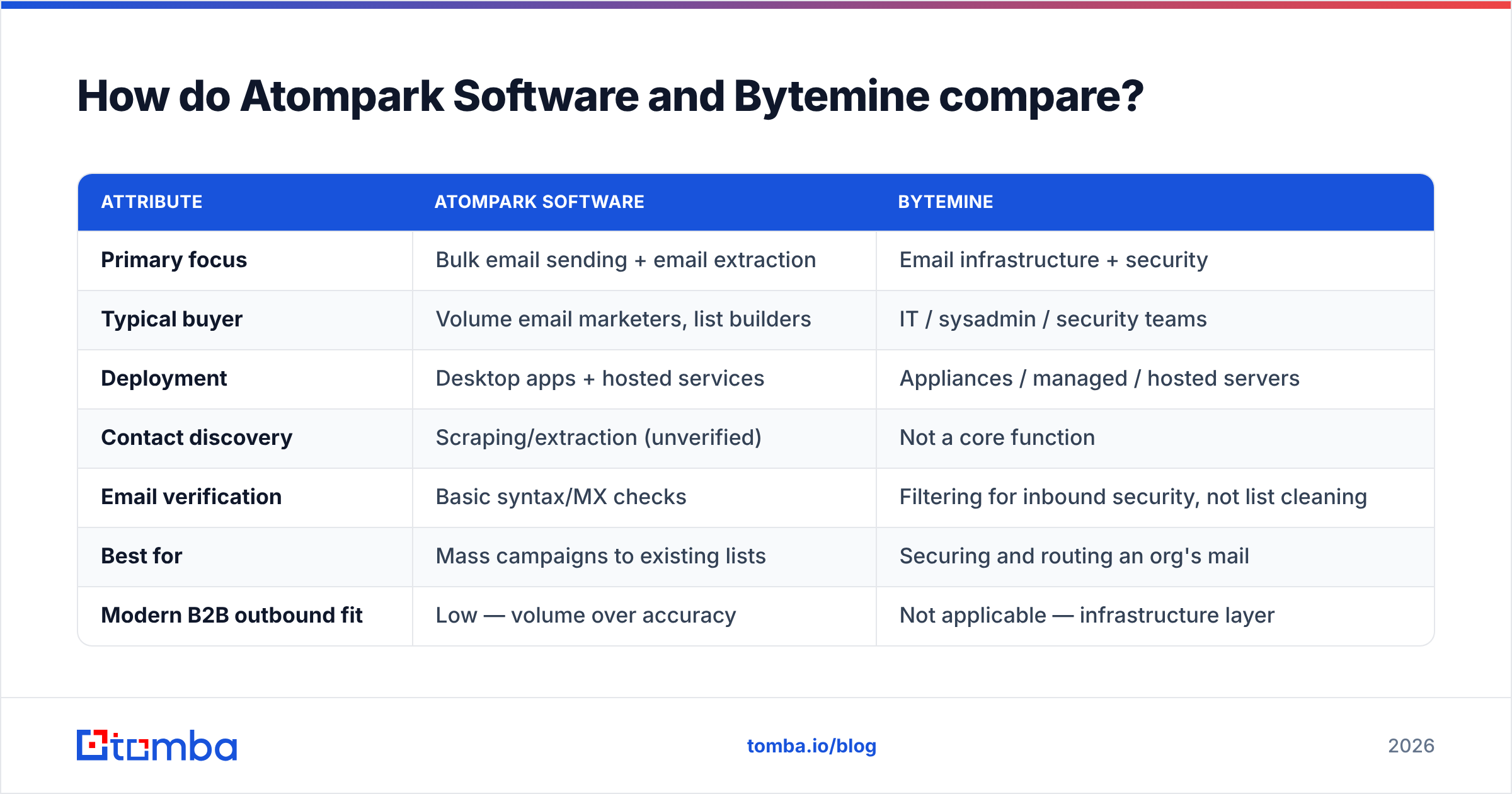
Because these tools sit in adjacent-but-separate niches, the most honest comparison is by purpose, deployment, and fit rather than a fake feature-parity grid. Here is the breakdown:
| Attribute | Atompark Software | Bytemine |
|---|---|---|
| Primary focus | Bulk email sending + email extraction | Email infrastructure + security |
| Typical buyer | Volume email marketers, list builders | IT / sysadmin / security teams |
| Deployment | Desktop apps + hosted services | Appliances / managed / hosted servers |
| Contact discovery | Scraping/extraction (unverified) | Not a core function |
| Email verification | Basic syntax/MX checks | Filtering for inbound security, not list cleaning |
| Best for | Mass campaigns to existing lists | Securing and routing an org's mail |
| Modern B2B outbound fit | Low — volume over accuracy | Not applicable — infrastructure layer |
| Self-serve API for prospecting | Limited | No |
The pattern is clear: if your goal is getting a clean, accurate list of decision-makers to email, neither product is purpose-built for it. Atompark gets you volume and scraped addresses of unknown quality; Bytemine keeps your mail server safe. Both are legitimate, but neither is a B2B contact database with live verification.
What is Atompark Software best for?#
Atompark is a reasonable pick if all of the following are true:
- You already own a permission-based list and need a sending engine outside a mainstream ESP.
- You want desktop control and one-time license pricing rather than a subscription.
- Your compliance posture genuinely supports the volume model you are running.
Where it struggles is the part most sales teams care about now: data quality. Scraped addresses are not verified against live mail servers, catch-all domains are a coin flip, and bounce rates on cold lists can wreck your sender reputation fast. In 2026, mailbox providers weigh engagement and bounce signals heavily, so "more addresses" is not the same as "more inbox placements."
What is Bytemine best for?#
Bytemine earns its place when the job is infrastructure and security:
- You need a hardened mail gateway in front of an organization's inbound mail.
- You want managed hosting and delivery with security baked in.
- You have an IT team that owns email at the server level, not a marketing team chasing prospects.
It is genuinely good at that layer. It is simply not a prospecting, enrichment, or list-building tool — and no amount of comparison framing changes that. If a vendor sold you on Bytemine for "lead generation," that was the wrong sale.
Where do both tools fall short for modern outbound?#
Here is the gap that sends people searching "Atompark Software vs Bytemine" in the first place: neither answers "who do I email, and is this address real?" Modern outbound needs three things that fall outside both products:
- Accurate discovery — find the right person's email by name and company domain, on demand.
- Live verification — confirm the mailbox exists before you send, including catch-all handling.
- Workflow fit — push verified contacts into your CRM, spreadsheet, or sequencing tool without manual copy-paste.
Scraping (Atompark) skips real verification. Infrastructure (Bytemine) skips discovery entirely. That is why teams end up bolting on a dedicated finder-and-verifier anyway. For background on why verification is now non-negotiable, G2's category data on email-verification tools shows accuracy and bounce reduction as the top-rated criteria buyers cite (g2.com).
)
Is there a better alternative for B2B email finding in 2026?#
Yes — and it solves the actual job both tools leave open. A dedicated email finder is built around discovery plus verification, not volume sending or server security. This is where Tomba fits cleanly: you give it a name and a company domain (or just a domain), and it returns professional email addresses with a confidence score, then verifies them against live mail servers.
Here is how the discovery-and-verification model compares to the two tools above on the criteria that decide outbound results:
| Capability | Atompark | Bytemine | Tomba |
|---|---|---|---|
| Find email by name + domain | Scrape only | No | Yes, scored |
| Live email verification | Basic | Inbound filtering | Yes, including catch-all |
| Bulk + API access | Limited | No | Yes — bulk + API |
| CRM / Sheets integration | Minimal | No | HubSpot, Salesforce, Sheets,Zapier |
| Free tier to test | Varies | No | 25 free searches/mo |
| Starter price | License-based | Quote-based | $49/mo |
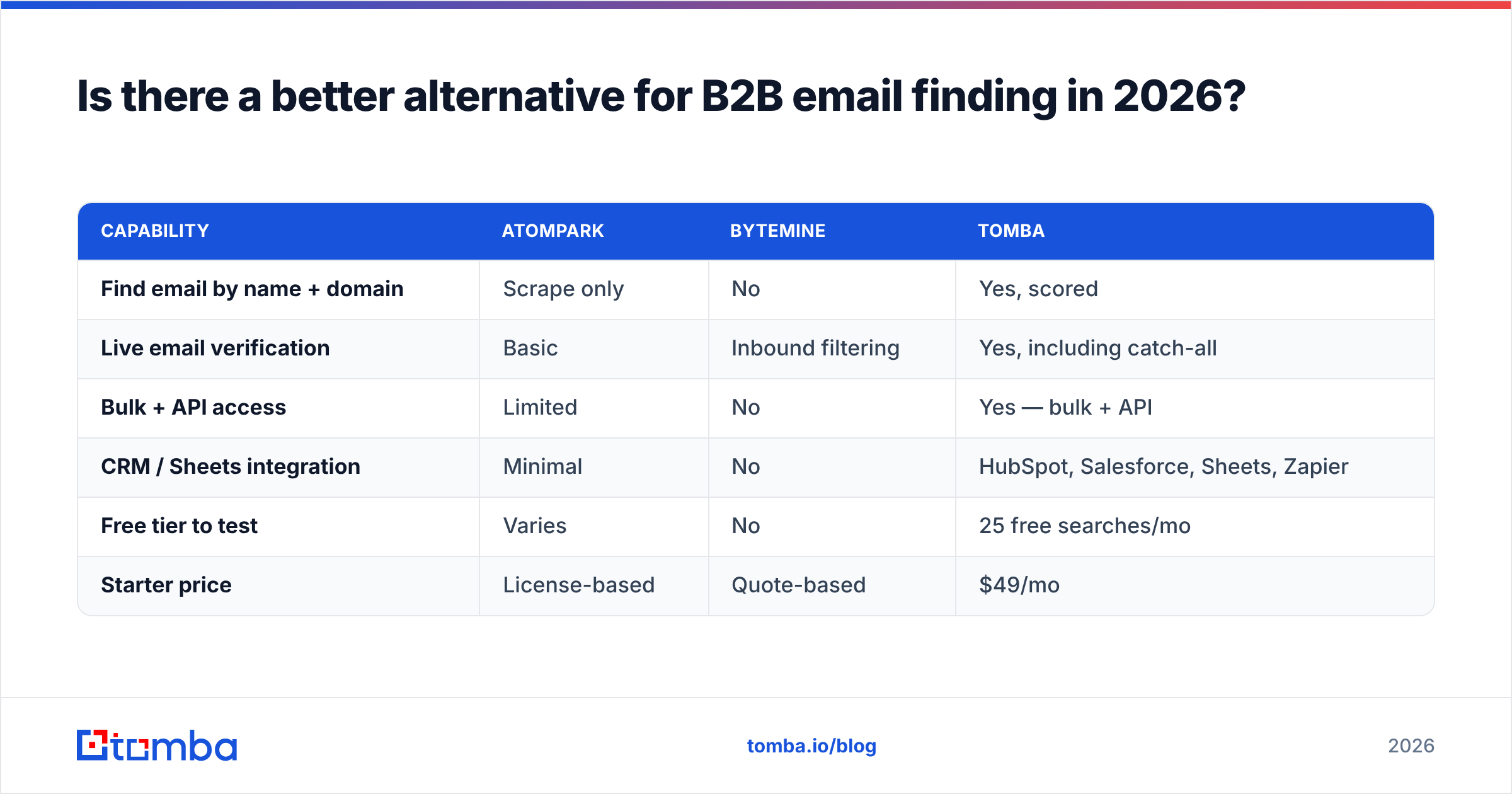
A few things worth calling out honestly. Tomba is not a mail server or a security gateway, so it does not replace what Bytemine does at the infrastructure layer — if you need a secure mail gateway, keep that separate. And Tomba is not a spray-and-pray bulk sender, which is by design: the goal is verified, targeted contacts that protect your domain reputation, not maximum send volume.
What Tomba does replace is the messy middle most teams improvise: scraping addresses, guessing formats, and hoping they land. You can run single lookups, bulk email finder jobs, or call the email finder API directly, and pair every result with the email verifier before anything hits a send queue.
How do you choose the right tool for your job?#
Use the job, not the brand, to decide:
- You need to secure and route an organization's email → an infrastructure vendor like Bytemine (or a comparable mail-gateway provider). Discovery tools are irrelevant here.
- You have a permission-based list and want a standalone sending engine → Atompark or a mainstream ESP, with the deliverability caveats above. Cross-reference reviews on a neutral directory like Capterra before committing to a license.
- You need verified B2B contacts to run targeted outbound → a dedicated email finder and verifier. This is the case most sales and growth teams are actually in, and it is the one neither Atompark nor Bytemine was built to serve.
The mistake to avoid is forcing one tool to do all three. Bulk senders verify weakly. Infrastructure tools do not prospect. Finders do not send blasts or secure servers — and that focus is a feature, because each layer does its one job well.
Frequently asked questions#
Is Atompark Software the same kind of tool as Bytemine? No. Atompark focuses on bulk email sending and address extraction; Bytemine focuses on email infrastructure and security. They are adjacent but not direct competitors, which is why a feature-for-feature comparison can mislead you.
Can either tool find a specific person's verified work email? Not reliably. Atompark can scrape addresses but does not verify them against live mailboxes; Bytemine is not a discovery tool at all. For that job you want a dedicated finder such as the Tomba Email Finder.
Which is cheaper? Atompark leans toward license-based pricing and Bytemine toward quote-based infrastructure deals, so a flat comparison is hard. If you only need verified contacts, a discovery tool's transparent tiers (Tomba starts free, then $49/mo) are usually the more predictable spend — see current Tomba pricing.
Do I still need a verifier if I use an extractor? Yes. Scraped or extracted lists carry unknown bounce risk. Running them through an email verifier before sending is the single fastest way to protect deliverability.
The bottom line#
Atompark Software and Bytemine are real tools that do real jobs — bulk sending and email infrastructure, respectively. Neither is the tool you want when the actual goal is finding and verifying B2B email addresses for targeted outreach. If that is your job, start with a finder built for accuracy and verification rather than volume or plumbing.
Try the Tomba Email Finder free: 25 searches a month, no card required. Enter a name and a domain, get a scored professional email, verify it against live servers, and push it straight into your CRM or spreadsheet — so the only addresses you send to are the ones that actually exist.
Ready to find emails that actually work?
Join 150,000+ professionals who stopped guessing and started sending. Free credits on signup — no credit card required.
Get the Tomba newsletter
Practical outbound tactics and product updates — once every two weeks.
About the author