Atompark Software vs Cloudura.ai: 2026 B2B Tool Comparison
Atompark builds bulk email-marketing tools; Cloudura.ai sells AI sales intelligence. We break down features, pricing, data quality, and which one fits modern B2B outbound in 2026.
You typed two very different tools into the same search box. That tells me something. This isn't really an Atompark Software vs Cloudura feature-for-feature face-off. You're trying to figure out which kind of tool your outbound motion needs in 2026. Is it a bulk email-sending suite, or an AI-driven sales intelligence platform? This guide answers that.
TL;DR#
- Atompark Software is a long-running desktop-and-cloud email/SMS marketing toolkit (Atomic Mail Sender, Atomic Email Studio, Atomic Email Hunter). It's built to send and extract at volume.
- Cloudura.ai is a newer AI sales intelligence platform. It pairs a contact database with intent signals and sequencing for B2B prospecting teams.
- In the Atompark Software vs Cloudura matchup, the two overlap only at the edges (both touch "finding emails"). So the real question is blast-and-extract vs data-and-intent.
- Neither is primarily a high-accuracy email finder + verifier. If clean, verified contact data is the bottleneck, a dedicated tool like Tomba Email Finder usually beats bolting that job onto either platform.
- Read on for a side-by-side table, pricing reality checks, and a decision framework.
What is Atompark Software?#
Atompark is one of the older names in email marketing software. Founded in the mid-2000s, it ships a family of products rather than a single app:
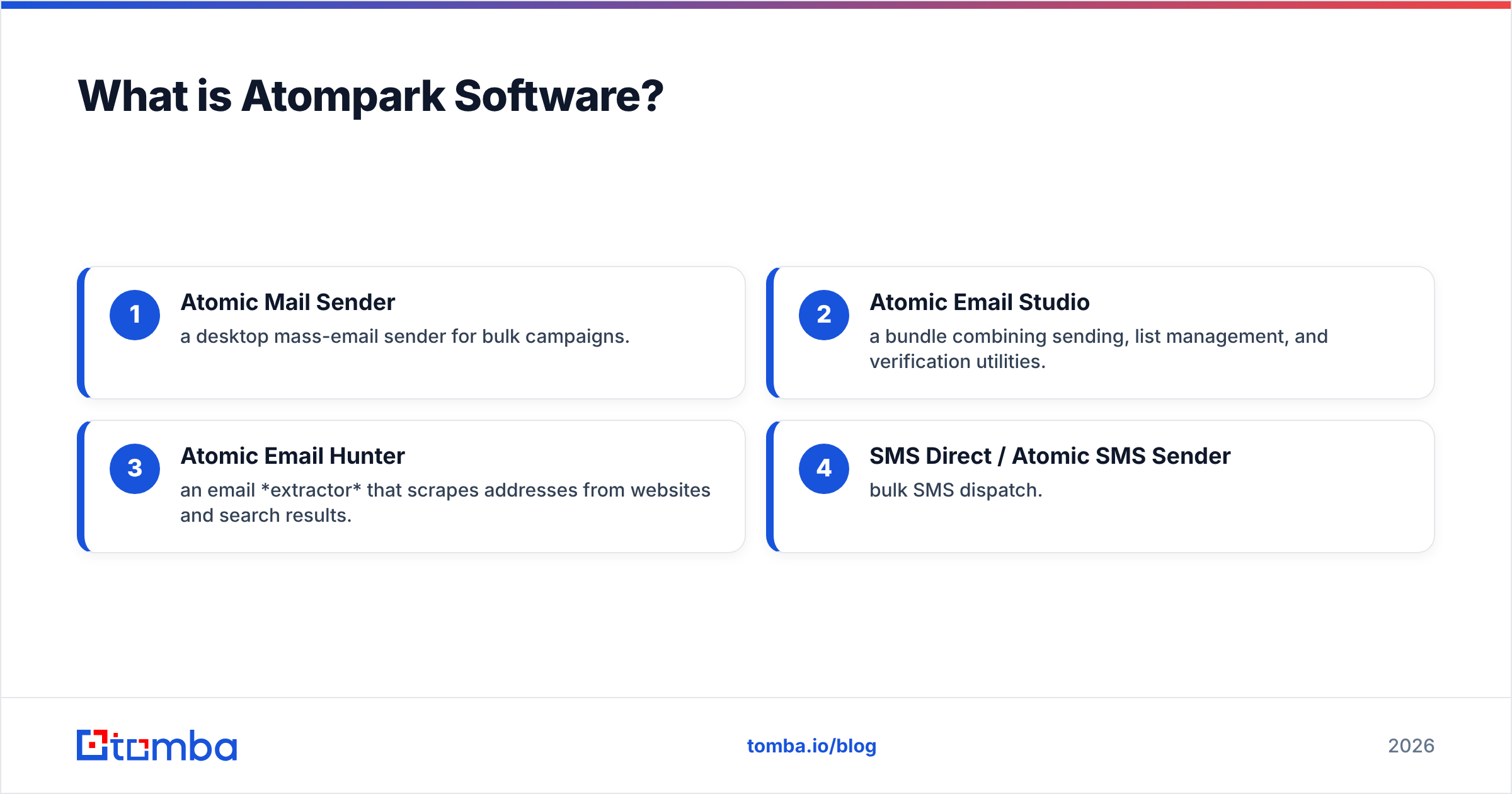
- Atomic Mail Sender — a desktop mass-email sender for bulk campaigns.
- Atomic Email Studio — a bundle combining sending, list management, and verification utilities.
- Atomic Email Hunter — an email extractor that scrapes addresses from websites and search results.
- SMS Direct / Atomic SMS Sender — bulk SMS dispatch.
The philosophy is volume and ownership. You install software (or use the cloud version), load your own lists, and send. That appeals to teams who want a one-time-license feel and full control over their sending. You can read more on the vendor's own site at atompark.com.
The trade-off is that "send-it-yourself" tooling pushes deliverability, list hygiene, and compliance onto you. Modern inbox providers are unforgiving. Raw sending power without strong email deliverability practices can quietly torch your domain.

What is Cloudura.ai?#
Cloudura.ai sits in a completely different category. It's an AI sales intelligence and prospecting platform: a B2B contact and company database layered with enrichment, buying-intent signals, and outbound sequence features. Think "find the right accounts, get contact data, and start sequences" rather than "load a list and blast it."
Its pitch is the modern GTM stack story. AI surfaces in-market accounts, enriches the records, and feeds your reps a prioritized list. That's closer to the world of Apollo, Lusha, or ZoomInfo than to a desktop mail sender. You can see how buyers rate platforms in this space on G2 and Capterra.
The catch with any intent-data platform is simple. The model is only as good as the underlying contact data, and database freshness varies wildly by region and seniority. That's the dimension worth scrutinizing hardest.
Atompark Software vs Cloudura.ai: how do they compare?#
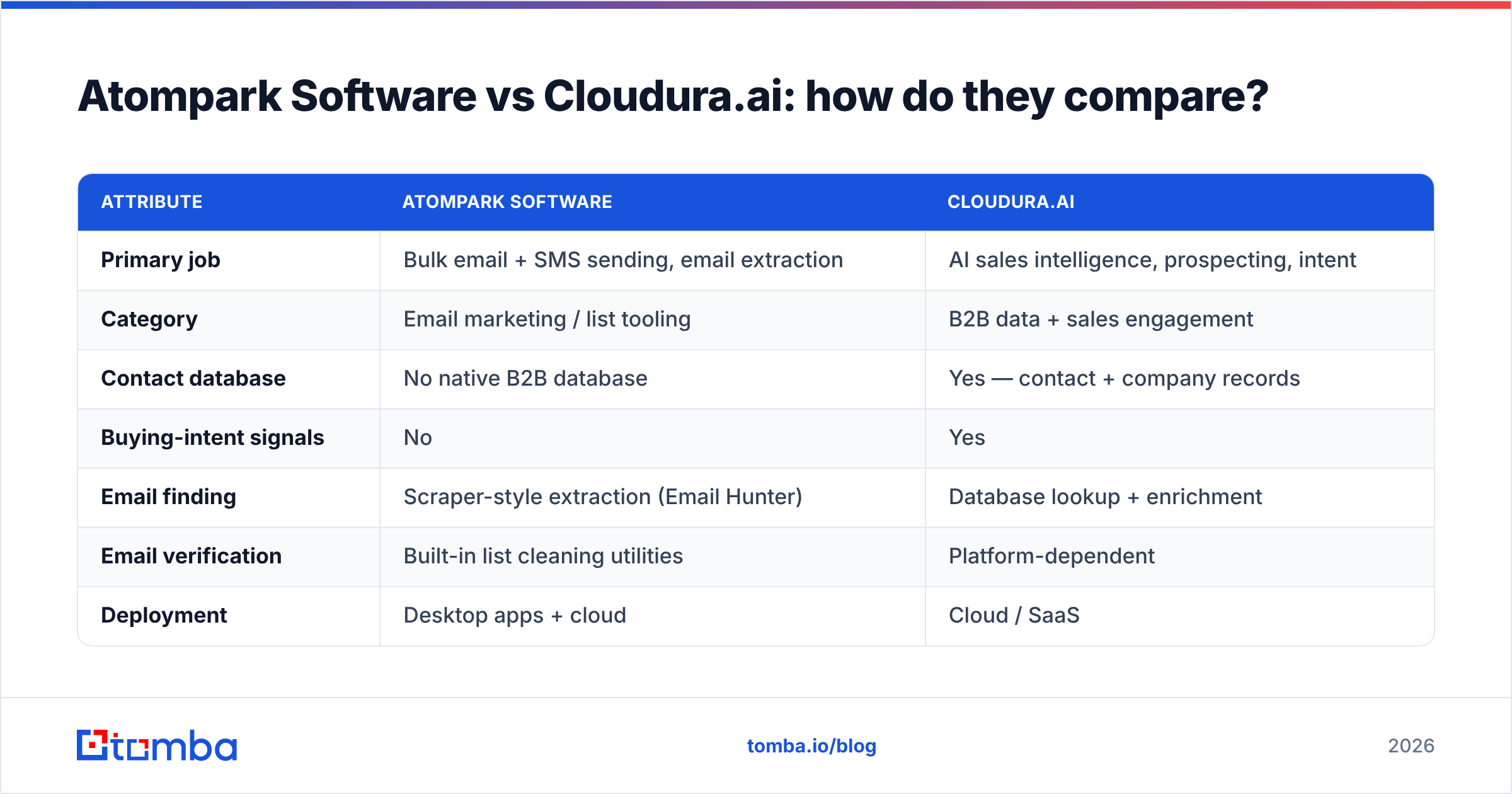
Here's the honest side-by-side. These are different tools, so several rows are "not the point of this product" rather than a knock.
| Attribute | Atompark Software | Cloudura.ai |
|---|---|---|
| Primary job | Bulk email + SMS sending, email extraction | AI sales intelligence, prospecting, intent |
| Category | Email marketing / list tooling | B2B data + sales engagement |
| Contact database | No native B2B database | Yes — contact + company records |
| Buying-intent signals | No | Yes |
| Email finding | Scraper-style extraction (Email Hunter) | Database lookup + enrichment |
| Email verification | Built-in list cleaning utilities | Platform-dependent |
| Deployment | Desktop apps + cloud | Cloud / SaaS |
| Best for | High-volume senders managing own lists | SDR/RevOps teams building pipeline |
| Pricing model | License / tiered product purchases | SaaS subscription, credit-based |
| Compliance burden | High (you own sending) | Shared (platform-sourced data) |
The Atompark Software vs Cloudura pattern is clear. Atompark is an execution-layer tool that sends and scrapes. Cloudura.ai is a discovery-layer tool that finds and prioritizes accounts. If you bought one expecting the other's strengths, you'll be disappointed.
)
Which one fits your use case?#
Match the tool to the actual job your team is stuck on.
- You have lists and need to send at scale → Atompark leans your way. Its mail and SMS senders are purpose-built for blasting owned audiences, and a one-time-license model can be cheaper than per-seat SaaS at high volume.
- You don't know who to contact yet → Cloudura.ai is the better shape. A database plus intent helps you build target lists from scratch, which Atompark simply doesn't do.
- Your bottleneck is bad contact data → Neither is ideal. Extractors produce unverified, often stale scrapes, and sales-intelligence databases vary in coverage. This is where a focused email finder plus an email verifier earns its keep.
- You're in a regulated market (GDPR/CAN-SPAM) → Tread carefully with scraped lists from extractor tools. Permission and provenance matter more than volume.
)
Is data accuracy the real deciding factor?#
Yes. And it's where both tools have gaps you should plan around.
Scraping addresses (Atompark's Email Hunter approach) gives you quantity but not validity. A scraped inbox can be a role address, a typo, a long-dead account, or a spam trap. Send to enough of those and your sender reputation collapses. Then even your good emails stop landing.
Database platforms like Cloudura.ai give you structured records, but coverage and freshness differ by geography and role. A contact that was accurate at last refresh may have changed jobs months ago. Most teams discover this only after a campaign bounces.
The fix isn't loyalty to one platform. It's a verification step in front of any sending. That's why mature outbound stacks separate three jobs:
- Find the right email (by name, domain, or company).
- Verify it's deliverable before it ever enters a sequence.
- Enrich the record with role, company, and firmographic data.
Tomba handles all three as distinct, API-accessible steps. See how data enrichment and a domain search plug into a list before you hand it to a sender like Atompark or a sequencer inside Cloudura.ai. For high-volume runs, the bulk email finder verifies thousands of records in one pass.
How does pricing compare?#
Pricing models differ enough that a flat "X is cheaper" claim would mislead you.
- Atompark uses a product/license approach. You buy specific tools (Mail Sender, Studio, Email Hunter) at tiered prices, sometimes as one-time purchases with paid upgrades. Good for predictable, high-volume sending without recurring per-seat fees.
- Cloudura.ai uses SaaS subscriptions, typically credit-based for data lookups and seat-based for sequencing. That's standard for the sales-intelligence category.
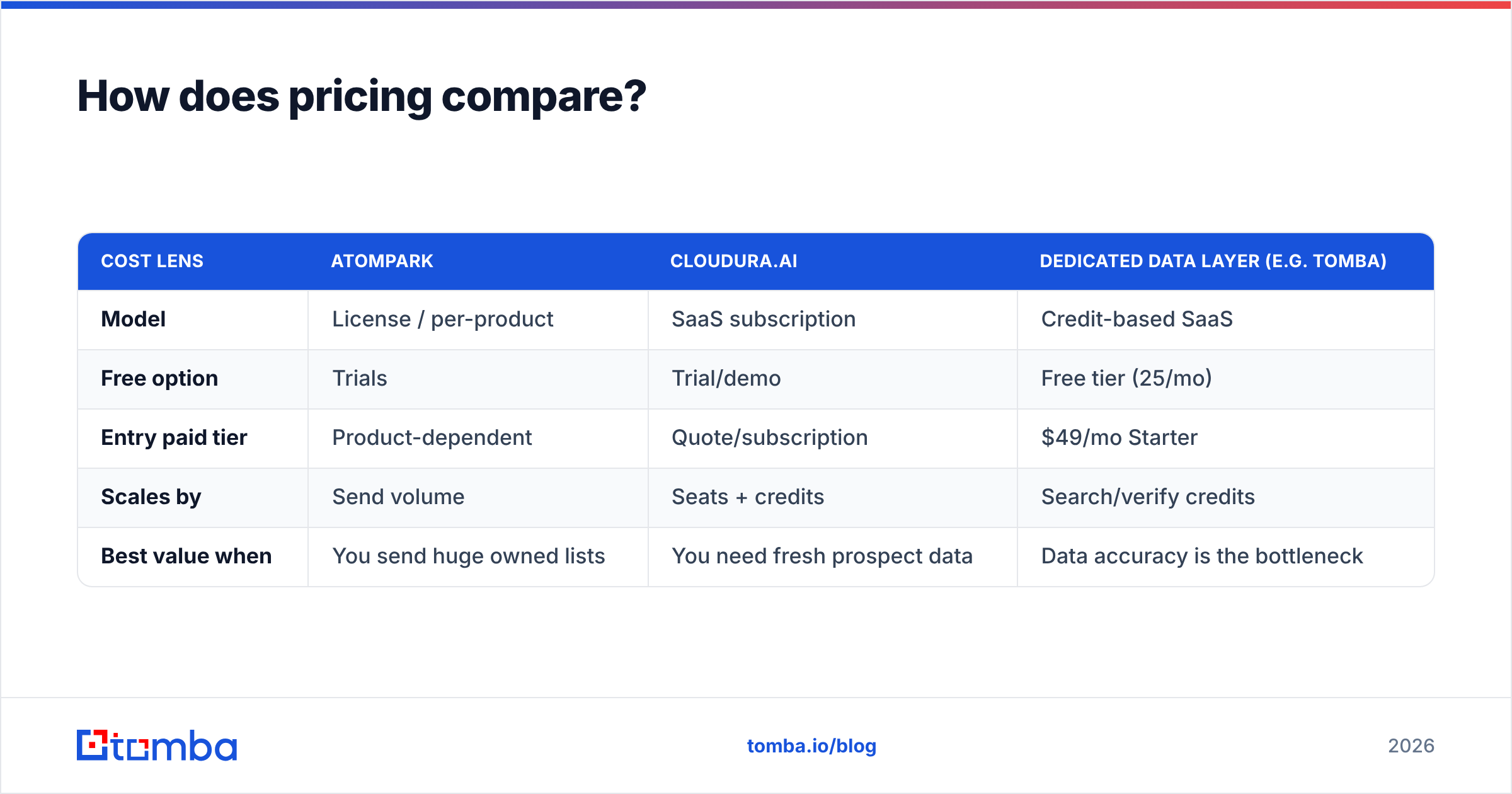
For contrast, a dedicated data layer is usually transparent and credit-metered. Tomba's published pricing runs a Free tier (25 searches/month), Starter at $49/mo, Growth at $99/mo, Pro at $249/mo, and custom Enterprise. The point isn't that one number wins. You should price the job (find, verify, send) separately, because bundling those into one tool almost always means one of the three is weak.
| Cost lens | Atompark | Cloudura.ai | Dedicated data layer (e.g. Tomba) |
|---|---|---|---|
| Model | License / per-product | SaaS subscription | Credit-based SaaS |
| Free option | Trials | Trial/demo | Free tier (25/mo) |
| Entry paid tier | Product-dependent | Quote/subscription | $49/mo Starter |
| Scales by | Send volume | Seats + credits | Search/verify credits |
| Best value when | You send huge owned lists | You need fresh prospect data | Data accuracy is the bottleneck |
What's the smarter way to combine these tools?#
Stop thinking either/or. The best 2026 stacks are layered, and each layer does one thing well.
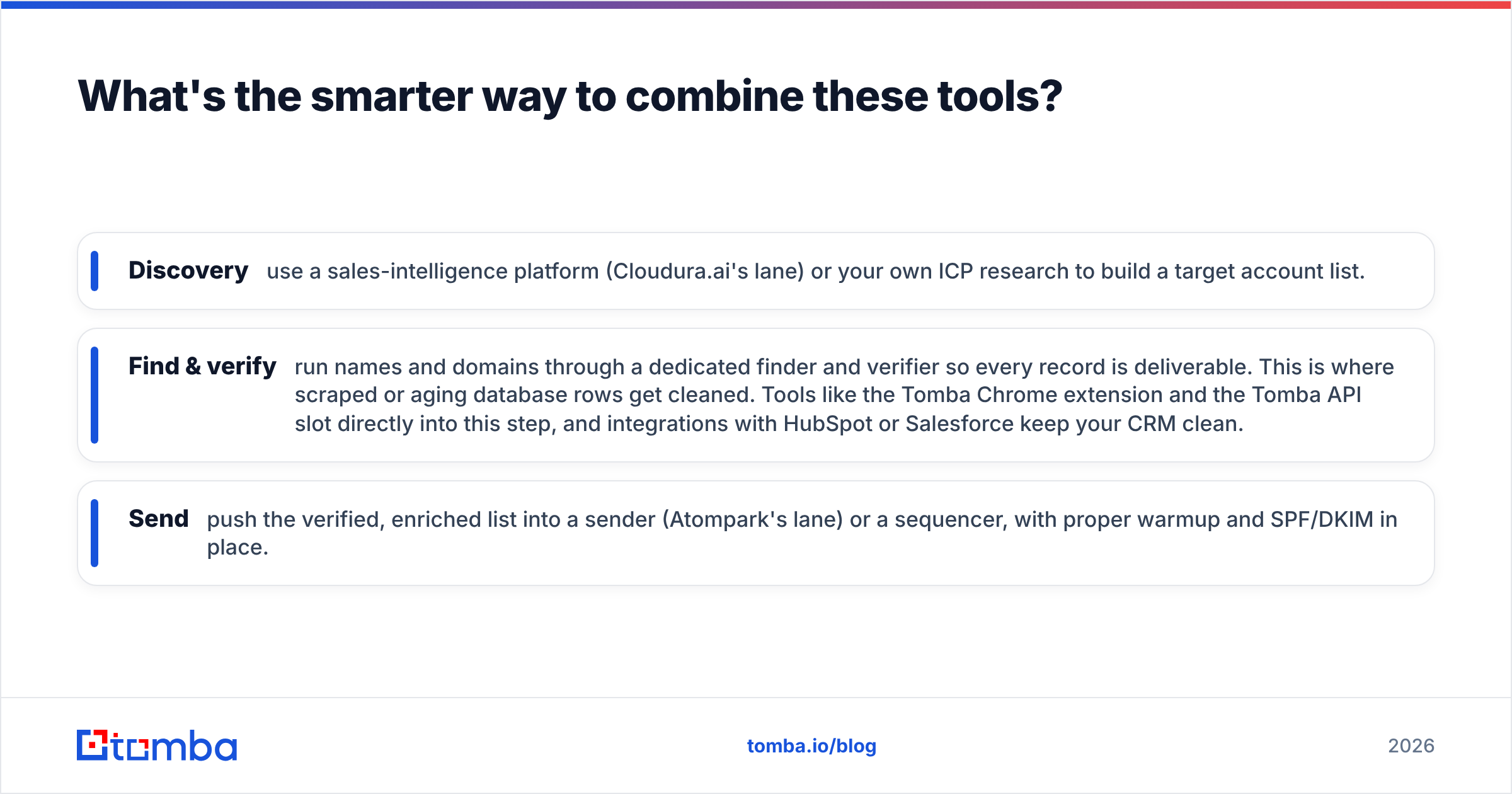
A practical pipeline looks like this:
- Discovery — use a sales-intelligence platform (Cloudura.ai's lane) or your own ICP research to build a target account list.
- Find & verify — run names and domains through a dedicated finder and verifier so every record is deliverable. This is where scraped or aging database rows get cleaned. Tools like the Tomba Chrome extension and the Tomba API slot directly into this step, and integrations with HubSpot or Salesforce keep your CRM clean.
- Send — push the verified, enriched list into a sender (Atompark's lane) or a sequencer, with proper warmup and SPF/DKIM in place.
In that model, Atompark and Cloudura.ai aren't rivals. They're different stations on the same assembly line. The verification layer in the middle is what protects your domain reputation regardless of which sender or database you pick.
Frequently asked questions#
Is Atompark Software the same as an email finder? Not quite. Its Atomic Email Hunter extracts addresses by scraping, which yields unverified emails. A true email finder resolves a known person at a known company to a verified address — a different, higher-accuracy job.
Is Cloudura.ai a good Apollo or ZoomInfo alternative? It competes in the same sales-intelligence category, so it can be. Evaluate it on database coverage for your target geography and seniority, plus how accurate its emails are once exported. Always verify exported lists before sending.
Can I just use one tool for everything? You can, but you'll usually sacrifice accuracy. Bundled "find + send" tools tend to be strong at one and weak at the other. Separating find, verify, and send is what keeps deliverability high.
Which is better for cold outreach in 2026? For building cold lists, a data platform like Cloudura.ai is closer to the need. For sending to lists you already own, Atompark fits. For not getting blocked, a verification layer is mandatory either way.
The bottom line#
The Atompark Software vs Cloudura choice comes down to different problems. Atompark sends and scrapes at volume. Cloudura.ai discovers and prioritizes accounts with AI. Pick Atompark if your bottleneck is sending owned lists. Pick Cloudura.ai if you need to find target accounts and intent. But recognize the gap both leave — verified, accurate contact data — and fill it deliberately.
That's the cheapest insurance in outbound. Before any address reaches a sender or sequencer, run it through the Tomba Email Finder to find and verify professional emails by name, domain, or company. Start on the free tier, confirm your list is deliverable, and let Atompark or Cloudura.ai do what each does best — on clean data that won't burn your domain.
// get started
Find, verify and enrich your first contacts today
Start on the free plan with 25 searches a month, then scale when your team is ready.
Free plan · No credit card required · GDPR & CCPA
// about the author