Atompark Software vs Generect: B2B Lead Tools Compared 2026
Atompark Software vs Generect: one ships bulk email and SMS senders, the other sells fresh B2B lead data. Here's which fits your 2026 pipeline — and where Tomba beats both.
Choosing between Atompark Software vs Generect trips up a lot of B2B teams because the two tools barely overlap. One is a veteran desktop-and-cloud bulk email and SMS sender. The other is a modern B2B lead-data provider built to feed CRMs and outbound sequences. Picking the wrong one means you either buy a blast tool when you needed leads, or buy a lead list when you needed delivery infrastructure.
This guide breaks down what each actually does, where they fit, what they cost, and which one belongs in your 2026 outbound stack — plus where a dedicated data tool like Tomba slots in to fill the gaps both leave behind.
TL;DR#
- Atompark Software is a sender. Its lineup (Atomic Mail Sender, Atomic Email Studio, bulk SMS) is built to send high-volume email and SMS campaigns, not to find verified contacts.
- Generect is a data engine. It supplies B2B company and people data — emails, job titles, LinkedIn — designed to fill your pipeline and CRM.
- They solve different problems: Atompark answers "how do I send to my list," Generect answers "how do I build a list."
- For accuracy-first email finding and verification at a transparent price, Tomba beats both on a per-lead basis — and pairs cleanly with whichever sender you choose.
- If you can only buy one, buy the tool that fixes your current bottleneck: data quality (Generect/Tomba) or send volume (Atompark).
What is Atompark Software?#
Atompark is one of the older names in email marketing software. The company is best known for desktop products like Atomic Mail Sender and Atomic Email Studio, alongside bulk SMS sending and email-list management utilities. Its core promise is volume: load a list, design a message, and push large batches of email or SMS without a per-send SaaS markup.
Think of Atompark like buying your own delivery truck instead of paying a courier per package. You control the vehicle, you handle the maintenance, and you eat the cost of anything that goes wrong on the road — including deliverability and list hygiene.
That model has real strengths. You own the software, the sending cadence is yours, and for teams mailing lists they already own (event attendees, opt-in subscribers, existing customers), it can be cheaper at scale than per-contact platforms. The official product range is documented on atompark.com.
The weakness is just as real: Atompark does not find contacts, and it does not deeply verify them. If your list is stale or scraped, a powerful sender just helps you hit spam traps faster. Sending muscle without email deliverability discipline is a liability, not an advantage.

What is Generect?#
Generect is a B2B lead-generation and data platform. Instead of sending, it focuses on sourcing — surfacing companies and decision-makers that match your ideal customer profile and handing you their contact details (work emails, roles, LinkedIn profiles) to push into a CRM or sequencer.
If Atompark is the delivery truck, Generect is the supplier filling the warehouse. It cares about freshness, match rate, and how cleanly the data lands in your existing tools. You can read its positioning on the official generect.com site.
Generect's pitch is real-time or near-real-time lead generation rather than a static, aging database. For SDR teams that burn through lists quickly, fresh data matters more than raw volume — a smaller list of accurate, current contacts outperforms a giant list of bounces every time. That said, lead-data vendors vary widely in coverage by region and seniority, so match rate on your exact ICP is the number that matters, not the headline database size.
Atompark Software vs Generect: how do they compare?#
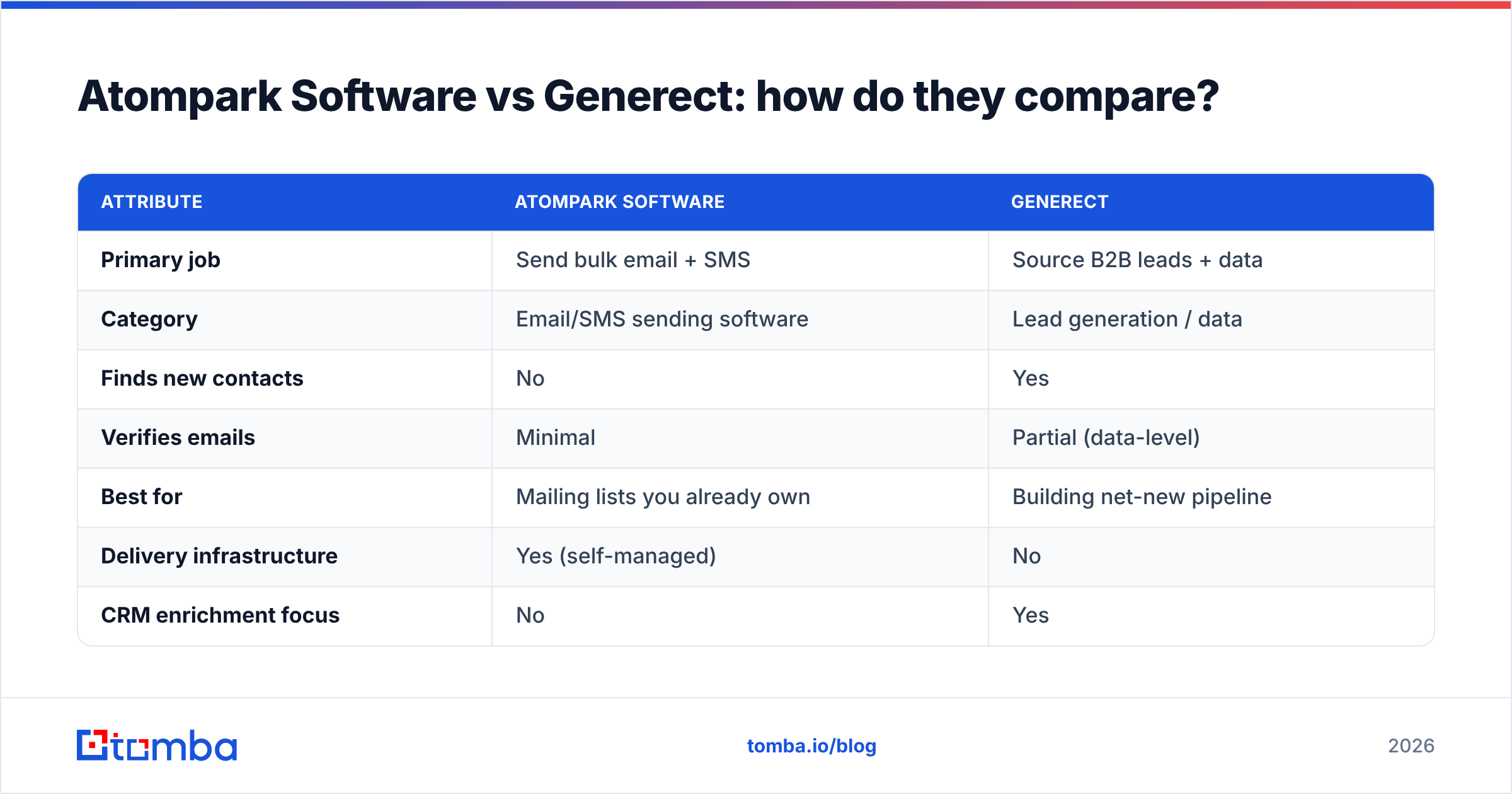
Here's the core difference in one table. Notice that almost every row is a contrast, not a competition — these tools sit at opposite ends of the outbound workflow.
| Attribute | Atompark Software | Generect |
|---|---|---|
| Primary job | Send bulk email + SMS | Source B2B leads + data |
| Category | Email/SMS sending software | Lead generation / data |
| Finds new contacts | No | Yes |
| Verifies emails | Minimal | Partial (data-level) |
| Best for | Mailing lists you already own | Building net-new pipeline |
| Delivery infrastructure | Yes (self-managed) | No |
| CRM enrichment focus | No | Yes |
| Pricing model | License / volume | Subscription / credits |
| Learning curve | Moderate (desktop tools) | Low (web app) |
The takeaway: these are complements, not substitutes. A complete outbound motion needs both a source of accurate contacts and a way to reach them. Buying Atompark to solve a data problem — or Generect to solve a sending problem — leaves the actual bottleneck untouched.
Which one fits your use case?#
Match the tool to the job you're actually trying to do. Use these four scenarios as a quick filter:
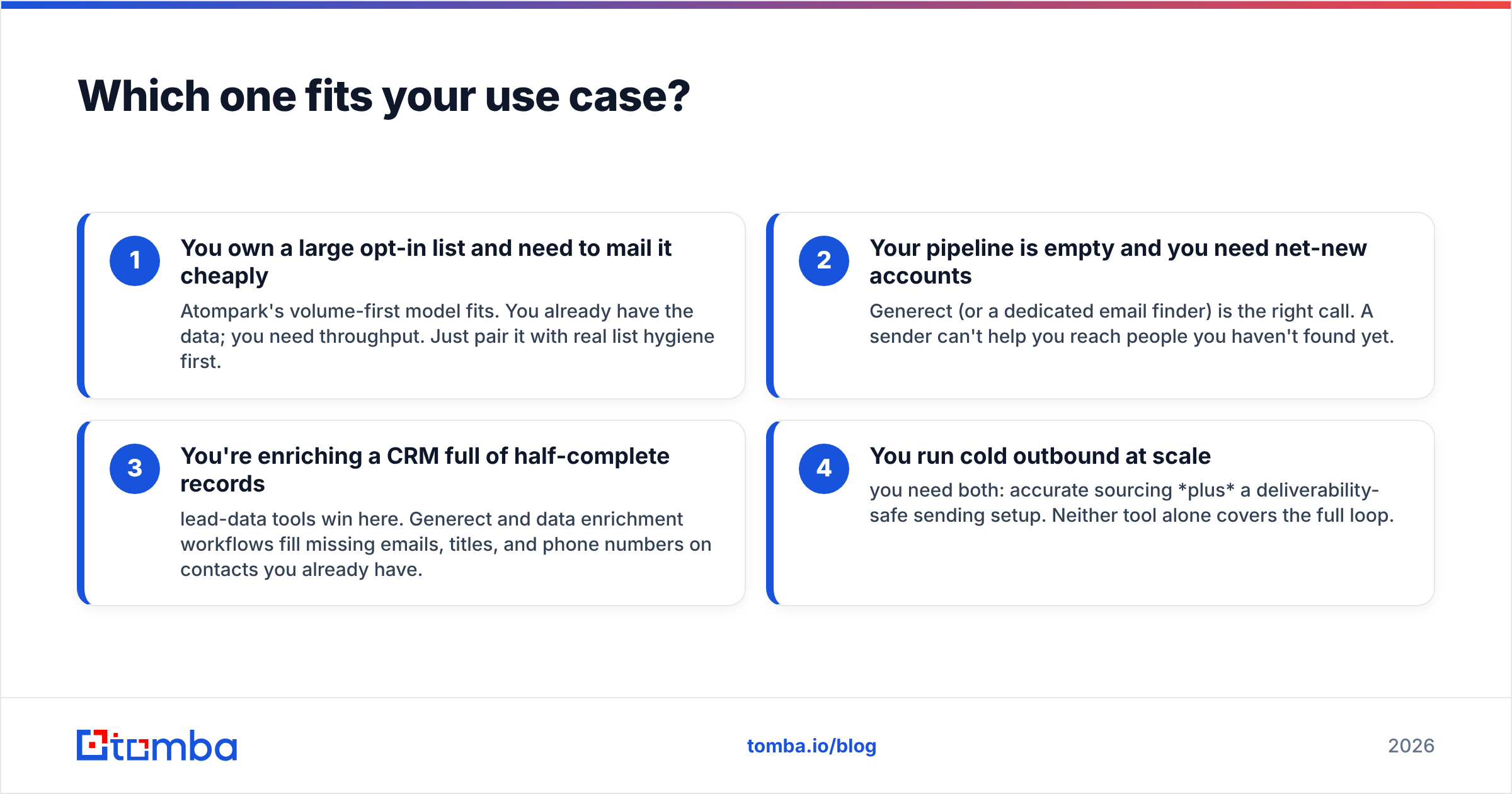
- You own a large opt-in list and need to mail it cheaply — Atompark's volume-first model fits. You already have the data; you need throughput. Just pair it with real list hygiene first.
- Your pipeline is empty and you need net-new accounts — Generect (or a dedicated email finder) is the right call. A sender can't help you reach people you haven't found yet.
- You're enriching a CRM full of half-complete records — lead-data tools win here. Generect and data enrichment workflows fill missing emails, titles, and phone numbers on contacts you already have.
- You run cold outbound at scale — you need both: accurate sourcing plus a deliverability-safe sending setup. Neither tool alone covers the full loop.
The mistake teams make is treating "Atompark Software vs Generect" as an either/or when their real stack needs a source, a verifier, and a sender working together.
Where does Tomba fit in this comparison?#
Tomba sits exactly where both tools are weakest: turning a name, company, or domain into a verified, deliverable email — accurately and at a transparent price.
Generect gives you leads, but you still want an independent verification pass before you send, because every bounce damages sender reputation. Atompark gives you sending power, but feeding it unverified addresses is how you land on a blacklist. Tomba's email verifier and domain search close both gaps — and for catch-all domains that wreck most verification tools, the catch-all verifier gives you a usable confidence signal instead of a shrug.
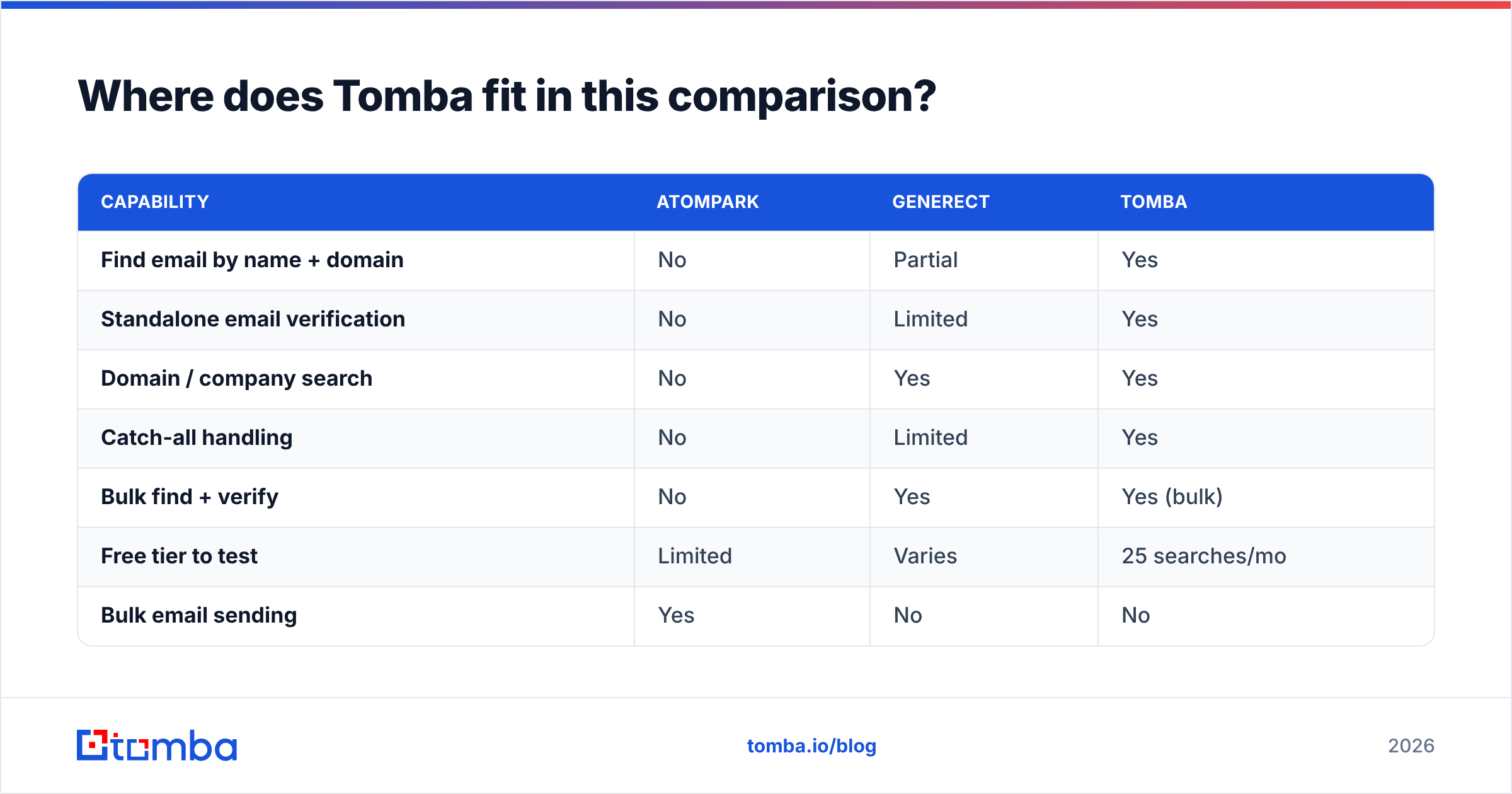
Here's how the three line up on the jobs that actually move pipeline:
| Capability | Atompark | Generect | Tomba |
|---|---|---|---|
| Find email by name + domain | No | Partial | Yes |
| Standalone email verification | No | Limited | Yes |
| Domain / company search | No | Yes | Yes |
| Catch-all handling | No | Limited | Yes |
| Bulk find + verify | No | Yes | Yes (bulk) |
| Free tier to test | Limited | Varies | 25 searches/mo |
| Bulk email sending | Yes | No | No |
Tomba is not a sender — and that focus is the point. It does one thing, the contact-accuracy layer, better than a generalist sender or a broad data platform does as a side feature. You bring the sending tool; Tomba makes sure what you send actually arrives.

How much do they cost in 2026?#
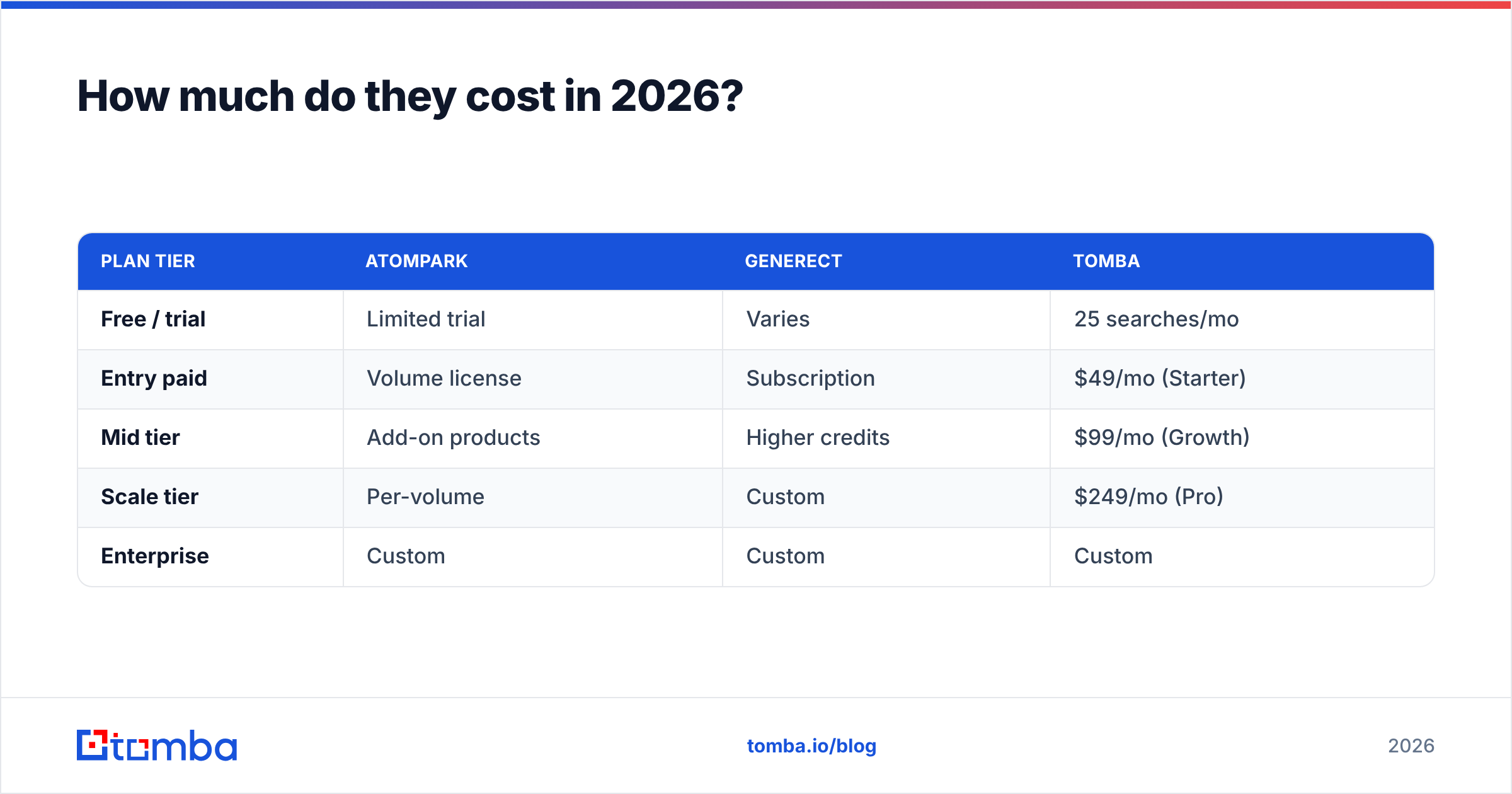
Pricing models differ enough that a flat "X is cheaper" misses the point. Atompark leans on license/volume economics, Generect on subscription/credit tiers, and Tomba on transparent monthly plans with a real free tier.
| Plan tier | Atompark | Generect | Tomba |
|---|---|---|---|
| Free / trial | Limited trial | Varies | 25 searches/mo |
| Entry paid | Volume license | Subscription | $49/mo (Starter) |
| Mid tier | Add-on products | Higher credits | $99/mo (Growth) |
| Scale tier | Per-volume | Custom | $249/mo (Pro) |
| Enterprise | Custom | Custom | Custom |
A few honest caveats. Atompark's license model can be cheaper if you already own clean lists and mail them often — the savings evaporate if you're paying in bounced sends and reputation damage. Generect's value tracks entirely to match rate on your ICP; benchmark it on your real territory before committing. And Tomba's pricing is public end to end on the Tomba pricing page, with the $49/mo Starter tier and a free plan so you can test accuracy before paying. Always run a small live sample through any of these before signing an annual deal — vendor-reported accuracy and your accuracy are rarely the same number.
Atompark Software vs Generect: which should you choose?#
Choose based on your bottleneck, not the brand.
- If your problem is reaching a list you already own, Atompark's sending tools are a legitimate, low-recurring-cost option — provided you verify the list first.
- If your problem is an empty or stale pipeline, Generect's lead data is the better buy, because a sender can't manufacture contacts.
- If your problem is bounces, low reply rates, or wasted credits on bad addresses, the fix is an accuracy layer — and that's where Tomba earns its place regardless of which of the other two you run.
Most growing teams end up with a two- or three-tool stack: a data source, a verification layer, and a sender. The trap is buying one tool and expecting it to cover all three. Compare options honestly on independent review sites like G2 using your own criteria, then test the shortlist on live data.
If contact accuracy is your weak point — and for most outbound teams in 2026, it is — start with the Tomba Email Finder. Find and verify professional emails by name, company, or domain, handle catch-all domains other tools choke on, and feed clean, deliverable contacts straight into Atompark, Generect, or whatever sender you already run. Spin up the free 25-search plan, test it against your own list, and only pay once the accuracy proves itself.
// get started
Find, verify and enrich your first contacts today
Start on the free plan with 25 searches a month, then scale when your team is ready.
Free plan · No credit card required · GDPR & CCPA
// about the author