Atompark Software vs Kipplo: 2026 Email Tool Comparison
Atompark Software vs Kipplo, compared head-to-head for 2026: bulk email blasting vs modern cold outreach, pricing, deliverability, and which one actually books meetings.
Choosing between Atompark Software and Kipplo usually means choosing between two eras of email. One grew up sending high-volume blasts from desktop software; the other was built for modern, reply-driven cold outreach. They overlap on the word "email" and almost nowhere else.
This guide breaks down where each tool actually wins, what they cost in 2026, and — the part most comparison posts skip — why neither one fixes the problem that quietly kills most campaigns: bad contact data.
TL;DR — Atompark Software vs Kipplo#
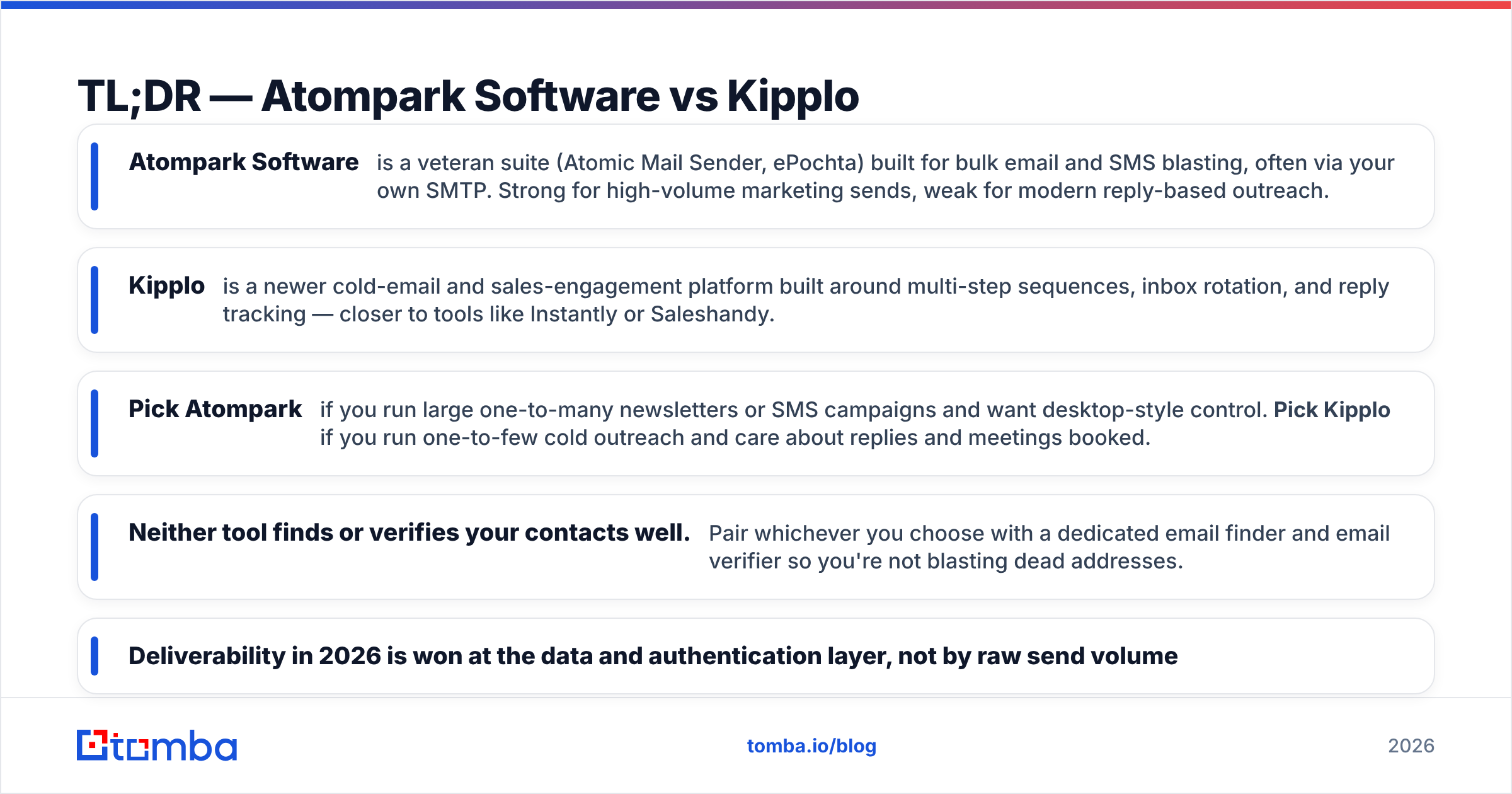
- Atompark Software is a veteran suite (Atomic Mail Sender, ePochta) built for bulk email and SMS blasting, often via your own SMTP. Strong for high-volume marketing sends, weak for modern reply-based outreach.
- Kipplo is a newer cold-email and sales-engagement platform built around multi-step sequences, inbox rotation, and reply tracking — closer to tools like Instantly or Saleshandy.
- Pick Atompark if you run large one-to-many newsletters or SMS campaigns and want desktop-style control. Pick Kipplo if you run one-to-few cold outreach and care about replies and meetings booked.
- Neither tool finds or verifies your contacts well. Pair whichever you choose with a dedicated email finder and email verifier so you're not blasting dead addresses.
- Deliverability in 2026 is won at the data and authentication layer, not by raw send volume.
What is Atompark Software?#
Atompark is one of the oldest names in mass email. Its best-known products — Atomic Mail Sender and the ePochta line — are aimed at sending large volumes of email (and SMS) to lists you already own. The model is closer to classic email-marketing software than to a sales engagement platform: you load a list, design a message, plug in an SMTP server, and send at scale.
That heritage is both the strength and the limitation. Atompark gives you granular control over sending, templates, and list management, and it's comfortable with very large databases. But it was designed for broadcast — one message to many people — rather than the personalized, multi-touch sequences that define modern outbound.
If your job is to push a monthly newsletter or a promotional blast to tens of thousands of opted-in subscribers, that broadcast model is fine. If your job is to start conversations with cold prospects who've never heard of you, it's the wrong shape of tool.
What is Kipplo?#
Kipplo is a modern cold-email platform built for the reply economy. Instead of optimizing for raw volume, it optimizes for landing in the primary inbox and getting responses. The feature set reflects that: multi-step sequences with automatic follow-ups, multiple sending inboxes rotated to spread volume, unified inbox for replies, and analytics centered on open, reply, and positive-reply rates.
This puts Kipplo in the same competitive set as tools like Instantly, Smartlead, and Saleshandy. If you've used any of those, the mental model transfers: connect a handful of warmed sending accounts, upload a targeted list, write a short sequence, and let the platform pace sends to protect sender reputation.
The trade-off is that Kipplo is purpose-built for cold outreach. It's not trying to be your newsletter tool or your transactional email service. For SDR teams and founders doing outbound, that focus is a feature. For a marketing team running broadcast campaigns, it's a poor fit.
How do Atompark Software and Kipplo compare on features and pricing?#
The clearest way to see the difference is side by side. The two tools are optimized for opposite ends of the email spectrum.
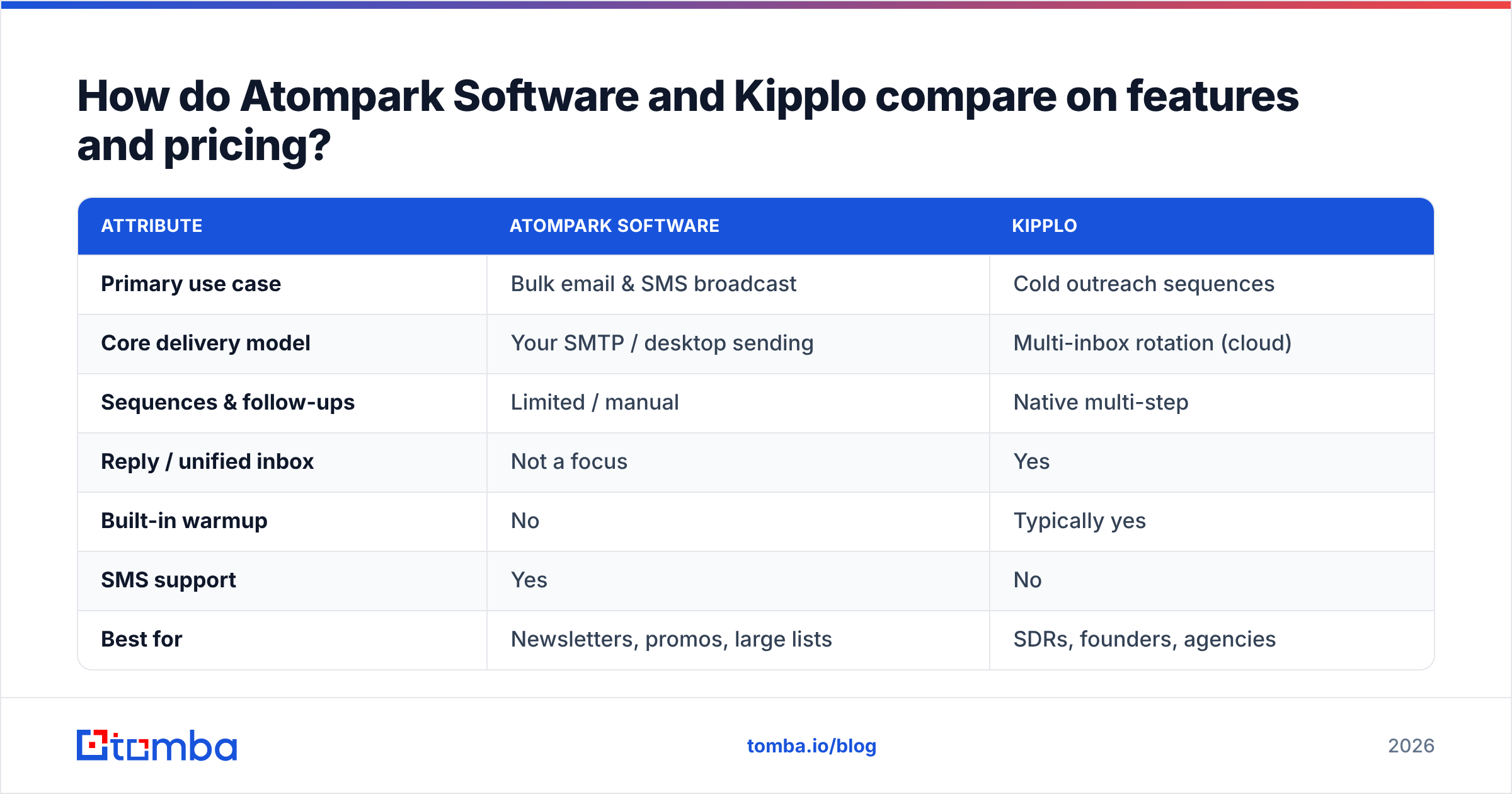
| Attribute | Atompark Software | Kipplo |
|---|---|---|
| Primary use case | Bulk email & SMS broadcast | Cold outreach sequences |
| Core delivery model | Your SMTP / desktop sending | Multi-inbox rotation (cloud) |
| Sequences & follow-ups | Limited / manual | Native multi-step |
| Reply / unified inbox | Not a focus | Yes |
| Built-in warmup | No | Typically yes |
| SMS support | Yes | No |
| Best for | Newsletters, promos, large lists | SDRs, founders, agencies |
| Learning curve | Moderate (legacy UI) | Low (modern SaaS) |
| Contact finding/verification | Minimal | Minimal |
A few takeaways from the table:
- Atompark is broadcast-first. Its SMS support and SMTP control make it useful for marketing teams who own large lists and want to send promotions or alerts at scale.
- Kipplo is conversation-first. Sequences, inbox rotation, and reply tracking are the whole point, which is exactly what cold outbound needs.
- Send architecture differs fundamentally. Atompark often leans on your own SMTP, which gives control but puts deliverability squarely on your shoulders. Kipplo abstracts sending across rotated inboxes to protect reputation.
- Neither solves data quality. Both assume you arrive with a clean, verified list. That assumption is where most campaigns quietly fail.
For exact, current numbers, check each vendor's own pricing page directly — bulk-sender pricing (Atompark) and per-seat SaaS pricing (Kipplo) move often, and you can compare both against transparent Tomba pricing for the data layer that feeds them.
Which one has better deliverability in 2026?#
Deliverability is decided before either tool sends a single message — by your data, your authentication, and your sending behavior. That's the honest answer, and it reframes the whole comparison.
Kipplo has a structural edge for cold outreach because it's designed around the behaviors that protect inbox placement: gradual volume ramp, inbox rotation, and built-in warmup. Those map directly to how Gmail and Outlook decide whether you're a trusted sender. Google's own Postmaster Tools guidance makes clear that low spam complaint rates and authenticated, consistent sending matter far more than volume.
Atompark can deliver well too, but more of the responsibility shifts to you. Sending bulk volume through your own SMTP without careful authentication and list hygiene is the fastest way to land in spam or on a blacklist. If you go the Atompark route, you'll want to be rigorous about SPF records, DKIM, and DMARC, and you'll want to monitor your domain reputation continuously.
But here's the part both tools share: the single biggest deliverability lever is not sending technique — it's whether the addresses on your list are real. Every bounce tells the mailbox provider you didn't clean your list, and bounce rate is one of the loudest negative signals there is. A 5% bounce rate can tank an otherwise healthy domain.

Why does contact data quality matter more than the tool you pick?#
The uncomfortable truth: a great sending tool with a bad list loses to a mediocre tool with a clean one. Atompark vs Kipplo is a real decision, but it's the second decision. The first is where your contacts come from and whether they're valid.
Consider the math. If 20% of your list is invalid — a conservative figure for scraped or aging B2B data — then one in five sends is a wasted credit, a bounce, and a small ding to your sender reputation. Multiply that across a campaign and you've degraded deliverability for the 80% of contacts who were real. No sequence builder or SMTP tweak recovers that.
This is the gap neither Atompark nor Kipplo is built to close. They're delivery tools, not data tools. To feed them well you need:
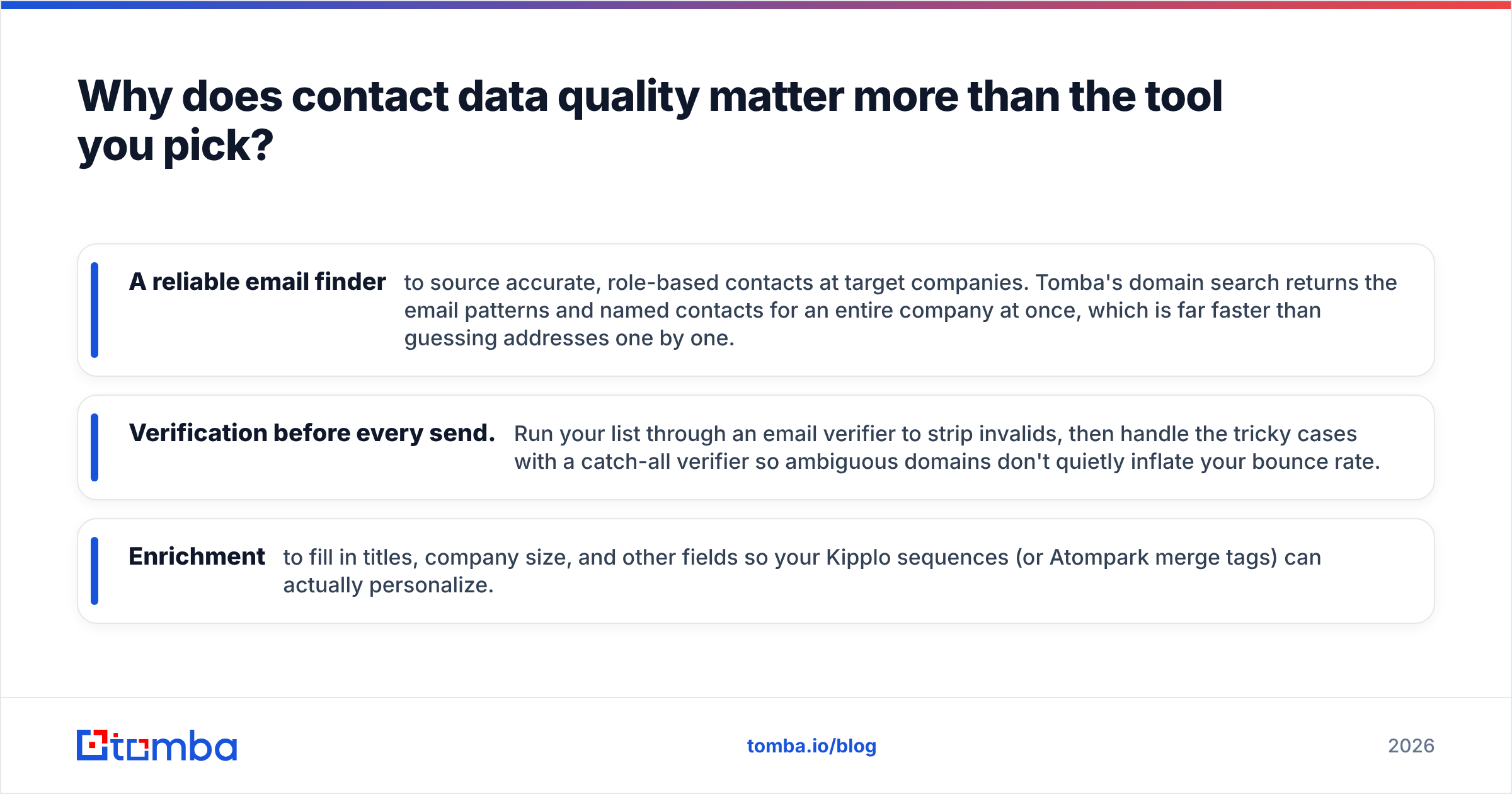
- A reliable email finder to source accurate, role-based contacts at target companies. Tomba's domain search returns the email patterns and named contacts for an entire company at once, which is far faster than guessing addresses one by one.
- Verification before every send. Run your list through an email verifier to strip invalids, then handle the tricky cases with a catch-all verifier so ambiguous domains don't quietly inflate your bounce rate.
- Enrichment to fill in titles, company size, and other fields so your Kipplo sequences (or Atompark merge tags) can actually personalize.
Do that, and either tool performs dramatically better. Skip it, and the best platform on the market still underdelivers.
Atompark Software vs Kipplo: which should you choose?#
Match the tool to the motion, not the brand.
Choose Atompark Software if:
- You run high-volume, one-to-many marketing or SMS campaigns to lists you already own.
- You want desktop-style control and are comfortable managing your own SMTP and authentication.
- Broadcast newsletters, promotions, and alerts are your main use case — not cold prospecting.
Choose Kipplo if:
- You run cold outbound and measure success in replies and meetings booked.
- You want native sequences, follow-ups, inbox rotation, and a unified reply inbox.
- You value a modern, low-learning-curve SaaS over legacy software.
Choose neither as your whole stack. Both are sending layers. Whichever you pick, put a data layer in front of it. That's not a Tomba pitch so much as a deliverability fact: the campaigns that win in 2026 are the ones that never sent to a dead address in the first place.
For teams already evaluating modern outreach tools, it's also worth scanning the wider field — sites like G2 and Capterra list dozens of alternatives in both the bulk-email and cold-outreach categories, and the right fit depends heavily on your sending motion.
How do you build a stack that actually books meetings?#
A clean four-step workflow beats arguing over which sender is marginally better:
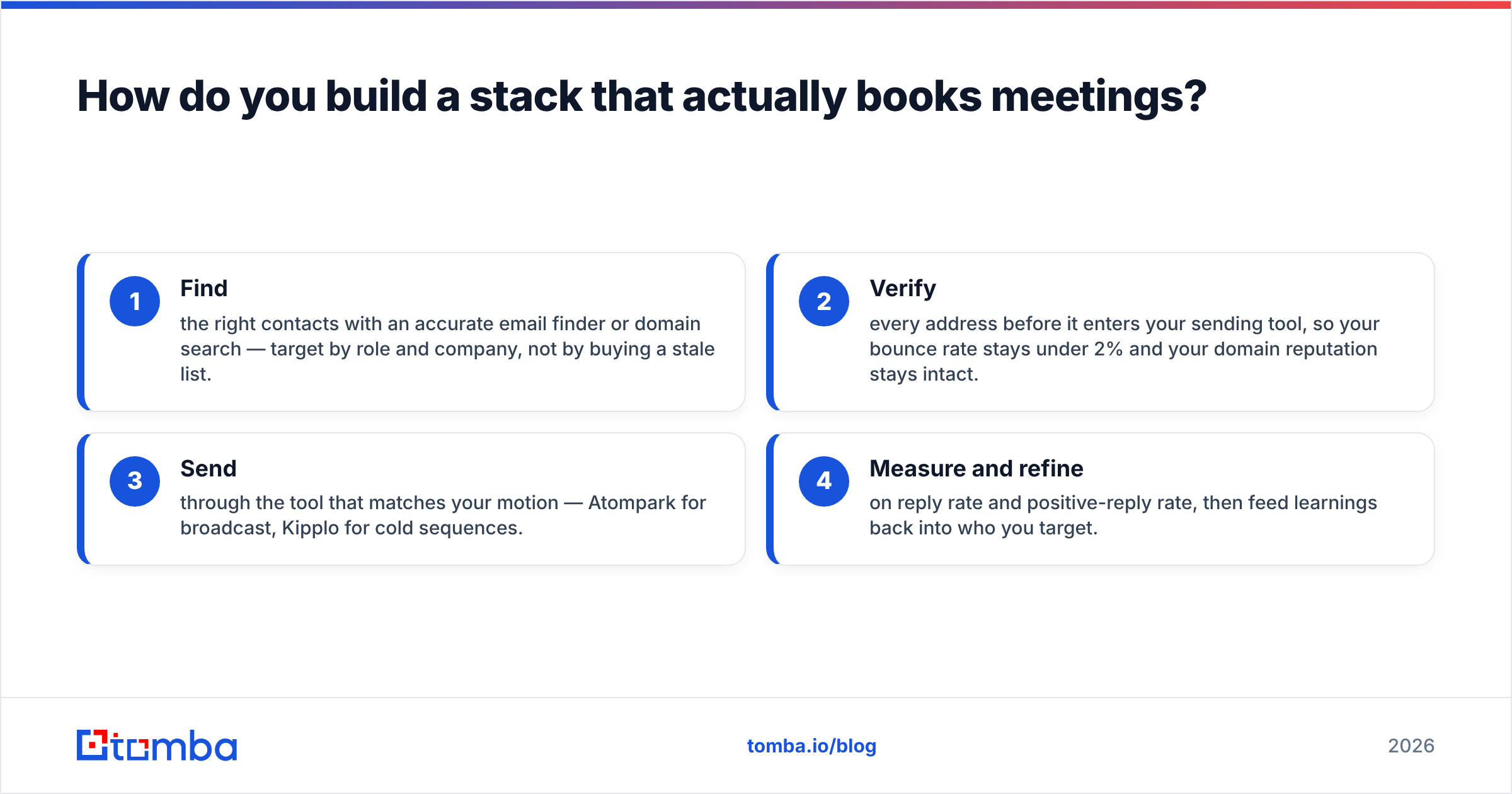
- Find the right contacts with an accurate email finder or domain search — target by role and company, not by buying a stale list.
- Verify every address before it enters your sending tool, so your bounce rate stays under 2% and your domain reputation stays intact.
- Send through the tool that matches your motion — Atompark for broadcast, Kipplo for cold sequences.
- Measure and refine on reply rate and positive-reply rate, then feed learnings back into who you target.
Step two is the one most teams skip, and it's the one that protects every other step. You can automate the whole find-and-verify front end with the Tomba API or run it in bulk before each campaign with the bulk email finder.
The bottom line#
Atompark Software and Kipplo aren't really competitors — they serve different motions. Atompark is a capable bulk-email and SMS broadcaster with a legacy backbone; Kipplo is a modern cold-outreach platform built for replies. Pick Atompark for high-volume marketing to owned lists, and Kipplo for personalized outbound that needs sequences and inbox rotation.
But don't let the tool debate distract you from the decision that moves the needle most: data quality. Before you send a single message through either platform, make sure your contacts are real, current, and verified.
That's where Tomba fits. Use the Tomba Email Finder to source accurate B2B contacts by company, name, or domain, then verify them before they ever reach Atompark or Kipplo — so every send counts, your sender reputation stays clean, and your replies go up. Start free with 25 searches a month and scale into a paid plan only when the pipeline proves itself.
// get started
Find, verify and enrich your first contacts today
Start on the free plan with 25 searches a month, then scale when your team is ready.
Free plan · No credit card required · GDPR & CCPA
// about the author