Atompark Software vs Lead411: Which Tool Wins in 2026?
Atompark Software and Lead411 solve different halves of outreach: one sends bulk email, the other builds verified B2B lists. Here is how they compare in 2026 — and where a dedicated finder fits.
Atompark Software and Lead411 get lumped into the same "email outreach" bucket, but they sit on opposite ends of the workflow. One is a veteran desktop email-and-SMS marketing suite. The other is a cloud B2B sales-intelligence platform built around verified contact data and buyer intent. Picking between them is less "which is better" and more "which job am I actually trying to do."
This guide breaks down what each tool is, where each one is strong, what they cost, and the gap neither fully covers: clean, accurate contact discovery at the moment you need it.
TL;DR#
- Atompark Software is a suite of mostly desktop tools (Atomic Mail Sender, Email Hunter, Email Verifier, SMS sender) aimed at bulk email and SMS marketing on a one-time-license model.
- Lead411 is a cloud B2B sales-intelligence platform: verified emails, direct-dial phones, company data, and intent signals on a per-seat subscription.
- They barely overlap — Atompark sends and scrapes, Lead411 sources verified contacts and triggers. Choosing depends on whether your bottleneck is delivery or data.
- Both have real weak spots: Atompark's scraped data needs heavy verification; Lead411 gets expensive fast and locks features behind higher tiers.
- For accurate, on-demand email discovery and verification without the bulk-software baggage, a focused finder like Tomba Email Finder often beats bolting either tool onto the wrong problem.
What is Atompark Software?#
Atompark is one of the older names in email marketing software, around since the early 2000s. Instead of a single cloud app, it sells a family of standalone tools you license and (mostly) run on Windows:
- Atomic Mail Sender — bulk email blasting from your own SMTP or theirs.
- Atomic Email Hunter — scrapes email addresses from websites and search results.
- Atomic Email Verifier — checks list validity before you send.
- Atomic SMS Sender / EasySendy — SMS and hybrid email+SMS campaigns.
The pitch is ownership: you buy a license once (or subscribe to the cloud EasySendy product) and you control the sending. That appeals to small businesses, agencies, and anyone who wants to avoid recurring SaaS fees or platform sending limits.
The trade-off is that Atompark is built around volume, not accuracy. The Email Hunter scrapes whatever it finds, which means raw, unverified, often outdated addresses. You're expected to clean lists yourself, and deliverability rests entirely on how careful you are. If you treat it as a fire-and-forget blaster, you'll burn your sending domain. See Atompark's own product range at atompark.com and reviews on G2.

What is Lead411?#
Lead411 is a cloud B2B sales-intelligence platform. You don't bring your own list — Lead411 is the list. It maintains a database of company and contact records with verified business emails, direct-dial mobile numbers, technographics, and "Bombora-powered" buyer intent signals.
Where Atompark assumes you already know who to contact and just need to reach them, Lead411 helps you decide who to contact in the first place. Its standout features include:
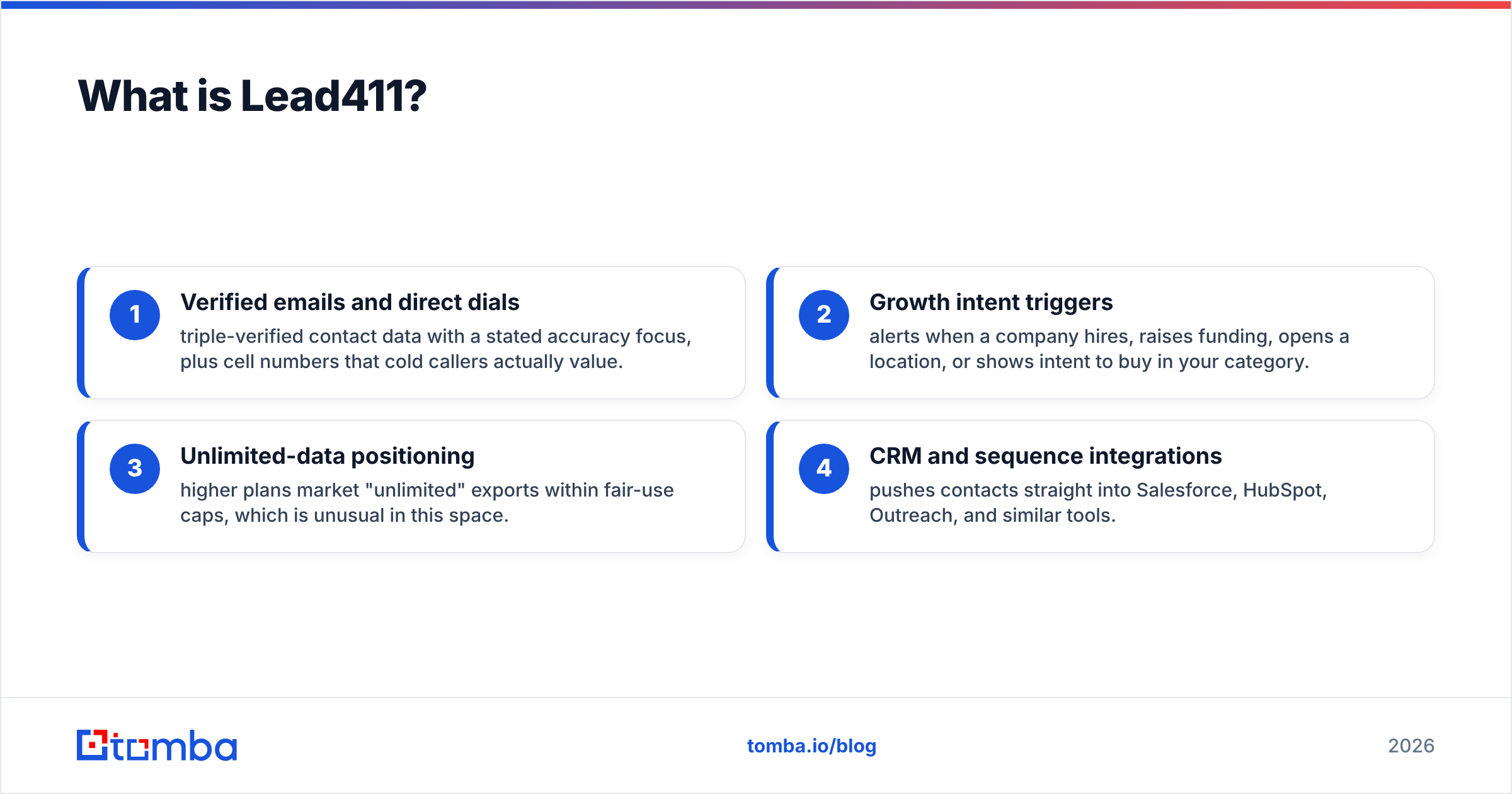
- Verified emails and direct dials — triple-verified contact data with a stated accuracy focus, plus cell numbers that cold callers actually value.
- Growth intent triggers — alerts when a company hires, raises funding, opens a location, or shows intent to buy in your category.
- Unlimited-data positioning — higher plans market "unlimited" exports within fair-use caps, which is unusual in this space.
- CRM and sequence integrations — pushes contacts straight into Salesforce, HubSpot, Outreach, and similar tools.
In short, Lead411 is a top-of-funnel data engine for outbound teams. You can read its feature set on the official Lead411 site and compare ratings on Capterra.
Atompark Software vs Lead411: how do they compare?#
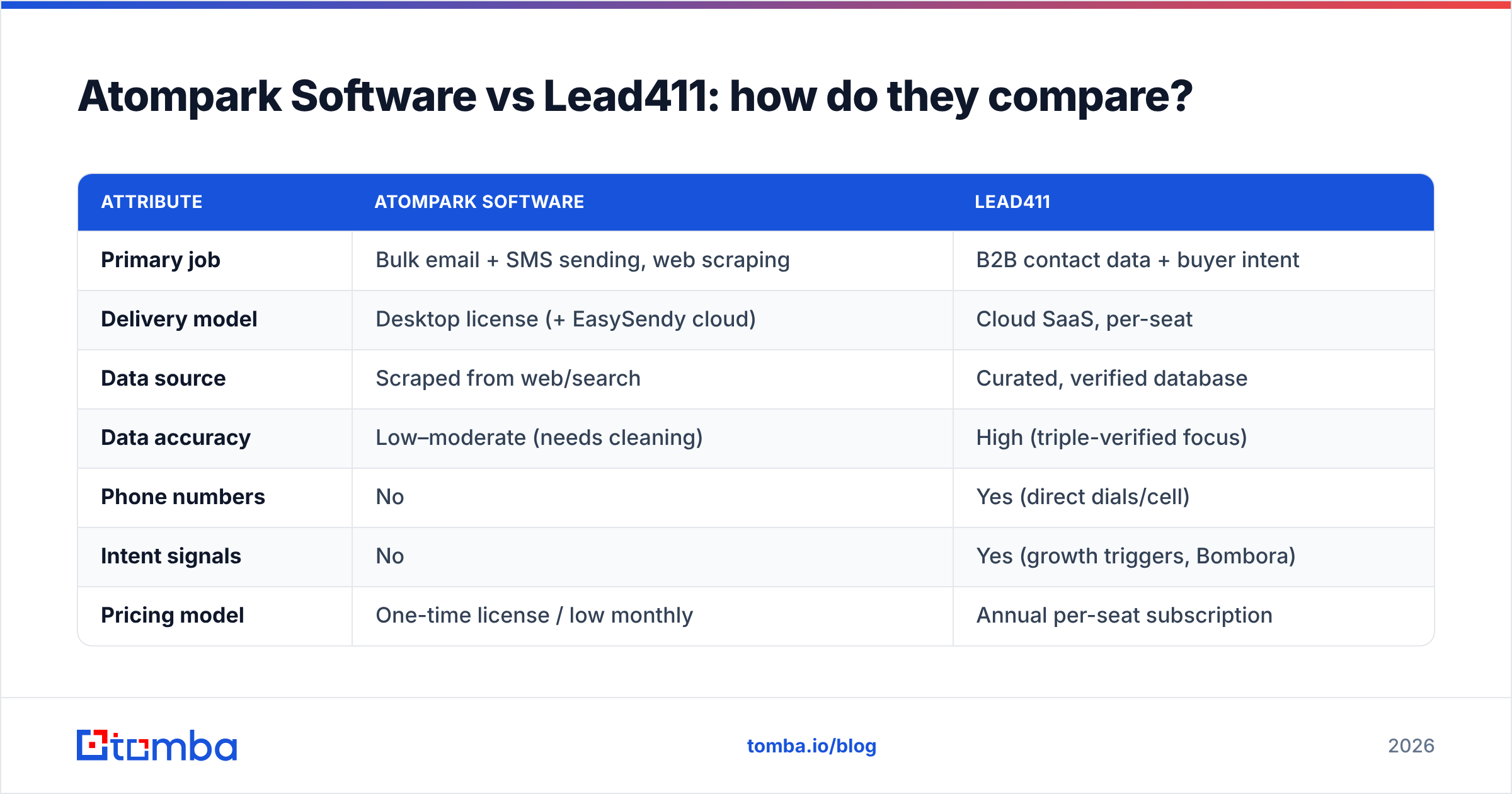
The fastest way to see the difference is side by side. These two tools answer different questions, and the table makes that obvious.
| Attribute | Atompark Software | Lead411 |
|---|---|---|
| Primary job | Bulk email + SMS sending, web scraping | B2B contact data + buyer intent |
| Delivery model | Desktop license (+ EasySendy cloud) | Cloud SaaS, per-seat |
| Data source | Scraped from web/search | Curated, verified database |
| Data accuracy | Low–moderate (needs cleaning) | High (triple-verified focus) |
| Phone numbers | No | Yes (direct dials/cell) |
| Intent signals | No | Yes (growth triggers, Bombora) |
| Pricing model | One-time license / low monthly | Annual per-seat subscription |
| Typical buyer | SMBs, agencies, DIY senders | SDR/AE teams, RevOps |
| Free option | Trial versions | Free trial (limited credits) |
| Best for | Owning your sending stack cheaply | Sourcing fresh, verified leads |
The honest summary: if your problem is "I have a list and need to send to it cheaply," Atompark is in the conversation. If your problem is "I need to find the right verified decision-makers and know when they're buying," Lead411 is the better-fit category — at a meaningfully higher price.
Actually, let me embed that properly:
Which one is more accurate?#
Lead411 wins on data accuracy, and it isn't close. Its entire model depends on maintaining verified records, so emails and phone numbers go through validation before they reach you. That's the difference between a curated database and a scraper.
Atompark's Email Hunter pulls whatever public addresses it can crawl. Some are gold, many are role accounts (info@, sales@), spam traps, or long-dead. Atompark even ships a separate Email Verifier precisely because raw scraped data can't be trusted as-is. The workflow assumes a cleanup pass — and if you skip it, your bounce rate and sender reputation pay the price.
But "accuracy" cuts both ways. Lead411's database is broad, yet no provider covers every niche, region, or freshly changed role. Database tools go stale between refresh cycles. That's why many teams pair a database with a real-time finder and verifier — to confirm an address right before sending rather than trusting a months-old record.
This is exactly where a dedicated email verifier earns its keep. Whether your list came from Atompark's scraper, a Lead411 export, or a manual prospecting session, running it through a real-time verification step catches the bounces neither tool fully prevents on its own.
What about pricing?#
Pricing is where the philosophies diverge hardest.
Atompark leans on the one-time-license model. You pay once for a desktop tool (Email Hunter, Mail Sender, etc.) — typically in the low-to-mid hundreds of dollars per product — and own it, with optional upgrades. The cloud EasySendy product runs on subscriber-based monthly tiers. The appeal is predictability and no per-lead metering.
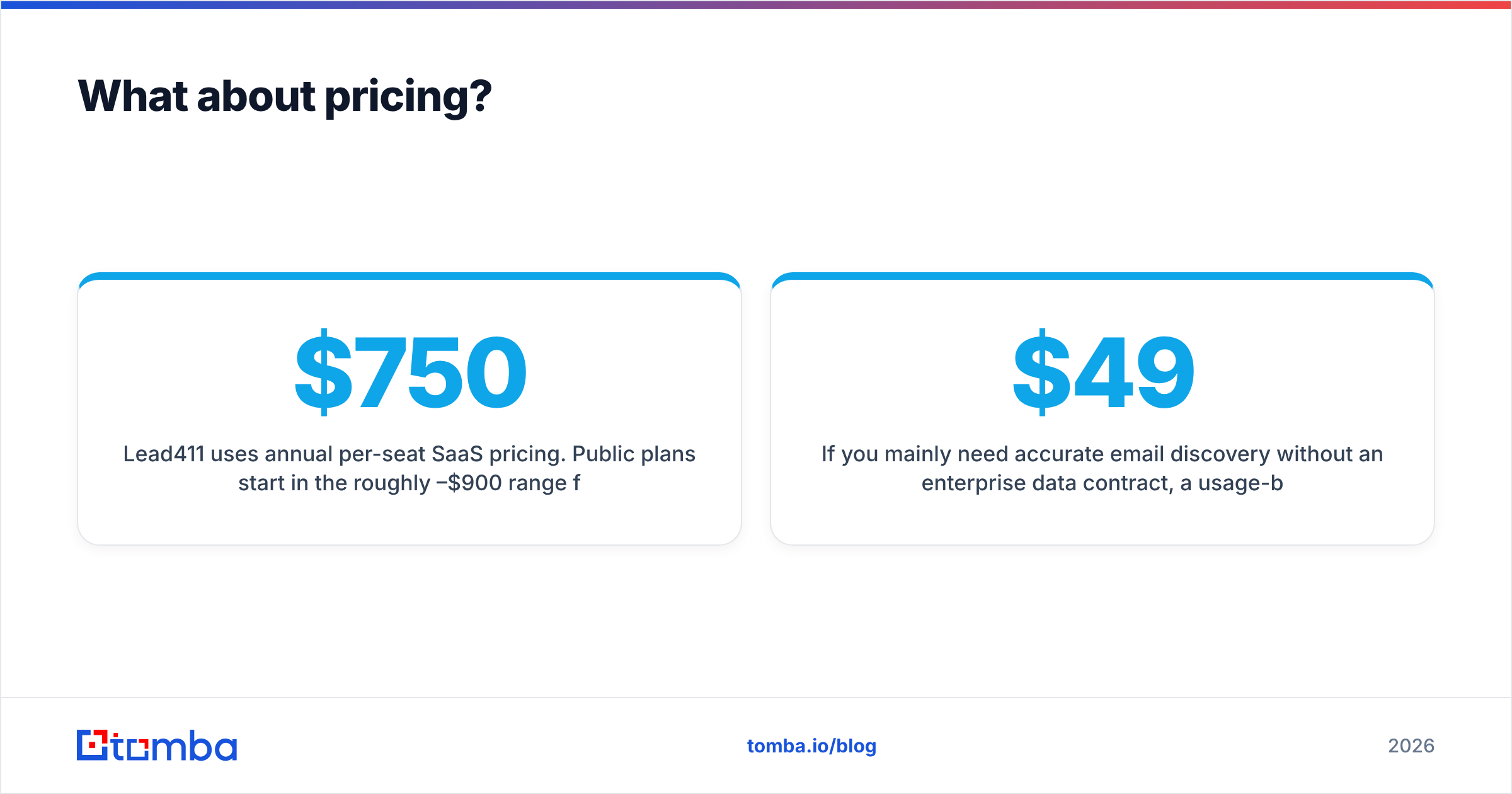
Lead411 uses annual per-seat SaaS pricing. Public plans start in the roughly $750–$900 per user per year range for the Basic Plus tier, with higher "Pro/Enterprise" tiers adding intent data, more exports, and integrations. There's a free trial with limited credits, but no permanent free tier. For a small team, the annual commitment adds up quickly.
Neither is "cheap" once you account for the real total cost:
- With Atompark you save on subscription fees but pay in time — cleaning, verifying, and managing deliverability yourself.
- With Lead411 you save time but pay in seats and renewals, and you're committed annually.
If you mainly need accurate email discovery without an enterprise data contract, a usage-based finder is far lighter. For reference, Tomba pricing starts free (25 searches/month), then $49/mo Starter, $99/mo Growth, and $249/mo Pro — so you can scale spend to actual usage instead of buying a full intelligence platform or a desktop suite you'll babysit.
Which tool fits which use case?#
Match the tool to the job, not the hype.
Choose Atompark Software if:
- You already have an opt-in or owned list and just need a cheap, self-hosted way to send bulk email or SMS.
- You prefer a one-time license over recurring SaaS bills.
- You're comfortable doing your own list hygiene and SMTP/deliverability management.
- You're an agency or SMB running occasional campaigns, not continuous outbound.
Choose Lead411 if:
- Your bottleneck is finding verified decision-makers, not sending to them.
- You need direct-dial phone numbers for cold calling alongside emails.
- Buyer-intent triggers (funding, hiring, tech changes) would sharpen your timing.
- You run a dedicated SDR/AE motion and can justify annual per-seat cost.
Choose a focused finder + verifier (like Tomba) if:
- You want accurate emails on demand without a heavyweight platform contract.
- You need to verify lists from any source before sending.
- You'd rather pay for usage than seats, and start free.
- You want API, CRM, and spreadsheet access without a sales call.
That third path is the one most teams underestimate. You don't always need a full intelligence suite or a desktop blaster — sometimes you just need the right email, confirmed deliverable, pushed into your CRM. Tools like domain search and data enrichment cover the "find and complete the record" job without the overhead of either competitor.
Where do both tools fall short?#
Every comparison should name the gaps, so here they are.
Atompark's weak spots:
- Scraped data is unverified by default; deliverability is your problem.
- Desktop-first means limited collaboration, no real cloud workflow for teams.
- No phone data, no intent signals — it's a sending tool, not a sourcing tool.
- Aggressive bulk sending without warmup risks blacklisting your domain.
Lead411's weak spots:
- Cost scales fast; small teams feel the annual per-seat pinch.
- Best features (intent, higher export caps) sit behind upper tiers.
- Database coverage varies by industry, region, and seniority.
- You're buying the whole platform even if you only need verified emails.
The shared blind spot is point-of-use verification. Atompark scrapes then expects you to clean; Lead411 verifies on a refresh cycle, not at the moment you hit send. Addresses change constantly — people switch jobs, domains migrate, mailboxes close. A real-time check right before outreach is the cheapest insurance against a wrecked bounce rate, and it's exactly the layer a bulk email finder and verifier adds on top of either tool.
How should you actually combine these tools?#
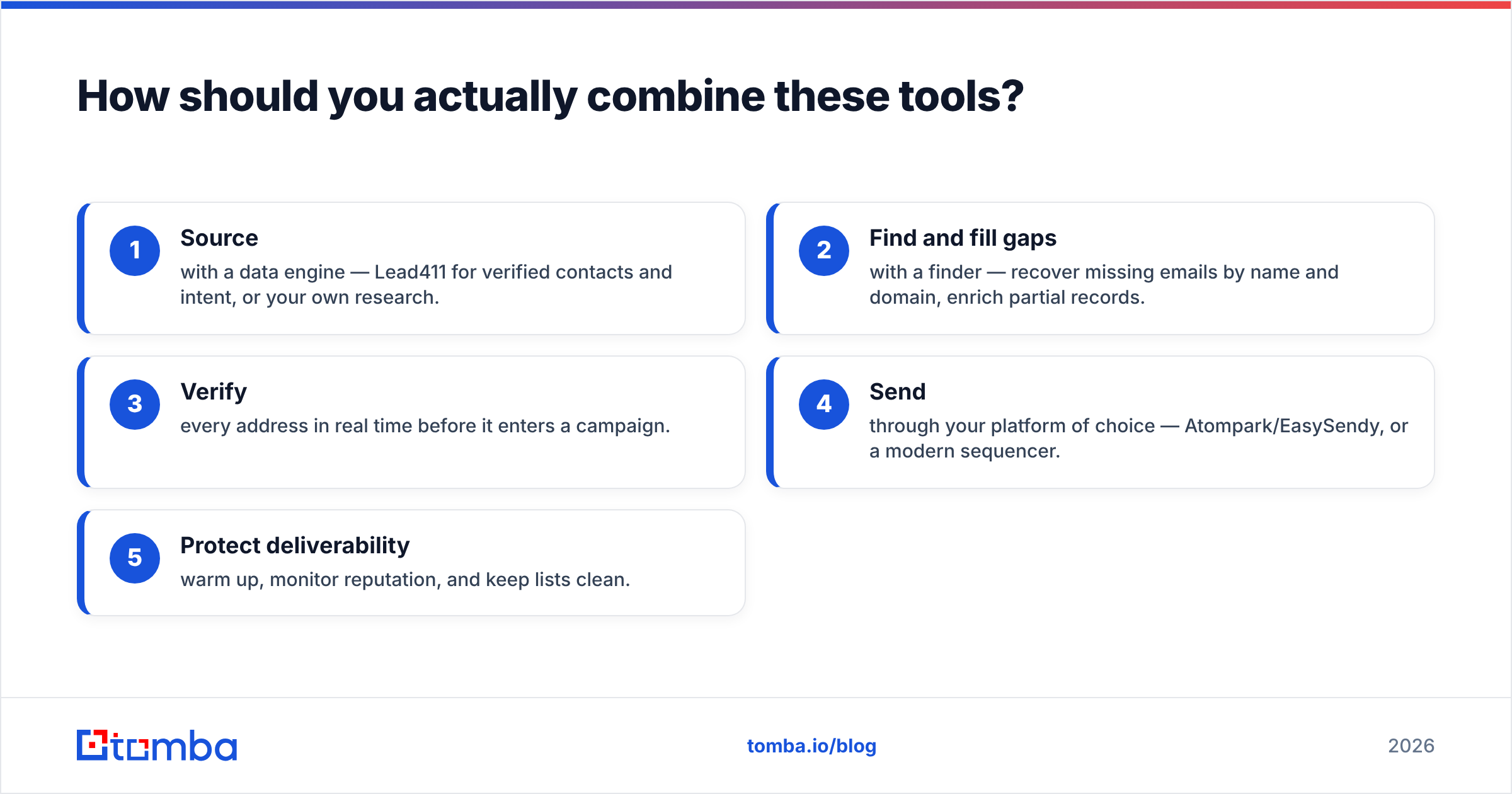
The smartest stacks rarely pick one and stop. A realistic 2026 workflow looks like this:
- Source with a data engine — Lead411 for verified contacts and intent, or your own research.
- Find and fill gaps with a finder — recover missing emails by name and domain, enrich partial records.
- Verify every address in real time before it enters a campaign.
- Send through your platform of choice — Atompark/EasySendy, or a modern sequencer.
- Protect deliverability — warm up, monitor reputation, and keep lists clean.
Notice that steps 2 and 3 — find and verify — are where deals quietly die when skipped. You can spend on Lead411's database and still bounce because a contact left last quarter. You can blast through Atompark and still land in spam because half the scraped list never existed. The verification layer is what makes the rest of the spend pay off.
That's the case for keeping a lightweight, accurate finder in your stack regardless of which big tool you commit to. It's the connective tissue between "we have data" and "the email actually arrives."
Verdict: Atompark Software vs Lead411#
There's no single winner because they're not really competitors — they're complements pointed at different problems.
- Pick Lead411 if your growth depends on sourcing fresh, verified, intent-rich B2B contacts and you can fund a per-seat platform.
- Pick Atompark Software if you own your audience and want a cheap, self-controlled way to send bulk email or SMS, and you'll handle hygiene yourself.
- Pick neither as your accuracy layer — both leave a verification gap that quietly costs you deliverability and replies.
If your core need is finding professional email addresses by name, company, or domain and confirming they're real before you send, skip the all-in-one assumption. Tomba Email Finder does that one job exceptionally well: search by domain or name, verify in real time, enrich the record, and push it into your CRM or spreadsheet — starting free at 25 searches a month, scaling to $49/mo and up only as you grow. Pair it with whichever sender or database you choose, and you close the gap that Atompark and Lead411 both leave open. Start free and find your next batch of verified contacts today.
// get started
Find, verify and enrich your first contacts today
Start on the free plan with 25 searches a month, then scale when your team is ready.
Free plan · No credit card required · GDPR & CCPA
// about the author