Atompark Software vs LeadEngineAI: 2026 Comparison Guide
Atompark Software ships bulk email and SMS blasting; LeadEngineAI promises AI-sourced leads. Here's which one fits your 2026 outbound stack — and where neither is enough.
You are weighing two very different products that get lumped together in the same "sales tool" bucket: Atompark Software, a long-running bulk email and SMS sender, and LeadEngineAI, a newer AI-branded lead-sourcing platform. They solve different halves of the outbound problem, and picking the wrong one wastes a quarter of pipeline. This guide breaks down what each actually does, where the data and deliverability gaps sit, and how to assemble a stack that works in 2026.
TL;DR — Atompark Software vs LeadEngineAI at a glance#
- Atompark Software is a sending tool. Its strengths are bulk email and SMS distribution (Atomic Mail Sender, ePochta), not finding or verifying contacts.
- LeadEngineAI is a sourcing tool. It markets AI-generated B2B leads and enrichment, but list freshness and verification quality vary widely by industry.
- Neither is a complete outbound engine. Atompark blasts to lists it doesn't validate; LeadEngineAI sources contacts you still need to verify before sending.
- The expensive failure is deliverability. Sending unverified data through any mass mailer torches your domain reputation fast.
- The fix is a verification layer like Tomba between sourcing and sending — clean, validated emails before a single campaign goes out.
What is Atompark Software?#
Atompark Software is a Ukraine-founded vendor that has shipped desktop and cloud bulk-messaging tools since the early 2000s. Its best-known products are Atomic Mail Sender, the ePochta suite (mailer, SMS, list manager, and a verifier), and various scraping utilities. The pitch is volume: load a list, design a message, and send thousands of emails or SMS messages on a schedule.
That heritage matters. Atompark is built around the send, not the target. It assumes you already have a list and want to push messages to it at scale, optionally rotating SMTP servers and personalizing fields. For teams running newsletters or transactional-style blasts to opted-in audiences, that model is fine. For cold B2B outbound, it has a structural weakness: the quality of your results is entirely capped by the quality of the list you bring, and Atompark does little to improve that list before it fires.
You can read the company's own product range on the official Atompark site, and independent user reviews on G2 give a feel for where it shines (raw sending throughput) and where it frustrates (data hygiene, modern deliverability controls).
What is LeadEngineAI?#
LeadEngineAI positions itself as an AI-driven lead generation and enrichment platform. The category promise — shared by dozens of similarly named tools that appeared after the 2023–2024 AI wave — is that you describe an ideal customer profile and the system returns matching companies and contacts, often with emails, titles, and firmographics attached.
The appeal is obvious: skip the manual prospecting and let a model assemble your list. The catch is equally well known to anyone who has run these tools at volume. "AI-sourced" usually means the same underlying scraped-and-aggregated B2B datasets that power most lead vendors, repackaged with a natural-language search layer. The model helps you query faster; it does not magically make the contact data fresher or the emails deliverable. Job changes, role turnover, and catch-all domains still produce a meaningful bounce tail unless you verify.
So LeadEngineAI sits at the opposite end of the funnel from Atompark. One finds contacts; the other sends to them. Comparing them head-to-head is a little like comparing a fishing rod to a frying pan — you likely need both, plus something in between to clean the catch.
Atompark Software vs LeadEngineAI: feature comparison#
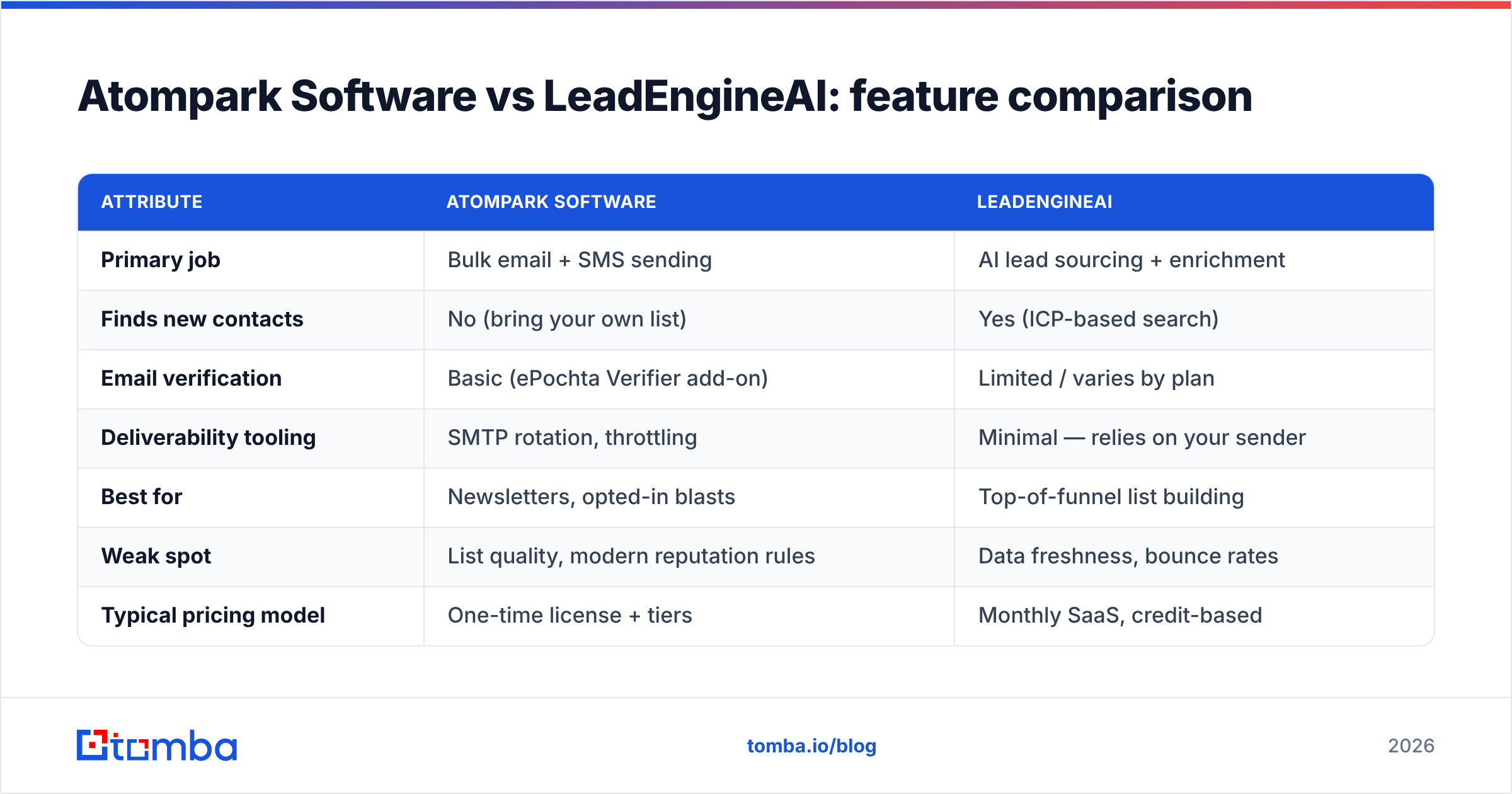
Here is the core breakdown across the attributes that actually decide outbound outcomes.
| Attribute | Atompark Software | LeadEngineAI |
|---|---|---|
| Primary job | Bulk email + SMS sending | AI lead sourcing + enrichment |
| Finds new contacts | No (bring your own list) | Yes (ICP-based search) |
| Email verification | Basic (ePochta Verifier add-on) | Limited / varies by plan |
| Deliverability tooling | SMTP rotation, throttling | Minimal — relies on your sender |
| Best for | Newsletters, opted-in blasts | Top-of-funnel list building |
| Weak spot | List quality, modern reputation rules | Data freshness, bounce rates |
| Typical pricing model | One-time license + tiers | Monthly SaaS, credit-based |
| Free option | Trial / limited free tools | Limited free credits (varies) |
The table makes the real conclusion visible: these tools barely overlap. The honest question is not "which one wins" but "which gap am I actually trying to close, and what am I missing on the other side?"
Is Atompark better than LeadEngineAI for cold outbound?#
Short answer: neither is good at cold outbound alone, and they fail for opposite reasons.
Atompark gives you a powerful sending machine pointed at whatever list you feed it. If that list is scraped, stale, or full of catch-all domains, you will send a high-volume campaign straight into spam folders and bounce filters. Mass mailers are exactly the tools that mailbox providers scrutinize hardest, so a dirty list plus a high-throughput sender is the fastest known way to wreck a sending domain.
LeadEngineAI gives you a list but hands off the hard part — making sure those addresses are real and reachable — to you. Its enrichment may look complete in the UI, yet a chunk of "valid-looking" emails will be guesses, old aliases, or unverifiable catch-alls. Send those without a verification pass and you inherit the same bounce problem from the other direction.
This is why experienced outbound teams treat sourcing, verification, and sending as three separate jobs with three separate quality bars. The middle job — verification — is where both of these tools are weakest, and it is the one that protects everything downstream. A dedicated email verifier sits between your sourced list and your sender and removes the addresses that would otherwise damage your reputation.
How do data quality and deliverability compare?#
Data quality is the whole ballgame, and it splits into two measurable things: how fresh the contact is, and whether the email actually accepts mail.
Freshness is LeadEngineAI's responsibility and its biggest variable. AI lead tools are only as current as their last data refresh, and B2B contact data decays at roughly 2–3% per month as people change jobs. A six-month-old "enriched" record can be a third wrong before you ever hit send.
Acceptance is where Atompark's model breaks down. The ePochta Verifier exists, but bolt-on verification inside a mass-mailing suite tends to be syntax-and-MX level, not the deeper SMTP and catch-all handling that prevents bounces on tricky domains. Catch-all domains in particular — where the server accepts everything at the SMTP layer regardless of whether the mailbox exists — need a specialized catch-all verifier to score confidently. A generic checker will wave them through or reject them outright, and both errors cost you.
For the underlying mechanics of why this matters, the concept of email deliverability is worth understanding: providers like Google and Microsoft weigh your bounce rate, complaint rate, and sending history heavily. One bad blast can suppress an otherwise healthy domain for weeks.

What does each tool cost in 2026?#
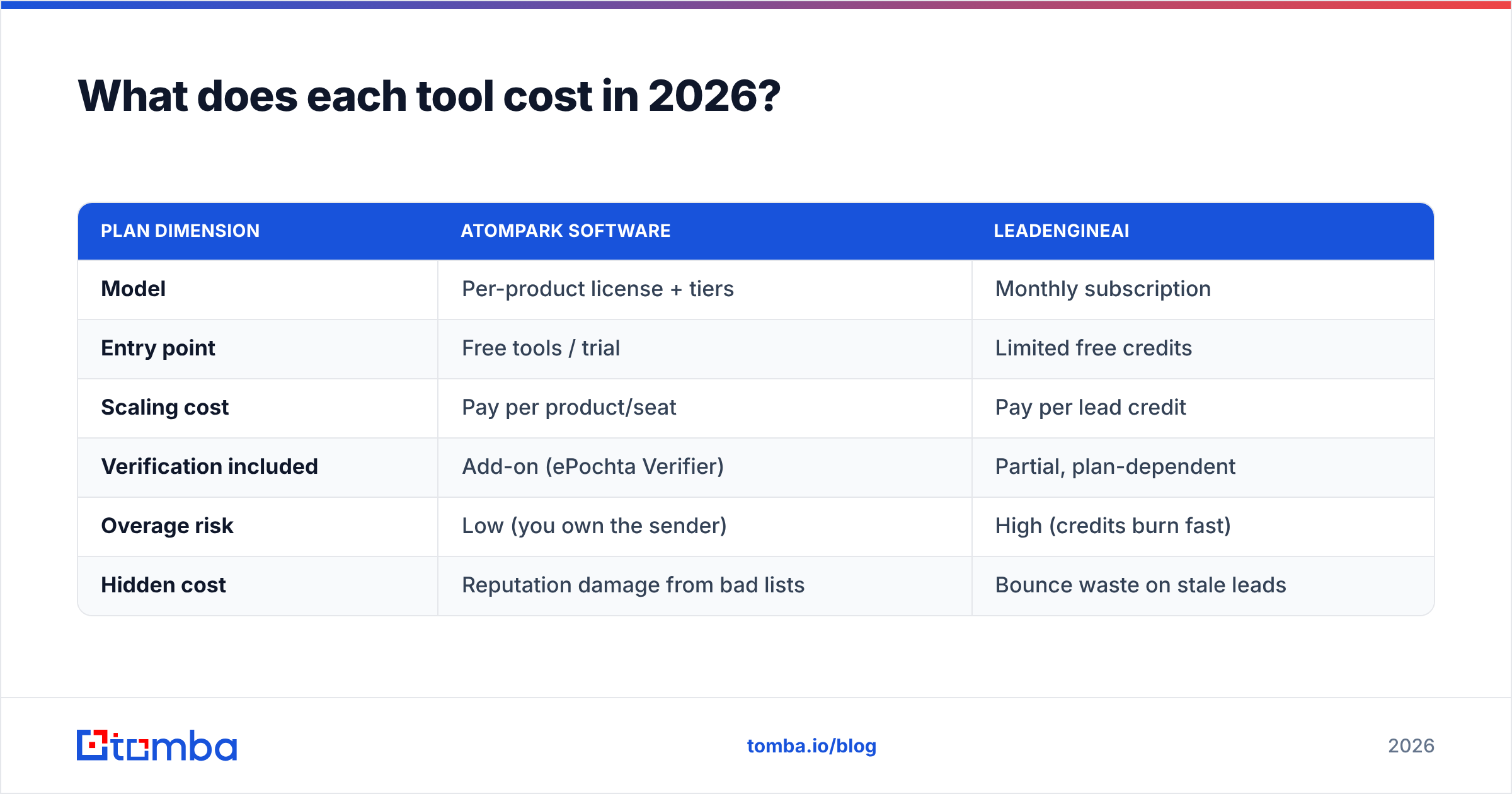
Pricing models differ enough that a flat dollar comparison misleads, so weigh the structure, not just the number.
| Plan dimension | Atompark Software | LeadEngineAI |
|---|---|---|
| Model | Per-product license + tiers | Monthly subscription |
| Entry point | Free tools / trial | Limited free credits |
| Scaling cost | Pay per product/seat | Pay per lead credit |
| Verification included | Add-on (ePochta Verifier) | Partial, plan-dependent |
| Overage risk | Low (you own the sender) | High (credits burn fast) |
| Hidden cost | Reputation damage from bad lists | Bounce waste on stale leads |
The hidden-cost row is the one to internalize. With Atompark, the sticker price is low but a damaged domain costs you future deliverability across every campaign. With LeadEngineAI, credits evaporate on contacts you cannot verify, so your effective cost per usable lead can be several times the headline rate. Either way, the cheapest line item — verification — is the one that protects the expensive ones.
Where does Tomba fit between sourcing and sending?#
Tomba fills the verification and accurate-sourcing gap that sits between a tool like LeadEngineAI and a sender like Atompark. Instead of replacing either, it makes both safe to use.
Three jobs map cleanly to Tomba tools:
- Find the right contact, accurately. The email finder returns professional email addresses by name and domain with a confidence score and source citations, so you are not guessing at formats.
- Search a whole company at once. Domain search pulls the verified addresses behind a company domain — useful when LeadEngineAI gives you a company but a thin contact list.
- Verify before you send. The verifier and catch-all verifier validate every address at the SMTP level, removing the bounces that would otherwise hit Atompark's send and your reputation.
Tomba's data sourcing is transparent — you can review where the data comes from rather than trusting an opaque "AI" black box. And because it exposes a clean email finder API, it slots into whatever sourcing and sending tools you already run, including Sheets, HubSpot, and
Zapier workflows.
For teams processing large lists, bulk email finding and verification let you clean a LeadEngineAI export in one pass before it ever touches Atompark's queue.
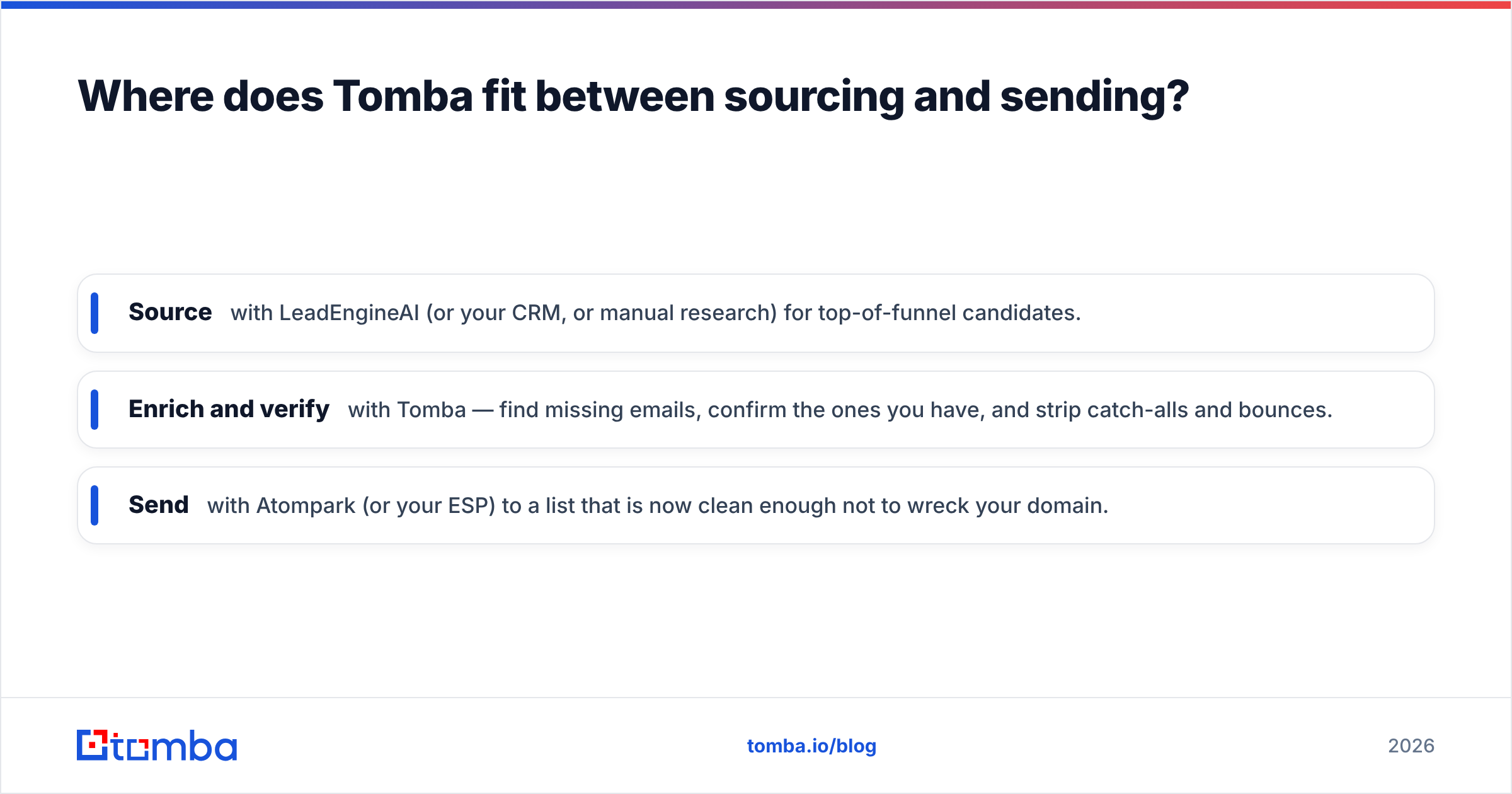
A practical 2026 stack#
- Source with LeadEngineAI (or your CRM, or manual research) for top-of-funnel candidates.
- Enrich and verify with Tomba — find missing emails, confirm the ones you have, and strip catch-alls and bounces.
- Send with Atompark (or your ESP) to a list that is now clean enough not to wreck your domain.
That sequence respects what each tool is genuinely good at and refuses to let any one of them do a job it was not built for.
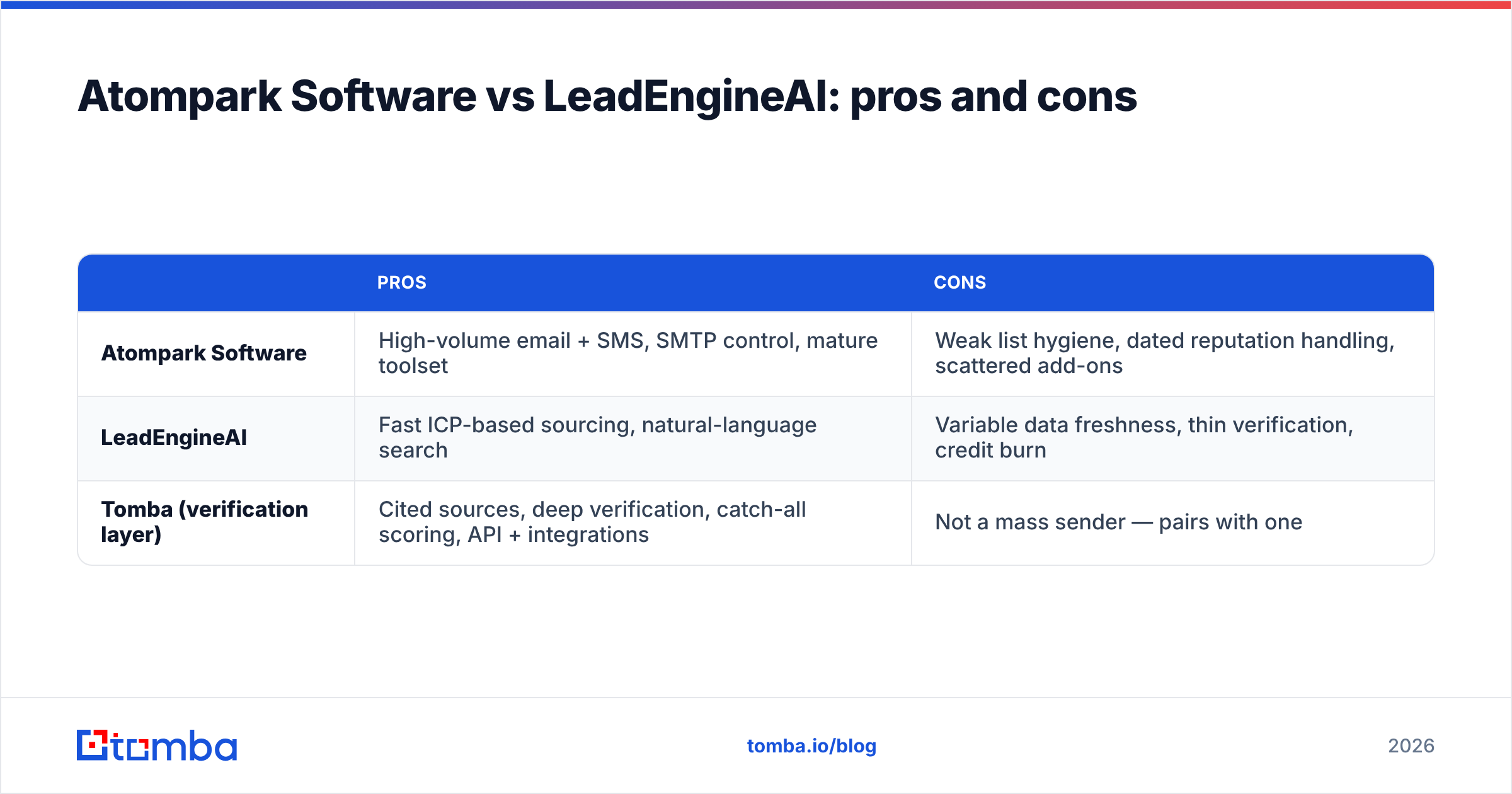
Atompark Software vs LeadEngineAI: pros and cons#
| Pros | Cons | |
|---|---|---|
| Atompark Software | High-volume email + SMS, SMTP control, mature toolset | Weak list hygiene, dated reputation handling, scattered add-ons |
| LeadEngineAI | Fast ICP-based sourcing, natural-language search | Variable data freshness, thin verification, credit burn |
| Tomba (verification layer) | Cited sources, deep verification, catch-all scoring, API + integrations | Not a mass sender — pairs with one |
The pattern repeats: each row's weakness is another tool's strength. The winning move in 2026 is composition, not a single all-in-one bet.
Which should you choose?#
Choose based on the gap you are actually feeling.
- You already have clean, opted-in lists and just need to send a lot, cheaply? Atompark Software is a reasonable, low-cost sender. Add a real verification step anyway.
- You have no list and need to build one fast from an ICP? LeadEngineAI (or any reputable lead source) gets you candidates — but budget for verification, because the raw export will bounce.
- You care most about not bouncing and not burning your domain? Start with the verification layer first. It is the cheapest tool in the stack and the one that protects every dollar you spend on the other two.
Most teams that compare Atompark Software vs LeadEngineAI discover, a few weeks in, that the comparison was the wrong frame. The real decision is how to keep your data clean enough that whichever sender you pick actually lands in the inbox. Get that right and both tools perform better; get it wrong and the best sender and the smartest AI sourcing in the world still net you spam-foldered campaigns.
Final recommendation#
If you only fix one thing this quarter, fix verification. Run your sourced contacts — from LeadEngineAI, your CRM, or anywhere else — through Tomba's email finder and verifier before they reach Atompark or any mass sender. You will cut bounces, protect your sending domain, and stop paying to email people who left their jobs months ago.
Start free with 25 searches on the Tomba Email Finder, then scale on the Starter plan at $49/mo when your volume grows. Check the full Tomba pricing to match a tier to your outbound — and build the clean-data layer that makes every other tool in your stack worth its price.
// get started
Find, verify and enrich your first contacts today
Start on the free plan with 25 searches a month, then scale when your team is ready.
Free plan · No credit card required · GDPR & CCPA
// about the author