Atompark Software vs Onemorelead: 2026 Lead Tool Comparison
Atompark Software sells bulk-email tools; Onemorelead sells B2B contact lists. We compare pricing, data freshness, and deliverability so you pick the right one for outbound in 2026.
Atompark Software and Onemorelead get compared a lot, which is strange when you look closely: they barely do the same job. One is a desktop bulk-email suite that has been around since the early 2000s. The other is a newer web app that sells pre-built B2B contact lists. If you are choosing between them for outbound in 2026, the real question is not "which is better" but "which problem are you actually trying to solve."
This guide breaks down what each tool does, where the data comes from, what it costs, and where both leave a gap you will want to fill before you hit send.
TL;DR#
- Atompark Software is a toolbox of email-marketing utilities (sender, verifier, extractor, designer). You bring your own list; it helps you clean and blast it.
- Onemorelead is a B2B data provider. You buy access to its contact database and export lists by title, industry, or location.
- Pricing models differ wildly: Atompark leans on one-time desktop licenses plus a cloud "MassMail" plan; Onemorelead is subscription credits for contacts.
- Neither verifies in real time at the moment you reach out — both ship data that ages, so a separate verification step protects your sender reputation.
- Best combo for most teams: source and confirm contacts with a live finder/verifier, then use a dedicated sending platform with proper warmup.
What is Atompark Software?#
Atompark Software is a Ukraine-founded vendor that has sold email-marketing tools for roughly two decades. It is not a single product — it is a family of them. The best-known pieces are Atomic Mail Sender (a desktop bulk sender), Atomic Email Studio (an all-in-one bundle), Atomic Email Hunter (an on-page email extractor), and Atomic Email Verifier. There is also a hosted side, MassMail, for people who would rather not run desktop software.
The mental model: Atompark is a workshop. It hands you the hammer, the saw, and the sander, but you supply the wood. You point the Hunter at websites or search results, it scrapes addresses, the Verifier trims obvious junk, and the Sender mails them. It is powerful for people who want local control and a perpetual license instead of a monthly bill.
The trade-offs are also classic desktop-software trade-offs. Sending high volume from your own IP and domain without managed warmup is risky for deliverability. Scraped addresses skew toward generic inboxes (info@, sales@) rather than the named decision-maker you actually want. And the UI feels its age next to modern SaaS.
You can read Atompark's own product breakdown on atompark.com, and skim real user notes on G2 before committing.
What is Onemorelead?#
Onemorelead is a web-based B2B contact database. Instead of giving you tools to build a list, it sells you the list. You filter by job title, industry, company size, and geography, then export verified business contacts — name, company, email, sometimes phone — into your CRM or cold-email tool.
The mental model here is a grocery store rather than a workshop. You do not grow the vegetables; you grab what you need off the shelf and leave. For a small team that just wants 5,000 marketing-director emails in the US SaaS space by Friday, that convenience is the entire pitch.
The catch with any pre-built list provider is freshness. B2B data decays fast — people change jobs constantly, and a contact that was accurate at export can be stale weeks later. List sellers verify in batches on their schedule, not at the moment you send. So the export feels clean, but reality has already moved on. That is why a data enrichment and re-verification pass before any campaign is not optional.

Atompark Software vs Onemorelead: how do they actually compare?#
Here is the side-by-side. Read it as "different categories of tool" rather than "two horses in one race."
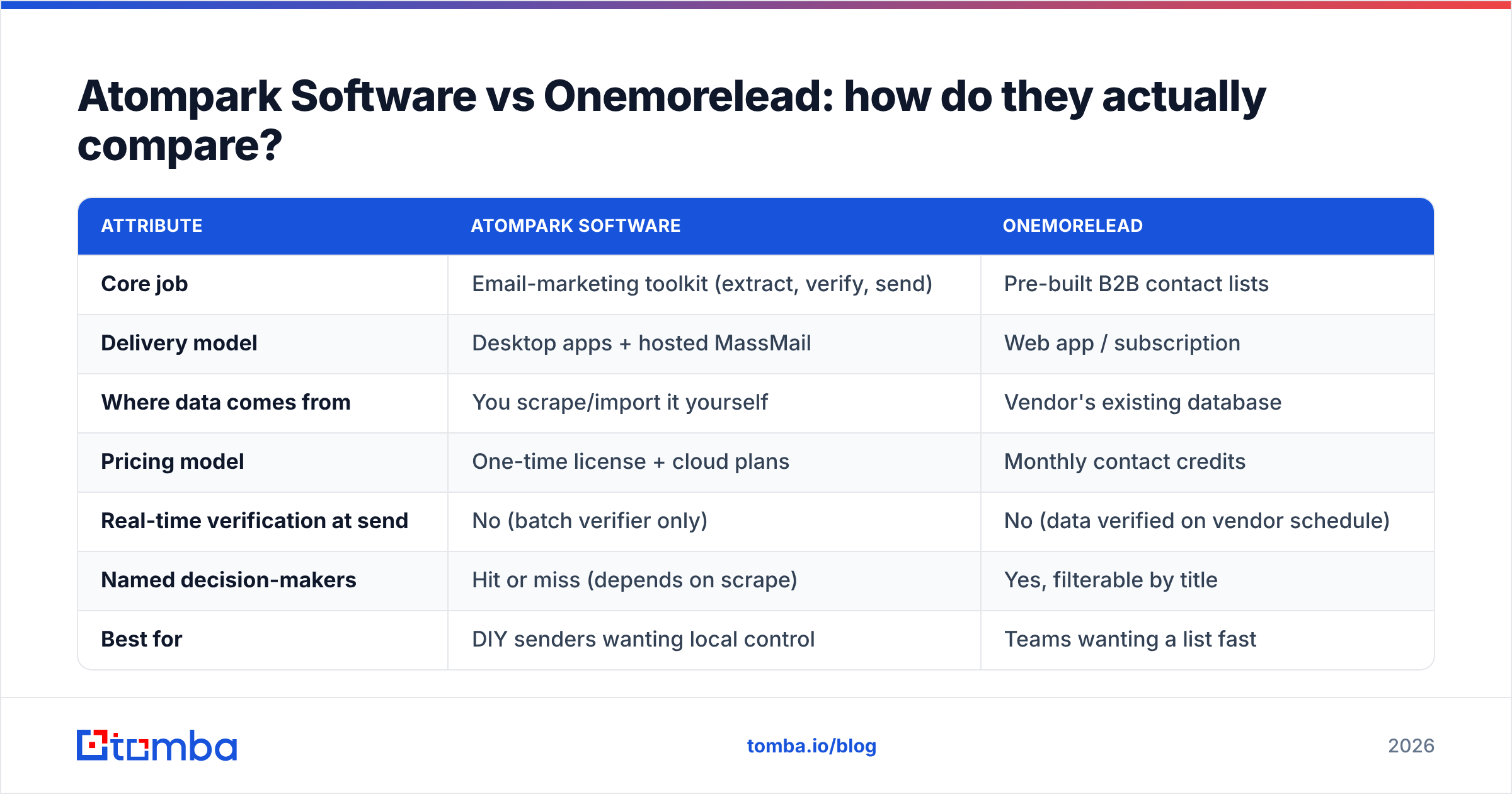
| Attribute | Atompark Software | Onemorelead |
|---|---|---|
| Core job | Email-marketing toolkit (extract, verify, send) | Pre-built B2B contact lists |
| Delivery model | Desktop apps + hosted MassMail | Web app / subscription |
| Where data comes from | You scrape/import it yourself | Vendor's existing database |
| Pricing model | One-time license + cloud plans | Monthly contact credits |
| Real-time verification at send | No (batch verifier only) | No (data verified on vendor schedule) |
| Named decision-makers | Hit or miss (depends on scrape) | Yes, filterable by title |
| Best for | DIY senders wanting local control | Teams wanting a list fast |
| Main risk | Deliverability on self-managed IP | Data staleness after export |
The pattern is clear: Atompark gives you control and ownership; Onemorelead gives you speed and ready-made targeting. Neither one closes the loop on accuracy at the moment that matters — when you actually press send.
Which has better data accuracy?#
Neither wins this outright, and that surprises people.
Atompark's accuracy depends entirely on your inputs. Scrape a clean, well-maintained company site and the Hunter pulls usable addresses. Scrape an old directory and you collect dead mailboxes and role accounts that route to nobody. The built-in Atomic Email Verifier does syntax and MX checks, which catches the obvious garbage but cannot confirm whether a specific human still reads that inbox.
Onemorelead's accuracy depends on its refresh cycle. Pre-built databases are only as good as their last verification sweep. A provider can advertise a high validity rate and still hand you contacts who left the company two months ago, because the sweep ran before they quit. The number on the marketing page describes the database in aggregate, not your specific export today.
This is the structural weakness of both static approaches, and it is exactly where a live tool earns its keep. A modern email verifier checks an address against the mail server at the moment you ask, not weeks earlier. Pair that with a catch-all verifier for domains that accept everything, and you stop guessing about email deliverability before your first bounce ever lands.
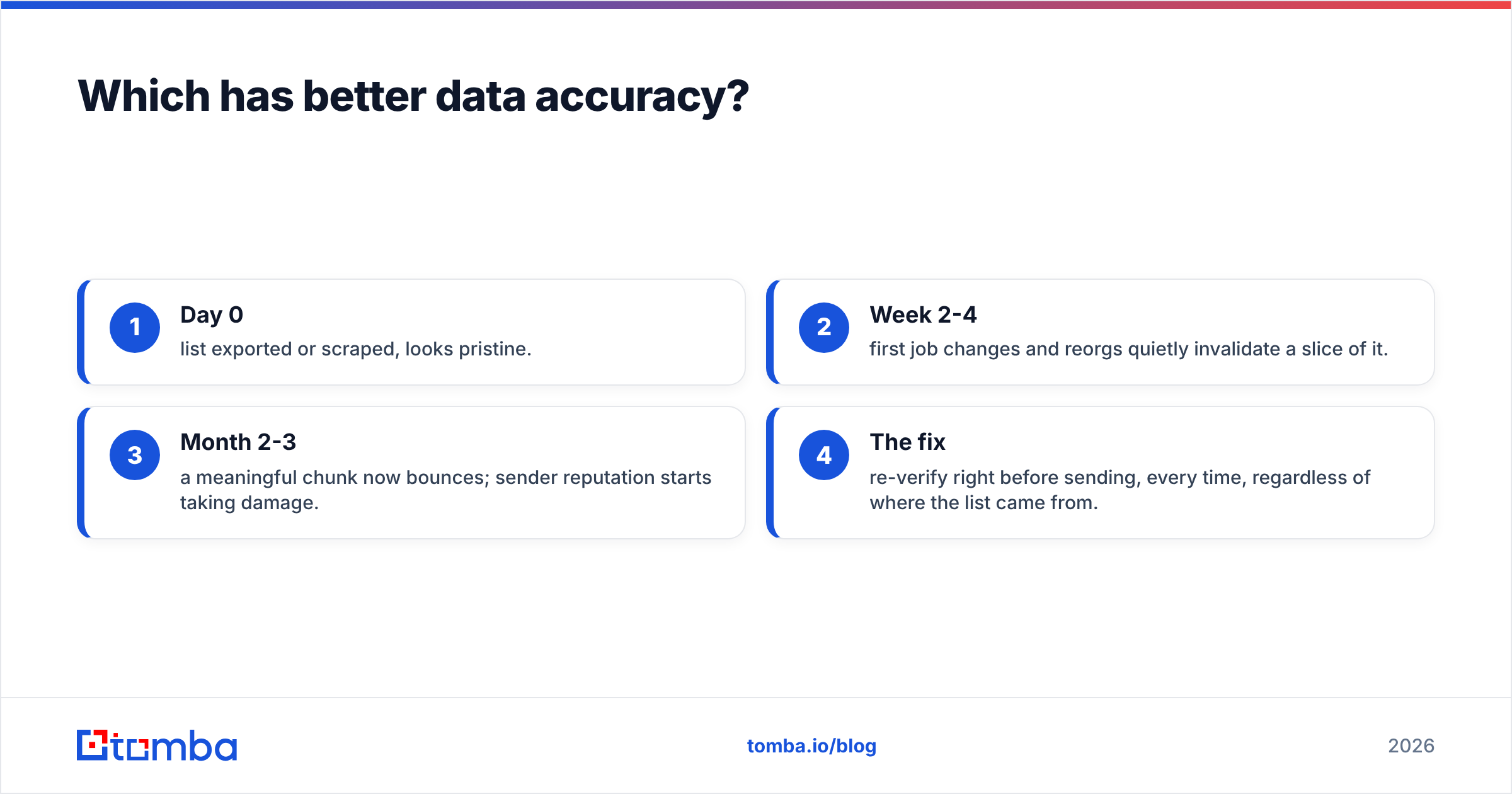
A simple rule of thumb for accuracy decay:
- Day 0 — list exported or scraped, looks pristine.
- Week 2-4 — first job changes and reorgs quietly invalidate a slice of it.
- Month 2-3 — a meaningful chunk now bounces; sender reputation starts taking damage.
- The fix — re-verify right before sending, every time, regardless of where the list came from.
Which is better for deliverability?#
Deliverability is where the choice actually bites, because it has less to do with the list and more to do with how you send.
Atompark's desktop senders put the deliverability burden on you. You are responsible for your domain's SPF record, DKIM, DMARC, IP reputation, and warmup. Done carefully, self-hosted sending works. Done carelessly — a fresh domain blasting thousands of cold emails on day one — it gets you blocklisted fast. Atompark gives you the gun; aiming it safely is your job.
Onemorelead is upstream of the sending problem. It hands you addresses; it does not send for you, so deliverability lands on whatever cold-email platform you load the list into. The risk it introduces is indirect: stale or mistargeted contacts produce bounces and spam complaints, and those two metrics are what mailbox providers watch most closely. A bad list will tank a perfectly warmed-up domain.
So neither tool is a deliverability solution on its own. The list quality and the sending hygiene are two separate gates, and you have to pass both. That is why teams increasingly decouple the steps: source contacts from a finder, scrub them through a verifier, then send through a platform built for warmup and inbox placement.
What about pricing?#
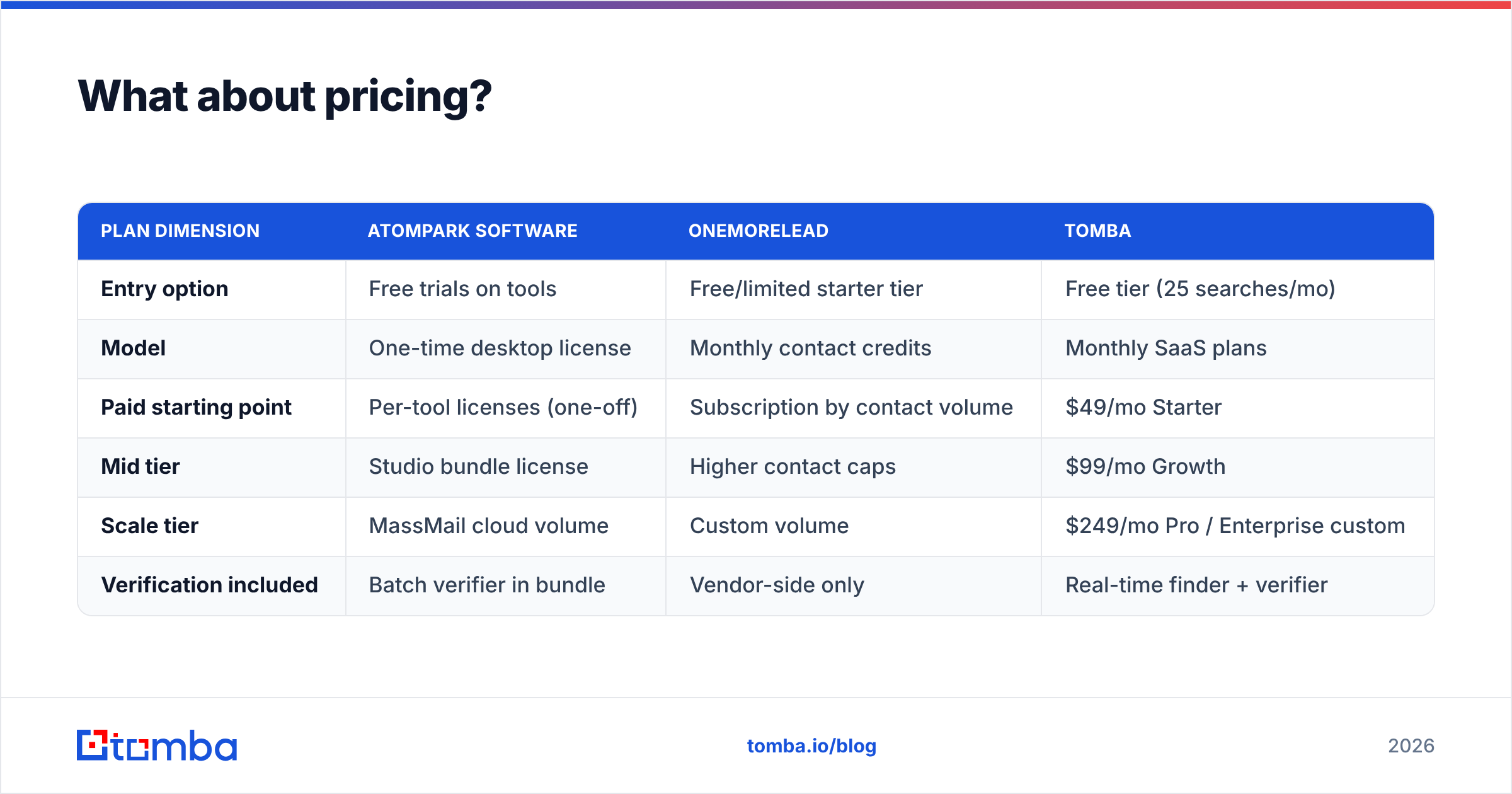
The pricing philosophies could not be more different, which makes a flat dollar comparison misleading.
| Plan dimension | Atompark Software | Onemorelead | Tomba |
|---|---|---|---|
| Entry option | Free trials on tools | Free/limited starter tier | Free tier (25 searches/mo) |
| Model | One-time desktop license | Monthly contact credits | Monthly SaaS plans |
| Paid starting point | Per-tool licenses (one-off) | Subscription by contact volume | $49/mo Starter |
| Mid tier | Studio bundle license | Higher contact caps | $99/mo Growth |
| Scale tier | MassMail cloud volume | Custom volume | $249/mo Pro / Enterprise custom |
| Verification included | Batch verifier in bundle | Vendor-side only | Real-time finder + verifier |
Atompark's one-time license appeals to anyone allergic to subscriptions — pay once, own the desktop tool. But "own it forever" also means you own the maintenance, the deliverability risk, and the aging UI. Onemorelead's credit model is predictable and cheap to start, but you are renting access to data whose value drops the moment you stop paying.
For a transparent monthly model that bundles finding and live verification, compare both against Tomba pricing: a free tier to test, then $49/mo Starter, $99/mo Growth, and $249/mo Pro. The point is not that one is universally cheapest — it is that you should price the whole workflow, not just the one tool you are looking at.
When should you pick each tool?#
Pick Atompark Software if you want perpetual desktop licenses, you are comfortable managing your own sending infrastructure, and you specifically need an on-page extractor plus a self-hosted blaster under one roof. It rewards technical, hands-on operators who value local control over convenience.
Pick Onemorelead if your bottleneck is simply getting a targeted list fast, you do not want to scrape anything, and you have a separate, well-warmed sending setup waiting for the contacts. It is a shortcut to volume, not a complete campaign engine.
Pick neither as your whole stack if accuracy at send time matters to you — which, for cold outbound in 2026, it should. Both tools leave the freshness gap open. You will still want a live finder and verifier in front of whatever you send.
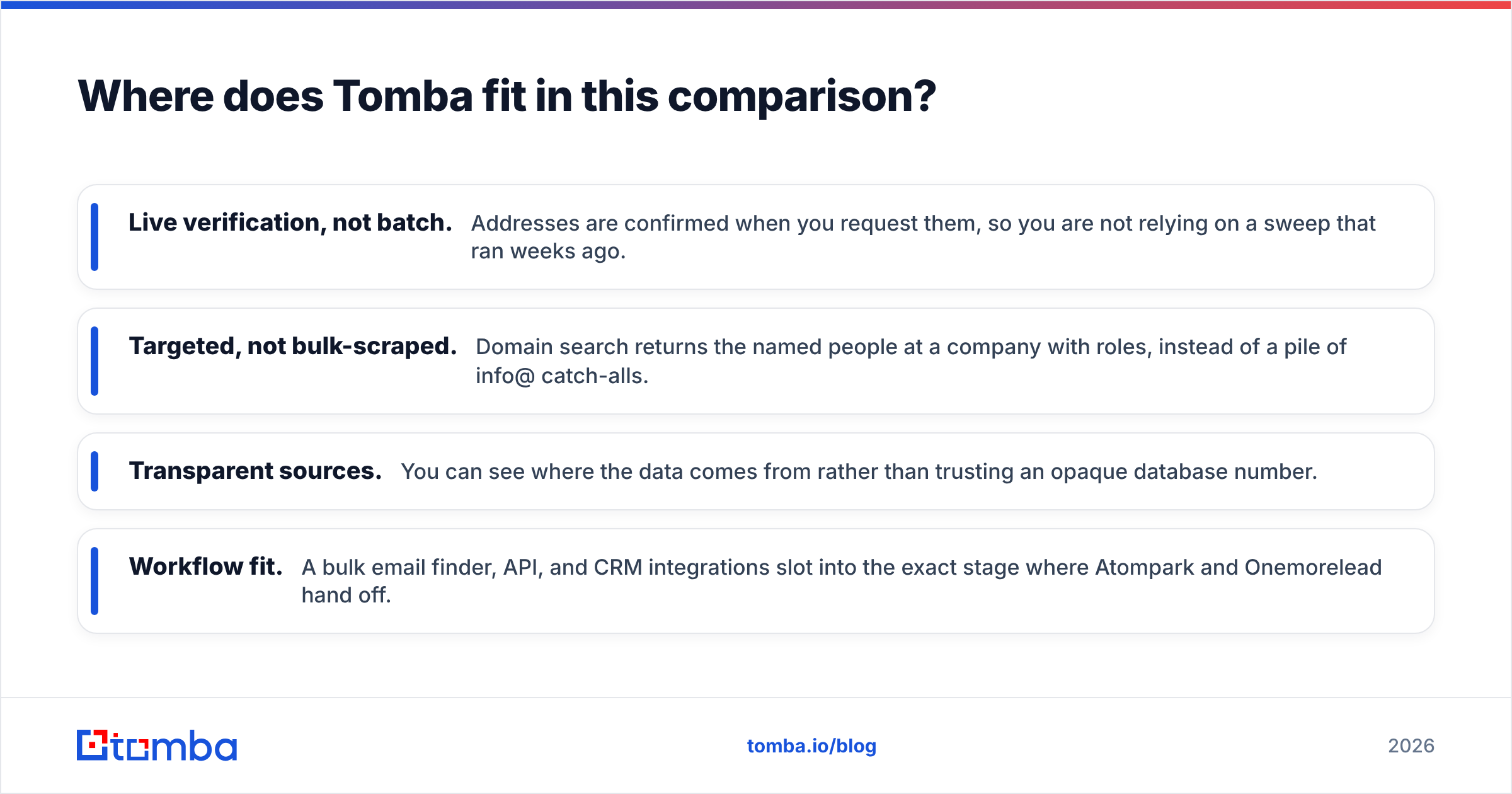
Where does Tomba fit in this comparison?#
Tomba sits at the accuracy layer that both Atompark and Onemorelead leave exposed. Rather than scraping blindly or selling a pre-aged list, the email finder locates the specific decision-maker's professional address by name, company, or domain — and verifies it against the mail server in the same pass.
A few concrete differences that matter for outbound quality:
- Live verification, not batch. Addresses are confirmed when you request them, so you are not relying on a sweep that ran weeks ago.
- Targeted, not bulk-scraped. Domain search returns the named people at a company with roles, instead of a pile of info@ catch-alls.
- Transparent sources. You can see where the data comes from rather than trusting an opaque database number.
- Workflow fit. A bulk email finder, API, and CRM integrations slot into the exact stage where Atompark and Onemorelead hand off.
None of this makes Atompark's extractor or Onemorelead's list inherently useless. It means the smart move is layering: source where it is convenient, then confirm before you commit your sender reputation to it.
The honest verdict#
Atompark Software and Onemorelead are not really competitors — they are different answers to different questions. Atompark is a DIY workshop for people who want to own their tools and run their own sending. Onemorelead is a convenience store for people who want a list now and will send it elsewhere. Both are legitimate; both share the same blind spot, which is that static data ages and neither verifies at the moment of truth.
If your outbound depends on reaching real, current decision-makers — and it does — close that gap with a tool built for it. Start free with the Tomba Email Finder: find the exact person, verify the address live, and load only clean contacts into whichever sending setup you prefer. Source fast or source DIY, but never send to a list you have not confirmed today.
// get started
Find, verify and enrich your first contacts today
Start on the free plan with 25 searches a month, then scale when your team is ready.
Free plan · No credit card required · GDPR & CCPA
// about the author