Atompark Software vs Pubrio: Which Tool Wins in 2026?
Atompark Software vs Pubrio go head-to-head: bulk email sending versus modern B2B lead intelligence. See features, pricing, and which fits your stack in 2026.
Choosing between Atompark Software and Pubrio feels like a fair fight until you look closely — and then you realize they barely play the same sport. One is a veteran desktop and bulk-email toolmaker. The other is a modern, AI-flavored B2B data and prospecting platform. Picking the "winner" depends entirely on whether your bottleneck is sending mail or finding the right people to send it to.
This guide breaks down both platforms on features, pricing, data quality, and real-world use cases, then shows where a dedicated data tool fits into the picture.
TL;DR#
- Atompark Software is best for high-volume bulk email and SMS sending. It is a mature, sender-side toolset (Atomic Mail Sender, MaxBulk-style workflows) aimed at marketers who already own a list.
- Pubrio is a newer B2B sales-intelligence platform: contact database, email finder, and enrichment built for prospecting teams that need new leads.
- They solve different problems — Atompark moves volume, Pubrio sources contacts. Comparing them one-to-one only makes sense if you're deciding which gap to fill first.
- Data quality and deliverability matter more than raw send volume. A clean, verified list beats a giant unverified one every time.
- For most B2B teams, the real answer is a find-and-verify layer first (so your sends actually land), then a sender that fits your volume.
What is Atompark Software?#
Atompark Software is a long-running software company best known for its bulk email and SMS sending tools. Its flagship products — desktop apps like Atomic Mail Sender and related mailing utilities — are built for marketers who need to push large volumes of messages through their own SMTP or a connected service.
The Atompark philosophy is classic email marketing: you bring the list, you build the message, the software handles the sending mechanics — personalization tokens, throttling, scheduling, and basic list management. It has historically appealed to small businesses, agencies, and solo operators who want a one-time-license desktop tool rather than a recurring SaaS subscription.
What Atompark is not is a prospecting or data-discovery engine. It assumes you already have email addresses. If your list is stale, scraped, or unverified, Atompark will happily send to all of it — bounces and spam complaints included. That's the core limitation: it's a powerful megaphone with no opinion about who's standing in the crowd.

What is Pubrio?#
Pubrio sits on the opposite end of the workflow. It's a B2B sales-intelligence and lead-generation platform — a searchable contact and company database with an email finder, filters for building targeted lists, and data enrichment to fill in missing fields. The pitch is modern and AI-forward: describe your ideal customer, and Pubrio surfaces matching contacts with work emails attached.
For sales and growth teams, that's the part of the funnel Atompark ignores entirely. Pubrio is about acquisition — turning a target market definition into an actionable list of named people with reachable contact details. It competes more directly with tools like Apollo, RocketReach, and other database-plus-finder platforms than with a bulk sender.
The trade-off: Pubrio is a data subscription. Database coverage, email accuracy, and how aggressively credits are metered are the variables that decide whether it's worth the money for your specific market.
Atompark Software vs Pubrio: how do they compare?#
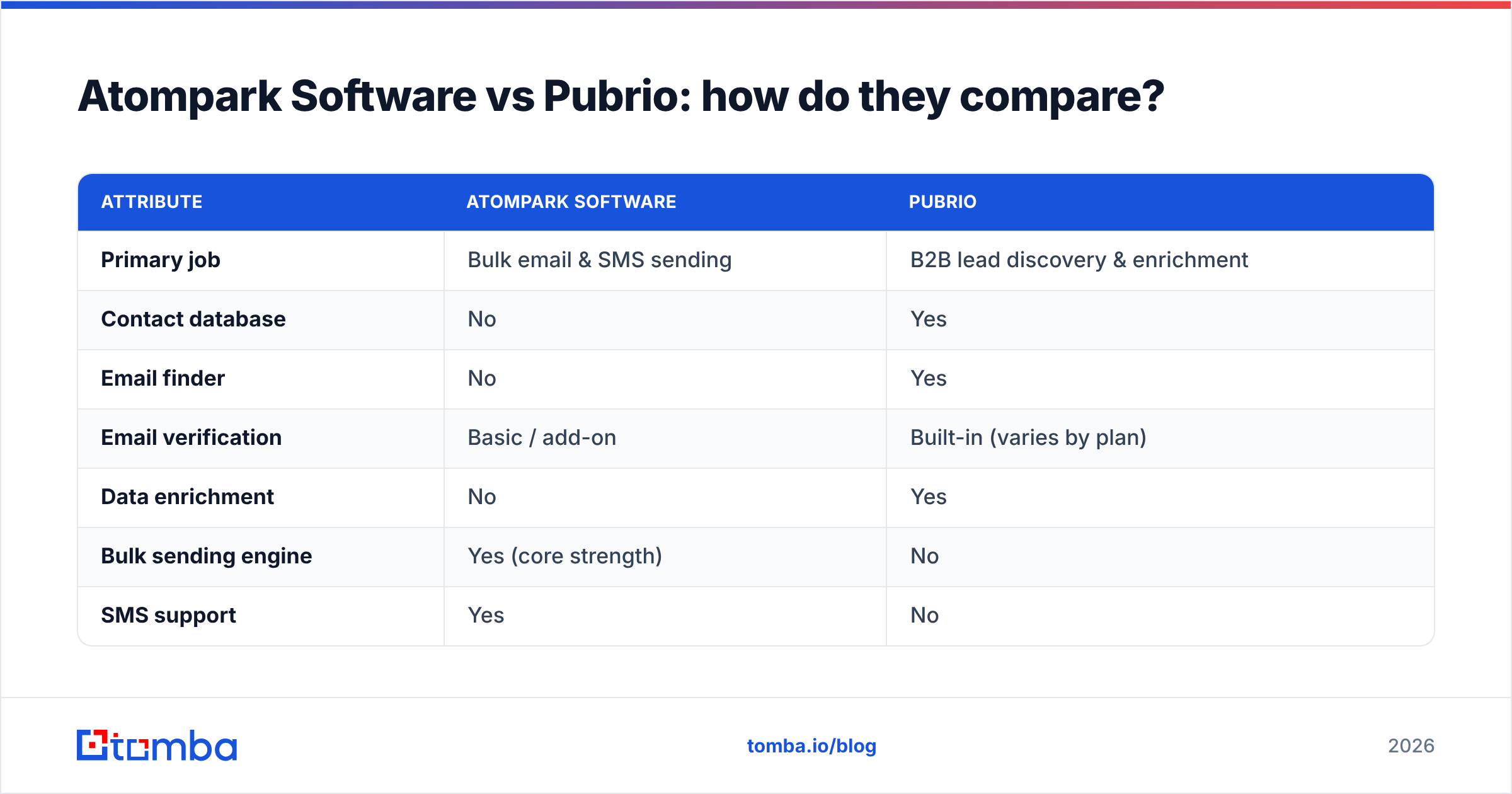
Here's the head-to-head on the attributes that actually drive a buying decision. Note that several rows are "not applicable" — that's the whole point. These tools occupy different stages of the outbound workflow.
| Attribute | Atompark Software | Pubrio |
|---|---|---|
| Primary job | Bulk email & SMS sending | B2B lead discovery & enrichment |
| Contact database | No | Yes |
| Email finder | No | Yes |
| Email verification | Basic / add-on | Built-in (varies by plan) |
| Data enrichment | No | Yes |
| Bulk sending engine | Yes (core strength) | No |
| SMS support | Yes | No |
| Pricing model | License / one-time-leaning | SaaS subscription + credits |
| Best for | List owners sending at volume | Teams sourcing new prospects |
| Weak spot | No data sourcing or hygiene | No native sending engine |
The table makes the verdict obvious: if you ask "which is better?" without context, you get a useless answer. The honest framing is which gap is costing you more revenue right now — empty pipeline (Pubrio's domain) or inefficient sending (Atompark's domain).
Which one fits your use case?#
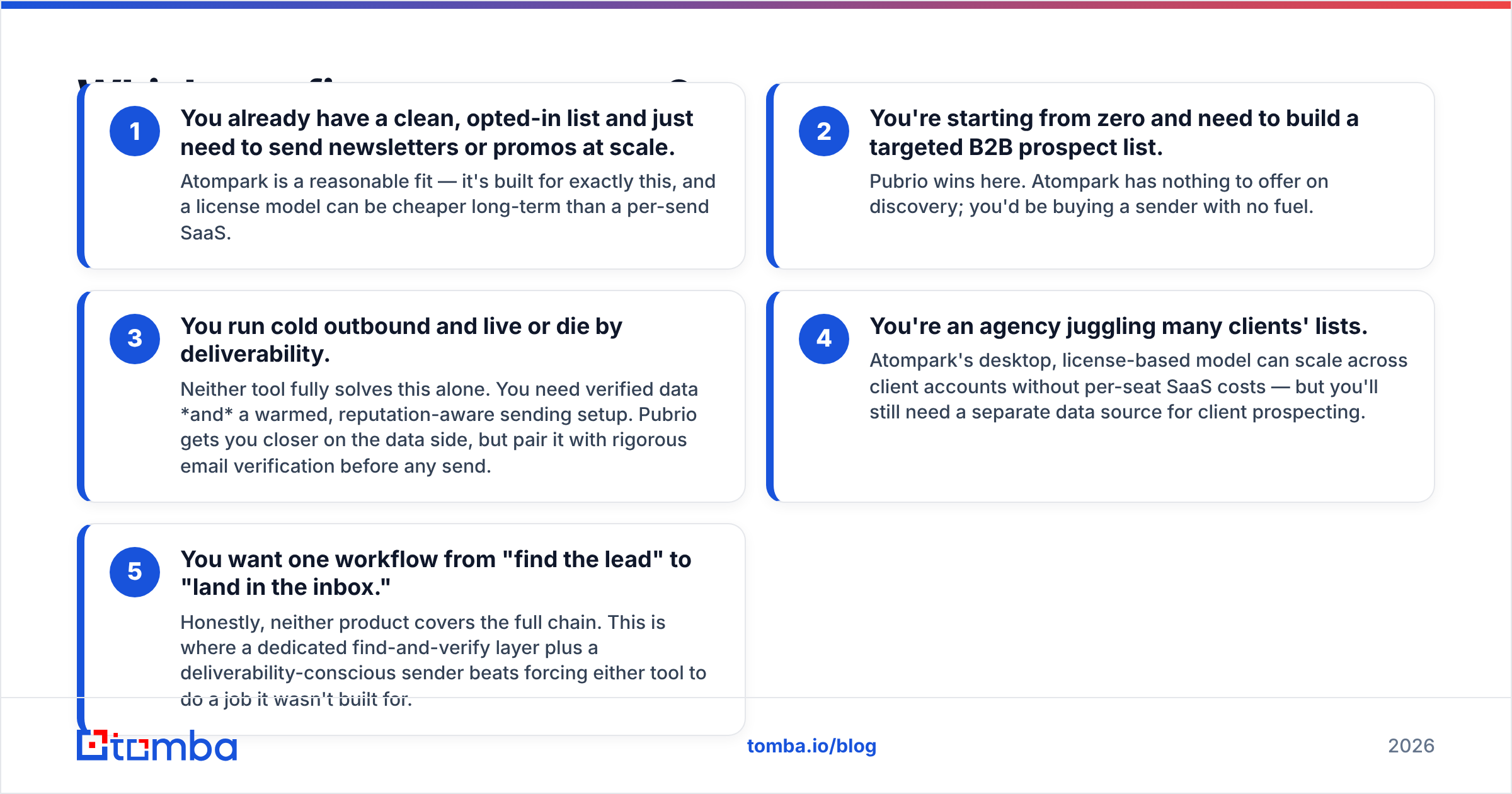
Use these five scenarios to map your situation to the right tool. The bold lead tells you which way to lean.
You already have a clean, opted-in list and just need to send newsletters or promos at scale. Atompark is a reasonable fit — it's built for exactly this, and a license model can be cheaper long-term than a per-send SaaS.
You're starting from zero and need to build a targeted B2B prospect list. Pubrio wins here. Atompark has nothing to offer on discovery; you'd be buying a sender with no fuel.
You run cold outbound and live or die by deliverability. Neither tool fully solves this alone. You need verified data and a warmed, reputation-aware sending setup. Pubrio gets you closer on the data side, but pair it with rigorous email verification before any send.
You're an agency juggling many clients' lists. Atompark's desktop, license-based model can scale across client accounts without per-seat SaaS costs — but you'll still need a separate data source for client prospecting.
You want one workflow from "find the lead" to "land in the inbox." Honestly, neither product covers the full chain. This is where a dedicated find-and-verify layer plus a deliverability-conscious sender beats forcing either tool to do a job it wasn't built for.
The pattern across all five: data quality is the hinge. A bulk sender amplifies whatever list you feed it, and a lead database is only as good as its email accuracy.
Is bulk volume or data quality more important?#
Data quality wins, and it isn't close. This is the single most common mistake in outbound: teams obsess over send volume and ignore list hygiene, then wonder why their open rates crater and their domain lands on a blocklist.
Here's the mechanism in plain terms. Mailbox providers like Gmail and Outlook watch your bounce rate and spam-complaint rate. According to widely cited industry guidance from sources like HubSpot's email deliverability research, a sender reputation damaged by high bounces can quietly route even your good mail to spam. So a giant unverified list sent through a powerful tool like Atompark isn't an advantage — it's a liability that compounds.
A smaller, verified list does three things a bloated one can't:
- Protects your sender reputation by keeping bounces near zero.
- Improves engagement metrics because you're reaching real, relevant people.
- Saves money — you're not burning send capacity or data credits on dead addresses.
This is exactly why a verification and enrichment step belongs between finding contacts and sending to them. Pubrio handles part of this; a specialized verifier or data enrichment pass handles the rest.

What does each platform cost?#
Pricing is where the two diverge in philosophy as much as numbers. Atompark has historically leaned toward one-time desktop licenses (with paid upgrades), which can look cheaper over a multi-year horizon if your needs are stable. Pubrio, like most modern data platforms, runs on tiered SaaS subscriptions with credit-based metering for lookups and enrichment.
Because both vendors adjust pricing over time, always confirm current numbers on the official sites — Atompark's homepage and Pubrio's plans page — rather than trusting any third-party figure, including this one. Cross-check buyer reviews on G2 to see how real users describe value and hidden costs.
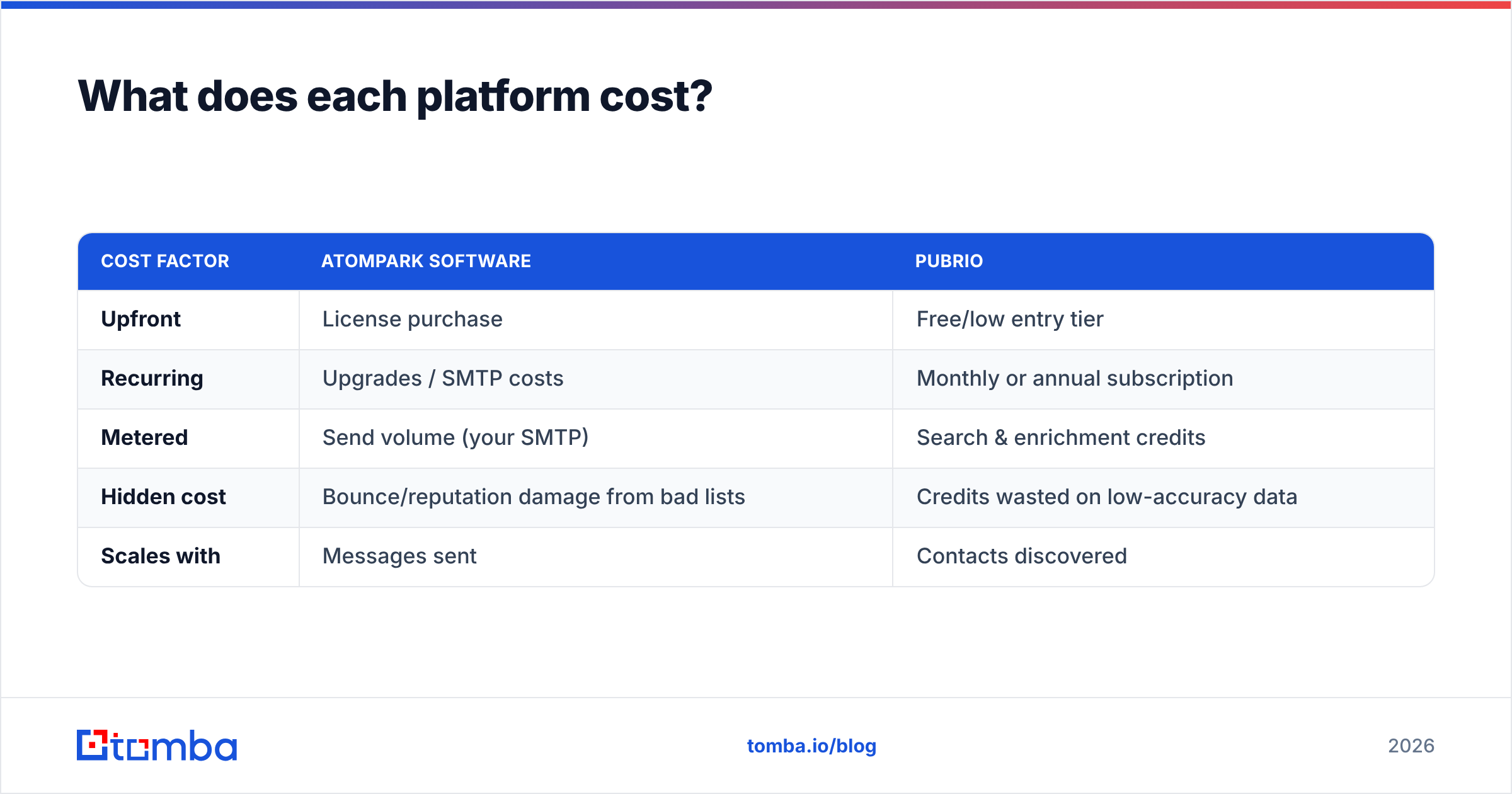
A rough way to think about total cost of ownership:
| Cost factor | Atompark Software | Pubrio |
|---|---|---|
| Upfront | License purchase | Free/low entry tier |
| Recurring | Upgrades / SMTP costs | Monthly or annual subscription |
| Metered | Send volume (your SMTP) | Search & enrichment credits |
| Hidden cost | Bounce/reputation damage from bad lists | Credits wasted on low-accuracy data |
| Scales with | Messages sent | Contacts discovered |
The "hidden cost" row is the one buyers underestimate. With Atompark, a bad list silently destroys deliverability. With any data platform, low email accuracy means you pay credits for contacts you can never actually reach. Both failure modes trace back to the same root cause: unverified data.
Where does a dedicated email finder fit in?#
Right in the gap neither tool fully owns. Whether you choose Atompark, Pubrio, or both, you still need a reliable way to find correct professional emails and verify them before they hit a sending queue. That's a specialized job, and general-purpose platforms tend to treat it as a feature rather than a focus.
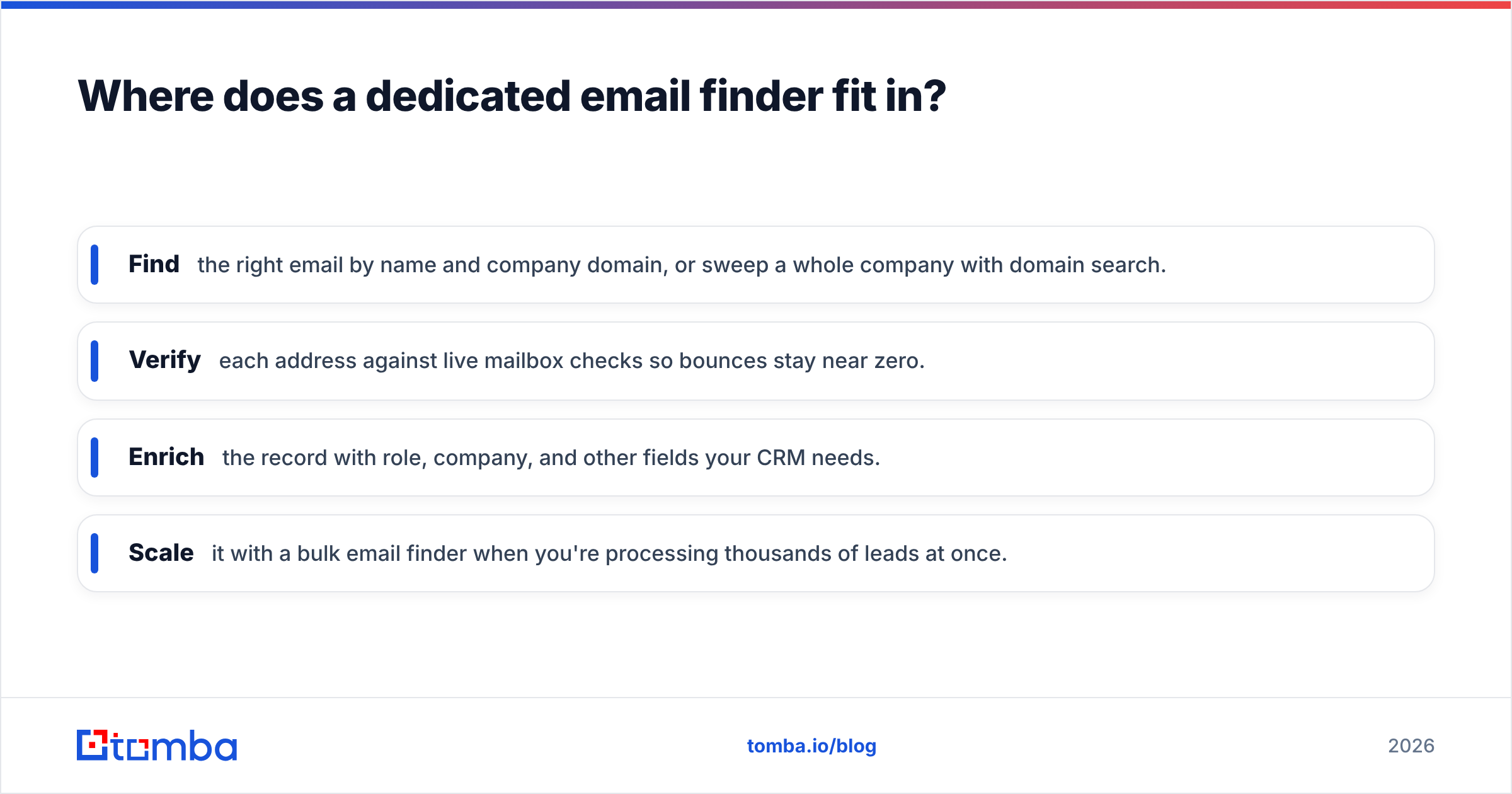
A focused tool like the Tomba Email Finder approaches the problem from the data-accuracy angle first. Instead of handing you a giant list and hoping, the workflow is:
- Find the right email by name and company domain, or sweep a whole company with domain search.
- Verify each address against live mailbox checks so bounces stay near zero.
- Enrich the record with role, company, and other fields your CRM needs.
- Scale it with a bulk email finder when you're processing thousands of leads at once.
This is the layer that makes everything downstream work. Feed verified addresses into Atompark and your bulk sends stop poisoning your reputation. Feed them alongside Pubrio's database and you close the accuracy gaps that credits-based platforms inevitably leave. For teams that want to wire it into existing systems, an API-first approach keeps the data clean at the source rather than cleaning up after a bad send.
The point isn't that you must replace either platform. It's that the find-and-verify step is non-negotiable, and treating it as a first-class part of the workflow — not an afterthought — is what separates outbound programs that scale from ones that flame out.
So, Atompark Software or Pubrio?#
The honest verdict: buy for the gap you actually have.
- If your problem is sending — you own a clean list and need volume, scheduling, and SMS — Atompark is the more direct fit, and its license model can be economical.
- If your problem is sourcing — you need new, targeted B2B contacts with emails attached — Pubrio is the right category of tool, and Atompark won't help at all.
- If your problem is both (and for most growing teams, it is), don't force one product to do two jobs. Pair a discovery tool with a sender, and put a verification layer between them.
Neither platform is a scam or a mistake; they're just answers to different questions. The teams that win in 2026 are the ones that stop arguing about senders versus databases and start protecting the one asset both depend on: accurate, verified contact data.
Get the data layer right first#
Before you commit to Atompark for volume or Pubrio for discovery, fix the foundation. Use the Tomba Email Finder to find and verify professional emails so every contact you load — into a bulk sender, a CRM, or a sequencer — is real and reachable. Start free with 25 searches a month, then scale on the Starter plan at $49/mo as your pipeline grows. Check current Tomba pricing for the full breakdown. Clean data in means landed mail out — and that's the part no bulk sender or database can fake for you.
Ready to find emails that actually work?
Join 150,000+ professionals who stopped guessing and started sending. Free credits on signup — no credit card required.
Get the Tomba newsletter
Practical outbound tactics and product updates — once every two weeks.
About the author