Atompark Software vs Sparklane: B2B Tools Compared 2026
Atompark Software vs Sparklane — one sends bulk email, the other scores B2B leads. See which fits your pipeline in 2026, and where both leave a data gap.
Atompark Software and Sparklane get lumped together in "B2B outreach tool" searches, but they solve opposite halves of the problem. One blasts email at scale. The other tells you who to email in the first place. Picking between them without knowing that difference is how teams waste a budget cycle.
TL;DR#
- Atompark Software is a bulk-email and mass-mailing toolkit (Atomic Mail Sender, Email Studio). It's a sending engine, not a data provider.
- Sparklane is a French B2B predictive lead-generation and sales-intelligence platform. It scores accounts and surfaces buying signals — it does not send your campaigns.
- They are complements, not true competitors. Choosing one over the other only makes sense if you already have the other half covered.
- Neither tool is built to find and verify individual professional email addresses on demand — that's the gap a dedicated email finder fills.
- For most 2026 outbound teams, the winning stack is accurate contact data first, then a sender or an intelligence layer on top.
What is Atompark Software?#
Atompark Software is a long-running vendor of desktop and cloud email-marketing utilities. Its best-known products are Atomic Mail Sender and Atomic Email Studio — Windows applications that let you build mailing lists, design HTML emails, and push large send volumes from your own SMTP or theirs.
Think of Atompark as the printing press of your outreach. It will produce and ship enormous volumes of identical material fast. What it will not do is tell you whether the addresses on your list are real, reachable, or worth contacting. The quality of what comes out depends entirely on the quality of the list you feed in.
That model made sense a decade ago when buying a list and blasting it was tolerated. In 2026, mailbox providers punish that pattern hard. Send to stale or unverified addresses and your bounce rate spikes, your sender reputation tanks, and even your good emails land in spam.

What is Sparklane?#
Sparklane is a European sales-intelligence platform focused on predictive lead generation. It ingests company-level signals — hiring, funding, leadership changes, technology adoption — and recommends which accounts your reps should prioritize. Its strength is account selection and timing, not message delivery.
Sparklane answers "who should I talk to and why now?" It is closer to a research analyst than a mail server. You still need a way to reach the people it points you toward, and you still need a tool to actually run the campaign.
So the honest framing of Atompark Software vs Sparklane is not "which is better." It's "which problem do you have right now?" — distribution or targeting.
Atompark Software vs Sparklane: side-by-side comparison#
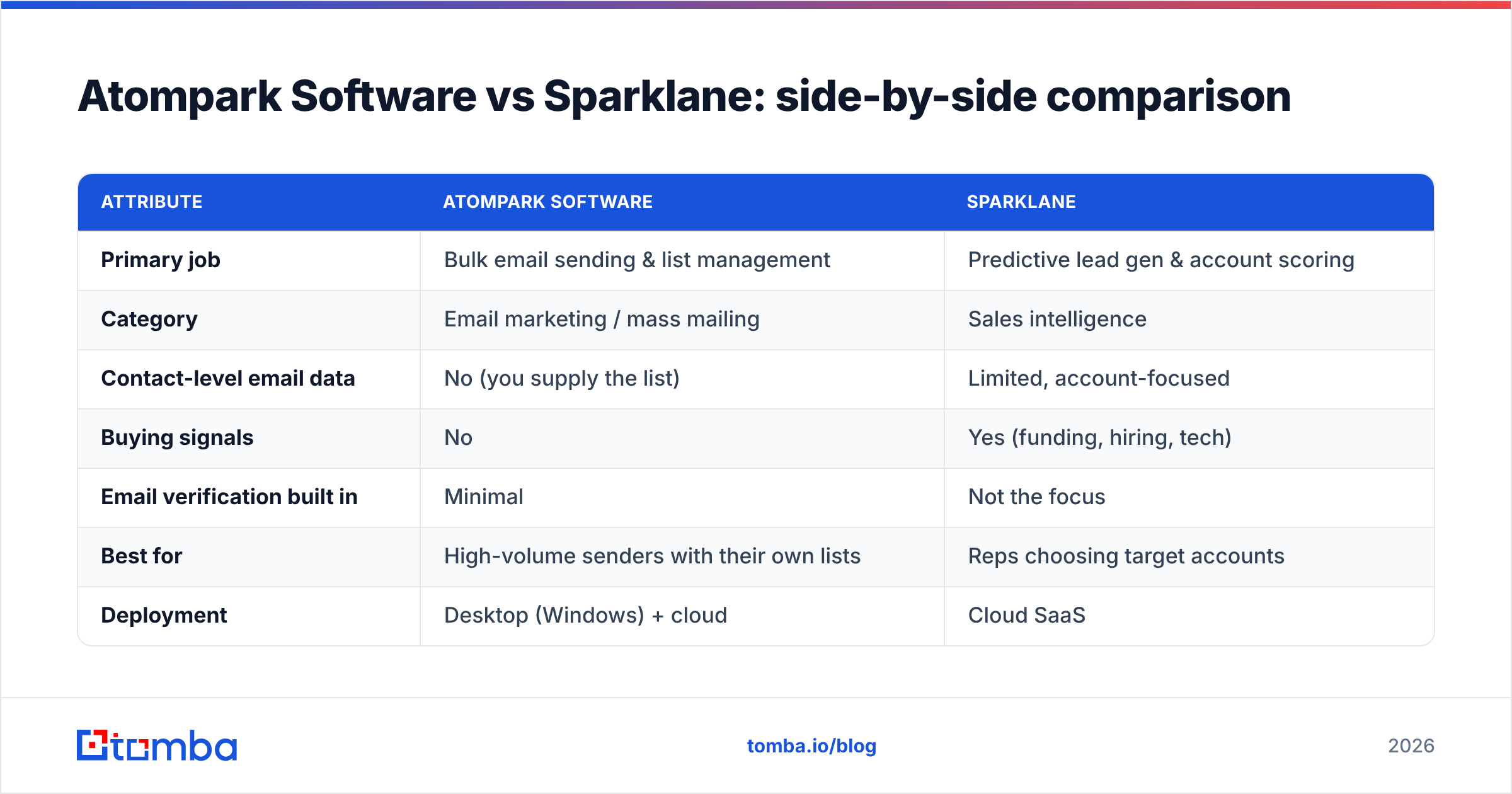
Here's the core breakdown across the dimensions that actually change a buying decision.
| Attribute | Atompark Software | Sparklane |
|---|---|---|
| Primary job | Bulk email sending & list management | Predictive lead gen & account scoring |
| Category | Email marketing / mass mailing | Sales intelligence |
| Contact-level email data | No (you supply the list) | Limited, account-focused |
| Buying signals | No | Yes (funding, hiring, tech) |
| Email verification built in | Minimal | Not the focus |
| Best for | High-volume senders with their own lists | Reps choosing target accounts |
| Deployment | Desktop (Windows) + cloud | Cloud SaaS |
| Typical buyer | SMB marketers | Mid-market B2B sales teams |
| Pricing model | One-time license / tiered | Quote-based subscription |
| Region strength | Global / Eastern Europe roots | France & EU |
The table makes the split obvious: these tools barely overlap. Atompark owns the send. Sparklane owns the select. Neither owns the find-and-verify-the-actual-person step in the middle — and that step is where most cold campaigns silently fail.
Which one is better for B2B outreach in 2026?#
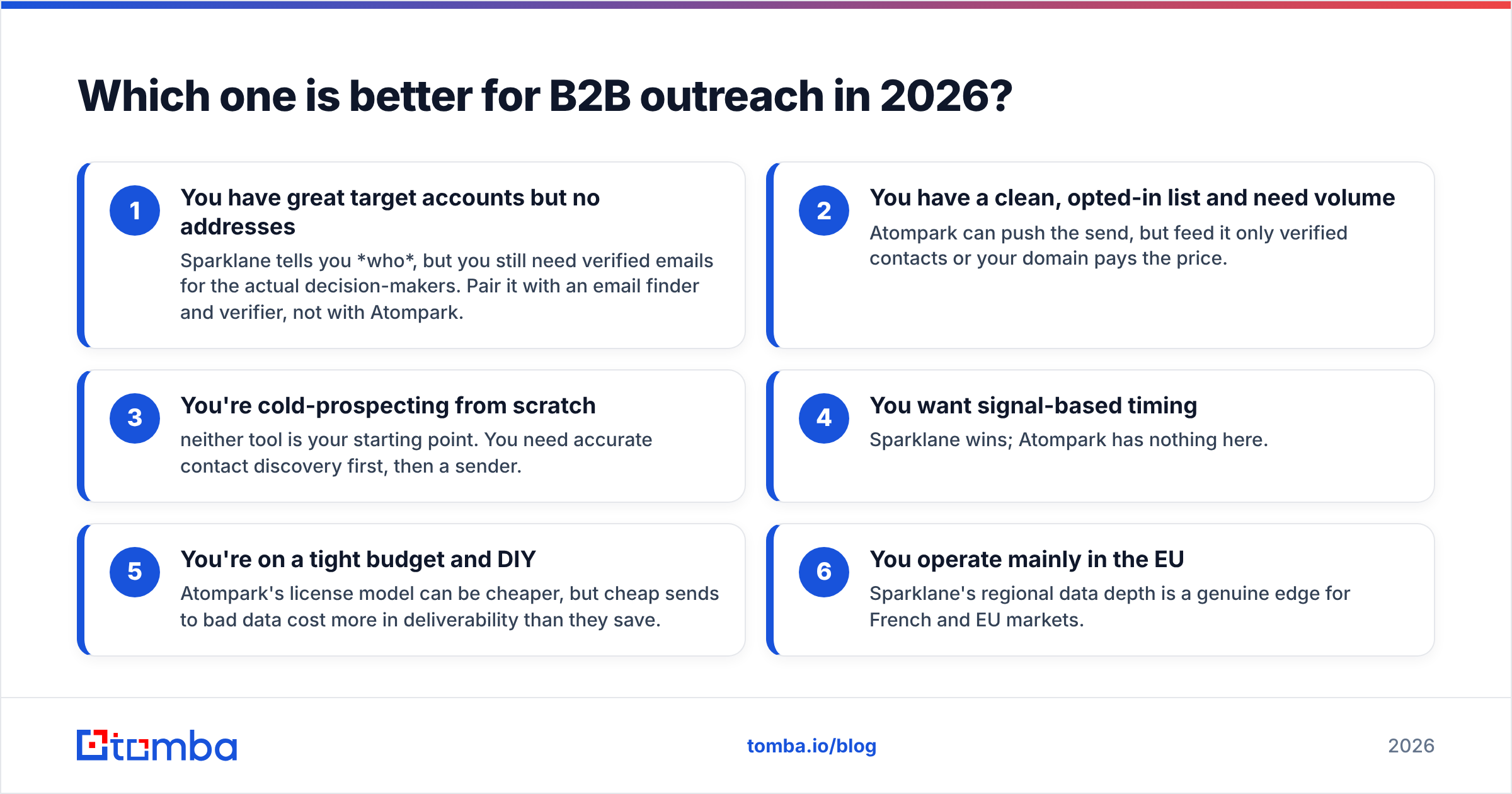
Short answer: it depends on what's already broken in your funnel. Use this decision logic.
- You have great target accounts but no addresses — Sparklane tells you who, but you still need verified emails for the actual decision-makers. Pair it with an email finder and verifier, not with Atompark.
- You have a clean, opted-in list and need volume — Atompark can push the send, but feed it only verified contacts or your domain pays the price.
- You're cold-prospecting from scratch — neither tool is your starting point. You need accurate contact discovery first, then a sender.
- You want signal-based timing — Sparklane wins; Atompark has nothing here.
- You're on a tight budget and DIY — Atompark's license model can be cheaper, but cheap sends to bad data cost more in deliverability than they save.
- You operate mainly in the EU — Sparklane's regional data depth is a genuine edge for French and EU markets.
Notice that four of those six paths route through a data problem that neither product solves well. That's not an accident of this comparison — it's the structural gap in the "sender vs intelligence" framing.
Where both tools fall short — the data gap#
Both Atompark and Sparklane assume you already have, or can easily get, accurate contact-level data. In practice that assumption is where pipelines leak.
A bulk sender amplifies whatever list you give it. Garbage in, garbage out — at scale, instantly, to your reputation. A sales-intelligence tool points you at accounts but rarely hands you the verified personal email of the VP you actually need to reach. You're left manually guessing formats, which is slow and error-prone.
This is exactly the job a dedicated email-finding stack does. Tools like Tomba's domain search return every discoverable address pattern at a company, and a verifier confirms which ones are deliverable before you ever load them into a sender. The result is a list that raises deliverability instead of eroding it.

How does Tomba fit alongside Atompark or Sparklane?#
Tomba isn't a bulk sender and isn't a predictive-scoring engine, so it competes with neither directly. It fills the middle layer both of them assume away: turning a company or a name into a verified, deliverable email address.
A realistic 2026 stack looks like this:
- Targeting — Sparklane (or your CRM signals) decides which accounts matter.
- Contact discovery — Tomba's email finder and bulk email finder turn those accounts into verified contacts.
- Verification — Tomba's email verifier strips out risky and catch-all addresses before send.
- Sending — Atompark (or any ESP) delivers the campaign to a clean list.
Each layer does one job well. The mistake is asking a sender to be a data source, or asking an intelligence tool to be a contact database.
Pricing snapshot#
Pricing models differ enough that a straight per-seat comparison misleads, so here's the shape of each.
| Tier | Atompark | Sparklane | Tomba |
|---|---|---|---|
| Entry | License / low monthly | Quote-based | Free — 25 searches/mo |
| Mid | Volume-based add-ons | Custom subscription | Starter $49/mo, Growth $99/mo |
| High | Higher send caps | Enterprise quote | Pro $249/mo |
| Custom | Yes | Yes (default model) | Enterprise custom |
| Free option | Trial | No public free tier | Yes (25/mo) |
Atompark leans toward a license/volume model, Sparklane sells almost entirely by quote, and Tomba publishes transparent tiers — see full Tomba pricing for current limits. If predictable, low-commitment cost matters, a published-tier tool is easier to budget than a quote-only platform.
Pros and cons#
Atompark Software
- Pros: handles very high send volumes, desktop control, one-time license option, mature feature set for HTML email building.
- Cons: no contact data, weak built-in verification, Windows-centric, easy to damage email deliverability if your list isn't clean, dated UX.
Sparklane
- Pros: strong predictive signals, excellent EU/France account data, good for prioritization and timing, account-level enrichment.
- Cons: quote-only pricing, not a sending tool, limited person-level email discovery, less useful outside core European markets.
The shared weakness: both push the burden of accurate, verified, person-level contact data back onto you. Solve that first and either tool performs far better.
When should you pick which?#
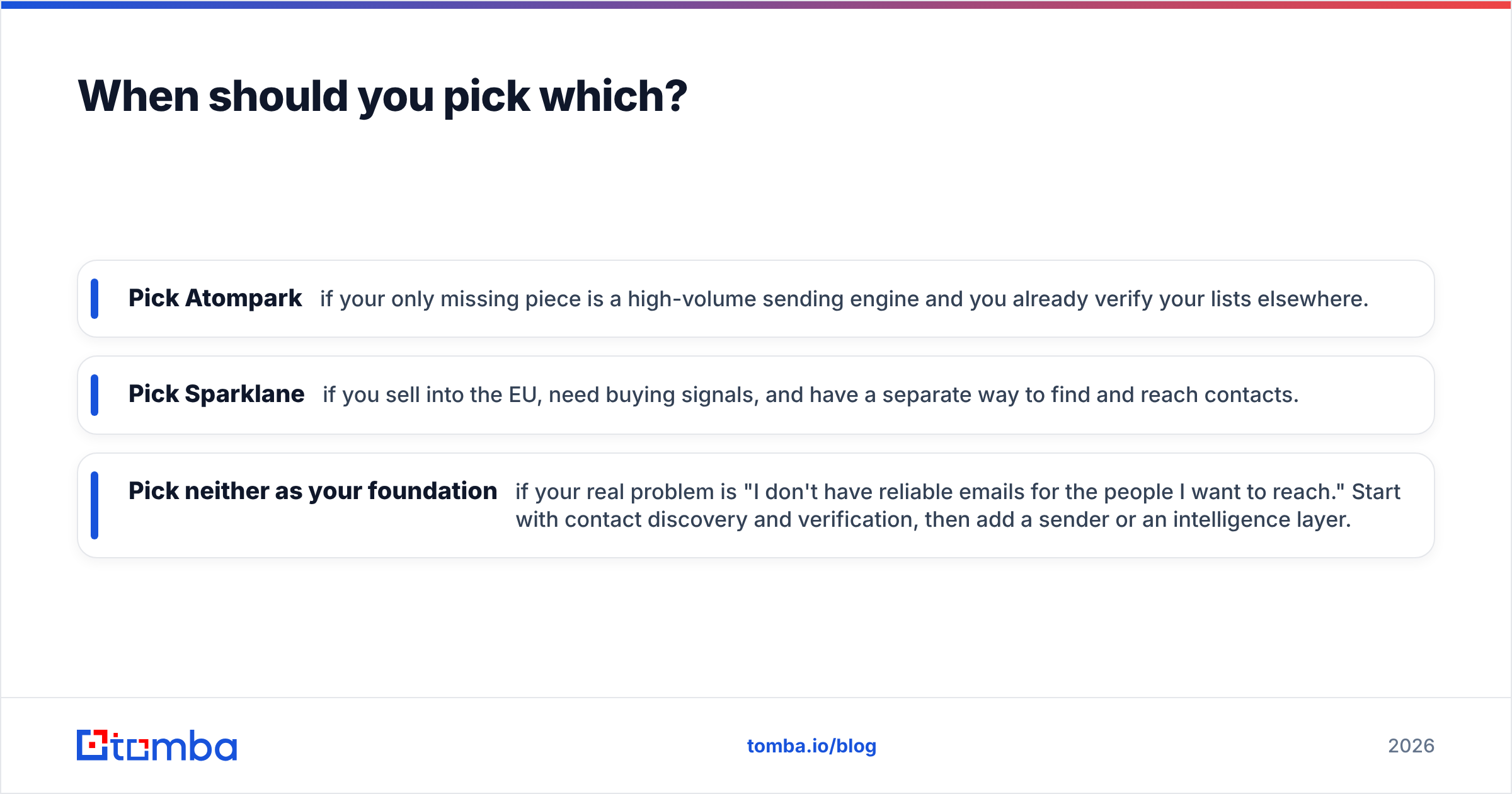
- Pick Atompark if your only missing piece is a high-volume sending engine and you already verify your lists elsewhere.
- Pick Sparklane if you sell into the EU, need buying signals, and have a separate way to find and reach contacts.
- Pick neither as your foundation if your real problem is "I don't have reliable emails for the people I want to reach." Start with contact discovery and verification, then add a sender or an intelligence layer.
For evaluating data-first options, independent review sites like G2 and Capterra are worth a scan — filter by verified-buyer reviews rather than star averages, which inflate easily. For deliverability fundamentals, vendor docs from established players like HubSpot cover list hygiene well.
How to build the stack that actually converts#
The pattern that wins in 2026 is unglamorous: clean data first, then volume. A smaller list of verified, well-targeted contacts beats a massive list of guesses every time — better reply rates, lower bounce rates, and a sender reputation that keeps you in the inbox.
If you're comparing Atompark Software vs Sparklane and feeling like neither quite closes the loop, that instinct is correct. Plug the data gap before you spend on either.
Start with the Tomba Email Finder to turn your target accounts into verified, deliverable contacts — free for your first 25 searches, no card required. Feed that clean list into your sender or layer it under your intelligence tool, and watch the same campaigns perform like they were built on better data. Because they were.
// get started
Find, verify and enrich your first contacts today
Start on the free plan with 25 searches a month, then scale when your team is ready.
Free plan · No credit card required · GDPR & CCPA
// about the author