Please Find Attached: Smarter Email Alternatives for 2026
Still typing "please find attached" on every email? Here are 20+ modern, natural alternatives, real examples, and a tone-matched cheat sheet for 2026.
You open a new email, attach the file, and your fingers type it automatically: "Please find attached." It feels safe, professional, and final. It is also the phrasing equivalent of a beige waiting room — nobody complains, but nobody remembers it either.
This guide breaks down what the "attached find" construction really means, whether it still belongs in your 2026 emails, and exactly what to write instead depending on who you're emailing and why.
TL;DR#
- "Please find attached" is grammatically fine but stylistically tired — it's a holdover from formal letter-writing that survives mostly out of habit.
- Lead with the attachment's value, not the verb. "I've attached the Q3 report so you can review the revenue split" beats "Please find attached the Q3 report."
- Match the phrase to the relationship. Cold prospects, internal teammates, and executives each need a different register.
- The biggest attachment mistake isn't the wording — it's sending to the wrong or unverified address, so the file never gets read.
- Use the tone-matched table below as a copy-paste cheat sheet for formal, neutral, and casual contexts.
What does "please find attached" actually mean?#
"Please find attached" is a fixed business phrase that signals: there is a file with this email, go look at it. The "find" doesn't literally ask the reader to search — it's a leftover from formal correspondence where "find enclosed" meant "discover, included with this letter, the document I'm referencing."
The "attached find" inversion ("Attached please find the invoice") is even older and more stilted. It reads like a 1950s memo, which is exactly why it sticks around in legal, finance, and government email where formality is the default. According to Grammarly, the phrase isn't incorrect — it's simply more formal and less natural than how people actually talk.
The problem is not grammar. The problem is that the phrase does zero work. It tells the reader a file exists (they can already see the paperclip icon) but says nothing about why they should open it or what to do next.
)
Is "please find attached" outdated in 2026?#
Short answer: it's not wrong, but it's lazy. In 2026, email is more skimmed than read. Recipients decide in under two seconds whether an attachment is worth a click. A phrase that adds no context is a wasted opportunity.
Here's the practical test. Compare these two openers:
- "Please find attached the proposal." → The reader has to open the file to learn anything.
- "I've attached the proposal — the pricing you asked about is on page two." → The reader already knows the file is relevant and where to look.
The second version respects the reader's time and increases the odds they actually engage. That's the whole game. HubSpot's research on email etiquette consistently shows that specificity and reader-focused phrasing outperform formulaic openers.
When is the old phrase still acceptable? In genuinely formal contexts — a legal filing, a contract transmittal, a regulatory submission — "Please find attached" matches the register and nobody blinks. Everywhere else, you have better options.
What can you say instead of "please find attached"?#
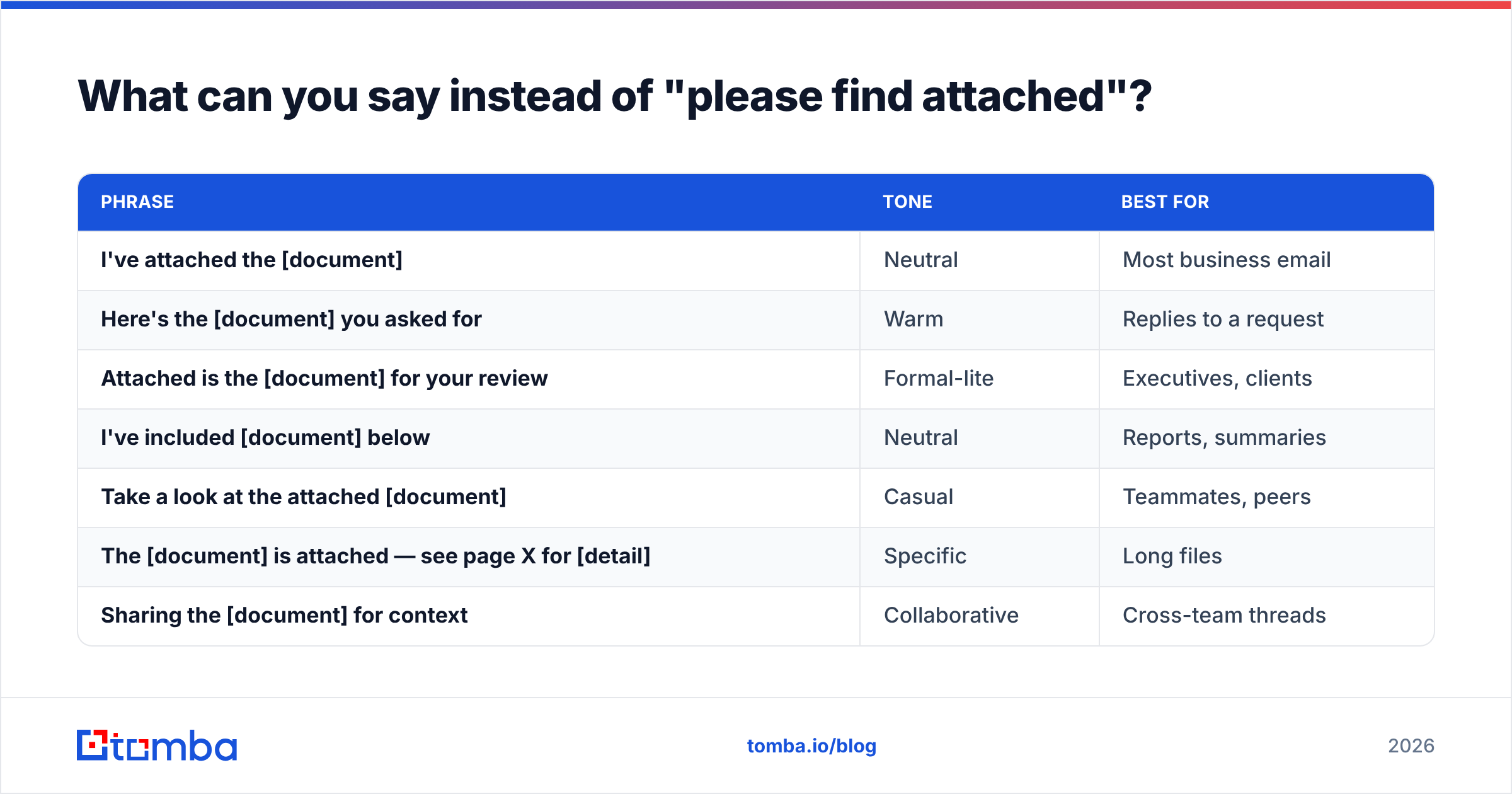
Here are the alternatives that actually sound like a human wrote them, grouped by tone. Pick based on your relationship with the recipient.
| Phrase | Tone | Best for |
|---|---|---|
| I've attached the [document] | Neutral | Most business email |
| Here's the [document] you asked for | Warm | Replies to a request |
| Attached is the [document] for your review | Formal-lite | Executives, clients |
| I've included [document] below | Neutral | Reports, summaries |
| Take a look at the attached [document] | Casual | Teammates, peers |
| The [document] is attached — see page X for [detail] | Specific | Long files |
| Sharing the [document] for context | Collaborative | Cross-team threads |
| Please find attached the [document] | Formal | Legal, finance, gov |
The pattern across the strong options: name the document, then add a reason to open it. The phrasing is just the wrapper — the value sits in the specificity.
How do you mention an attachment without sounding robotic?#
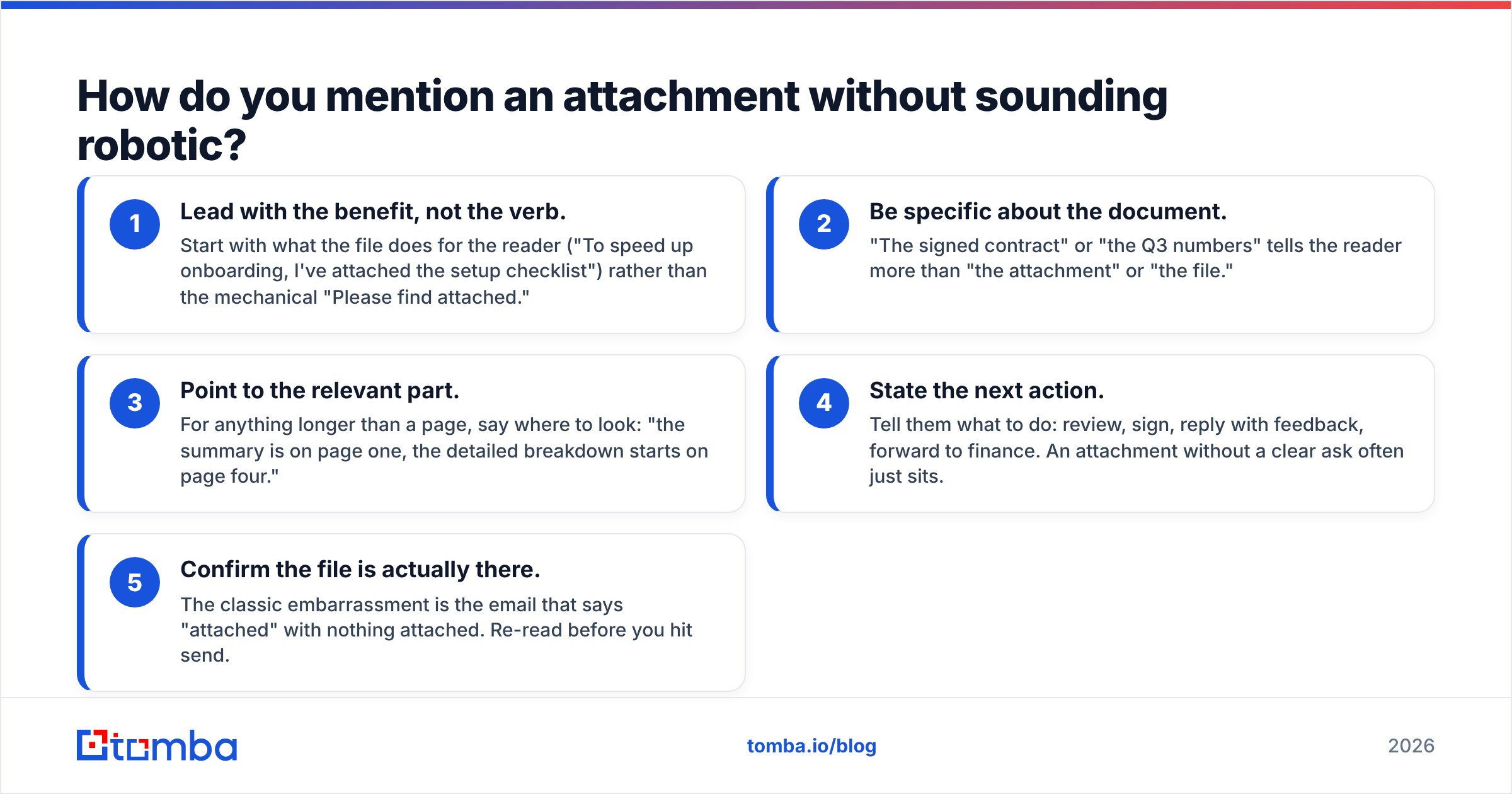
Follow these five moves and your attachment lines will read naturally every time:
- Lead with the benefit, not the verb. Start with what the file does for the reader ("To speed up onboarding, I've attached the setup checklist") rather than the mechanical "Please find attached."
- Be specific about the document. "The signed contract" or "the Q3 numbers" tells the reader more than "the attachment" or "the file."
- Point to the relevant part. For anything longer than a page, say where to look: "the summary is on page one, the detailed breakdown starts on page four."
- State the next action. Tell them what to do: review, sign, reply with feedback, forward to finance. An attachment without a clear ask often just sits.
- Confirm the file is actually there. The classic embarrassment is the email that says "attached" with nothing attached. Re-read before you hit send.
If you write a lot of these, a saved snippet library helps. Tomba's cold email templates and subject line generator cover the surrounding copy so the attachment line isn't the only thing carrying the email.
What are the most common attachment-email mistakes?#
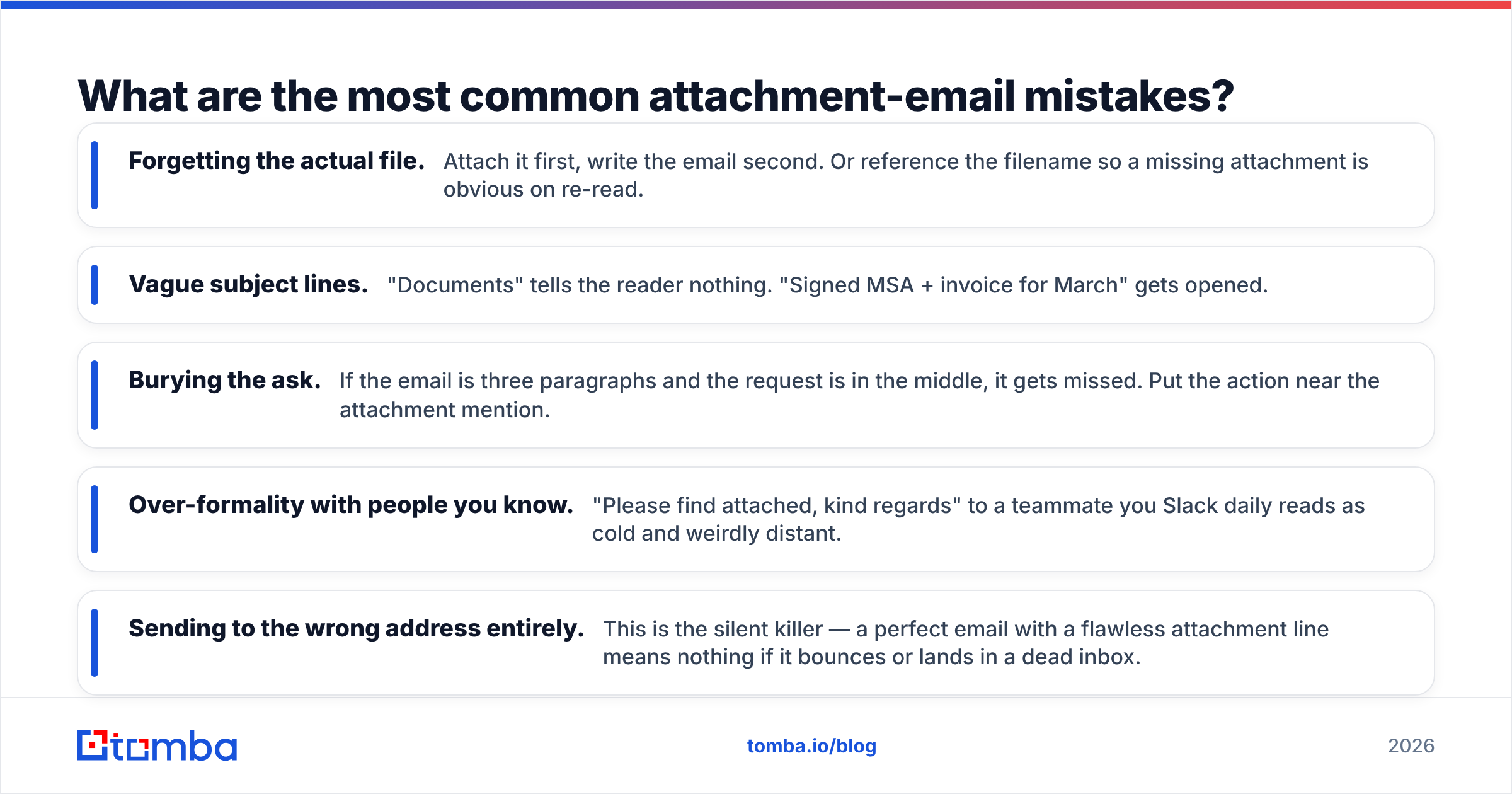
Beyond the phrasing itself, these are the errors that cost you replies:
- Forgetting the actual file. Attach it first, write the email second. Or reference the filename so a missing attachment is obvious on re-read.
- Vague subject lines. "Documents" tells the reader nothing. "Signed MSA + invoice for March" gets opened.
- Burying the ask. If the email is three paragraphs and the request is in the middle, it gets missed. Put the action near the attachment mention.
- Over-formality with people you know. "Please find attached, kind regards" to a teammate you Slack daily reads as cold and weirdly distant.
- Sending to the wrong address entirely. This is the silent killer — a perfect email with a flawless attachment line means nothing if it bounces or lands in a dead inbox.
That last point deserves its own section, because it's where most attachment emails actually fail.
Why does the recipient's email address matter more than the phrasing?#
Here's the conclusion first: the best attachment sentence in the world is worthless if the email never reaches a real person. Phrasing optimizes the email that gets read; a correct, verified address determines whether it gets read at all.
Think of it like mailing a contract. You can use beautiful handwriting and the perfect cover note, but if the street address is wrong, the envelope ends up in a sorting-facility void. Email is the same — a bounced or guessed address means your carefully worded "I've attached the proposal" reaches nobody.
This matters most in outbound and cold contexts, where you don't already have the contact in your CRM. Before you craft the attachment line, you need a deliverable address. That's where finding and verifying the contact comes in — a quick email verification pass catches typos, dead mailboxes, and risky domains before they tank your sender reputation.
)
How does attachment phrasing fit into cold email and deliverability?#
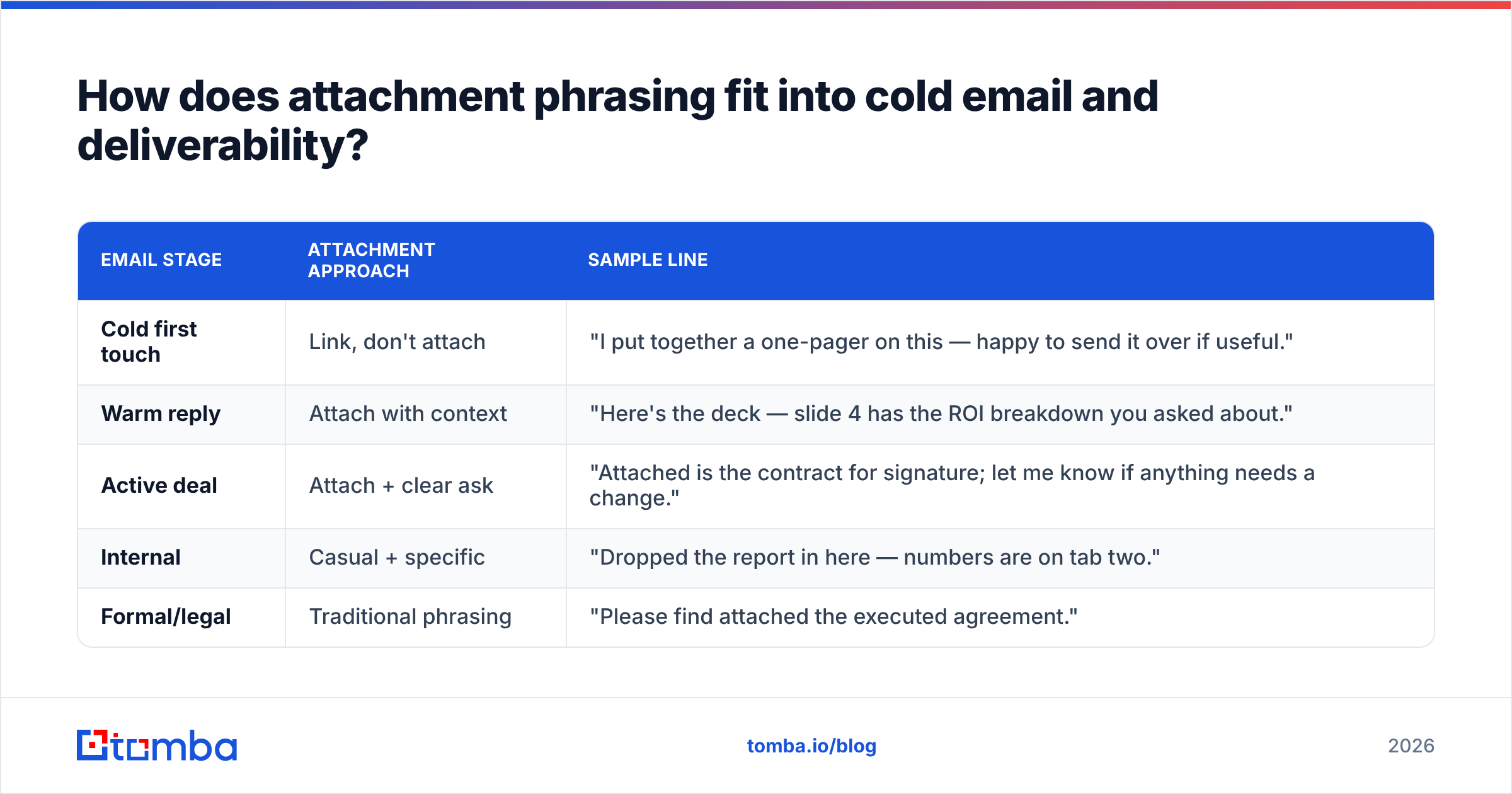
In cold outreach, attachments are risky. Spam filters treat unsolicited attachments with suspicion, and a heavy file from an unknown sender can hurt your email deliverability. The safer pattern in cold email is to reference the resource and link to it, or to send it only after the prospect replies.
So the phrasing strategy shifts by stage:
| Email stage | Attachment approach | Sample line |
|---|---|---|
| Cold first touch | Link, don't attach | "I put together a one-pager on this — happy to send it over if useful." |
| Warm reply | Attach with context | "Here's the deck — slide 4 has the ROI breakdown you asked about." |
| Active deal | Attach + clear ask | "Attached is the contract for signature; let me know if anything needs a change." |
| Internal | Casual + specific | "Dropped the report in here — numbers are on tab two." |
| Formal/legal | Traditional phrasing | "Please find attached the executed agreement." |
The takeaway: there's no single correct phrase. There's a correct phrase for each context, and "please find attached" is right for exactly one of those rows.
If your outreach volume is high, pairing good phrasing with a clean prospect list matters more than any single word choice. A verified contact list plus a reader-focused attachment line is the combination that actually moves reply rates.
Quick reference: rewrite "please find attached" in 5 seconds#
When you catch yourself typing the old phrase, swap in one of these by context:
- Neutral default: "I've attached [document]."
- Replying to a request: "Here's the [document] you asked for."
- Need them to act: "I've attached [document] — could you [sign / review / reply] by [date]?"
- Long file: "[Document] is attached; the part you'll care about is on page [X]."
- Formal only: "Please find attached [document]."
Each takes the same number of keystrokes as the autopilot version, but earns more attention.
Frequently asked questions#
Is "please find attached" grammatically correct? Yes. It's a complete, correct sentence in the imperative mood. The criticism is about style and register, not grammar. It's simply more formal and less natural than modern alternatives.
Should I ever use "attached please find"? Rarely. The inverted "attached please find" or "attached find" is even more archaic than the standard phrase. Reserve it for the most formal legal or governmental correspondence, if at all.
What's the most natural alternative? "I've attached [the document]" is the safest, most natural default for the vast majority of business email. It's clear, brief, and works across nearly every relationship.
Do attachments hurt cold email deliverability? They can. Unsolicited attachments raise spam-filter suspicion and add weight that some gateways flag. In cold outreach, reference a resource or link to it instead, and save attachments for replies. Protect your domain by checking sender reputation regularly.
Get the email to the right person first#
You can perfect every word of "I've attached the proposal" and still get nowhere if the address is a guess. Before you worry about phrasing, make sure the email lands. Tomba's Email Finder locates accurate, professional email addresses by name, company, or domain — so your carefully written attachment email reaches a real inbox instead of bouncing. Start free with 25 searches a month, and scale up through Tomba's pricing plans as your outreach grows. Nail the recipient, then nail the wording — in that order.
// get started
Find, verify and enrich your first contacts today
Start on the free plan with 25 searches a month, then scale when your team is ready.
Free plan · No credit card required · GDPR & CCPA
// about the author