Attio vs Twenty (2026): Which Modern CRM Wins for B2B?
Attio's polished automation or Twenty's open-source freedom? A neutral, feature-by-feature breakdown of two modern CRMs in 2026—plus how to keep either one full of accurate B2B data.
Choosing a CRM in 2026 used to mean picking a shade of the same heavy, sales-rep-hostile software. Attio and Twenty are the two products most often cited when teams say they want something different — flexible, fast, and built for the way modern revenue teams actually work. They look similar on the surface and solve the problem from opposite directions.
This is a straight comparison: what each tool is, where each one wins, real pricing, and the trade-offs nobody mentions in the launch tweets.
TL;DR#
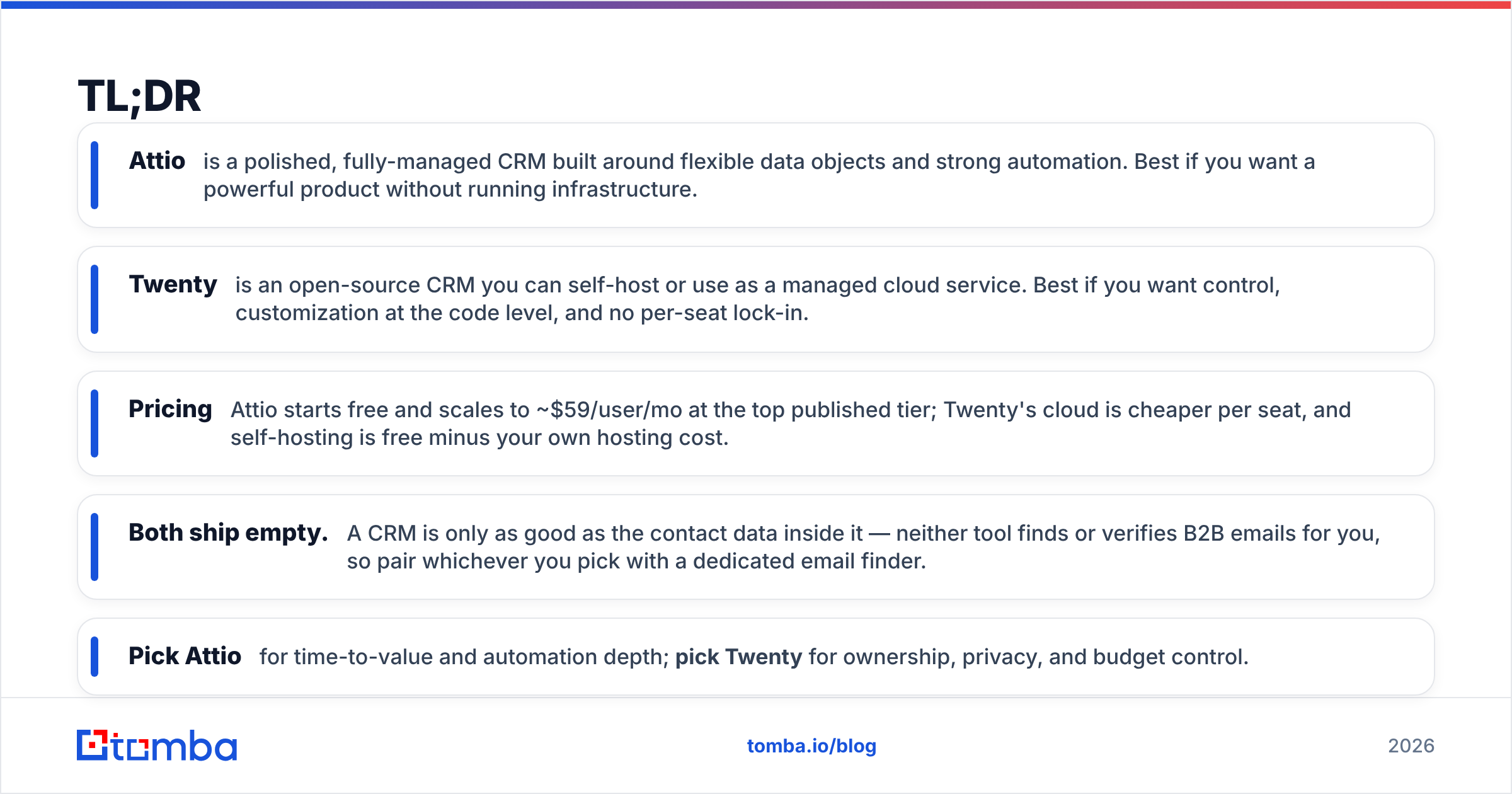
- Attio is a polished, fully-managed CRM built around flexible data objects and strong automation. Best if you want a powerful product without running infrastructure.
- Twenty is an open-source CRM you can self-host or use as a managed cloud service. Best if you want control, customization at the code level, and no per-seat lock-in.
- Pricing: Attio starts free and scales to ~$59/user/mo at the top published tier; Twenty's cloud is cheaper per seat, and self-hosting is free minus your own hosting cost.
- Both ship empty. A CRM is only as good as the contact data inside it — neither tool finds or verifies B2B emails for you, so pair whichever you pick with a dedicated email finder.
- Pick Attio for time-to-value and automation depth; pick Twenty for ownership, privacy, and budget control.
What is Attio?#
Attio is a cloud-native CRM that treats your data like a flexible database rather than a fixed contacts-and-deals schema. Everything is an "object" — people, companies, deals, or any custom entity you invent (partners, properties, candidates) — and you build views, reports, and workflows on top of those objects.
The pitch is that Attio adapts to your process instead of forcing your process into someone else's idea of a sales pipeline. It auto-enriches companies from their domain, syncs your email and calendar to build relationship history automatically, and has a genuinely strong automation builder for sequences and internal handoffs.
It is fully managed SaaS. You sign up, your team logs in, and you never think about servers. That convenience is the whole point — and, for some teams, the whole objection.
What is Twenty?#
Twenty is an open-source CRM — the code lives publicly on GitHub under a permissive license, and you can self-host it on your own infrastructure or pay for their managed cloud. It is explicitly positioned as the open alternative to Salesforce and HubSpot, and it has grown fast because developers and privacy-conscious teams like owning their stack.
Functionally it covers the CRM basics well: customizable objects, a Kanban and table view of records, pipelines, and a growing API. Because it is open source, you can read exactly what it does with your data, fork it, build custom objects in code, and avoid per-seat pricing entirely if you run it yourself.
The trade-off is responsibility. Self-hosting means you handle updates, backups, security patches, and uptime. The managed cloud removes that burden but also removes the "it's free" headline.
Attio vs Twenty: the core differences at a glance#
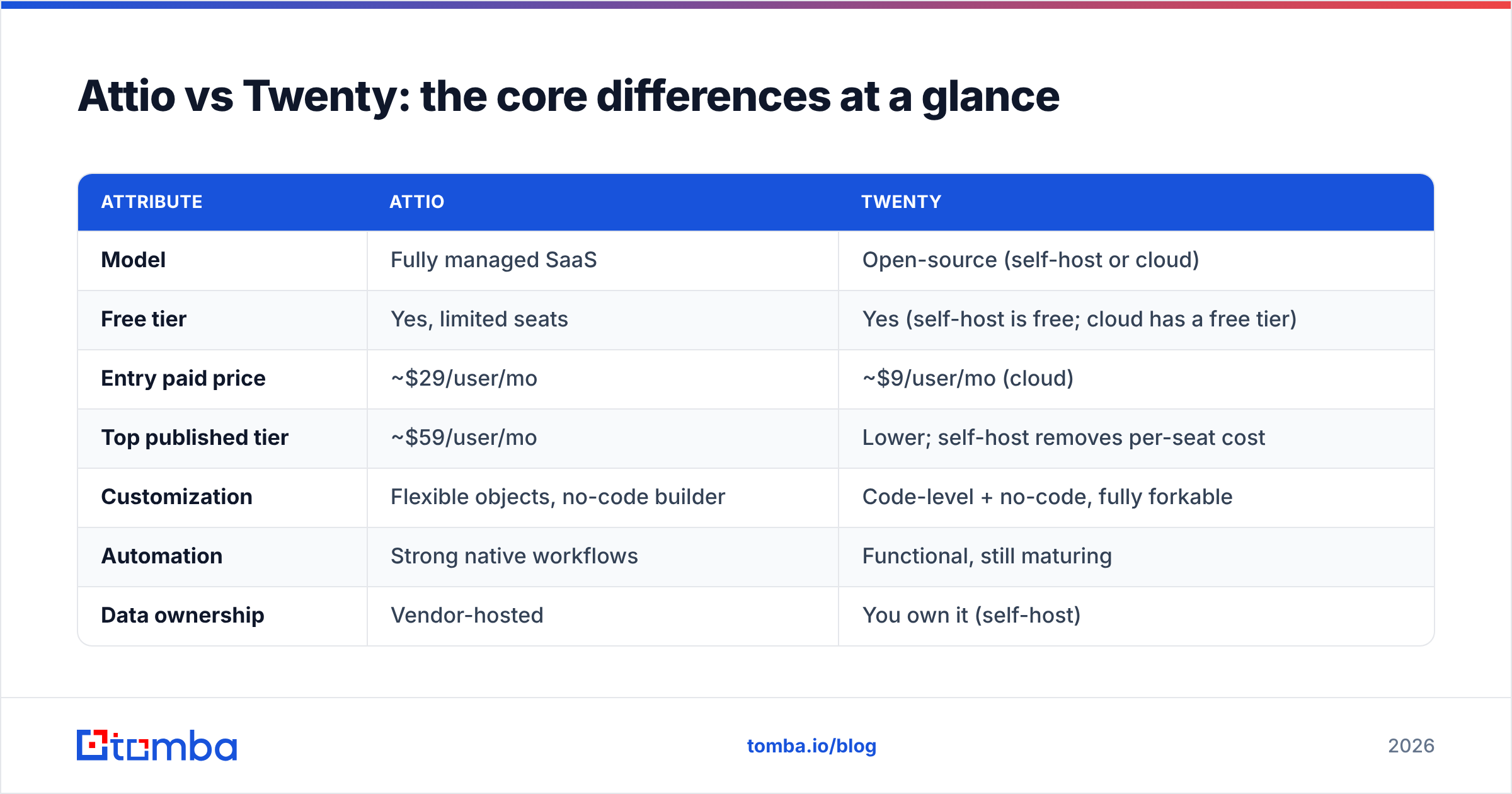
The fastest way to see where these two diverge is feature by feature.
| Attribute | Attio | Twenty |
|---|---|---|
| Model | Fully managed SaaS | Open-source (self-host or cloud) |
| Free tier | Yes, limited seats | Yes (self-host is free; cloud has a free tier) |
| Entry paid price | ~$29/user/mo | ~$9/user/mo (cloud) |
| Top published tier | ~$59/user/mo | Lower; self-host removes per-seat cost |
| Customization | Flexible objects, no-code builder | Code-level + no-code, fully forkable |
| Automation | Strong native workflows | Functional, still maturing |
| Data ownership | Vendor-hosted | You own it (self-host) |
| Best for | Speed, polish, automation | Control, privacy, budget |
A few things to read between the rows:
- Time-to-value favors Attio. You can be running real workflows the same afternoon. No DevOps, no Docker, no Postgres tuning.
- Cost-at-scale favors Twenty. Per-seat pricing compounds; a 25-person team feels the difference fast, and self-hosting flattens that curve.
- Customization is a tie with different ceilings. Attio's no-code builder is deeper out of the box; Twenty's open code has no ceiling if you have engineering time.
- Risk profiles differ. Attio's risk is vendor lock-in and pricing changes. Twenty's risk is operational — patches and uptime are on you when you self-host.
- Maturity favors Attio today. It has had more years and funding to polish automation, reporting, and integrations; Twenty is closing the gap quickly but is younger.
- Compliance favors Twenty for strict shops. If data must never leave your infrastructure, self-hosting is a clean answer that no SaaS can match.
Is Attio better than Twenty?#
It depends on what you're optimizing for — there is no universal winner.
Choose Attio if you want the best product experience with zero infrastructure work, your team values automation and reporting over raw control, and per-seat pricing fits your budget. Sales and RevOps teams that want to move this week, not next quarter, lean Attio.
Choose Twenty if you want to own your data outright, you have (or can rent) engineering time, you're cost-sensitive at scale, or you operate in a regulated environment where self-hosting solves a compliance problem. Technical founders and privacy-first teams lean Twenty.
The honest framing: Attio sells you convenience, Twenty sells you control. Both are legitimate purchases. What neither one sells you is the thing your pipeline actually runs on — accurate contact data.
What both CRMs leave out: the data problem#
Here's the part that trips up teams who obsess over which CRM to buy: a CRM is a container, not a source. Attio and Twenty both give you a beautiful, flexible home for contacts. Neither one fills that home with verified, deliverable B2B email addresses and phone numbers.
You import a list and half the emails bounce. You enrich a company record and the decision-maker's contact is missing. The CRM faithfully stores whatever you give it — including the garbage. That's why "which CRM" is the wrong first question. The first question is where does clean data come from, and how does it get in.
This is where a dedicated prospecting layer matters more than the CRM logo. Tools like Tomba's email finder locate professional emails by name and domain, the email verifier confirms they're deliverable before you ever hit send, and data enrichment fills in the missing fields on records you already have. Feed that into either CRM and the tool you picked suddenly looks a lot smarter.
How do Attio and Twenty handle pricing?#
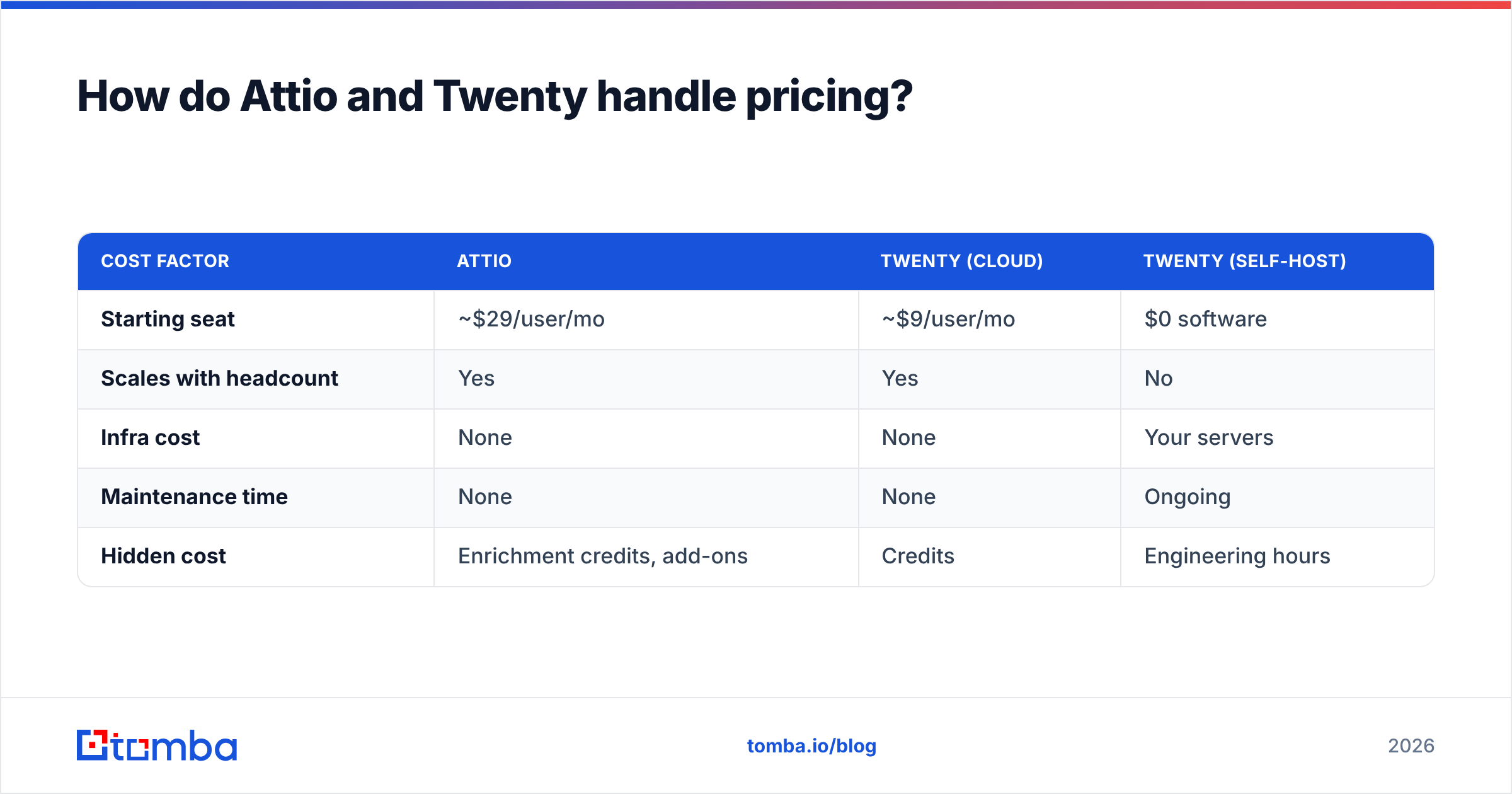
Pricing is where the two philosophies show most clearly.
Attio uses classic per-seat SaaS tiers: a free plan for small teams, then paid plans that climb as you add seats and unlock automation, reporting, and higher enrichment limits. Predictable, but it scales linearly with headcount, and the published top tier sits around $59/user/mo.
Twenty's cloud is cheaper per seat, and self-hosting changes the math entirely — your cost becomes whatever your server bill is, regardless of how many users log in. For a 40-person go-to-market org, that gap is the difference between a meaningful monthly line item and almost nothing.
| Cost factor | Attio | Twenty (cloud) | Twenty (self-host) |
|---|---|---|---|
| Starting seat | ~$29/user/mo | ~$9/user/mo | $0 software |
| Scales with headcount | Yes | Yes | No |
| Infra cost | None | None | Your servers |
| Maintenance time | None | None | Ongoing |
| Hidden cost | Enrichment credits, add-ons | Credits | Engineering hours |
One caveat that applies to both: enrichment and contact credits are almost always metered separately or capped. If your team prospects heavily, you'll burn through native enrichment fast — another reason an external email-finding workflow with its own transparent pricing usually ends up cheaper and more accurate than relying on whatever the CRM bundles.
Which integrates better with the rest of your stack?#
Attio has the larger native integration catalog today — email, calendar, Slack, and a solid API, plus an automation layer that connects to common GTM tools without much glue. If you live inside a typical SaaS stack, things tend to "just work."
Twenty's integration story is API-first and improving steadily, and because it's open source you can build any connector you need rather than waiting for a vendor roadmap. Power users route both tools through automation platforms like Zapier or Make, or push contacts in programmatically via the Tomba API so freshly found, verified leads land in the right CRM object automatically.
The practical rule: Attio wins on out-of-the-box breadth, Twenty wins on "I can build exactly what I want." For evaluating either, real user reviews on G2 are worth more than any vendor landing page.
Attio vs Twenty: pros and cons#
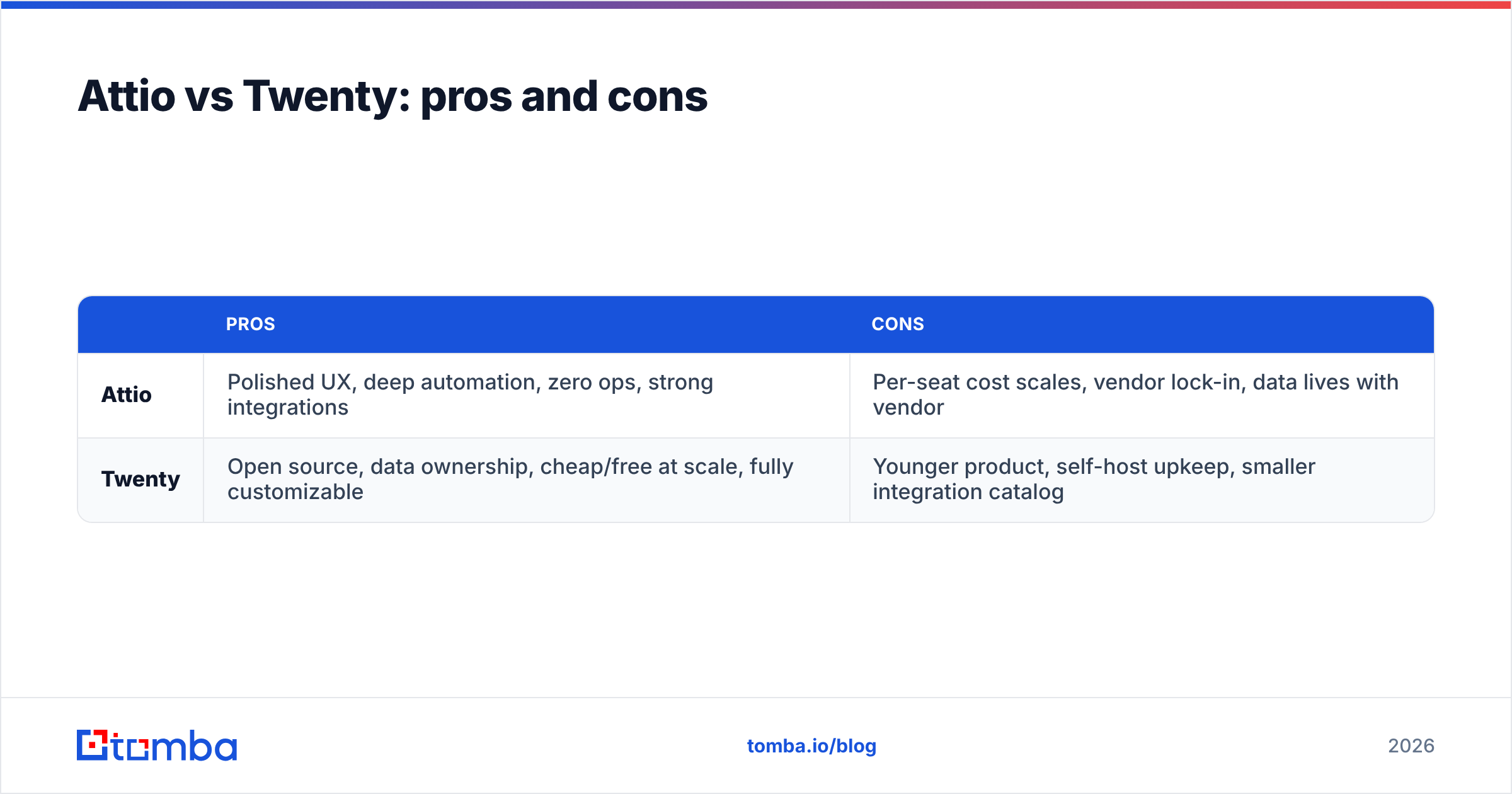
| Pros | Cons | |
|---|---|---|
| Attio | Polished UX, deep automation, zero ops, strong integrations | Per-seat cost scales, vendor lock-in, data lives with vendor |
| Twenty | Open source, data ownership, cheap/free at scale, fully customizable | Younger product, self-host upkeep, smaller integration catalog |
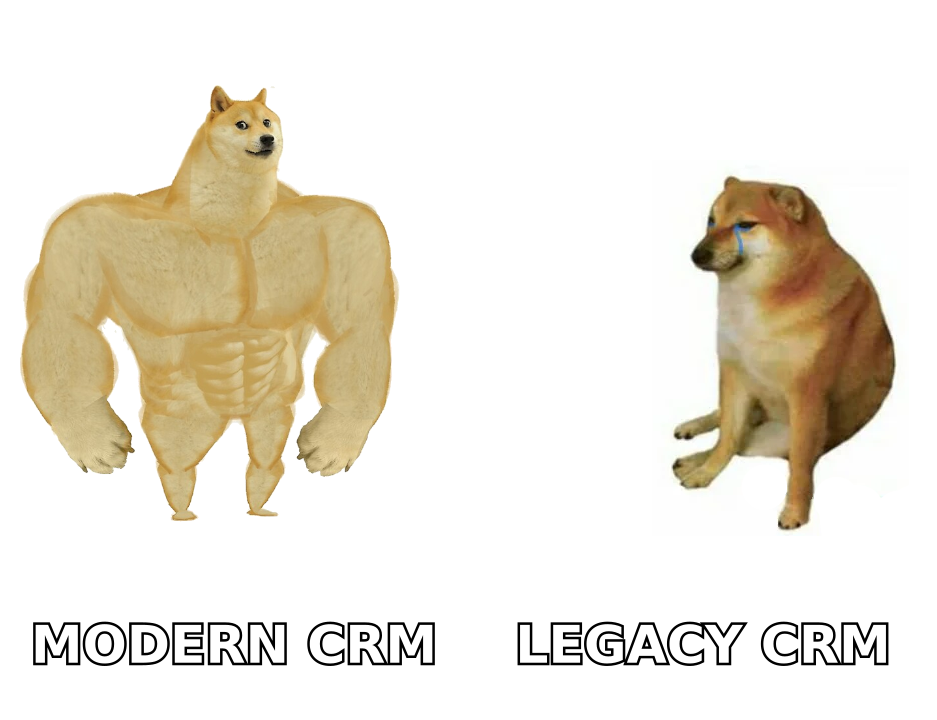
If you're migrating from a legacy CRM, both are a clear upgrade in flexibility and speed. The decision is genuinely about ownership versus convenience — and that's a values question as much as a feature one.
Which should your team actually pick?#
Here's the decision in one paragraph. If you're a fast-moving sales or RevOps team that wants to be productive today and doesn't want to think about servers, pick Attio and accept the per-seat cost. If you're technical, budget-conscious, privacy-driven, or scaling past the point where seat pricing stings, pick Twenty — self-host if you have the ops muscle, use their cloud if you don't.
Either way, do not skip the data layer. The most common reason a CRM rollout fails isn't the CRM — it's that reps stop trusting the records because the emails bounce and the fields are stale. Solve that first and the Attio-vs-Twenty choice becomes low-stakes. You can read more about where reliable contact data comes from before you commit either way.
The bottom line#
Attio and Twenty represent two honest answers to the same question: a managed product that trades money for time, and an open-source one that trades time for control. Pick based on your team's appetite for ownership, not on which homepage looks slicker — you can confirm the latest specifics on Attio's site and Twenty's site before you sign anything.
But whichever you choose, fill it with data you can trust. Start with Tomba's Email Finder — find verified professional emails by name, company, or domain, verify them before they hit your CRM, and feed both Attio and Twenty the clean, deliverable contacts that turn a tidy database into actual pipeline. The free tier gives you 25 searches a month to test it; from there, Tomba's plans start at $49/mo. The CRM is the container. Tomba fills it.
Ready to find emails that actually work?
Join 150,000+ professionals who stopped guessing and started sending. Free credits on signup — no credit card required.
Get the Tomba newsletter
Practical outbound tactics and product updates — once every two weeks.
About the author