Authority Building Email: How to Earn Trust in 2026
An authority building email earns trust before it asks for anything. Here's the framework, templates, and metrics that turn cold prospects into replies in 2026.
TL;DR
- An authority building email leads with proof and relevance, not a pitch — you earn the right to ask before you ask.
- The format works in three layers: a credible sender, a specific insight, and a low-friction next step.
- Authority is built on accurate targeting; sending expert-grade copy to the wrong inbox burns the whole effort.
- Reply rate, not open rate, is the metric that tells you whether your authority is landing.
- Use a repeatable template, personalize the first two lines, and verify every address before you hit send.
What is an authority building email?#
An authority building email is a message that establishes your credibility before it asks the recipient for anything. Think of it like a doctor's waiting room: you trust the framed diplomas on the wall long before the doctor says a word. The email does the same job — it signals competence, relevance, and good faith so the reader lowers their guard and actually reads your ask.
Most cold outreach does the opposite. It opens with "I'd love to show you a demo" — the equivalent of a stranger asking to borrow your car in the first sentence. An authority email flips the order. It demonstrates that you understand the reader's world, contributes something useful, and only then proposes a small, reasonable next step.
The payoff is measurable. According to HubSpot's sales benchmarks, personalized, relevance-led outreach consistently outperforms generic blasts on reply rate — and reply rate is what actually moves pipeline.
)
Why does authority matter more than volume in 2026?#
Because inboxes got smarter and buyers got more skeptical. Spam filters now weigh engagement signals, and a wave of low-relevance email tanks your sender reputation. Sending 10,000 mediocre messages doesn't just waste time — it can poison your domain so even your good emails stop landing.
Authority changes the math. A smaller volume of credible, well-targeted emails generates more replies and protects your deliverability. You are trading reach for trust, and trust compounds. The first credible email makes the follow-up easier; the follow-up makes the meeting easier.
Here's the core principle in four moves:
- Lead with proof, not pitch. Open with a result, a data point, or a named client outcome the reader recognizes.
- Make it about them. Reference something specific — their recent launch, a hiring signal, a public post — so the message could only have been written to one person.
- Teach, don't sell. Give a genuinely useful observation or resource with no strings attached.
- Ask small. Request a reply or 15 minutes, never a full commitment, in the first touch.
Skip any one of these and the email reverts to noise. The bold leads above aren't decoration — they're the spine of every message you send.
What does an authority building email look like?#
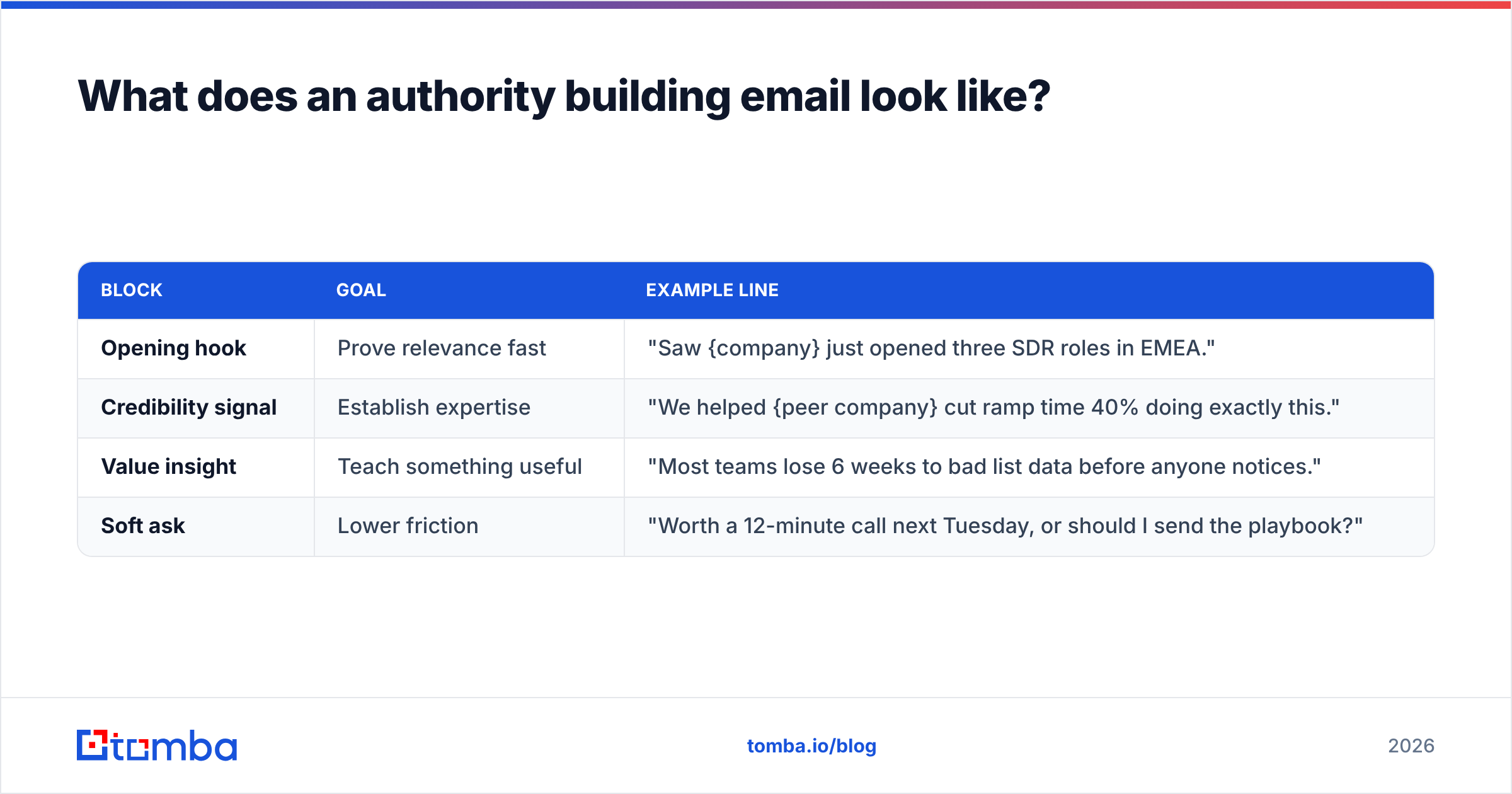
Below is a reusable skeleton. Each block maps to one of the four moves. Keep the whole thing under 120 words — authority is concise, rambling is not.
| Block | Goal | Example line |
|---|---|---|
| Opening hook | Prove relevance fast | "Saw {company} just opened three SDR roles in EMEA." |
| Credibility signal | Establish expertise | "We helped {peer company} cut ramp time 40% doing exactly this." |
| Value insight | Teach something useful | "Most teams lose 6 weeks to bad list data before anyone notices." |
| Soft ask | Lower friction | "Worth a 12-minute call next Tuesday, or should I send the playbook?" |
Notice what's missing: no "I hope this email finds you well," no three-paragraph company history, no five-link signature. Every sentence either builds credibility or reduces friction. If a line does neither, cut it.
You can templatize the structure while keeping the first two lines fully custom. Tools like the free cold email templates library give you a starting frame, and an AI cold email writer can draft variants you then edit for voice. The template is the skeleton; your specificity is the muscle.
How is an authority email different from a normal cold email?#
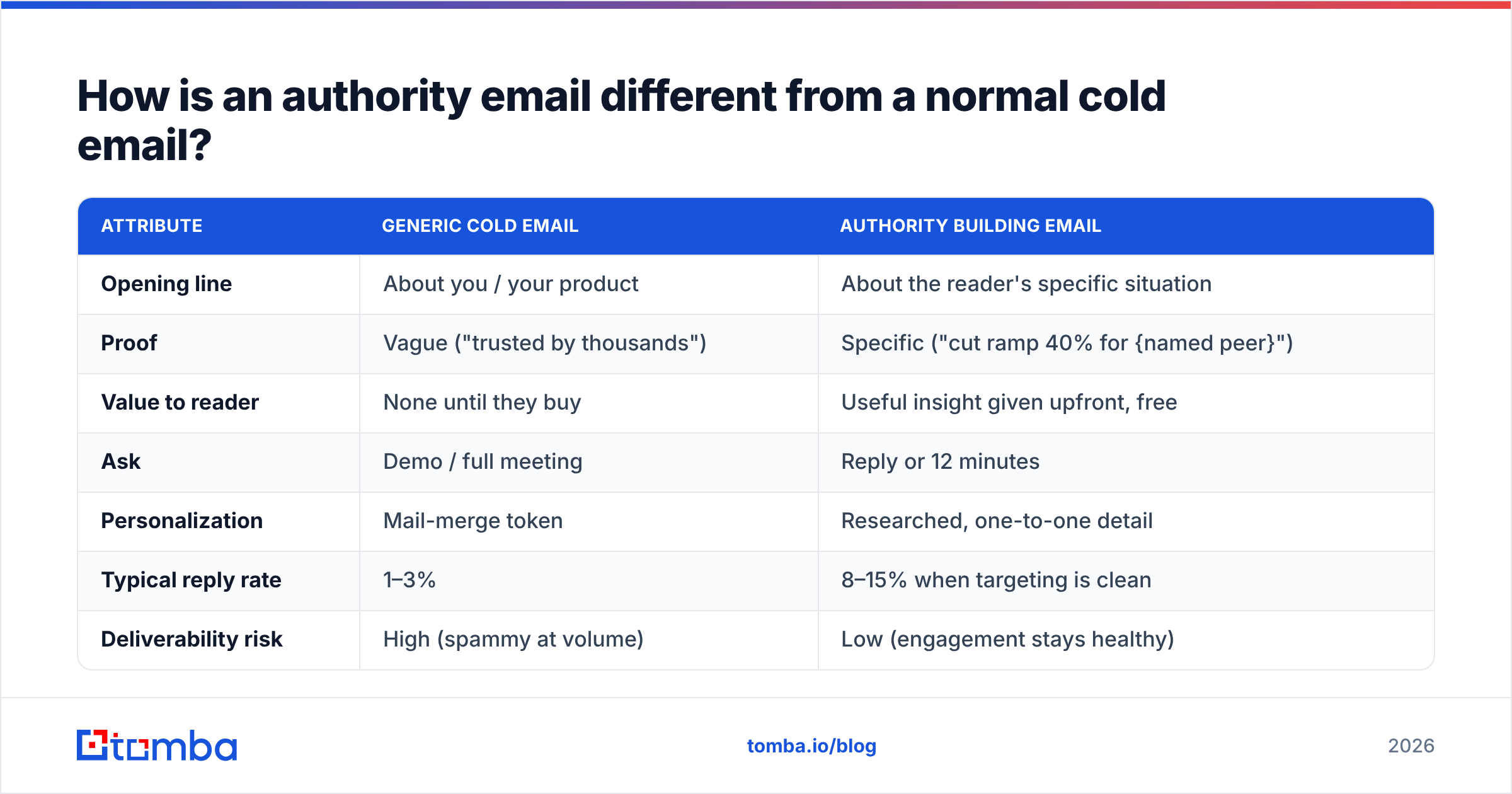
The difference is sequence and intent. A standard cold email optimizes for the sender's goal — book the meeting. An authority email optimizes for the reader's experience first, which is what ultimately earns the meeting.
| Attribute | Generic cold email | Authority building email |
|---|---|---|
| Opening line | About you / your product | About the reader's specific situation |
| Proof | Vague ("trusted by thousands") | Specific ("cut ramp 40% for {named peer}") |
| Value to reader | None until they buy | Useful insight given upfront, free |
| Ask | Demo / full meeting | Reply or 12 minutes |
| Personalization | Mail-merge token | Researched, one-to-one detail |
| Typical reply rate | 1–3% | 8–15% when targeting is clean |
| Deliverability risk | High (spammy at volume) | Low (engagement stays healthy) |
The reply-rate gap is not magic — it's relevance. When the message reads as if a knowledgeable peer wrote it specifically for the reader, the reader responds like it's a peer conversation. You can track your own numbers against the email response rate benchmark to see where you land.
How do you build authority before the email even arrives?#
Authority starts upstream of the copy. The most elegant email in the world fails if it hits a stale, guessed, or shared inbox. Three things have to be true before send:
- The address is real and current. Bounces hurt your reputation and erase any authority you built.
- The person actually owns the problem you're solving. A brilliant pitch to the wrong role is just well-written noise.
- Your domain is healthy. Authentication and a clean sending history decide whether you even reach the inbox.
This is where targeting quality quietly determines copywriting ROI. If you spend an hour crafting a credible message and send it to a catch-all address scraped two years ago, the authority evaporates on a bounce. Sourcing verified, role-accurate contacts with an email finder and confirming them with an email verifier is the unglamorous foundation under every reply you'll ever get.
)
For deeper context on what separates a deliverable address from a risky one, G2's deliverability research is a solid neutral reference, and analyst coverage from Gartner frames why data quality keeps rising on the priority list for revenue teams.
What are the building blocks of a high-authority message?#
Break it into components you can grade individually. When a campaign underperforms, you can fix the weak block instead of rewriting everything.
- Sender legitimacy. A real name, a real title, a real company domain, and authentication that passes. Authority dies the instant the reader suspects a bot.
- A specific trigger. Funding, a hire, a product launch, a published article — proof you noticed something true about them.
- A credibility anchor. A named result or recognizable client that maps to the reader's situation. Specific beats impressive.
- A teaching moment. One insight the reader can use even if they never reply. Generosity reads as confidence.
- A frictionless ask. A yes/no question or a 12-minute window. The smaller the ask, the higher the reply rate.
- A clean signature. One link, one line of context. Clutter signals desperation.
Run every draft against these six. If any block is generic, the whole email drops a tier. The list is also a useful onboarding checklist for new reps — it turns "write a good email" into six concrete, gradable decisions.
How do you scale authority without sounding like a robot?#
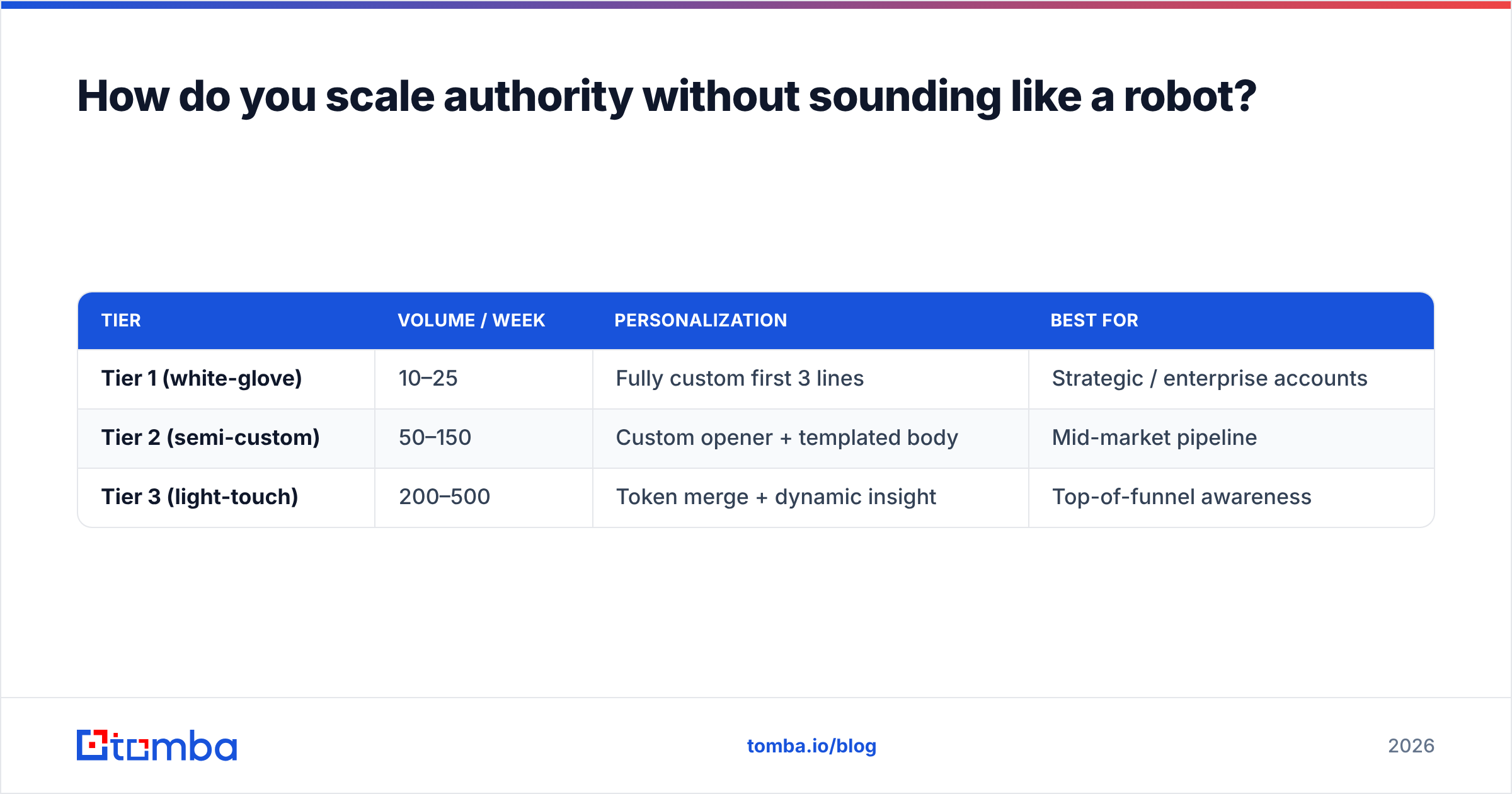
The trap is volume. The moment you try to send authority emails at blast scale, personalization collapses and you're back to noise. The fix is a tiered system: deeply custom for high-value accounts, lightly templated for the mid-tier, and fully automated only for the lowest-stakes outreach.
| Tier | Volume / week | Personalization | Best for |
|---|---|---|---|
| Tier 1 (white-glove) | 10–25 | Fully custom first 3 lines | Strategic / enterprise accounts |
| Tier 2 (semi-custom) | 50–150 | Custom opener + templated body | Mid-market pipeline |
| Tier 3 (light-touch) | 200–500 | Token merge + dynamic insight | Top-of-funnel awareness |
The data layer makes tiering possible. Pull a clean list by company with domain search, enrich each contact with role and seniority, and let those attributes drive which tier — and which template — each prospect gets. The copy stays human because the system, not the rep, handles the sorting. You can see Tomba pricing for how the credit tiers map to these volumes.
A note on honesty: automation should accelerate research, not fake it. If your "personalized" line is a merge token that anyone could have written, the reader knows. Use enrichment to find a true detail worth mentioning, then write that detail in plain language. The tool finds the fact; you supply the voice.
How do you measure whether your authority is landing?#
Stop celebrating open rate. With privacy changes and prefetching, opens are a vanity number — a bot can open your email. The metrics that actually reflect authority are downstream:
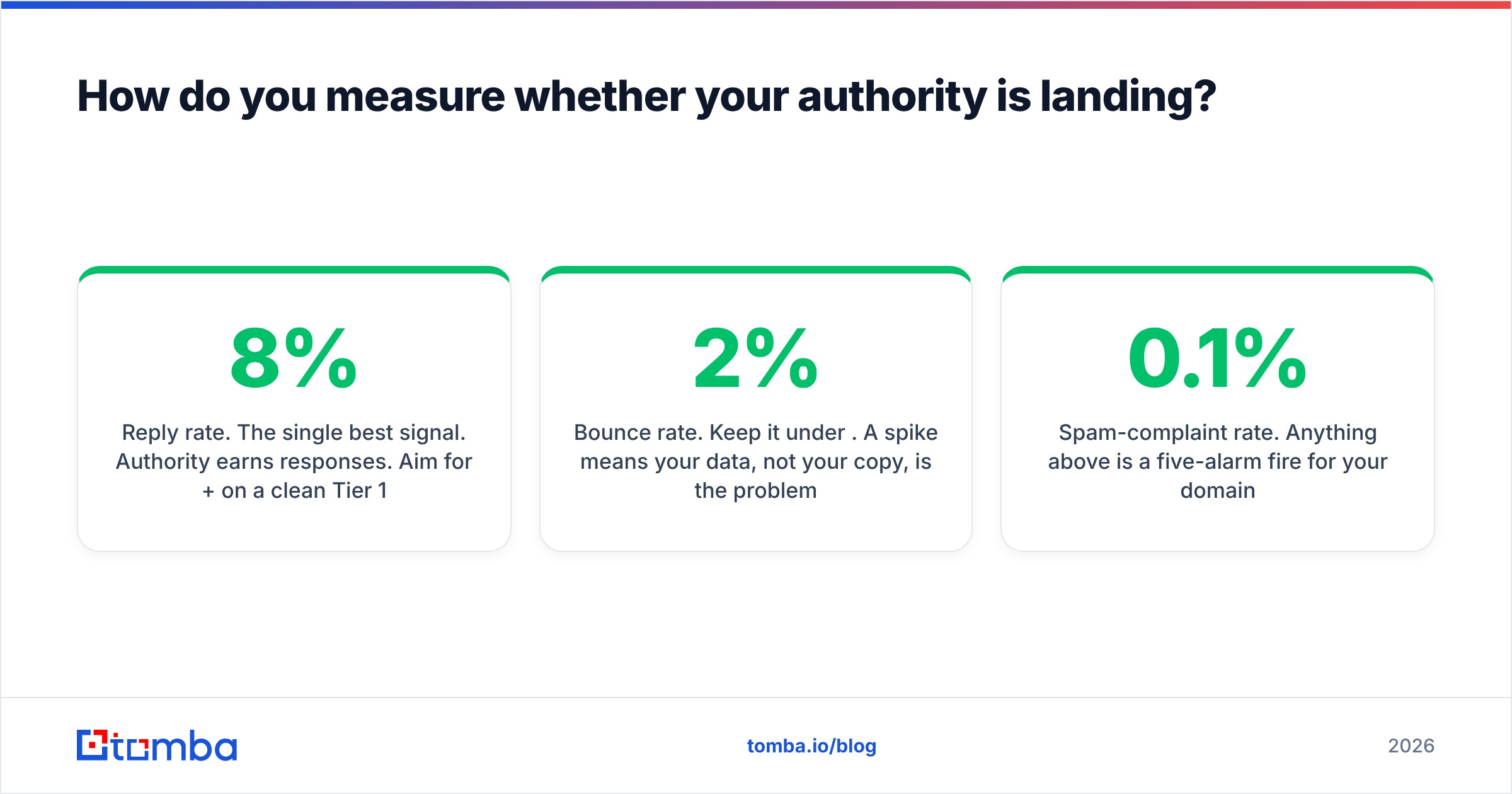
- Reply rate. The single best signal. Authority earns responses. Aim for 8%+ on a clean Tier 1 list.
- Positive reply rate. Of those replies, how many are interested versus "unsubscribe"? This separates relevance from annoyance.
- Meeting-booked rate. The conversion from reply to calendar. Authority shortens this because trust is already established.
- Bounce rate. Keep it under 2%. A spike means your data, not your copy, is the problem.
- Spam-complaint rate. Anything above 0.1% is a five-alarm fire for your domain.
Track these per tier and per template. When Tier 2 replies dip, you'll know to test a new opener rather than blame the whole program. The discipline of measuring by block — data, opener, insight, ask — is what turns "we sent some emails" into a repeatable authority engine.
A quick worked example#
Here's the skeleton filled in for a real-feeling Tier 1 send:
Subject: the EMEA SDR ramp problem
Hi Dana — saw Northwind just posted three SDR roles in Berlin and Madrid. Scaling that fast usually means new reps spend their first six weeks chasing bad list data instead of selling. We helped Meridian cut that ramp window by 40% by fixing the data layer before the first email went out. Happy to send the one-page playbook we used, or grab 12 minutes Thursday — whichever's easier. Either way, the hiring spree is a great sign.
Count the moves: specific trigger (the job posts), teaching insight (the six-week data problem), credibility anchor (Meridian's 40%), soft ask (playbook or 12 minutes), genuine warmth (the closing line). Under 90 words, zero filler, and it could only have been written to Dana.
Where should you start?#
Start with the data, because authority you can't deliver is authority you don't have. The best-written email in this entire guide returns nothing if it bounces or lands on the wrong person.
Build your target list with the Tomba Email Finder — search by domain, name, or company to pull verified, role-accurate professional addresses, then layer enrichment so every message is sorted into the right tier with a true, specific detail to open on. Clean data is the diploma on the waiting-room wall: it does the trust-building before you say a word. Pair it with the framework above, measure by reply rate, and your next campaign earns responses instead of spam complaints. Find your first 25 verified contacts free, then scale the ones that reply.
// get started
Find, verify and enrich your first contacts today
Start on the free plan with 25 searches a month, then scale when your team is ready.
Free plan · No credit card required · GDPR & CCPA
// about the author