Automated Follow Up System: The 2026 Playbook for Reply Rates
Most deals die in the gap between the first touch and the fifth. Here's how to build an automated follow up system that books meetings without sounding like a robot.
Most reps send one email, hear nothing, and quietly move on. That single habit is where the majority of pipeline leaks out. An automated follow up system is the fix: a structured, mostly hands-off sequence that keeps touching a prospect across email, phone, and social until they reply, book, or formally opt out.
This guide breaks down what that system actually looks like in 2026, how to build one without sounding like a spam cannon, and which tools and data inputs make the difference between "ignored" and "booked."
TL;DR#
- A follow-up gap kills more deals than a bad pitch. Roughly 80% of conversions happen after the fifth touch, but most reps stop at one or two.
- Automation handles the schedule; you own the relevance. The system sends on time; your data, segmentation, and copy make it feel personal.
- Bad data breaks everything downstream. A sequence built on guessed emails just automates your bounce rate. Verified contact data is the foundation.
- A good system spans channels — email, phone, and LinkedIn — with clear stop rules so nobody gets hammered after replying.
- You can build a working version this week using a sequencer, verified contact data, and the cadence template below.
What is an automated follow up system?#
An automated follow up system is software-driven workflow that delivers a planned series of touches to a prospect or customer without you manually queuing each one. Think of it like a thermostat for your pipeline: you set the target behavior once — five emails over three weeks, a call on day four, a LinkedIn touch on day nine — and the system maintains that schedule across hundreds of contacts at the same time.
The key distinction: automation controls timing and delivery, not judgment. The system decides when to send; you decide who goes in, what each message says, and when someone should exit. When those two halves are aligned, follow-up stops being a memory game and becomes a repeatable process.
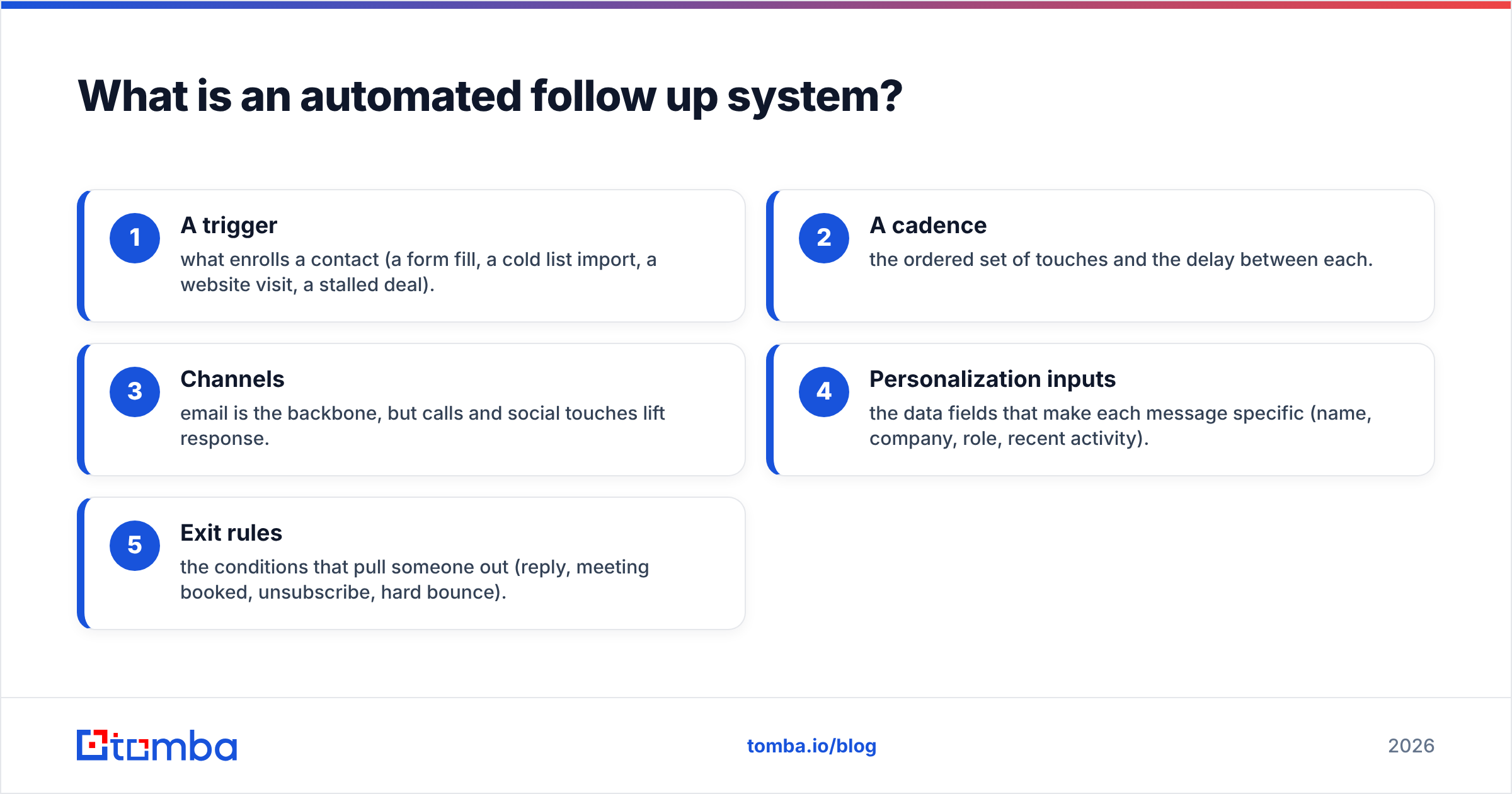
A complete system has five moving parts:
- A trigger — what enrolls a contact (a form fill, a cold list import, a website visit, a stalled deal).
- A cadence — the ordered set of touches and the delay between each.
- Channels — email is the backbone, but calls and social touches lift response.
- Personalization inputs — the data fields that make each message specific (name, company, role, recent activity).
- Exit rules — the conditions that pull someone out (reply, meeting booked, unsubscribe, hard bounce).
)
Why do most follow-up efforts fail?#
They fail for three boring, fixable reasons.
Reps give up too early. Industry data from vendors like HubSpot consistently shows that a large share of replies arrive on the third touch or later, yet the median rep sends one or two messages. The math is brutal: if you stop at touch two, you're voluntarily skipping the touches that actually convert.
The data is wrong. You can automate a perfect cadence, but if 20% of your addresses bounce, you've automated a deliverability problem. Every hard bounce chips away at your sender reputation, which then drags down the inboxing of the good addresses too. Clean input is non-negotiable.
The messages are obviously automated. "Just bumping this to the top of your inbox" is a tell. When every follow-up reads like a template with a swapped first name, prospects pattern-match it as bulk and ignore it. The cure isn't writing each one by hand — it's feeding the system better data so the merge fields carry real signal.
A follow-up system only multiplies what you put into it. Garbage cadence at scale is just faster garbage.
What does a high-performing cadence look like?#
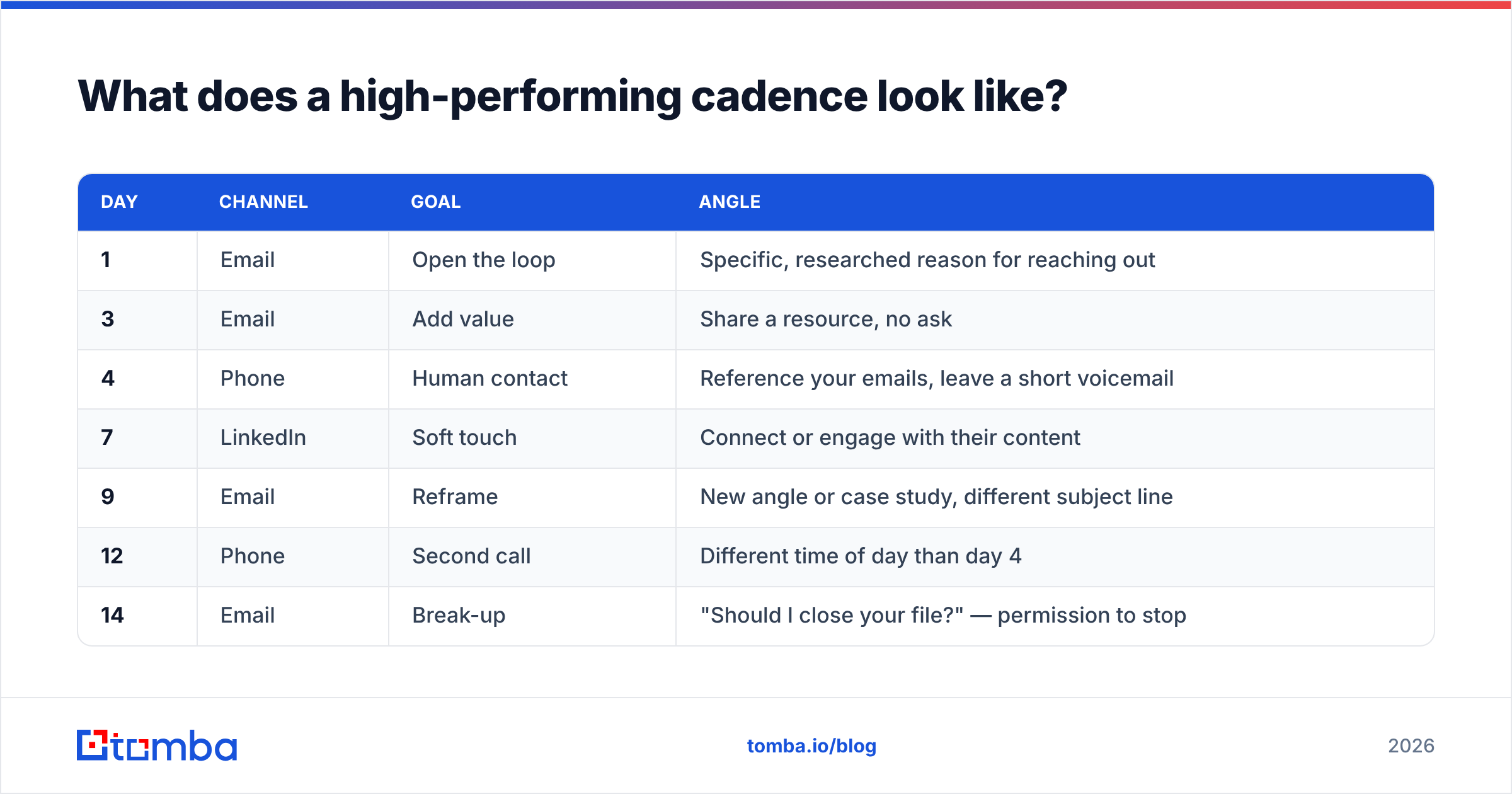
There's no single magic sequence, but proven B2B cadences share a shape: front-loaded value, multi-channel touches, and a clean break. Here's a 14-day template you can adapt.
| Day | Channel | Goal | Angle |
|---|---|---|---|
| 1 | Open the loop | Specific, researched reason for reaching out | |
| 3 | Add value | Share a resource, no ask | |
| 4 | Phone | Human contact | Reference your emails, leave a short voicemail |
| 7 | Soft touch | Connect or engage with their content | |
| 9 | Reframe | New angle or case study, different subject line | |
| 12 | Phone | Second call | Different time of day than day 4 |
| 14 | Break-up | "Should I close your file?" — permission to stop |
Notice what this cadence does: it varies the channel, varies the time of day for calls, and ends with a graceful exit instead of nagging forever. The break-up email on day 14 often pulls more replies than any message before it, because it triggers loss aversion without pressure.
The automation layer schedules all of this. Your job is to make sure the right people are enrolled and the merge fields are accurate.
Which tools build the system?#
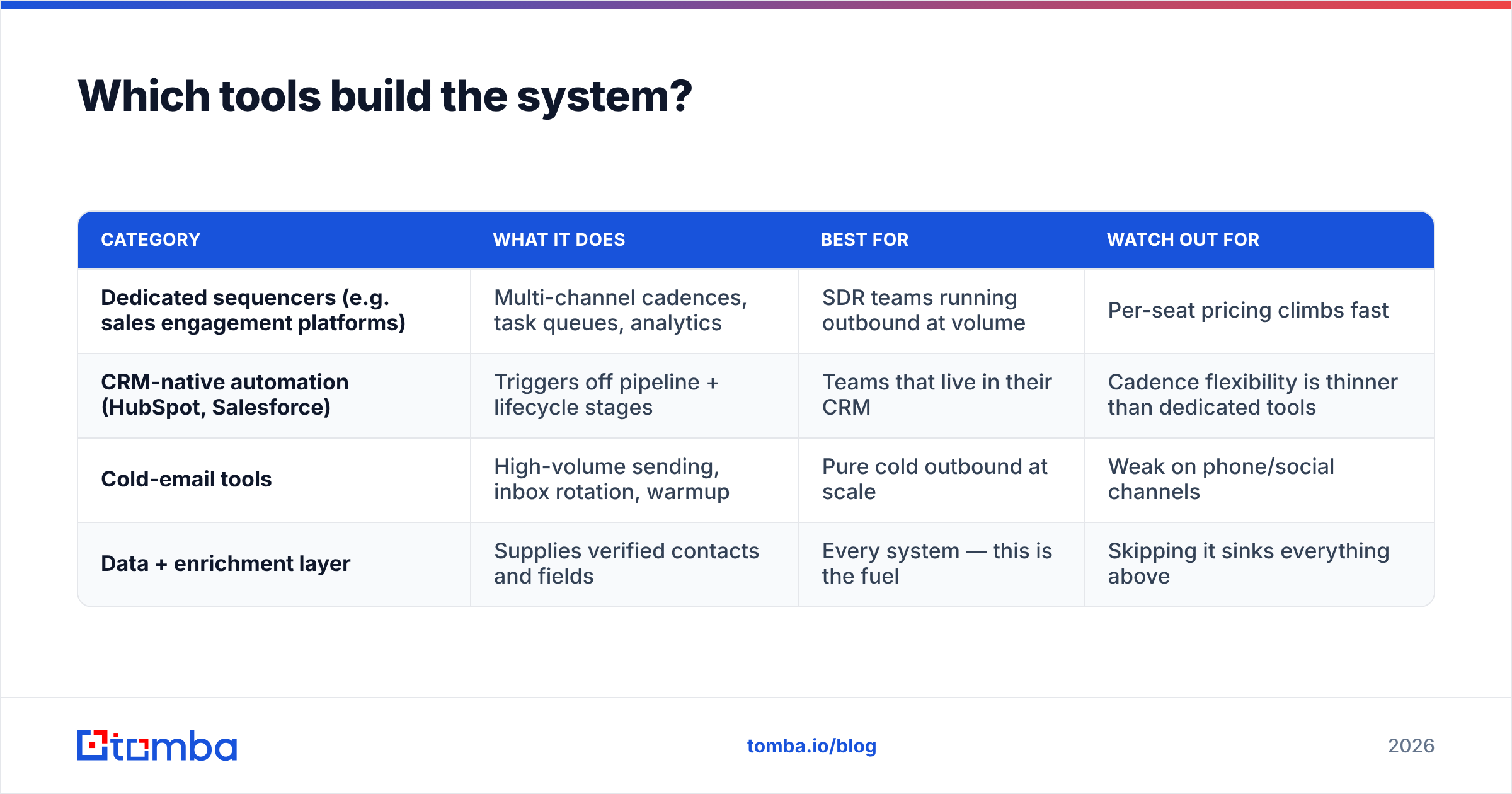
The market splits into a few categories, and most teams stitch two or three together. Here's how the main options compare on the dimensions that matter.
| Category | What it does | Best for | Watch out for |
|---|---|---|---|
| Dedicated sequencers (e.g. sales engagement platforms) | Multi-channel cadences, task queues, analytics | SDR teams running outbound at volume | Per-seat pricing climbs fast |
| CRM-native automation (HubSpot, Salesforce) | Triggers off pipeline + lifecycle stages | Teams that live in their CRM | Cadence flexibility is thinner than dedicated tools |
| Cold-email tools | High-volume sending, inbox rotation, warmup | Pure cold outbound at scale | Weak on phone/social channels |
| Data + enrichment layer | Supplies verified contacts and fields | Every system — this is the fuel | Skipping it sinks everything above |
The mistake teams make is shopping for the sequencer first and the data last. It should be the reverse. A mediocre sequencer fed verified, enriched contacts will outperform a premium platform running on a scraped, half-bounced list every single time.
That's where your data layer earns its keep. Before a contact ever enters a cadence, you want a confirmed email, a confirmed role, and ideally a phone number. Tools like the Tomba Email Finder and email verifier handle the first two, and data enrichment fills in the fields your merge tags depend on. Run that step before enrollment, not after the bounces roll in.
)
How do you keep an automated system from feeling robotic?#
The paradox of follow-up automation: the more you automate the schedule, the more human the content needs to be. Three tactics keep it from reading like a mail-merge.
Personalize the variable that matters, not the obvious one. Anyone can merge {{first_name}}. The touch that lands references something specific — a recent funding round, a job posting, a product launch. That requires enriched data on each contact, which is exactly why the data layer comes first.
Vary structure, not just words. If every email in the sequence is three sentences with a question at the end, the pattern is the giveaway. Mix a one-liner, a resource share, a short case study, and a break-up. Different shapes read as different people thinking, not a machine cycling templates.
Respect the exit instantly. Nothing breaks trust faster than a "just following up" email sent the day after someone replied "not interested." Your stop rules have to be airtight — reply, bounce, unsubscribe, and meeting-booked should all pull a contact out immediately. This is a configuration detail, but it's the one prospects notice most.
The system gives you leverage. Whether that leverage builds relationships or burns lists depends entirely on the inputs.
What metrics tell you it's working?#
Track these four and ignore vanity opens (open tracking is increasingly unreliable post-Apple Mail privacy changes anyway).
- Reply rate — the real signal. Healthy cold cadences land 5–15% depending on list quality and niche.
- Positive reply rate — replies that aren't "no." This is what actually feeds pipeline.
- Bounce rate — keep it under 3%. Above that, your data hygiene is the problem, not your copy.
- Meetings booked per 100 contacts — the only number your revenue leader cares about.
If reply rate is low but bounce rate is also low, fix the copy and targeting. If bounce rate is high, stop everything and fix the data — no amount of clever writing survives a dirty list. You can sanity-check addresses in bulk before launch using a bulk email finder workflow so you're not learning about bad contacts from your bounce report.
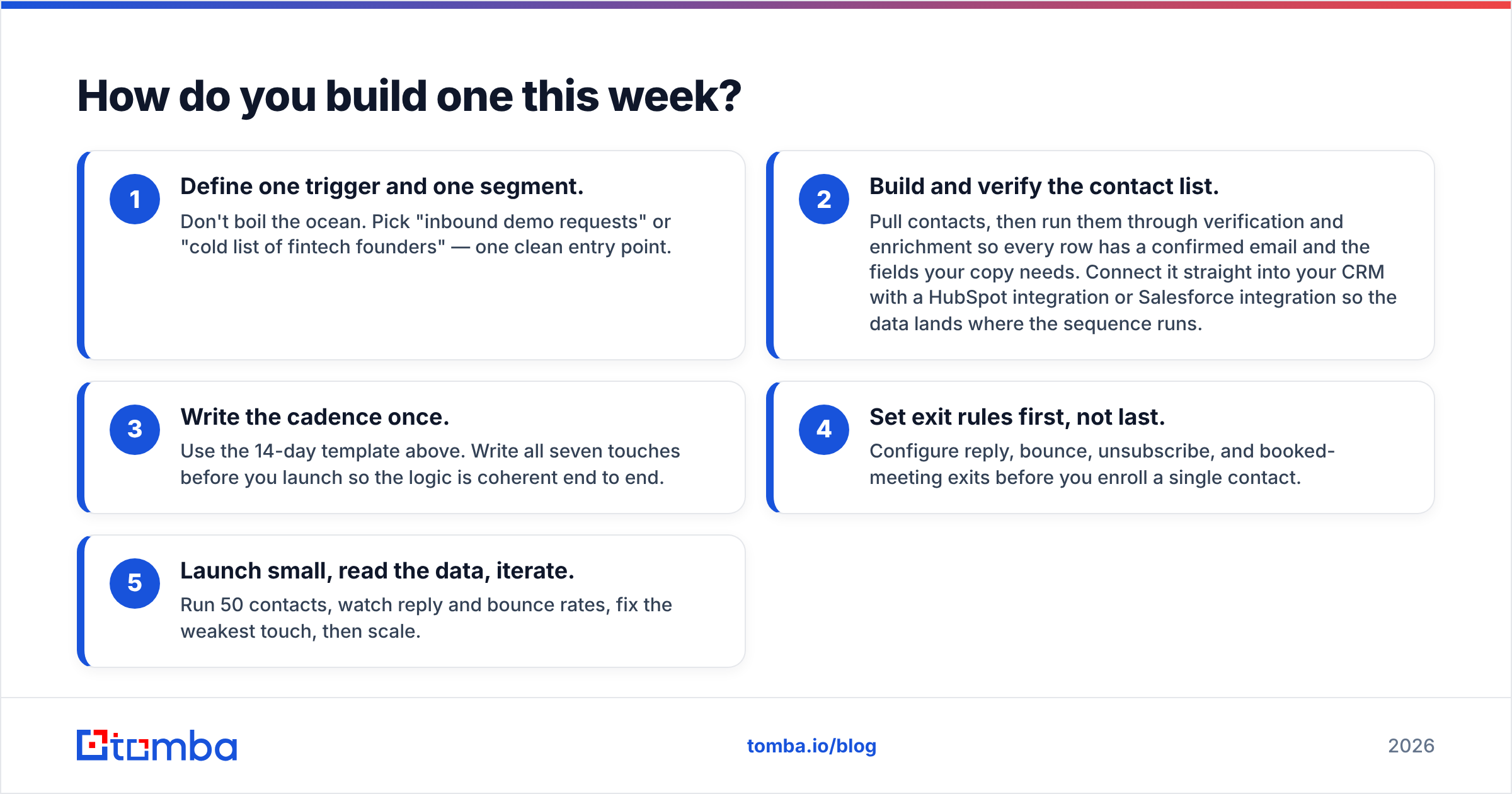
How do you build one this week?#
A realistic five-step setup that a single rep can stand up in a few days:
- Define one trigger and one segment. Don't boil the ocean. Pick "inbound demo requests" or "cold list of fintech founders" — one clean entry point.
- Build and verify the contact list. Pull contacts, then run them through verification and enrichment so every row has a confirmed email and the fields your copy needs. Connect it straight into your CRM with a HubSpot integration or Salesforce integration so the data lands where the sequence runs.
- Write the cadence once. Use the 14-day template above. Write all seven touches before you launch so the logic is coherent end to end.
- Set exit rules first, not last. Configure reply, bounce, unsubscribe, and booked-meeting exits before you enroll a single contact.
- Launch small, read the data, iterate. Run 50 contacts, watch reply and bounce rates, fix the weakest touch, then scale.
The whole thing rests on step two. A sequence is only as good as the contacts inside it.
Frequently asked questions#
How many follow-ups is too many? For cold outbound, five to seven touches over two to three weeks is the sweet spot, ending with a break-up message. Beyond that you're harming your sender reputation more than your pipeline.
Does automation hurt deliverability? Only if you run it on bad data or send too aggressively from a cold domain. Verified lists, gradual volume ramp, and proper authentication keep you in the inbox. Compare options on a review site like G2 before committing to a sender platform.
Can I automate replies too? You can draft and suggest, but a human should approve anything that goes to a prospect mid-conversation. Automate the chase, not the relationship.
The bottom line#
An automated follow up system is the highest-leverage process most sales teams aren't running well. The schedule is the easy part — any sequencer handles it. The hard part, and the part that decides whether you book meetings or burn your domain, is the quality of the contacts you pour in.
Start there. Build your list on verified emails and enriched fields with the Tomba Email Finder, confirm every address before enrollment, and let your cadence do the patient, repetitive work that human memory always drops. Check the Tomba pricing tiers — the free plan is enough to test a first segment — and put a real system behind your follow-up instead of relying on sticky notes and good intentions.
// get started
Find, verify and enrich your first contacts today
Start on the free plan with 25 searches a month, then scale when your team is ready.
Free plan · No credit card required · GDPR & CCPA
// about the author