Automated Nurture Campaigns: The 2026 B2B Growth Playbook
Cold leads rarely buy on the first touch. Automated nurture campaigns keep prospects warm with timed, relevant messages—here's how to build one that books meetings in 2026.
Most of your leads are not ready to buy the day they enter your funnel. Some need a week, some need six months, and almost none will reply to a single email. Automated nurture campaigns exist to cover that gap—staying useful in a prospect's inbox until the timing is right—without a rep manually chasing every contact.
This guide breaks down what an automated nurture campaign actually is, how to build one, which platforms fit which team, and the mistakes that quietly kill deliverability before your sequence ever lands.
TL;DR#
- Automated nurture campaigns are pre-built, trigger-based message sequences (email, LinkedIn, SMS, ads) that move a lead from "aware" to "ready to talk" without manual sending.
- The highest-performing campaigns are behavior-triggered, not time-only—they react to opens, clicks, page visits, and form fills.
- Clean data is the prerequisite: a nurture flow built on bounced or stale contacts burns sender reputation faster than it builds pipeline.
- Expect to compare platforms on branching logic, native CRM sync, deliverability tooling, and price—not just template libraries.
- Start small: one segment, one goal, five to seven touches. Scale only after you can measure reply and meeting rates.
What is an automated nurture campaign?#
An automated nurture campaign is a sequence of pre-planned messages that fire automatically based on time or behavior, designed to build trust with a lead until they are sales-ready.
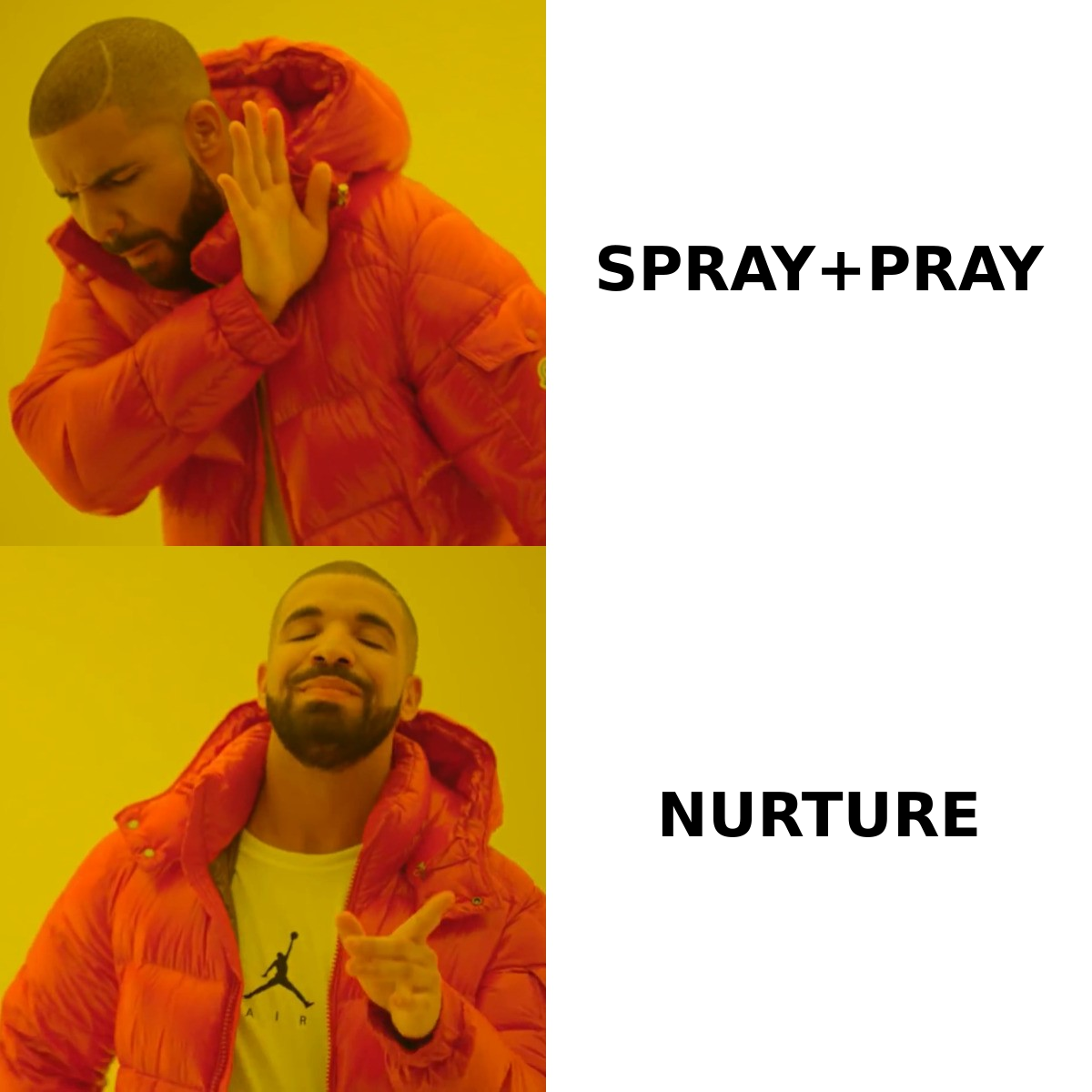
Think of it like a slow cooker versus a microwave. A cold blast email is the microwave—fast, aggressive, and it often leaves the middle cold. Nurture is the slow cooker: low heat, consistent, and the result is something people actually want. Technically, it's a workflow engine that watches lead attributes and events, then sends the next best message on a schedule you define.
The key difference from a one-off cold email is continuity with context. Each touch assumes the prior ones happened and adjusts. If a prospect clicked your pricing page, the next email talks about ROI, not "just checking in."
What are the core components of a nurture workflow?#
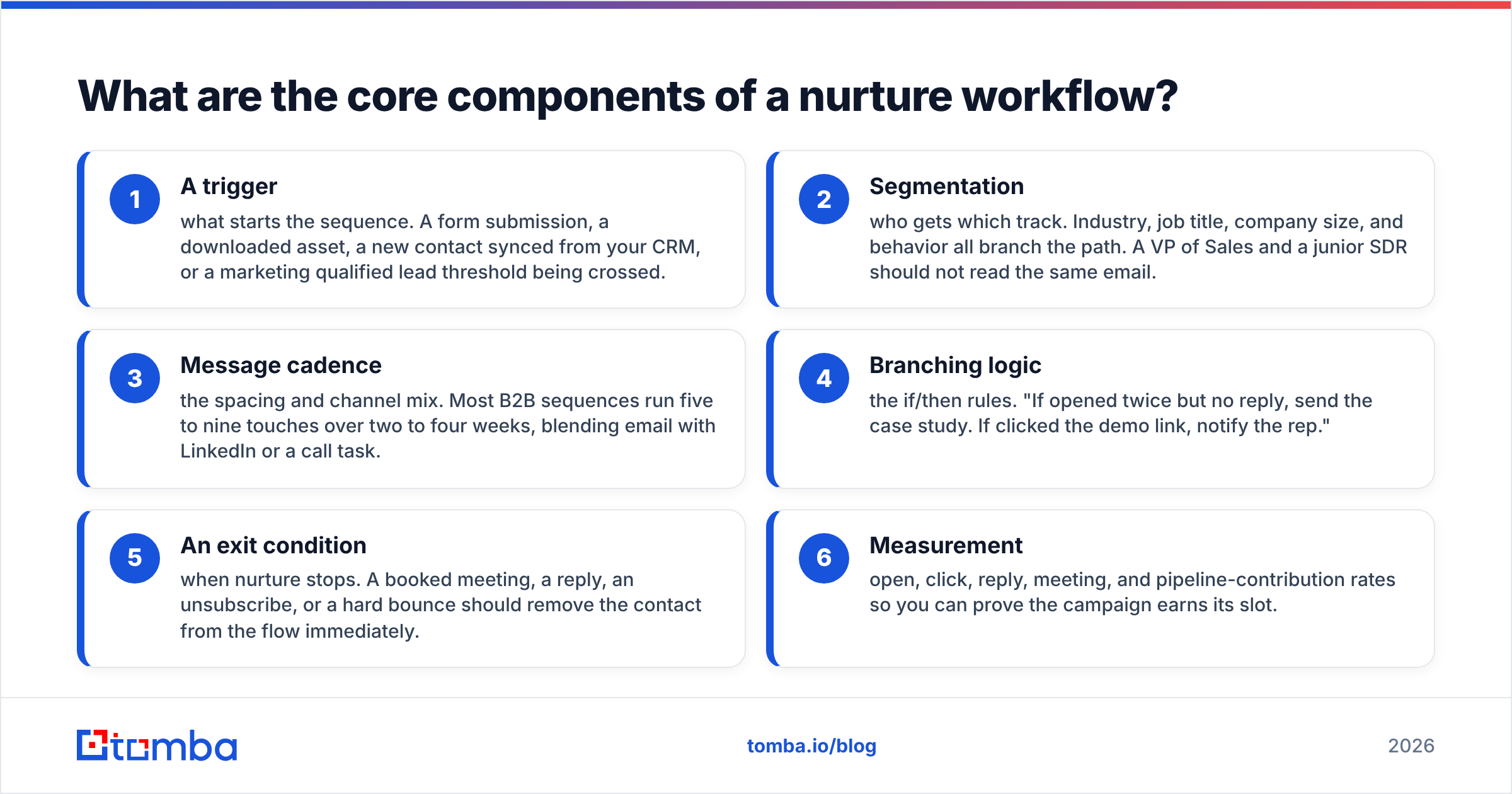
Before you pick a tool, understand the moving parts. Every effective automated nurture campaign is built from the same building blocks:
- A trigger — what starts the sequence. A form submission, a downloaded asset, a new contact synced from your CRM, or a marketing qualified lead threshold being crossed.
- Segmentation — who gets which track. Industry, job title, company size, and behavior all branch the path. A VP of Sales and a junior SDR should not read the same email.
- Message cadence — the spacing and channel mix. Most B2B sequences run five to nine touches over two to four weeks, blending email with LinkedIn or a call task.
- Branching logic — the if/then rules. "If opened twice but no reply, send the case study. If clicked the demo link, notify the rep."
- An exit condition — when nurture stops. A booked meeting, a reply, an unsubscribe, or a hard bounce should remove the contact from the flow immediately.
- Measurement — open, click, reply, meeting, and pipeline-contribution rates so you can prove the campaign earns its slot.
Get these six right and the platform you choose matters far less than the strategy behind it.
Why do most nurture campaigns fail?#
They fail on data quality and relevance—rarely on copy. You can write the best five-email sequence of your career, but if 18% of the list bounces, mailbox providers will throttle the whole campaign and your "good" contacts never see message three.
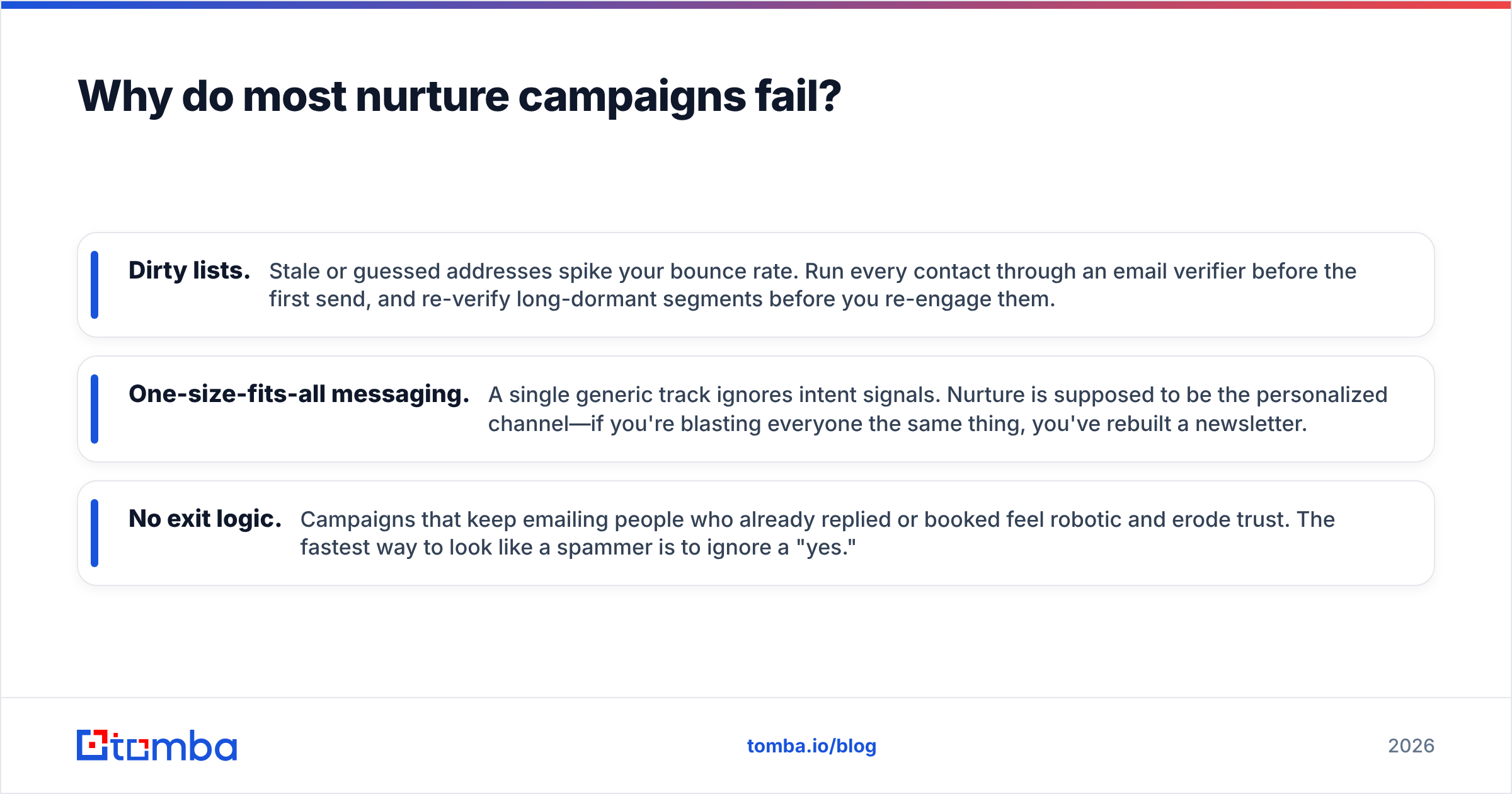
Three failure patterns dominate:
- Dirty lists. Stale or guessed addresses spike your bounce rate. Run every contact through an email verifier before the first send, and re-verify long-dormant segments before you re-engage them.
- One-size-fits-all messaging. A single generic track ignores intent signals. Nurture is supposed to be the personalized channel—if you're blasting everyone the same thing, you've rebuilt a newsletter.
- No exit logic. Campaigns that keep emailing people who already replied or booked feel robotic and erode trust. The fastest way to look like a spammer is to ignore a "yes."
Deliverability is the silent killer here. Sender reputation compounds: a few weeks of high bounces and spam complaints can suppress your domain for months. Treat list hygiene as part of the campaign, not a one-time chore.
How do you build an automated nurture campaign step by step?#
Here's a practical build sequence you can run this week.
Step 1 — Define one segment and one goal. Resist the urge to automate everything. Pick "inbound demo requests that went cold" and a goal of "book a meeting." Narrow scope makes the campaign measurable.
Step 2 — Source and verify the contacts. Pull the right people into the segment. If you're filling gaps—missing decision-makers at target accounts—use an email finder to locate verified addresses by name and domain, then enrich the records with role and company data so your branching logic has something to work with. Tomba's data enrichment can append job titles and company attributes that drive segmentation.
Step 3 — Map the message tree. Write five to seven touches. Lead with value (a relevant resource), then social proof (a case study), then a soft ask, then a direct ask. Each branch should respond to behavior.
Step 4 — Set triggers and delays. Space touches two to four business days apart. Add behavior triggers: a pricing-page visit jumps the lead ahead; a reply removes them.
Step 5 — Connect your CRM. Sync so reps see activity and the campaign respects deal stages. A native HubSpot integration or Salesforce sync prevents the classic mistake of nurturing a contact your AE just closed.
Step 6 — Test, then scale. Send to a small batch, watch deliverability and replies for a week, fix the weak email, then expand. Treat the first run as a pilot, not a launch.

Which platform should you use for automated nurture campaigns?#
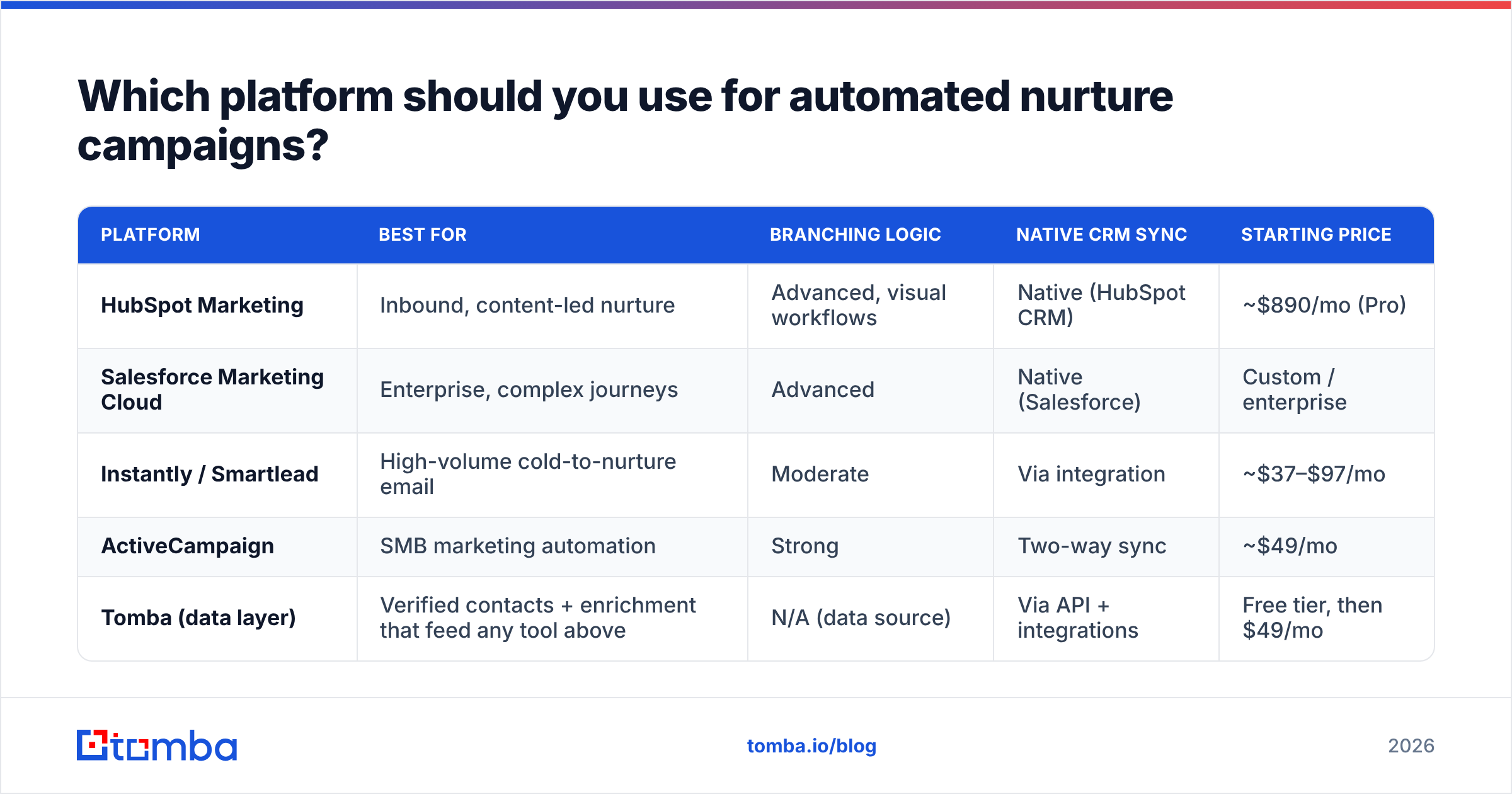
The right tool depends on whether you lean marketing (inbound, content-driven) or sales (outbound, rep-driven). Below is an honest comparison of common categories so you can match the platform to your motion.
| Platform | Best for | Branching logic | Native CRM sync | Starting price |
|---|---|---|---|---|
| HubSpot Marketing | Inbound, content-led nurture | Advanced, visual workflows | Native (HubSpot CRM) | ~$890/mo (Pro) |
| Salesforce Marketing Cloud | Enterprise, complex journeys | Advanced | Native (Salesforce) | Custom / enterprise |
| Instantly / Smartlead | High-volume cold-to-nurture email | Moderate | Via integration | ~$37–$97/mo |
| ActiveCampaign | SMB marketing automation | Strong | Two-way sync | ~$49/mo |
| Tomba (data layer) | Verified contacts + enrichment that feed any tool above | N/A (data source) | Via API + integrations | Free tier, then $49/mo |
A point worth being honest about: most of these platforms assume you already have clean, accurate contact data. They are execution engines, not data sources. That's where a tool like Tomba sits underneath your nurture stack rather than competing with it—you find and verify the contacts, then push them into whichever automation platform runs your sequences. Compare full Tomba pricing against the marketing-suite costs above and the math usually favors keeping data and execution as separate, specialized layers.
For a deeper third-party view of automation platforms, G2's marketing automation category and HubSpot's own workflow documentation are useful neutral references when you shortlist.
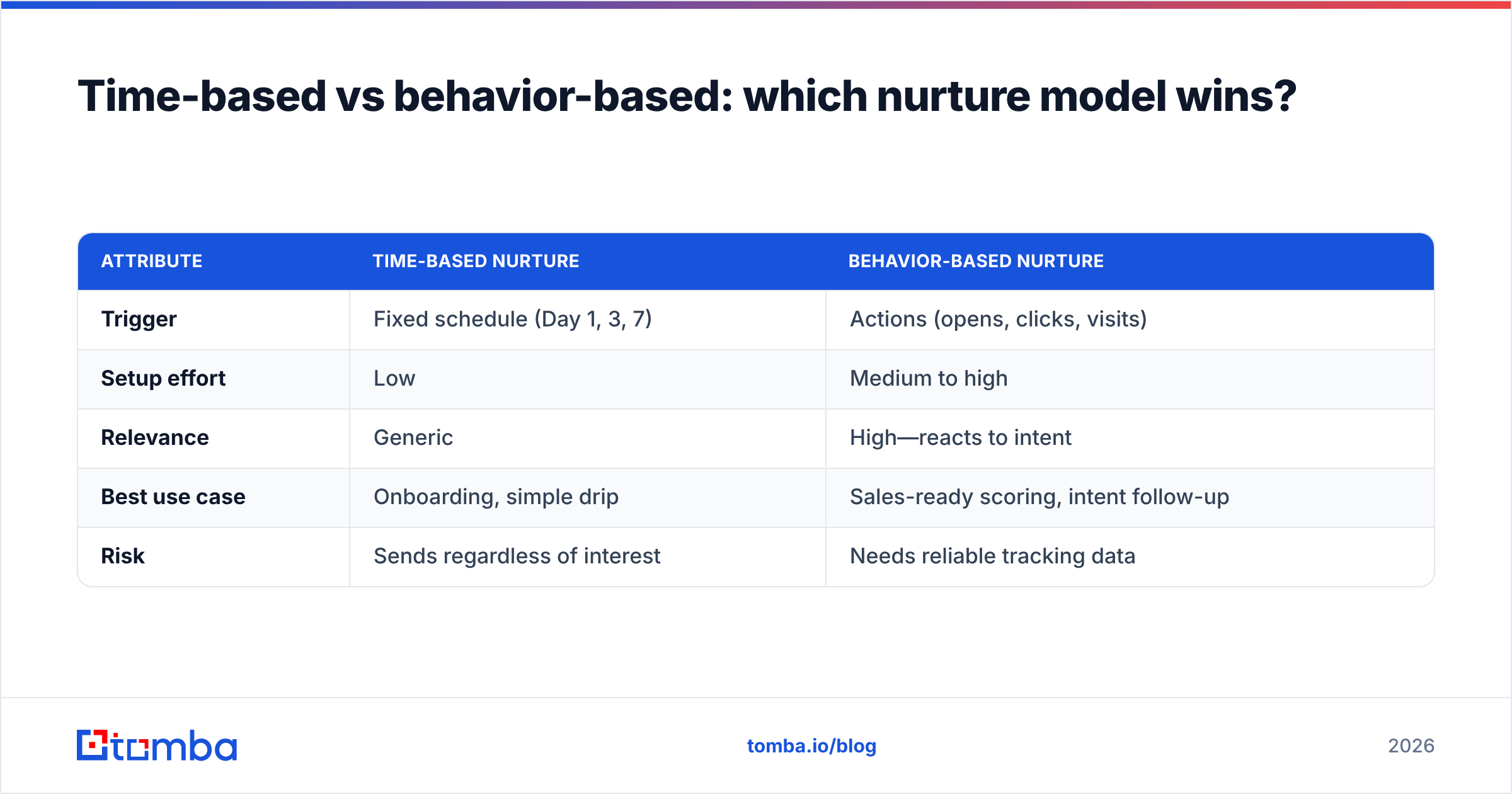
Time-based vs behavior-based: which nurture model wins?#
Behavior-based wins on results, but time-based is easier to launch—so most teams blend the two.
| Attribute | Time-based nurture | Behavior-based nurture |
|---|---|---|
| Trigger | Fixed schedule (Day 1, 3, 7) | Actions (opens, clicks, visits) |
| Setup effort | Low | Medium to high |
| Relevance | Generic | High—reacts to intent |
| Best use case | Onboarding, simple drip | Sales-ready scoring, intent follow-up |
| Risk | Sends regardless of interest | Needs reliable tracking data |
A pragmatic pattern: start every lead on a light time-based backbone (so no one falls through the cracks), and layer behavior triggers on top so engaged leads accelerate and disengaged ones slow down. The blend gives you coverage and relevance without overbuilding on day one.
How do you measure if a nurture campaign is working?#
Track the funnel, not just the inbox. Opens feel good but rarely correlate with revenue. The metrics that matter, in order:
- Reply rate — the first real signal of relevance. Below 2% on a warm segment means the messaging is off.
- Meeting-booked rate — the conversion you actually care about. This is your campaign's reason to exist.
- Pipeline contribution — dollar value of opportunities the campaign sourced or influenced.
- Unsubscribe and spam rate — your early-warning system. A rising spam rate means you're nurturing too aggressively or the list is dirty.
- Bounce rate — keep it under 2–3%. Higher means your verification step is failing and your sender reputation is at risk.
Salesforce and other CRM vendors publish B2B benchmark research worth reviewing to set realistic targets for your industry—don't anchor on the inflated open rates vendors love to quote.
How does data quality change your nurture results?#
Data quality is the multiplier on everything else. Two teams can run the identical sequence; the one with verified, enriched contacts will see double the reply rate because their messages reach real inboxes and their segmentation is accurate.
Here's the cause-and-effect chain:
- Verified emails → low bounce rate → protected sender reputation → more messages delivered.
- Enriched records → accurate segmentation → relevant copy → higher reply rate.
- Deduplicated lists → no contact gets three "first touches" → less unsubscribe damage.
This is why the smartest move before launching any automated nurture campaign is not picking a fancier tool—it's cleaning and completing your contact data. A free email checker handles spot checks; a bulk email finder handles list-scale enrichment when you're filling in missing decision-makers across hundreds of target accounts.
What does a good 5-touch nurture sequence look like?#
A reliable starting template, tuned for a re-engagement segment:
- Touch 1 (Day 1): Lead with a relevant insight or resource. No ask. Establish you're worth reading.
- Touch 2 (Day 4): Share a customer story that mirrors their situation. Soft CTA: "Worth a look?"
- Touch 3 (Day 8): Address a specific objection or pain point. Offer a concrete next step.
- Touch 4 (Day 12): Direct ask for a short call, with two specific time windows.
- Touch 5 (Day 16): A short, polite breakup email. "I'll stop here—reply if the timing changes." These often outperform every earlier touch because they create urgency and feel human.
Behavior overrides the schedule: a pricing-page visit triggers an immediate rep notification, and any reply exits the contact from the automation. Keep the copy short, second person, and specific. If a sentence could appear in anyone's email, cut it.
Closing: clean data first, then automate#
Automated nurture campaigns reward the teams that treat data as the foundation, not an afterthought. The sequence logic, the platform, the clever copy—all of it sits on top of whether your messages actually reach real, correctly-segmented people.
Start there. Use the Tomba Email Finder to source and verify the contacts feeding your nurture flows, enrich them with the role and company data your branching logic needs, and push the clean list into whichever automation platform runs your sequences. The free tier gives you 25 searches a month to test it; the $49/mo Starter plan scales with your first real campaigns. Get the data right, and every nurture touch you send afterward works harder.
// get started
Find, verify and enrich your first contacts today
Start on the free plan with 25 searches a month, then scale when your team is ready.
Free plan · No credit card required · GDPR & CCPA
// about the author