Automated Sales Funnel in 2026: A Complete Build Guide
An automated sales funnel turns scattered leads into predictable revenue. Here's how to build one in 2026 — stages, tools, and the data layer that makes it work.
TL;DR
- An automated sales funnel uses software to move a prospect from first touch to closed deal with minimal manual work — capture, enrich, score, nurture, and hand off, all triggered by behavior.
- The funnel is only as good as the data feeding it. Garbage contacts in means bounced emails and dead sequences out.
- You can build a working version with five layers: capture, data/enrichment, scoring, nurture automation, and CRM handoff.
- Automation handles volume and timing; humans still close. Don't automate the parts that need a pulse.
- Start lean: a free email finder, one CRM, and one sequencing tool will outperform a bloated stack you never configure.
What is an automated sales funnel?#
An automated sales funnel is a system that guides prospects through predictable stages — awareness, interest, evaluation, and decision — using software triggers instead of manual nudges. Think of it like an airport baggage system: you drop a bag at check-in and it routes itself through scanners, sorters, and conveyors to the right plane without a person carrying it the whole way. Your leads should travel the same way.
Technically, the funnel is a chain of conditional automations. A form fill triggers an enrichment lookup. Enriched data triggers a score. A score above a threshold triggers a sequence. A reply triggers a CRM task for a human. Each stage hands off cleanly to the next, and nothing sits in a spreadsheet waiting for someone to remember it.
The payoff is consistency. A manual process forgets to follow up on Friday afternoon. An automated one doesn't. Done right, it compresses your sales cycle and lets a small team behave like a large one.
)
Why do most sales funnels fail without automation?#
Most funnels leak at the seams — the handoffs between stages. A lead fills out a form, then waits three days for a rep to notice. A prospect replies "interested," and the message gets buried. These are timing failures, and timing is exactly what software is good at.
The second failure mode is bad data. According to HubSpot research, a meaningful share of B2B contact data decays every year as people change jobs. If your funnel runs on a list you bought 18 months ago, you're automating bounces. That's why the data layer — not the email tool — is the real foundation.
The third is over-automation. Teams wire up a 12-step sequence, set it live, and never read a reply. Prospects can tell when they're talking to a conveyor belt. The fix isn't less automation; it's automating the mechanical work (lookups, scheduling, logging) and reserving humans for judgment (objection handling, pricing, trust).
What are the stages of an automated sales funnel?#
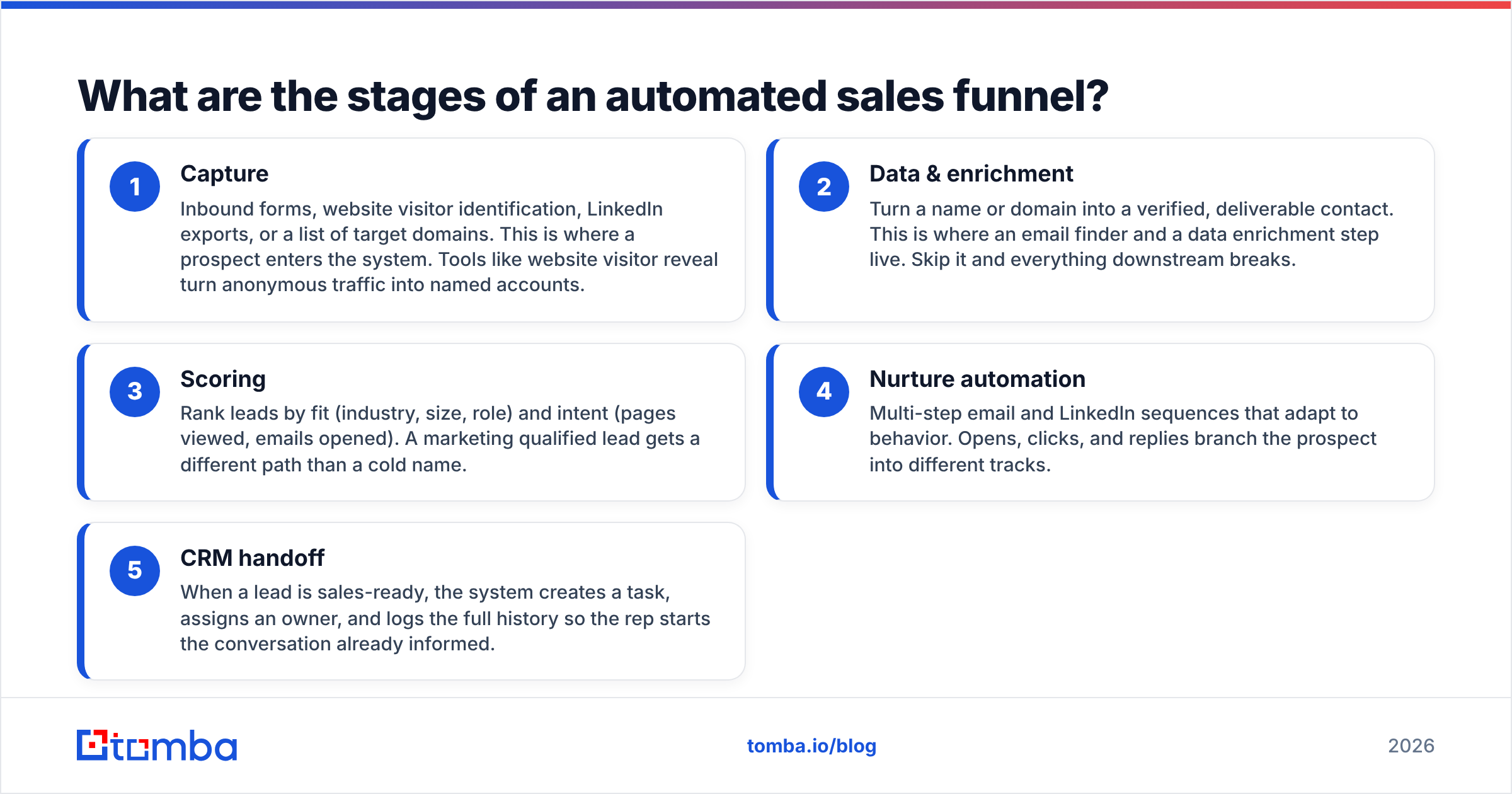
Every funnel has the same skeleton, regardless of tooling. Here are the five layers you actually need to build, in order:
- Capture — Inbound forms, website visitor identification, LinkedIn exports, or a list of target domains. This is where a prospect enters the system. Tools like website visitor reveal turn anonymous traffic into named accounts.
- Data & enrichment — Turn a name or domain into a verified, deliverable contact. This is where an email finder and a data enrichment step live. Skip it and everything downstream breaks.
- Scoring — Rank leads by fit (industry, size, role) and intent (pages viewed, emails opened). A marketing qualified lead gets a different path than a cold name.
- Nurture automation — Multi-step email and LinkedIn sequences that adapt to behavior. Opens, clicks, and replies branch the prospect into different tracks.
- CRM handoff — When a lead is sales-ready, the system creates a task, assigns an owner, and logs the full history so the rep starts the conversation already informed.
The mistake is building stage 4 first because sequencing tools are flashy. Build stage 2 first. Clean data is the cheapest way to lift every metric above it.
Which tools do you need to automate a sales funnel?#
You can assemble a capable funnel from four categories of tool. You don't need all of them on day one, but you'll want at least one in each column as you scale.
| Funnel layer | What it does | Example tools | Starting cost |
|---|---|---|---|
| Data & enrichment | Find and verify contacts | Tomba, Clearbit, Apollo | Free tier available |
| Sequencing | Send and branch outreach | Instantly, Salesloft, Reply.io | ~$30–$100/mo |
| CRM | Store and route deals | HubSpot, Pipedrive, Salesforce | Free–$50/seat |
| Automation glue | Connect the stack |
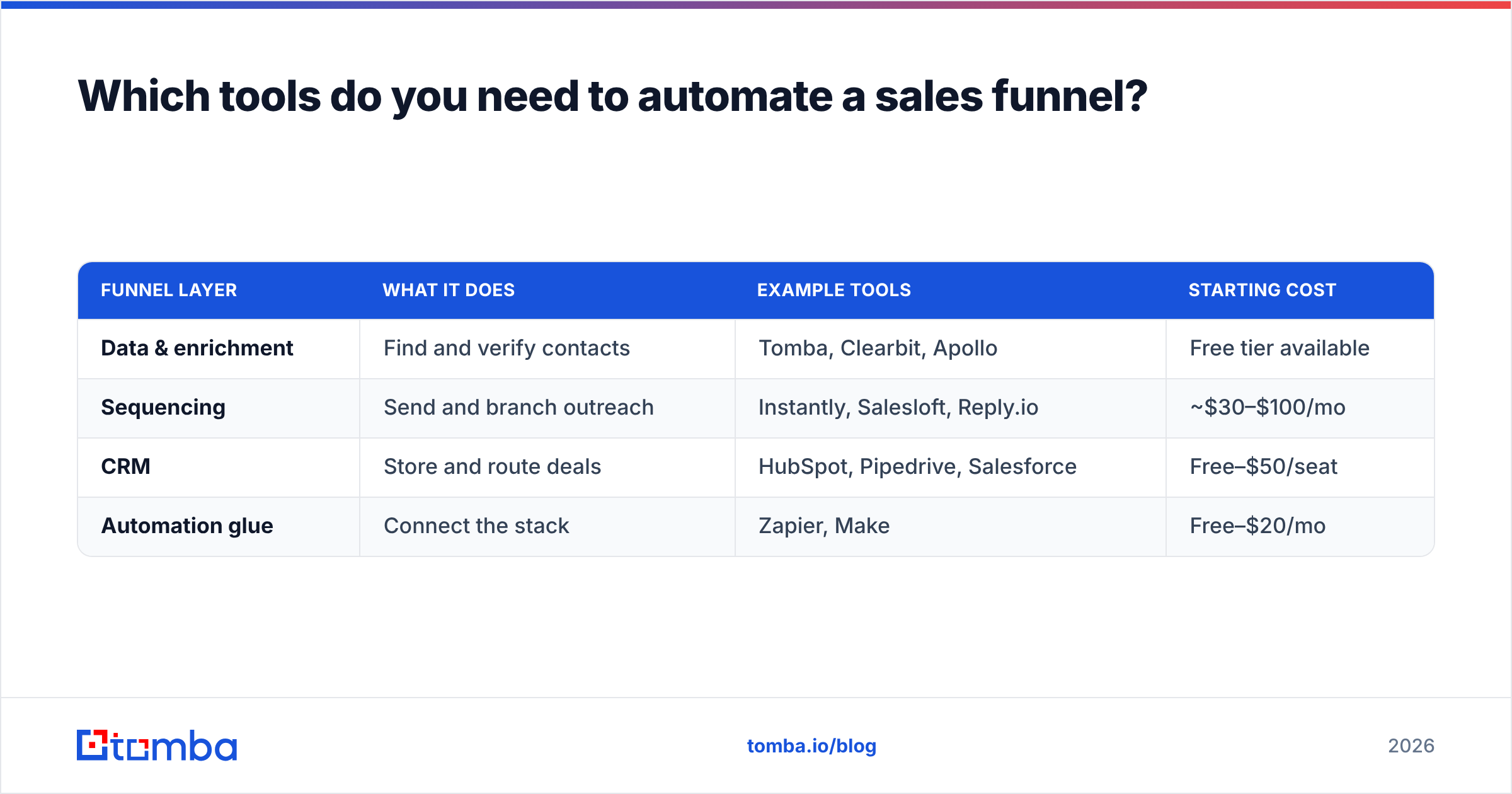
Zapier, Make | Free–$20/mo |
The "glue" layer matters more than people expect. A funnel is a series of handoffs, and tools like Zapier or Make.com are what carry a verified contact from your finder into your CRM without copy-paste. If you already run HubSpot, the native HubSpot integration removes a step entirely.
A note on cost discipline: more tools is not more pipeline. Two well-connected tools beat six that don't talk to each other. Audit your stack quarterly and cut anything that hasn't fired an automation in 30 days.
How does data quality make or break funnel automation?#
Data quality is the single biggest lever on funnel performance, full stop. Every downstream metric — deliverability, reply rate, meetings booked — sits on top of whether the contact is real and reachable.
Here's the chain reaction. Send to unverified addresses and your bounce rate climbs. A high bounce rate damages your sender reputation. A damaged reputation means even your good emails land in spam. Now your entire funnel underperforms, and you blame the copy when the real problem was the list. Run contacts through an email verifier before they ever enter a sequence, and you cut that failure off at the source.
)
The trickiest data problem is catch-all domains — servers that accept every address whether the mailbox exists or not. Standard verification can't confirm them, which is why a dedicated catch-all verifier exists. For B2B funnels targeting enterprise domains, this is the difference between a 2% and a 12% bounce rate.
Where does the data come from? Reputable providers are transparent about their data sources and refresh cadence. Treat any vendor that won't explain where its emails originate as a liability, not an asset — opaque data is how you end up on a blacklist.
Is an automated sales funnel better than a manual one?#
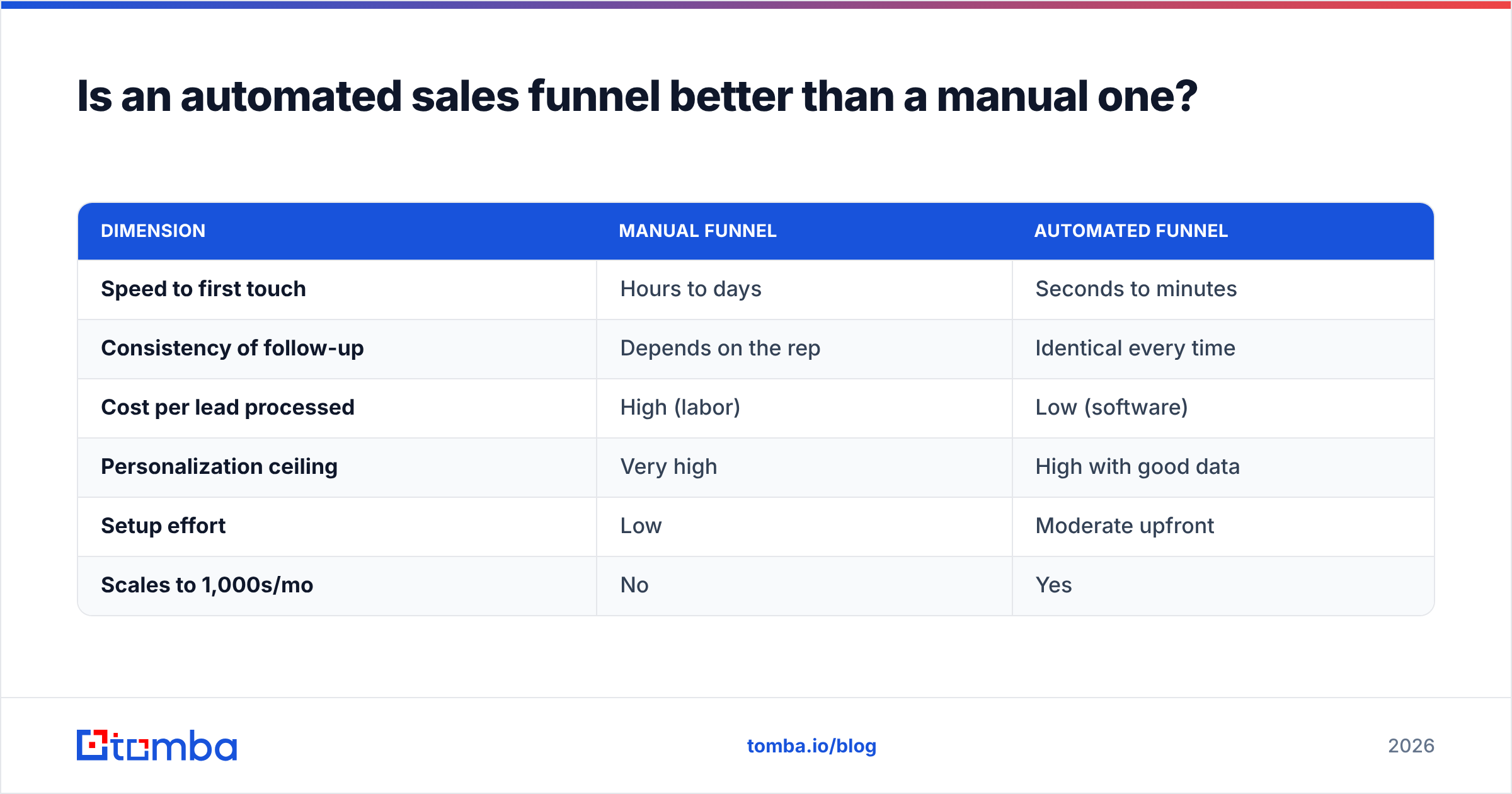
For repeatable, high-volume motions, automation wins on every measurable axis. For complex, high-touch enterprise deals, a hybrid wins. The right answer depends on your deal size and volume, so weigh both honestly.
| Dimension | Manual funnel | Automated funnel |
|---|---|---|
| Speed to first touch | Hours to days | Seconds to minutes |
| Consistency of follow-up | Depends on the rep | Identical every time |
| Cost per lead processed | High (labor) | Low (software) |
| Personalization ceiling | Very high | High with good data |
| Setup effort | Low | Moderate upfront |
| Scales to 1,000s/mo | No | Yes |
The honest caveat: automation amplifies whatever you point it at. A great offer with clean data scales beautifully. A weak offer with bad data scales your failure faster. Fix the fundamentals before you pour volume through the pipe.
There's also a trust cost to getting it wrong. Buyers in 2026 are fluent in automated outreach and instantly recognize a generic blast. The funnels that win use automation for timing and routing while keeping the message specific to the account. According to Gartner, B2B buyers spend the majority of their journey doing independent research — so your automation should feel like a helpful concierge showing up at the right moment, not a megaphone.
How do you build an automated sales funnel step by step?#
Here's a concrete build order you can implement this week. It assumes a B2B motion and a modest budget.
- Define one ideal customer profile. Pick a single industry, company size, and job title. A narrow funnel converts; a broad one leaks.
- Source target domains. Pull a list of companies that match. Use domain search to find every relevant contact at each company in one pass.
- Find and verify contacts. Run names and domains through an email finder, then verify. For large lists, a bulk email finder processes thousands at once. Add B2B phone numbers for a multi-channel touch.
- Push verified data to your CRM. Use a native integration or Zapier so every confirmed contact lands with full firmographic detail attached.
- Build the scoring rule. Even a simple "title matches ICP = +10, opened email = +5" rule routes hot leads to humans and keeps cold ones in nurture.
- Write a three-touch sequence with branches. Touch one is value, touch two is a case study, touch three is a direct ask. Branch on replies — a reply pulls the prospect out of automation and into a human conversation.
- Set the human handoff. When a lead crosses your score threshold or replies, auto-create a CRM task assigned to a rep, with the full history attached.
That's a complete funnel. Notice that steps 2–4 are all data work. If you're not sure where to start, the Tomba API lets you wire finding, verification, and enrichment directly into whatever capture form or CRM you already run, so the data layer becomes invisible plumbing rather than a manual chore.
How do you measure and improve an automated funnel?#
Track five numbers and review them weekly. Vanity metrics like "emails sent" tell you nothing; these tell you where the funnel leaks.
- Bounce rate — Should sit under 3%. Higher means your verification step is failing or your data is stale.
- Reply rate — The honest measure of message-market fit. Under 1% means the offer or targeting is off, not the volume.
- Lead-to-meeting rate — How many qualified leads become real conversations. This exposes handoff problems.
- Sales cycle length — Automation should compress this. If it isn't, your handoffs are slow.
- Response rate by segment — Compare your response rate across industries and titles to find your best-fit niche, then double down.
Improve by changing one variable at a time. Swap the subject line for two weeks, measure, then swap the offer. Funnels that get tweaked on instinct never compound; funnels that get tested methodically get better every quarter. Tools like G2 are useful for benchmarking which platforms other teams in your category actually keep versus churn.
Common mistakes that quietly kill funnel automation#
A few failure patterns show up again and again. Watch for these:
- Skipping verification to save credits. You'll spend the savings ten times over on a damaged sender reputation.
- Over-segmenting before you have volume. Twelve micro-sequences with ten contacts each can't teach you anything. Start with one.
- Automating the reply. The moment a human responds, a human should answer. Never let a bot handle a live buyer.
- No exit conditions. Every sequence needs a "stop" trigger — a reply, a meeting booked, an unsubscribe. Funnels that keep emailing engaged prospects feel robotic and burn trust.
- Ignoring deliverability hygiene. Warm your domain, authenticate it, and monitor email deliverability continuously. The best funnel in the world fails from the spam folder.
Build your funnel on data you can trust#
An automated sales funnel lives or dies on the contacts feeding it. You can perfect your copy, scoring, and sequencing — but if the email bounces, none of it fires. Start at the foundation: a verified, deliverable list of people who actually match your ideal customer.
The Tomba Email Finder is built for exactly this. Find professional email addresses by domain, name, or company, verify them in the same flow, and push clean records straight into your funnel through the API or a native CRM integration. The free tier gives you 25 searches a month to test the fit, and paid plans start at $49/mo on the Starter tier — see the full Tomba pricing for Growth ($99/mo) and Pro ($249/mo). Feed your funnel real data, and every automation above it starts to pay off.
// get started
Find, verify and enrich your first contacts today
Start on the free plan with 25 searches a month, then scale when your team is ready.
Free plan · No credit card required · GDPR & CCPA
// about the author