Automated Sales Outreach in Healthcare: 2026 Playbook
Selling into hospitals, clinics, and health systems is slow and compliance-heavy. Here is how to automate healthcare sales outreach in 2026 without tripping HIPAA or torching your domain.
Selling into healthcare is its own sport. The buying committee is large, the compliance bar is high, and the people you need to reach — clinical directors, practice managers, VPs of revenue cycle — guard their inboxes like a triage nurse guards a crash cart. Automated sales outreach healthcare campaigns can work, but the rules are stricter than in almost any other B2B vertical.
This guide shows you how to build automated sales outreach for healthcare that stays compliant, protects your sending domain, and still books meetings in 2026.
TL;DR#
- Automation works in healthcare — but only on top of clean, consented, verified data. Bad lists are the fastest way to a HIPAA headache and a blacklisted domain.
- Separate marketing outreach from anything touching PHI. Prospecting an office manager about your software is fine; automation must never carry protected health information.
- Verification is non-negotiable. Healthcare email lists decay 25–30% a year as staff rotate. Verify before every send.
- Multi-channel beats email-only. Pair email with phone and LinkedIn — clinical buyers respond on different channels than SaaS buyers.
- Tooling stack: a compliant data/finder layer (Tomba), a sequencer, and a CRM. Keep them tight and auditable.
Why is healthcare outreach harder than normal B2B?#
Three forces make this vertical unforgiving.
First, regulation. HIPAA governs protected health information, and while a cold sales email to a hospital procurement lead usually isn't PHI, the moment your automation references a patient, a claim, or a clinical record, you're in regulated territory. The U.S. Department of Health and Human Services publishes the actual HIPAA rules — read them, don't guess.
Second, gatekeeping and turnover. Healthcare has some of the highest administrative staff turnover in any industry. The practice manager you found last quarter may already be gone, which means your "verified" list rots fast.
Third, trust. Clinical and administrative buyers are bombarded by vendors. Generic "I'd love to hop on a call" templates get deleted on sight. Relevance and credibility do the heavy lifting.
)
What does "compliant" automated outreach actually look like?#
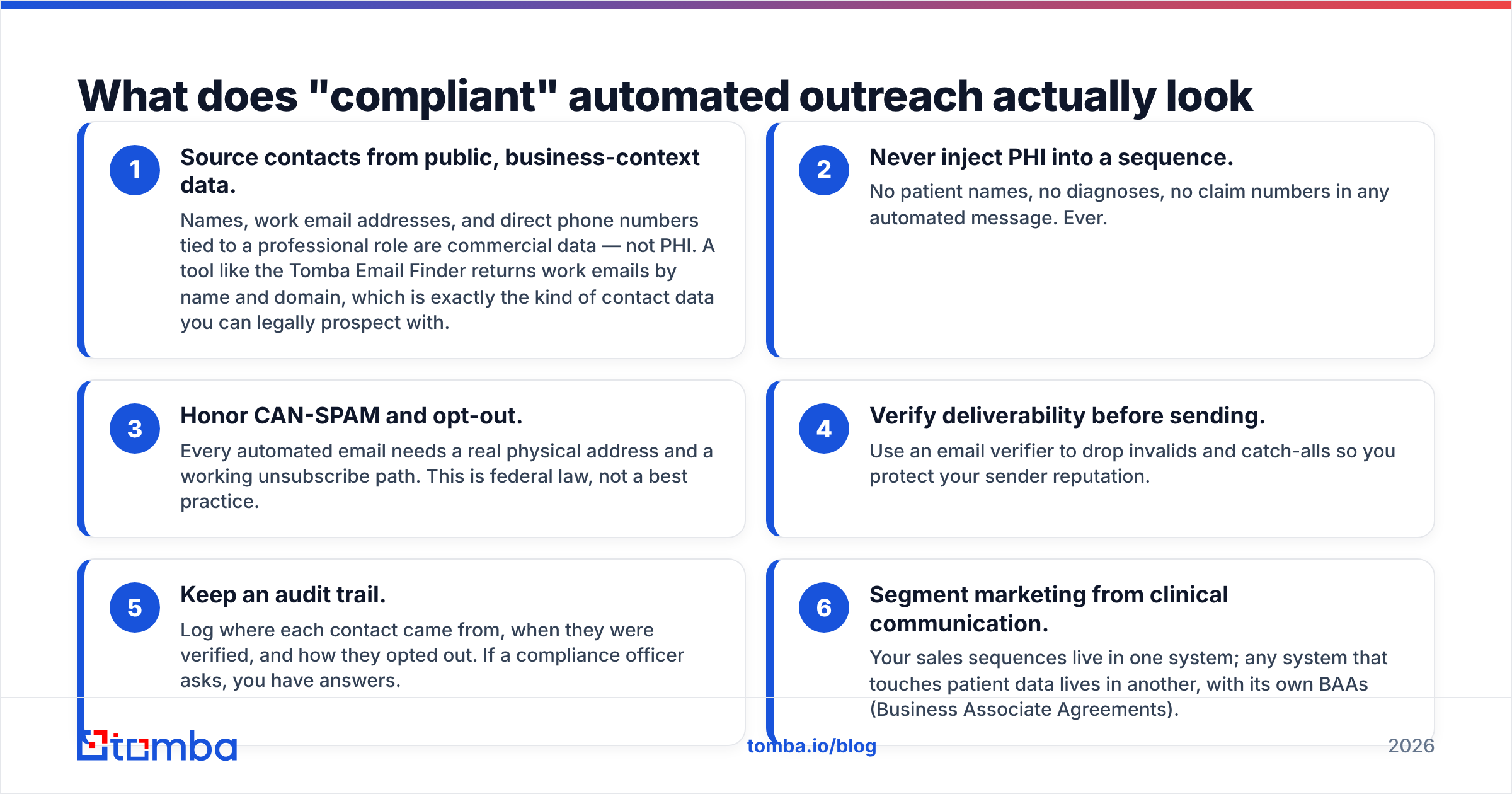
Compliant automation is less about the software and more about what data flows through it. Here's the core concept as a structured checklist:
- Source contacts from public, business-context data. Names, work email addresses, and direct phone numbers tied to a professional role are commercial data — not PHI. A tool like the Tomba Email Finder returns work emails by name and domain, which is exactly the kind of contact data you can legally prospect with.
- Never inject PHI into a sequence. No patient names, no diagnoses, no claim numbers in any automated message. Ever.
- Honor CAN-SPAM and opt-out. Every automated email needs a real physical address and a working unsubscribe path. This is federal law, not a best practice.
- Verify deliverability before sending. Use an email verifier to drop invalids and catch-alls so you protect your sender reputation.
- Keep an audit trail. Log where each contact came from, when they were verified, and how they opted out. If a compliance officer asks, you have answers.
- Segment marketing from clinical communication. Your sales sequences live in one system; any system that touches patient data lives in another, with its own BAAs (Business Associate Agreements).
Nail those six and automation becomes a force multiplier instead of a liability.
How do you build a healthcare outreach data layer?#
Garbage in, garbage out — and in healthcare, garbage in can also mean compliance exposure. Your data layer needs three jobs done well: find, verify, and enrich.
Find. Start from the organization. Hospitals, clinics, dental groups, and medtech firms all have predictable email patterns. Run a domain search on a health system's domain to surface the roles you care about — procurement, IT, revenue cycle, department heads — instead of buying a stale list you can't trace.
Verify. Healthcare inboxes churn. A name that resolved six months ago may now bounce. Bouncing 8% of a send tanks your domain reputation and quietly kills deliverability for the rest of the campaign. Verify the full list immediately before each batch, and re-verify anything older than 30 days.
Enrich. Role, seniority, facility size, and specialty let you segment so the message is relevant. A 4-provider dental practice and a 600-bed hospital network need completely different pitches.
)
Which tools fit a healthcare outreach stack in 2026?#
You need three layers: a compliant data/finder layer, a sequencer, and a CRM. Many teams over-buy here. You rarely need a single mega-platform; a tight, auditable stack is easier to defend in a compliance review.
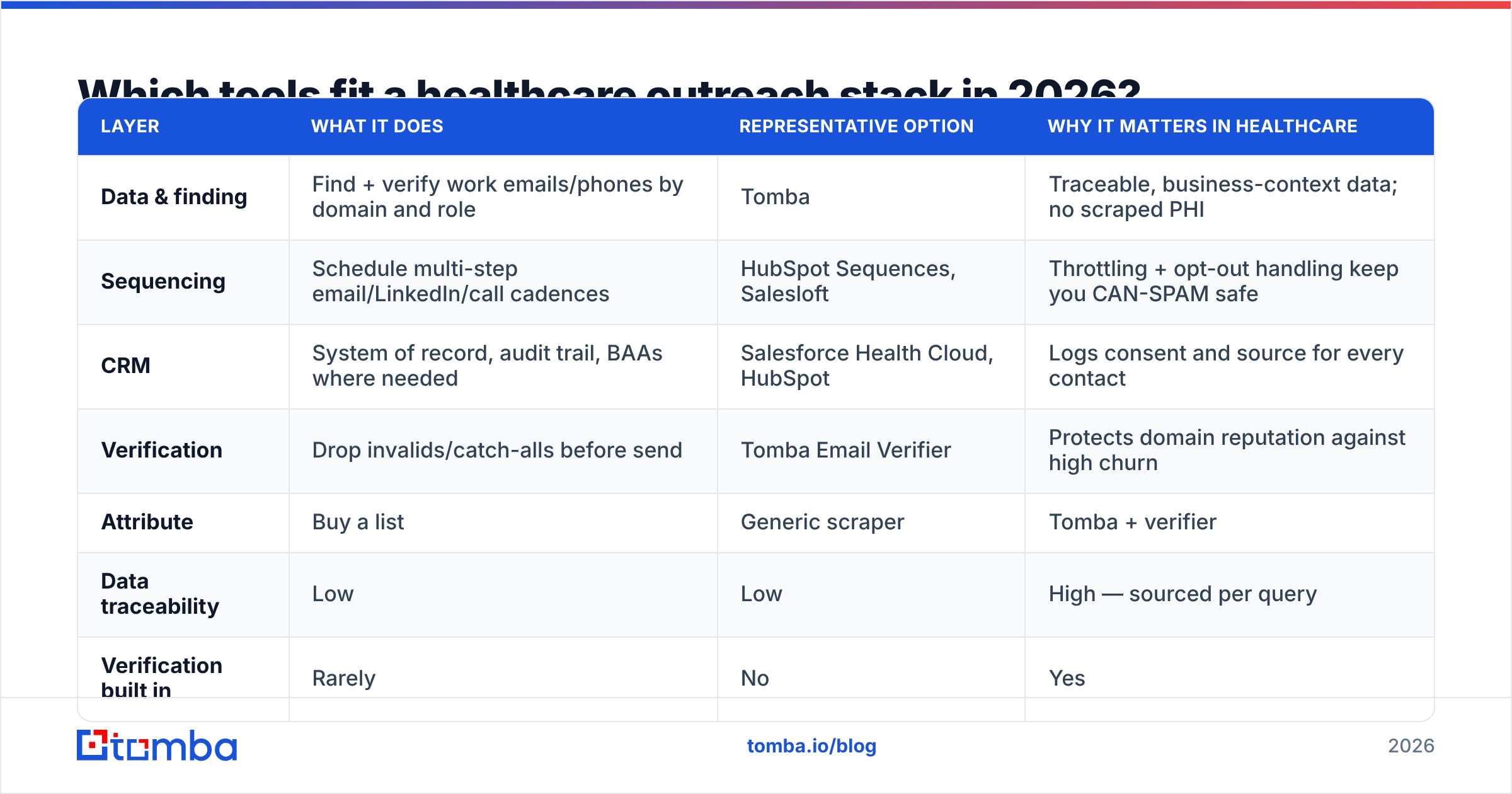
| Layer | What it does | Representative option | Why it matters in healthcare |
|---|---|---|---|
| Data & finding | Find + verify work emails/phones by domain and role | Tomba | Traceable, business-context data; no scraped PHI |
| Sequencing | Schedule multi-step email/LinkedIn/call cadences | HubSpot Sequences, Salesloft | Throttling + opt-out handling keep you CAN-SPAM safe |
| CRM | System of record, audit trail, BAAs where needed | Salesforce Health Cloud, HubSpot | Logs consent and source for every contact |
| Verification | Drop invalids/catch-alls before send | Tomba Email Verifier | Protects domain reputation against high churn |
How a few approaches compare on the attributes that matter most for this vertical:
| Attribute | Buy a list | Generic scraper | Tomba + verifier |
|---|---|---|---|
| Data traceability | Low | Low | High — sourced per query |
| Verification built in | Rarely | No | Yes |
| Free tier to test | No | Varies | 25 searches/mo |
| Starter price | Often $1k+ upfront | Cheap but risky | $49/mo |
| Compliance posture | Weak | Weak | Defensible |
Tomba's published pricing runs Free (25 searches/mo), Starter $49/mo, Growth $99/mo, Pro $249/mo, and Enterprise custom — so you can pilot a healthcare campaign on the free tier before committing budget. For deeper feature comparisons across vendors, independent review sites like G2 are a better neutral reference than any vendor's own page.
How should you sequence outreach to healthcare buyers?#
Email-only sequences underperform here. Clinical and administrative buyers often answer a direct phone call faster than they open a cold email, and many vet vendors on LinkedIn before replying. Multi-channel is the default, not a bonus.
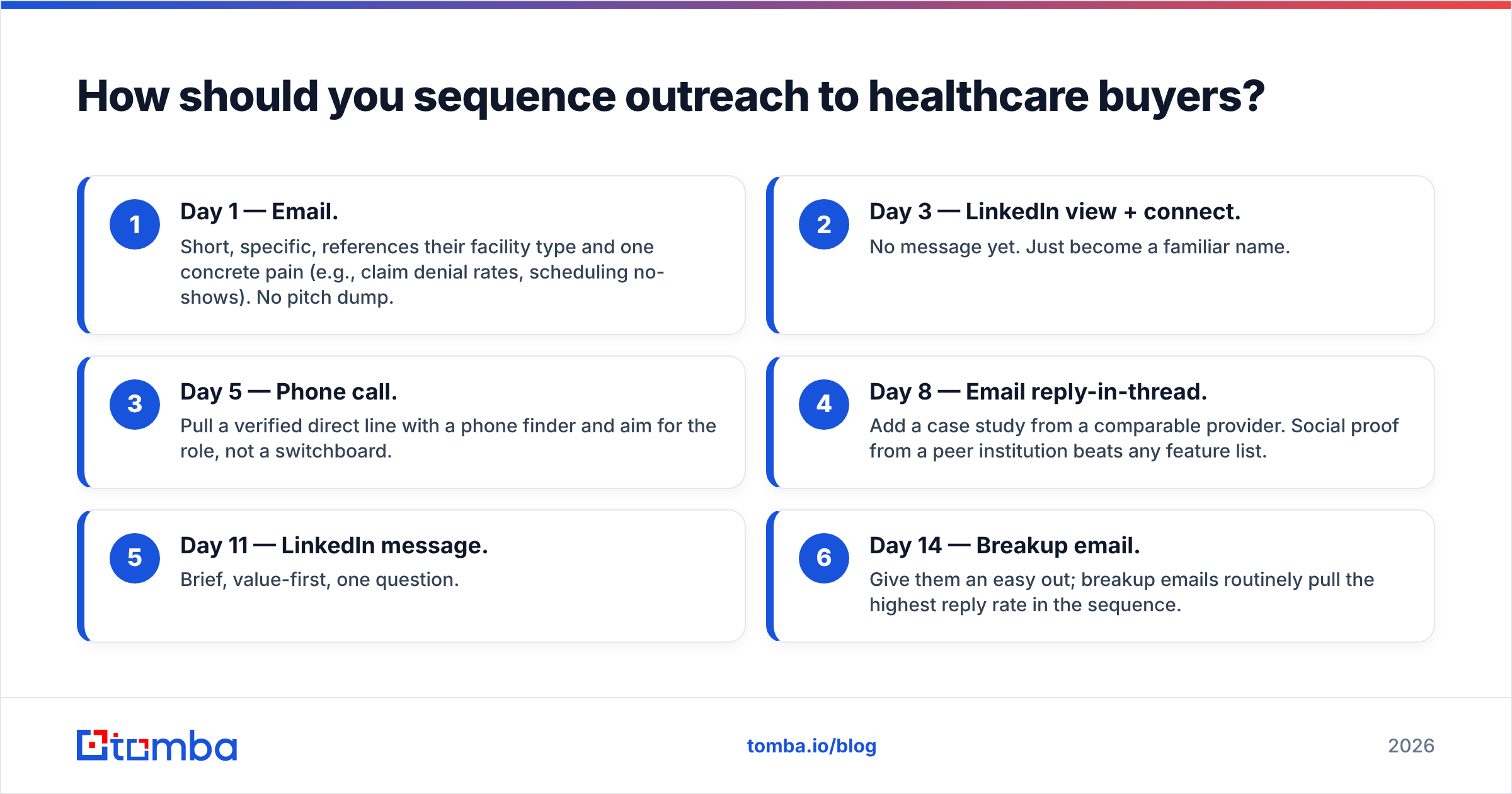
A workable 14-day cadence for a mid-market health system:
- Day 1 — Email. Short, specific, references their facility type and one concrete pain (e.g., claim denial rates, scheduling no-shows). No pitch dump.
- Day 3 — LinkedIn view + connect. No message yet. Just become a familiar name.
- Day 5 — Phone call. Pull a verified direct line with a phone finder and aim for the role, not a switchboard.
- Day 8 — Email reply-in-thread. Add a case study from a comparable provider. Social proof from a peer institution beats any feature list.
- Day 11 — LinkedIn message. Brief, value-first, one question.
- Day 14 — Breakup email. Give them an easy out; breakup emails routinely pull the highest reply rate in the sequence.
Keep daily send volume low and warmed. Healthcare domains often have aggressive spam filtering, so a slow, reputation-safe ramp beats blasting 500 emails on day one.
What does a good healthcare cold email look like?#
Three rules separate replies from the trash folder:
- Lead with their world, not your product. "Saw your network added two urgent-care sites this year" lands; "We're an industry-leading platform" does not.
- Be specific and short. Under 90 words. One ask. One link, max.
- Prove credibility fast. Name a comparable client, a relevant certification, or a concrete metric. Vague claims read as risk to a compliance-minded buyer.
If you want a starting framework, vendor playbooks like HubSpot's sales email guidance are a solid, free reference for structure — then adapt the tone for a clinical audience that has zero patience for fluff.
How do you measure and protect deliverability?#
Two dashboards matter: the campaign metrics (open, reply, meeting rates) and the health metrics (bounce rate, spam complaints, domain reputation). In healthcare, the second set is where campaigns die.
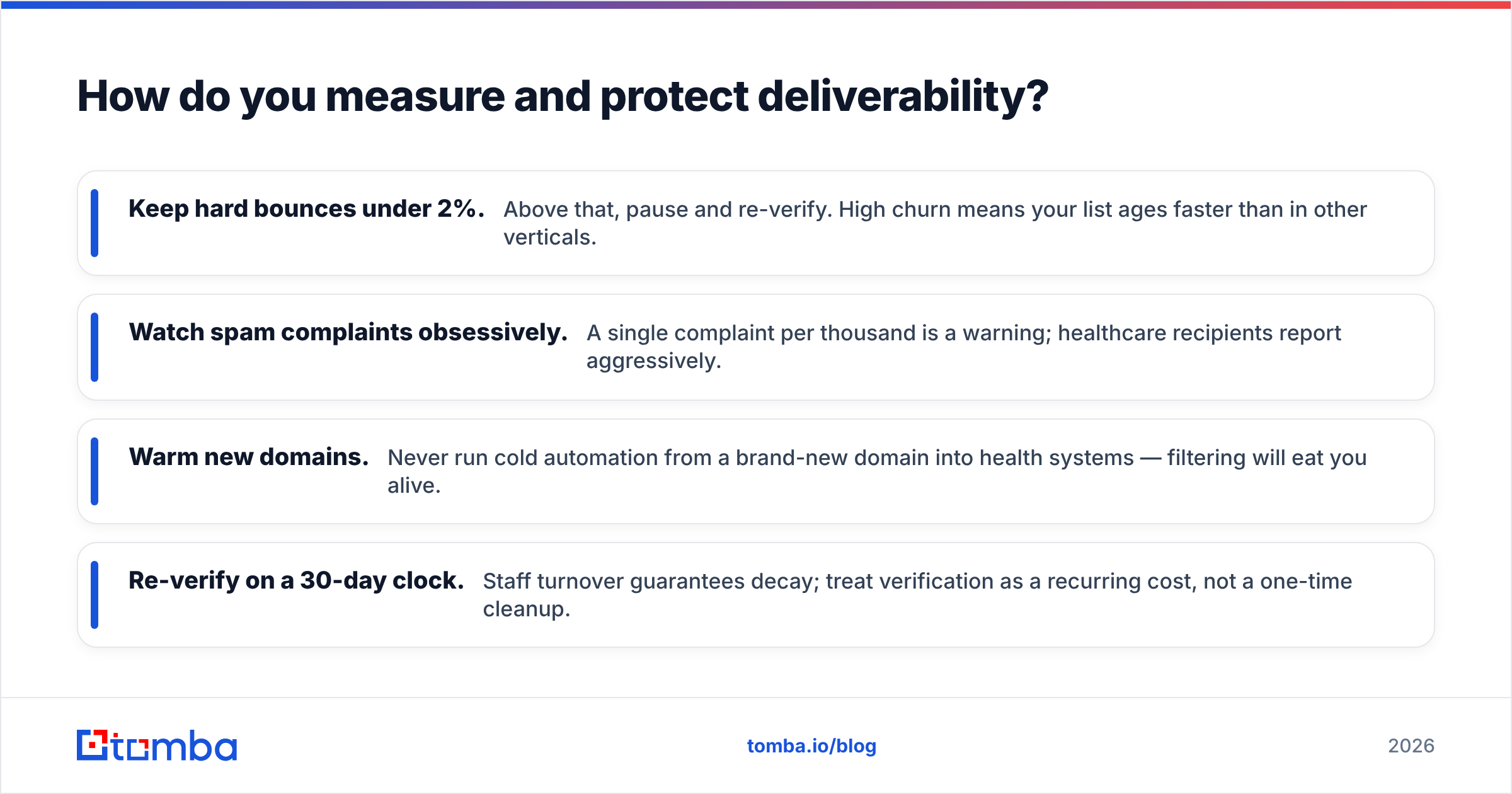
- Keep hard bounces under 2%. Above that, pause and re-verify. High churn means your list ages faster than in other verticals.
- Watch spam complaints obsessively. A single complaint per thousand is a warning; healthcare recipients report aggressively.
- Warm new domains. Never run cold automation from a brand-new domain into health systems — filtering will eat you alive.
- Re-verify on a 30-day clock. Staff turnover guarantees decay; treat verification as a recurring cost, not a one-time cleanup.
The cheapest insurance against all of this is verifying every address before it enters a sequence. A clean list of 400 beats a dirty list of 4,000 every single time.
Common mistakes to avoid#
- Putting PHI in a sequence. The single fastest way to turn a marketing problem into a legal one.
- Buying a "healthcare decision-maker" list. Untraceable, stale, and often non-compliant. Source per-query instead.
- One message for every facility size. A solo practice and a hospital network are different buyers with different budgets and cycles.
- Skipping verification to "save time." You'll pay it back tenfold in lost deliverability.
- Email-only cadences. You're leaving the phone and LinkedIn — the two channels healthcare buyers actually answer — on the table.
Putting your automated sales outreach healthcare plan together#
Automated sales outreach in healthcare isn't about sending more — it's about sending clean, relevant, compliant messages to verified people through more than one channel. Get the data layer right and the rest of the stack is straightforward.
Start where the leverage is highest: accurate, traceable contact data. Use the Tomba Email Finder to pull work emails and direct lines by domain and role. Run them through Tomba's email verifier before every batch. Then feed only clean, opted-in contacts into your sequencer. You can pilot the whole approach on the free tier — 25 searches a month — before you spend a dollar, then scale into a paid plan once your healthcare campaign is proving out meetings. Build the data layer right, and compliant automation stops being a contradiction and starts being your edge.
Ready to find emails that actually work?
Join 150,000+ professionals who stopped guessing and started sending. Free credits on signup — no credit card required.
Get the Tomba newsletter
Practical outbound tactics and product updates — once every two weeks.
About the author