Automation vs Manual Follow-Ups: What Wins in 2026?
Should you automate every follow-up or send each one by hand? Here is the honest 2026 breakdown of reply rates, cost, and where each approach actually wins.
Most reps lose deals not because the first email was bad, but because the second, third, and fourth never went out. The real question for 2026 is not whether to follow up — it is whether a machine or a human should be pulling the trigger.
TL;DR
- Automation wins on consistency and scale. It never forgets day 3, day 7, or day 14, and it lets one rep run thousands of sequences at once.
- Manual wins on relevance and trust. A hand-written reply that references a prospect's latest post still out-converts any template on high-value accounts.
- The data is lopsided but nuanced: automated cadences drive volume, but personalized manual touches can lift reply rates 2–3x on the accounts that matter.
- The 2026 winner is hybrid: automate the structure and timing, reserve human effort for the moments where a real person changes the outcome.
- Clean data is the prerequisite. Neither approach survives a list full of bounces — start by verifying contacts with a tool like Tomba Email Finder.
What is the difference between automated and manual follow-ups?#
The difference is who decides to send and who writes the message. A manual follow-up is a human choosing, in the moment, to reach back out — opening the thread, reading the context, typing something specific, and hitting send. An automated follow-up is a pre-built sequence: you write the steps once, set the timing, and software sends each touch on schedule unless the prospect replies or books.
Think of it like cooking. Manual follow-ups are a chef plating each dish by hand — slow, expensive, but precise. Automation is a well-run kitchen line — every plate comes out on time and identical, but nobody is adjusting the seasoning for the person at table 9.
Both are trying to solve the same problem: 80% of B2B sales require five or more follow-ups, yet most reps stop after one or two. The gap between "should follow up" and "actually followed up" is where automation earns its keep, and where manual effort, applied selectively, earns the deal.
Here is how the two approaches line up across the attributes that decide cold outreach outcomes.
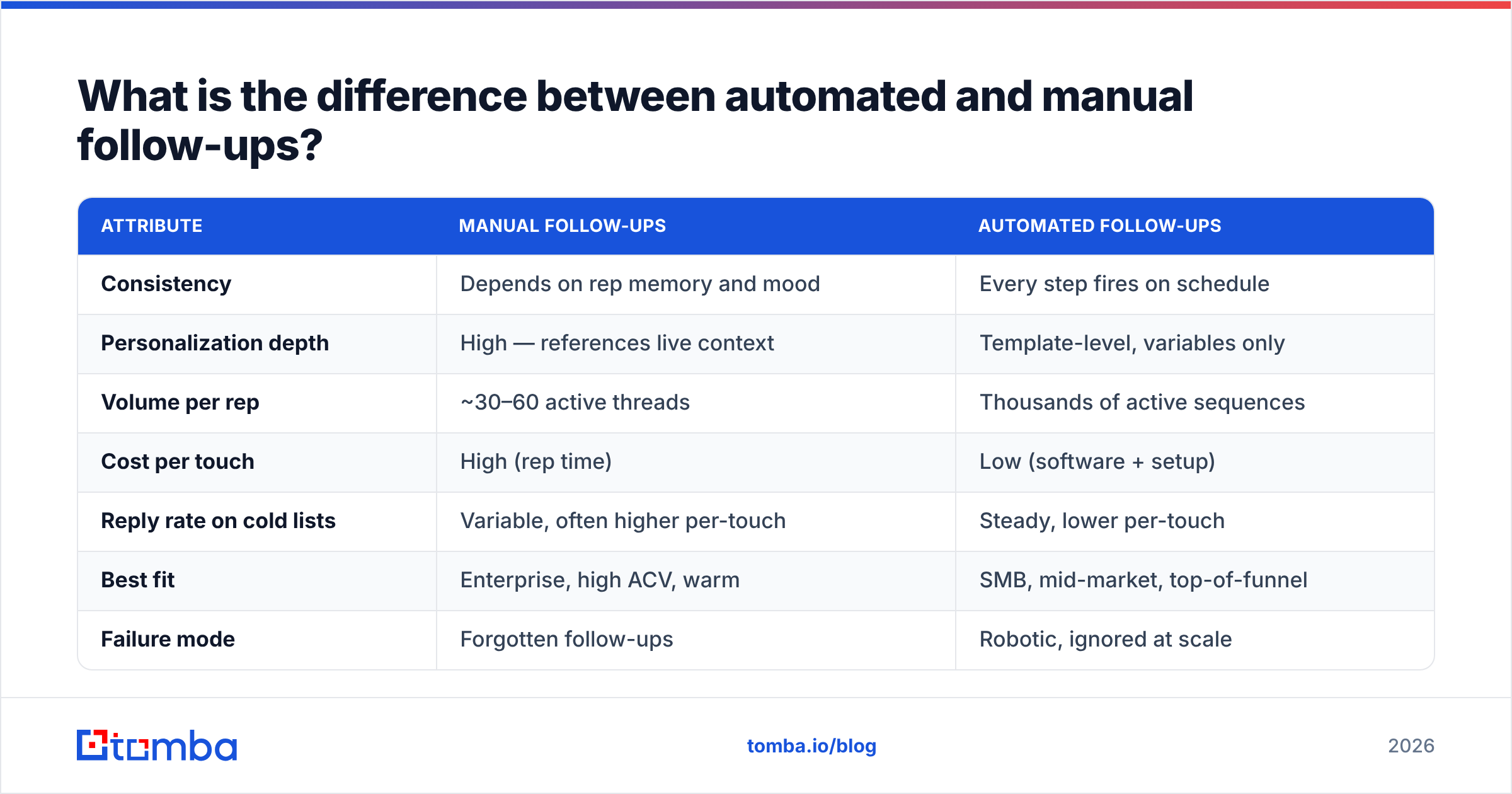
| Attribute | Manual follow-ups | Automated follow-ups |
|---|---|---|
| Consistency | Depends on rep memory and mood | Every step fires on schedule |
| Personalization depth | High — references live context | Template-level, variables only |
| Volume per rep | ~30–60 active threads | Thousands of active sequences |
| Cost per touch | High (rep time) | Low (software + setup) |
| Reply rate on cold lists | Variable, often higher per-touch | Steady, lower per-touch |
| Best fit | Enterprise, high ACV, warm | SMB, mid-market, top-of-funnel |
| Failure mode | Forgotten follow-ups | Robotic, ignored at scale |
| Setup time | Minutes per prospect | Hours upfront, then hands-off |

Is automation better than manual follow-ups?#
For volume and reliability, yes — automation is better. For trust and conversion on a specific named account, manual still wins. The honest answer is that "better" depends entirely on what you are optimizing for.
Automation's core advantage is that it removes the human failure point. A sales automation sequence does not get distracted, take a vacation, or decide a prospect "probably is not interested." It executes the full cadence — day 1, day 3, day 7, day 12, day 20 — across every contact in the list. When you are working hundreds or thousands of leads, that reliability is worth more than any single clever email.
But automation has a ceiling. The moment a prospect senses they are touch #4 in a templated flow, the reply rate collapses. Spray-and-pray automation is the reason inboxes are full of "just bumping this up" messages nobody answers. Volume without relevance trains your audience to ignore you, and it puts your sender reputation at risk.
Manual follow-ups invert the trade. A rep who reads a prospect's recent LinkedIn post, references a funding round, or answers a question from the last call can write something no template matches. On a $50k deal, that 20 minutes of effort is trivially worth it. On a $200/year deal, it is economically insane.
So the question is not "which is better" in the abstract. It is which is better for this segment, at this deal size, at this stage.
How do automated and manual follow-ups compare on reply rates?#
Manual personalization wins per-touch; automation wins on total replies generated. Both can be true at once because they operate at different scales.
Industry benchmarks from outreach platforms consistently show a few patterns:
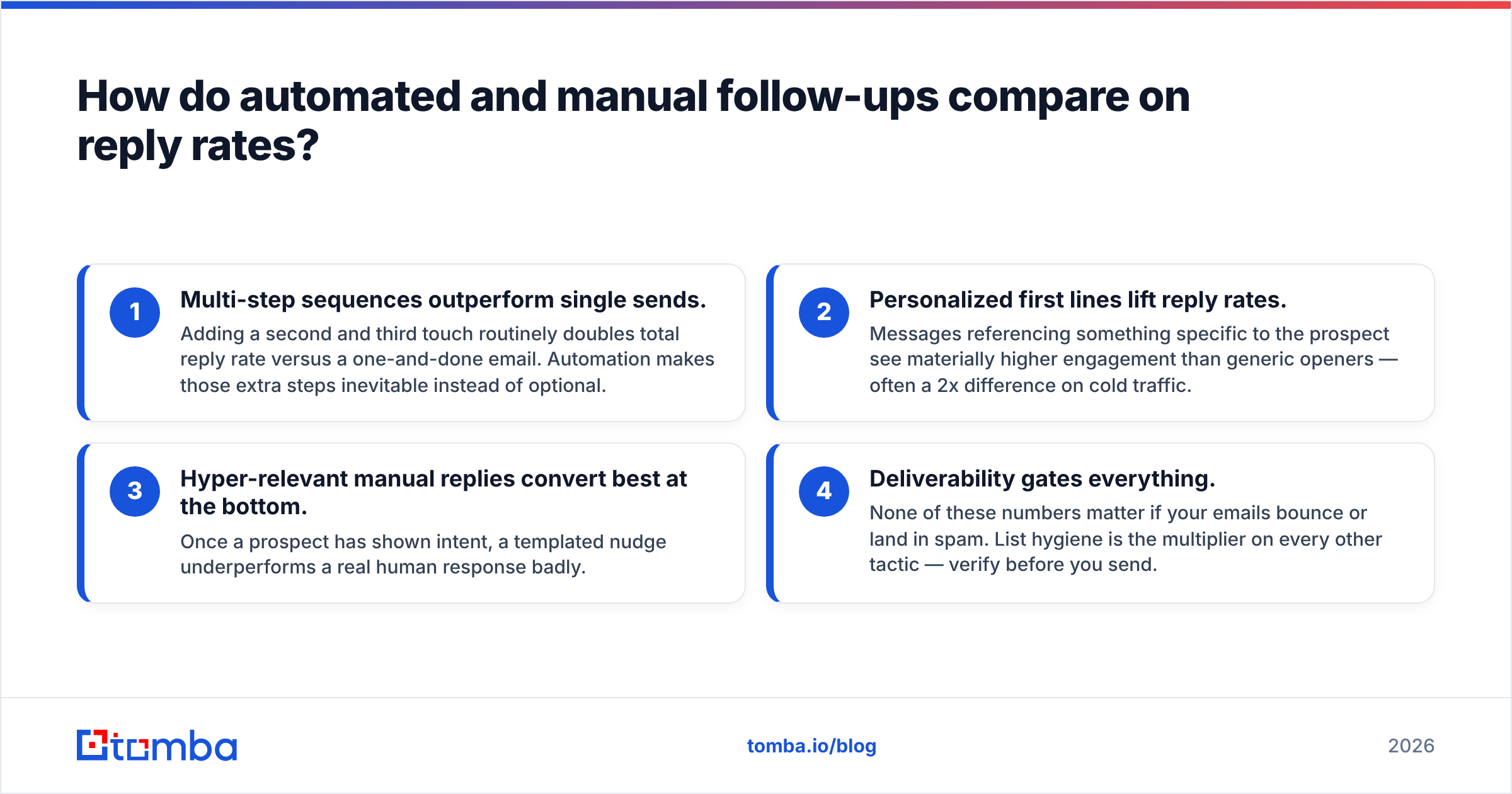
- Multi-step sequences outperform single sends. Adding a second and third touch routinely doubles total reply rate versus a one-and-done email. Automation makes those extra steps inevitable instead of optional.
- Personalized first lines lift reply rates. Messages referencing something specific to the prospect see materially higher engagement than generic openers — often a 2x difference on cold traffic.
- Hyper-relevant manual replies convert best at the bottom. Once a prospect has shown intent, a templated nudge underperforms a real human response badly.
- Deliverability gates everything. None of these numbers matter if your emails bounce or land in spam. List hygiene is the multiplier on every other tactic — verify before you send.
The takeaway: automation maximizes the number of qualified replies because it guarantees coverage, while manual effort maximizes the quality of replies on the accounts where quality changes the revenue outcome. Smart teams measure both, not just one.
When should you use manual follow-ups?#
Use manual follow-ups when the deal is big enough, the relationship is warm enough, or the context is specific enough that a human touch changes the math. Specifically:
- High-ACV enterprise deals. When a single close is worth five or six figures, rep time is cheap relative to the prize. Personalize everything.
- Post-meeting follow-ups. After a discovery call or demo, a templated recap reads as lazy. Reference what was actually said.
- Champion and stakeholder nurture. Multi-threaded enterprise deals need messages tailored to each persona — the CFO and the end user do not get the same note.
- Trigger-based outreach. A prospect just got promoted, raised funding, or shipped a product. A timely, specific congratulations-plus-offer beats any cadence step.
- Re-engaging a stalled deal. When a sequence has gone cold, a candid, human "should I close your file?" often outperforms another automated bump.
The common thread: manual is for moments where being a real, attentive person is the competitive advantage. If your message could have been sent by a robot, a robot should have sent it.
When should you automate follow-ups?#
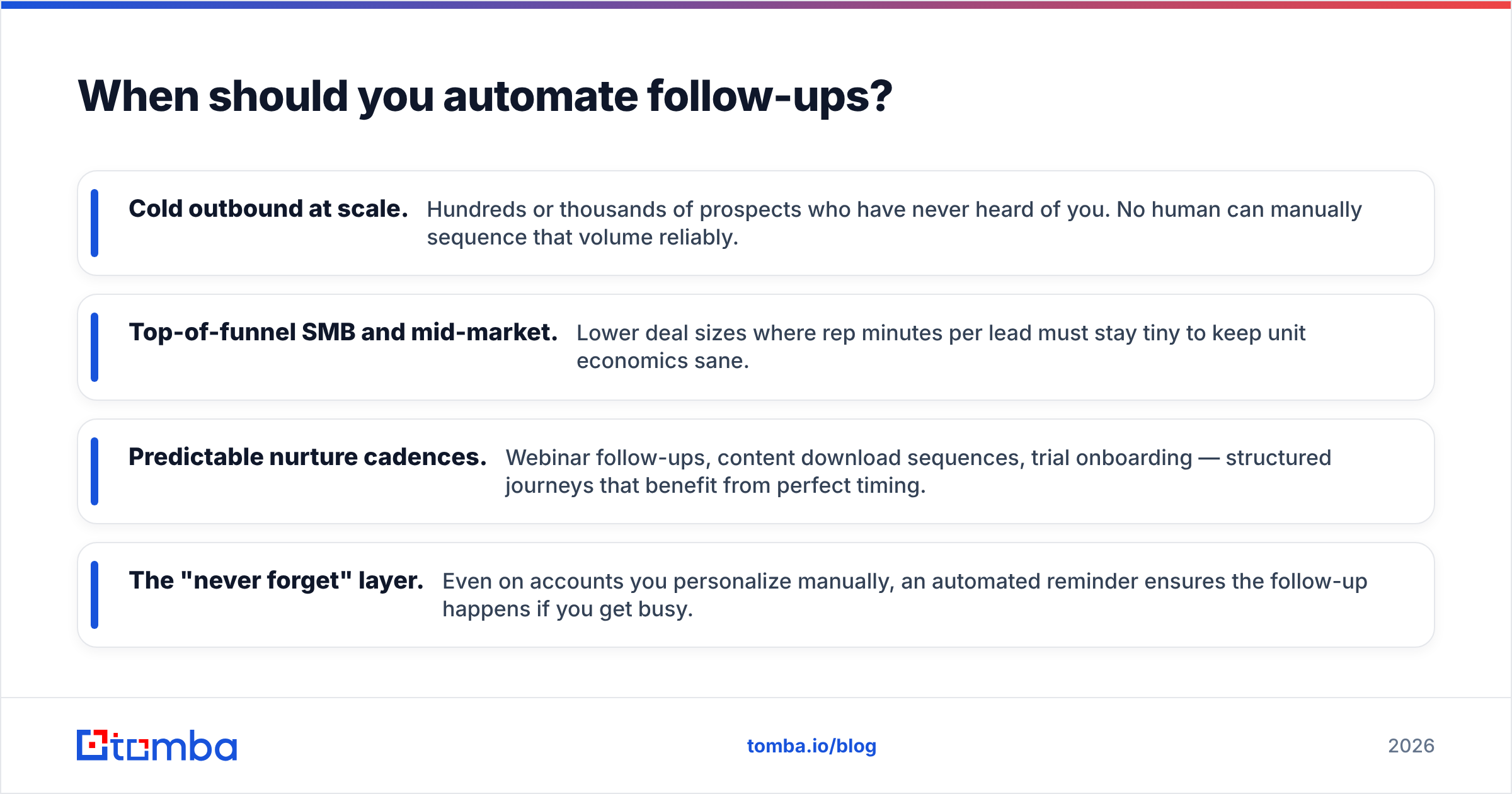
Automate when you are working volume, when timing matters more than wording, and when the cost of a human touch outweighs its marginal value. That covers most top-of-funnel activity:
- Cold outbound at scale. Hundreds or thousands of prospects who have never heard of you. No human can manually sequence that volume reliably.
- Top-of-funnel SMB and mid-market. Lower deal sizes where rep minutes per lead must stay tiny to keep unit economics sane.
- Predictable nurture cadences. Webinar follow-ups, content download sequences, trial onboarding — structured journeys that benefit from perfect timing.
- The "never forget" layer. Even on accounts you personalize manually, an automated reminder ensures the follow-up happens if you get busy.
The best automation is invisible. It handles the timing and the structure so the prospect never feels processed. Tools like Instantly, Saleshandy, and Reply.io all build sequences; the differentiator is how well you feed them clean, well-segmented data and how human your templates read. You can pressure-test your copy with a free cold email AI writer before it ever enters a sequence.
What does a hybrid follow-up system look like in 2026?#
The winning 2026 model automates the skeleton and humanizes the joints. You let software guarantee coverage and timing, then insert real human effort at the two or three moments where it moves the needle.
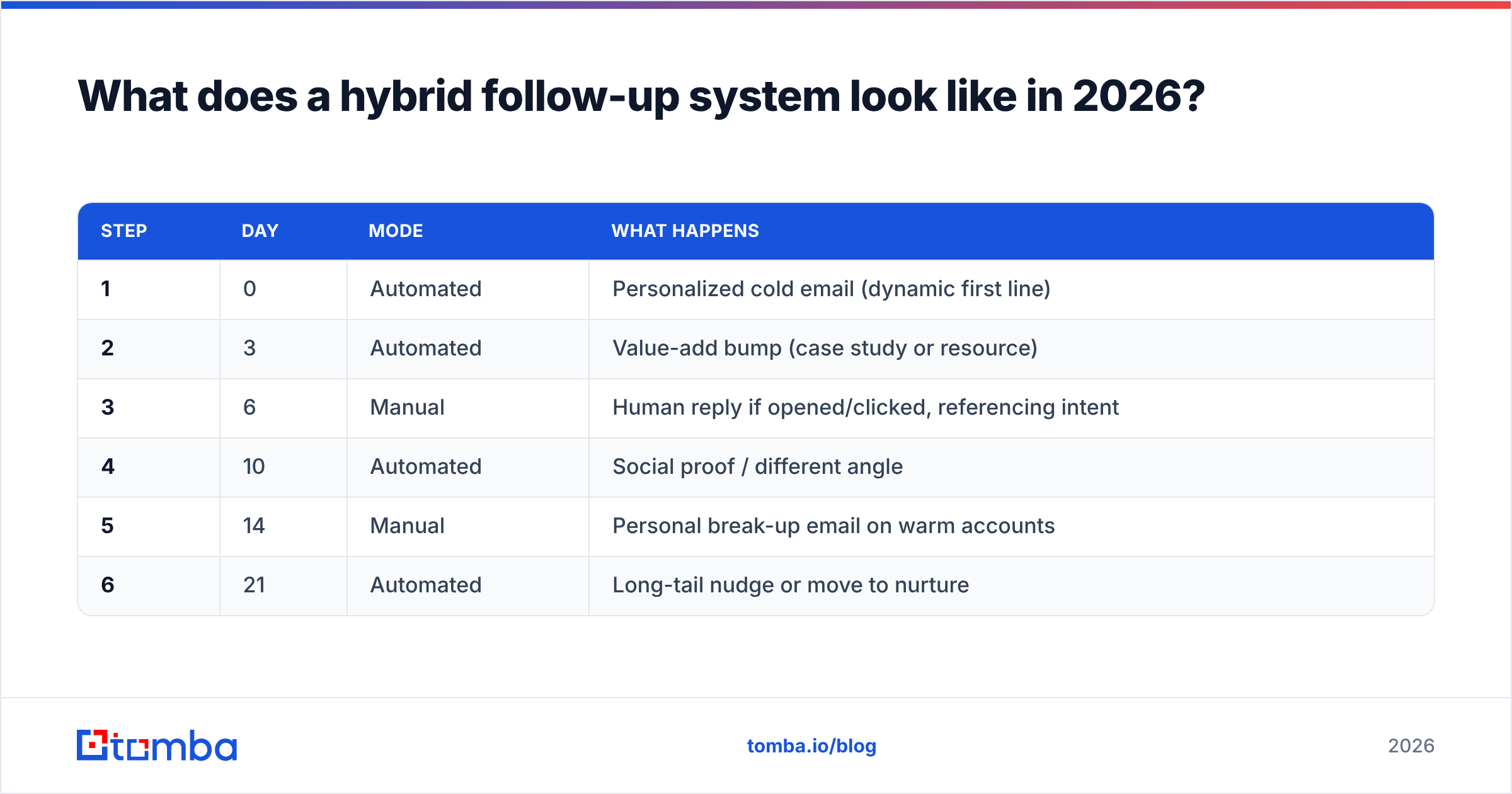
A practical hybrid cadence looks like this:
| Step | Day | Mode | What happens |
|---|---|---|---|
| 1 | 0 | Automated | Personalized cold email (dynamic first line) |
| 2 | 3 | Automated | Value-add bump (case study or resource) |
| 3 | 6 | Manual | Human reply if opened/clicked, referencing intent |
| 4 | 10 | Automated | Social proof / different angle |
| 5 | 14 | Manual | Personal break-up email on warm accounts |
| 6 | 21 | Automated | Long-tail nudge or move to nurture |
The rule of thumb: automation handles steps 1, 2, 4, and 6; a human handles 3 and 5 whenever the account shows signal or clears a deal-size threshold. You get the coverage of automation with the conversion of personalization, without paying human cost on dead leads.
Two things make this work in practice. First, segmentation — route high-value accounts to a human-heavy track and low-value volume to a fully automated one. Second, data quality — every step above assumes the email is real and the inbox is live. A 30% bounce rate torches your sender reputation and makes the entire cadence moot, automated or manual.
This is where your prospecting stack matters as much as your sequencing tool. Before any follow-up logic runs, you need verified contacts. Run your list through an email verifier and pull fresh, accurate addresses with a proper email finder so automation amplifies good data instead of multiplying bad data. For a deeper look at how response patterns shift across cadence length, the concept of response rate is worth understanding before you tune your steps.
How do you measure which approach is working?#
Track reply rate per step, total replies per rep-hour, and cost per booked meeting — and compare your manual track against your automated track separately. Blended averages hide the truth.
Watch for these signals:
- Reply rate decaying across steps means your automation reads robotic — inject a manual touch earlier.
- High volume but low meeting conversion means you are automating accounts that deserve a human.
- Great conversion but low pipeline means you are manually crafting messages for leads that should be on autopilot.
- Rising bounce or spam rates mean your data, not your method, is the problem. Audit list hygiene first.
The point of measurement is to keep redrawing the line between "let the machine do it" and "a human should handle this." That line moves as your deal sizes, team size, and inbox reputation change. Authoritative outreach research from vendors like HubSpot and peer reviews on G2 are useful for benchmarking, but your own per-segment numbers are the only ones that decide your cadence.
Automation vs manual follow-ups: the verdict#
Neither approach wins outright — the format of the question is the trap. Automation is the right default for coverage, timing, and scale; manual is the right exception for trust, relevance, and high-value conversion. Teams that pick one religiously lose to teams that blend them deliberately.
For 2026, build automation as your baseline so no follow-up is ever forgotten, then spend your scarce human attention only where a real person changes the outcome. Structure from the machine, judgment from the human.
And underneath all of it: clean, verified contact data. The smartest cadence in the world fails against a list of dead inboxes. Start every follow-up system by finding and verifying real decision-maker emails with the Tomba Email Finder — search by domain, name, or company, verify in bulk, and feed your automation accurate data from day one. You can test it free (25 searches a month), and scale up through Tomba's plans starting at $49/mo as your volume grows. Better follow-ups start with better data.
// get started
Find, verify and enrich your first contacts today
Start on the free plan with 25 searches a month, then scale when your team is ready.
Free plan · No credit card required · GDPR & CCPA
// about the author