Average Click-to-Open Rate: 2026 Benchmarks and Wins
Open rates lie after MPP. The average click-to-open rate tells you whether your email content actually lands. Here are the 2026 CTOR benchmarks and the levers that move it.
TL;DR
- Click-to-open rate (CTOR) = unique clicks ÷ unique opens. It measures whether the people who opened your email found the content worth clicking — a content and offer signal, not a deliverability one.
- A healthy average click-to-open rate in 2026 sits around 10–15% for most B2B email, with top quartile senders pushing past 20%.
- Apple Mail Privacy Protection (MPP) has inflated open rates since 2021, which makes CTOR a far more trustworthy engagement metric than open rate or plain CTR.
- The biggest CTOR killers are a mismatch between subject line and body, weak CTAs, and broken or irrelevant targeting — not your send time.
- Clean data feeds every one of these numbers. If bots and dead addresses pad your opens, your CTOR math breaks before you even start.
If you only track one engagement metric this year, make it click-to-open rate. Open rate tells you the envelope got noticed. Click rate tells you the whole list reacted. CTOR tells you the only thing that matters once someone is actually reading: did the content earn the click?
What is the average click-to-open rate?#
The average click-to-open rate is the percentage of people who opened your email and then clicked a link inside it. Think of it like a store: open rate is how many people walked through the door, and CTOR is how many of those browsers actually picked something off the shelf. A crowded store with empty hands means the window display worked but the products didn't.
Formally:
CTOR = (unique clicks ÷ unique opens) × 100
So if 1,000 people opened your campaign and 120 clicked, your CTOR is 12%. Note that this is different from plain click-through rate (CTR), which divides clicks by emails delivered — including everyone who never opened. CTOR isolates the engaged audience, which is exactly why it survives the open-rate chaos that MPP introduced.
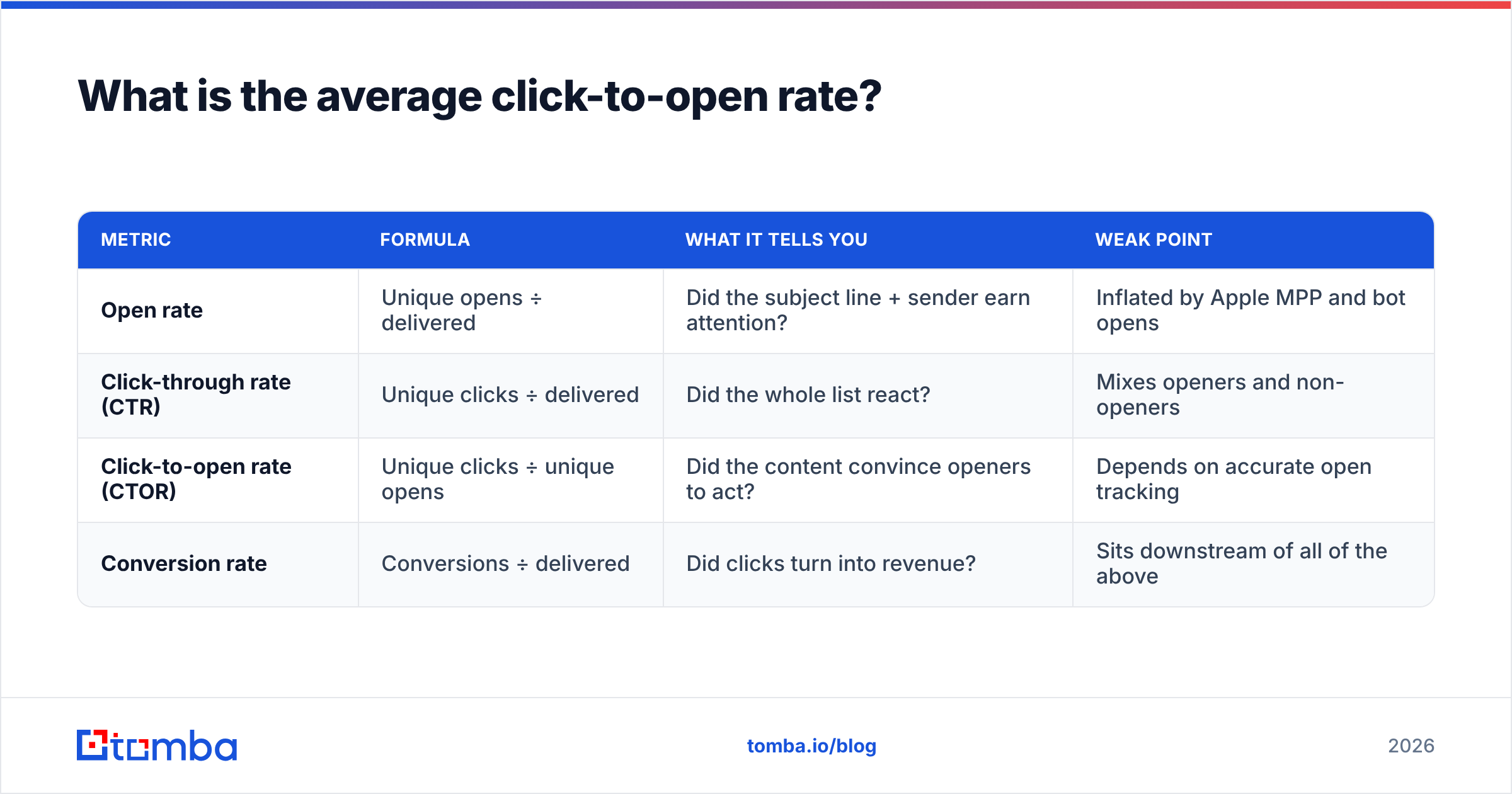
Here is how the three core metrics relate:
| Metric | Formula | What it tells you | Weak point |
|---|---|---|---|
| Open rate | Unique opens ÷ delivered | Did the subject line + sender earn attention? | Inflated by Apple MPP and bot opens |
| Click-through rate (CTR) | Unique clicks ÷ delivered | Did the whole list react? | Mixes openers and non-openers |
| Click-to-open rate (CTOR) | Unique clicks ÷ unique opens | Did the content convince openers to act? | Depends on accurate open tracking |
| Conversion rate | Conversions ÷ delivered | Did clicks turn into revenue? | Sits downstream of all of the above |
CTOR is the cleanest read on content quality. When it drops, the problem is almost always inside the email — the offer, the copy, the CTA, or a targeting mismatch — not the inbox placement.
)
What is a good average click-to-open rate in 2026?#
A good average click-to-open rate in 2026 is roughly 10–15%, with anything above 20% considered strong. Below 6% usually signals a content or targeting problem worth fixing before your next send.
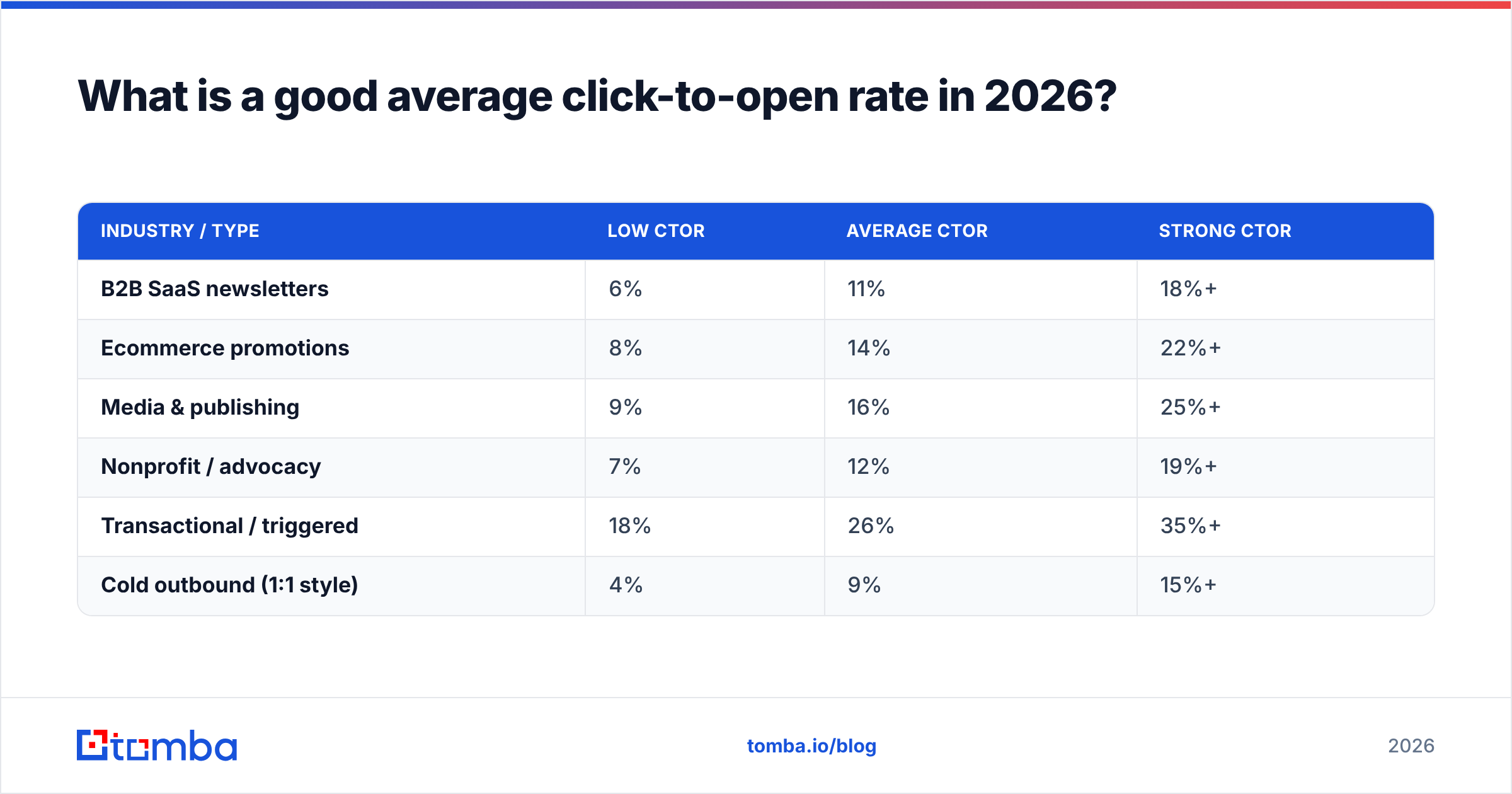
Those numbers shift by industry, audience temperature, and email type. Transactional and triggered emails (password resets, order confirmations, abandoned-cart nudges) routinely clear 20–30% CTOR because the recipient is already expecting and wanting them. Cold or semi-cold newsletter blasts sit lower. Here is a realistic 2026 benchmark spread:
| Industry / type | Low CTOR | Average CTOR | Strong CTOR |
|---|---|---|---|
| B2B SaaS newsletters | 6% | 11% | 18%+ |
| Ecommerce promotions | 8% | 14% | 22%+ |
| Media & publishing | 9% | 16% | 25%+ |
| Nonprofit / advocacy | 7% | 12% | 19%+ |
| Transactional / triggered | 18% | 26% | 35%+ |
| Cold outbound (1:1 style) | 4% | 9% | 15%+ |
Treat any external benchmark as a starting line, not a verdict. Your own rolling 90-day average is the number that matters. If your CTOR is climbing month over month, you are winning regardless of where some industry chart sits. Providers like HubSpot and Mailchimp publish updated benchmark sets each year — cross-reference two or three rather than trusting a single source.
One caution: a suspiciously high CTOR can be a red flag, not a trophy. If open tracking is undercounting (privacy proxies, image blocking) while clicks register normally, the ratio inflates artificially. That is one more reason your underlying list hygiene and tracking setup have to be solid before you read anything into the percentage.
How do you calculate click-to-open rate correctly?#
You calculate CTOR by dividing unique clicks by unique opens for the same campaign, then multiplying by 100 — but the word unique is doing heavy lifting. Use these rules to keep the number honest:
- Always use unique events, never totals. One subscriber who clicks four links is one unique click, not four. Total clicks divided by total opens produces a meaningless figure that swings with how many links you stuffed in the email.
- Match the time window. Count opens and clicks over the same period (most teams use 7 days post-send). Mixing a 30-day open window with a 24-hour click window distorts the ratio.
- Strip bot and security-scanner activity. Corporate security tools and image proxies fire opens and sometimes clicks automatically. Most ESPs now filter these, but verify yours does.
- Exclude unsubscribe and list-management links from your click count if your goal is to measure content interest, not exits.
- Segment before you average. A blended CTOR across new subscribers, dormant contacts, and power users hides the truth. Calculate per segment, then compare.
- Tie it to a clean denominator. Your open count is only as trustworthy as your list. Padding from invalid addresses, spam traps, and duplicate records corrupts the math from the bottom up.
That last point is where most teams quietly lose the plot. If 15% of your "delivered" list is dead weight that still somehow registers opens through automated scanning, every downstream metric — open rate, CTOR, conversion rate — is built on sand. Running your list through an email verifier before a major send strips out the addresses that distort the denominator. For ongoing list building, pulling contacts from a source with verified data — rather than scraping and hoping — keeps the rot from accumulating in the first place.
Why does CTOR matter more than open rate now?#
CTOR matters more than open rate because Apple's Mail Privacy Protection broke open tracking for a huge slice of your audience. Since 2021, Apple Mail preloads email images on Apple's servers whether or not the recipient ever looks at the message, firing a "open" event for contacts who never read a word.
The practical fallout:
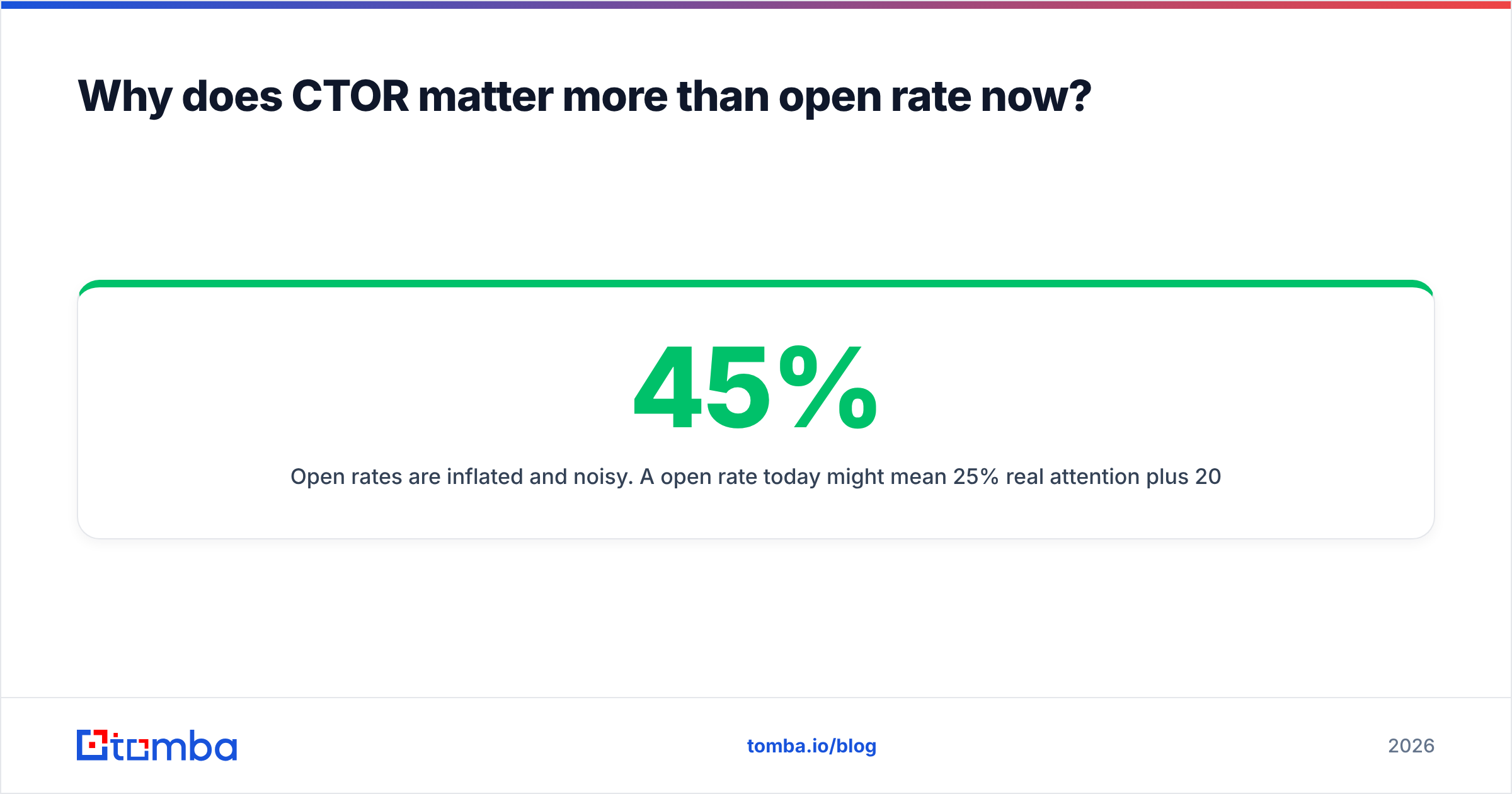
- Open rates are inflated and noisy. A 45% open rate today might mean 25% real attention plus 20% phantom Apple opens. You cannot tell which is which at the individual level.
- Open-based automation misfires. "Send a follow-up to anyone who didn't open" now skips real non-openers who were counted as opens by MPP.
- Subject-line A/B tests lost resolution. When opens are partly synthetic, small lifts get buried in noise.
Clicks, by contrast, require a deliberate human action. Nobody's privacy proxy intends to click your pricing-page CTA. That makes click-based metrics — CTOR chief among them — the engagement signals you can still trust. Many senders have shifted their entire reporting and segmentation model from "opened vs. not opened" to "clicked vs. not clicked" for exactly this reason.
CTOR also isolates a variable open rate can't: content performance independent of subject line. A great subject with a weak body produces high opens and low CTOR. A boring subject with a brilliant offer produces low opens and high CTOR. Reading the two together tells you precisely where to put your editing time. If you want a deeper primer on the inbox-side mechanics, the email deliverability glossary entry is a useful companion to this engagement view.
)
How do you improve your average click-to-open rate?#
You improve CTOR by closing the gap between what the subject line promised and what the body delivers, then making the next action effortless. Because CTOR only counts people who already opened, every fix lives inside the email. Here are the highest-leverage moves, roughly in order of impact:
- Honor the subject-line promise. The single biggest CTOR killer is a bait-and-switch. If the subject implies a discount, the discount and its CTA should be visible without scrolling. Tools like a subject line tester help you set expectations the body can actually meet.
- Use one primary CTA. Multiple competing buttons split attention and depress unique clicks. Lead with a single, obvious action; demote everything else to text links.
- Make the CTA above the fold and button-shaped. Plain-text links underperform buttons in most B2C contexts; in B2B, a clear text link near the top can outperform a buried button. Test both.
- Segment for relevance. A message that's right for power users is wrong for week-one signups. Tighter segments routinely add 3–5 points of CTOR because the offer matches the reader.
- Cut the word count. Openers skim. Front-load the value, trim the throat-clearing intro, and get to the click fast. Shorter emails generally convert openers better than long ones.
- Personalize beyond the first name. Reference the recipient's plan, industry, or last action. Relevance, not gimmickry, is what moves the click.
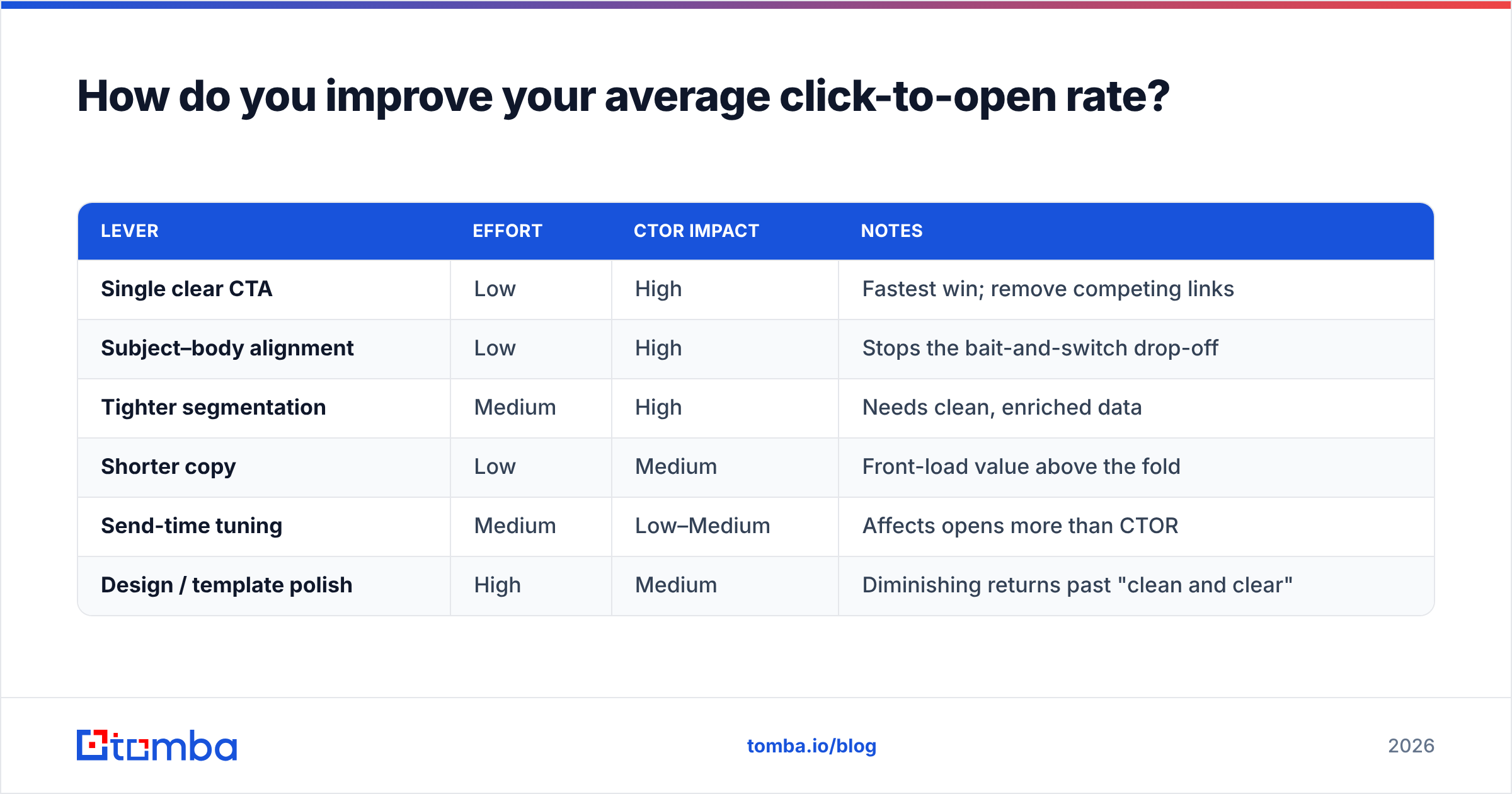
Here is how the main levers compare on effort versus payoff:
| Lever | Effort | CTOR impact | Notes |
|---|---|---|---|
| Single clear CTA | Low | High | Fastest win; remove competing links |
| Subject–body alignment | Low | High | Stops the bait-and-switch drop-off |
| Tighter segmentation | Medium | High | Needs clean, enriched data |
| Shorter copy | Low | Medium | Front-load value above the fold |
| Send-time tuning | Medium | Low–Medium | Affects opens more than CTOR |
| Design / template polish | High | Medium | Diminishing returns past "clean and clear" |
Notice what's not at the top: send-time optimization. It nudges opens, but it does little for CTOR because the people in your CTOR denominator already opened. Spend your energy on the offer and the CTA, not on chasing the perfect 10:14 a.m. send.
What data problems quietly wreck your CTOR?#
Bad data wrecks CTOR in two directions at once: it inflates the denominator with fake opens and starves the numerator by sending relevant content to the wrong or non-existent people. You can write the best email of your career and still post a terrible CTOR if a third of the list shouldn't have received it.
The usual culprits:
- Invalid and stale addresses that bounce or sit dormant, dragging engagement averages down and risking your sender reputation.
- Catch-all domains that accept everything, so you never know which addresses are real until you actually send — and a failed send hurts your numbers.
- Spam traps and duplicates that pad your list and, in the case of traps, actively damage placement.
- Mistargeted contacts — right email, wrong person — where the content has zero relevance to the reader, so they open out of curiosity and never click.
The fix is upstream of any copy edit. Verify the list, enrich the records so your segmentation is accurate, and source new contacts from validated data instead of scraped guesses. A quick pre-send pass with an email verifier removes the dead weight, while pulling fresh, accurate contacts through a proper email finder keeps new additions clean from day one. Clean data won't write your CTA for you — but it makes sure the great CTA you wrote actually reaches people capable of clicking it.
One more habit: reconcile your CTOR against conversion. If CTOR is healthy but conversions lag, the click is landing on a weak page — that's a landing-page problem, not an email one. If CTOR itself is the bottleneck, you're back to the content and data levers above. Knowing which number is broken saves you from optimizing the wrong stage.
Putting it together#
The average click-to-open rate is the engagement metric that survived the privacy era. Open rate got noisy, plain CTR mixes the wrong populations, and conversion sits too far downstream to debug a single email. CTOR points straight at the question you can actually act on: given that someone opened, did your content earn the click? Aim for the 10–15% range, track your own rolling average more closely than any benchmark chart, and fix content and data before you touch send times.
And remember the order of operations: clean the data, then write the email, then read the metric. A CTOR calculated on a list full of phantom opens and dead addresses isn't a measurement — it's a guess. Get the inputs right and the percentage finally tells you the truth.
Ready to stop measuring engagement on a dirty list? Start with the Tomba Email Finder to build lists from verified, professional addresses by domain, name, or company — and feed your campaigns the clean denominator your CTOR math depends on. Pair it with the free 25-search tier on the Tomba pricing page to see the difference accurate data makes before you commit to a plan. Your next click-to-open rate will thank you.
// get started
Find, verify and enrich your first contacts today
Start on the free plan with 25 searches a month, then scale when your team is ready.
Free plan · No credit card required · GDPR & CCPA
// about the author