Average Cold Email Open Rate in 2026: Benchmarks & Fixes
What counts as a good cold email open rate in 2026? Real benchmarks by industry, why open tracking is breaking, and the levers that actually move the number.
You sent 500 cold emails. 180 got opened. Is 36% good, bad, or a rounding error caused by Apple's privacy bots? That single question is harder to answer in 2026 than it was three years ago, and getting it wrong sends reps chasing the wrong metric for months.
This guide gives you the real numbers, the asterisks behind them, and the handful of levers that actually move opens.
TL;DR#
- The average cold email open rate in 2026 lands between 35% and 45% for well-targeted B2B campaigns sent to verified lists — but raw open data is now inflated by privacy proxies.
- Apple Mail Privacy Protection (MPP) and bot pre-fetching pre-open a large share of emails, so a "44% open rate" often hides a true human-open figure closer to 25-30%.
- List quality beats subject-line wizardry. A verified, well-matched list will out-open a clever subject sent to scraped junk every time.
- Deliverability is the silent ceiling. If you land in spam, your open rate is measuring the wrong universe of inboxes.
- Stop optimizing opens in isolation. Reply rate and positive-reply rate are the metrics that survived the privacy era intact.
What is the average cold email open rate in 2026?#
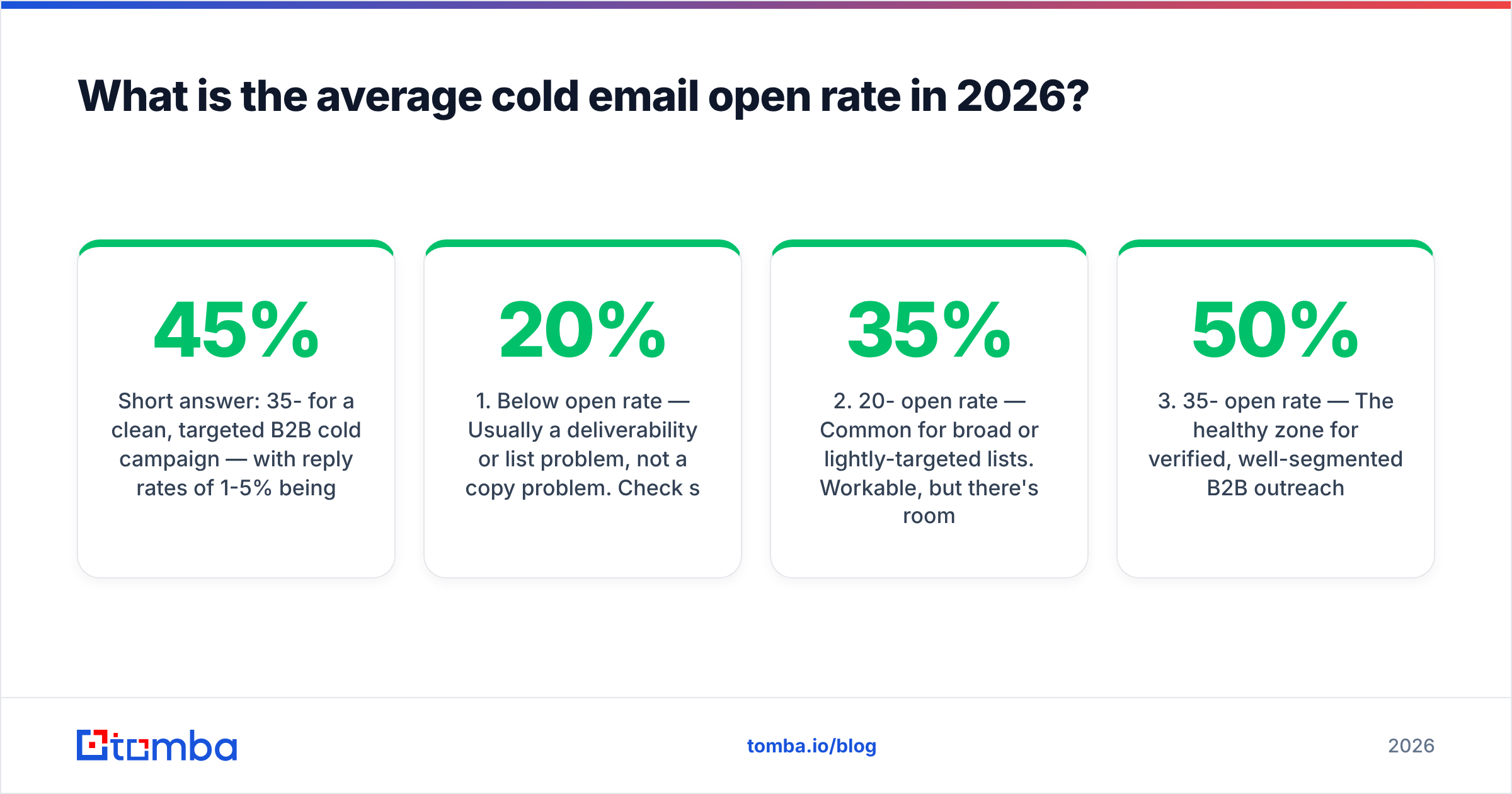
Short answer: 35-45% for a clean, targeted B2B cold campaign — with reply rates of 1-5% being the number that actually pays the bills.
Open rate is the percentage of delivered emails that get opened at least once. Think of it like a storefront: deliverability decides whether your shop is even on the street, and open rate measures how many people walked past and pushed the door open. A great window display (subject line) helps, but if your store is in the wrong neighborhood (bad list), nobody opens anything.
Here's the catch in 2026: the "door opening" is now partly automated. Privacy tools and security scanners open emails before a human ever sees them, so the reported number drifts upward while real attention stays flat or falls.
A rough sense of the spread you'll see across campaigns:
- Below 20% open rate — Usually a deliverability or list problem, not a copy problem. Check spam placement and bounce rate first.
- 20-35% open rate — Common for broad or lightly-targeted lists. Workable, but there's room to tighten targeting.
- 35-50% open rate — The healthy zone for verified, well-segmented B2B outreach.
- Above 55% open rate — Often inflated by Apple MPP and bot opens. Be skeptical and look at reply rate to confirm real interest.

Why are cold email open rates so unreliable now?#
Because a growing share of "opens" are machines, not people. Three forces broke the metric:
- Apple Mail Privacy Protection. Since iOS 15, Apple Mail pre-loads the tracking pixel for every message, registering an open whether or not the recipient looked. With Apple Mail holding a large share of email clients, this alone can inflate reported opens by 10-20 points.
- Corporate security scanners. Gateways like Proofpoint and Microsoft Defender click links and load images to sandbox-check them. That triggers both fake opens and fake clicks.
- Image blocking the other direction. Plenty of Outlook and corporate setups block images by default, so genuine human opens go uncounted. The pixel never fires.
So your open number is simultaneously inflated by bots and deflated by image blocking. The error bars are huge. Google's own Gmail Postmaster Tools won't show you opens at all — it reports spam rate and reputation, which is a hint about where the industry's attention is going.
The practical takeaway: treat open rate as a directional signal for subject lines and send timing, not as a north-star metric. For a deeper primer on the underlying mechanics, the email deliverability glossary entry is a good refresher.
What is a good cold email open rate by industry?#
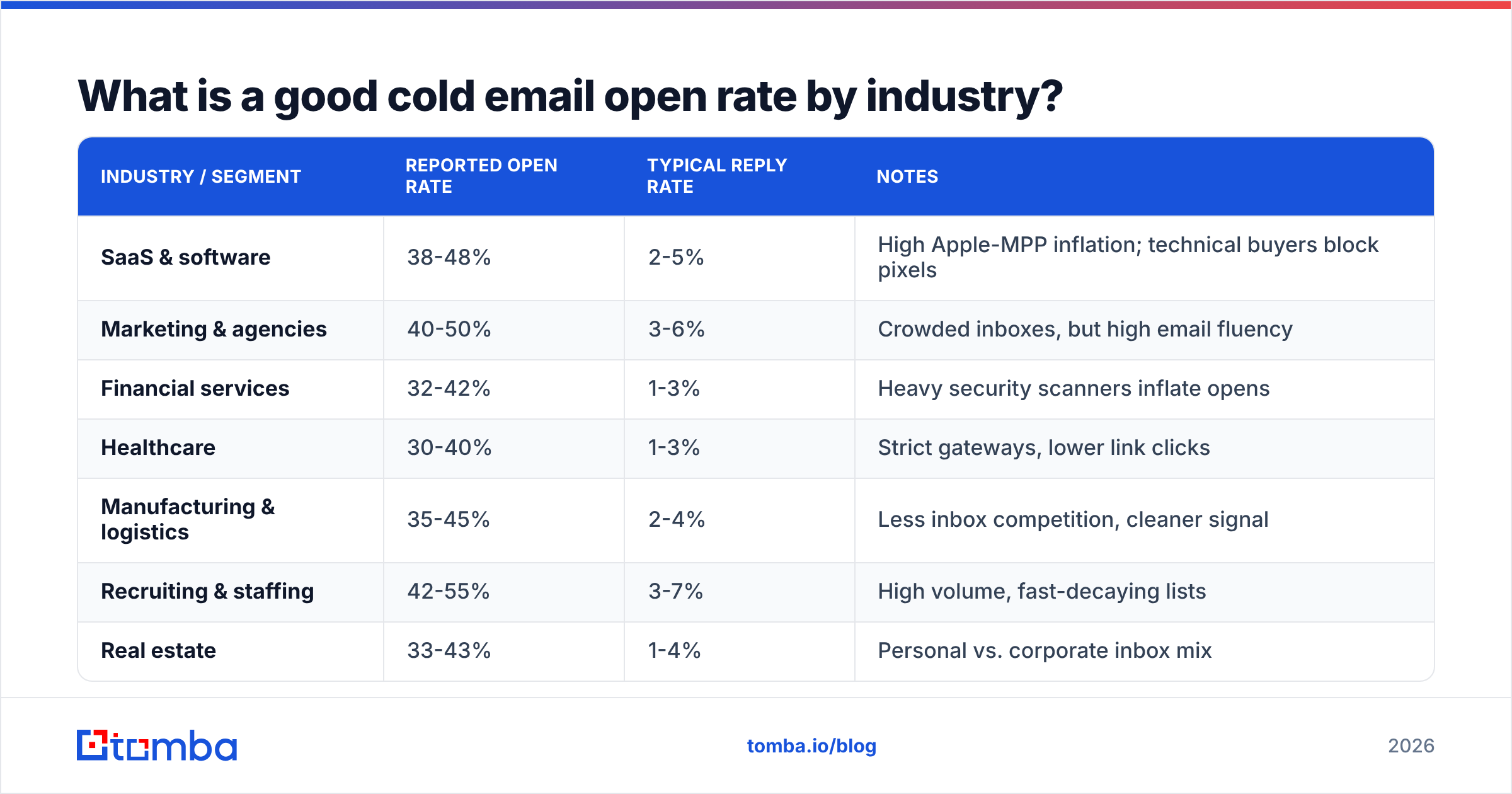
Benchmarks vary by vertical, list freshness, and how technical your audience is (technical buyers block more pixels). The table below reflects observed ranges for verified, opted-targeted B2B cold outreach in 2026 — reported opens, before stripping bot inflation.
| Industry / segment | Reported open rate | Typical reply rate | Notes |
|---|---|---|---|
| SaaS & software | 38-48% | 2-5% | High Apple-MPP inflation; technical buyers block pixels |
| Marketing & agencies | 40-50% | 3-6% | Crowded inboxes, but high email fluency |
| Financial services | 32-42% | 1-3% | Heavy security scanners inflate opens |
| Healthcare | 30-40% | 1-3% | Strict gateways, lower link clicks |
| Manufacturing & logistics | 35-45% | 2-4% | Less inbox competition, cleaner signal |
| Recruiting & staffing | 42-55% | 3-7% | High volume, fast-decaying lists |
| Real estate | 33-43% | 1-4% | Personal vs. corporate inbox mix |
Two rules of thumb when reading any benchmark table, including this one:
- Compare against your own past campaigns first. Your list sources and sending infrastructure matter more than someone else's vertical average.
- A higher open rate with a lower reply rate is often worse. It usually means you wrote a curiosity-gap subject line that over-promised and the body under-delivered.
How do I calculate and segment my open rate correctly?#
Calculate it on delivered, not sent, and then segment ruthlessly.
The formula:
Open rate = (Unique opens / Emails delivered) × 100Use delivered, not sent. If you divide by sent, bounces drag your number down and mask a deliverability problem as a "low engagement" problem. They're different diseases with different cures.
Then segment your reporting so the privacy noise doesn't average everything into mush:
- Split Apple Mail vs. everything else if your sending tool exposes client data. Watching the non-Apple cohort gives you a cleaner read on real human behavior.
- Segment by list source. Emails you found and verified yourself almost always out-open a purchased list. Seeing the gap justifies the cost of doing it right.
- Segment by send day and time before drawing any conclusions about "best time to send." Aggregate numbers hide the pattern.
- Track positive reply rate as the tiebreaker. When two campaigns show the same open rate, the one generating real conversations wins, full stop.
What actually moves the average cold email open rate?#
List quality and deliverability move it far more than subject lines do — though subject lines still matter at the margin. Here's the priority order, highest leverage first.
1. Send to verified, accurate addresses#
Bounces are the fastest way to wreck both your open rate and your sender reputation. Every email that hits a dead mailbox tells mailbox providers you're working from a stale or scraped list, and they respond by routing more of your mail to spam — which silently shrinks the denominator of inboxes that could have opened.
Run every address through an email verifier before you send, and use a catch-all verifier for domains that accept everything so you're not guessing. If you're sourcing contacts at scale, find them by company with domain search rather than buying a list of unknown provenance.

2. Protect deliverability before you scale volume#
You can't open an email that never reached the inbox. The non-negotiables:
- Authenticate your domain with SPF, DKIM, and DMARC. Missing records are an instant trust penalty. The SPF record entry explains the first piece.
- Warm up new sending domains and mailboxes gradually over weeks, not days. A cold domain blasting 500 emails on day one is a spam-filter magnet.
- Keep spam complaints under 0.1% and monitor sender reputation continuously. Google now enforces this bright-line threshold for bulk senders, per its sender guidelines.
- Use a dedicated sending domain (like
try-yourbrand.com) so cold outreach can't damage your primary domain's reputation.
3. Write subject lines that earn the open honestly#
Subject lines are the third lever, not the first — but a bad one still tanks an otherwise great campaign. What works in 2026:
- Short and lowercase-casual beats title-case marketing speak. "quick question about [company]" reads like a human, not a blast.
- Personalization that's actually specific — a recent funding round, a job posting, a product launch — not just
{{firstName}}token-stuffing, which buyers now pattern-match as automated. - No clickbait. A curiosity-gap subject that the body doesn't pay off inflates opens and destroys reply rate. You're optimizing the wrong number.
4. Send at the right time, to the right person#
Targeting the correct decision-maker matters more than the hour, but timing still nudges the number. Mid-morning on Tuesday through Thursday remains a reliable default for B2B. More importantly, make sure you're emailing someone whose job maps to your offer — a precise email finder result for the right VP beats a perfectly-timed send to the wrong intern.
Open rate vs. reply rate: which should I optimize?#
Optimize reply rate; use open rate only as a diagnostic.
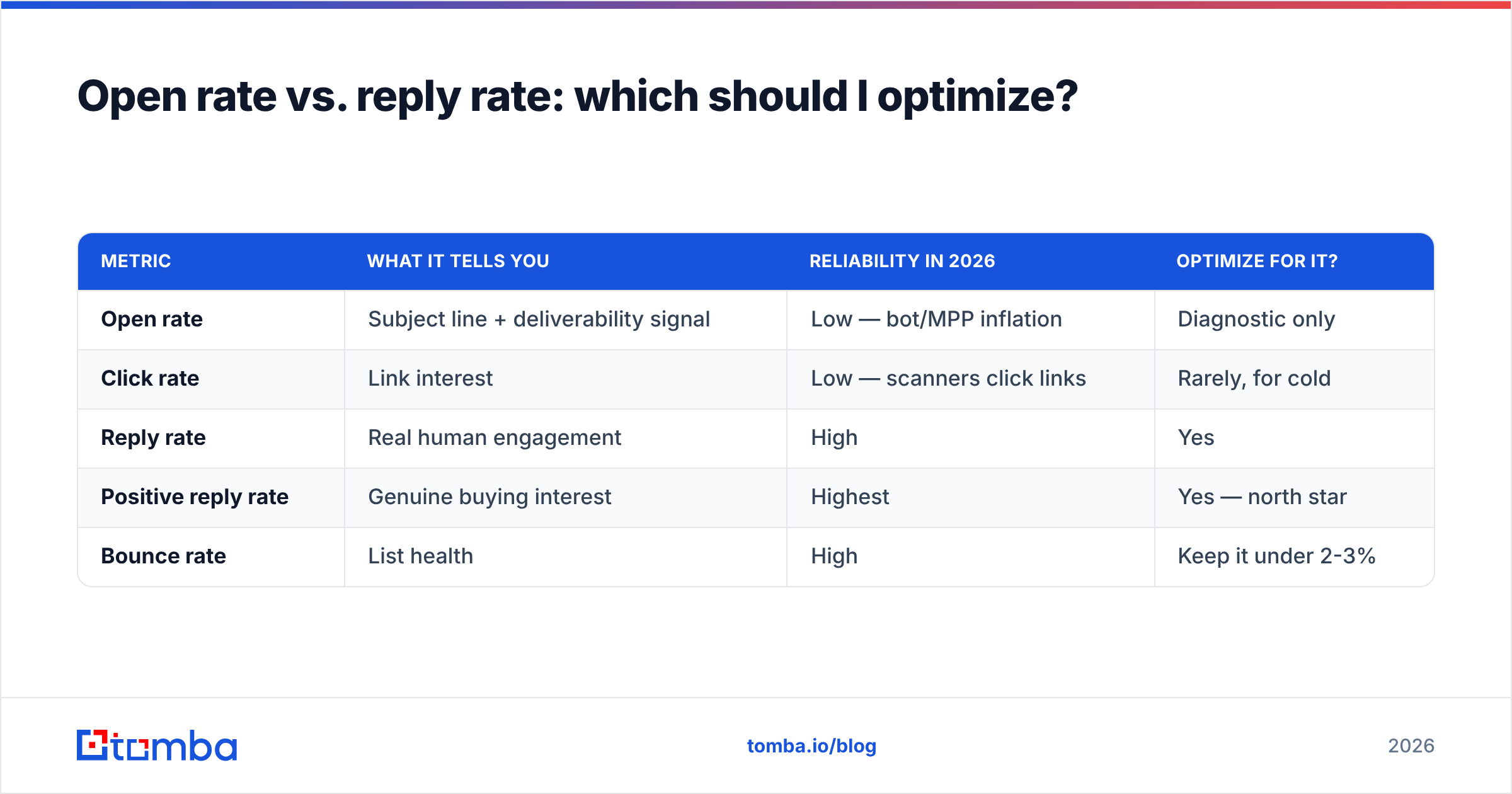
Here's the comparison that should reshape how your team reports:
| Metric | What it tells you | Reliability in 2026 | Optimize for it? |
|---|---|---|---|
| Open rate | Subject line + deliverability signal | Low — bot/MPP inflation | Diagnostic only |
| Click rate | Link interest | Low — scanners click links | Rarely, for cold |
| Reply rate | Real human engagement | High | Yes |
| Positive reply rate | Genuine buying interest | Highest | Yes — north star |
| Bounce rate | List health | High | Keep it under 2-3% |
A campaign with a 30% open rate and a 5% reply rate is beating a campaign with a 50% open rate and a 1% reply rate — every time. The first one found the right people and said something relevant. The second one wrote a sneaky subject line and a forgettable body.
This is why the smartest cold-email teams in 2026 have quietly stopped putting open rate on the executive dashboard. They report delivered → positive reply → meeting booked, and they treat opens the way a pilot treats an altimeter: useful instrument, not the destination.
How does list accuracy change the math?#
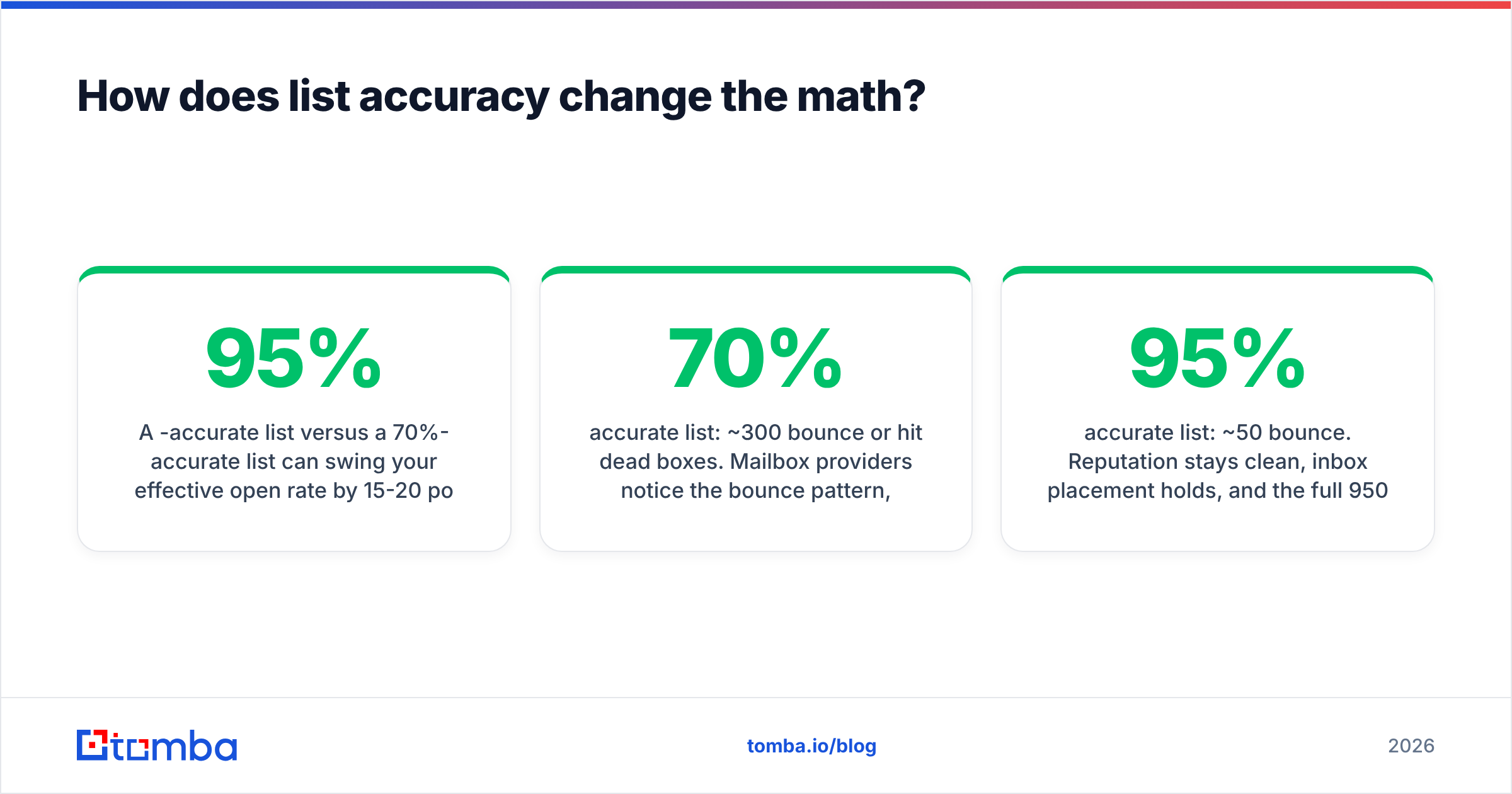
A 95%-accurate list versus a 70%-accurate list can swing your effective open rate by 15-20 points — without changing a single word of copy.
Walk through it. Send 1,000 emails:
- 70% accurate list: ~300 bounce or hit dead boxes. Mailbox providers notice the bounce pattern, reputation dips, and more of the remaining 700 get filtered to spam. Maybe 500 truly land. Your reported open rate looks mediocre and your domain is now damaged for the next campaign too.
- 95% accurate list: ~50 bounce. Reputation stays clean, inbox placement holds, and the full 950 are genuinely in play. Same subject line, dramatically better outcome.
The compounding effect is the part teams underestimate: bad lists don't just lose the bounced contacts, they poison deliverability for everyone downstream. That's why verification is upstream leverage. Pull contacts through bulk email finder workflows that verify as they go, and you protect the denominator your open rate depends on. Tomba's data sources page details how addresses are sourced and scored if you want to audit the accuracy claim yourself.
What's a realistic open-rate target to set for your team?#
Set a floor, not a hero number. A practical 2026 framework:
- Floor: 30% reported open rate. Below this, stop tweaking copy and audit deliverability and list quality.
- Healthy: 35-45%. You're targeting well and landing in inboxes.
- Suspiciously high: 55%+. Don't celebrate yet — confirm with reply rate that the opens are human.
- The number that actually matters: 3%+ positive reply rate. That's where pipeline comes from.
Tie compensation and dashboards to replies and meetings, and use open rate the way it's meant to be used in the privacy era — as an early-warning light for deliverability, not a trophy.
Where Tomba fits#
Your open rate is only as good as the addresses behind it, and that's the part you fully control. The Tomba Email Finder locates verified professional emails by name, company, or domain, so the contacts entering your sequence are real, current, and matched to the right decision-maker — the single biggest lever on the number you're trying to lift. Pair it with the built-in verifier to keep bounces low and your sender reputation intact, start free with 25 searches a month, and review the full Tomba pricing when you're ready to scale. Fix the list, and the open rate follows.
// get started
Find, verify and enrich your first contacts today
Start on the free plan with 25 searches a month, then scale when your team is ready.
Free plan · No credit card required · GDPR & CCPA
// about the author