Average CTR for Email Marketing in 2026: Benchmarks & Fixes
What counts as a good click-through rate in 2026? See the average CTR for email marketing by industry, how it's calculated, and the levers that actually move clicks.
TL;DR
- The average CTR for email marketing in 2026 lands around 2-3% for broadcast campaigns, with most industries clustered between 1.5% and 4%.
- CTR (clicks ÷ delivered) is a harsher, more honest metric than open rate — and since Apple Mail Privacy Protection broke open tracking, it's the number serious teams now optimize.
- Benchmarks swing wildly by industry: hobbies and government newsletters can top 4%, while retail and daily-deal blasts often sit under 1.5%.
- The biggest CTR killers are dirty lists, weak segmentation, and burying the call to action — not bad button colors.
- You can't out-design a list full of dead addresses. Deliverability and data quality set the ceiling on every click rate.
What is CTR in email marketing?#
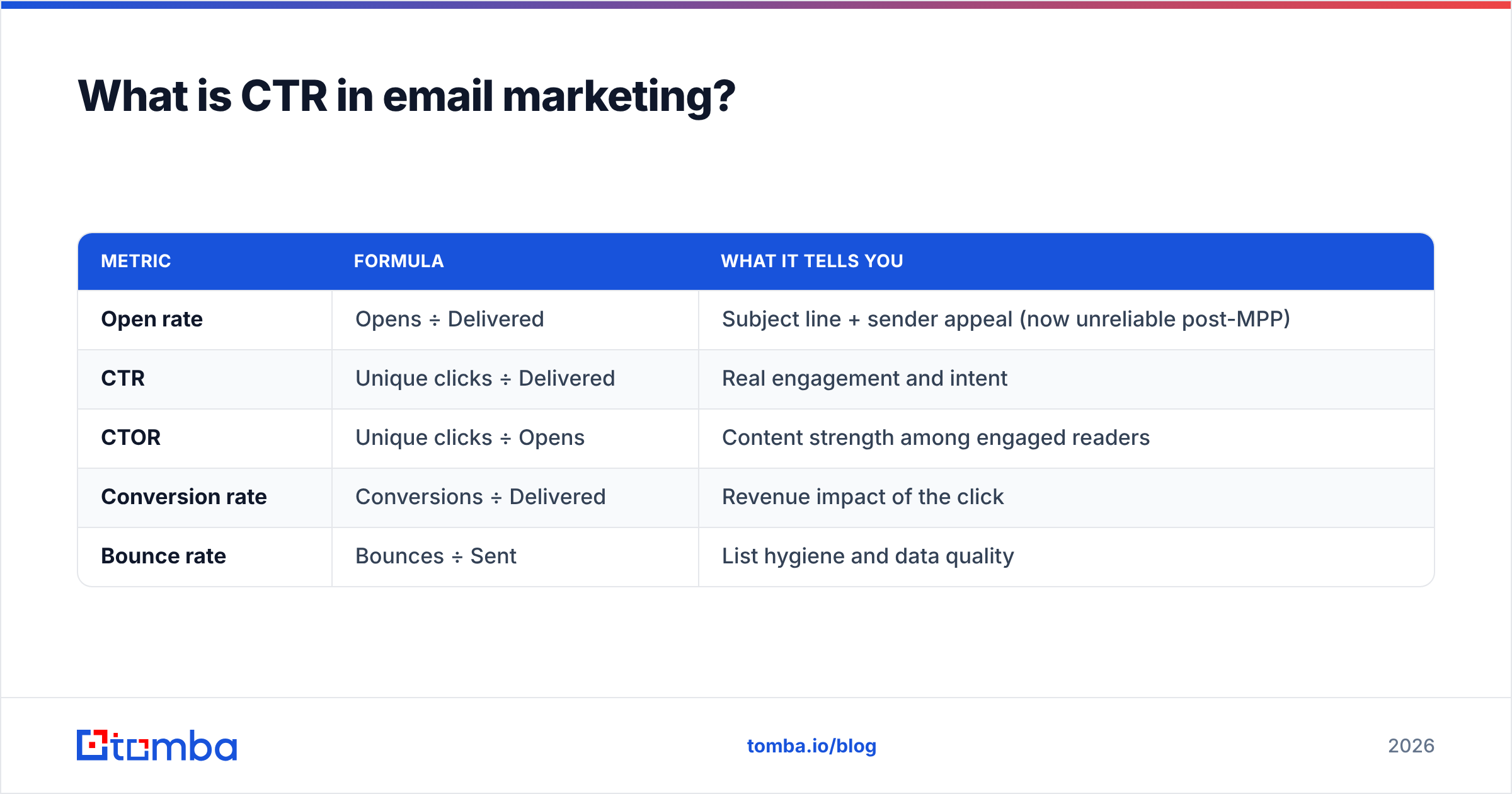
Click-through rate (CTR) is the percentage of delivered emails that earn at least one click on a link. Think of it like a store: open rate is how many people walked through the door, but CTR is how many actually picked something up and walked toward the register. It measures intent, not curiosity.
The standard formula is straightforward:
CTR = (Unique clicks ÷ Emails delivered) × 100
Note the denominator is delivered, not sent. If you blast 10,000 emails but 1,000 bounce, your CTR is calculated against the 9,000 that actually landed. That distinction matters, because a high bounce rate quietly inflates or distorts every downstream metric you report.
There's a sibling metric you'll see in reports: click-to-open rate (CTOR), which is clicks divided by opens rather than delivered. CTOR isolates how compelling your content was for people who already opened. Both are useful, but for year-over-year benchmarking, plain CTR against delivered volume is the standard most platforms publish.
| Metric | Formula | What it tells you |
|---|---|---|
| Open rate | Opens ÷ Delivered | Subject line + sender appeal (now unreliable post-MPP) |
| CTR | Unique clicks ÷ Delivered | Real engagement and intent |
| CTOR | Unique clicks ÷ Opens | Content strength among engaged readers |
| Conversion rate | Conversions ÷ Delivered | Revenue impact of the click |
| Bounce rate | Bounces ÷ Sent | List hygiene and data quality |
What is the average CTR for email marketing in 2026?#
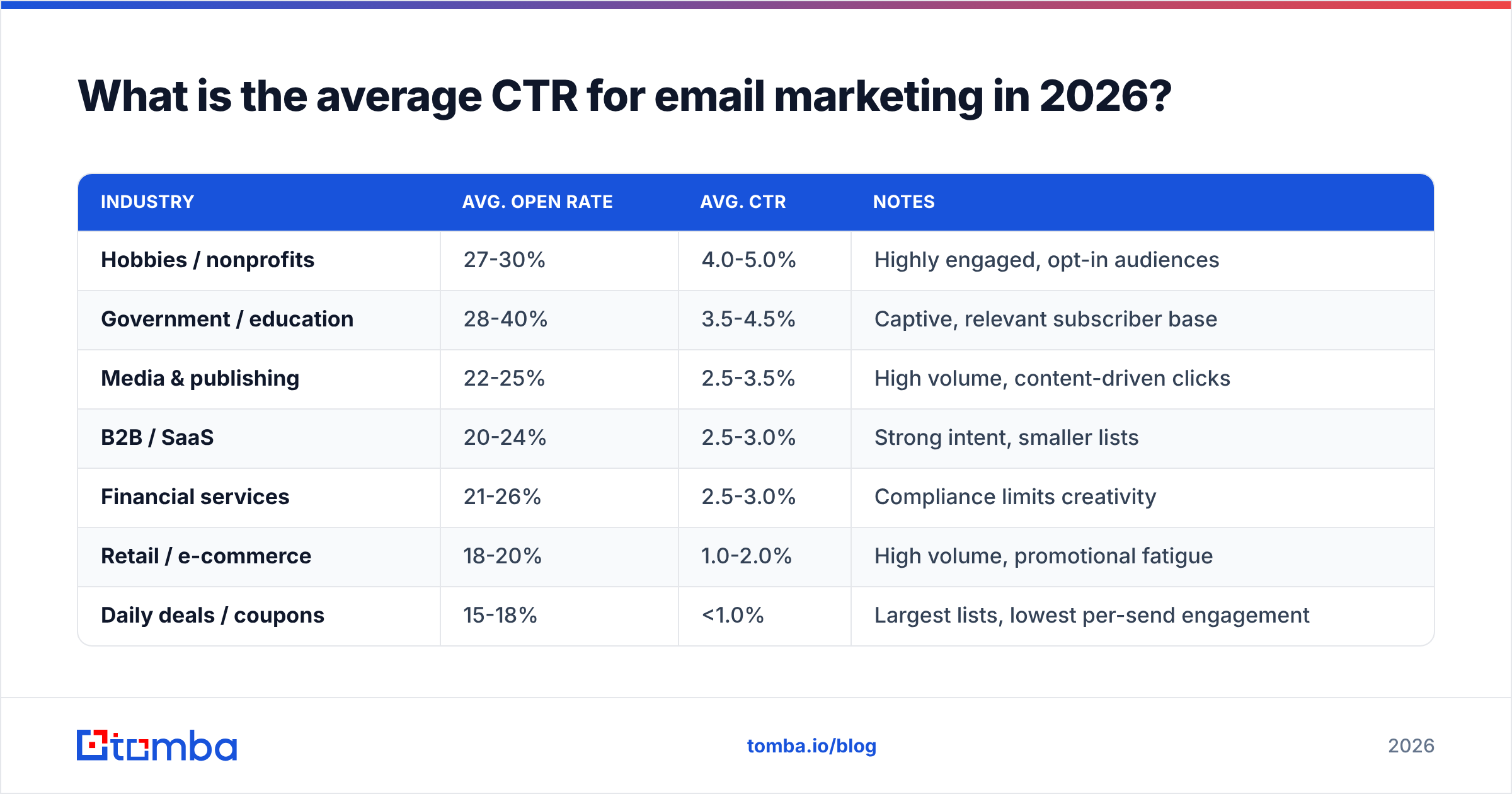
The short answer: the average CTR for email marketing is roughly 2-3% across all industries in 2026. Most credible aggregate reports — Mailchimp, Campaign Monitor, and HubSpot among them — have hovered in this band for years, and 2026 is no exception.
But the "all industries" average is close to useless for setting your own target. A B2B SaaS onboarding sequence and a flash-sale retail blast are different sports. Here's how the benchmarks break down by sector based on widely cited industry aggregates:
| Industry | Avg. open rate | Avg. CTR | Notes |
|---|---|---|---|
| Hobbies / nonprofits | 27-30% | 4.0-5.0% | Highly engaged, opt-in audiences |
| Government / education | 28-40% | 3.5-4.5% | Captive, relevant subscriber base |
| Media & publishing | 22-25% | 2.5-3.5% | High volume, content-driven clicks |
| B2B / SaaS | 20-24% | 2.5-3.0% | Strong intent, smaller lists |
| Financial services | 21-26% | 2.5-3.0% | Compliance limits creativity |
| Retail / e-commerce | 18-20% | 1.0-2.0% | High volume, promotional fatigue |
| Daily deals / coupons | 15-18% | <1.0% | Largest lists, lowest per-send engagement |
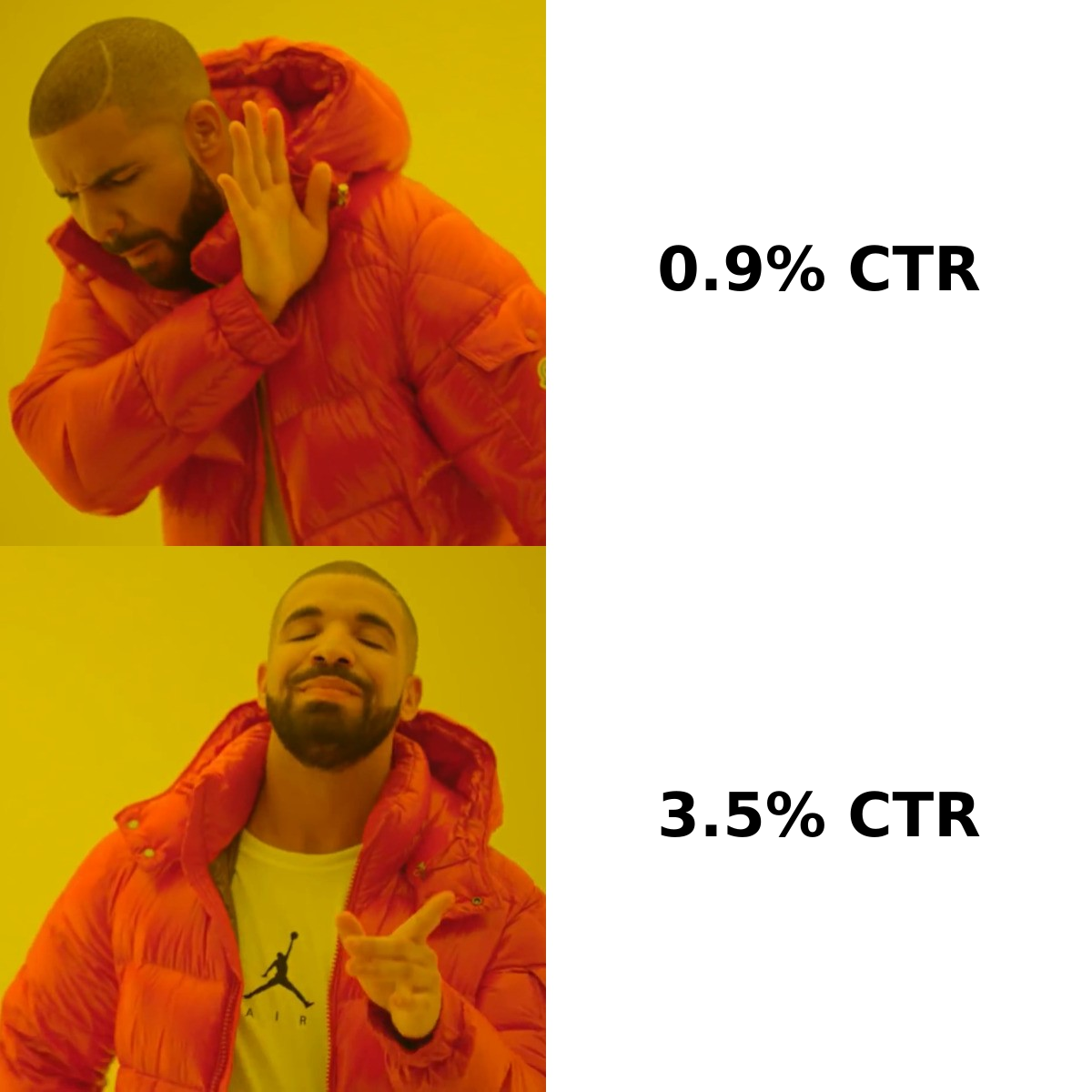
A few takeaways. First, smaller, intent-rich lists almost always beat giant promotional ones on CTR — relevance compounds. Second, if you're in retail and your CTR is 1.5%, you're not failing; you're average for your category. Context is everything, and comparing your travel newsletter to a government bulletin will only make you miserable.
One more wrinkle for 2026: Apple's Mail Privacy Protection (MPP) and similar features have inflated open rates with machine-triggered "opens" since 2021. That makes CTR the more trustworthy north star. When opens are noisy, clicks are signal. If you're still optimizing primarily for open rate, you're tuning an instrument with a broken needle. For the underlying mechanics, see our glossary entry on email response rate.
How is a "good" CTR different from an average one?#
A good CTR is one that beats your industry benchmark and trends upward against your own history. Chasing someone else's number is a trap; the only fair comparison is you-last-quarter versus you-now.
As a rough rule of thumb for 2026:
- Below 1% — Investigate. Likely a list-quality, targeting, or deliverability problem rather than a copy problem.
- 1-2% — Below average for most sectors. Room to improve segmentation and CTA clarity.
- 2-3% — Solidly average. You're doing the fundamentals right.
- 3-5% — Strong. Good segmentation, clean data, relevant offers.
- Above 5% — Excellent, usually a sign of tight niche targeting or a re-engaged, opt-in audience.
The teams that consistently live above 4% rarely have a secret subject-line formula. They have clean lists, sharp segments, and one obvious thing to click. That order matters — the rest of this post follows it.
What factors actually move email CTR?#
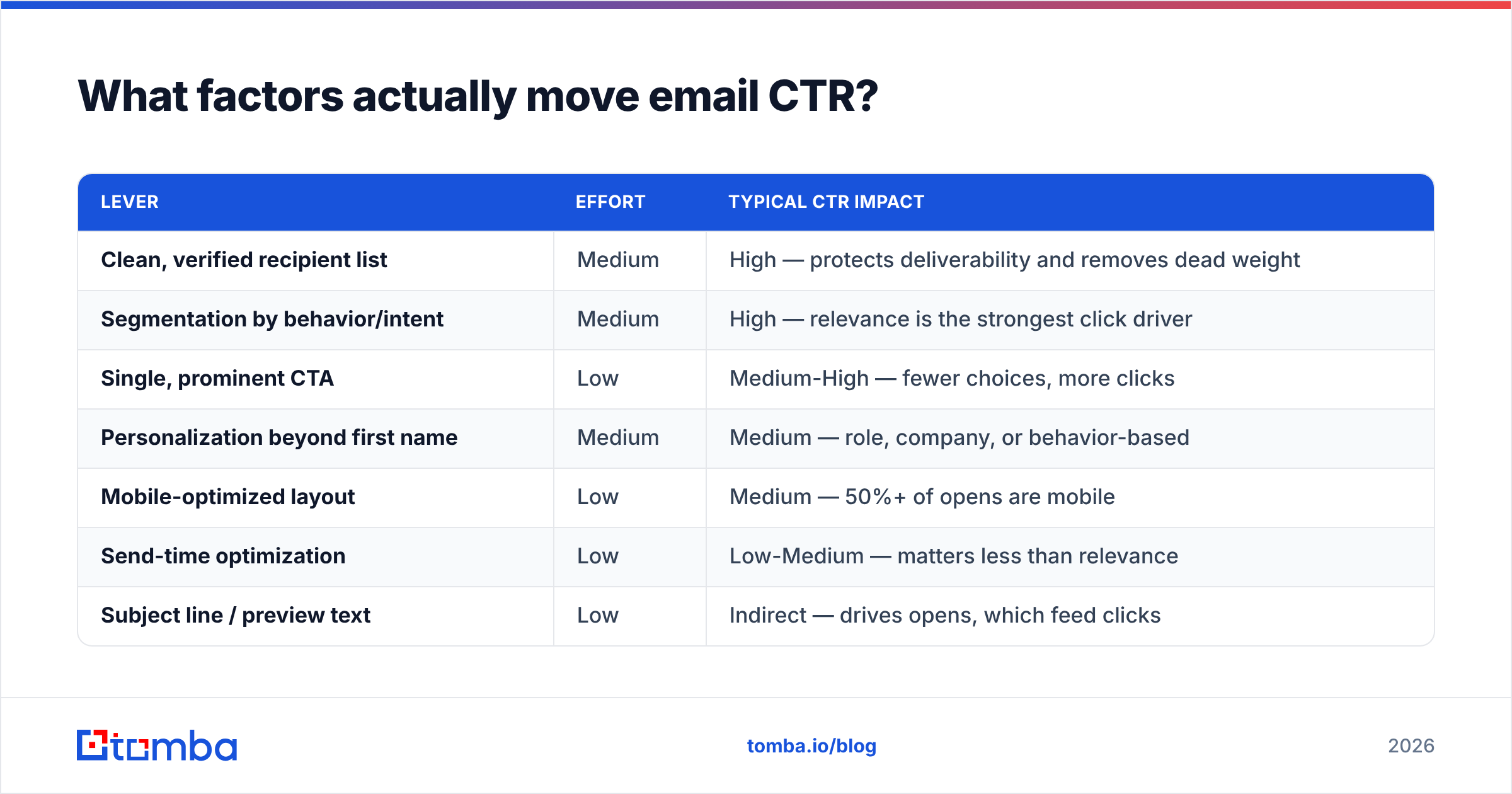
Most CTR advice fixates on the email itself: button color, copy length, GIF or no GIF. Those matter at the margins. But the levers with the largest effect sit upstream, in who you're emailing and whether the message reaches them at all.
| Lever | Effort | Typical CTR impact |
|---|---|---|
| Clean, verified recipient list | Medium | High — protects deliverability and removes dead weight |
| Segmentation by behavior/intent | Medium | High — relevance is the strongest click driver |
| Single, prominent CTA | Low | Medium-High — fewer choices, more clicks |
| Personalization beyond first name | Medium | Medium — role, company, or behavior-based |
| Mobile-optimized layout | Low | Medium — 50%+ of opens are mobile |
| Send-time optimization | Low | Low-Medium — matters less than relevance |
| Subject line / preview text | Low | Indirect — drives opens, which feed clicks |
Notice what's at the top. List quality and segmentation outrank every design tweak. Here's the uncomfortable math: if 15% of your list is invalid, abandoned, or spam-trap addresses, those contacts will never click — but they will drag down your delivered-based CTR and erode your sender reputation. A worse reputation means more of your good emails land in spam, which lowers CTR further. It's a doom loop, and no amount of A/B testing the headline fixes it.
That's why verifying your list before a send is the highest-ROI thing most teams ignore. Running addresses through an email verifier removes hard bounces and risky addresses before they ever touch your sender score. Pair that with strong email deliverability hygiene — authenticated domains, warmed-up sending IPs, and consistent volume — and you've raised the ceiling on every campaign before you've written a word.

How do you improve your email click-through rate?#
Treat CTR improvement as a stack, fixing the foundation before the finish. Here's the order that works:
1. Clean and verify the list first. Remove bounces, role accounts you don't want, and stale contacts. If you build lists through prospecting, validate every address at capture time. Tools like the email finder return verified professional addresses, so you start from clean data instead of guessing email patterns and hoping. Garbage in, garbage CTR.
2. Segment by behavior, not just demographics. A subscriber who clicked twice last month wants a different email than one who's been silent for 90 days. Even three crude segments — engaged, lapsing, dormant — beat one undifferentiated blast. Relevance is the single biggest CTR multiplier, and segmentation is how you buy it.
3. Give them one clear thing to do. Multiple competing CTAs split attention and dilute clicks. Decide the single action that matters for this email and make it visually obvious above the fold. If everything is a priority, nothing gets clicked.
4. Write for the click, not the open. Your subject line earns the open; your body and CTA earn the click. Make the value of clicking concrete: "See your 2026 pricing" beats "Learn more." If you need a starting point, a subject line tester helps you stop guessing on the part that gates everything downstream.
5. Optimize for mobile. More than half of opens happen on phones. A CTA that requires pinch-zooming is a CTA that doesn't get tapped. Single-column layouts, large tap targets, and short paragraphs win.
6. Test one variable at a time. A/B test the CTA, then the subject line, then send time — never all at once. You can only learn from a test where you can attribute the result to one change.
For deeper, repeatable workflows on the copy side, our guides on cold email templates walk through structures that consistently earn clicks in outbound contexts.
How does deliverability cap your CTR?#
Deliverability is the invisible ceiling on every click rate you'll ever report. Here's the analogy: you can write the most persuasive flyer in the world, but if the post office dumps half your mail in a landfill, your response rate collapses — and it has nothing to do with the flyer.
When your emails land in spam or get throttled, three things happen at once:
- Fewer emails are actually seen, so raw clicks drop.
- Spam-foldered messages still count as "delivered" by most ESPs, so your CTR denominator stays high while the numerator falls — a double penalty.
- Low engagement signals to mailbox providers that your mail is unwanted, worsening placement on the next send.
This is why the highest-CTR senders obsess over the boring stuff: SPF, DKIM, and DMARC authentication; consistent send volume; prompt list pruning; and never emailing addresses that bounce. If you're seeing a sudden CTR drop with no copy or audience change, suspect deliverability before you suspect your creative. A quick check of your authentication records and bounce logs will usually reveal the culprit faster than another round of headline testing.
The data layer underneath all of this matters too. Whether you build lists in-house or enrich existing records, the accuracy of your contact data — verified emails, correct roles, current companies — determines how much of your audience is reachable and relevant. That's the real starting line for CTR, long before anyone opens your design editor.
What CTR mistakes quietly tank your numbers?#
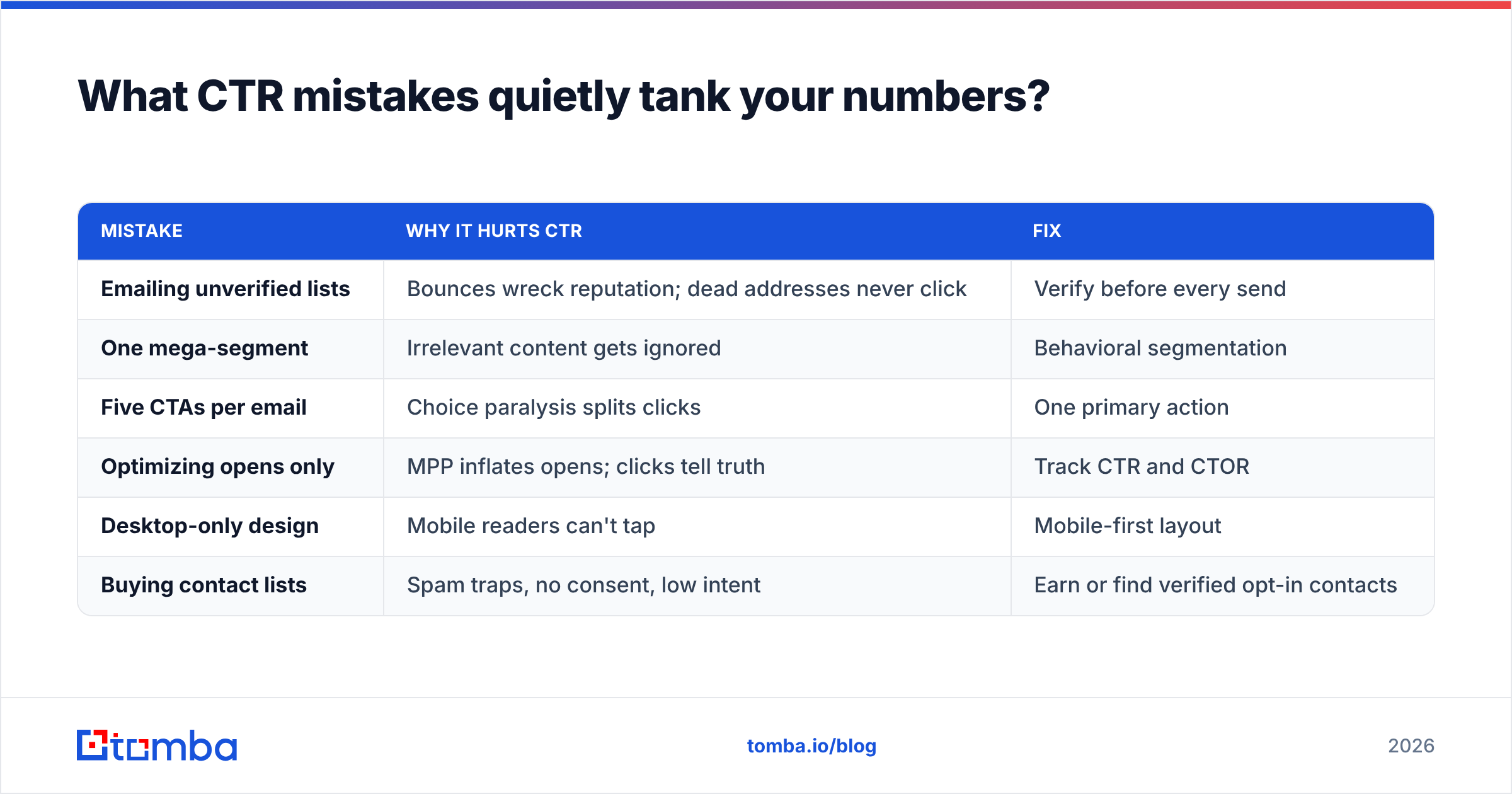
A few recurring errors show up in nearly every underperforming program:
| Mistake | Why it hurts CTR | Fix |
|---|---|---|
| Emailing unverified lists | Bounces wreck reputation; dead addresses never click | Verify before every send |
| One mega-segment | Irrelevant content gets ignored | Behavioral segmentation |
| Five CTAs per email | Choice paralysis splits clicks | One primary action |
| Optimizing opens only | MPP inflates opens; clicks tell truth | Track CTR and CTOR |
| Desktop-only design | Mobile readers can't tap | Mobile-first layout |
| Buying contact lists | Spam traps, no consent, low intent | Earn or find verified opt-in contacts |
The thread connecting most of these is data quality and relevance. You'll get more lift from removing 2,000 dead addresses and splitting your list into three real segments than from any subject-line marathon. Start where the leverage is.
Frequently asked questions#
What is a good CTR for email marketing in 2026? Anything above your industry benchmark and trending up. As a rule of thumb, 2-3% is average, 3-5% is strong, and above 5% is excellent — usually the sign of a tightly targeted, opt-in audience.
Why is my email open rate high but CTR low? Two common causes. First, Apple Mail Privacy Protection inflates open counts with machine-triggered opens, so your "high" open rate may be partly fictional. Second, your subject line is over-promising relative to the body — people open, feel let down, and don't click. Tighten the match between subject and content.
Is CTR or CTOR more important? CTR (against delivered) is better for benchmarking against industry data and tracking overall campaign health. CTOR (against opens) is better for isolating content quality among engaged readers. Track both; report CTR externally.
Does list size affect CTR? Inversely, usually. Larger broadcast lists tend to have lower CTR because they include more marginal, low-intent contacts. Smaller, well-segmented, verified lists almost always outperform on a percentage basis.
The bottom line#
The average CTR for email marketing in 2026 sits around 2-3%, but your target should be your own past performance plus your industry's benchmark — not a vanity number. And the fastest path to a higher click rate isn't a clever headline; it's a clean, verified, well-segmented list reaching inboxes that actually want to hear from you.
That foundation starts with accurate contact data. If you're building or refreshing your outreach lists, Tomba's Email Finder returns verified professional email addresses by name, company, or domain — so every contact you send to is real, reachable, and worth a click. Start free with 25 searches a month, then scale on the Starter plan at $49/mo when your list outgrows it. Clean data first, clicks second — in that order.
// get started
Find, verify and enrich your first contacts today
Start on the free plan with 25 searches a month, then scale when your team is ready.
Free plan · No credit card required · GDPR & CCPA
// about the author