Average Open and Click Rates in 2026 (Real Benchmarks)
What counts as a good open rate or click rate in 2026? Real benchmarks by industry and channel, why Apple Mail broke open tracking, and how to fix weak numbers.
TL;DR
- The average email open rate across industries in 2026 sits around 35-42%, and the average click rate around 2-3% — but open data is inflated and unreliable since Apple Mail Privacy Protection started pre-loading images.
- Cold outreach plays by different rules: expect 40-60% opens (when tracking works), 5-12% reply rates, and far lower click rates because the goal is a reply, not a click.
- A "good" number depends entirely on your industry, list quality, and email type. Treat the benchmarks below as a starting line, not a verdict.
- Open rate is now a directional metric. Click rate, click-to-open rate (CTOR), reply rate, and conversions are what you should actually optimize.
- The fastest way to lift every number at once is cleaner data: verified, deliverable addresses that land in the inbox in the first place.
What are average open and click rates in 2026?#
Here's the short answer: across all industries, the average open rate is roughly 35-42% and the average click rate is roughly 2-3% in 2026. Those figures come from aggregated sends across email service providers, and they've drifted upward over the last few years — not because engagement exploded, but because open tracking got noisier.
Think of open rate like a doorbell camera that sometimes triggers on a passing breeze. After Apple's Mail Privacy Protection (MPP) began pre-fetching images for a large share of recipients, many "opens" now register before a human ever sees the message. So the number went up while the meaning went down. Click rate, by contrast, still requires a deliberate human action, which makes it the more honest of the two headline metrics.
If you want one rule of thumb to carry into the rest of this post: trust clicks over opens, and trust replies over both when your goal is a conversation rather than a purchase.

What's a good open rate vs a good click rate by industry?#
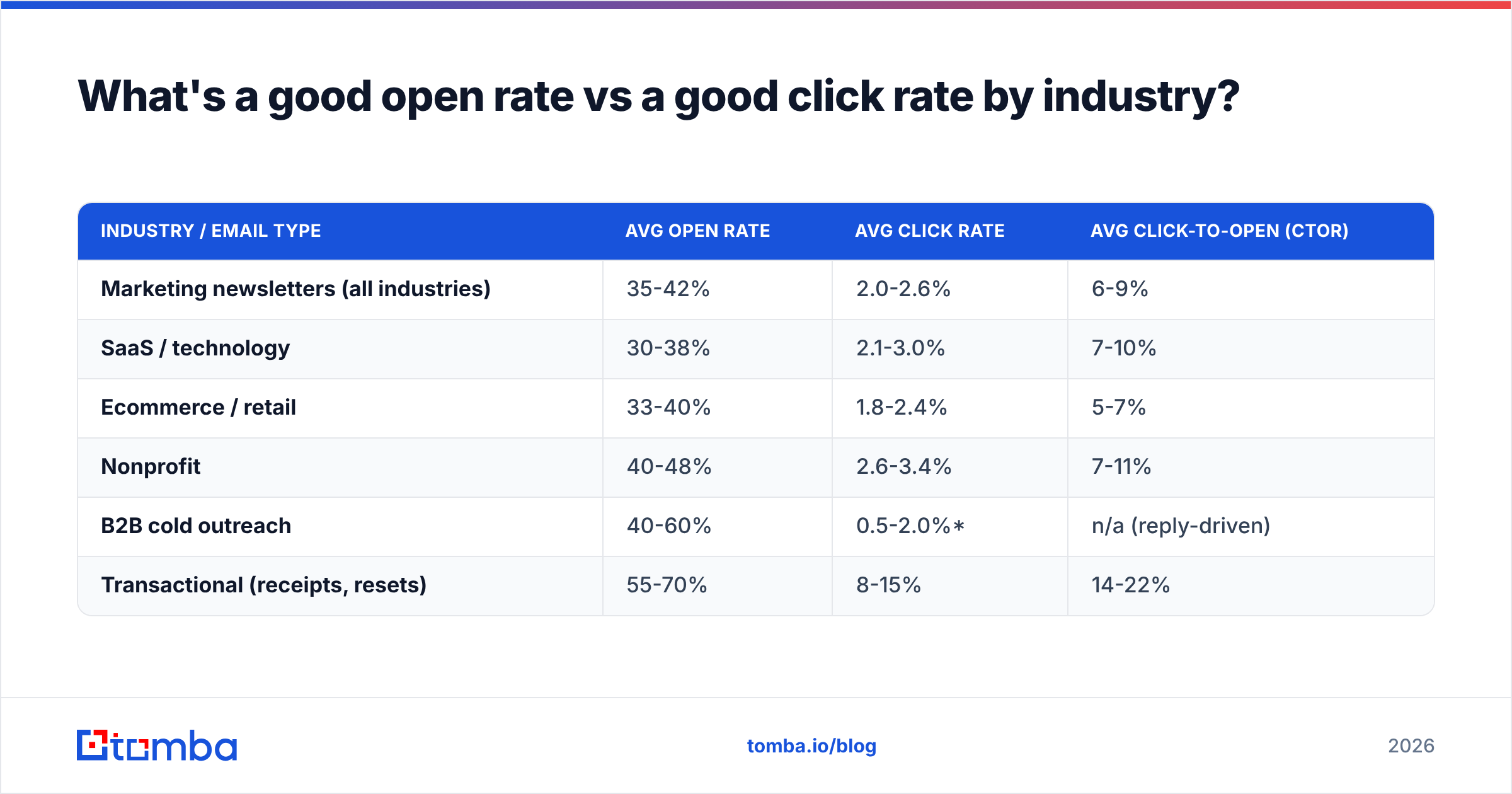
Averages hide enormous variation. A nonprofit newsletter and a cold SaaS prospecting sequence are not playing the same game. Below are representative 2026 benchmark ranges you can use to sanity-check your own dashboard.
| Industry / email type | Avg open rate | Avg click rate | Avg click-to-open (CTOR) |
|---|---|---|---|
| Marketing newsletters (all industries) | 35-42% | 2.0-2.6% | 6-9% |
| SaaS / technology | 30-38% | 2.1-3.0% | 7-10% |
| Ecommerce / retail | 33-40% | 1.8-2.4% | 5-7% |
| Nonprofit | 40-48% | 2.6-3.4% | 7-11% |
| B2B cold outreach | 40-60% | 0.5-2.0%* | n/a (reply-driven) |
| Transactional (receipts, resets) | 55-70% | 8-15% | 14-22% |
*Cold outreach click rates look low because most sequences intentionally avoid links in the first touch — links can hurt deliverability and the real KPI is the reply rate, typically 5-12% for a well-targeted list.
Two takeaways. First, transactional email crushes everything because the recipient is expecting it. Second, "B2B cold" and "marketing newsletter" should never be benchmarked against each other — different intent, different list, different success metric.
For deliverability context on why these numbers swing so hard, our primer on email deliverability breaks down inbox placement versus engagement.
Why is open rate unreliable now?#
Because a machine, not a person, often triggers it. Here are the four forces distorting open data in 2026, in order of impact:
- Apple Mail Privacy Protection — MPP routes images through Apple's proxy and pre-loads them, firing your tracking pixel whether or not the user opens the message. With Apple Mail commanding a large slice of opens, a big chunk of your "opens" are synthetic.
- Image blocking — recipients (and corporate gateways) that block images never fire the pixel, so genuine opens go uncounted. This pushes in the opposite direction, understating opens for privacy-conscious audiences.
- Bot and security scanners — link-protection tools and spam filters click and load content automatically, inflating both opens and clicks on the first few minutes after send.
- Pre-fetch and caching — Gmail and other providers cache images, which can register opens without a real view.
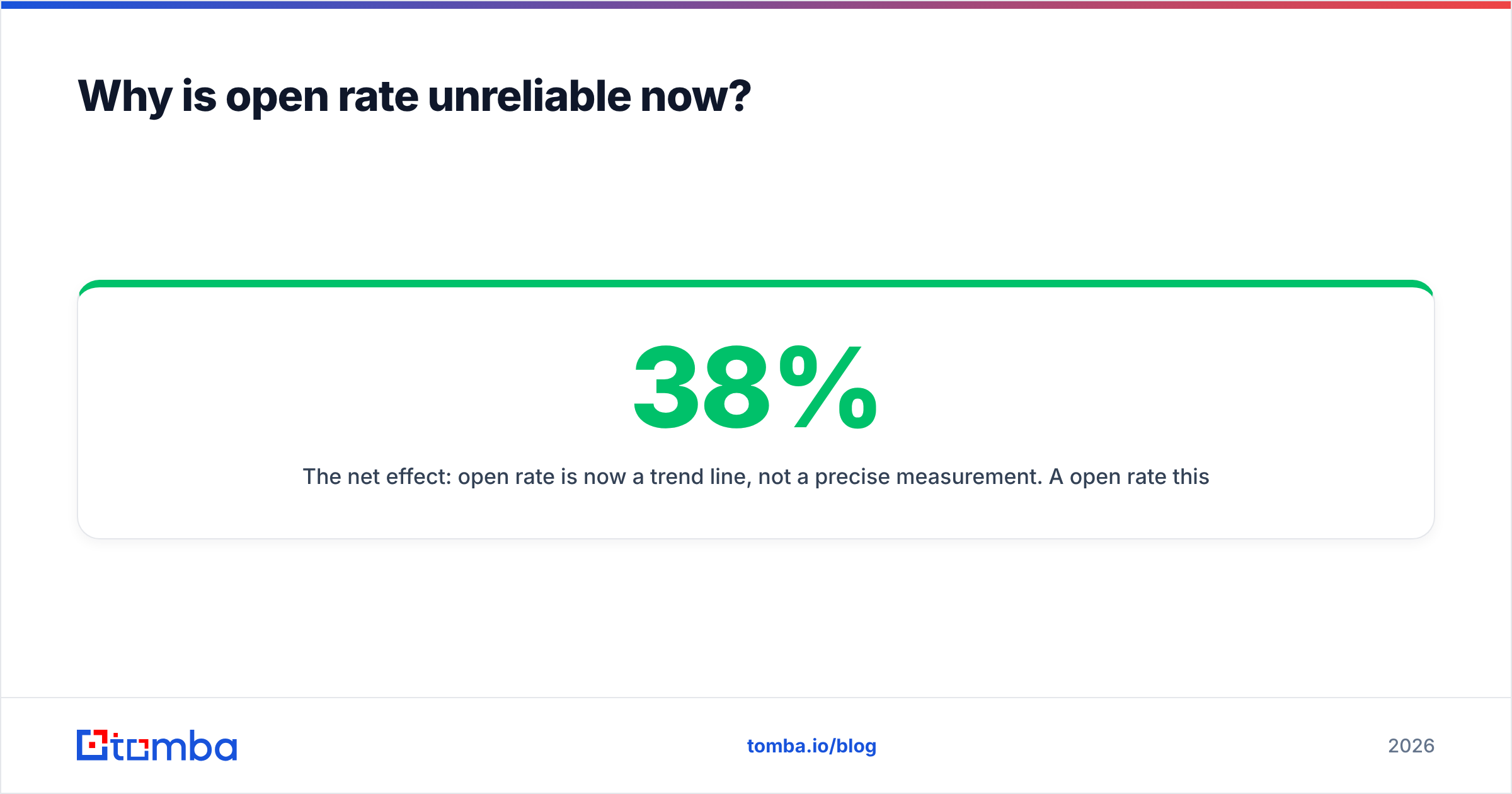
The net effect: open rate is now a trend line, not a precise measurement. A 38% open rate this week versus 41% last week tells you very little. A 38% open rate that collapses to 12% tells you something is broken — likely deliverability or list quality.
This is exactly why list hygiene matters more than ever. Sending to dead, mistyped, or spam-trap addresses tanks your sender reputation, which then suppresses every downstream metric. Running addresses through an email verifier before a campaign removes the invalid contacts that quietly drag your numbers down.
Which metrics should you actually track instead?#
Lead with the metrics a machine can't fake. Here's the hierarchy I'd recommend for 2026, framed by what each one really tells you:
- Click rate — did a human care enough to act? Still the most trustworthy top-of-funnel signal for marketing email.
- Click-to-open rate (CTOR) — of the people who opened, how many clicked? Even with inflated opens, a rising CTOR signals stronger creative and offer relevance.
- Reply rate — the north star for cold outreach. A reply is a human typing back; no proxy or scanner produces that.
- Conversion rate — demos booked, trials started, revenue. The only metric your CFO cares about.
- Bounce rate and spam complaint rate — your early-warning system. Rising bounces mean dirty data; rising complaints mean wrong audience or bad consent.
Notice open rate isn't on the "optimize" list. Keep watching it for anomalies — a sudden drop is a useful smoke alarm — but stop celebrating a 45% open as if it were revenue. For cold campaigns specifically, our breakdown of the email response rate explains how to set realistic reply targets.

How do you improve weak open and click rates?#
Fix the inputs and the outputs follow. Improving engagement is less about clever subject lines and more about reaching real people in the inbox. Work down this list in order — earlier fixes have bigger leverage.
1. Clean your list before you send. Invalid and risky addresses cause hard bounces, and bounces are the single fastest way to wreck sender reputation. Verify every address, and for ambiguous domains use a catch-all verifier so you're not guessing on deliverability.
2. Authenticate your domain. SPF, DKIM, and DMARC are table stakes in 2026. Without them, mailbox providers throttle or junk you regardless of content. A quick SPF record check is a five-minute win.
3. Warm up new sending domains and inboxes. Ramp volume gradually so providers learn you're legitimate. Cold-starting at high volume is a one-way ticket to the spam folder.
4. Segment and personalize. Relevance drives clicks. A tightly targeted send to 500 right-fit contacts beats a blast to 5,000 mismatched ones on every metric that matters.
5. Test subject lines and timing — but measure with clicks. Because opens are noisy, judge subject-line tests by downstream clicks and replies, not by the open delta alone. A free subject line generator gives you variants to test.
The throughline across all five: better data beats better copy. You can A/B test headlines forever, but if 20% of your list is undeliverable, you're optimizing a leaky bucket.
How do marketing and cold-email benchmarks differ?#
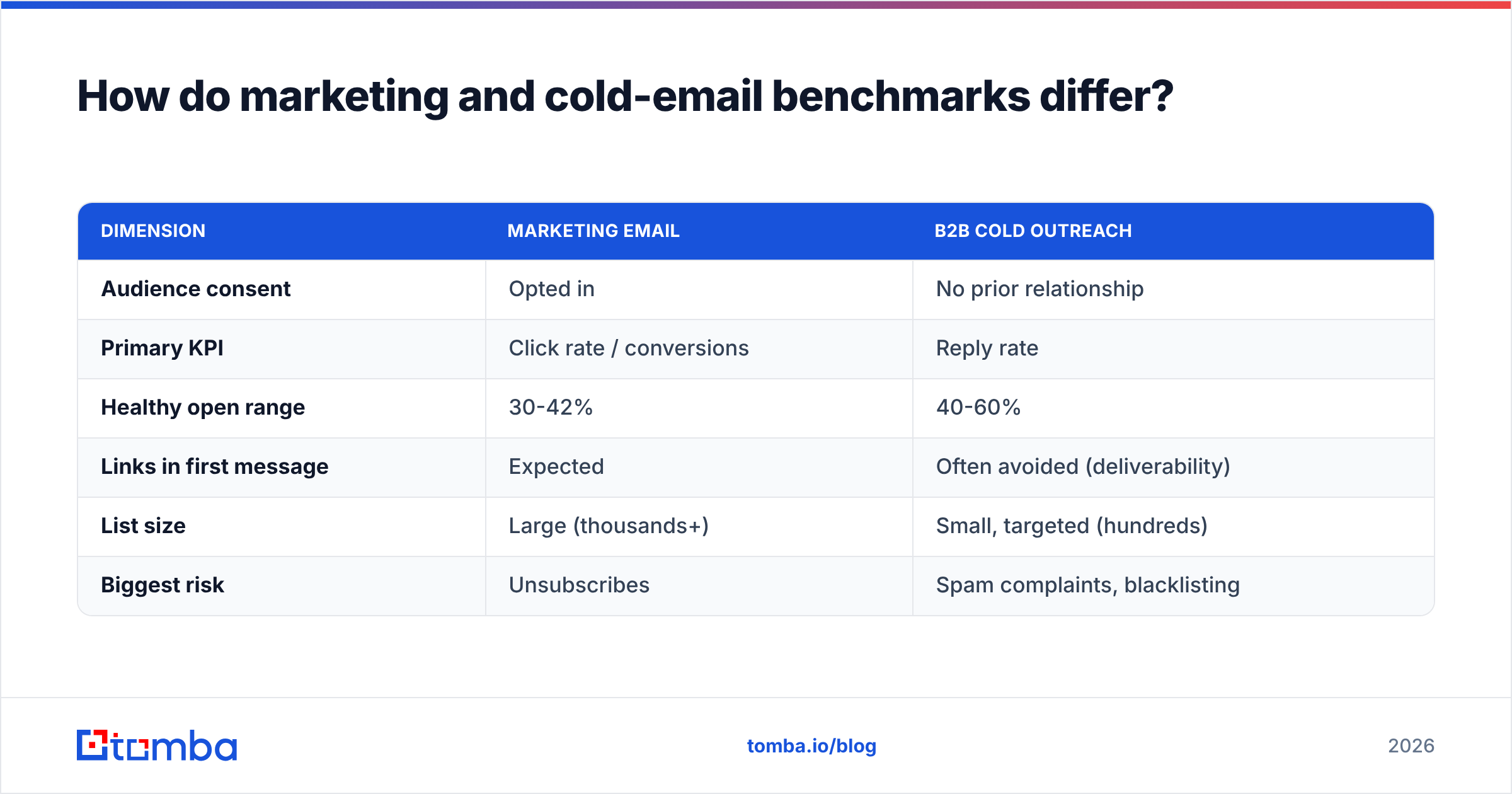
They differ because the contract with the recipient is different. A newsletter subscriber opted in; a cold prospect did not. That single fact reshapes every benchmark.
| Dimension | Marketing email | B2B cold outreach |
|---|---|---|
| Audience consent | Opted in | No prior relationship |
| Primary KPI | Click rate / conversions | Reply rate |
| Healthy open range | 30-42% | 40-60% |
| Links in first message | Expected | Often avoided (deliverability) |
| List size | Large (thousands+) | Small, targeted (hundreds) |
| Biggest risk | Unsubscribes | Spam complaints, blacklisting |
For cold outreach, a 50% open rate with a 1% reply rate is a failure — you got attention but said nothing worth answering. A 45% open rate with a 9% reply rate is a win. The lesson: pair every open benchmark with the action metric that defines success for that channel.
Cold outreach also lives and dies on accurate contact data. There's no margin for guesswork when you're sending a few hundred high-intent messages — every bounced address is both a wasted slot and a reputation hit. Sourcing addresses through a verified email finder instead of scraping keeps your bounce rate low and your benchmarks honest.
What tools and benchmarks should you trust?#
Use multiple independent sources and weight recent data. Reputable, regularly updated benchmark reports include Mailchimp's email marketing benchmarks, HubSpot's marketing statistics, and peer-review platforms like G2 for tool-level performance signals. Cross-reference them rather than trusting any single number.
A quick checklist for evaluating any benchmark you read:
- How recent is it? Pre-2022 open-rate data predates Apple MPP and is effectively obsolete.
- What's the sample? Industry, region, and list size dramatically change the figure.
- What's being measured? "Open rate" defined as pixel fires is not comparable across providers.
- Is click or reply data included? Reports that only cite opens are telling half the story.
When you compare your own dashboard against these sources, normalize for your industry first, then your email type, then your list quality. Only after those three adjustments is a comparison meaningful.
Frequently asked questions#
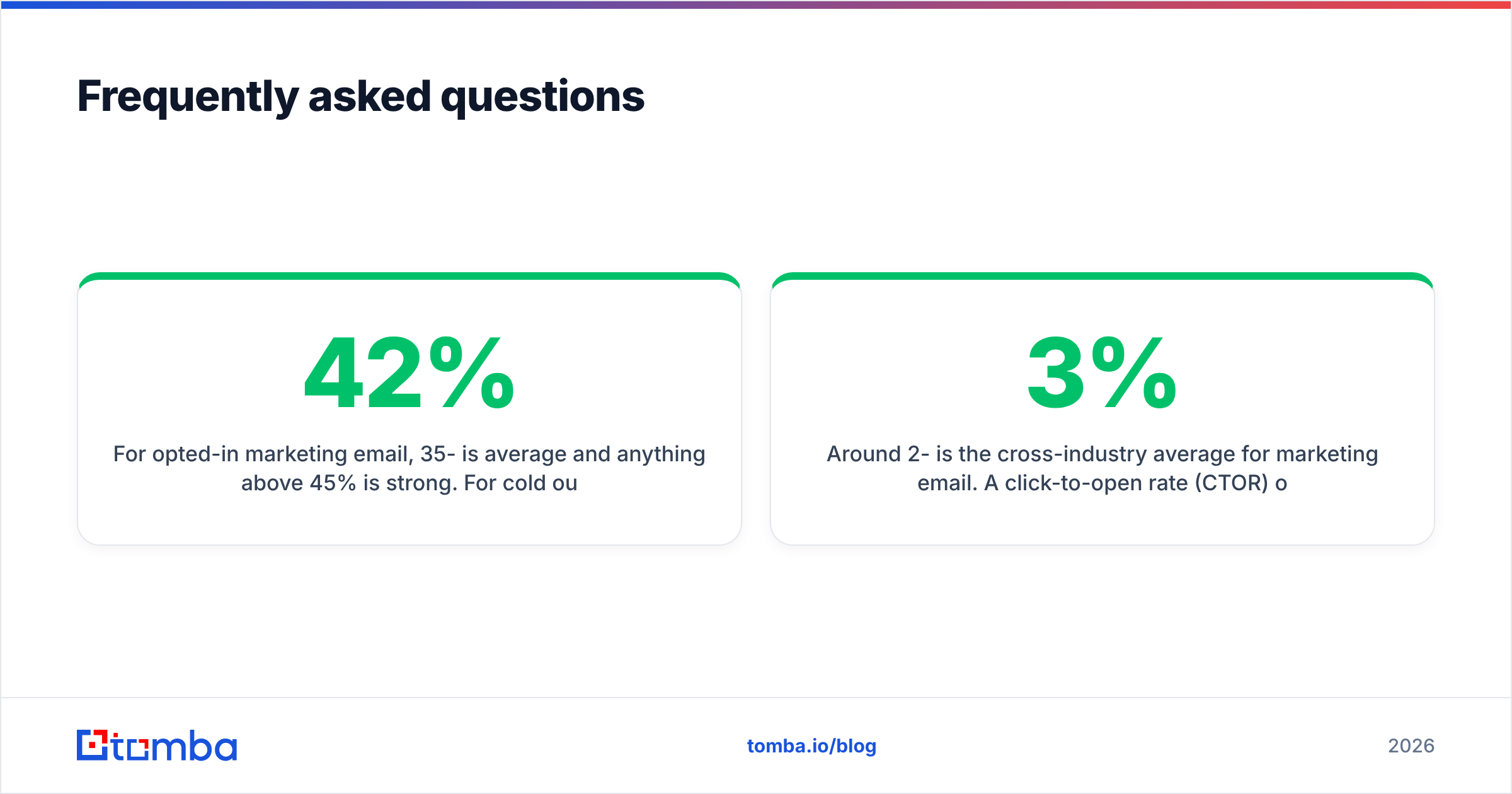
What is a good open rate in 2026? For opted-in marketing email, 35-42% is average and anything above 45% is strong. For cold outreach, aim for 40-60% — but always pair it with reply rate, since opens alone are inflated by Apple Mail Privacy Protection.
What is a good click rate? Around 2-3% is the cross-industry average for marketing email. A click-to-open rate (CTOR) of 7-10% is a healthier signal of content relevance because it controls for inflated opens.
Why did my open rate suddenly spike or drop? A spike often means bot/scanner activity or Apple MPP pre-fetching. A sharp drop usually signals a deliverability problem — check authentication, bounce rate, and whether you're landing in spam. Verify your list to rule out dirty data first.
Are open rates still worth tracking at all? Yes, but only as a trend and anomaly detector — not as a success metric. Optimize clicks, replies, and conversions instead.
Make your benchmarks honest with cleaner data#
Every open rate, click rate, and reply rate you'll ever measure rests on one assumption: that your emails reach real, deliverable inboxes. Break that assumption and no subject line or send-time tweak will save your numbers. That's why the highest-leverage move in 2026 isn't another A/B test — it's better data going in.
Start with the source. The Tomba Email Finder finds verified professional email addresses by name, company, or domain, so your campaigns launch against accurate, deliverable contacts instead of guesses. Pair it with verification, check your Tomba pricing options (a free tier with 25 searches/month lets you test before you commit), and watch your benchmarks start reflecting real human engagement — not pixel noise. Clean data first, better numbers after.
// get started
Find, verify and enrich your first contacts today
Start on the free plan with 25 searches a month, then scale when your team is ready.
Free plan · No credit card required · GDPR & CCPA
// about the author