Avoxi Pricing, Reviews, Pros and Cons (2026 Buyer Guide)
A neutral 2026 breakdown of Avoxi pricing, real user reviews, and the honest pros and cons of its cloud voice and virtual number platform — plus where it fits a B2B sales stack.
This guide covers Avoxi pricing, reviews, pros and cons in one place. Avoxi sells itself as a global cloud voice platform. It offers virtual numbers in 170+ countries, a browser-based contact center, and call routing with no desk phone. But the pricing page raises more questions than it answers. The reviews are split too. So here is the plain version: what Avoxi costs in 2026, what users praise, what they complain about, and the honest pros and cons before you commit a sales team.
TL;DR#
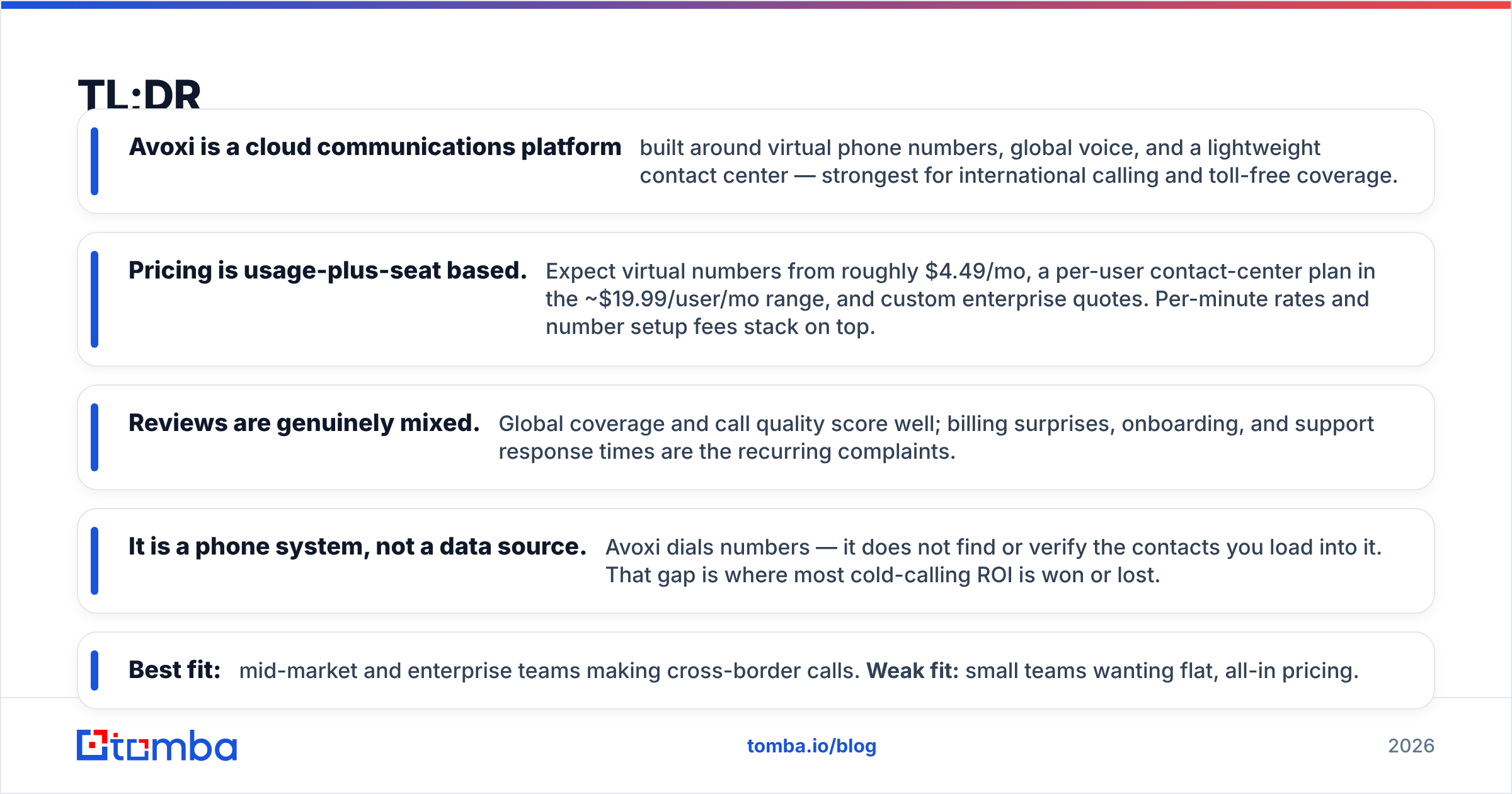
- Avoxi is a cloud communications platform built around virtual phone numbers, global voice, and a light contact center. It is strongest for international calling and toll-free coverage.
- Pricing is usage-plus-seat based. Expect virtual numbers from roughly $4.49/mo. A per-user contact-center plan sits in the ~$19.99/user/mo range. Enterprise quotes are custom. Per-minute rates and number setup fees stack on top.
- Reviews are genuinely mixed. Global coverage and call quality score well. Billing surprises, onboarding, and support speed are the recurring complaints.
- It is a phone system, not a data source. Avoxi dials numbers. It does not find or verify the contacts you load into it. That gap is where most cold-calling ROI is won or lost.
- Best fit: mid-market and enterprise teams making cross-border calls. Weak fit: small teams that want flat, all-in pricing.
What is Avoxi and who is it for?#
Think of Avoxi as the phone line and switchboard for a company that no longer owns a switchboard. You do not buy hardware in every country. Instead, you rent local, national, toll-free, and mobile virtual numbers in the cloud. Your reps then answer them from a browser or softphone. In plain terms, it is a cloud VoIP and Contact Center as a Service (CCaaS) provider focused on global voice.
The platform's real edge is reach. Avoxi advertises virtual numbers across 170+ countries. That matters if your support or sales lines need to look local in London, São Paulo, and Singapore at once. Around that core sit call recording, IVR menus, call queues, analytics, CRM integrations, and basic outbound dialing.
It is aimed at three buyers: international support teams that need local presence, sales orgs running cross-border outbound, and IT/telecom managers who want to consolidate a messy spread of regional carriers into one dashboard. It is not really aimed at a five-person startup that just wants cheap, predictable U.S. calling. That buyer usually finds Avoxi's pricing model heavier than it needs.
How much does Avoxi cost in 2026?#
Short answer: it depends on numbers, seats, and minutes. There is no single flat price. Avoxi splits cost across three things that bill separately. First, the virtual numbers themselves. Second, the per-user software plan. Third, the per-minute voice usage. That is normal for global voice providers. But it makes "what will this cost me" harder to answer than a flat SaaS sticker.
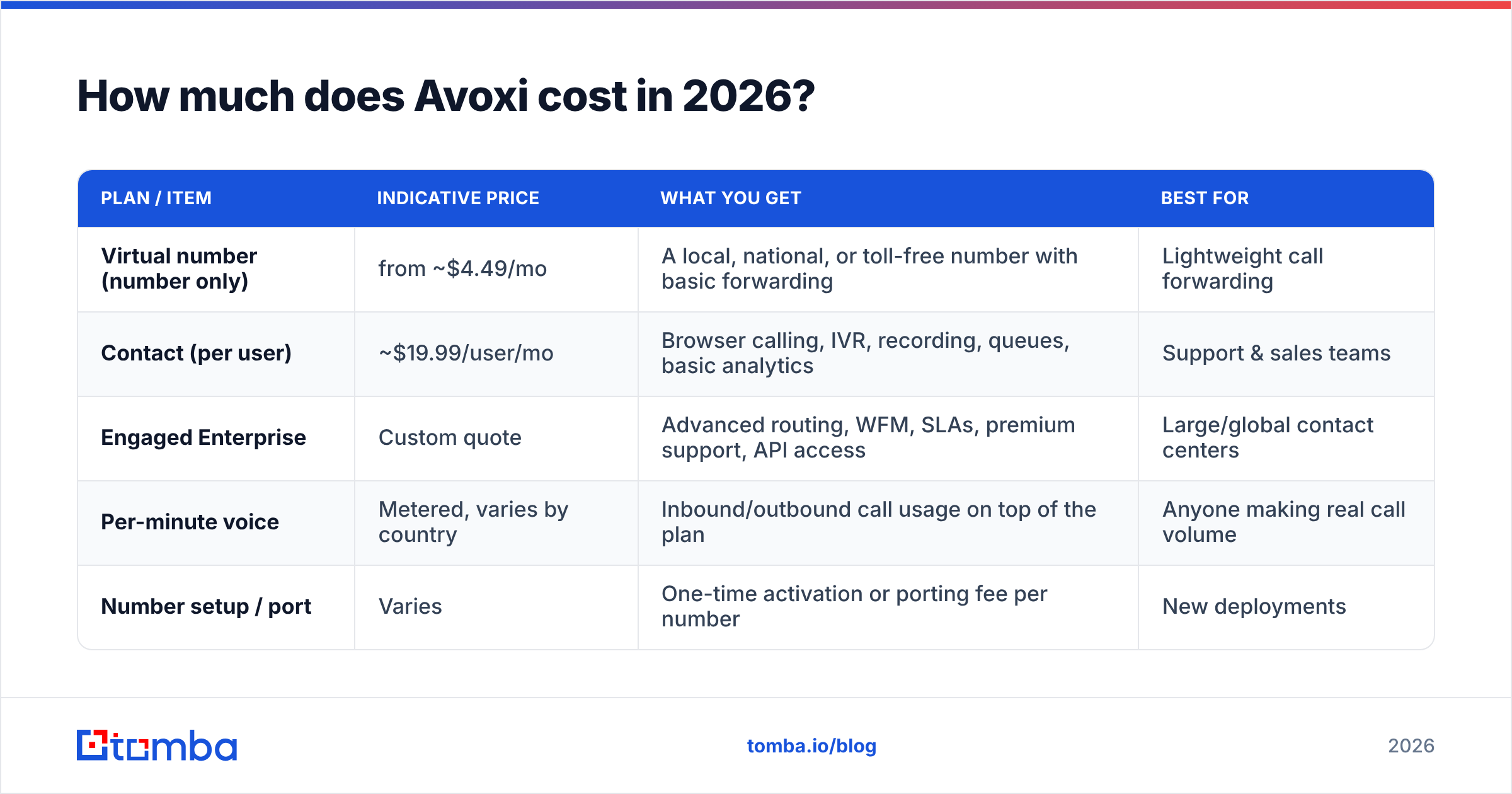
Here is the indicative shape of Avoxi's published plans. Treat these as ballpark. Telecom pricing shifts by country and promotion, so confirm live numbers on Avoxi's own pricing page before you budget.
| Plan / item | Indicative price | What you get | Best for |
|---|---|---|---|
| Virtual number (number only) | from ~$4.49/mo | A local, national, or toll-free number with basic forwarding | Lightweight call forwarding |
| Contact (per user) | ~$19.99/user/mo | Browser calling, IVR, recording, queues, basic analytics | Support & sales teams |
| Engaged Enterprise | Custom quote | Advanced routing, WFM, SLAs, premium support, API access | Large/global contact centers |
| Per-minute voice | Metered, varies by country | Inbound/outbound call usage on top of the plan | Anyone making real call volume |
| Number setup / port | Varies | One-time activation or porting fee per number | New deployments |
A few things to internalize about this model. First, the per-minute charges are the variable that wrecks naive budgets. A team that calls many mobile numbers in expensive destinations pays far more than the seat price suggests. Second, some premium and toll-free numbers carry higher monthly and per-minute rates than the entry figure above. Third, enterprise features like queue callback, advanced analytics, and workforce tools live behind the custom tier. So the "real" price for a serious contact center is almost always a sales-led quote, not a self-serve number.

Wait — ignore that placeholder reasoning. The point stands without a chart: before you pay per minute to dial anyone, the number and email on the record need to be right.
Are you comparing Avoxi against other voice and outreach platforms on price? The lesson from every honest pricing review is the same. Compare total cost of ownership — seats plus numbers plus minutes plus setup — not headline per-seat rates.
What do Avoxi reviews actually say?#
Conclusion first: users love the global coverage and call clarity. They grumble about billing, onboarding, and support speed. Across public review sites the pattern is consistent enough to trust.
On the positive side, reviewers on G2 and Capterra repeatedly highlight:
- International number availability — getting a local presence in hard-to-cover countries is the single most praised feature.
- Call quality — clear connections and stable uptime for a cloud voice product.
- Browser-based simplicity — reps can take calls without hardware or heavy installs.
- Reasonable entry cost for numbers — the per-number price is competitive for occasional forwarding.
The recurring criticisms cluster just as tightly:
- Billing surprises — per-minute usage and add-on fees that buyers did not fully model up front.
- Onboarding and number provisioning — porting and activating numbers in regulated countries can be slow. Documentation rules are strict. It is often the carrier's fault, but it lands on Avoxi's reviews.
- Support responsiveness — slower-than-expected replies on lower tiers is the most common one-to-two-star theme.
- UI/admin depth — some find the analytics and admin controls thinner than enterprise rivals.
None of this makes Avoxi a bad product. It makes it a telecom product. The value is real, and the friction is the friction every global voice vendor carries. The teams that review it well are the ones that modeled per-minute cost honestly and had patience with country-by-country provisioning.
What are the pros and cons of Avoxi?#
Here is the balanced view, stripped of marketing.
| Pros | Cons | |
|---|---|---|
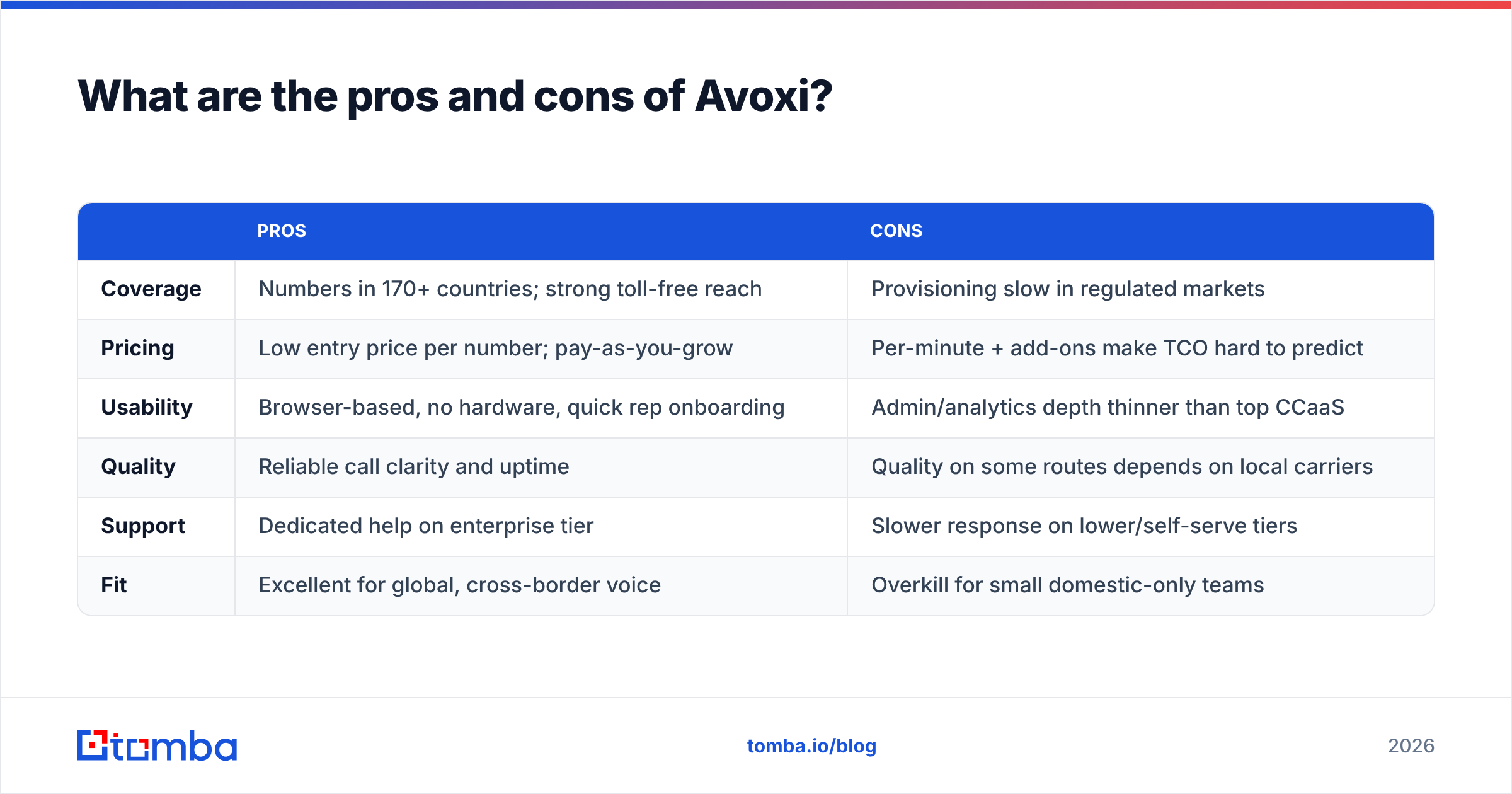
| Coverage | Numbers in 170+ countries; strong toll-free reach | Provisioning slow in regulated markets |
| Pricing | Low entry price per number; pay-as-you-grow | Per-minute + add-ons make TCO hard to predict |
| Usability | Browser-based, no hardware, quick rep onboarding | Admin/analytics depth thinner than top CCaaS |
| Quality | Reliable call clarity and uptime | Quality on some routes depends on local carriers |
| Support | Dedicated help on enterprise tier | Slower response on lower/self-serve tiers |
| Fit | Excellent for global, cross-border voice | Overkill for small domestic-only teams |
The headline trade-off: Avoxi optimizes for global reach, not for pricing simplicity. If your priority is one predictable monthly bill, the metered model will frustrate you. If your priority is sounding local in twenty countries without managing twenty carriers, few competitors do it as cleanly.
Is Avoxi worth it compared to alternatives?#
It depends on the job. For pure global voice and virtual numbers, Avoxi is a legitimate shortlist candidate alongside the broader cloud-telephony field. Do you want a full sales engagement stack — dialer, sequences, email, and analytics in one place? Then buyers often pair or replace it with a dedicated sales engagement platform. And for teams whose real bottleneck is who to call rather than how, the spend belongs upstream in data, not in the phone system.
That last point is the one most sales leaders miss. A dialer is only as good as the list feeding it. If 30% of your numbers are wrong and a chunk of your contacts have bounced emails, you are paying per minute to ring dead lines. The fix is not a better phone system. It is clean, verified contact data before the first dial.

This is where a B2B sales stack should be layered on purpose. Use Avoxi, or any cloud voice tool, for the conversation. Use a data layer to make sure the conversation reaches a real person. Tomba's phone finder and phone validator exist for that hand-off. They confirm the number is live and tied to the right contact before it ever hits the dialer. Pair that with an email finder so your follow-up — call, then email — lands on verified addresses instead of guesses.
For broader list building, a B2B database plus data enrichment fills the gaps Avoxi was never meant to fill. Think job titles, company size, and direct dials. The result: reps spend minutes talking, not dialing voicemail.
How should you budget for Avoxi realistically?#
Build your estimate from four lines, not one. The mistake that drives the "billing surprise" reviews is simple. Buyers budget the seat price and forget the rest.
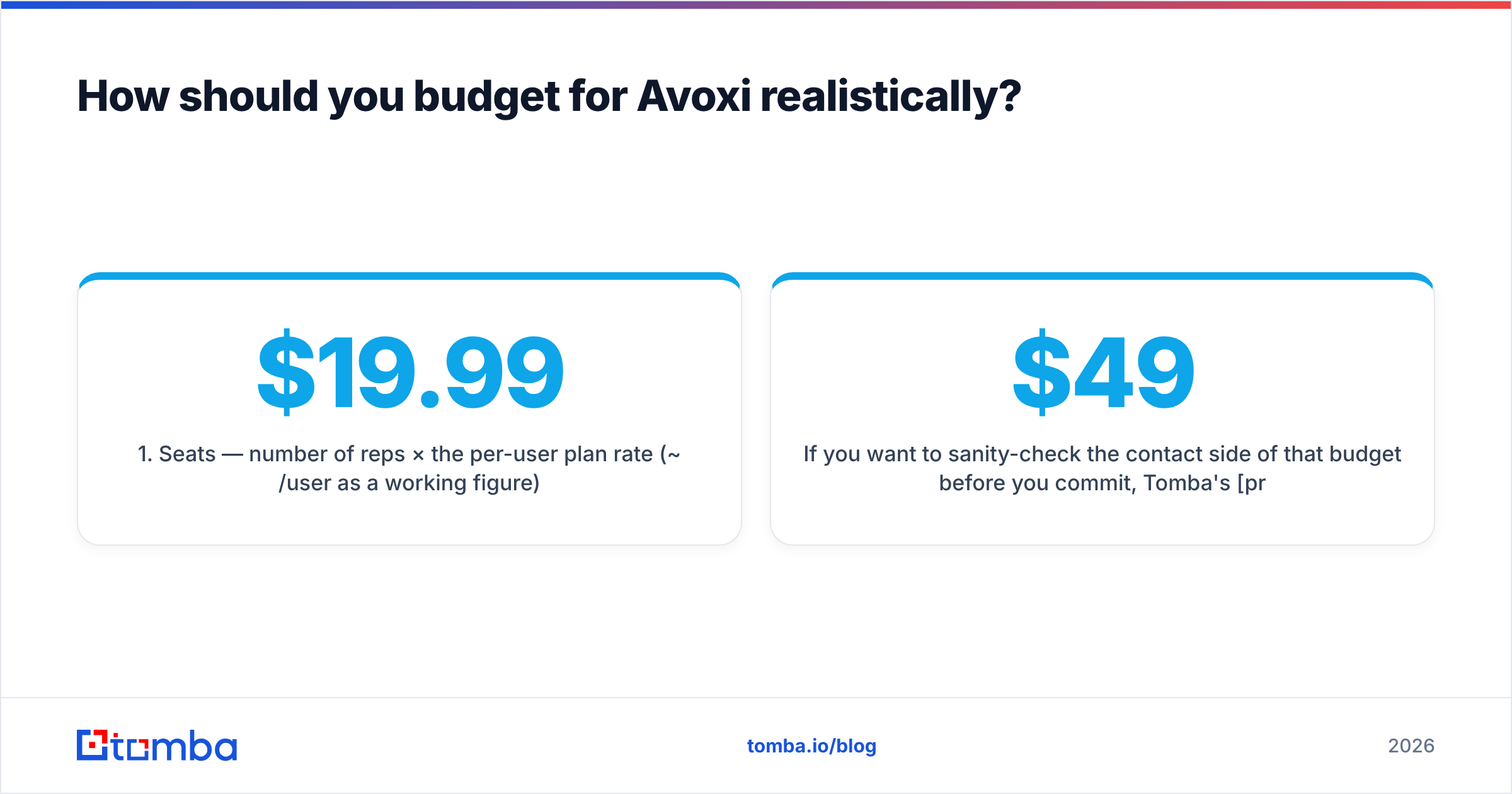
- Seats — number of reps × the per-user plan rate (~$19.99/user/mo as a working figure).
- Numbers — each virtual number's monthly rate, which varies sharply by country and type (local vs toll-free vs mobile).
- Minutes — your realistic monthly call volume × the per-minute rate for the destinations you actually call. Pull last quarter's call logs. Do not guess.
- One-time fees — setup, porting, and any documentation-heavy activations in regulated countries.
Run that math against a competitor's all-in quote and you get a true comparison. A team making heavy international mobile calls may find a metered model expensive. A team forwarding a handful of country numbers to a central desk may find it very cheap. Same vendor, opposite verdicts. That is exactly why the reviews split.
Want to sanity-check the contact side of that budget before you commit? Tomba's pricing is flat and predictable by design — Free (25 searches/mo), Starter $49/mo, Growth $99/mo, and Pro $249/mo. So the data layer of your stack does not carry the same metered uncertainty as the voice layer.
Who should buy Avoxi — and who should skip it?#
Buy Avoxi if you run international support or outbound, need local and toll-free presence across many countries, want to retire a patchwork of regional carriers, and you have the patience and call-volume data to model metered pricing properly.
Skip Avoxi if you are a small, domestic-only team that wants one flat monthly bill. Skip it too if you need a deeply integrated sales-engagement suite out of the box, or if your real problem is list quality rather than call infrastructure. In that last case, money spent on contact data returns more than money spent on a second phone feature.
The honest summary: Avoxi is a capable global voice platform with a pricing model that rewards careful buyers and punishes lazy ones. The reviews are not contradictory. They reflect whether each buyer did the homework.
Avoxi pricing, reviews, pros and cons: the bottom line#
Here is the full take on Avoxi pricing, reviews, pros and cons. Avoxi earns its place on a global-voice shortlist. Its coverage is genuinely strong, its call quality holds up, and its entry pricing for numbers is fair. The cons are real but manageable: metered cost is unpredictable, provisioning has friction, and support is uneven. You handle them by budgeting across seats, numbers, minutes, and setup instead of just the seat price.
But remember what a phone system can and cannot do. Avoxi connects calls. It does not tell you the number is right or the contact still works there. Before you pay per minute to dial, make the list worth dialing. Start with Tomba's Email Finder to build verified, accurate contact records by domain, name, or company. Then layer in phone finding and validation so every Avoxi minute reaches a real person. Clean data first, great conversations second. That order is where cold-calling ROI actually comes from.
// get started
Find, verify and enrich your first contacts today
Start on the free plan with 25 searches a month, then scale when your team is ready.
Free plan · No credit card required · GDPR & CCPA
// about the author