B2B Audience Research in 2026: A Practical Step-by-Step Guide
A practical 2026 framework for B2B audience research: build ICPs, segment by intent, and turn raw firmographics into pipeline you can actually close.
You can have the best product on the market and still miss quota if you are aiming at the wrong people. B2B audience research is the work that fixes that — it tells you who actually buys, why they buy, and where to reach them before you spend a dollar on outreach. This guide walks through a repeatable 2026 framework you can run with a small team.
TL;DR#
- B2B audience research is the structured process of defining, segmenting, and validating the companies and people most likely to buy from you.
- Start with an evidence-based ICP (ideal customer profile) drawn from your closed-won deals, not opinions in a slide deck.
- Layer firmographic, technographic, and intent data to move from "anyone in SaaS" to "RevOps leaders at 50–200-person Series B SaaS firms using HubSpot."
- Validate segments with real contact data and small test campaigns before scaling spend.
- Tools like Tomba's data enrichment and domain search turn a target list into reachable, verified contacts.
What is B2B audience research?#
B2B audience research is the process of identifying and understanding the specific organizations and decision-makers most likely to buy your product — and the messaging that moves them.
Think of it like a fishing trip. You can throw a line anywhere and hope, or you can check the water temperature, the season, and where the fish actually feed. Audience research is checking the conditions before you cast. Technically, it combines market segmentation, buyer-persona development, and account selection into one continuous workflow that feeds every campaign you run.
The difference between B2C and B2B research matters here. In B2C you study individuals and emotions. In B2B you study buying committees — typically five to eleven people per deal according to Gartner — across two layers: the company (the account) and the people inside it (the personas). Good research holds both layers in focus at once.
Why does B2B audience research matter in 2026?#
Because waste is more expensive than ever. Ad costs keep climbing, inboxes are more defended, and buyers do most of their research before they ever talk to sales. If your list is wrong, every downstream metric — open rate, reply rate, response rate, win rate — inherits that error.
Three shifts make research non-negotiable this year:
- Buyers self-educate. Forrester and others have long noted that most of the B2B buying journey happens before a sales conversation. You need to be in front of the right account early, with relevant content.
- AI lowered the cost of bad outreach. Anyone can now blast 10,000 generic emails. The teams that win are the ones whose 500 emails are aimed correctly.
- Deliverability is tied to relevance. Sending to mismatched, unverified contacts hurts your sender reputation and tanks inbox placement. Precise targeting is a deliverability strategy, not just a marketing one.
How do you build an evidence-based ICP?#
Start with your own closed-won deals, not a brainstorm. Your best customers already told you who your ideal customer is — you just have to read the pattern.
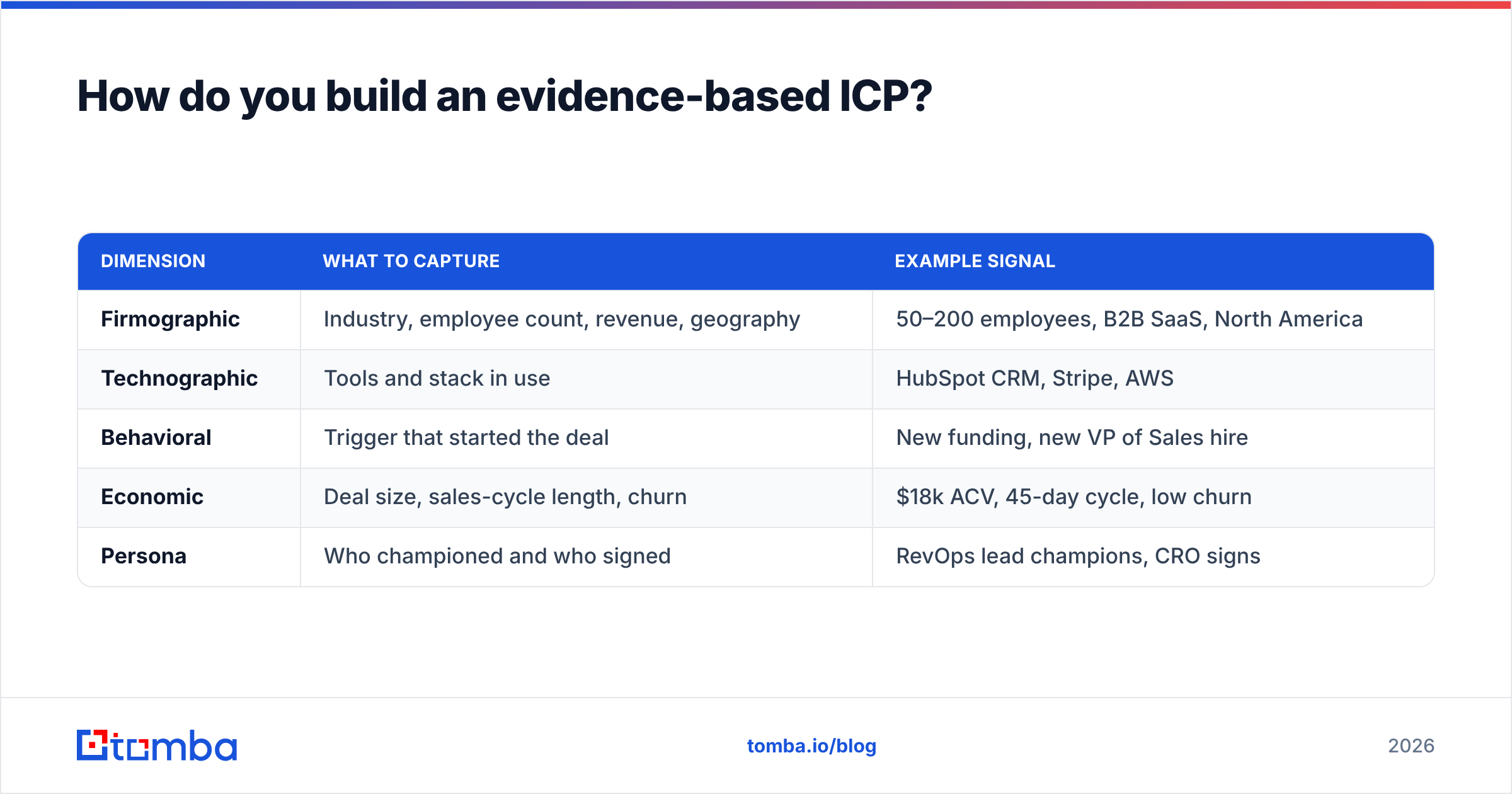
Pull your last 20–50 won deals and tag each on these dimensions. A simple table keeps it honest:
| Dimension | What to capture | Example signal |
|---|---|---|
| Firmographic | Industry, employee count, revenue, geography | 50–200 employees, B2B SaaS, North America |
| Technographic | Tools and stack in use | HubSpot CRM, Stripe, AWS |
| Behavioral | Trigger that started the deal | New funding, new VP of Sales hire |
| Economic | Deal size, sales-cycle length, churn | $18k ACV, 45-day cycle, low churn |
| Persona | Who championed and who signed | RevOps lead champions, CRO signs |
When the same attributes keep showing up in your best accounts (high value, fast close, low churn), that is your ICP. When they show up in your churned or stalled deals, that is your anti-ICP — equally valuable, because it tells your reps and ads who to skip.
A practical rule: if you cannot point to at least five existing customers that match a proposed ICP, it is a hypothesis, not a profile. Treat it as something to test, not a target to scale.
What data do you need, and where does it come from?#
You need three data layers stacked on top of each other. Each one narrows the audience and raises relevance.
- Firmographic data — the company's size, industry, location, and revenue. This is your coarse filter. It answers "is this the right kind of company?"
- Technographic data — the software a company runs. If you integrate with Salesforce, knowing who uses Salesforce is gold. This answers "are they technically a fit?"
- Intent and trigger data — funding rounds, hiring spikes, leadership changes, content consumption. This answers "are they likely to buy now?"
- Contact data — the verified emails, phone numbers, and LinkedIn profiles of the actual humans on the buying committee. Without this layer, the other three are just a wish list.
The first three tell you who to chase. The last one makes the chase possible. This is where a lot of research projects quietly fail: teams build a beautiful target-account list in a spreadsheet and then have no reliable way to reach the people inside those accounts. Using a domain search to pull the verified contacts at each target company — and data enrichment to fill in titles, seniority, and social profiles — closes that gap.
For credibility checks on where data comes from and how fresh it is, vet any provider's data sources and run a sample before you commit. Third-party review sites like G2 and Capterra are useful for sanity-checking accuracy claims against real user feedback.
How do you segment a B2B audience?#
Segmentation turns one giant "total addressable market" into a handful of addressable, message-able groups. The goal is segments that are distinct enough to deserve different messaging but large enough to be worth the effort.
Run segmentation in this order:
- Fit segmentation — split by ICP match: tier 1 (perfect fit), tier 2 (good fit), tier 3 (edge cases). Spend your best resources on tier 1.
- Persona segmentation — within each account, separate the economic buyer, the champion, and the end user. A CFO and an end user need different emails.
- Trigger segmentation — group by the event that makes now the right time: new funding, a competitor switch, a compliance deadline.
- Channel segmentation — decide where each group is reachable: cold email, LinkedIn outreach, phone, or paid.
A common mistake is segmenting by what is easy to filter (country, industry) instead of by what predicts a purchase (trigger, fit, persona). Easy filters feel productive but rarely change your reply rate. Predictive segments do.
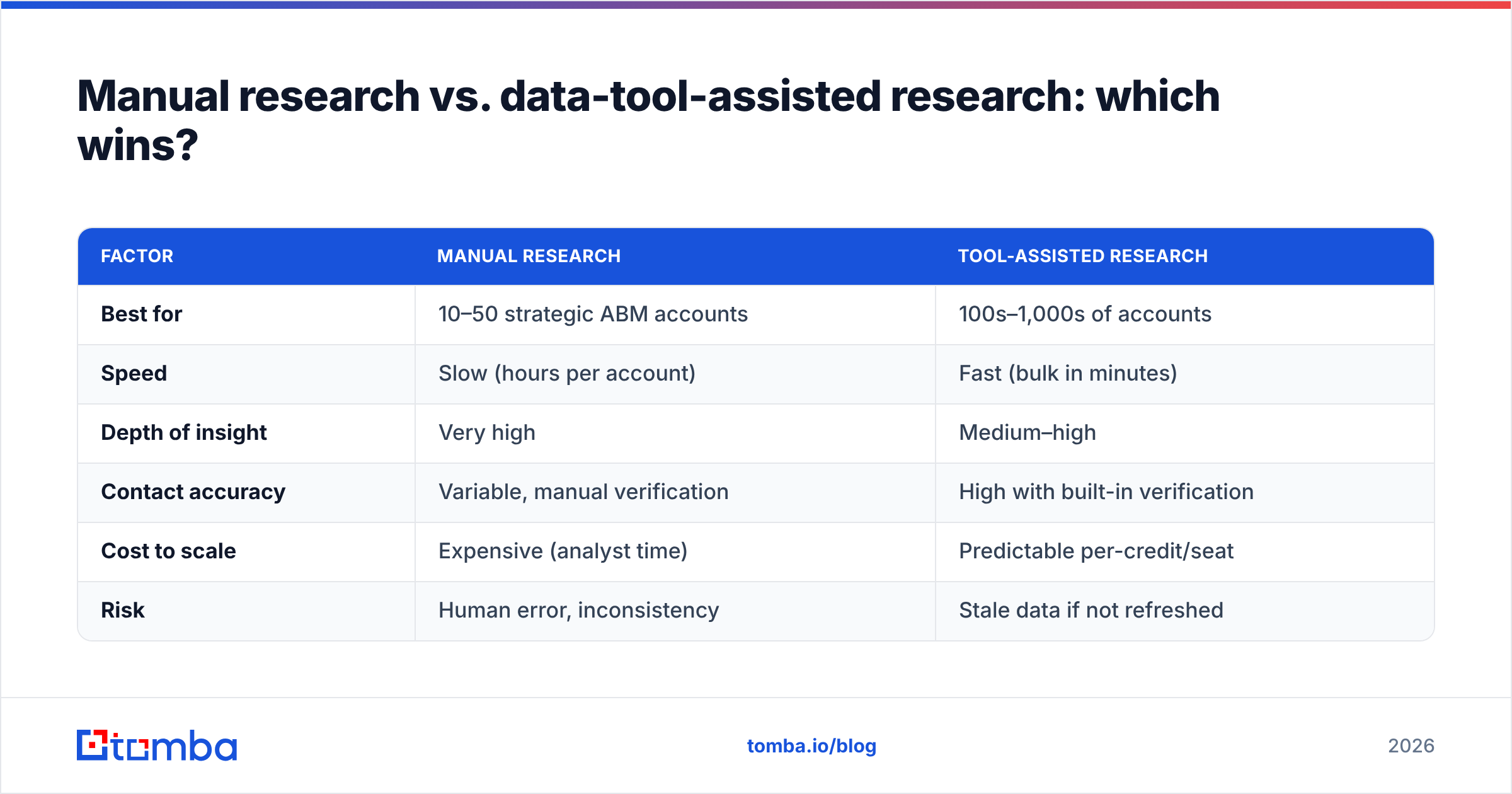
Manual research vs. data-tool-assisted research: which wins?#
Both have a place. Manual research goes deep on a few strategic accounts; tool-assisted research scales across hundreds. Most teams need a blend, weighted toward tools as their list grows.
| Factor | Manual research | Tool-assisted research |
|---|---|---|
| Best for | 10–50 strategic ABM accounts | 100s–1,000s of accounts |
| Speed | Slow (hours per account) | Fast (bulk in minutes) |
| Depth of insight | Very high | Medium–high |
| Contact accuracy | Variable, manual verification | High with built-in verification |
| Cost to scale | Expensive (analyst time) | Predictable per-credit/seat |
| Risk | Human error, inconsistency | Stale data if not refreshed |
The honest takeaway: for a named-account ABM motion, nothing beats a human reading the 10-K and the LinkedIn posts. For everything above 50 accounts, a tool that combines firmographics with verified contacts — and supports bulk lead generation — is the only way to keep quality high without burning your team out. The smartest teams use tools to build and verify the list, then apply human judgment to the top tier.
How do you validate your audience before scaling?#
Never scale spend on an untested segment. Validation is cheap insurance against an expensive mistake.
Run a three-step validation loop:
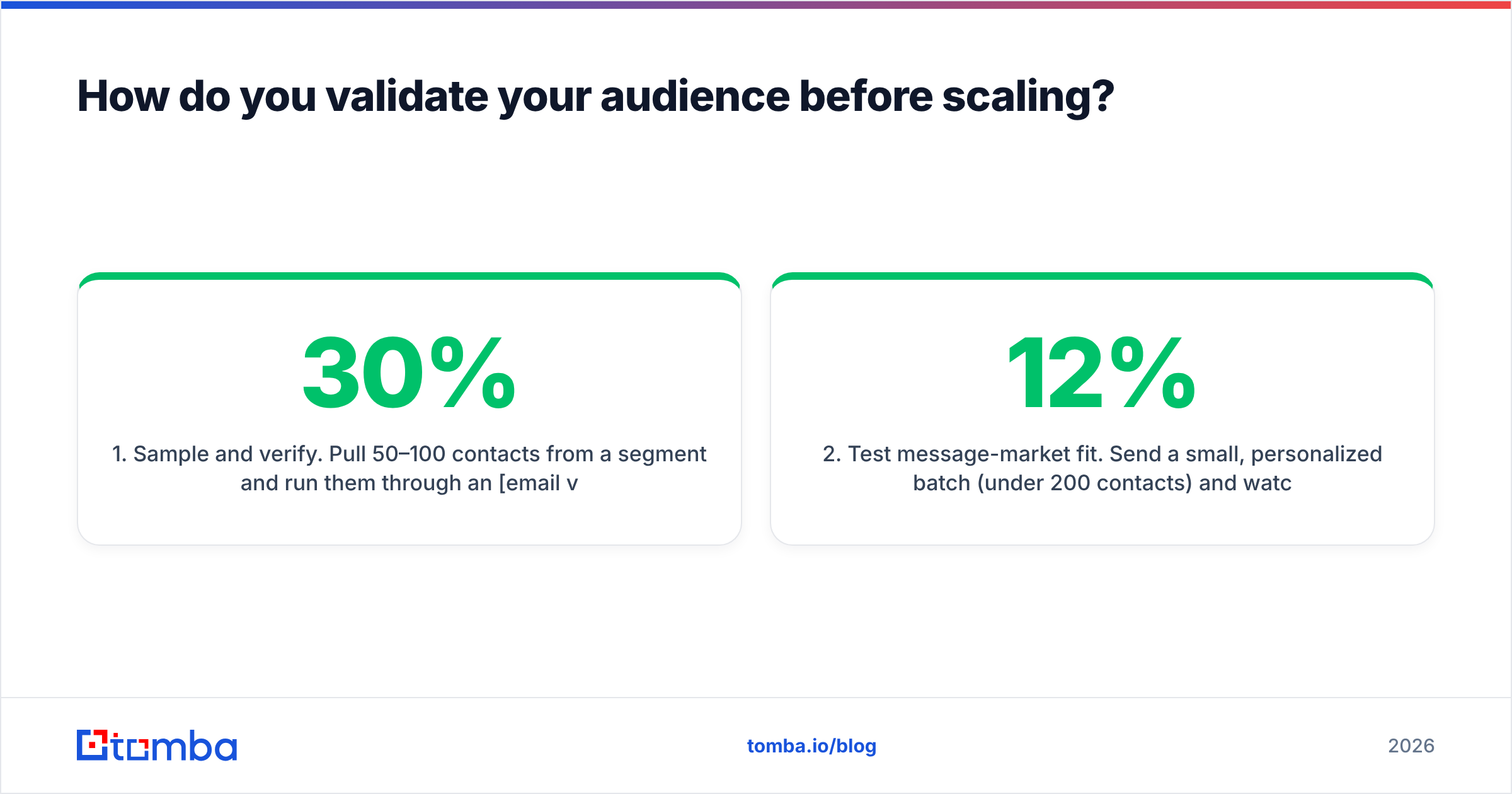
- Sample and verify. Pull 50–100 contacts from a segment and run them through an email verifier. If 30% bounce, your data source — or your ICP filter — is off. Fix it before you send anything.
- Test message-market fit. Send a small, personalized batch (under 200 contacts) and watch reply rate and reply sentiment, not just opens. A 12% positive-reply rate says "scale this." A 1% rate says "rethink the segment or the message."
- Check the unit economics. Map replies to meetings to opportunities. A segment that books meetings but never advances to pipeline is a vanity segment. Kill it.
This loop also protects deliverability. Verifying before you send keeps bounce rates low, which protects email deliverability and keeps your domain out of spam folders. Research and deliverability are the same discipline viewed from two angles.
What does a complete B2B audience research workflow look like?#
Here is the end-to-end flow, start to finish, that a two-person team can run in a week:
- Mine closed-won deals to extract the evidence-based ICP (half a day).
- Define anti-ICP so reps and ad targeting know who to exclude (one hour).
- Build the target-account list using firmographic + technographic filters (one day).
- Layer trigger data to prioritize accounts that are in-market now (half a day).
- Find and enrich contacts at each account with verified emails and roles (one day, automated with a bulk email finder).
- Segment by fit, persona, and trigger (half a day).
- Validate with verification plus a small test campaign (two to three days, mostly waiting for replies).
- Hand off clean, segmented, verified lists to sales and paid media.
Notice that steps 5 and 7 — finding contacts and verifying them — are the operational heart of the whole thing. The strategy is only as good as the data that executes it. If you want to wire this into your stack, Tomba's integrations push enriched contacts straight into your CRM, and the API lets you automate the find-and-verify steps inside your own workflow.
How much should B2B audience research cost?#
Less than you think, if you scope it as a recurring process rather than a one-off consulting project. Your two real costs are people-time and data tooling. Time you already pay for; the tooling is where you choose your tier.
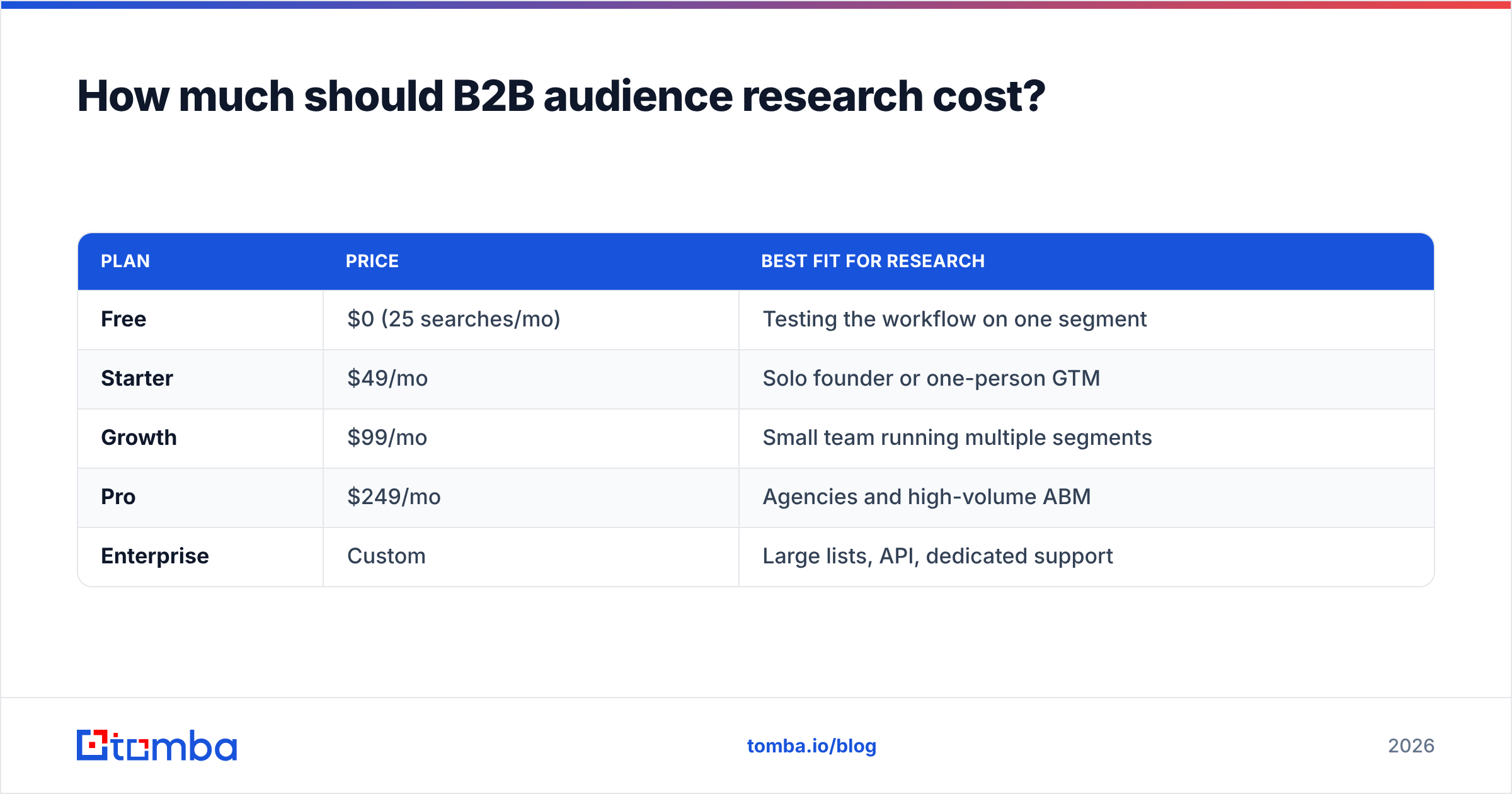
For reference on data tooling, here is how Tomba's tiers map to research workloads:
| Plan | Price | Best fit for research |
|---|---|---|
| Free | $0 (25 searches/mo) | Testing the workflow on one segment |
| Starter | $49/mo | Solo founder or one-person GTM |
| Growth | $99/mo | Small team running multiple segments |
| Pro | $249/mo | Agencies and high-volume ABM |
| Enterprise | Custom | Large lists, API, dedicated support |
You can see full Tomba pricing for credit limits per tier. The point is not the exact number — it is that audience research data should be a small, predictable line item, not a five-figure project. If a vendor wants enterprise money before you have validated a single segment, that is a flag.
Common B2B audience research mistakes to avoid#
- Confusing TAM with ICP. Your total addressable market is everyone who could buy. Your ICP is who you should chase first. Selling to the whole TAM at once is how small teams spread themselves into irrelevance.
- Skipping verification. An unverified list looks the same in a spreadsheet as a clean one — until your bounce rate wrecks your domain. Always verify before you send.
- Researching once. Companies grow, churn, raise funding, and change stacks. An ICP from 18 months ago is a liability. Refresh quarterly.
- Ignoring the anti-ICP. Knowing who to skip saves more money than knowing who to chase.
- Optimizing for opens. Opens are noisy and increasingly unreliable. Optimize for positive replies and pipeline.
The bottom line#
B2B audience research is the highest-leverage work in your entire go-to-market motion because every other activity inherits its accuracy. Get the audience right and average copy still converts; get it wrong and brilliant copy still bounces. Build the ICP from evidence, stack firmographic, technographic, and intent data, segment by what predicts a purchase, and validate before you scale.
When you are ready to turn a target-account list into verified, reachable contacts, the Tomba Email Finder is built for exactly this step — find professional emails by domain, name, or company, verify them in the same workflow, and push them straight into your CRM. Start on the free tier, run one segment end to end, and let the reply rate tell you whether your research is working. That feedback loop, run every quarter, is what separates teams that guess from teams that grow.
// get started
Find, verify and enrich your first contacts today
Start on the free plan with 25 searches a month, then scale when your team is ready.
Free plan · No credit card required · GDPR & CCPA
// about the author