B2B Blogs in 2026: How to Build One That Drives Pipeline
Most B2B blogs publish into the void. Here's how the ones that actually generate pipeline are structured in 2026 — topics, cadence, distribution, and the data layer behind them.
Most B2B blogs are a graveyard. Three posts in 2023, a "we're hiring" update, and a half-finished thought-leadership piece nobody read. Meanwhile a handful of competitors in your category are pulling thousands of qualified visitors a month and turning them into demos. The gap is almost never talent or budget — it's structure, cadence, and the data behind the content. This guide breaks down exactly how high-performing B2B blogs are built in 2026.
TL;DR#
- A B2B blog is a pipeline asset, not a press room. Treat it like a product with a roadmap, owners, and success metrics — not a place to dump announcements.
- Pillar-and-cluster beats random publishing. A few deep, authoritative pages supported by tightly linked supporting posts win search far more reliably than 40 disconnected articles.
- Distribution is half the job. If you spend 100% of your time writing and 0% distributing, you've built a great asset nobody will find.
- Data quality decides ROI. The blog generates demand; clean contact data and enrichment convert that demand into booked meetings.
- Measure pipeline, not page views. The only B2B blog metrics that survive a budget review are influenced pipeline and closed revenue.
What is a B2B blog and why does it still matter in 2026?#
A B2B blog is a company-owned content channel built to attract, educate, and convert other businesses — not consumers. Think of it less like a magazine and more like a 24/7 sales development rep who never sleeps, never asks for commission, and answers the exact questions your buyers type into Google at 11pm.
That distinction matters because B2B buying cycles are long, multi-stakeholder, and research-heavy. According to Gartner, B2B buyers spend the majority of their purchase journey doing independent research before they ever talk to a vendor. Your blog is how you show up during that self-guided research — and how you frame the problem in a way that makes your product the obvious answer.
Despite a decade of "blogging is dead" headlines, organic content remains one of the highest-ROI channels in B2B. HubSpot's marketing research consistently shows companies that publish consistently generate dramatically more leads than those that don't. The catch in 2026 is that the bar is higher: AI-generated filler is everywhere, so thin content gets ignored by both readers and search engines. Depth, originality, and first-party data are the new moat.
Caption placeholder: 
What makes B2B blogs different from B2C content?#
The mistake most teams make is copying B2C playbooks. A consumer brand can ride a trend, post daily, and win on volume and personality. A B2B blog wins on different axes:
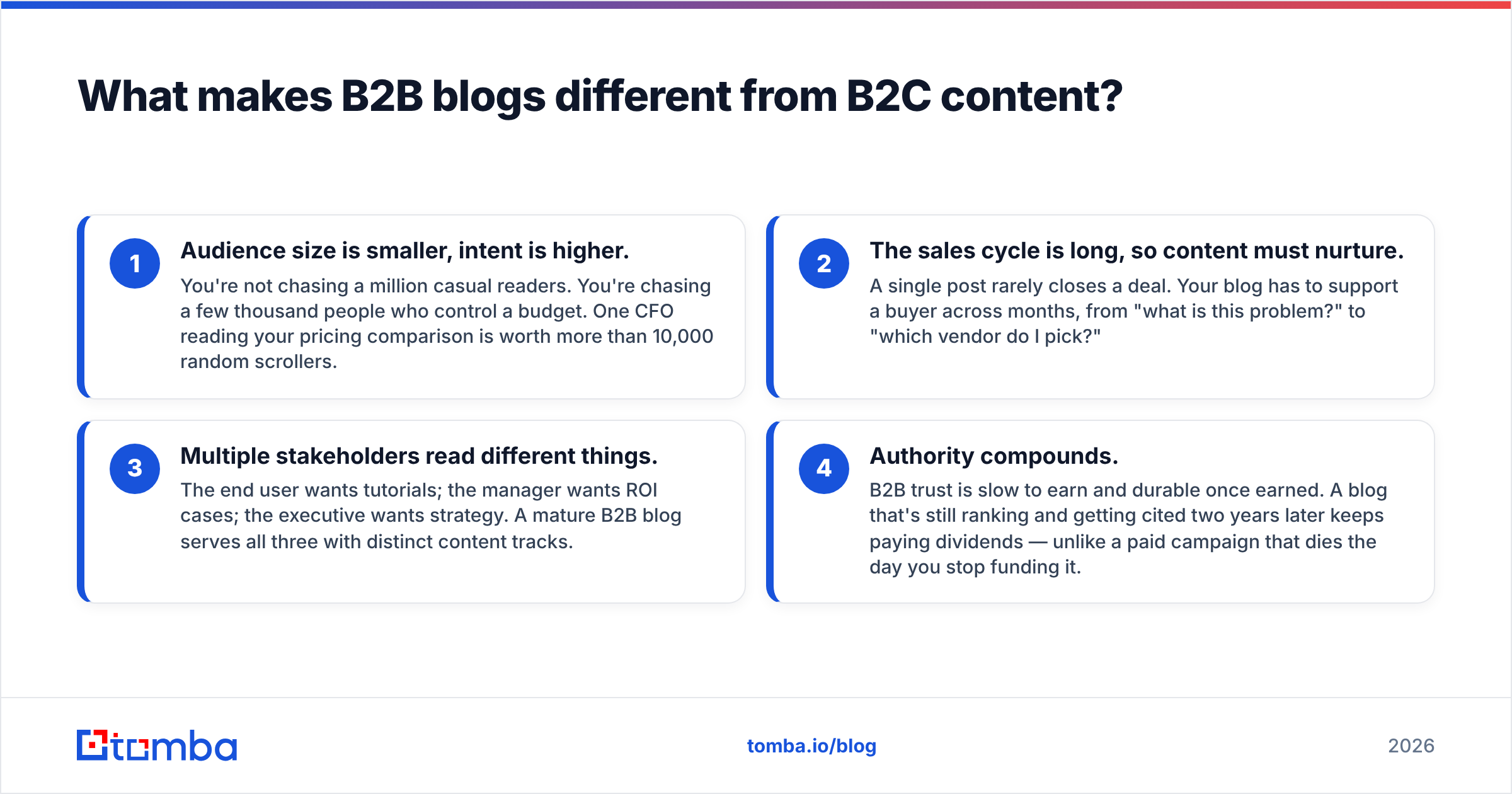
- Audience size is smaller, intent is higher. You're not chasing a million casual readers. You're chasing a few thousand people who control a budget. One CFO reading your pricing comparison is worth more than 10,000 random scrollers.
- The sales cycle is long, so content must nurture. A single post rarely closes a deal. Your blog has to support a buyer across months, from "what is this problem?" to "which vendor do I pick?"
- Multiple stakeholders read different things. The end user wants tutorials; the manager wants ROI cases; the executive wants strategy. A mature B2B blog serves all three with distinct content tracks.
- Authority compounds. B2B trust is slow to earn and durable once earned. A blog that's still ranking and getting cited two years later keeps paying dividends — unlike a paid campaign that dies the day you stop funding it.
This is why a B2B blog should be planned around your buyer's journey and your marketing qualified lead definition, not around whatever you felt like writing this week.
How do you structure a B2B blog that actually ranks?#
The most reliable architecture in 2026 is still pillar-and-cluster. You build a small number of comprehensive "pillar" pages targeting broad, high-value terms, then surround each with a cluster of specific supporting posts that all link back to the pillar. Search engines read this as topical authority; readers read it as "these people actually know their stuff."
Here's how the two dominant approaches compare:
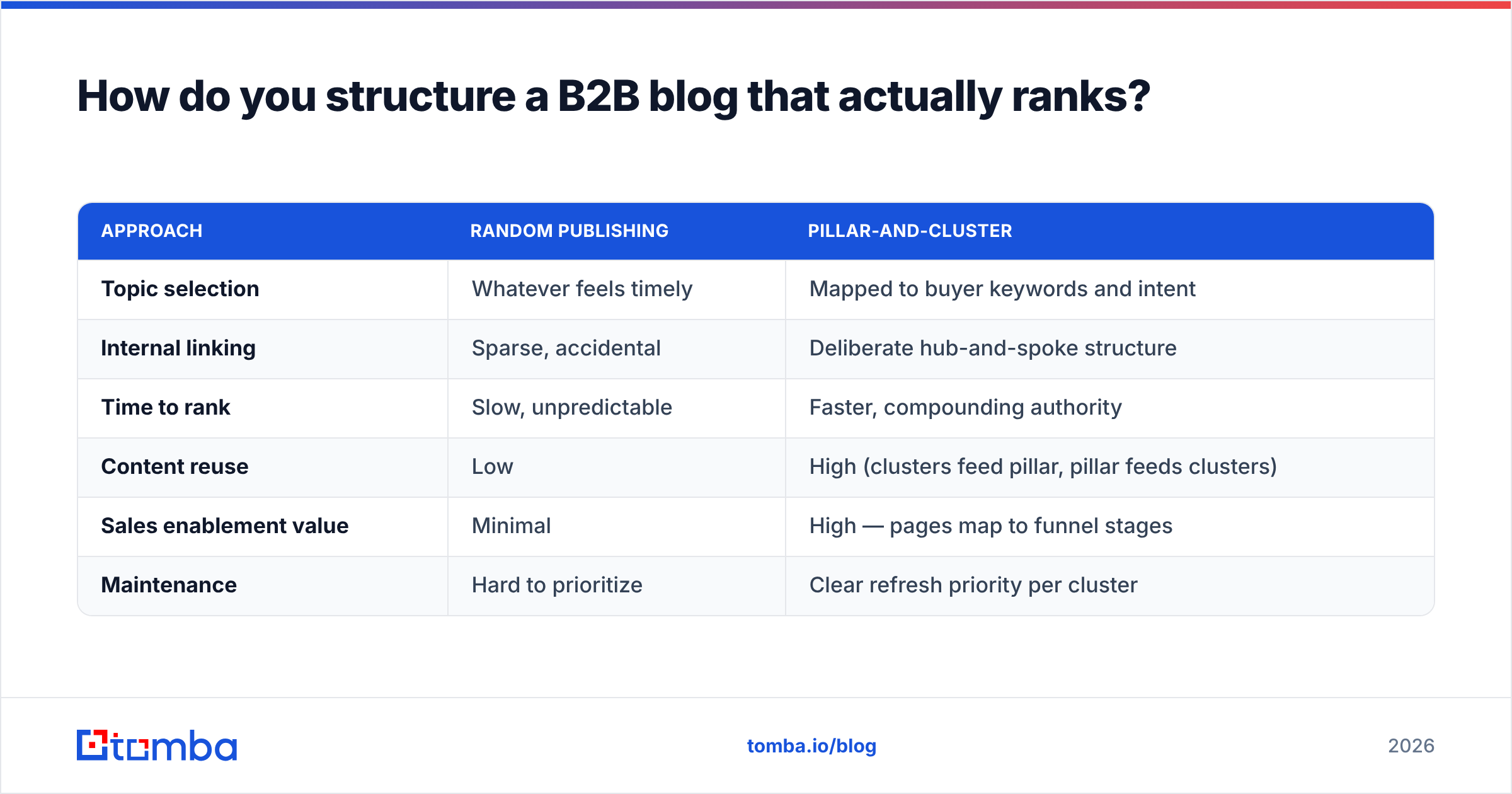
| Approach | Random publishing | Pillar-and-cluster |
|---|---|---|
| Topic selection | Whatever feels timely | Mapped to buyer keywords and intent |
| Internal linking | Sparse, accidental | Deliberate hub-and-spoke structure |
| Time to rank | Slow, unpredictable | Faster, compounding authority |
| Content reuse | Low | High (clusters feed pillar, pillar feeds clusters) |
| Sales enablement value | Minimal | High — pages map to funnel stages |
| Maintenance | Hard to prioritize | Clear refresh priority per cluster |
A practical 2026 content stack for a single pillar looks like this:
- Pillar page — a 3,000+ word definitive guide on a core category term ("B2B lead generation," "email deliverability," "sales prospecting").
- Comparison posts — "X vs Y," "best X tools," and "X alternatives." These capture buyers in active evaluation mode and convert far above average.
- How-to and tactical posts — narrow, problem-solving content that earns long-tail traffic and links into the pillar.
- Data and opinion posts — original benchmarks, surveys, or contrarian takes that earn backlinks and citations from other sites.
If you only do one thing differently this quarter, replace your "publish and pray" calendar with three pillars and ten clusters built around them.
What topics should a B2B blog cover?#
Start where buying intent is highest and work backwards. A simple priority order:
- Bottom-of-funnel comparison content first. "Tomba vs competitor," "best email finders," "X pricing." These readers are ready to buy. Capturing them is the fastest path to pipeline.
- Problem-aware middle-of-funnel content next. "How to improve cold email response rates," "why your emails land in spam." These readers have the pain but haven't picked a solution.
- Top-of-funnel educational content last. Broad "what is X" explainers. Important for authority and links, but slower to convert — don't lead with them.
A common failure is inverting this list: teams write dozens of top-of-funnel explainers because they're easy, then wonder why traffic doesn't convert. Flip it. Win the high-intent terms first, then build the awareness layer once the revenue engine is proven.
When you produce comparison and tactical content, back claims with first-party data wherever possible. A post that says "we tested 12 email finder tools and here's the accuracy data" will out-rank and out-convert a generic listicle every time, because it's something an AI summary can't fabricate and competitors can't easily copy.
How often should you publish, and who should own it?#
Cadence beats volume, and consistency beats intensity. A blog that ships two genuinely useful posts a month for a year crushes one that dumps fifteen posts in January and goes silent.
Practical guidance for 2026:
- Pick a sustainable cadence and protect it. Two to four high-quality posts a month is realistic for most B2B teams. One great post beats four mediocre ones.
- Assign a single owner. Blogs die in committees. One person owns the calendar, briefs, and publishing. Subject-matter experts contribute; the owner ships.
- Build a refresh loop. In 2026, updating and re-optimizing existing posts often returns more than net-new content. Audit quarterly: which posts rank 8–20 and could crack the top 5 with an update?
- Repurpose every post. One pillar becomes a newsletter, three LinkedIn posts, a short video script, and a sales one-pager. The blog is the source of truth your whole GTM motion draws from.
Caption placeholder: 
How do you turn blog traffic into actual pipeline?#
Traffic that doesn't convert is a vanity metric. The bridge between "reader" and "revenue" is built from three things: capture, identification, and enrichment.
Capture. Every high-intent post needs a clear next step — a relevant lead magnet, a free tool, a demo CTA, or a newsletter opt-in. Generic "subscribe" boxes underperform. Offer something tied to the post's specific problem.
Identification. Most blog visitors never fill out a form. Reveal who's actually reading and turn anonymous demand into named accounts your sales team can pursue. This is where website visitor identification and intent data earn their keep.
Enrichment. Once you have a name, a company, or a partial record, data enrichment fills in the gaps — verified email, role, company size — so SDRs can reach out with context instead of cold-guessing. A blog that generates 500 MQLs a month is only as valuable as your ability to contact those leads accurately.
This is the part teams under-invest in. They obsess over headlines and word counts, then hand sales a spreadsheet full of bounced emails and missing phone numbers. The content engine and the data engine have to work together, or the pipeline number never moves.
Pair your editorial calendar with practical conversion assets, too. Tools like cold email templates help your team follow up on blog-sourced leads with messaging that actually gets replies, closing the loop from reader to booked meeting.
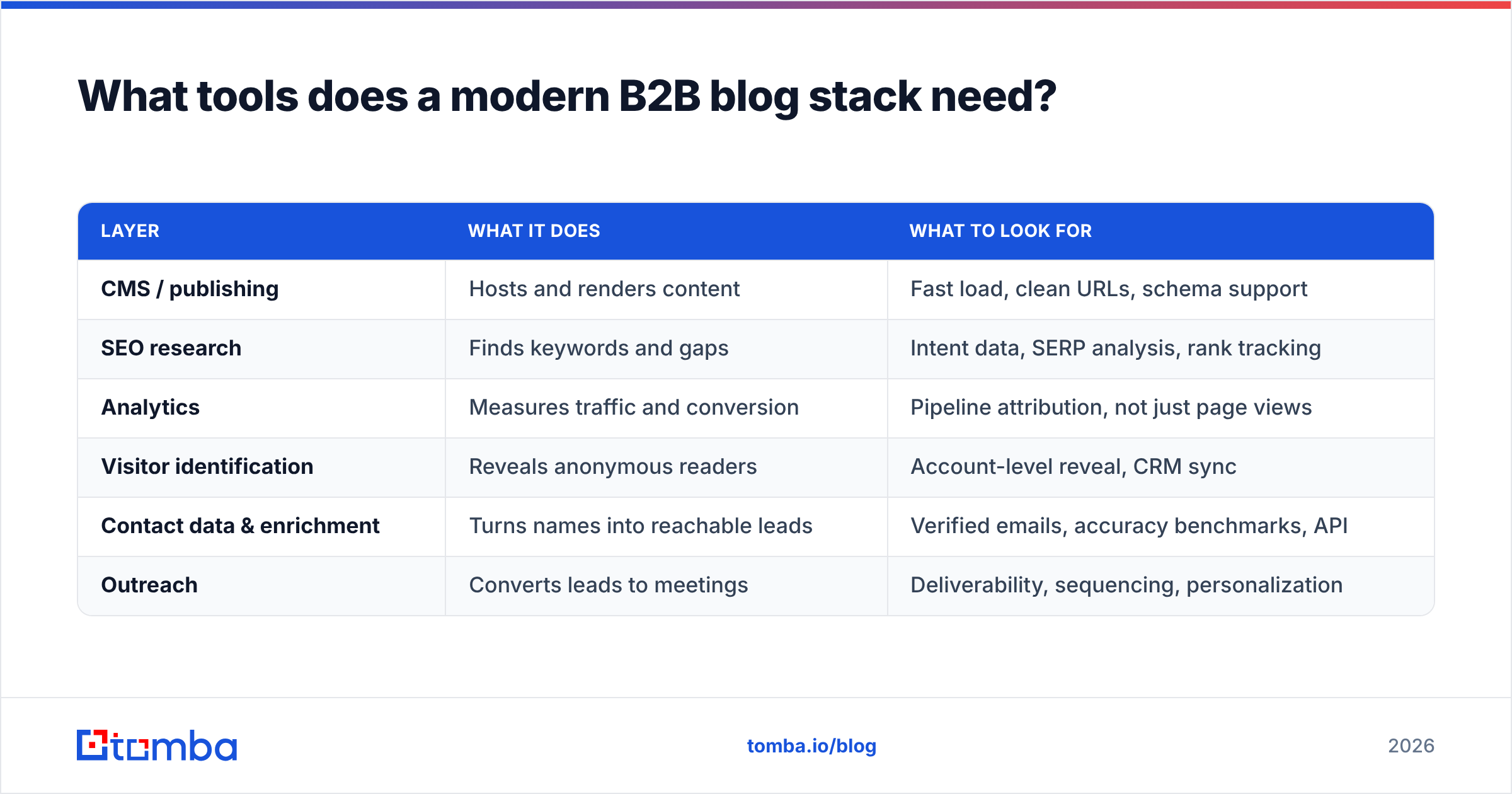
What tools does a modern B2B blog stack need?#
You don't need 30 tools. You need one solid choice in each of these categories:
| Layer | What it does | What to look for |
|---|---|---|
| CMS / publishing | Hosts and renders content | Fast load, clean URLs, schema support |
| SEO research | Finds keywords and gaps | Intent data, SERP analysis, rank tracking |
| Analytics | Measures traffic and conversion | Pipeline attribution, not just page views |
| Visitor identification | Reveals anonymous readers | Account-level reveal, CRM sync |
| Contact data & enrichment | Turns names into reachable leads | Verified emails, accuracy benchmarks, API |
| Outreach | Converts leads to meetings | Deliverability, sequencing, personalization |
For credible vendor research across any of these categories, peer-review sites like G2 are a better starting point than vendor landing pages, because you're reading what actual buyers report rather than marketing copy.
The most overlooked layer is contact data. A blog can produce demand all day, but if your team can't reach the people behind it, conversion stalls. Tools that find and verify professional emails — backed by transparent data sources and accuracy reporting — are what convert a busy blog into a full calendar.
How do you measure whether your B2B blog is working?#
Stop reporting page views to your CFO. Report these instead:
- Influenced pipeline. Dollar value of opportunities where a contact touched the blog before converting. This is the metric that protects your budget.
- Assisted conversions. How often blog content appears in the path to a closed deal, even when it's not the last touch.
- Organic-sourced demos. Booked meetings traceable to organic blog entry pages.
- Ranking velocity on commercial terms. Are your comparison and "best of" pages climbing? Those are the pages that print revenue.
- Cost per qualified lead vs. paid. Mature blogs usually beat paid channels on this metric — and the gap widens over time as content compounds.
Set up tracking before you scale, not after. A B2B blog with 100 posts and no attribution is a museum; a blog with 20 posts and clean pipeline reporting is a growth engine.
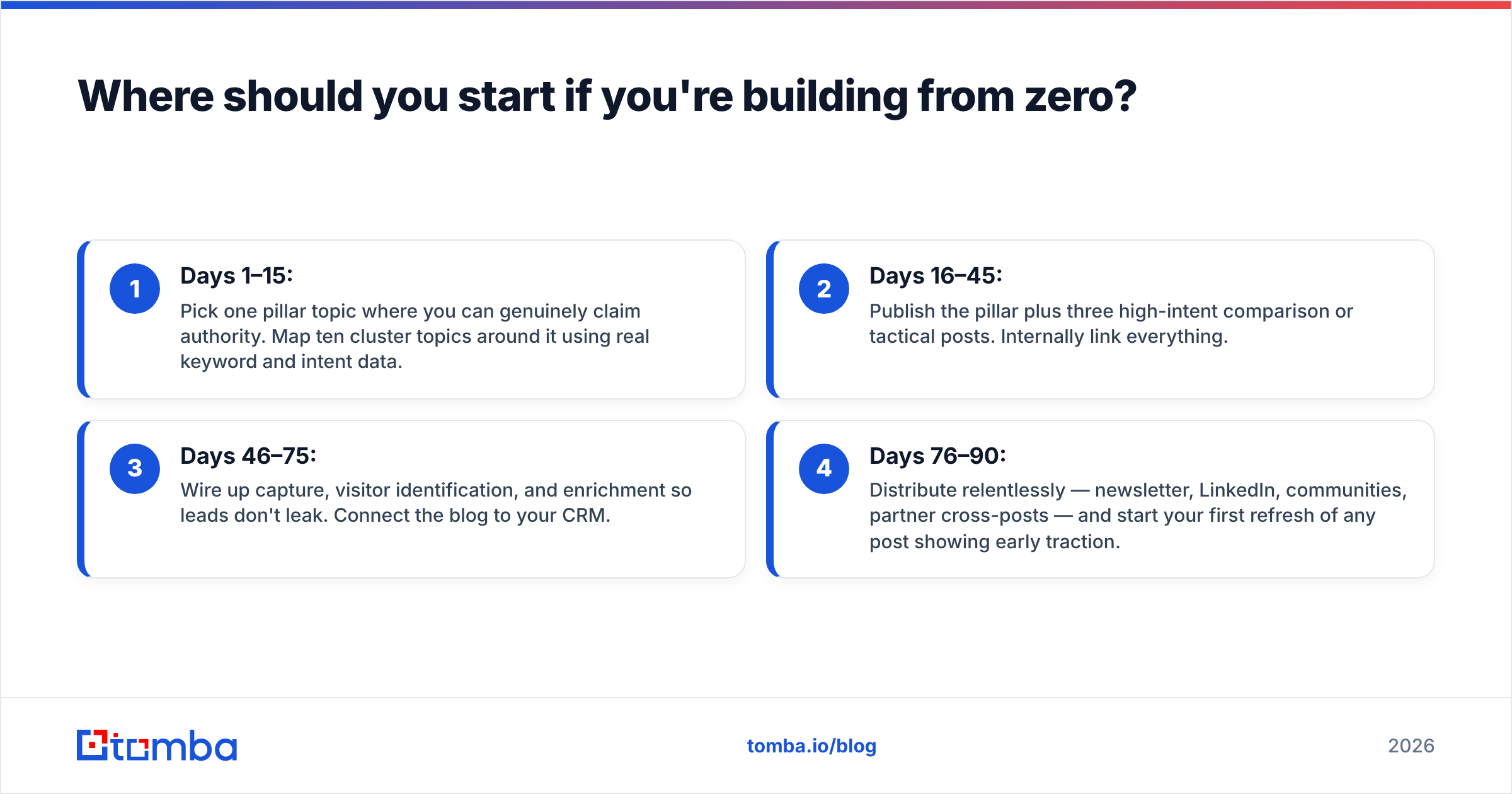
Where should you start if you're building from zero?#
Don't try to boil the ocean. A 90-day plan that works:
- Days 1–15: Pick one pillar topic where you can genuinely claim authority. Map ten cluster topics around it using real keyword and intent data.
- Days 16–45: Publish the pillar plus three high-intent comparison or tactical posts. Internally link everything.
- Days 46–75: Wire up capture, visitor identification, and enrichment so leads don't leak. Connect the blog to your CRM.
- Days 76–90: Distribute relentlessly — newsletter, LinkedIn, communities, partner cross-posts — and start your first refresh of any post showing early traction.
After 90 days you'll have a working loop: content attracts intent, identification names it, enrichment makes it reachable, and outreach books the meeting. Then you repeat with the next pillar.
Final word: the blog is the engine, data is the fuel#
The best B2B blogs in 2026 aren't the ones with the cleverest headlines — they're the ones wired directly into a revenue engine. Great content brings the right people to your door. Clean, verified contact data is what lets you actually start the conversation.
If your blog is generating traffic but your sales team is drowning in bad contact data, fix the fuel line. Tomba's Email Finder turns the companies and names your content attracts into verified, reachable contacts — by domain, by name, or in bulk — so the demand your blog creates doesn't die in a stale spreadsheet. Start free with 25 searches a month, and check Tomba pricing when you're ready to scale from a content experiment into a pipeline machine.
// get started
Find, verify and enrich your first contacts today
Start on the free plan with 25 searches a month, then scale when your team is ready.
Free plan · No credit card required · GDPR & CCPA
// about the author