B2B Brand Awareness in 2026: The Complete Growth Guide
Most B2B buyers pick the vendor they already trust before they ever fill out a form. Here is how to build B2B brand awareness that compounds into pipeline in 2026.
B2B Brand Awareness in 2026: The Complete Growth Guide
TL;DR
- B2B brand awareness is the percentage of your target market that recognizes and trusts your company before they are actively shopping — and it decides who gets the first call when a need appears.
- Roughly 95% of your buyers are out-of-market at any moment; brand-building is how you stay memorable until they re-enter the buying window.
- Awareness is measurable: aided/unaided recall, share of search, branded search volume, and direct traffic are the metrics that matter, not vanity impressions.
- The fastest-compounding channels in 2026 are founder-led content, owned media (podcast/newsletter), category POV content, and consistent visual identity.
- Brand and demand are not enemies — pair broad reach with accurate contact data so you can convert recognition into pipeline the moment intent shows up.
What is B2B brand awareness?#
B2B brand awareness is how many people in your target market know your company exists, what you do, and whether they trust you — before they ever talk to sales.
Think of it like being the restaurant locals already recommend. When a friend asks "where should we eat?", they name your place without checking a map. In B2B, when a VP of Sales finally gets budget for a prospecting tool, you want your name to be the one that surfaces from memory first. That head-start is brand awareness, and it is worth more than any single ad click.
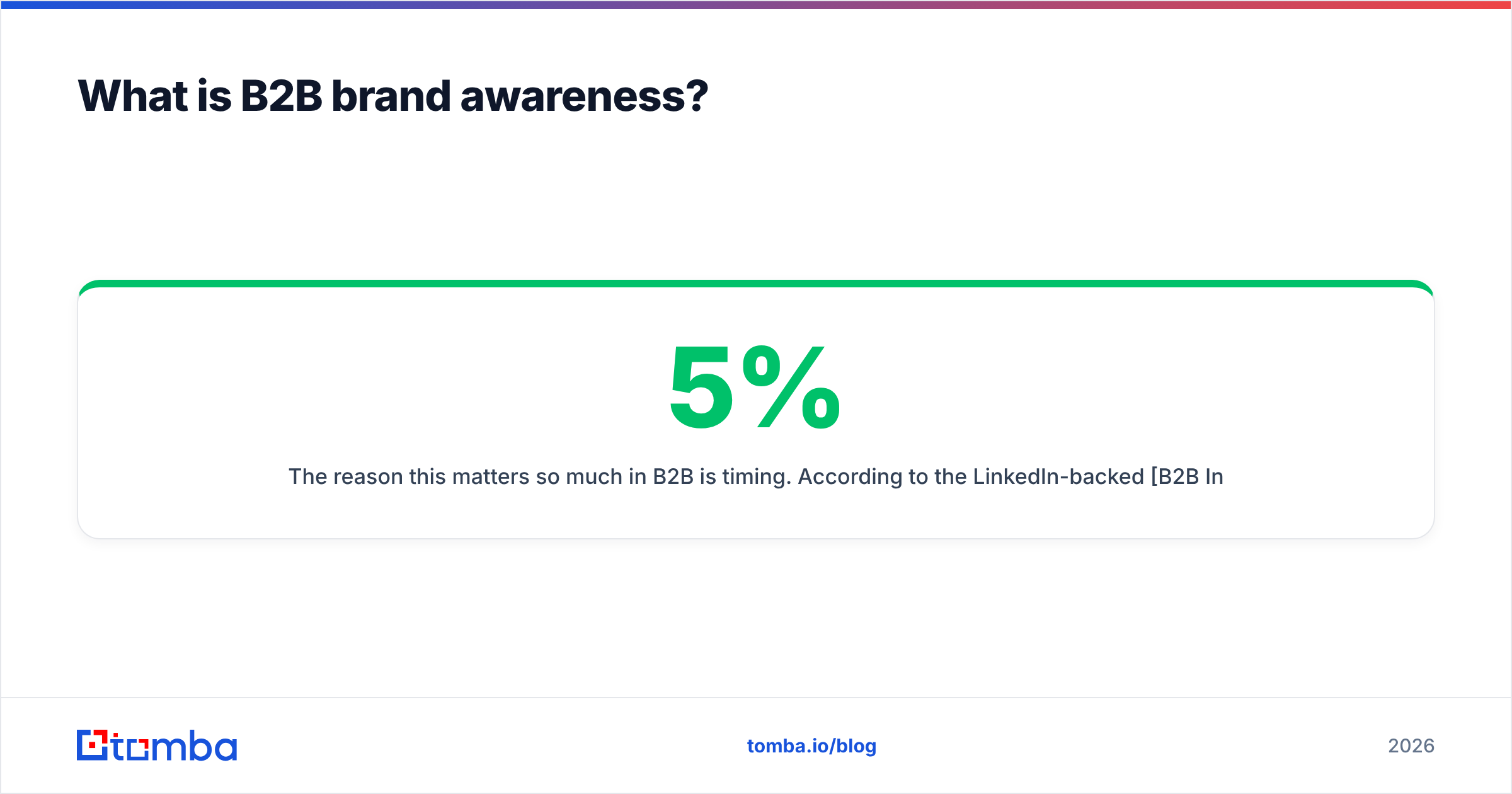
The reason this matters so much in B2B is timing. According to the LinkedIn-backed B2B Institute research popularized by Professor John Dawes, only about 5% of your potential buyers are in-market to purchase at any given time. The other 95% are not reading your bottom-funnel comparison page. They will not convert this quarter no matter how aggressive your retargeting is. Brand awareness is the long game of being remembered by that 95% so that when they enter the market, you are already on the shortlist.
)
Why does brand awareness matter for B2B revenue?#
Brand awareness shortens every other part of your funnel. Conclusion first: known brands close faster, pay less per lead, and win deals at higher prices.
Here is the mechanism. A buyer who already recognizes you needs less convincing. Your emails get opened because the sender name is familiar. Your demo requests come pre-qualified. Your sales cycle compresses because you are not starting from "who are you?" Research from Gartner consistently shows that B2B buyers complete the majority of their decision-making before contacting a vendor — which means the work of being considered happens in the awareness phase, long before a rep is involved.
There is also a pricing effect. When two vendors offer similar features, the better-known brand can charge a premium because trust reduces perceived risk. In committee-driven B2B purchases, "nobody got fired for picking the known brand" is a real psychological force. Awareness is risk insurance for the buyer.
And there is a compounding effect on outbound. If you run cold email or LinkedIn outreach, brand recognition raises reply rates dramatically. A prospect who has seen your founder's posts for six months replies to your email as a warm contact, not a stranger. Brand makes your outbound feel like inbound.
What are the types of brand awareness in B2B?#
Not all awareness is equal. These are the four levels, from weakest to strongest:
- Aided recall — The buyer recognizes your name when they see it in a list (e.g., on a G2 grid). This is the floor: you exist in their mind, but only when prompted.
- Unaided recall — The buyer names you unprompted when asked "what tools do you know in this category?" This is far more valuable because it means you own mental real estate without a cue.
- Top-of-mind awareness — You are the first name they say. In a crowded category, being first recalled is often the difference between getting the RFP and not.
- Brand trust and preference — They not only remember you, they actively prefer you and will defend the choice internally. This is where awareness converts into pricing power and shorter cycles.
Most B2B companies obsess over lead capture while their unaided recall sits near zero. The work is to climb this ladder deliberately, channel by channel.
How do you measure B2B brand awareness?#
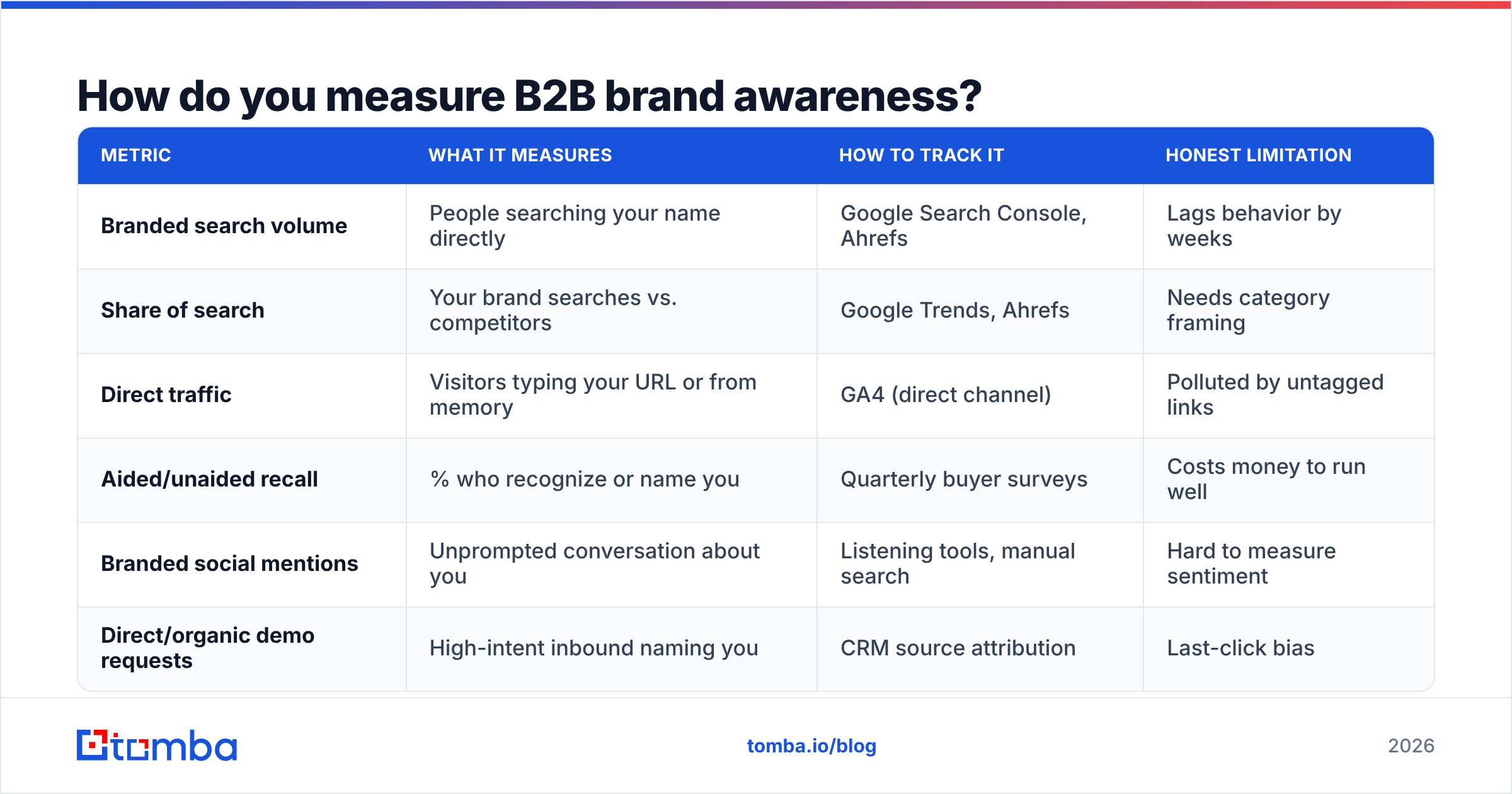
You measure brand awareness with a mix of survey data and behavioral signals — never with impressions alone. Impressions tell you a screen loaded; they do not tell you a human remembered you.
| Metric | What it measures | How to track it | Honest limitation |
|---|---|---|---|
| Branded search volume | People searching your name directly | Google Search Console, Ahrefs | Lags behavior by weeks |
| Share of search | Your brand searches vs. competitors | Google Trends, Ahrefs | Needs category framing |
| Direct traffic | Visitors typing your URL or from memory | GA4 (direct channel) | Polluted by untagged links |
| Aided/unaided recall | % who recognize or name you | Quarterly buyer surveys | Costs money to run well |
| Branded social mentions | Unprompted conversation about you | Listening tools, manual search | Hard to measure sentiment |
| Direct/organic demo requests | High-intent inbound naming you | CRM source attribution | Last-click bias |
The single best free proxy is branded search volume over time. If more people are Googling your company name month over month, your awareness is genuinely growing. The single best paid proxy is a quarterly unaided recall survey of your ICP — expensive, but it is the closest thing to ground truth.
A practical RevOps tip: tie these brand metrics into your revenue operations dashboards alongside pipeline. When leadership can see branded search rising and sales cycles shrinking, the brand budget stops being the first thing cut in a downturn.
Which channels build B2B brand awareness fastest in 2026?#
The channels that compound fastest in 2026 reward consistency and a point of view over polish and budget. Here is where to focus:
- Founder-led and employee-led content — A founder posting genuine, specific insight on LinkedIn outperforms a faceless company page by a wide margin. People trust people.
- Owned media (podcast or newsletter) — Building a Tomba-style newsletter or a niche podcast gives you a direct line to your market that no algorithm can throttle.
- Category POV / thought leadership — Pick a contrarian, defensible position on how your category should work and repeat it everywhere. Brands are remembered for stances, not feature lists.
- Consistent visual identity — Same logo, colors, and voice across every touchpoint. Inconsistency resets recognition to zero each time.
- Strategic partnerships and co-marketing — Borrow the trust of an established brand by appearing alongside it (webinars, integrations, joint reports).
- Review sites and third-party validation — Profiles on Capterra and G2 are awareness surfaces where in-market buyers compare you to rivals.
)
Notice what is not on this list: generic display ads, one-off stunts, and "going viral." Awareness in B2B is built by showing up consistently to a narrow audience, not by a single big swing.
How is brand awareness different from demand generation and lead generation?#
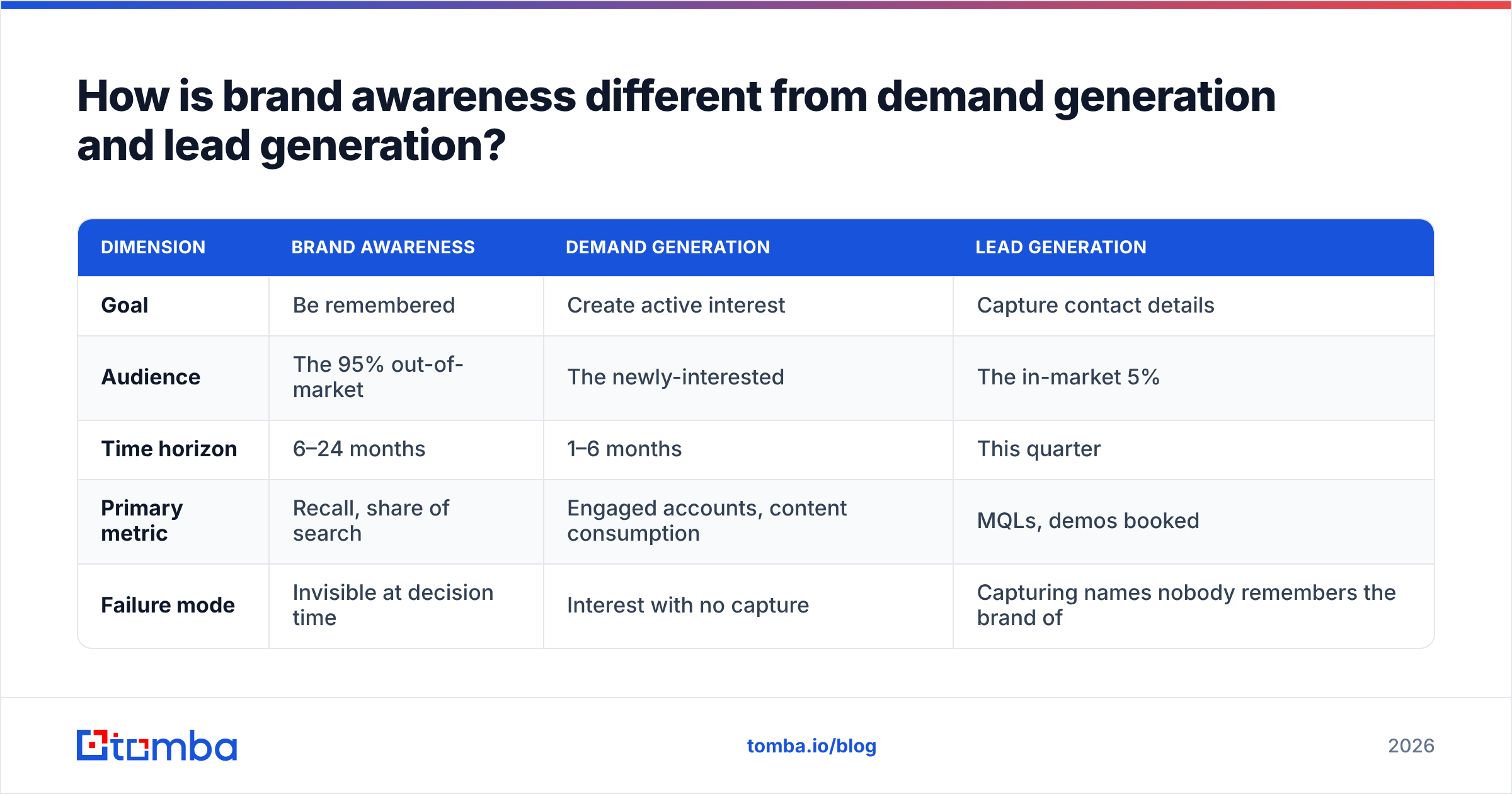
Brand awareness, demand generation, and lead generation are three stages of the same machine — and confusing them is why most B2B funnels leak.
| Dimension | Brand awareness | Demand generation | Lead generation |
|---|---|---|---|
| Goal | Be remembered | Create active interest | Capture contact details |
| Audience | The 95% out-of-market | The newly-interested | The in-market 5% |
| Time horizon | 6–24 months | 1–6 months | This quarter |
| Primary metric | Recall, share of search | Engaged accounts, content consumption | MQLs, demos booked |
| Failure mode | Invisible at decision time | Interest with no capture | Capturing names nobody remembers the brand of |
The mistake is running pure lead-gen with zero brand. You can capture a thousand emails, but if none of those people recognize you, your nurture sequences fight an uphill battle and your response rate stays in the gutter. Brand makes demand gen cheaper, and demand gen makes lead gen convert. They stack.
Equally, brand without a capture mechanism is a charity. You build recognition, then have no way to act when intent appears. The fix is having clean, enriched contact data ready so that the moment an account shows interest, you can reach the right decision-maker by name — which is exactly where accurate B2B data earns its keep.
How do you turn brand awareness into pipeline?#
You convert awareness into pipeline by being ready to act the instant a recognized account shows intent — and that readiness depends entirely on data quality.
Picture the sequence. A marketing director has followed your founder for eight months (awareness). Her company hits a growth wall and she starts researching solutions (demand). She visits your pricing page twice (intent). At this exact moment, the difference between a closed deal and a missed one is whether you can identify the account, find the right contact, and reach out before a competitor does.
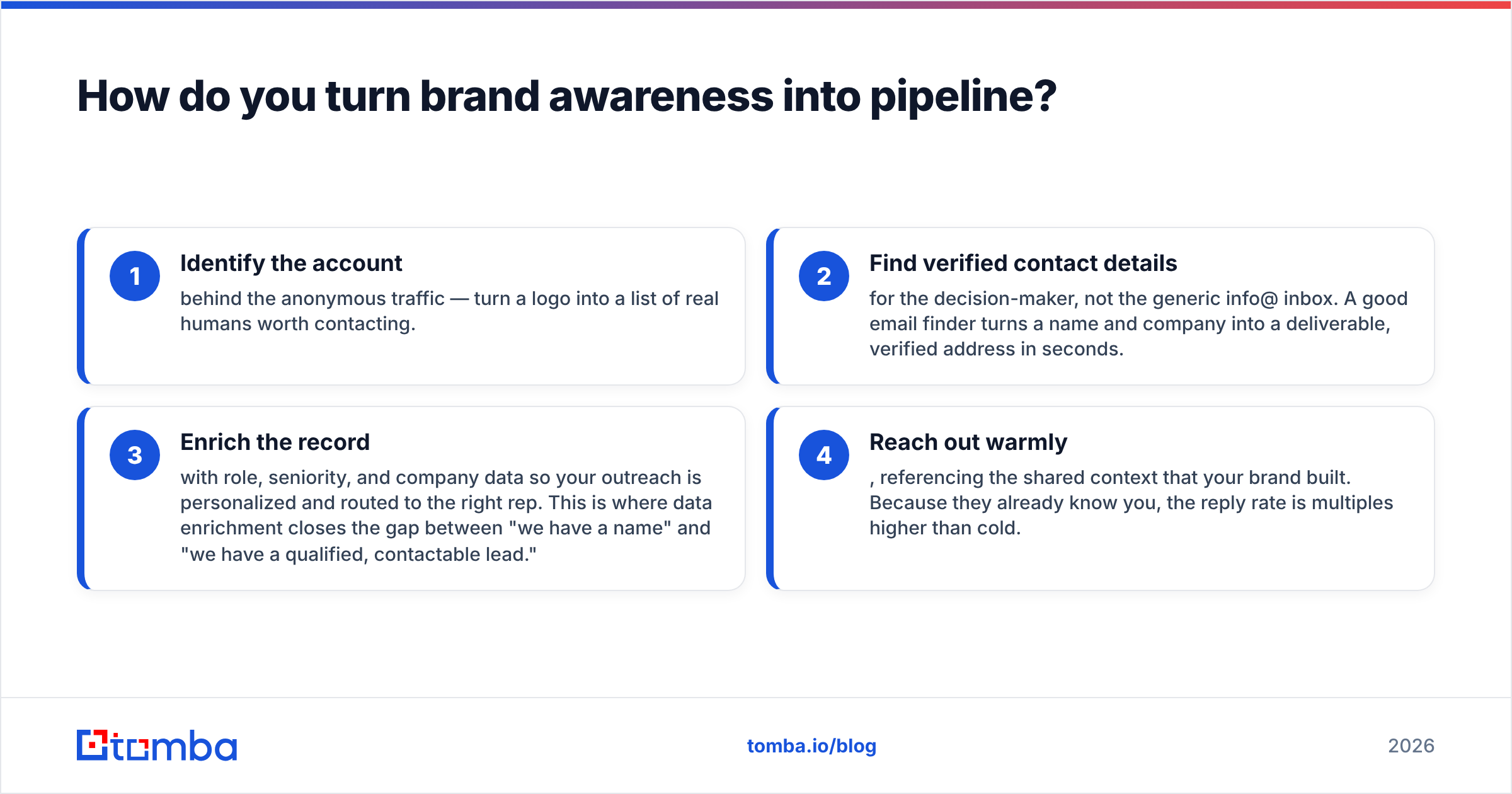
That is an operational problem, not a brand problem. You need to:
- Identify the account behind the anonymous traffic — turn a logo into a list of real humans worth contacting.
- Find verified contact details for the decision-maker, not the generic info@ inbox. A good email finder turns a name and company into a deliverable, verified address in seconds.
- Enrich the record with role, seniority, and company data so your outreach is personalized and routed to the right rep. This is where data enrichment closes the gap between "we have a name" and "we have a qualified, contactable lead."
- Reach out warmly, referencing the shared context that your brand built. Because they already know you, the reply rate is multiples higher than cold.
This is why brand and data belong in the same conversation. Awareness creates the willingness to engage; accurate contact data creates the ability to engage. Skip either half and the pipeline never materializes. If you are scaling this, a B2B database and bulk lookups let you act on hundreds of warmed accounts at once rather than one painstaking lookup at a time.
How long does it take to build B2B brand awareness?#
Honestly: 12 to 24 months of consistent effort before you see compounding returns, with early leading indicators visible by month three to six.
Anyone promising overnight brand awareness is selling you ads, not brand. The reason is repetition — psychological research on memory and advertising (the work behind effective frequency) shows people need multiple exposures across time before a brand sticks. One viral moment fades; ninety LinkedIn posts over six months builds an asset.
Set expectations with leadership using leading indicators that move early:
- Months 1–3: Content cadence established, branded search flat but engagement rising.
- Months 3–6: Branded search begins ticking up, direct traffic grows, reply rates on outbound improve.
- Months 6–12: Unaided recall measurable in surveys, inbound demos start naming your content.
- Months 12–24: Awareness compounds into pricing power, shorter cycles, and lower blended CAC.
The companies that win are the ones that do not quit at month four when the dashboard still looks flat. Brand is a flywheel: slow to start, hard to stop once spinning.
What are the most common B2B brand awareness mistakes?#
The expensive mistakes are almost always about inconsistency and impatience, not creativity.
- Chasing reach over relevance. A million impressions from outside your ICP is worth less than a thousand from inside it. Narrow your audience.
- Inconsistent identity. Changing your message, logo, or positioning every quarter resets recognition to zero. Pick a lane and stay in it.
- Measuring only last-click. Attribution models that credit only the final touch make brand look worthless and starve it of budget. Track branded search and recall instead.
- No capture mechanism. Building awareness with no system to identify and contact warmed accounts is leaving pipeline on the table.
- Quitting too early. Killing the program at month four guarantees you paid for the hard part and skipped the payoff.
Conclusion: pair brand with the data to act on it#
B2B brand awareness is the long, compounding work of being the name your market remembers and trusts before they are ready to buy. It shortens cycles, raises win rates, and makes every dollar of demand and lead gen work harder. But recognition only becomes revenue when you can act on intent the moment it appears — and that requires clean, verified, enriched contact data sitting ready behind your brand.
That is where Tomba fits. Once your brand has earned the attention, the Tomba Email Finder turns a recognized company and a decision-maker's name into a verified, deliverable email address in seconds — so the trust you built converts into a real conversation instead of a missed window. Start free with 25 searches a month, and when you are ready to scale warmed outreach across your whole pipeline, the Starter plan at $49/mo opens up bulk lookups and enrichment. Build the brand. Then reach the people who now know your name.
// get started
Find, verify and enrich your first contacts today
Start on the free plan with 25 searches a month, then scale when your team is ready.
Free plan · No credit card required · GDPR & CCPA
// about the author