B2B Buyer Journey Statistics 2026: 35 Numbers That Matter
35 data-backed B2B buyer journey statistics for 2026 — committee size, anonymous research time, channel mix, and what it means for your GTM motion.
The modern B2B purchase looks almost nothing like the linear funnel your CRM still draws. Buyers self-educate for months, move in committees, and only raise their hand when they have already shortlisted vendors. If your go-to-market plan still assumes a single decision-maker reading your first email, the numbers below will sting.
This is a curated set of b2b buyer journey statistics for 2026 — pulled from how buying actually behaves now — plus what each number means for the way you prospect, build pipeline, and forecast.
TL;DR — The Numbers In One Glance#
- The average B2B buying group now spans 6 to 11 stakeholders, and most deals stall in committee, not in the demo.
- Buyers complete roughly 70% of their research anonymously before they ever talk to sales.
- Only about 5% of in-market accounts are actively buying at any given moment — the other 95% are future pipeline.
- Self-serve and digital channels are the preferred buying motion for ~33% of buyers, rising fastest among younger decision-makers.
- Speed still wins: contacting a lead within 5 minutes can lift qualification odds by up to 9x versus waiting 30+ minutes.
What Does The B2B Buyer Journey Look Like In 2026?#
The conclusion first: the journey is non-linear, committee-driven, and mostly invisible to you. Buyers loop between exploration, evaluation, and validation rather than marching down a funnel.
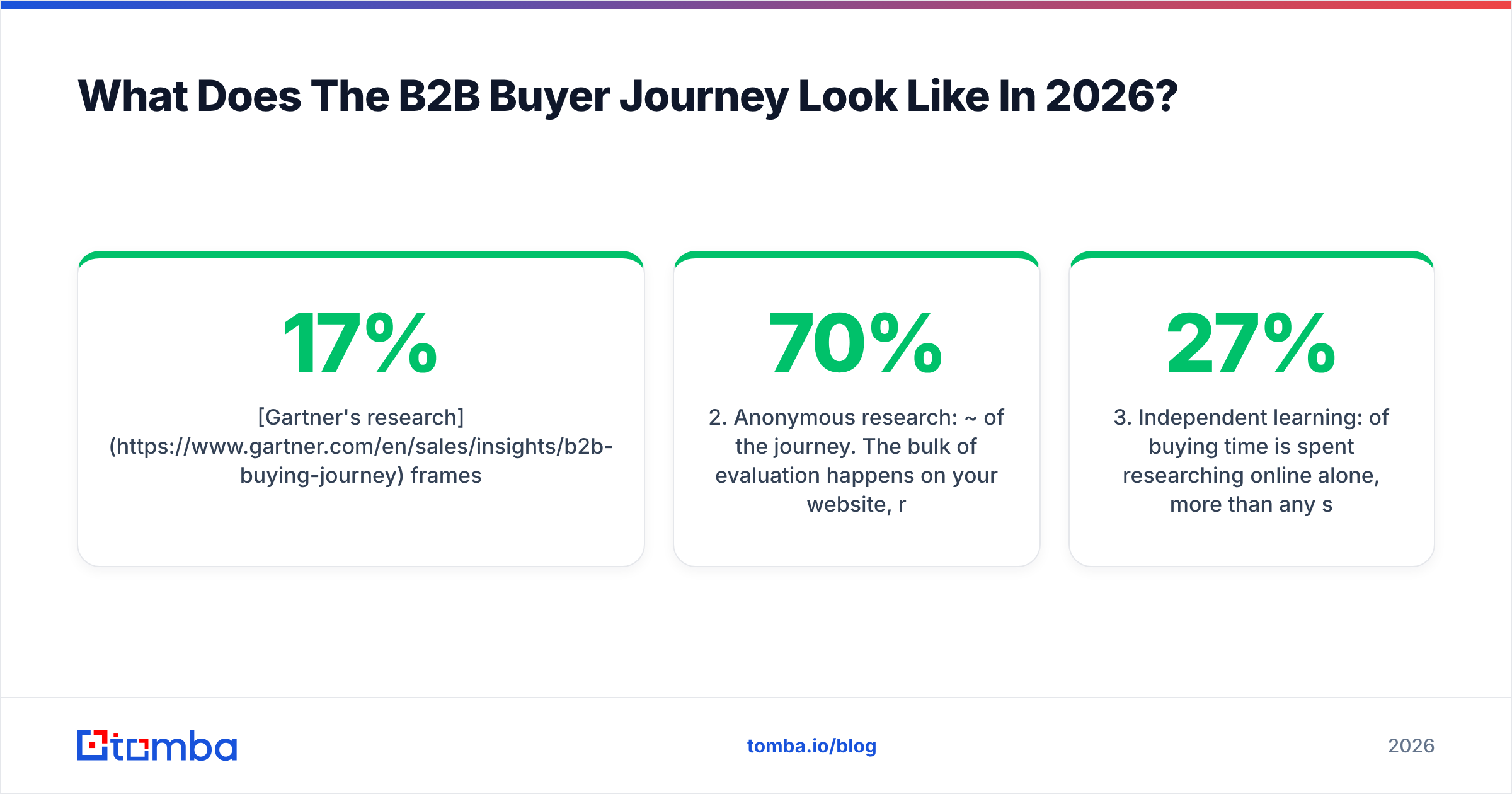
Gartner's research frames the journey as six "jobs" buyers complete in no fixed order — problem identification, solution exploration, requirements building, supplier selection, validation, and consensus creation. Buyers revisit each job multiple times, and the average buyer spends only 17% of total purchase time meeting with potential suppliers. Split that 17% across three or four vendors and any single rep gets roughly 5–6% of the buyer's attention.
Here are the structural numbers worth memorizing:
- Buying committee size: 6–11 people. Enterprise deals routinely exceed 10 stakeholders across procurement, finance, IT, security, and the line-of-business owner.
- Anonymous research: ~70% of the journey. The bulk of evaluation happens on your website, review sites, and peer communities before a form fill.
- Independent learning: 27% of buying time is spent researching online alone, more than any single sales interaction.
- Channel sprawl: ~10 channels. Buyers move across web, email, social, peer review, and analyst content during one purchase.
- Regret is common: a large share of buyers who complete a "high-ease" purchase later regret it, which means consensus — not speed alone — protects renewal.
The takeaway: you are being evaluated long before you know a deal exists. Your job is to be findable, credible, and fast once the buyer surfaces.
How Big Is The B2B Buying Committee?#
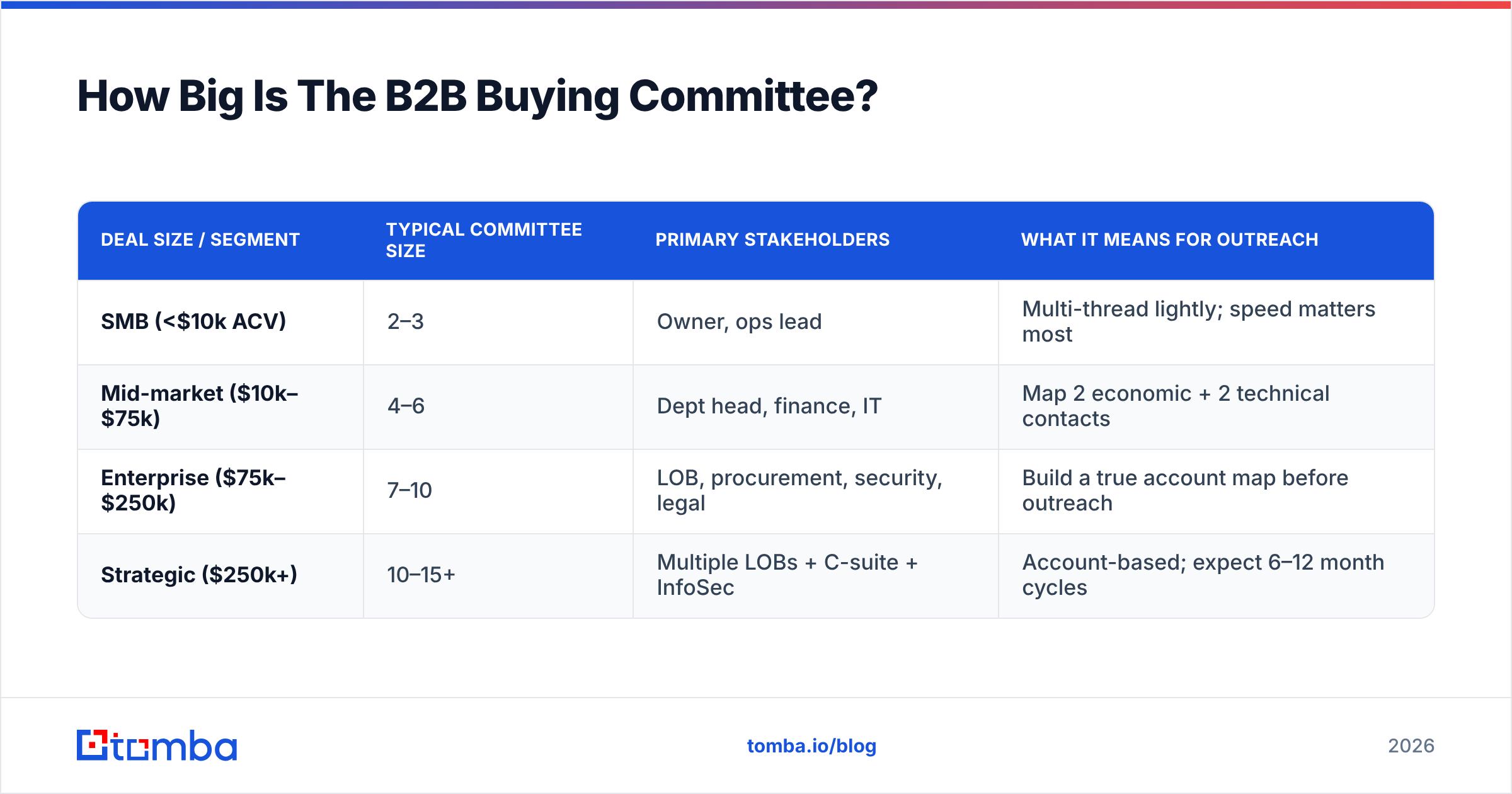
Short answer: bigger than your sequence assumes. The single-threaded deal is the number-one reason forecasted opportunities slip.
| Deal size / segment | Typical committee size | Primary stakeholders | What it means for outreach |
|---|---|---|---|
| SMB (<$10k ACV) | 2–3 | Owner, ops lead | Multi-thread lightly; speed matters most |
| Mid-market ($10k–$75k) | 4–6 | Dept head, finance, IT | Map 2 economic + 2 technical contacts |
| Enterprise ($75k–$250k) | 7–10 | LOB, procurement, security, legal | Build a true account map before outreach |
| Strategic ($250k+) | 10–15+ | Multiple LOBs + C-suite + InfoSec | Account-based; expect 6–12 month cycles |
The practical implication is that contact coverage is now a leading indicator. If you have one verified contact at a target account, you are statistically under-covering the committee by 80–90%. This is where building a full org map with a domain search pays off — you pull every reachable role at the company instead of guessing at one name.
A second-order stat: deals with three or more engaged contacts close at materially higher rates than single-contact deals. Multi-threading is not a nicety; it is the difference between a forecast and a fantasy.
What Percentage Of Buyers Research Before Contacting Sales?#
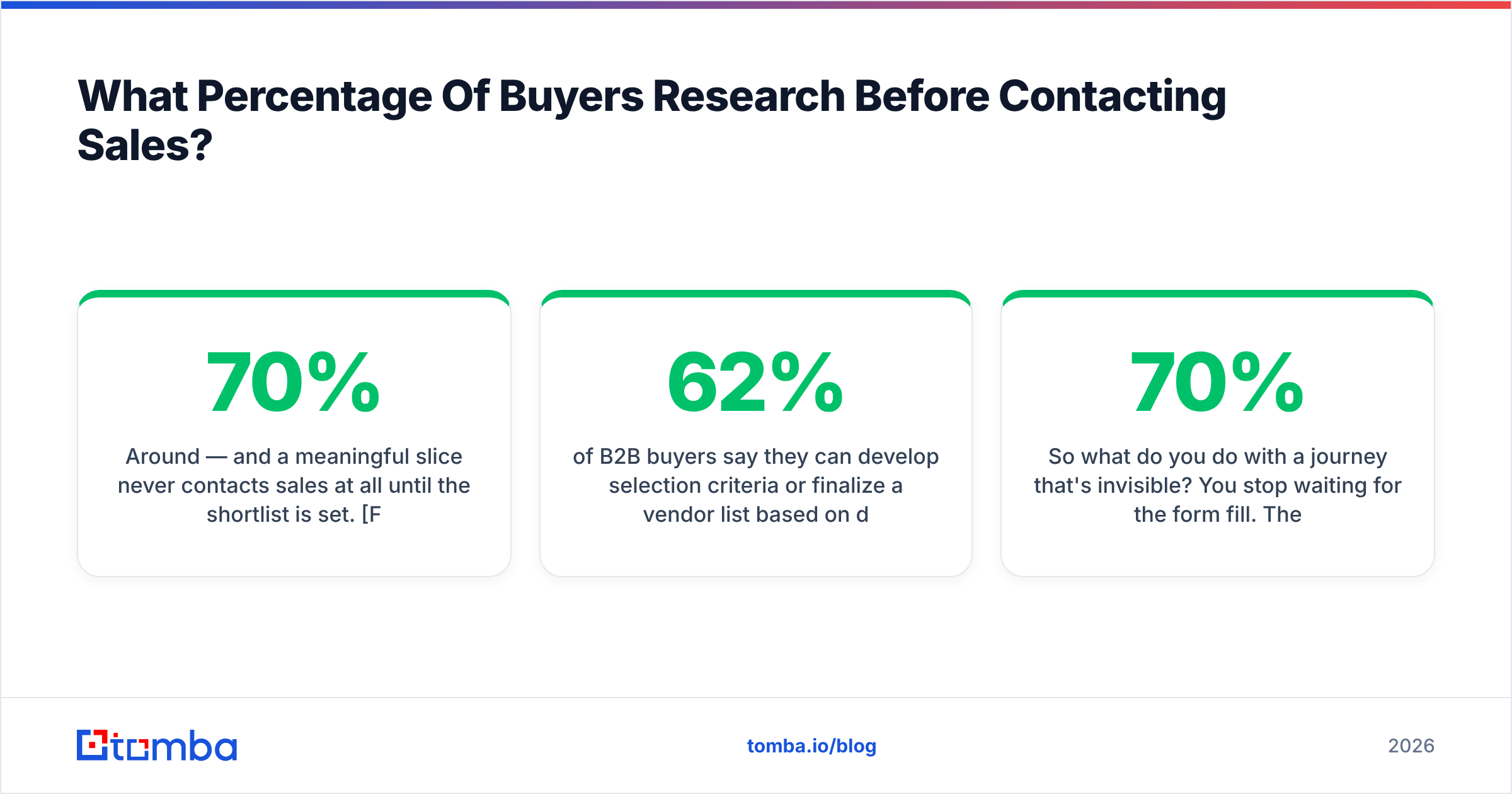
Around 70% — and a meaningful slice never contacts sales at all until the shortlist is set. Forrester and other analysts have tracked the steady shift toward buyer self-education for over a decade, and 2026 is the high-water mark.
Break it down:
- 62% of B2B buyers say they can develop selection criteria or finalize a vendor list based on digital content alone.
- Review sites and peer opinion rank among the top trusted sources; buyers consult sites like G2 before they consult your sales team.
- Dark social and communities — Slack groups, subreddits, private peer networks — drive demand you can't attribute, which is why "How did you hear about us?" answers keep saying "I don't remember."
So what do you do with a journey that's 70% invisible? You stop waiting for the form fill. The accounts researching you today are mostly anonymous, but they leave signals — repeat site visits, content downloads, hiring patterns, tech-stack changes. Capturing those signals and enriching them into reachable contacts is the entire game. Tools that combine visitor identification with contact enrichment let you act on intent before the competitor who's still waiting for an inbound lead.
Which Channels Do B2B Buyers Actually Prefer?#
The conclusion: it depends on the buyer's age and the deal's complexity, but digital self-serve is winning the early stages while human reps still close complex deals.
- ~33% of buyers prefer a fully self-serve, rep-free buying experience for at least part of the journey.
- **Millennial and Gen
Z buyers** — now the majority of B2B decision-makers — over-index on self-serve, mobile research, and video.
- Email remains the highest-ROI outbound channel for initiating contact, but only when the message is relevant and the address is deliverable.
- Phone still works for complex deals: a verified direct dial cuts through where email queues. Reps who layer calls onto email sequences see higher connect rates, which is why a phone finder belongs in the modern prospecting stack alongside email.
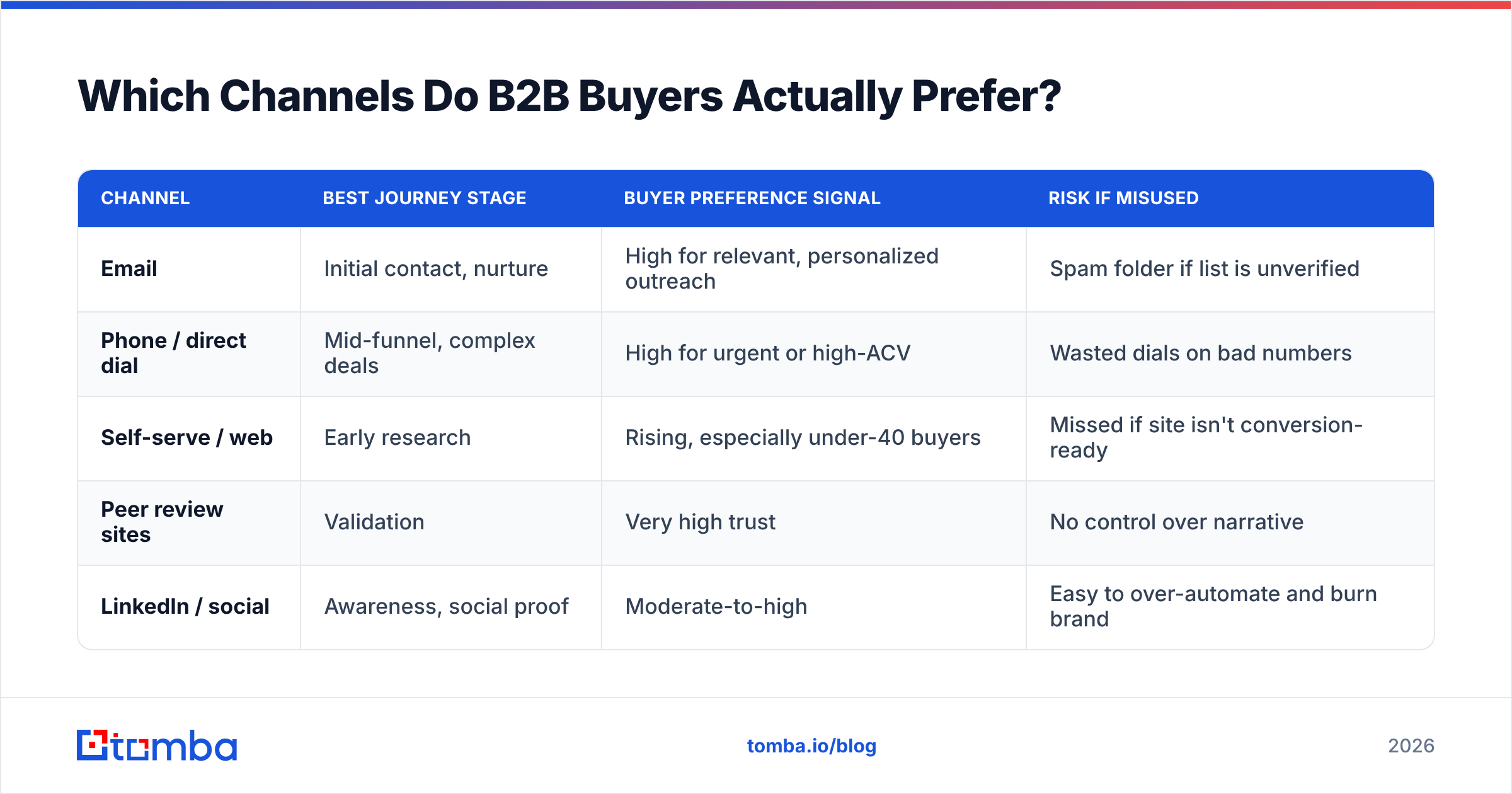
Here is the channel reality in a structured view:
| Channel | Best journey stage | Buyer preference signal | Risk if misused |
|---|---|---|---|
| Initial contact, nurture | High for relevant, personalized outreach | Spam folder if list is unverified | |
| Phone / direct dial | Mid-funnel, complex deals | High for urgent or high-ACV | Wasted dials on bad numbers |
| Self-serve / web | Early research | Rising, especially under-40 buyers | Missed if site isn't conversion-ready |
| Peer review sites | Validation | Very high trust | No control over narrative |
| LinkedIn / social | Awareness, social proof | Moderate-to-high | Easy to over-automate and burn brand |
The strategic point: you don't pick one channel, you sequence them. But every channel that requires reaching a human depends on accurate contact data underneath. Bad data quietly taxes every motion you run.
How Fast Do You Need To Respond?#
Immediately. This is the most actionable statistic in the entire buyer journey.
- Responding to a new lead within 5 minutes can make you up to 9x more likely to qualify it versus a 30-minute delay.
- Yet the median B2B response time is measured in hours, not minutes — a gap that's pure pipeline left on the table.
- 78% of buyers purchase from the vendor that responds first, because first contact often shapes the requirements list.
Speed only works if the contact data is ready before the signal fires. You cannot respond in five minutes if you spend twenty looking up the right person's email. This is the operational case for pre-enriched, verified contact records — having the email and direct line already validated so that "respond fast" is a workflow, not a scramble. A clean B2B database of your target accounts turns speed from a heroic effort into a default behavior.
What Do These Statistics Mean For Your GTM Motion?#
Pulling the numbers together, four mandates fall out:
- Multi-thread by default. With 6–11 buyers per deal, single-contact opportunities are structurally fragile. Map the committee before the first touch.
- Win the anonymous phase. Since ~70% of research happens before contact, invest in findable content, review-site presence, and signal capture — not just outbound volume.
- Sequence channels, don't bet on one. Email to open, phone to accelerate, self-serve to let buyers move at their own pace.
- Make data accuracy a system, not a task. Every stat above — committee coverage, fast response, multi-channel reach — collapses without verified, current contact data underneath it.
Notice the common thread: none of these mandates are about working harder. They are about reaching the right people, at the right moment, with data you can trust. The teams winning in 2026 treat contact accuracy as infrastructure, the same way they treat their CRM or their cloud bill.
How Accurate Is Your Buyer Data — And Why It Decides Everything#
Here's the uncomfortable stat that ties the rest together: B2B contact data decays at roughly 22–30% per year. People change jobs, companies rebrand, domains shift. A list you bought in January is materially wrong by summer.
That decay rate quietly sabotages every statistic on this page. You can't multi-thread a committee with stale emails. You can't respond in five minutes to a bounced address. You can't sequence channels to a phone number that's been reassigned. Data quality is not a back-office concern — it is the variable that decides whether your buyer-journey strategy survives contact with reality.
This is the practical reason to build your prospecting on a verified source. Finding the right person is step one; confirming the email actually lands is step two. Pairing an email finder with real-time email verification means the committee map you build today is still deliverable when the buying signal fires next month. Check the current Tomba pricing tiers if you want to see how that scales from a free trial to bulk enrichment.
Frequently Asked Questions#
How many people are in a B2B buying committee in 2026? Typically 6 to 11, scaling to 15+ for strategic enterprise deals. The committee includes economic buyers, technical evaluators, procurement, security, and end users — which is why single-threaded deals stall.
What percentage of the B2B buying journey is anonymous? About 70%. Buyers self-educate through your website, review sites, and peer communities before identifying themselves, and a large portion of selection criteria is set before any sales conversation.
Does fast response time really matter in B2B? Yes. Contacting a lead within five minutes can raise qualification odds up to ninefold versus a 30-minute delay, and a majority of buyers reward the first vendor to respond. The constraint is usually having accurate contact data ready, not desire.
Why does contact data accuracy affect buyer-journey performance? B2B data decays 22–30% per year. Stale records break multi-threading, slow response time, and waste channel spend, so accuracy is the foundation every other tactic depends on.
Turn These Statistics Into Pipeline#
The buyer journey rewards teams that reach the full committee, fast, with data they can trust. That starts with knowing exactly who to contact and being sure the message will land. Tomba's Email Finder lets you find and verify professional email addresses by domain, name, or company — so you can map a buying committee in minutes, multi-thread with confidence, and respond before your competitors even know the account is in-market. Start on the free tier and put these 2026 numbers to work on your next quarter's pipeline.
// get started
Find, verify and enrich your first contacts today
Start on the free plan with 25 searches a month, then scale when your team is ready.
Free plan · No credit card required · GDPR & CCPA
// about the author