B2B Cold Calling Statistics 2026: Data, Rates & Benchmarks
The B2B cold calling statistics that actually matter in 2026: connect rates, conversion benchmarks, best call times, and how accurate phone data changes the math.
B2B Cold Calling Statistics 2026: Data, Rates, and Benchmarks That Matter
Cold calling is not dead — but the version that worked in 2015 is. The reps still hitting quota in 2026 are not dialing more; they are dialing better numbers, at better times, with research in front of them. The statistics below show exactly where the leverage is.
TL;DR#
- Average B2B cold call connect rate sits around 5–8%, meaning most reps need 15–20 dials to reach one live decision-maker.
- It takes roughly 6–8 call attempts to connect with a prospect, yet most reps quit after 2.
- Wednesday and Thursday, late morning and late afternoon remain the highest-connect windows.
- Bad phone data wastes up to 30% of dialing time — accuracy is the single biggest lever on cold-call ROI.
- Calls paired with prior research or a warm trigger convert 2–3x better than blind dials.
Is cold calling still effective in 2026?#
Short answer: yes, but only as part of a multi-channel motion. Cold calling has not collapsed — it has stratified. Reps who treat the phone as a standalone numbers game see declining returns, while those who combine calls with email and LinkedIn see the phone outperform every other single channel for booking late-stage meetings.
The data backs this up. According to widely cited RAIN Group research, the majority of buyers are still willing to take a call from a new vendor at some point in the buying process, and a large share of executives have accepted a meeting that started with a cold call. The phone still wins where email loses: real-time objection handling and genuine human signal.
What changed is tolerance for waste. Buyers screen aggressively, spam filters route unknown numbers to voicemail, and a wrong number burns trust and time. That is why the highest-performing teams obsess over data quality before dial volume.

What is the average B2B cold call connect rate?#
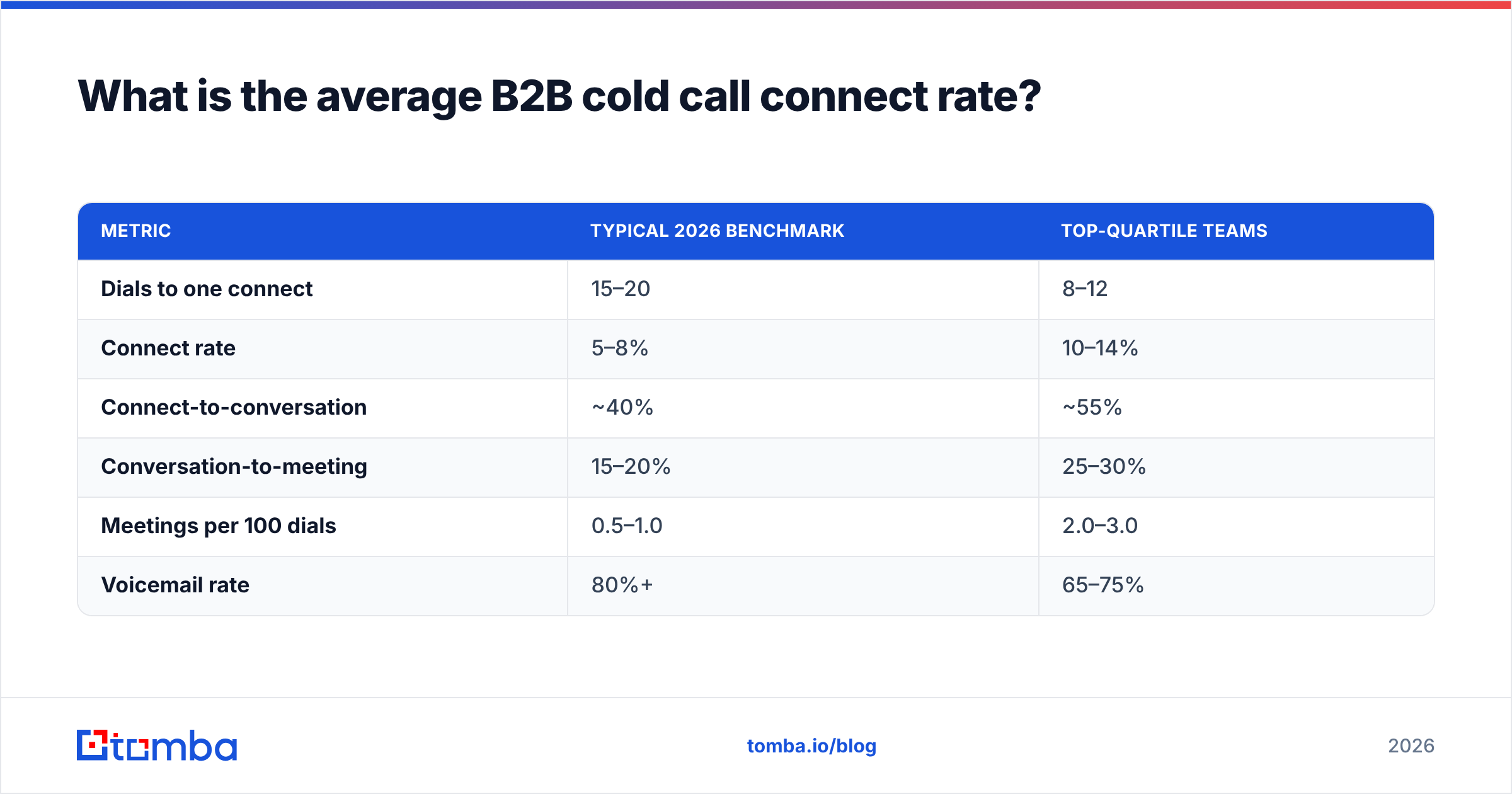
The average connect rate for B2B cold calls falls between 5% and 8% for most teams using standard contact lists. That means for every 100 dials, you reach 5 to 8 live humans who are actually the person you wanted.
But that headline number hides enormous variance driven by three factors:
- Data accuracy — direct-dial mobile numbers connect far more often than switchboard lines that route through gatekeepers.
- Persona seniority — VPs and C-level contacts are harder to reach than managers, but a connected exec is worth several manager conversations.
- Time of day — connect rates swing by 2x or more depending on when you dial.
Here is how the core funnel typically breaks down for a mid-market B2B team:
| Metric | Typical 2026 benchmark | Top-quartile teams |
|---|---|---|
| Dials to one connect | 15–20 | 8–12 |
| Connect rate | 5–8% | 10–14% |
| Connect-to-conversation | ~40% | ~55% |
| Conversation-to-meeting | 15–20% | 25–30% |
| Meetings per 100 dials | 0.5–1.0 | 2.0–3.0 |
| Voicemail rate | 80%+ | 65–75% |
The jump from average to top-quartile is not about working twice as hard. It is mostly about feeding the dialer accurate, current direct numbers instead of generic company lines — which is where a reliable phone finder changes the entire equation.
How many attempts does it take to reach a prospect?#
It takes an average of six to eight call attempts to connect with a B2B prospect, yet the majority of reps stop after just two. This is the single largest unforced error in cold calling, and it is fully within your control.
The persistence gap is stark:
- Roughly 44% of reps give up after one follow-up.
- The majority of sales happen after the fifth contact attempt.
- Spacing attempts across days and channels — call, email, LinkedIn, call — sharply increases the odds of a live conversation.
The lesson is not "dial the same number eight times in one afternoon." It is to build a cadence that mixes channels and respects timing. A prospect who ignored your Tuesday morning call may pick up Thursday afternoon, and an email that lands between attempts primes recognition so your name is not cold the third time. Pair your dialing cadence with verified contact details so you are never wasting one of those precious attempts on a dead line — start by building clean lists with an accurate email finder alongside your phone data.
When is the best time to make B2B cold calls?#
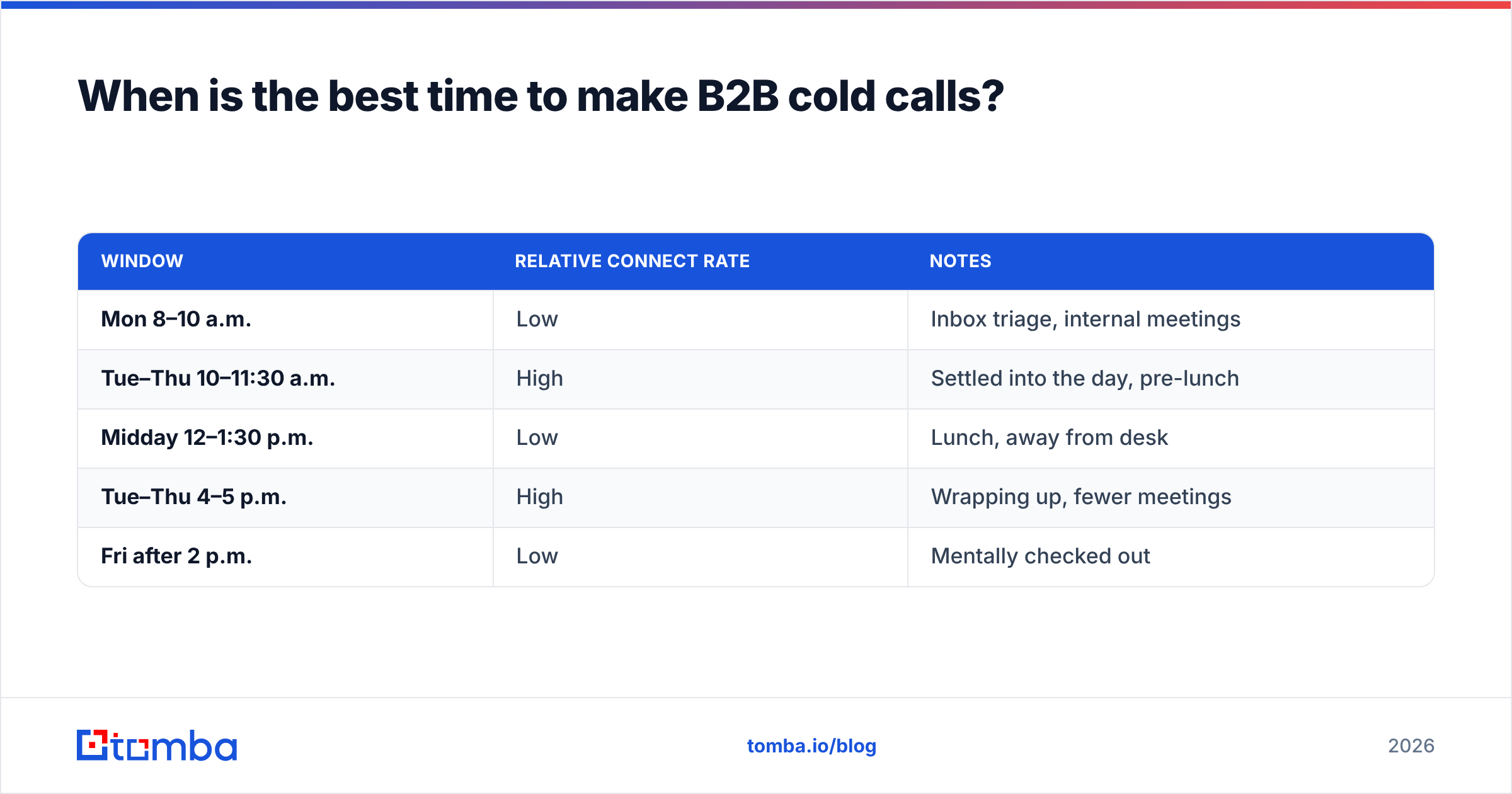
The best times to cold call are late morning (10–11:30 a.m.) and late afternoon (4–5 p.m.) on Wednesday and Thursday, in the prospect's local time zone. These windows consistently show the highest connect and conversion rates across multiple sales-data studies.
| Window | Relative connect rate | Notes |
|---|---|---|
| Mon 8–10 a.m. | Low | Inbox triage, internal meetings |
| Tue–Thu 10–11:30 a.m. | High | Settled into the day, pre-lunch |
| Midday 12–1:30 p.m. | Low | Lunch, away from desk |
| Tue–Thu 4–5 p.m. | High | Wrapping up, fewer meetings |
| Fri after 2 p.m. | Low | Mentally checked out |
Two practical notes. First, time zone matters more than absolute time — a 4 p.m. call to a prospect three zones away is a 1 p.m. call for them, which lands in the dead midday window. Second, these are population averages; your own historical CRM data on when your specific buyers pick up beats any benchmark. Track it, and let your real win rate by call window guide the cadence.
How does data quality change cold calling statistics?#
Data quality is the multiplier sitting underneath every other statistic on this page. A perfect script dialed against a stale list still fails, because the number rings to a person who left the company eight months ago.
Consider the math. B2B contact data decays at roughly 25–30% per year as people change jobs, companies restructure, and direct lines get reassigned. If your list is a year old, nearly a third of your dials are pre-doomed regardless of skill. Reps burn time, morale erodes, and the connect rate craters — not because cold calling stopped working, but because the inputs rotted.

This is where verification and enrichment pay for themselves:
- Verified direct dials connect at multiples of switchboard numbers.
- Phone validation strips disconnected and reassigned lines before they hit the dialer — a quick pass through a phone validator reclaims time you would otherwise waste.
- Enriched records — title, seniority, recent role change — let reps personalize the opener and skip dead personas entirely with proper data enrichment.
Teams that clean and enrich their list before a calling sprint routinely cut dials-per-connect in half. That is not a marginal tweak; it is the difference between one meeting per 200 dials and one per 90.
What cold calling benchmarks should reps actually track?#
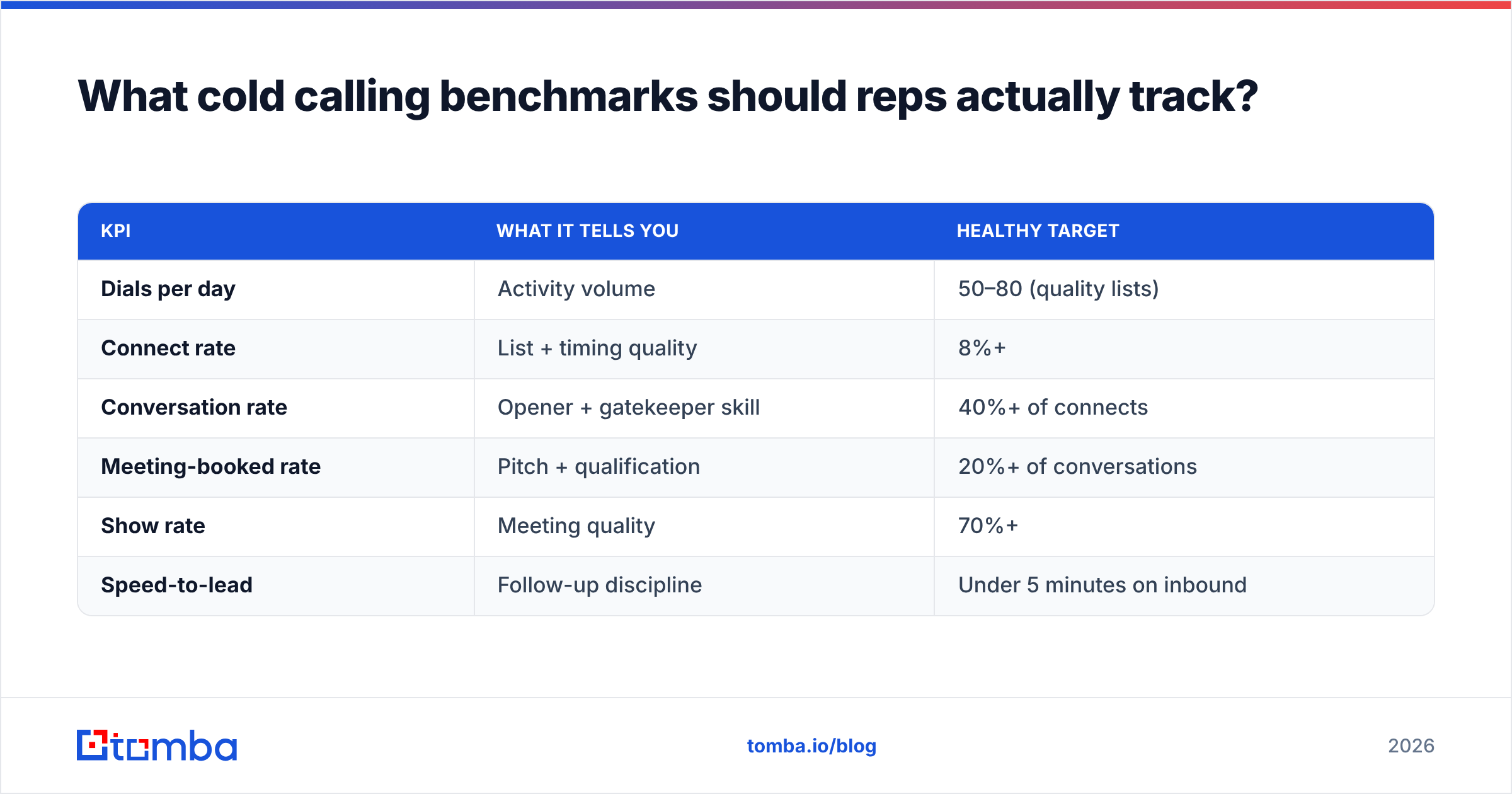
Track the full funnel, not just the vanity number at the top. Dials alone tell you nothing about quality. The metrics that drive coaching decisions are the conversion ratios between each stage.
| KPI | What it tells you | Healthy target |
|---|---|---|
| Dials per day | Activity volume | 50–80 (quality lists) |
| Connect rate | List + timing quality | 8%+ |
| Conversation rate | Opener + gatekeeper skill | 40%+ of connects |
| Meeting-booked rate | Pitch + qualification | 20%+ of conversations |
| Show rate | Meeting quality | 70%+ |
| Speed-to-lead | Follow-up discipline | Under 5 minutes on inbound |
A rep with a low connect rate but a high conversation-to-meeting ratio has a data problem, not a skill problem — fix the list. A rep with great connects but few meetings has a messaging problem — coach the script. Diagnosing which one you have is impossible without tracking the whole chain, and it is why generic "dial more" advice fails so often.
How does cold calling compare to other prospecting channels?#
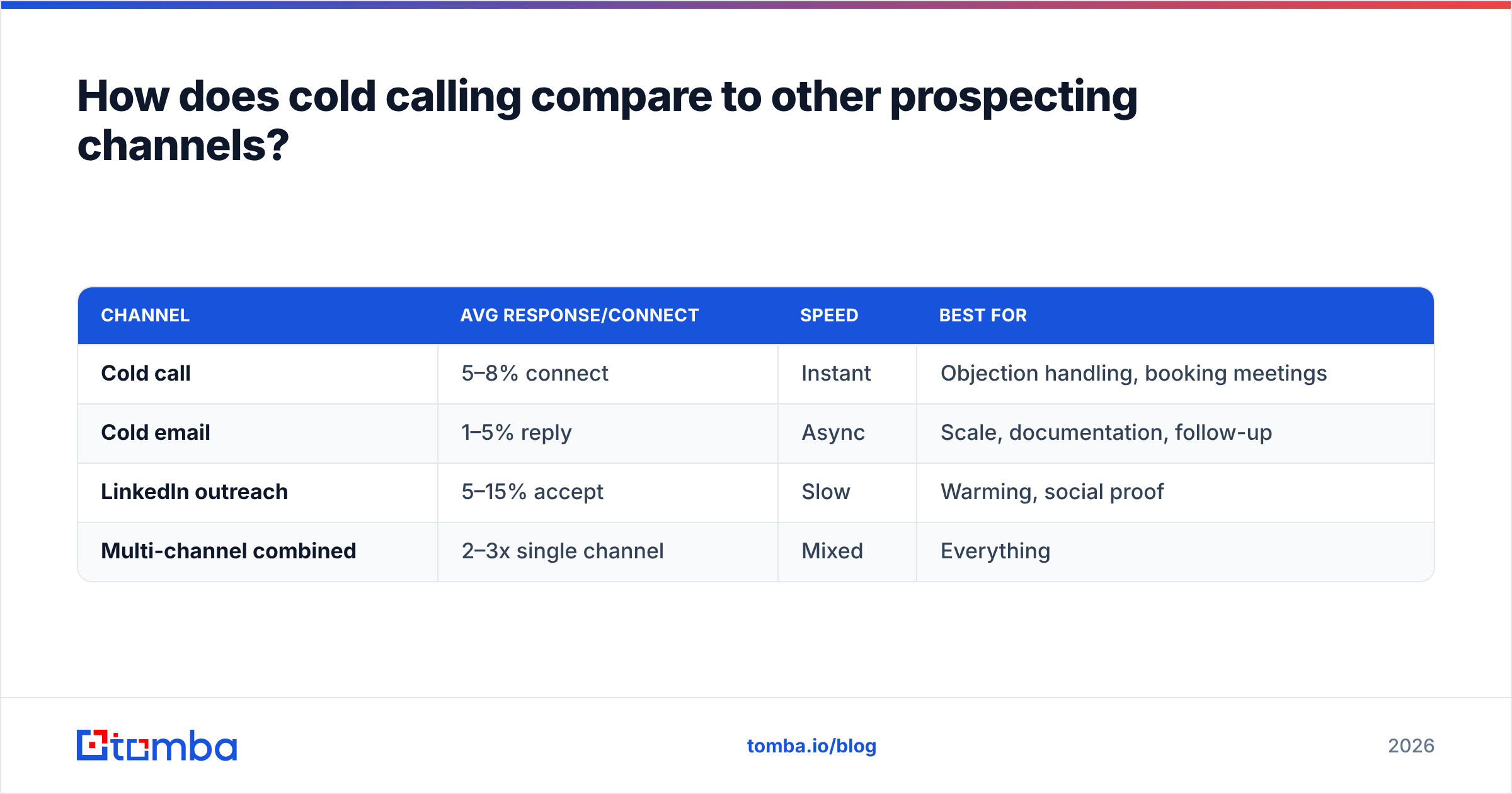
Cold calling is not competing with email and social — it works best layered on top of them. Each channel has a different strength, and the statistics make the case for combining rather than choosing.
| Channel | Avg response/connect | Speed | Best for |
|---|---|---|---|
| Cold call | 5–8% connect | Instant | Objection handling, booking meetings |
| Cold email | 1–5% reply | Async | Scale, documentation, follow-up |
| LinkedIn outreach | 5–15% accept | Slow | Warming, social proof |
| Multi-channel combined | 2–3x single channel | Mixed | Everything |
The standout statistic is the last row: sequences that touch a prospect across call, email, and LinkedIn convert two to three times better than any single channel run alone. The phone provides the human moment; email provides the paper trail and the recall; LinkedIn provides the credibility. For the deeper email side of that motion, our guide to LinkedIn outreach pairs naturally with a calling cadence.
The implication for your cold calling statistics is direct: a prospect who has seen your email and your LinkedIn name is no longer a true cold call. Your connect rate and your conversation rate both climb because recognition lowers the wall. That is why high-performing SDR teams never run the dialer in isolation.
Quick answers: B2B cold calling FAQ#
What is a good cold call connect rate in 2026? Anything at or above 8% is solid; top teams with clean direct-dial data reach 10–14%.
How many cold calls should a rep make per day? With a quality, enriched list, 50–80 focused dials beats 150 dials against a dirty list — connects, not dials, pay the bills.
Does the time of day really matter? Yes. Late morning and late afternoon mid-week roughly double connect rates versus Monday mornings and Friday afternoons.
Is cold calling worth it versus pure email? For booking meetings with senior buyers, the phone still outperforms email per-attempt — but the two together beat either alone.
The bottom line: numbers follow data quality#
Every cold calling statistic on this page bends to one input you control — the accuracy of your contact list. Connect rates, attempts-to-reach, and conversion all improve when you dial verified direct numbers tied to enriched, current records instead of a year-old export full of reassigned lines and departed contacts.
If you want your 2026 cold calling numbers to climb, start upstream of the dialer. Use Tomba's Email Finder to build accurate, verified contact lists, layer in direct phone numbers and enrichment, and feed your reps a list that actually connects. Check Tomba pricing — the free tier lets you test data quality on your own target accounts before you commit a single dollar. Better data in, better statistics out.
// get started
Find, verify and enrich your first contacts today
Start on the free plan with 25 searches a month, then scale when your team is ready.
Free plan · No credit card required · GDPR & CCPA
Get the Tomba newsletter
Product and data updates
// about the author