B2B Cold Email Sequence: 7-Step Framework That Books Meetings in 2026
A single cold email almost never lands a reply. Here's the exact 7-step B2B cold email sequence that builds momentum, handles silence, and books meetings in 2026.
A B2B cold email sequence is a planned series of messages sent to the same prospect over days or weeks, not a single email you fire once and forget. The single email is where most outbound dies. The sequence is where meetings get booked.
TL;DR#
- One email is not a strategy. 80% of replies in a well-built B2B cold email sequence come from follow-ups 2 through 5, not the first send.
- Seven touches over ~21 days is the sweet spot for most B2B motions — enough to stay top of mind without becoming a pest.
- Each touch needs a new angle. "Just bumping this" wastes a slot. Rotate value, social proof, a different pain point, and a clean breakup email.
- Data quality beats copy quality. A clever sequence sent to bad addresses bounces, tanks your sender reputation, and never reaches the inbox.
- Verify before you send. Use an email verifier to keep bounce rates under 3% and protect deliverability across the whole cadence.
What is a B2B cold email sequence?#
A B2B cold email sequence is a scheduled cadence of touchpoints aimed at one prospect who has never engaged with you. Think of it like watering a plant. One splash of water on dry soil mostly runs off the sides. The plant absorbs water when you give it a little, consistently, over time. A cold prospect works the same way: the first email rarely converts because there is no context, no trust, and no timing alignment. The follow-ups are what get absorbed.
The mechanics are simple. You define a list of touches, the gap between each, the channel (email, and often LinkedIn or a call), and the message angle for every step. Then you send — manually or through automation — and stop the moment someone replies or books.
Here is why the sequence matters more than any single email:
- Timing is mostly luck. Your prospect might be in a meeting, on vacation, or buried under 200 unread emails the day you send. Multiple touches multiply your chances of catching them at a free moment.
- Trust compounds. Seeing your name three or four times — professionally, without nagging — signals persistence and credibility, not desperation.
- Each angle reaches a different buyer. One person cares about cost, another about risk, another about speed. Rotating angles across the sequence lets one of them land.
- Breakup emails work. The "I'll close your file" message is consistently one of the highest-reply touches in B2B outbound, because loss aversion is a powerful motivator.
How many emails should a cold email sequence have?#
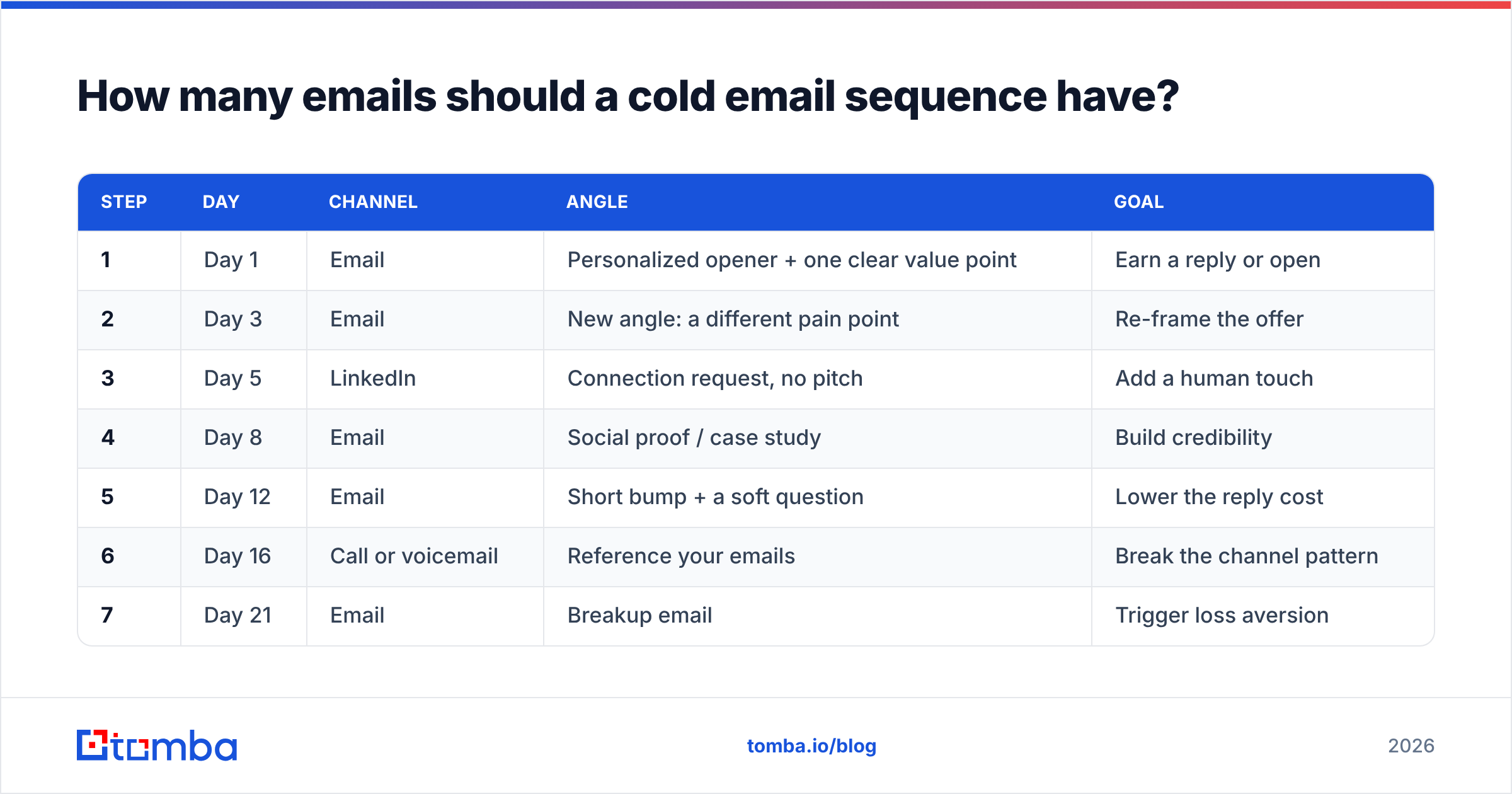
Five to eight touches over two to four weeks is the proven range for B2B. Fewer than four and you leave replies on the table. More than eight and you risk spam complaints and reputation damage. The classic 7-step structure below balances coverage with restraint.
| Step | Day | Channel | Angle | Goal |
|---|---|---|---|---|
| 1 | Day 1 | Personalized opener + one clear value point | Earn a reply or open | |
| 2 | Day 3 | New angle: a different pain point | Re-frame the offer | |
| 3 | Day 5 | Connection request, no pitch | Add a human touch | |
| 4 | Day 8 | Social proof / case study | Build credibility | |
| 5 | Day 12 | Short bump + a soft question | Lower the reply cost | |
| 6 | Day 16 | Call or voicemail | Reference your emails | Break the channel pattern |
| 7 | Day 21 | Breakup email | Trigger loss aversion |
The exact days are flexible. What is not flexible is the principle: space your touches so you stay visible without flooding the inbox, and change the message every single time. A sequence of seven identical "checking in" emails performs worse than three thoughtful ones.
What does each step actually say?#
Each touch carries one job. Crowding multiple asks into a single email is the fastest way to get ignored. Below is what each step should accomplish.
- Touch 1 — The opener. Lead with the prospect, not yourself. Reference a trigger: a funding round, a job posting, a product launch, a LinkedIn post. Then make one specific, outcome-focused claim. End with a low-friction question.
- Touch 2 — The reframe. Assume the first angle missed. Open a different pain point. "Most VPs of Sales I talk to are less worried about lead volume and more about reps wasting hours on bad data." This catches buyers your first email didn't.
- Touch 3 — The LinkedIn touch. A plain connection request, or a comment on their recent post. No pitch. You are simply becoming a familiar name so your next email feels warmer. This is where LinkedIn outreach earns its keep.
- Touch 4 — The proof. Now you've earned the right to show evidence. One tight customer story with a number: "We helped a 40-rep team cut prospecting time by 9 hours a week." Keep it to three sentences.
- Touch 5 — The soft bump. Two lines. Acknowledge they're busy, ask a single yes/no question. "Worth a 15-minute look, or is this off your radar for now?" The lower the cost of replying, the more replies you get.
- Touch 6 — The channel switch. A call or voicemail referencing your emails breaks the pattern and signals you're a real person, not a script.
- Touch 7 — The breakup. "I don't want to clutter your inbox, so I'll close your file — unless this is still worth a conversation." Polite, final, and one of your top-performing touches.
Why does data quality matter more than copy?#
Your sequence is only as good as the addresses you send it to. A perfect seven-touch cadence sent to a list with 30% invalid emails will bounce hard, get throttled by mailbox providers, and quietly destroy your sender reputation — which means even your valid prospects stop seeing you in the inbox.
The math is unforgiving. Mailbox providers like Google and Microsoft watch your bounce rate as a primary spam signal. Cross 3–5% and you start landing in spam folders. A multi-step sequence amplifies the damage because every bounced contact gets hit repeatedly, compounding the negative signal.
This is the order of operations that actually works:
- Find accurate addresses first. Use a dedicated email finder to source verified professional emails by name and domain, instead of guessing patterns.
- Verify the whole list. Run every address through verification before the first send, then re-check before high-volume touches.
- Handle catch-all domains carefully. Many B2B domains accept all mail, hiding invalid users. A catch-all verifier gives you a confidence signal so you don't fly blind.
- Warm up and pace. Don't blast 500 cold emails on day one from a fresh domain. Ramp volume gradually.
How do you write a cold email that gets opened and answered?#
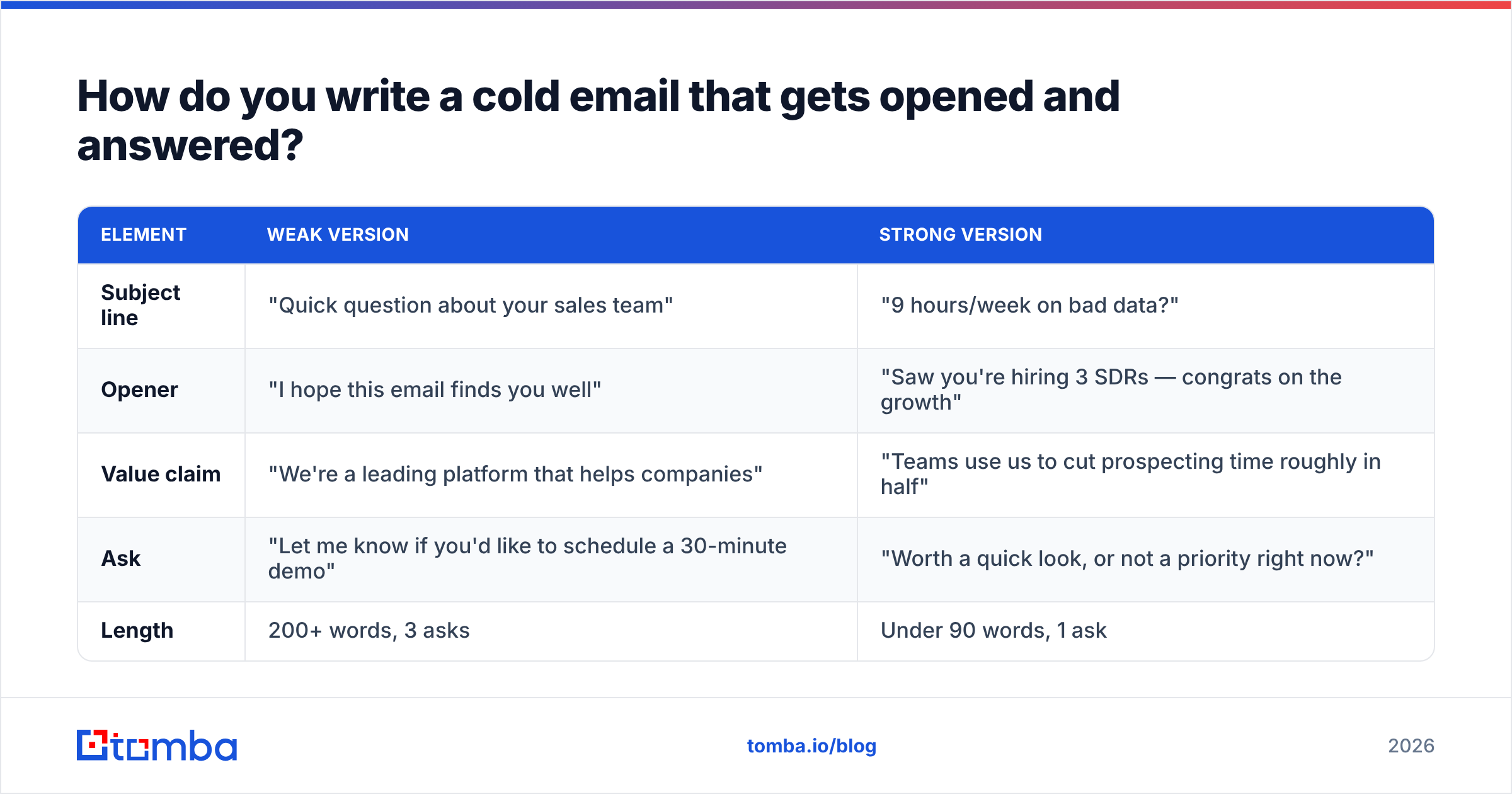
Keep it short, make it about them, and ask for one small thing. The structure that works across nearly every B2B cold email sequence is four parts: a relevant opener, a one-line value claim, a proof point, and a single soft ask.
| Element | Weak version | Strong version |
|---|---|---|
| Subject line | "Quick question about your sales team" | "9 hours/week on bad data?" |
| Opener | "I hope this email finds you well" | "Saw you're hiring 3 SDRs — congrats on the growth" |
| Value claim | "We're a leading platform that helps companies" | "Teams use us to cut prospecting time roughly in half" |
| Ask | "Let me know if you'd like to schedule a 30-minute demo" | "Worth a quick look, or not a priority right now?" |
| Length | 200+ words, 3 asks | Under 90 words, 1 ask |
A few rules that consistently lift reply rates:
- Write to one person, not a segment. Personalization beyond
{{first_name}}— a real reference to their company or role — is the single biggest reply driver. - Cut every sentence about yourself you can. Buyers care about their outcome, not your feature list.
- One call to action. Two asks in one email roughly halve your response rate. Make the next step obvious and tiny.
- Test subject lines. Short, specific, and curiosity-driven wins. If you want a head start, a subject line generator can spin up variants to A/B test.
For deeper benchmarks on what "good" looks like, HubSpot's email marketing research and the G2 sales engagement category are solid, vendor-neutral references.
Should you automate your cold email sequence?#
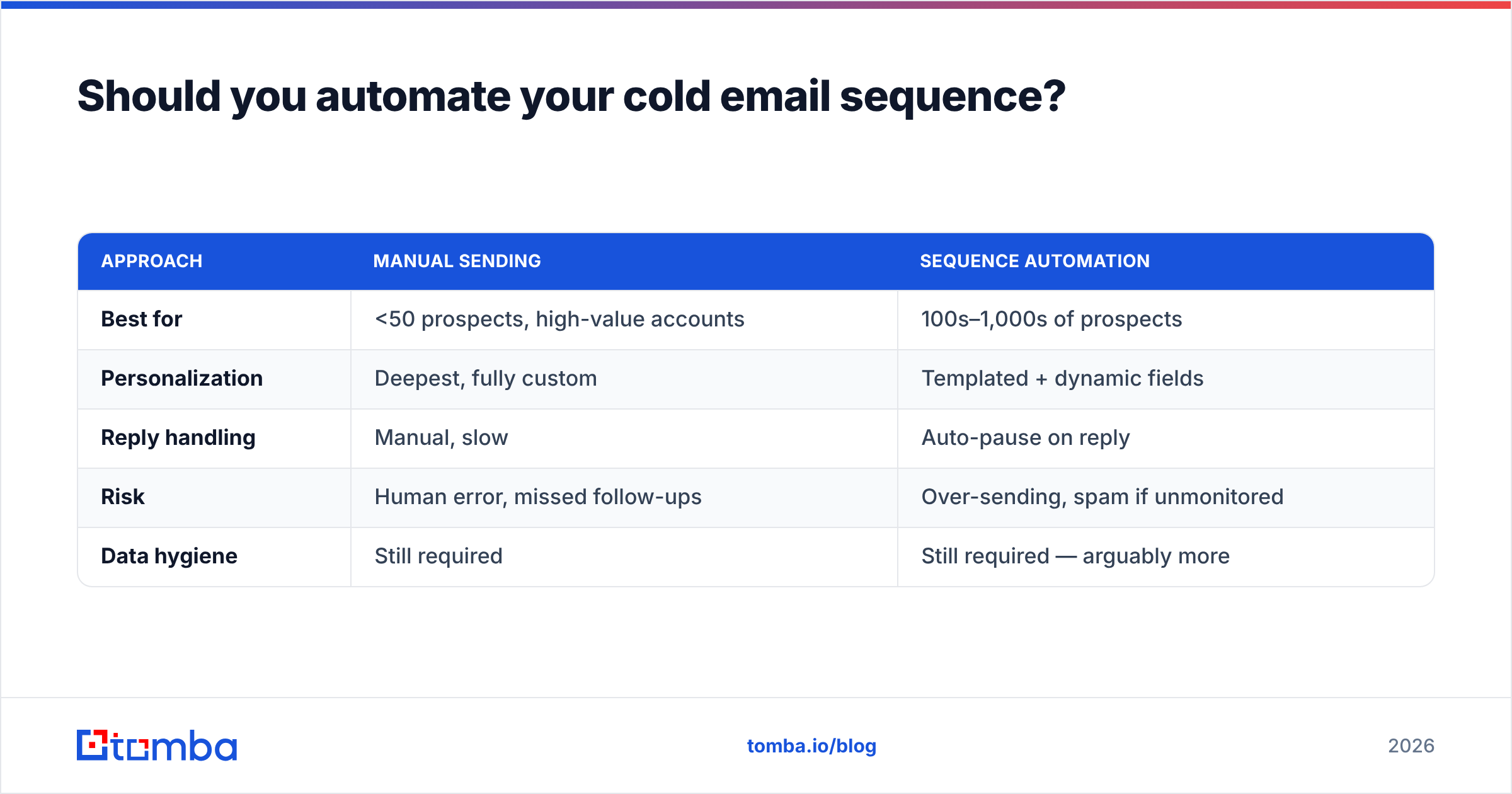
Automate the sending and scheduling; keep the targeting and personalization human. Automation tools are excellent at remembering to send touch 4 on day 8 and pausing the moment someone replies. They are terrible at deciding whether a prospect is actually a fit. The winning setup splits the labor: software handles cadence and timing, you handle list quality and the first-line personalization that makes each email feel one-to-one.
| Approach | Manual sending | Sequence automation |
|---|---|---|
| Best for | <50 prospects, high-value accounts | 100s–1,000s of prospects |
| Personalization | Deepest, fully custom | Templated + dynamic fields |
| Reply handling | Manual, slow | Auto-pause on reply |
| Risk | Human error, missed follow-ups | Over-sending, spam if unmonitored |
| Data hygiene | Still required | Still required — arguably more |
Whichever route you take, the non-negotiable is clean data feeding the system. You can wire verified contacts straight into your stack with the Tomba API or push enriched leads into your CRM through native integrations like HubSpot, Pipedrive, and Salesforce — so your sequence always runs on accurate, deduplicated addresses.
What metrics tell you the sequence is working?#
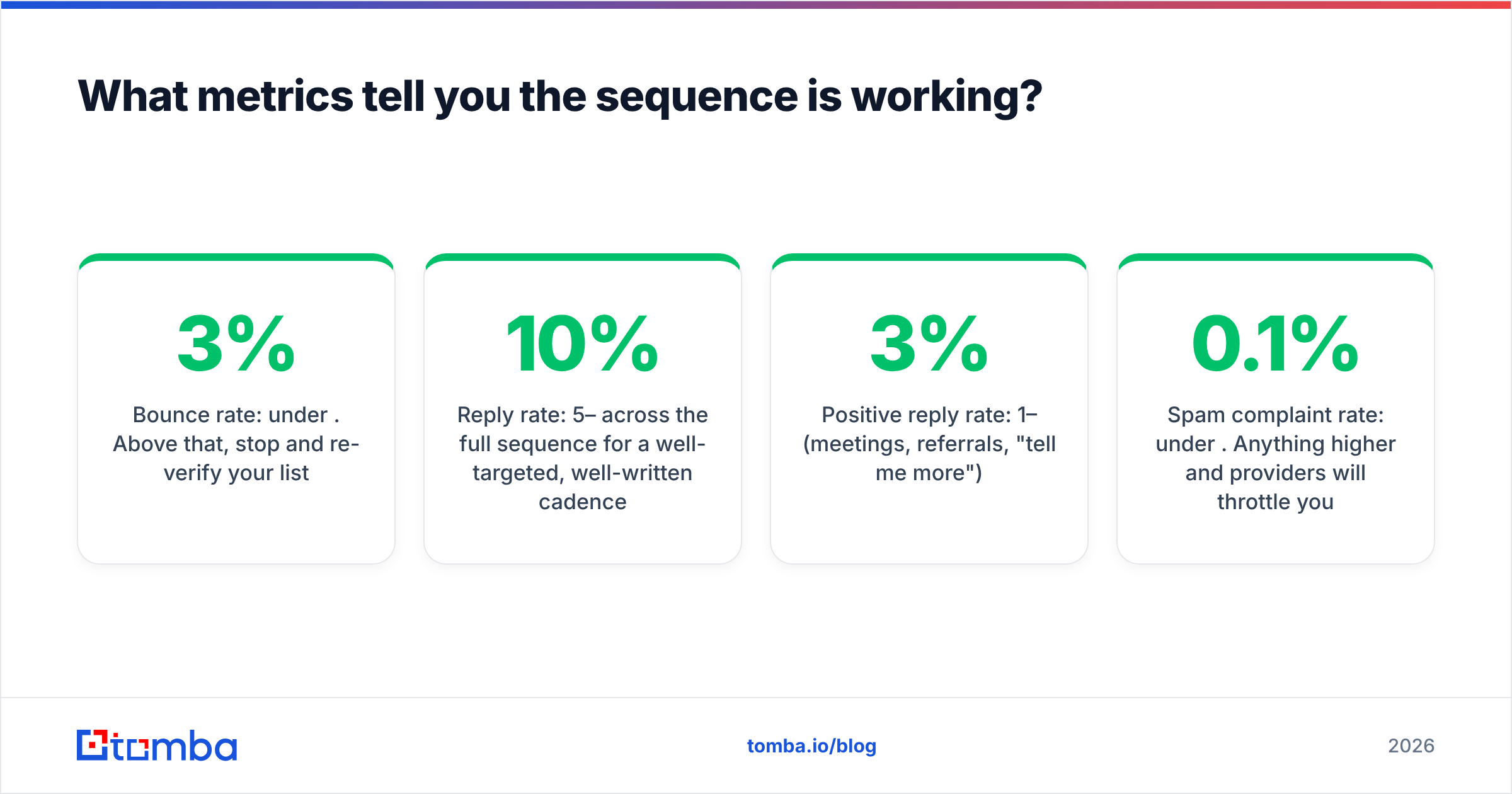
Track reply rate and positive-reply rate above everything else — opens are increasingly unreliable thanks to privacy features that auto-load images. A healthy B2B cold email sequence in 2026 typically lands in these ranges:
- Bounce rate: under 3%. Above that, stop and re-verify your list.
- Reply rate: 5–10% across the full sequence for a well-targeted, well-written cadence.
- Positive reply rate: 1–3% (meetings, referrals, "tell me more").
- Spam complaint rate: under 0.1%. Anything higher and providers will throttle you.
If your bounce rate is high, the problem is your data, not your copy. If your open rate is fine but replies are flat, the problem is your offer or your ask. Diagnosing which lever to pull saves you from rewriting emails that were never the issue. For more on how addresses are sourced and kept accurate, see where Tomba gets its data.
Common mistakes that kill a cold email sequence#
- Giving up after one or two touches. Most replies arrive at touch 3 or later. Quitting early wastes the work you already did.
- Sending identical follow-ups. "Bumping this up" with no new value teaches the prospect to ignore you.
- Skipping verification. Every bounce is a hit to your sender reputation that affects all future sends.
- Asking for too much, too soon. "Book a 30-minute demo" in email one is a big ask for a stranger. Start with a question.
- Ignoring deliverability basics. Without proper email deliverability setup — SPF, DKIM, warmup — even perfect emails land in spam.
Build your sequence on accurate data#
A great B2B cold email sequence is two things working together: a disciplined cadence with fresh angles at every step, and a clean, verified contact list underneath it. Nail the copy and the timing, but remember that none of it matters if your emails bounce before they're read.
Start with the foundation. Use the Tomba Email Finder to source verified professional email addresses by name, company, or domain, so every touch in your sequence reaches a real inbox. Pair it with verification, plug it into your outreach tool, and let your follow-ups do what a single cold email never could — book the meeting. Check Tomba pricing to start free with 25 searches a month and scale as your outbound grows.
// get started
Find, verify and enrich your first contacts today
Start on the free plan with 25 searches a month, then scale when your team is ready.
Free plan · No credit card required · GDPR & CCPA
// about the author