B2B Cold Email Subject Lines That Get Opened in 2026
The subject line decides whether your cold email gets read or trashed. Here are the formulas, data, and 40+ examples that drive opens in 2026.
B2B Cold Email Subject Lines That Get Opened in 2026
Your prospect sees a sender name and a subject line. That is the entire decision. Body copy you spent an hour polishing never gets a vote if the subject line loses the first half-second. This guide breaks down what actually moves open rates on cold outreach in 2026 — with formulas, data, and examples you can paste into your next sequence.
TL;DR#
- Short wins. Subject lines of 1–5 words and 30–50 characters consistently out-open clever long ones on mobile, where most B2B email is now triaged.
- Relevance beats curiosity. A specific reference to the prospect's company, role, or trigger event outperforms vague "quick question" bait.
- Avoid spam triggers and fake-reply tricks. "RE:" on a first-touch email and words like "free," "guarantee," and "act now" tank deliverability and trust.
- Personalization needs accurate data. A subject line referencing the wrong company or a bounced address is worse than a generic one — verify before you send.
- Test relentlessly. A/B two subject lines per send, track opens by segment, and kill the losers weekly.
What makes a B2B cold email subject line work?#
A cold subject line has one job: earn the open without lying. It is the storefront window, not the sales pitch. If it over-promises, the body disappoints and your reply rate craters even when opens look great.
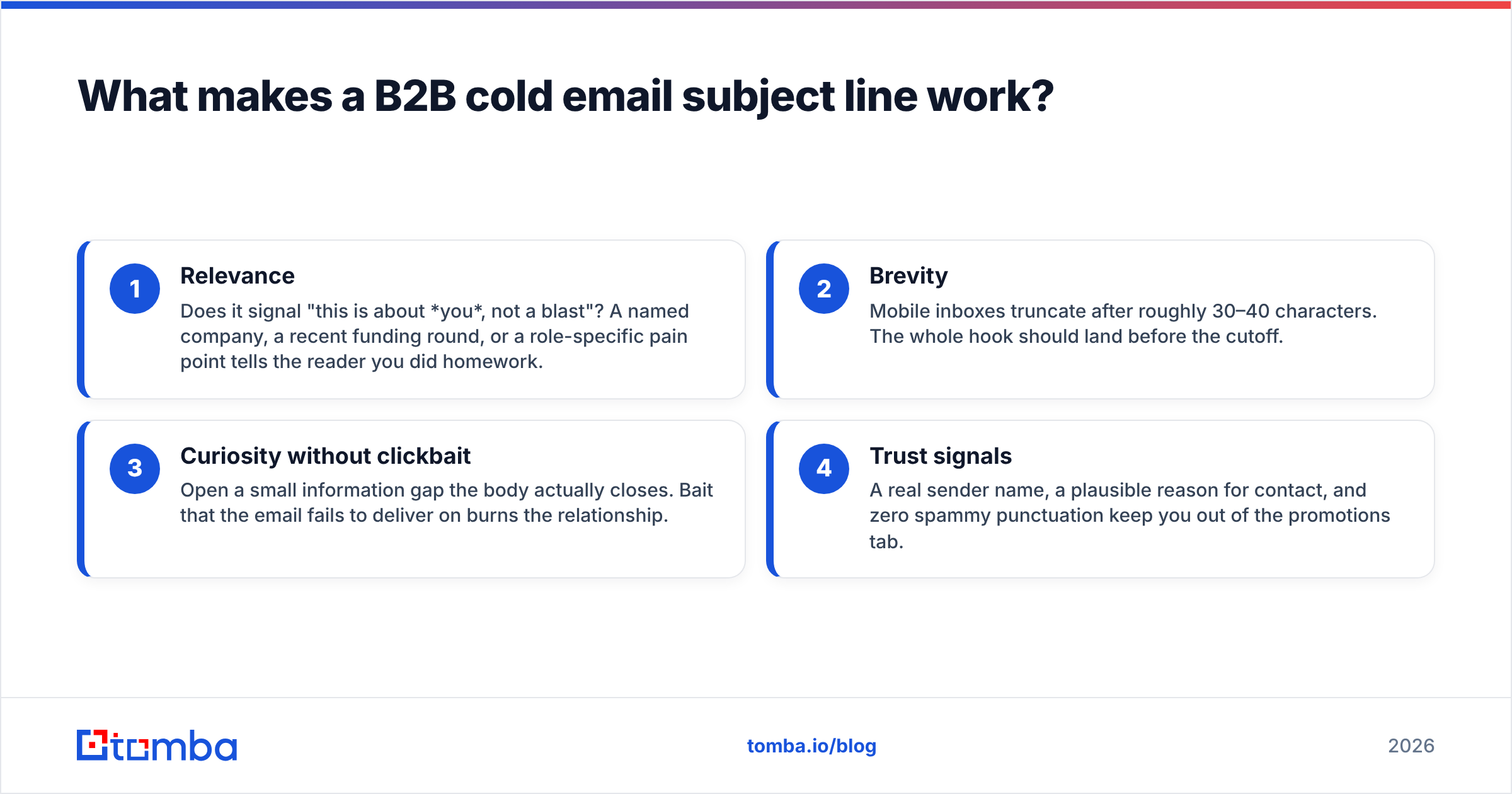
Four levers control whether a B2B subject line earns the click:
- Relevance — Does it signal "this is about you, not a blast"? A named company, a recent funding round, or a role-specific pain point tells the reader you did homework.
- Brevity — Mobile inboxes truncate after roughly 30–40 characters. The whole hook should land before the cutoff.
- Curiosity without clickbait — Open a small information gap the body actually closes. Bait that the email fails to deliver on burns the relationship.
- Trust signals — A real sender name, a plausible reason for contact, and zero spammy punctuation keep you out of the promotions tab.
Get those four right and you have a subject line that does its job. Miss one — usually relevance or brevity — and even a great offer stays unread.
What are the best B2B cold email subject line formulas?#
You do not need to reinvent a subject line for every prospect. Strong cold outreach leans on a handful of repeatable patterns, then fills them with researched specifics. Here are the formulas that reliably perform, with live examples.
- The personalized observation —
{{trigger event}} at {{company}}?→ "New SDR hires at Acme?" Reference something real and recent. - The peer/competitor angle —
How {{competitor}} handles {{problem}}→ "How Notion handles onboarding email" - The direct question —
Quick question about {{specific process}}→ "Question about your RevOps stack" - The mutual-connection bridge —
{{Name}} suggested I reach out→ only if it is true. - The number/result hook —
{{metric}} for {{role}} teams→ "30% fewer bounces for SDR teams" - The pattern-interrupt —
Probably not for you, but…→ low-pressure, high open rate when used sparingly.
The mechanic underneath every formula is the same: a variable you fill with verified, prospect-specific data. That is where most cold campaigns quietly fail — the template is fine, but the merge field is wrong, generic, or attached to an address that never existed. Clean inputs from a reliable email finder and an email verifier are what turn a formula into a reply.
Which subject lines should you avoid?#
Some patterns feel clever in a brainstorm and actively hurt you in the inbox. They either trip spam filters or burn trust the moment the email opens.
| Subject line pattern | Why it fails | Better alternative |
|---|---|---|
RE: our conversation (no prior contact) |
Deceptive; erodes trust and can violate sending policies | Question about {{project}} |
FREE strategy session!!! |
Classic spam trigger words + punctuation | Idea for {{team}}'s pipeline |
You won't BELIEVE this |
Clickbait; high opens, near-zero replies | {{specific result}} for {{role}} |
Touching base / Just checking in |
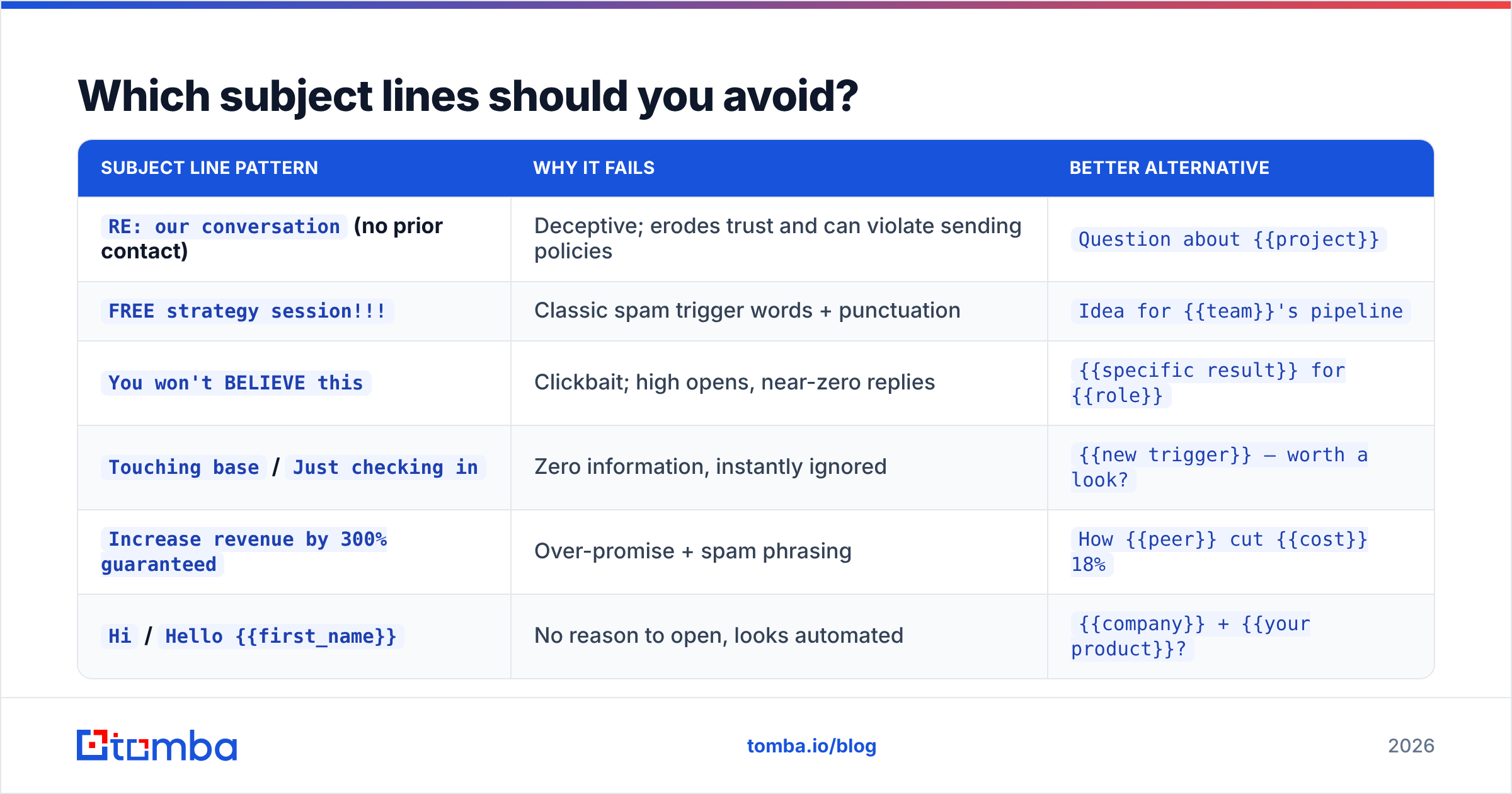
Zero information, instantly ignored | {{new trigger}} — worth a look? |
| Increase revenue by 300% guaranteed | Over-promise + spam phrasing | How {{peer}} cut {{cost}} 18% |
| Hi / Hello {{first_name}} | No reason to open, looks automated | {{company}} + {{your product}}? |
The "RE:" trick deserves a special callout. Faking a reply thread to manufacture familiarity is one of the fastest ways to get marked as spam and damage your sender reputation. Once your domain reputation drops, even your good subject lines land in the junk folder. According to HubSpot's research on email open rates, trust and relevance — not gimmicks — are what sustain engagement over a full sequence.
How long should a cold email subject line be?#
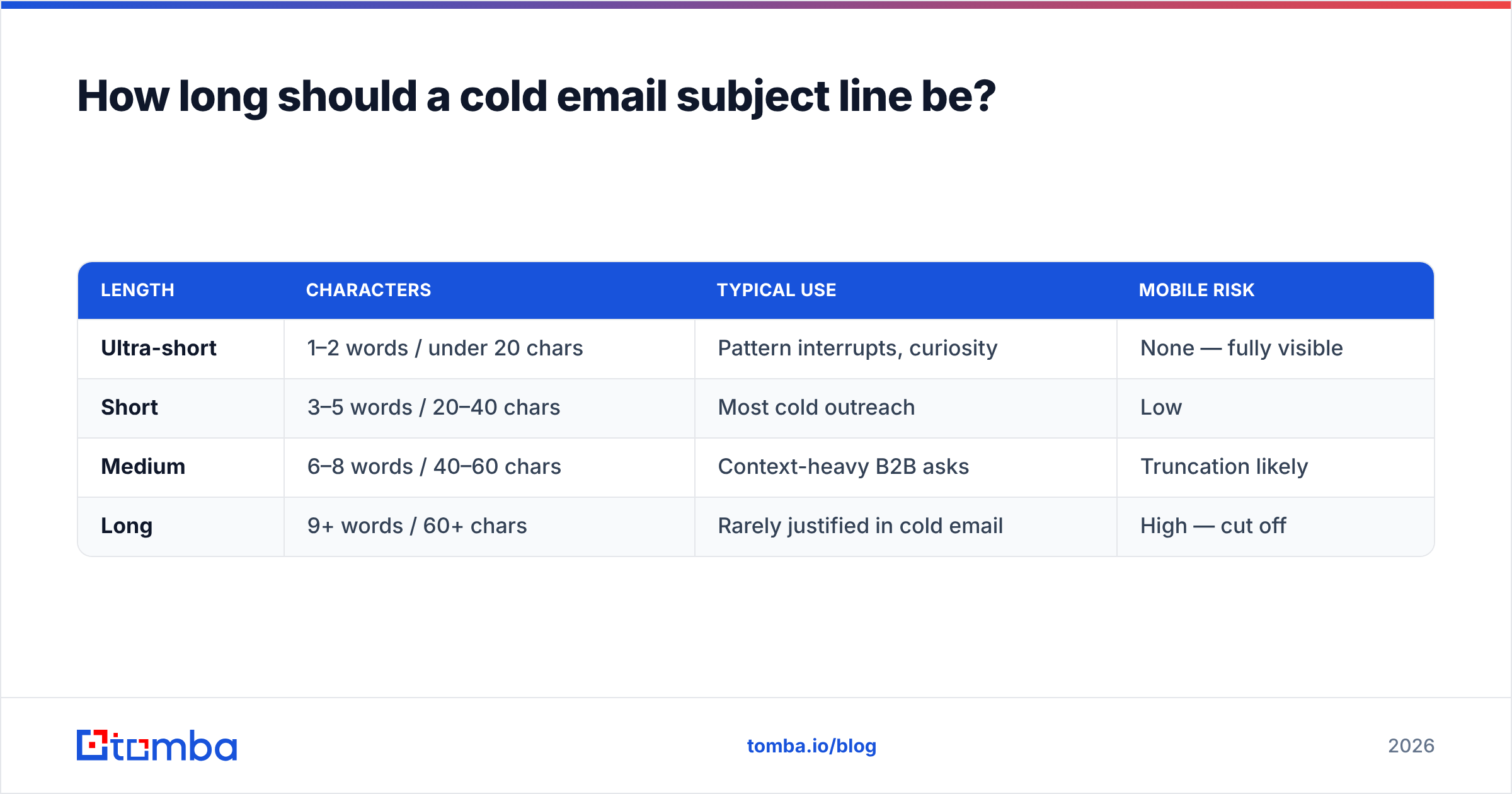
Keep it to 30–50 characters, or roughly 1–6 words. That is the band where the full line renders on a phone before truncation.
Think of the subject line like a highway billboard. A driver at 70 mph reads maybe six words. Your prospect skimming an inbox on the train gives you about the same. A 12-word subject line is a billboard with a paragraph on it — technically readable, functionally invisible.
Here is how length tends to play out across formats:
| Length | Characters | Typical use | Mobile risk |
|---|---|---|---|
| Ultra-short | 1–2 words / under 20 chars | Pattern interrupts, curiosity | None — fully visible |
| Short | 3–5 words / 20–40 chars | Most cold outreach | Low |
| Medium | 6–8 words / 40–60 chars | Context-heavy B2B asks | Truncation likely |
| Long | 9+ words / 60+ chars | Rarely justified in cold email | High — cut off |
Default to short. Reserve medium length for when the extra context genuinely raises relevance — for example, naming both the prospect's company and a specific initiative. Never go long on a first touch.
How do you personalize subject lines at scale?#
Personalization is the single biggest open-rate multiplier in B2B cold email — and the hardest to do without breaking your sequence. The trick is to personalize the variable, not rewrite the template.
A workable system looks like this:
- Tier 1 (high-value accounts): Manually researched subject lines referencing a specific trigger — a new exec hire, a product launch, a funding round.
- Tier 2 (segmented lists): Templated subject lines with one verified merge field, like company name or industry.
- Tier 3 (broad outbound): Formula-based lines with a single dynamic token, tested in volume.
Every tier depends on the same foundation: accurate contact data. A subject line that says "Question about Acme's hiring" is brilliant — unless the contact left Acme six months ago, or the email bounces. That is why your data layer and your copy layer are inseparable. Pull verified contacts with domain search and enrich them with role and company fields via data enrichment so your merge fields are never wrong. When you send to a verified, deliverable list, your clever subject line actually reaches a human instead of a dead mailbox.
For trigger-based personalization, tools like G2's buyer intent data can surface which accounts are actively researching your category — turning a generic "quick question" into a timely, relevant hook.
What are 15 cold email subject lines you can steal?#
These are ready to adapt. Swap the bracketed fields for verified, prospect-specific data.
Question about {{company}}'s outbound{{first_name}}, idea for your SDR teamSaw the {{role}} opening at {{company}}How {{peer company}} cut bounce rate 22%Worth 10 minutes, {{first_name}}?{{company}} + {{your tool}}Probably not for you, but…Your {{recent post}} on LinkedInQuick question re: {{specific process}}{{metric}} for {{industry}} teamsNoticed {{trigger event}}{{mutual contact}} mentioned youCutting {{cost}} at {{company}}One idea for Q3 pipelineIs {{pain point}} on your radar?
Notice none of them shout. They read like a note from a colleague who did a little research — which is exactly the impression a cold subject line should leave.
How do you A/B test cold email subject lines?#
Test one variable at a time, send to statistically meaningful segments, and let the data — not your taste — pick the winner.
A clean testing loop:
- Pick one variable — length, personalization token, or question vs. statement. Changing two at once makes the result unreadable.
- Split evenly — send variant A and variant B to randomized halves of the same segment, ideally 200+ contacts each for a stable read.
- Measure opens and replies — a subject line can win on opens and lose on replies if it over-promises. Reply rate is the metric that pays.
- Send at the same time — timing skews opens; control for it.
- Roll the winner forward — promote the winning line, then test it against a fresh challenger next week.
Track results by segment, because a subject line that crushes it with founders may flop with procurement. Over a quarter, this loop compounds: each week's winner becomes the new baseline to beat. If you want a deeper framework on outbound metrics, our guide to email response rate breaks down what "good" looks like by industry.
Do subject lines affect deliverability?#
Yes — directly. Spam filters read your subject line, and certain patterns are weighted heavily toward the junk folder regardless of how clean your copy is.
The high-risk patterns to avoid:
- All caps anywhere in the line ("LIMITED TIME")
- Excessive punctuation ("Act now!!!")
- Money/urgency words ("free," "guarantee," "cash," "urgent")
- Misleading "RE:" or "FWD:" on first contact
- Emoji overload in B2B contexts (one is fine; three reads as marketing blast)
But the subject line is only half the deliverability equation. The other half is who you send to. A list full of invalid or catch-all addresses generates bounces, and high bounce rates tell mailbox providers you are a spammer — at which point your perfect subject lines stop mattering. Maintaining strong email deliverability starts with a verified list, then layers good copy on top.
Subject lines vs. preview text: which matters more?#
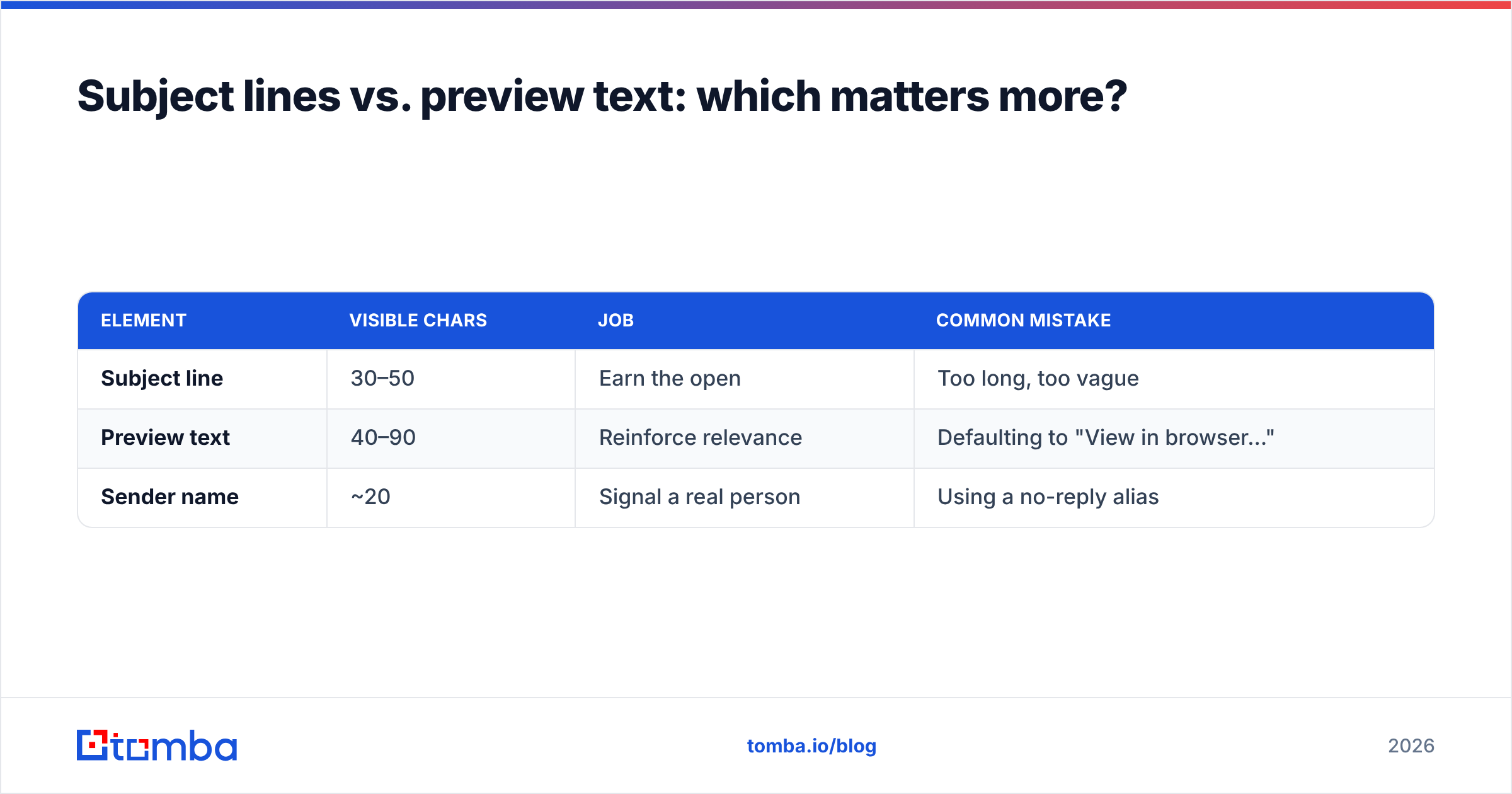
Both, working together. The subject line earns the open; the preview text (the gray snippet next to or below it) extends the hook and removes the last doubt.
| Element | Visible chars | Job | Common mistake |
|---|---|---|---|
| Subject line | 30–50 | Earn the open | Too long, too vague |
| Preview text | 40–90 | Reinforce relevance | Defaulting to "View in browser…" |
| Sender name | ~20 | Signal a real person | Using a no-reply alias |
Most cold senders ignore preview text entirely and let the email client pull the first line of the body — often a greeting or an image alt-tag. That wastes prime real estate. Write the first sentence of your body so it doubles as a compelling preview, or set the preview text explicitly in your sending tool. Sender name, subject, and preview are a three-part headline; tune all three.
How does data quality change your subject line strategy?#
Your subject line is only as good as the data behind the merge field. This is the point most "subject line hack" listicles skip, and it is the one that separates a 40% open rate from a 12% one.
Consider the difference. "Question about your work at {{company}}" is a fine subject line. But:
- If
{{company}}is blank because enrichment failed, the prospect sees a broken{{company}}literal — instant delete. - If the contact changed jobs, you reference the wrong employer and look careless.
- If the email is invalid, the subject line never gets seen at all.
Accurate, current, verified contact data is the silent prerequisite for every personalization tactic in this guide. That means finding the right person, confirming the address is live, and enriching the record with the fields your templates reference. You can do all three before a single email sends — and you should, because the cost of a bad merge field is not a wasted send, it is a damaged first impression you rarely get to redo.
Final takeaway and next step#
Great B2B cold email subject lines are short, specific, honest, and built on accurate data. Master the formulas above, avoid the spam-trap patterns, test one variable at a time, and never let a clever line sit on top of a dirty list.
The cheapest improvement most teams can make today is upstream of the copy: get the contact and the address right. Start with the Tomba Email Finder to source verified, deliverable B2B contacts by name, company, or domain — so every {{company}} and {{first_name}} in your subject line is correct, current, and lands in a real inbox. The free tier gives you 25 searches a month to test it, and paid plans start at $49/mo when you scale. Write the line, but verify the data first — that order is what gets you opened.
// get started
Find, verify and enrich your first contacts today
Start on the free plan with 25 searches a month, then scale when your team is ready.
Free plan · No credit card required · GDPR & CCPA
// about the author