B2B Cold Emails in 2026: The Playbook That Books Meetings
Most B2B cold emails get ignored. This 2026 playbook breaks down targeting, copy, deliverability, and follow-ups so your emails actually book meetings.
B2B cold emails still work in 2026 — but only if you treat them like a precision instrument, not a megaphone. The reps who win aren't sending more email. They're sending fewer, sharper messages to verified contacts who actually fit. This playbook shows you how to do exactly that.
TL;DR#
- Targeting beats volume. A list of 200 verified, well-matched prospects outperforms 5,000 scraped addresses every time.
- Deliverability is half the battle. Authentication, warmup, and clean lists decide whether your email reaches the inbox or the spam folder.
- Short, specific copy wins. Sub-120-word emails with one clear ask and a relevant trigger beat long pitches.
- Follow-ups carry the campaign. Most replies arrive on emails two through four, not the first send.
- Verified data is the foundation. Start with accurate emails from a tool like the Tomba Email Finder so the rest of your effort isn't wasted.
What are B2B cold emails, really?#
A B2B cold email is an unsolicited but relevant business message sent to a prospect you have not spoken with before, with the goal of starting a conversation — usually a demo, a call, or a reply. The word that matters most there is relevant. Cold does not mean random.
Think of it like knocking on the right door instead of every door on the street. A spray-and-pray blast treats every contact as identical. A modern B2B cold email assumes the recipient is a busy human who will give you about three seconds to prove you've done your homework.
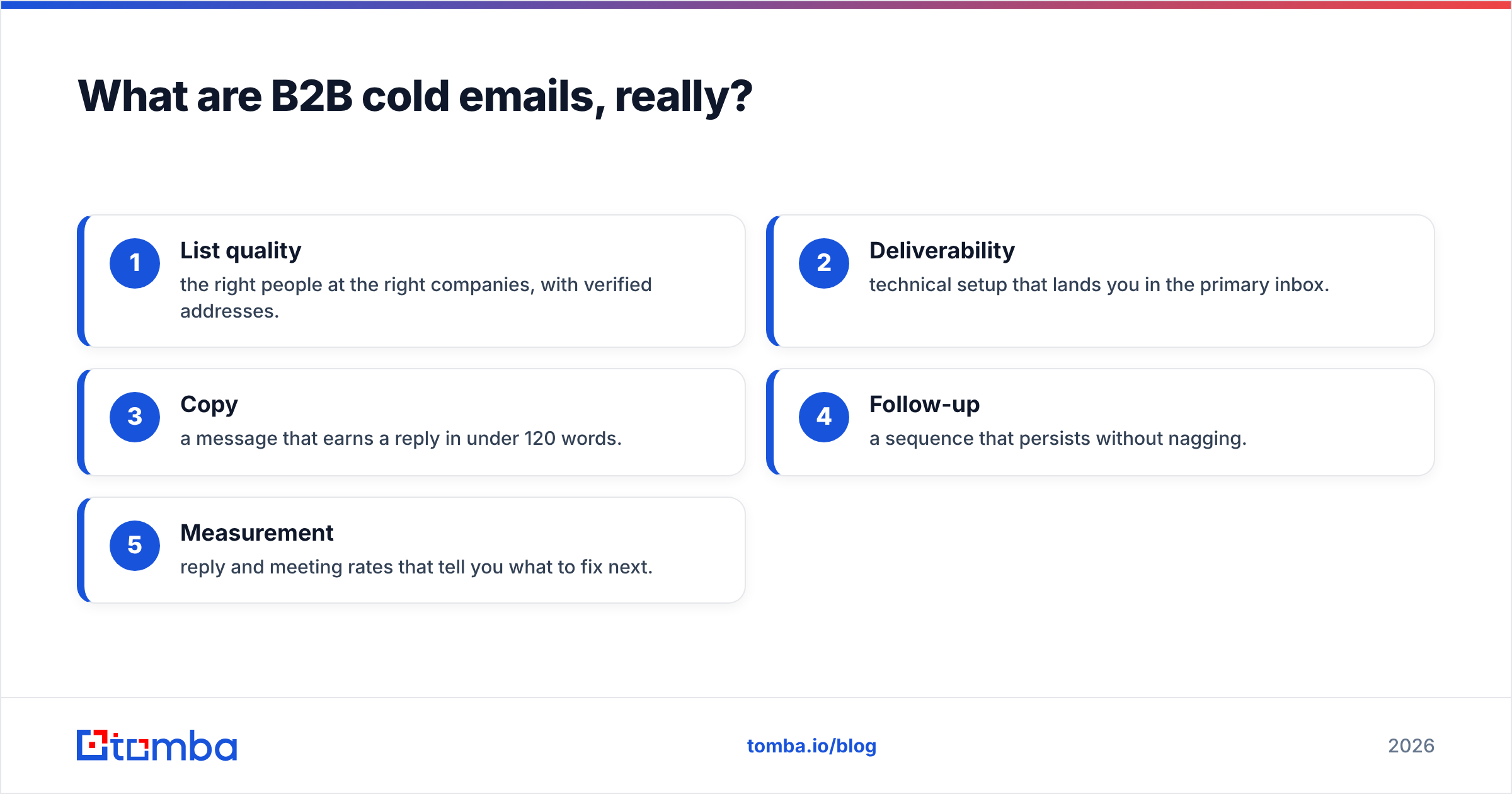
The mechanics break down into five layers, and weakness in any one of them sinks the whole campaign:
- List quality — the right people at the right companies, with verified addresses.
- Deliverability — technical setup that lands you in the primary inbox.
- Copy — a message that earns a reply in under 120 words.
- Follow-up — a sequence that persists without nagging.
- Measurement — reply and meeting rates that tell you what to fix next.
Do B2B cold emails still work in 2026?#
Yes — and the gap between good and bad senders has only widened. Inbox providers now lean heavily on engagement signals, so low-relevance blasts get filtered faster than ever, while targeted outreach to the right buyer still books meetings reliably.
The 2024-to-2026 shift is simple: bulk sending got punished, precision got rewarded. Google and Yahoo's bulk-sender requirements, rolled out in 2024 and tightened since, made authentication and low spam complaint rates non-negotiable. You can read the current expectations in Google's Email sender guidelines. The senders who adapted are doing better than ever. The ones still buying scraped lists are quietly disappearing from inboxes.
Here's the practical takeaway: the volume game is dead, but the relevance game is wide open.
What makes a B2B cold email actually get replies?#
Replies come from the intersection of right person, right reason, and right moment. Miss any of the three and even perfect copy falls flat.
Use this quick framework when you draft:
- Relevance — Does the first line prove you know their world? Reference a role, a recent hire, a tech-stack signal, or a company event.
- Brevity — Can they read it on a phone without scrolling? Aim for 50–120 words.
- One ask — Every email should make exactly one request. Two asks halve your reply rate.
- Low friction — "Worth a quick look?" converts better than "Can we book 30 minutes Tuesday at 2pm ET?"
- Credibility — One specific, quantified proof point beats three vague claims.
- Human tone — Write like a person emailing a peer, not a brand running a campaign.
A workable structure looks like this: one-line personalized opener, one or two lines on the problem you solve, one line of proof, one soft call to action. That's it. The discipline of cutting is what separates a 1% reply rate from a 10% one. If you need a starting point, browse a few cold email templates and then rewrite them in your own voice — never send a template verbatim.
How do you build a targeted B2B prospect list?#
Start with a tight ideal customer profile, then find verified contacts who match it — in that order. Most failed campaigns invert this: they grab a giant list first and try to force a fit afterward.
Your workflow should look like:
- Define the ICP. Industry, company size, region, and the specific role that owns the problem you solve.
- Source the companies. Use intent signals, hiring activity, tech-stack data, or your existing closed-won patterns.
- Find the people. Identify the decision-maker and one influencer per account.
- Get verified emails. Use domain search to pull addresses across a target company, then confirm each one.
- Verify before sending. Run every address through an email verifier to strip invalids and protect your sender reputation.
That last step is where most reps cut corners and pay for it. Sending to dead addresses spikes your bounce rate, and a high bounce rate tells inbox providers you're a careless sender. Clean lists aren't a nice-to-have — they're a deliverability requirement.
Targeted outreach vs. spray-and-pray: which wins?#
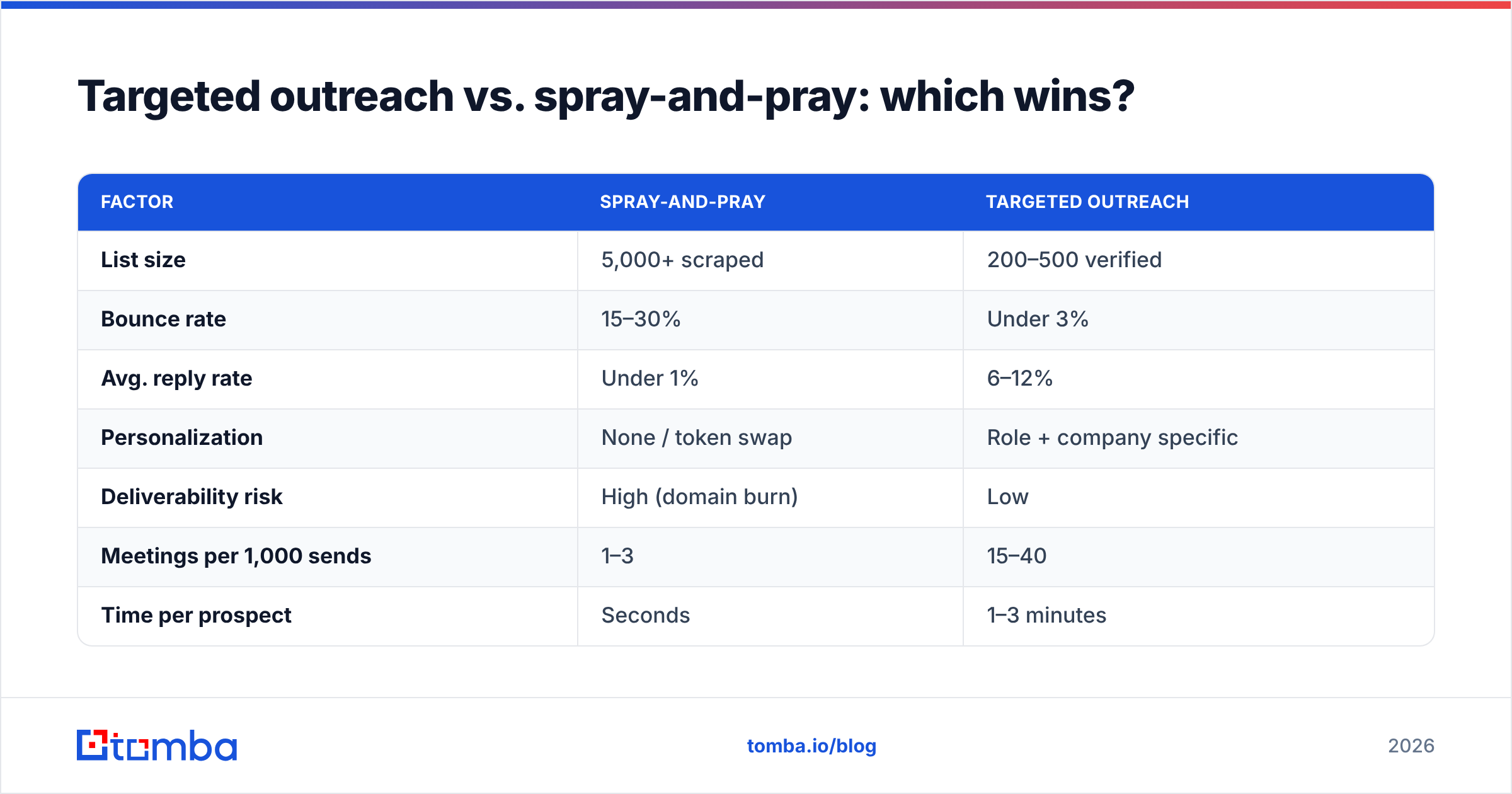
Targeted outreach wins on every metric that matters — reply rate, meetings booked, and sender reputation. The only thing spray-and-pray wins is raw send count, which is a vanity number.
| Factor | Spray-and-Pray | Targeted Outreach |
|---|---|---|
| List size | 5,000+ scraped | 200–500 verified |
| Bounce rate | 15–30% | Under 3% |
| Avg. reply rate | Under 1% | 6–12% |
| Personalization | None / token swap | Role + company specific |
| Deliverability risk | High (domain burn) | Low |
| Meetings per 1,000 sends | 1–3 | 15–40 |
| Time per prospect | Seconds | 1–3 minutes |
| Long-term outcome | Domain blacklisted | Compounding pipeline |
The math is counterintuitive but consistent: fewer, better emails produce more meetings and protect the asset (your domain) that lets you keep sending. Quality compounds; volume burns out.
How do you keep B2B cold emails out of spam?#
Deliverability is mostly technical hygiene, and the good news is that it's a checklist you can finish once and maintain. The bad news is that skipping it makes everything else pointless — the best copy in the world earns zero replies from the spam folder.
Cover these fundamentals:
- Authenticate your domain. Set up SPF, DKIM, and DMARC. These are now table stakes for any bulk sender.
- Warm up new domains and inboxes. Ramp sending volume gradually over 3–6 weeks instead of blasting from day one.
- Use a separate sending domain. Protect your primary brand domain by sending cold outreach from a dedicated lookalike domain.
- Keep lists clean. Verify addresses and remove non-responders to keep email deliverability high.
- Monitor reputation. Watch spam complaints and bounce rates; Google's free Postmaster Tools shows you exactly how Gmail sees your domain.
- Cap daily volume per inbox. Stay in the tens-per-inbox range and scale with more inboxes, not bigger blasts.
Treat deliverability like brushing your teeth: boring, daily, and catastrophic to ignore. The reps who never think about the spam folder are usually the ones living in it.

What does a high-performing follow-up sequence look like?#
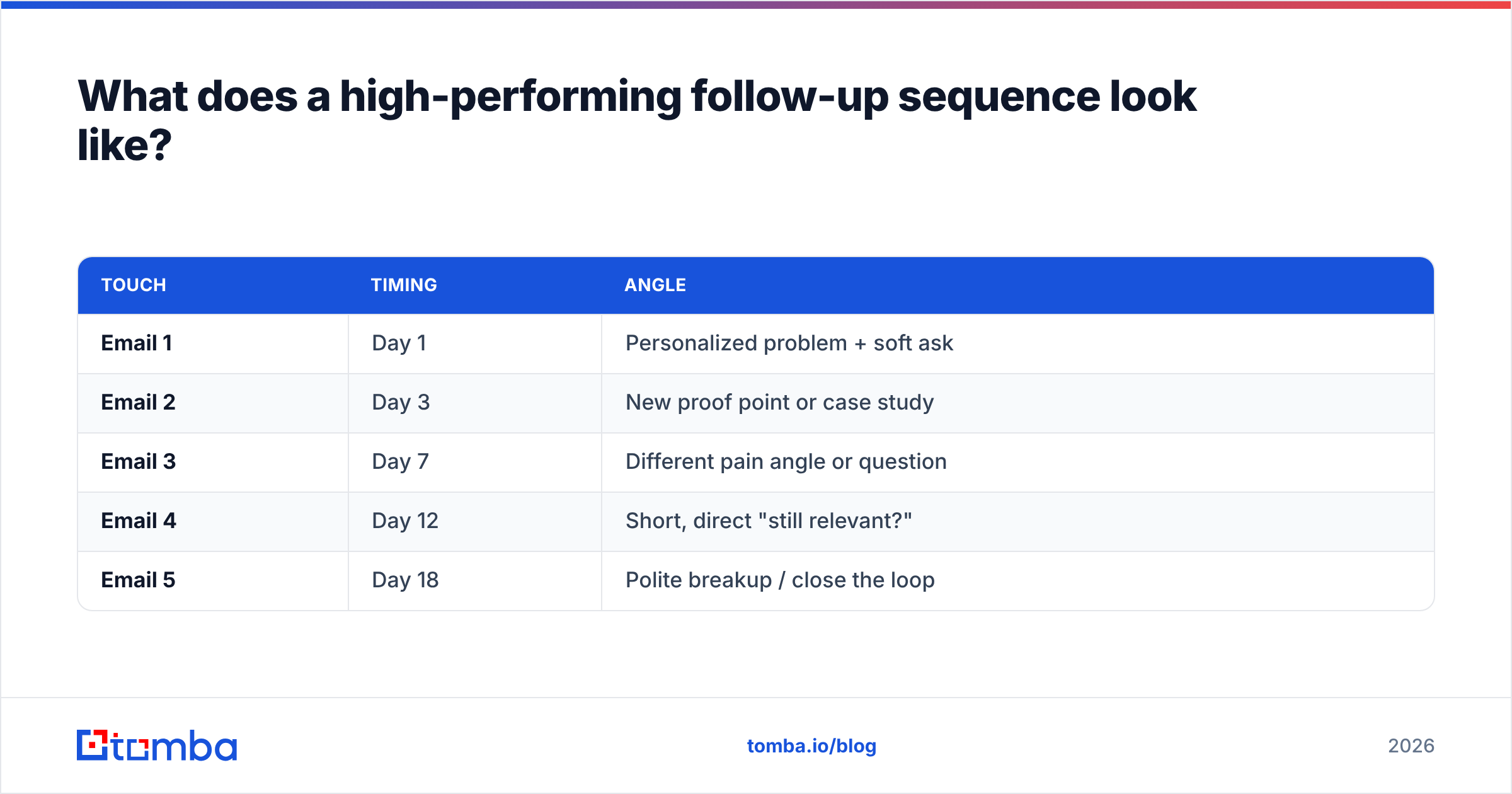
Most replies come from follow-ups, not the first email — so a single send is a campaign you've abandoned at 20% complete. A good sequence is persistent, spaced out, and adds a new angle each time instead of repeating "just bumping this."
A reliable four-to-five touch cadence:
| Touch | Timing | Angle |
|---|---|---|
| Email 1 | Day 1 | Personalized problem + soft ask |
| Email 2 | Day 3 | New proof point or case study |
| Email 3 | Day 7 | Different pain angle or question |
| Email 4 | Day 12 | Short, direct "still relevant?" |
| Email 5 | Day 18 | Polite breakup / close the loop |
Two rules make this work. First, every follow-up should add value or a new angle — never just guilt the recipient for not replying. Second, keep each message shorter than the last. By the breakup email, you should be down to two sentences.
Track your response rate across the sequence so you know which touch is doing the heavy lifting. Most teams discover that emails two and three carry the campaign, which is exactly why stopping at email one leaves most of your pipeline on the table.
How do you measure and improve B2B cold email performance?#
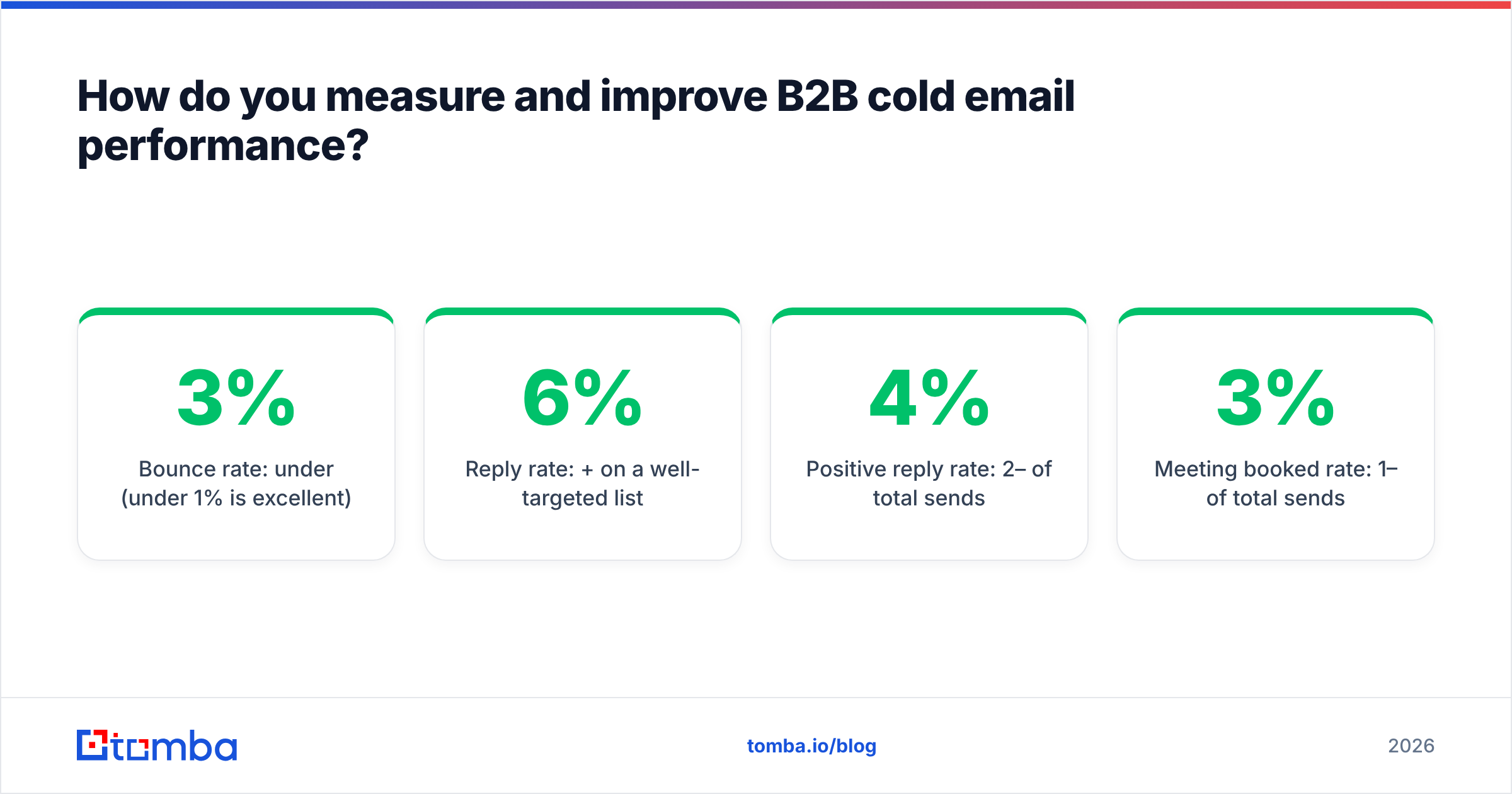
Track reply rate and meetings booked above everything else — open rate is increasingly unreliable thanks to privacy features that auto-fire opens. Vanity metrics feel good; reply and meeting rates pay the bills.
Benchmarks worth aiming for in 2026:
- Bounce rate: under 3% (under 1% is excellent)
- Reply rate: 6%+ on a well-targeted list
- Positive reply rate: 2–4% of total sends
- Meeting booked rate: 1–3% of total sends
Improve by changing one variable at a time. Test a new subject line for a week, hold everything else constant, and read the reply rate. Then test the opener. Then the call to action. Resist the urge to overhaul everything at once — you'll never know what actually moved the number.
If your replies are low across the board, the problem is almost always upstream: the list, not the copy. No subject line can save an email sent to the wrong person. That's why verified, well-matched data is the highest-leverage fix in the entire funnel — and why it deserves the most attention before you obsess over wording.
What tools do you need to run B2B cold emails at scale?#
You need four building blocks: a data source, a verifier, a sending platform, and an analytics view. Some platforms bundle these; the data layer is the one you should never compromise on.
- Email finder — to source verified addresses for your ICP. The Tomba Email Finder finds professional emails by name, domain, or company.
- Email verifier — to scrub your list before every send and keep bounces near zero.
- Sending + sequencing platform — to automate cadence and follow-ups.
- Reputation monitoring — Postmaster Tools or equivalent, plus your platform's deliverability reports.
When you're comparing platforms, check independent reviews on G2 rather than vendor marketing pages, and pay attention to data accuracy and bounce complaints specifically — those are the categories that quietly kill campaigns. For pricing transparency, you can compare options directly; Tomba's plans are listed on the Tomba pricing page, starting with a free tier of 25 searches per month and a Starter plan at $49/mo.
Common B2B cold email mistakes to avoid#
Even experienced teams trip over the same patterns. Run through this list before your next campaign:
- Sending unverified lists. Every bounce damages your reputation. Verify first, always.
- Writing for yourself, not the buyer. "We're excited to introduce" is about you. Lead with their problem.
- Asking for too much, too soon. A 30-minute demo request to a stranger is a big ask. Start smaller.
- One-and-done sends. No sequence means you're leaving the majority of replies uncollected.
- Ignoring mobile. Most cold emails are read on phones. If it doesn't render cleanly there, it's gone.
- Personalization theater. Inserting
{{first_name}}isn't personalization. A relevant first line is.
The bottom line#
B2B cold emails in 2026 reward precision and punish laziness. The formula isn't complicated: target tightly, verify your data, write short and specific, follow up with intent, and protect your deliverability. Do those five things and cold email remains one of the highest-ROI channels in B2B sales.
Everything starts with accurate contact data — because the sharpest copy and the cleanest follow-up sequence are worthless if the email never reaches a real person. Start by building a verified, well-matched prospect list with the Tomba Email Finder. Find the right decision-makers by name, domain, or company, verify them before you send, and give your campaign the one foundation it can't succeed without. Try it on the free tier and see how much your reply rate climbs when every email lands where it should.
// get started
Find, verify and enrich your first contacts today
Start on the free plan with 25 searches a month, then scale when your team is ready.
Free plan · No credit card required · GDPR & CCPA
// about the author