The B2B Conversion Funnel in 2026: Stages, Metrics & Fixes
Most B2B funnels leak revenue at every stage. Here's how the B2B conversion funnel actually works in 2026 — the stages, benchmarks, and the fixes that move the needle.
TL;DR
- A B2B conversion funnel maps how a stranger becomes a paying account across distinct stages — awareness, lead, MQL, SQL, opportunity, and closed-won — each with its own conversion rate.
- Median B2B visitor-to-lead conversion sits near 2-3%, and lead-to-close lands around 1-2%. If you don't know your stage-by-stage numbers, you're guessing.
- The biggest leaks are rarely "more traffic" problems. They're bad contact data, weak MQL-to-SQL handoffs, and slow follow-up.
- Clean, verified contact data at the top of the funnel compounds: better targeting means fewer bounced sends, higher reply rates, and more qualified opportunities downstream.
- This guide breaks down each stage, the benchmarks to measure against, and concrete fixes — including how accurate data from a tool like the email finder tightens the whole machine.
What is a B2B conversion funnel?#
A B2B conversion funnel is the staged path a buyer travels from first hearing about you to signing a contract. Think of it like a water slide with several gates: a crowd lines up at the top, but only a fraction makes it through each gate to the splash pool at the bottom. Your job is to widen the gates that matter and patch the leaks between them.
The B2B version differs from B2C in three ways. Deals involve buying committees (6-10 people on average), sales cycles stretch across weeks or months, and the purchase is rational and ROI-driven rather than impulse. That means your funnel has more stages, more handoffs between marketing and sales, and far more places for momentum to stall.
Most teams draw the funnel as a single tidy triangle. In reality it's closer to a relay race. Marketing runs the first leg (awareness to lead), then hands the baton to an SDR (lead to qualified), who hands it to an account executive (opportunity to close). Drop the baton at any exchange and the runner behind you is sprinting toward nobody.
What are the stages of the B2B conversion funnel?#
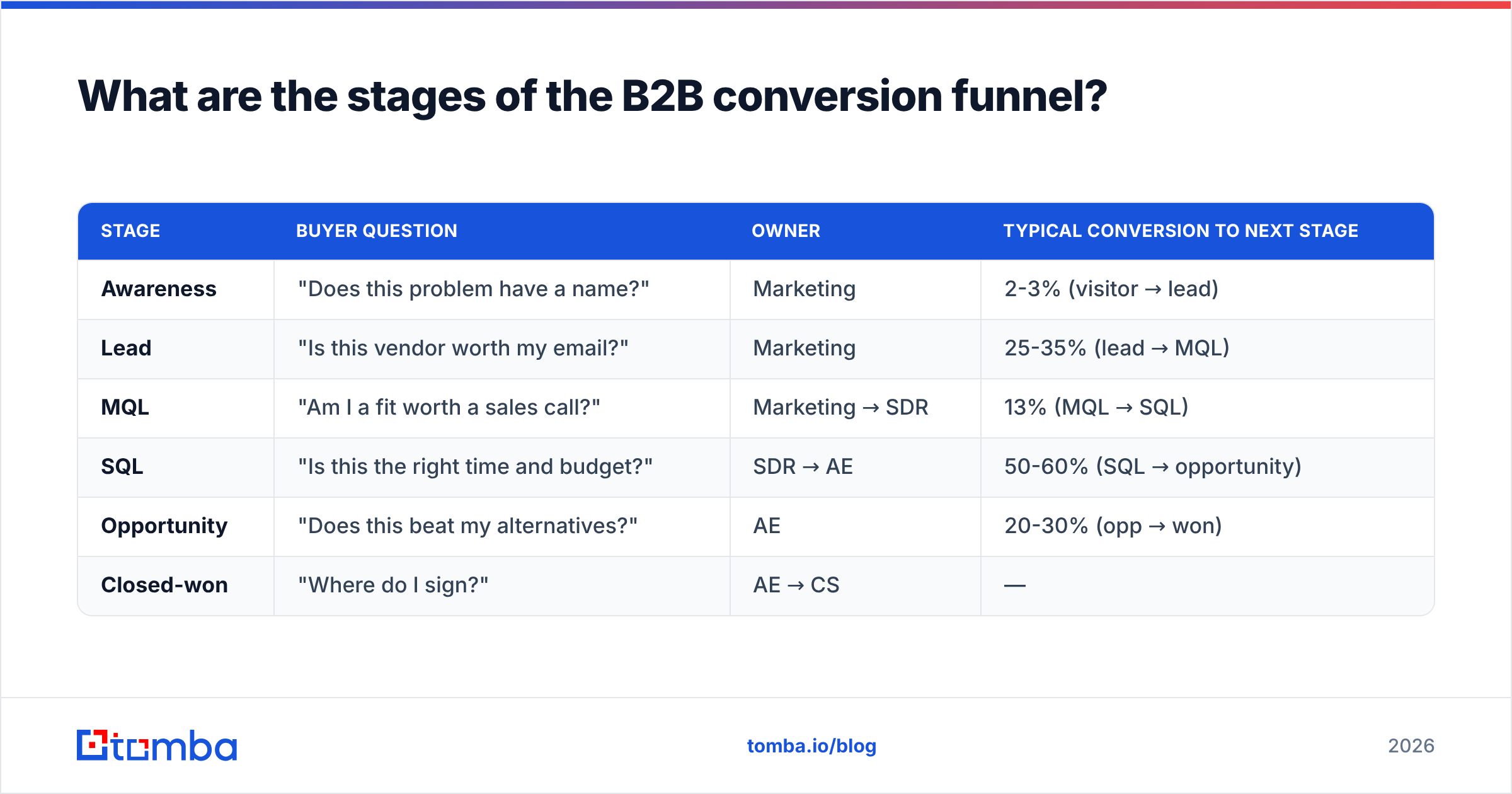
Here's the standard six-stage model, the question each stage answers, and the team that owns it.
| Stage | Buyer question | Owner | Typical conversion to next stage |
|---|---|---|---|
| Awareness | "Does this problem have a name?" | Marketing | 2-3% (visitor → lead) |
| Lead | "Is this vendor worth my email?" | Marketing | 25-35% (lead → MQL) |
| MQL | "Am I a fit worth a sales call?" | Marketing → SDR | 13% (MQL → SQL) |
| SQL | "Is this the right time and budget?" | SDR → AE | 50-60% (SQL → opportunity) |
| Opportunity | "Does this beat my alternatives?" | AE | 20-30% (opp → won) |
| Closed-won | "Where do I sign?" | AE → CS | — |
A few notes on reading this table. The MQL-to-SQL gate is historically the weakest joint in the entire funnel — it's where marketing and sales argue about lead quality, and where a 13% median means seven of every eight "qualified" leads get rejected by sales. The opportunity-to-won rate is your raw win rate, and it's the number your CFO cares about most.

Don't treat these stages as rigid. A product-led growth motion compresses awareness, lead, and MQL into a single self-serve signup. An enterprise ABM motion might add a "buying committee engaged" stage before opportunity. The point isn't to copy the model exactly — it's to define gates you can measure and that your whole team agrees on.
What are good B2B funnel conversion rate benchmarks in 2026?#
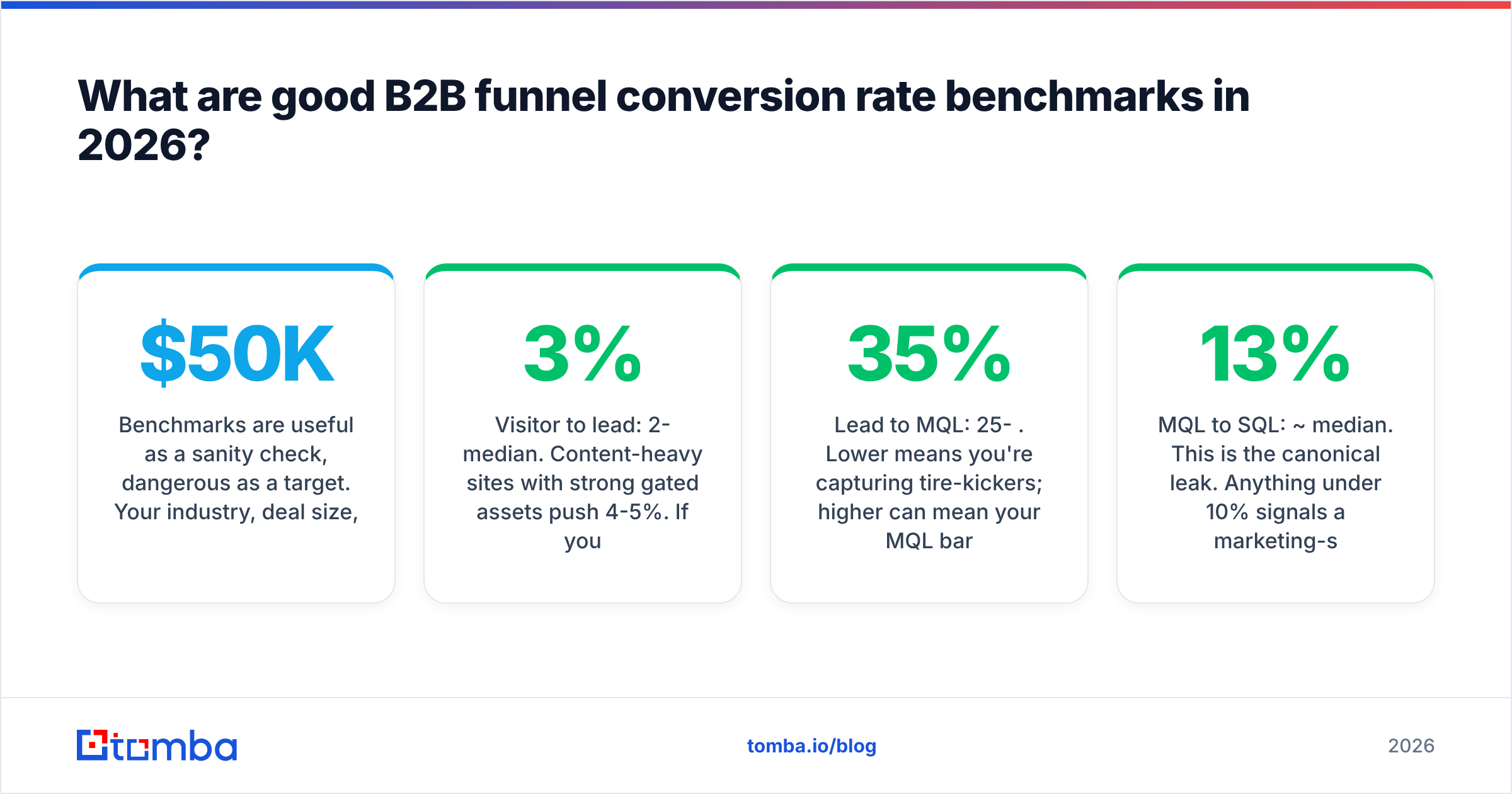
Benchmarks are useful as a sanity check, dangerous as a target. Your industry, deal size, and motion shift these numbers wildly — a $50K enterprise deal converts nothing like a $50/month subscription. Use the ranges below to find which of your stages is abnormally weak, not to declare victory.
- Visitor to lead: 2-3% median. Content-heavy sites with strong gated assets push 4-5%. If you're under 1%, your offer or targeting is off, not your traffic volume.
- Lead to MQL: 25-35%. Lower means you're capturing tire-kickers; higher can mean your MQL bar is too generous.
- MQL to SQL: ~13% median. This is the canonical leak. Anything under 10% signals a marketing-sales alignment problem.
- SQL to opportunity: 50-60%. SDRs should convert most genuinely qualified leads into a real opportunity.
- Opportunity to won: 20-30%. Your win rate. Top performers in competitive categories still rarely clear 35%.
- Overall lead to close: 1-2%. Compounding all the above. This is why top-of-funnel data quality matters so much — a 1% close rate means every wasted lead is expensive.
For external reference points, HubSpot's annual benchmark data and peer-review aggregators like G2 publish category-level conversion data worth comparing against. Just remember: a "good" rate is one trending up against your own baseline.
Where does the B2B conversion funnel leak the most?#
Three leaks account for the majority of lost B2B revenue, and none of them is "not enough traffic."
1. Garbage contact data at the top. If 20% of the emails you collect or source are invalid, you've kneecapped every downstream stage before it starts. Bounced sends hurt your sender reputation, which means even your good emails land in spam. A lead you can't reach is a lead that never converts — and most teams never measure this because the lead "exists" in the CRM.
2. The MQL-to-SQL handoff. Marketing celebrates a lead hitting a score threshold; sales finds out the "VP of Engineering" is an intern who downloaded an ebook. The fix is a shared, written definition of a qualified lead and a tight feedback loop where sales tells marketing why leads got rejected.
3. Slow follow-up. Research consistently shows that response time is the single biggest controllable lever on conversion. Lead a competitor by an hour and you've often already won the first meeting. Most teams respond in days.

Notice that two of the three biggest leaks trace back to data. You can't follow up fast on a contact you can't reach, and you can't qualify an MQL whose details are wrong. Fixing the funnel often starts with fixing the inputs.
How do you fix each stage of the funnel?#
Conclusion first: fix the stage with the worst rate relative to benchmark, not the stage that's easiest to tinker with. Here's a stage-by-stage playbook.
- Awareness → Lead: tighten the offer, not the ad budget. A specific, painful-problem lead magnet beats a generic "subscribe to our newsletter" by 3-5x. Match the offer to search intent and you lift conversion without touching spend.
- Lead → MQL: enrich before you score. A raw email tells you nothing. Append firmographics — company size, industry, role — so your scoring model is working with real signal. Tools like data enrichment turn a bare email into a scoreable profile.
- MQL → SQL: write the SLA. Marketing commits to a lead definition; sales commits to working every lead within X hours and logging a disposition. This single agreement fixes more funnels than any martech purchase.
- SQL → Opportunity: multi-thread early. With 6-10 buyers per deal, an SDR talking to one champion is fragile. Use a domain search to map the rest of the buying committee and reach them before the deal stalls.
- Opportunity → Won: kill it faster or close it faster. Stalled opportunities are a tax on your forecast. Tight next-step discipline and honest disqualification raise win rate by improving the denominator.
The thread running through every fix is reachability. You can have a perfect scoring model and a disciplined SLA, but if you can't actually contact the right person, the funnel still leaks. That's why verified contact data is foundational, not optional.
How does contact data quality change funnel math?#
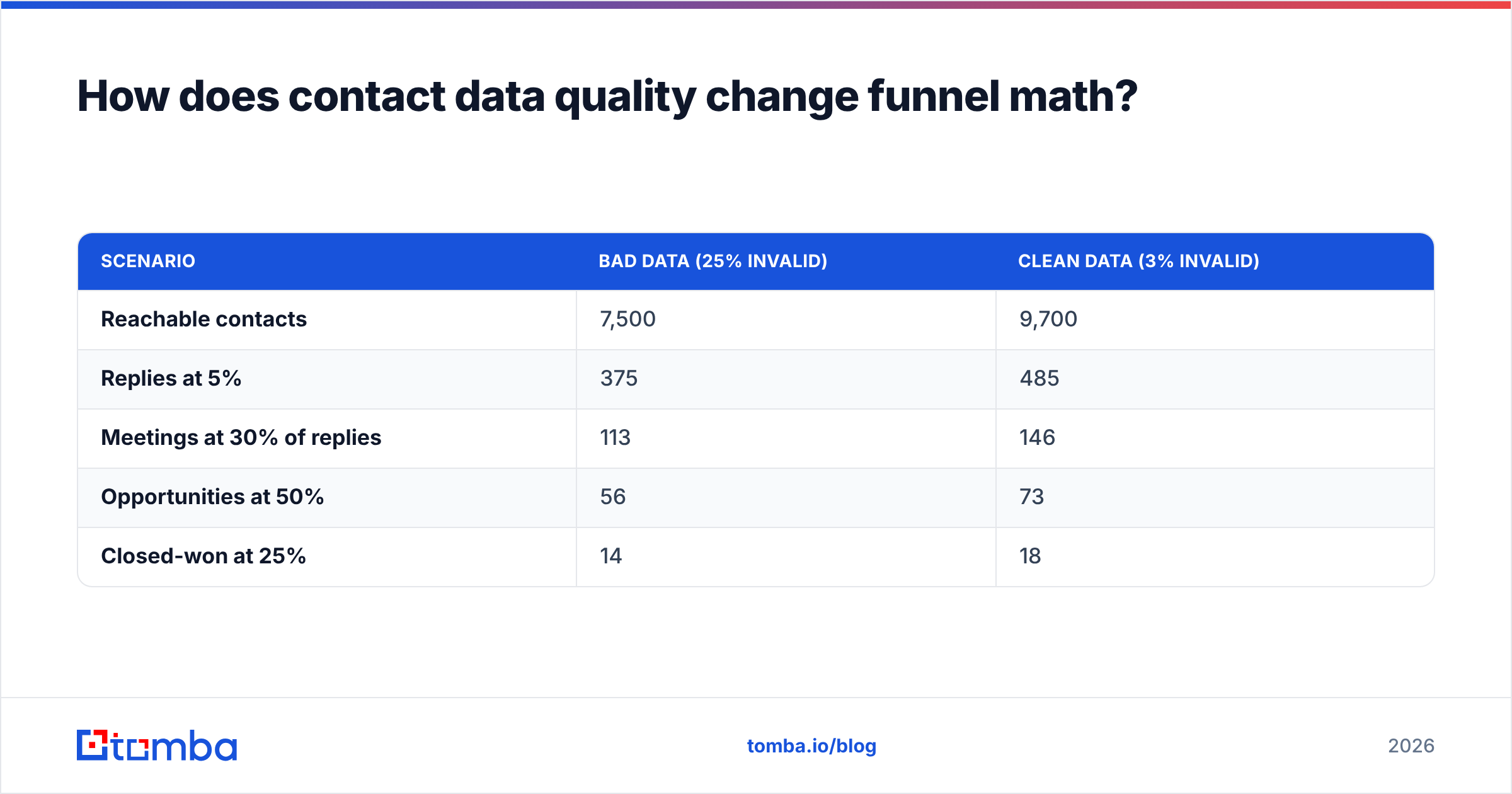
Small data improvements compound across stages, which is why they matter more than they look. Walk the math: imagine 10,000 sourced contacts.
| Scenario | Bad data (25% invalid) | Clean data (3% invalid) |
|---|---|---|
| Reachable contacts | 7,500 | 9,700 |
| Replies at 5% | 375 | 485 |
| Meetings at 30% of replies | 113 | 146 |
| Opportunities at 50% | 56 | 73 |
| Closed-won at 25% | 14 | 18 |
Same effort, same scripts, same team — the only variable changed is data accuracy, and you end with roughly 30% more closed deals. That's the leverage of cleaning the top of the funnel. It also protects deliverability: fewer invalid sends means a healthier domain and fewer of your legitimate emails getting filtered to spam.
This is where verification earns its keep. Running sourced contacts through an email verifier before you send strips out the invalids that would otherwise bounce, tank your sender reputation, and waste your reps' time. Pair that with bulk lookups via a bulk email finder when you're building a target account list, and the top of your funnel starts clean instead of getting cleaned up after the damage is done.
What metrics should you actually track?#
Track conversion rate and velocity at every gate, plus a few cross-stage diagnostics. Vanity metrics — raw traffic, total leads, "engagement" — feel good and decide nothing.
- Stage conversion rate: % moving from each stage to the next. Your leak detector.
- Stage velocity: average days spent in each stage. A stage that's slowing down is about to become a leak.
- Cost per stage: blended CAC broken out by stage shows where money is wasted on leads that never convert.
- Win rate by source: which channels produce leads that actually close, not just leads that fill the CRM.
- Data hygiene rate: % of contacts that are valid and reachable. The metric nobody tracks that quietly governs all the others.
Build these into a single dashboard and review weekly. The discipline of looking at stage-by-stage numbers — instead of one top-line "pipeline" figure — is what separates teams that fix funnels from teams that just complain about them. If you're formalizing the broader process, our overview of sales automation covers how to instrument these handoffs without drowning reps in manual logging.
How do you build a B2B funnel from scratch?#
If you're starting fresh, resist the urge to buy ten tools. Build in this order:
- Define your stages and exit criteria. Write down what has to be true for a contact to advance. Get marketing and sales to sign it.
- Instrument the gates. Even a spreadsheet beats nothing. You need a count entering and exiting each stage.
- Fix your data inputs. Source and verify contacts before they enter the funnel. Garbage in stays garbage all the way down.
- Set the follow-up SLA. Speed-to-lead is your cheapest win.
- Measure, find the worst gate, fix it, repeat. Funnel optimization is a loop, not a project.
Each cycle through that loop tightens the machine. The teams that win aren't the ones with the most leads — they're the ones who lose the fewest at each gate.
Putting it together#
The B2B conversion funnel rewards precision over volume. You don't need more strangers at the top; you need fewer qualified buyers slipping through the gates in the middle. That starts with knowing your stage-by-stage numbers, fixing the worst gate first, and — underneath all of it — feeding the funnel contact data you can actually trust.
If reachability is your bottleneck, that's the cheapest leak to fix. The Tomba Email Finder finds verified professional emails by name, company, or domain, so the contacts entering your funnel are real, reachable, and ready to convert. Start on the free tier (25 searches a month), and when you're ready to scale, plans run from $49/mo Starter to $99/mo Growth and $249/mo Pro — see the full Tomba pricing for details. Clean inputs, tighter funnel, more closed-won. Build the machine on data that holds up.
// get started
Find, verify and enrich your first contacts today
Start on the free plan with 25 searches a month, then scale when your team is ready.
Free plan · No credit card required · GDPR & CCPA
// about the author