B2B Conversion Rate Optimization: The 2026 Playbook
Most B2B funnels leak revenue at every stage. Here's a concrete 2026 playbook for B2B conversion rate optimization — benchmarks, tactics, and the data layer that makes it all work.
You can double your pipeline without doubling your traffic. That is the whole promise of conversion rate optimization — and in B2B, where a single closed deal can be worth six figures, the math is brutal in your favor. A 0.5% lift on a high-intent demo page can outearn a quarter of paid-ads spend.
Yet most B2B teams still treat conversion as a landing-page color test. This guide reframes b2b conversion rate optimization as a full-funnel discipline: from the first anonymous visit to the signed contract, including the unglamorous data work that makes every other tactic actually fire.
TL;DR#
- B2B conversion rate optimization (CRO) is the systematic process of increasing the percentage of prospects who advance at each funnel stage — not just form fills.
- B2B funnels are long and multi-touch, so you optimize stages, not a single page. Median visitor-to-lead sits around 2–3%; lead-to-MQL, MQL-to-SQL, and SQL-to-close each compound.
- The biggest hidden leak is bad contact data. Bounced emails and wrong phone numbers kill conversion before a human ever reads your copy.
- Prioritize tests with a simple ICE/PIE score, run them long enough to reach significance, and always segment by firmographics.
- A clean data layer — verified emails, enriched firmographics, accurate phone numbers — is the multiplier that makes copy, design, and timing tests worth running.
What is B2B conversion rate optimization?#
B2B conversion rate optimization is the practice of increasing the share of buyers who move forward at every step of a long, committee-driven sales cycle. Think of your funnel like a series of leaky buckets stacked on top of each other. Pouring more water (traffic) into the top bucket is expensive. CRO patches the holes so more water reaches the bottom bucket — revenue — from the traffic you already have.
B2C CRO often ends at "click buy now." B2B is different in three ways that change your entire approach:
- Multiple decision-makers. Gartner pegs the typical B2B buying group at six to ten people. You are not converting one person; you are converting a committee.
- Long cycles. Weeks to quarters, with many micro-conversions (content download, demo, trial, proposal) before the macro-conversion (closed deal).
- High deal value. Because contracts are large, small percentage lifts produce outsized revenue, which justifies deeper investment in testing and data.
That means your conversion "event" is rarely a single button. It is a chain. Optimizing the chain — and the data feeding it — is the job.
What are good B2B conversion rate benchmarks in 2026?#
Benchmarks are guardrails, not goals. Your own historical baseline matters more than any industry average, because traffic mix, ACV, and category maturity swing the numbers wildly. Still, you need a sane starting point to know whether a stage is broken or merely average.
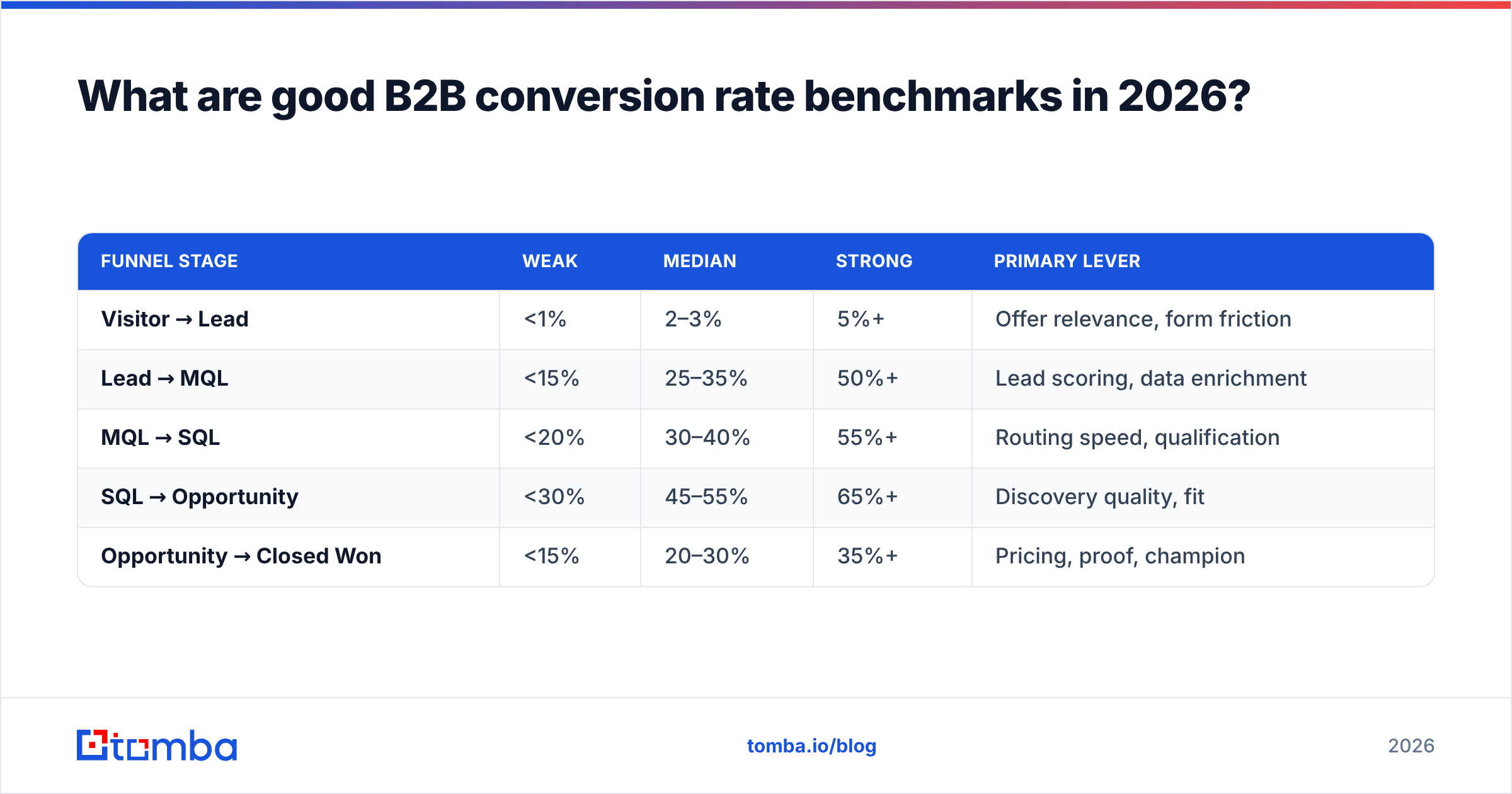
Here is a realistic stage-by-stage view for mid-market B2B SaaS and services. Treat these as directional medians, then segment against your own data.
| Funnel stage | Weak | Median | Strong | Primary lever |
|---|---|---|---|---|
| Visitor → Lead | <1% | 2–3% | 5%+ | Offer relevance, form friction |
| Lead → MQL | <15% | 25–35% | 50%+ | Lead scoring, data enrichment |
| MQL → SQL | <20% | 30–40% | 55%+ | Routing speed, qualification |
| SQL → Opportunity | <30% | 45–55% | 65%+ | Discovery quality, fit |
| Opportunity → Closed Won | <15% | 20–30% | 35%+ | Pricing, proof, champion |
Two things to notice. First, conversion compounds: a 10% improvement at three stages roughly multiplies, not adds. Second, the early stages depend heavily on data quality — scoring and routing collapse when the underlying contact records are wrong. We will return to that.
Why do most B2B CRO programs stall?#
They optimize the visible layer and ignore the plumbing. Teams A/B test hero headlines for months while 18% of their captured emails bounce and half their leads route to the wrong rep. You can't out-design dirty data.
The common failure modes:
- Testing without traffic. B2B pages often get hundreds, not millions, of visits. A test that needs 50,000 sessions to reach significance will never conclude. You need test design suited to low volume.
- Vanity micro-conversions. Optimizing "ebook downloads" that never become pipeline. Always tie a test to a downstream revenue metric.
- One-size-fits-all funnels. A 12-person enterprise buying committee and a self-serve solopreneur should not see the same path.
- Garbage contact data. Your nurture, scoring, routing, and outbound all assume the email and company info are correct. When they aren't, every downstream conversion number is depressed for reasons no page test can fix.
That last point is where a surprising amount of "lost" conversion actually hides.
How does data quality drive conversion rate?#
Clean, enriched contact data raises conversion at every post-capture stage — because routing, scoring, personalization, and deliverability all depend on it. It is the least sexy lever and frequently the highest-ROI one.
Walk the chain:
- Capture. A lead submits a form. If you only collected an email, you know almost nothing. Real-time data enrichment appends company size, industry, role, and tech stack so scoring and routing work instantly.
- Verify. If the email is fake or mistyped, your follow-up bounces and your sender reputation drops. Running addresses through an email verifier before they hit your sequence protects deliverability and keeps real prospects in the funnel.
- Route. Enriched firmographics let you send enterprise leads to AEs and SMB leads to self-serve — a routing decision that directly moves MQL→SQL rates.
- Personalize. Knowing role and industry lets you tailor the next email or page. Relevance is the single biggest driver of B2B response rate.
Skip these and you are A/B testing the paint while the foundation cracks. According to HubSpot's research on data decay, B2B contact data degrades roughly 22–30% per year as people change jobs — so this is a continuous process, not a one-time cleanup.
The data layer in five moves#
- Append on capture — enrich every inbound lead in real time, not in a monthly batch.
- Verify before send — catch bounces and catch-all domains before they touch your sequencer.
- Standardize fields — normalize company names, titles, and domains so scoring rules actually match.
- Re-enrich quarterly — refresh stale records to fight the 22–30% annual decay.
- Close the loop — feed closed-won firmographics back into scoring so the model sharpens over time.
Which tools do you actually need for B2B CRO?#
CRO tooling splits into four jobs: testing, behavior analytics, lead capture, and data quality. You do not need one of everything on day one. Match the tool to the leak you're fixing.
| Job to be done | Example tools | What it fixes | Start when |
|---|---|---|---|
| A/B & multivariate testing | VWO, Optimizely, Convert | Page-level conversion | You have stable traffic |
| Behavior analytics | Hotjar, Microsoft Clarity, FullStory | Where users drop off | You don't know why they leave |
| Lead capture & forms | Default forms, Typeform, chat | Form friction | Form completion is low |
| Data quality & enrichment | Tomba, Clearbit, |
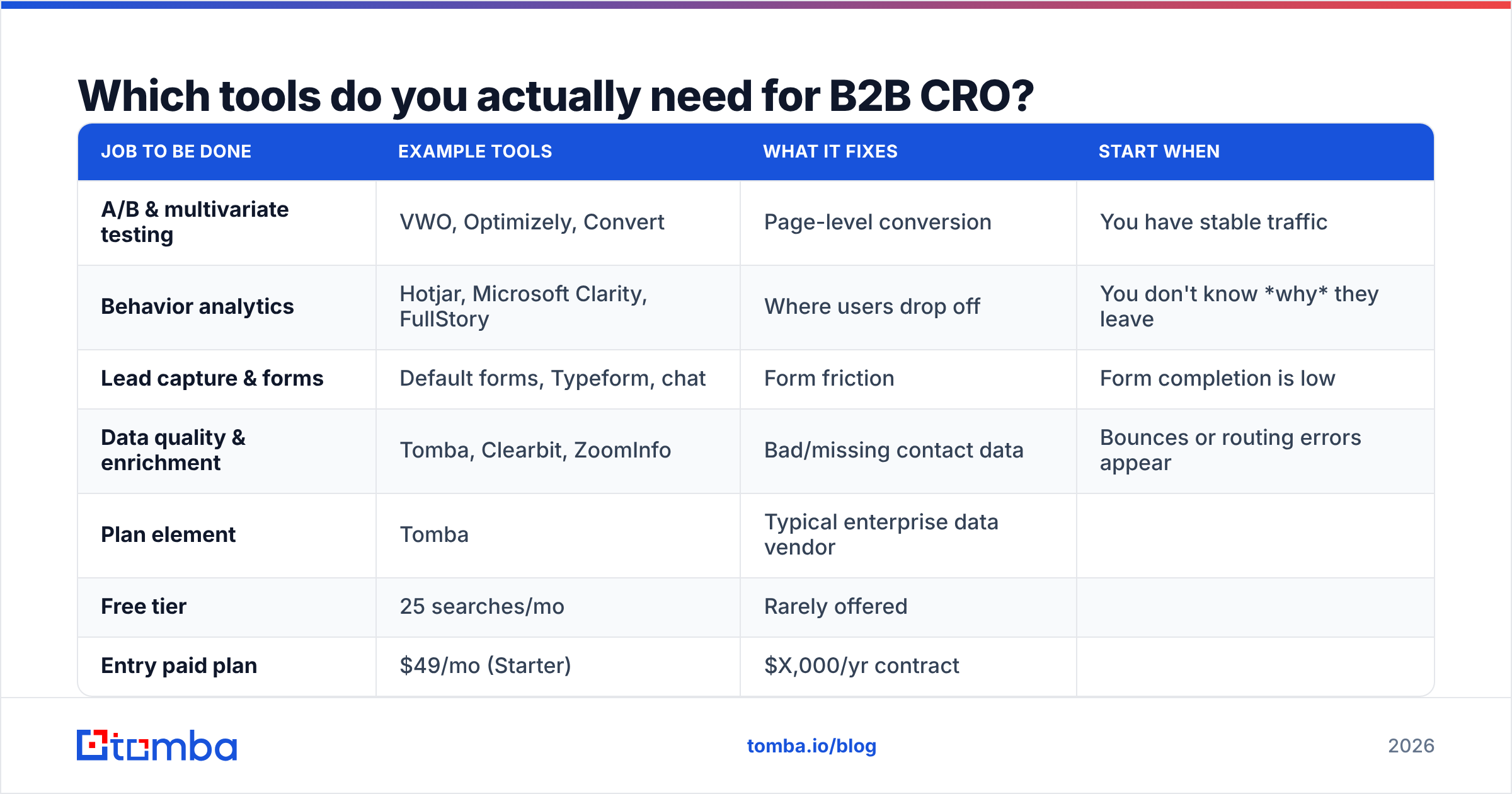
ZoomInfo | Bad/missing contact data | Bounces or routing errors appear |
For the data-quality column specifically, pricing and free tiers matter because you run high volumes. Here's an honest snapshot at the entry level:
| Plan element | Tomba | Typical enterprise data vendor |
|---|---|---|
| Free tier | 25 searches/mo | Rarely offered |
| Entry paid plan | $49/mo (Starter) | $X,000/yr contract |
| Mid plan | $99/mo (Growth) | Annual only |
| Pricing model | Self-serve, monthly | Sales-led, annual |
| Core use | Email finding & verification | Full data suite |
See full Tomba pricing for credits per tier. The point isn't that one tool wins everything — it's that you should not sign a five-figure annual data contract to fix a deliverability leak you could patch for $49/mo. Cross-check any vendor against neutral reviews on G2 before you commit.
How do you prioritize CRO experiments?#
Score every idea, run the highest-scoring tests first, and never trust your gut on what will win. Two simple frameworks beat endless debate:
- ICE — rate each idea 1–10 on Impact, Confidence, and Ease, then sort by the product. Fast and good enough for most teams.
- PIE — Potential, Importance, Ease. Similar, with "Importance" weighting pages by traffic value.
A practical prioritization loop:
- Find the biggest leak. Use funnel analytics to locate the stage with the worst relative conversion versus benchmark.
- Generate hypotheses. Form them as "If we change X, then Y will improve because
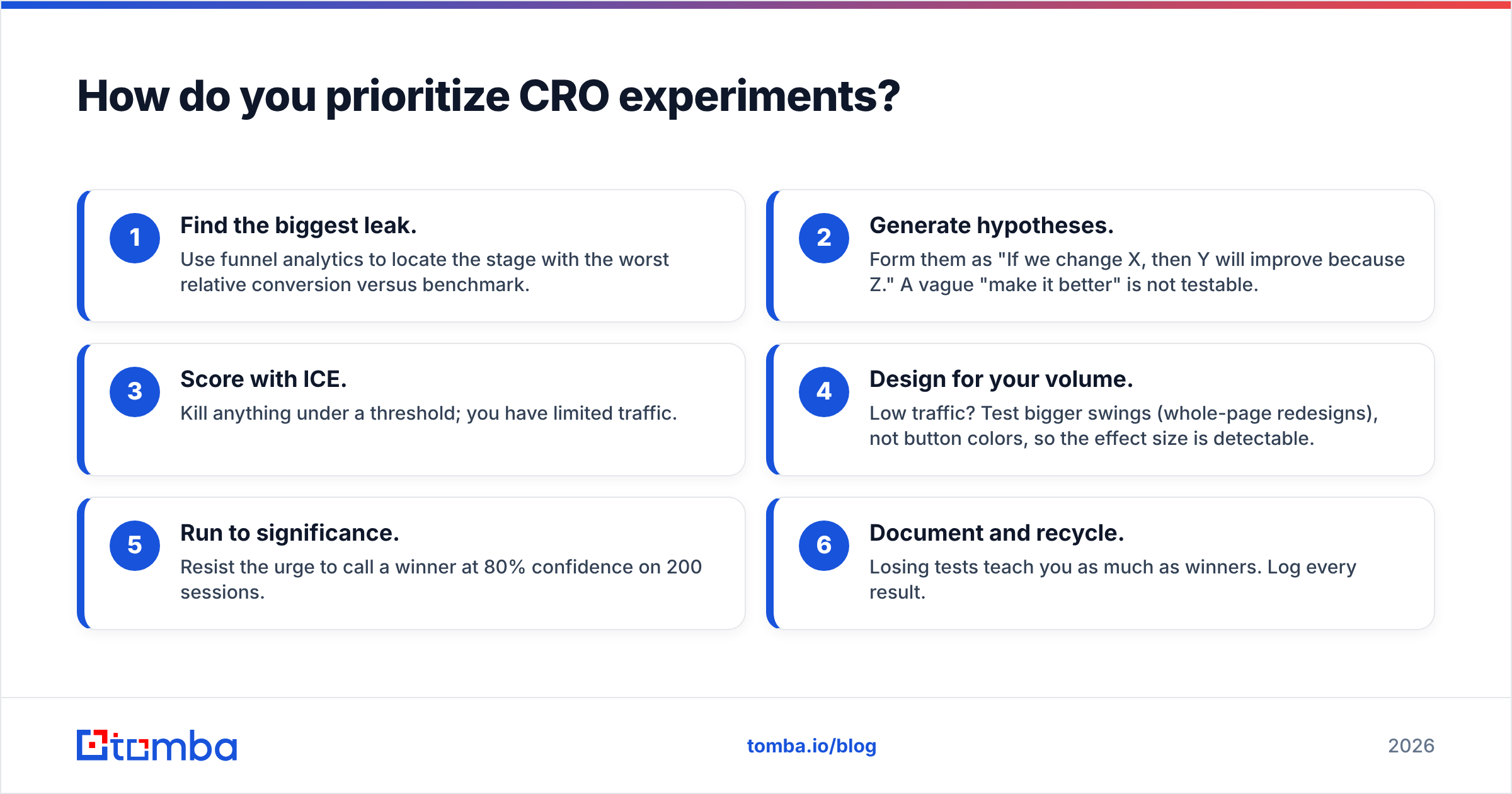
Z." A vague "make it better" is not testable. 3. Score with ICE. Kill anything under a threshold; you have limited traffic. 4. Design for your volume. Low traffic? Test bigger swings (whole-page redesigns), not button colors, so the effect size is detectable. 5. Run to significance. Resist the urge to call a winner at 80% confidence on 200 sessions. 6. Document and recycle. Losing tests teach you as much as winners. Log every result.
What are the highest-leverage B2B CRO tactics?#
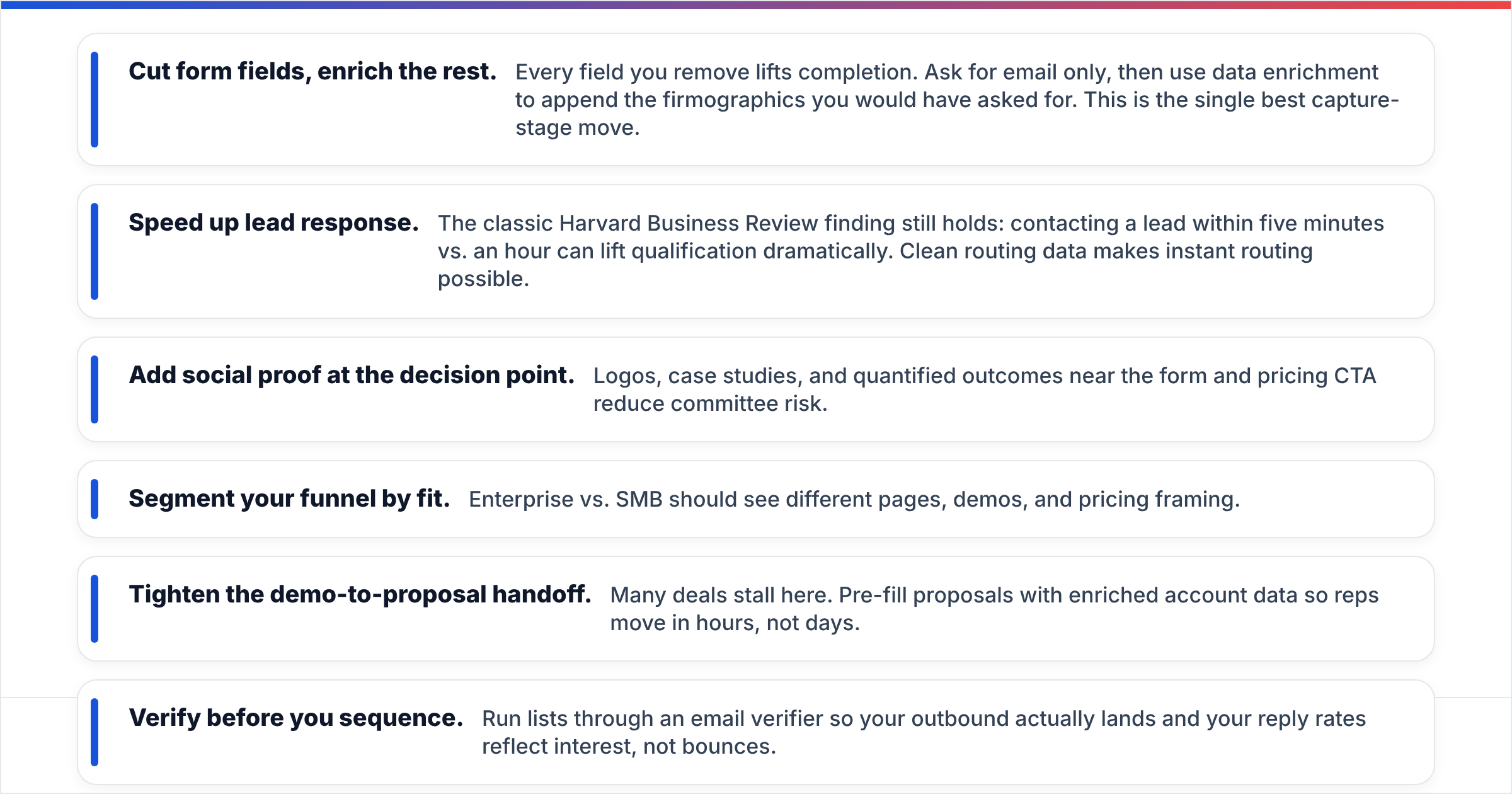
These consistently move B2B numbers across categories. Sequence them against your worst-performing stage.
- Cut form fields, enrich the rest. Every field you remove lifts completion. Ask for email only, then use data enrichment to append the firmographics you would have asked for. This is the single best capture-stage move.
- Speed up lead response. The classic Harvard Business Review finding still holds: contacting a lead within five minutes vs. an hour can lift qualification dramatically. Clean routing data makes instant routing possible.
- Add social proof at the decision point. Logos, case studies, and quantified outcomes near the form and pricing CTA reduce committee risk.
- Segment your funnel by fit. Enterprise vs. SMB should see different pages, demos, and pricing framing.
- Tighten the demo-to-proposal handoff. Many deals stall here. Pre-fill proposals with enriched account data so reps move in hours, not days.
- Verify before you sequence. Run lists through an email verifier so your outbound actually lands and your reply rates reflect interest, not bounces.
Notice how many tactics quietly depend on accurate data. That is not a coincidence — it is the through-line of modern CRO.
How do you measure CRO success without fooling yourself?#
Tie every test to a downstream revenue metric, segment your results, and account for statistical significance. Three discipline checks:
- Revenue-weight your conversions. A page that lifts demo requests 20% but those demos close at half the rate is a loss. Always trace to pipeline and closed-won.
- Segment everything. An aggregate "no change" often hides a big enterprise win cancelled out by an SMB loss. Cut results by firmographic, source, and device.
- Respect the math. With B2B traffic levels, use sequential testing methods or longer windows. A 95% confidence threshold on a real sample size protects you from shipping noise.
Keep a living scorecard: baseline conversion per stage, current, target, and the test that moved it. Over four quarters, the compounding becomes obvious — and so does the case for more investment.
Common B2B CRO mistakes to avoid#
- Chasing traffic over conversion. Doubling visits to a 1% page is more expensive than fixing the page.
- Ignoring mobile for B2B. Decision-makers research on phones even if they buy on desktop. Broken mobile forms leak quietly.
- Testing trivial elements at low traffic. Button color rarely matters; offer and audience fit almost always do.
- Letting data rot. Without quarterly re-enrichment, your scoring model degrades and conversion silently declines.
- No qualitative input. Numbers tell you what; session recordings and user interviews tell you why. You need both.
Bringing it together#
B2B conversion rate optimization is not a landing-page hobby — it is a full-funnel revenue discipline. The visible layer (copy, design, offers) matters, but it sits on top of a data layer that decides whether any of your tests can even work. Patch the plumbing first: enrich on capture, verify before you send, re-enrich on a schedule. Then test the biggest leaks with scored, significance-respecting experiments. The lifts compound, and on six-figure ACVs, the compounding is the entire point.
Start with the leak that quietly depresses every downstream metric: your contact data. Tomba's Email Finder lets you find and verify professional emails by name, domain, or company — so the leads you capture are reachable, your routing is accurate, and your conversion numbers reflect real buyer interest instead of bounced sends. Spin up the free tier (25 searches/mo), wire verification into your capture flow, and watch your post-capture conversion stop leaking. Clean data is the multiplier that makes every other CRO tactic worth running.
// get started
Find, verify and enrich your first contacts today
Start on the free plan with 25 searches a month, then scale when your team is ready.
Free plan · No credit card required · GDPR & CCPA
// about the author