How to Build a B2B Customer Profile That Converts in 2026
A B2B customer profile turns guesswork into a repeatable targeting system. Here's how to build one in 2026 — with firmographics, signals, and the data to back it.
A B2B customer profile is the difference between a sales team that chases everyone and one that closes the right accounts on repeat. Most teams think they have one. What they actually have is a vague memory of their three favorite logos and a hope that the next deal looks similar.
This guide shows you how to build a B2B customer profile that your reps, marketers, and RevOps team can actually act on in 2026 — backed by real data, not vibes.
TL;DR#
- A B2B customer profile (often called an Ideal Customer Profile, or ICP) is a data-backed description of the company most likely to buy, succeed, and stay.
- It is account-level, not person-level — don't confuse it with a buyer persona, which describes the individual.
- The strongest profiles stack four layers: firmographic, technographic, behavioral/intent, and fit-to-value.
- Build it from your own closed-won data first, then enrich and expand with external data sources.
- A profile is worthless without contact data to action it — that's where an email finder turns the list into pipeline.
What is a B2B customer profile?#
A B2B customer profile is a structured description of the type of company that gets the most value from your product and gives the most value back to your business. Think of it like a dating checklist for your pipeline: instead of swiping on every company that exists, you define exactly who you're looking for so you stop wasting evenings on bad matches.
In practice, a profile answers one question: if we could only sell to one kind of company, what would it look like? It captures attributes like industry, company size, revenue, tech stack, growth stage, and buying triggers — the traits shared by accounts that close fast, expand, and renew.
The term is used interchangeably with Ideal Customer Profile (ICP). Both describe the company, not the human. According to Gartner, the highest-performing go-to-market teams treat the ICP as a living definition that marketing, sales, and customer success all share — not a slide that lives in a forgotten deck.
How is a customer profile different from a buyer persona?#
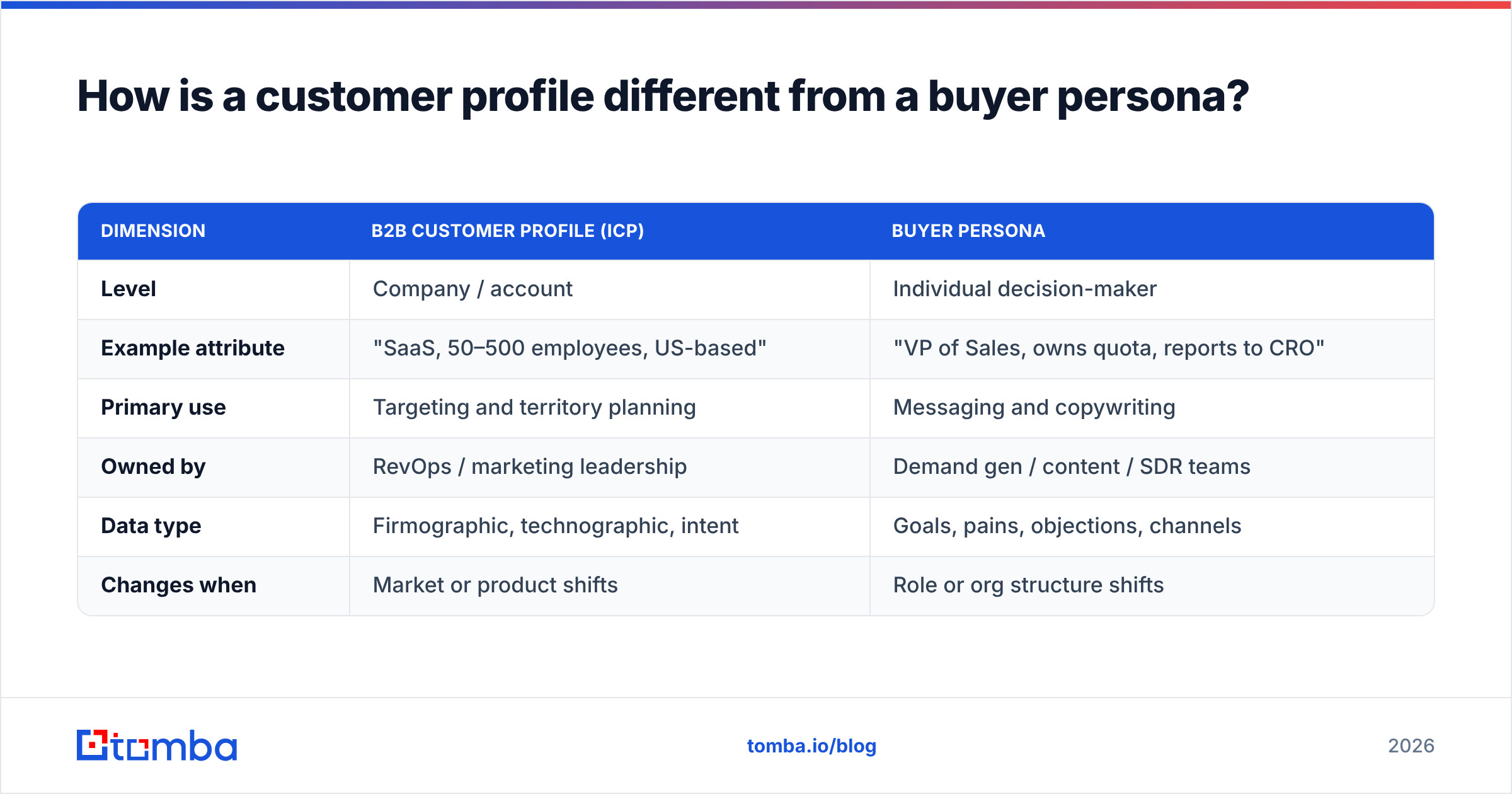
They operate at different altitudes. The customer profile is the account; the persona is the person inside that account.
| Dimension | B2B Customer Profile (ICP) | Buyer Persona |
|---|---|---|
| Level | Company / account | Individual decision-maker |
| Example attribute | "SaaS, 50–500 employees, US-based" | "VP of Sales, owns quota, reports to CRO" |
| Primary use | Targeting and territory planning | Messaging and copywriting |
| Owned by | RevOps / marketing leadership | Demand gen / content / SDR teams |
| Data type | Firmographic, technographic, intent | Goals, pains, objections, channels |
| Changes when | Market or product shifts | Role or org structure shifts |
You need both. The profile tells your team which doors to knock on; the persona tells them what to say when someone answers. Skipping the profile means great messaging aimed at companies that will never buy. If you want a deeper breakdown of the qualification side, the concept of a marketing qualified lead sits directly downstream of a tight ICP.
What are the four layers of a strong B2B customer profile?#
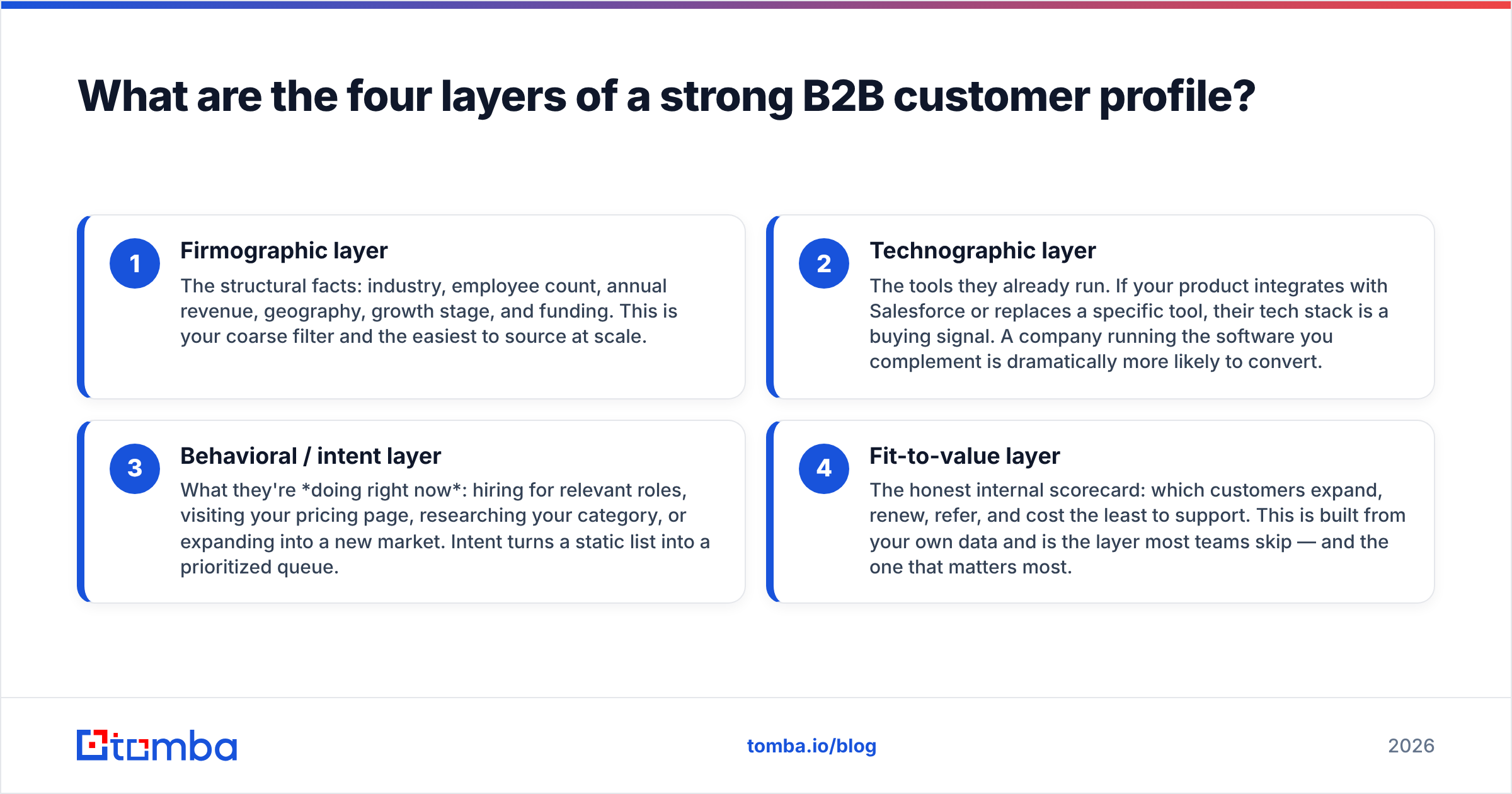
A profile that only lists "mid-market SaaS companies" is too thin to drive action. Stack these four layers to make it operational.
- Firmographic layer — The structural facts: industry, employee count, annual revenue, geography, growth stage, and funding. This is your coarse filter and the easiest to source at scale.
- Technographic layer — The tools they already run. If your product integrates with Salesforce or replaces a specific tool, their tech stack is a buying signal. A company running the software you complement is dramatically more likely to convert.
- Behavioral / intent layer — What they're doing right now: hiring for relevant roles, visiting your pricing page, researching your category, or expanding into a new market. Intent turns a static list into a prioritized queue.
- Fit-to-value layer — The honest internal scorecard: which customers expand, renew, refer, and cost the least to support. This is built from your own data and is the layer most teams skip — and the one that matters most.
When all four align, you get an account that is reachable, ready, and right. When you only have layer one, you get a giant list and a long sales cycle.
How do you actually build a B2B customer profile?#
Build it in five steps, in this order. The order matters — most teams start with assumptions and never validate them against reality.
Step 1 — Mine your closed-won data. Pull your best 20–50 customers. Not the biggest logos — the best: high retention, fast onboarding, strong expansion, low support burden. Look for the attributes they share. This is your ground truth.
Step 2 — Interview the humans. Talk to sales, CS, and a handful of those best customers. Why did they buy? What triggered the search? What nearly killed the deal? Patterns here become your intent signals and disqualifiers.
Step 3 — Codify the attributes. Write the profile down as filterable criteria, not adjectives. "Enterprise" is useless; "1,000+ employees, $100M+ revenue, North America, runs HubSpot" is a query you can run.
Step 4 — Source and enrich the data. Now turn criteria into a real list. Use a B2B database and data enrichment to populate firmographics and fill gaps. This is where the profile becomes a target account list.
Step 5 — Find the contacts and test. A list of company names doesn't book meetings. Pull verified contact data, run a small outbound test, and feed the results back into the profile. Did the "perfect fit" accounts actually respond? Refine and repeat.
Which data sources power a B2B customer profile?#
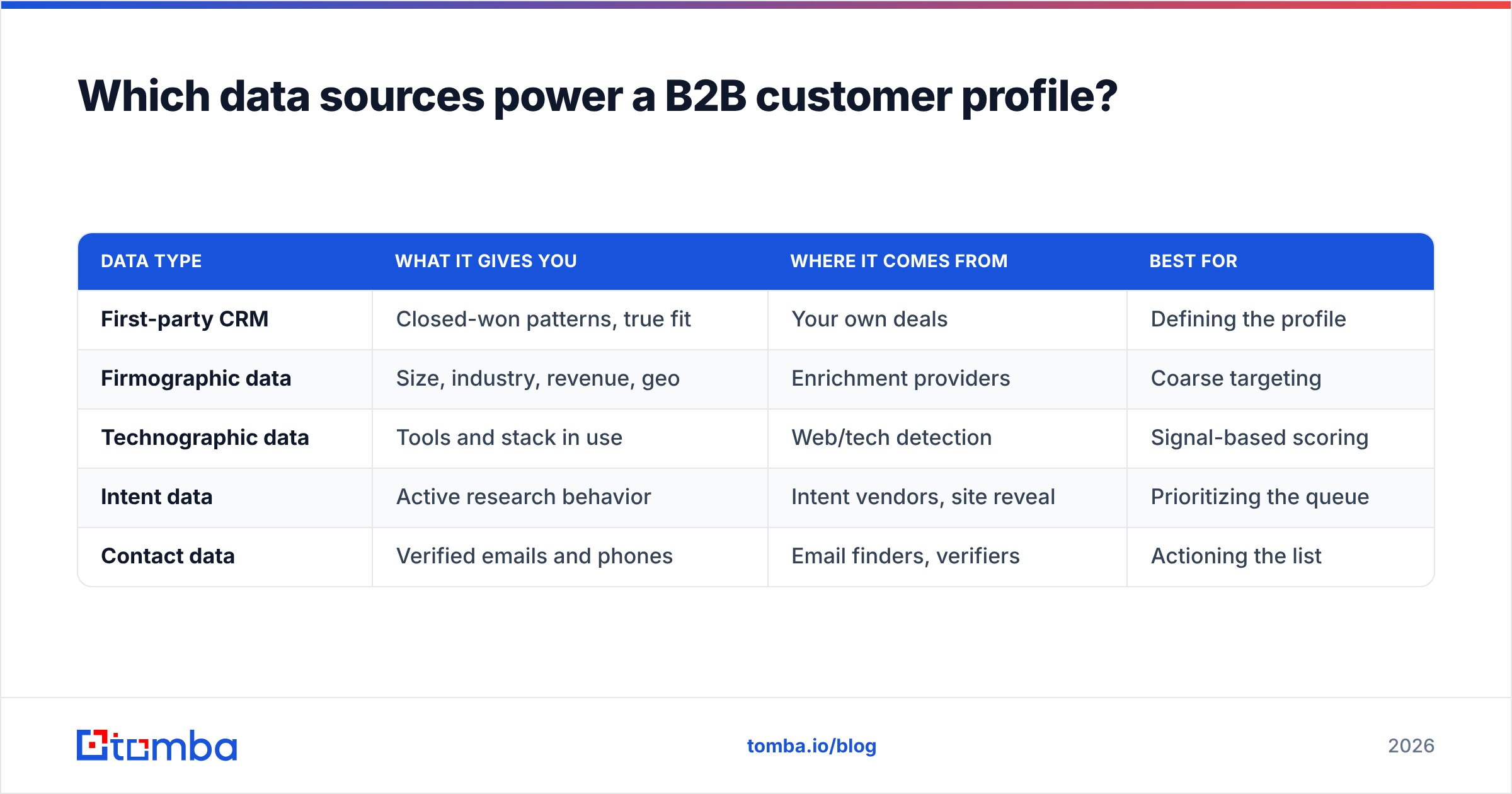
Your profile is only as good as the data behind it. Here's how the common source types compare for building and activating an ICP.
| Data type | What it gives you | Where it comes from | Best for |
|---|---|---|---|
| First-party CRM | Closed-won patterns, true fit | Your own deals | Defining the profile |
| Firmographic data | Size, industry, revenue, geo | Enrichment providers | Coarse targeting |
| Technographic data | Tools and stack in use | Web/tech detection | Signal-based scoring |
| Intent data | Active research behavior | Intent vendors, site reveal | Prioritizing the queue |
| Contact data | Verified emails and phones | Email finders, verifiers | Actioning the list |
The mistake teams make is buying expensive intent data before they've cleaned their first-party data. Start with what you own. Then layer external sources to expand reach, and finish with accurate contact data so the profile produces conversations, not just a spreadsheet. Reliable contact enrichment and verified emails are what separate a "nice analysis" from a working pipeline engine.
For an external benchmark on building account lists, HubSpot's research on ICP frameworks and peer reviews on G2 are useful reality checks against your internal assumptions.
How do you keep your customer profile from going stale?#
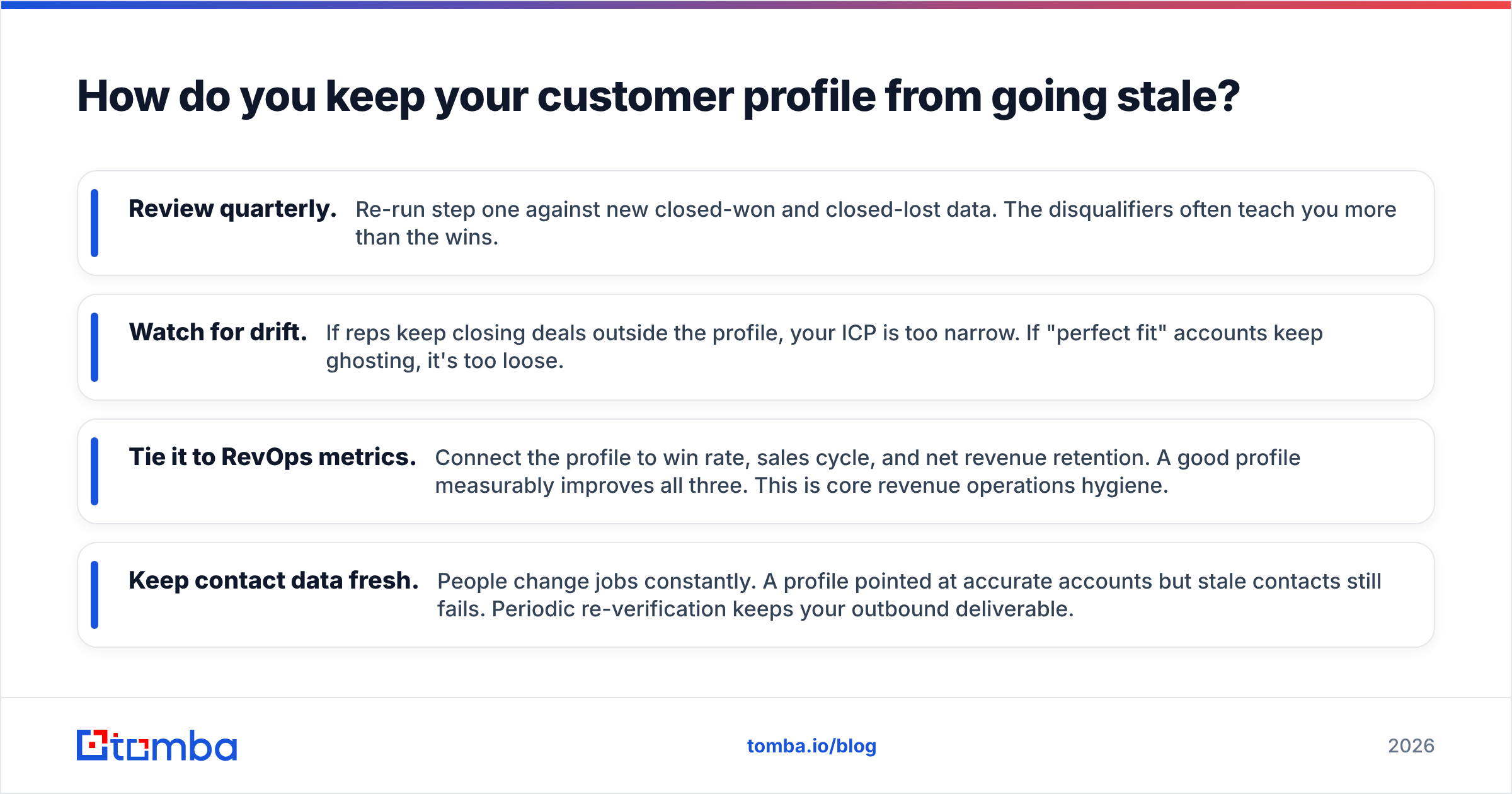
A B2B customer profile is a hypothesis, not a monument. Markets shift, products evolve, and last year's perfect account becomes this year's churn risk.
- Review quarterly. Re-run step one against new closed-won and closed-lost data. The disqualifiers often teach you more than the wins.
- Watch for drift. If reps keep closing deals outside the profile, your ICP is too narrow. If "perfect fit" accounts keep ghosting, it's too loose.
- Tie it to RevOps metrics. Connect the profile to win rate, sales cycle, and net revenue retention. A good profile measurably improves all three. This is core revenue operations hygiene.
- Keep contact data fresh. People change jobs constantly. A profile pointed at accurate accounts but stale contacts still fails. Periodic re-verification keeps your outbound deliverable.
What does a finished B2B customer profile look like?#
Here's a compact, real-world example so you can see the layers come together:
| Attribute | Definition |
|---|---|
| Industry | B2B SaaS, martech and sales tech |
| Size | 50–500 employees |
| Revenue | $5M–$50M ARR |
| Geography | US, UK, Canada |
| Tech stack | Runs HubSpot or Salesforce + outbound tooling |
| Trigger | Hiring SDRs, raised a round, expanding to new market |
| Disqualifiers | Pre-revenue, agencies reselling, sub-10 headcount |
That fits on an index card, and every line is something a rep or a query can act on. That's the bar: if a new SDR can read your profile and immediately know whether to work an account, you've built it right.
Turn your profile into pipeline with Tomba#
A B2B customer profile is the strategy. Verified contact data is what makes it print revenue. Once you know exactly which companies fit, Tomba's Email Finder lets you find professional email addresses by domain, name, or company — so your perfectly targeted account list becomes a list of real people you can actually reach.
Start on the free tier (25 searches a month), then scale through the Starter plan at $49/mo as your outbound proves out. See full Tomba pricing to match a plan to your volume. Define the profile, find the contacts, and stop spraying — build a targeting system your whole go-to-market team can run on.
// get started
Find, verify and enrich your first contacts today
Start on the free plan with 25 searches a month, then scale when your team is ready.
Free plan · No credit card required · GDPR & CCPA
// about the author