B2B Data Suppliers: 9 Best Providers Ranked for 2026
A neutral, hands-on comparison of the top B2B data suppliers in 2026 — accuracy, coverage, compliance, and pricing — so you stop overpaying for stale records.
B2B Data Suppliers: 9 Best Providers Ranked for 2026
Picking a B2B data supplier is the single most expensive decision your go-to-market team makes that nobody audits. You sign a five-figure contract, ingest a few hundred thousand records, and then quietly accept that a third of them bounce, mismatch, or belong to someone who left two years ago. This guide fixes that.
TL;DR
- The best B2B data suppliers in 2026 win on verified accuracy and recency, not raw record counts — a 200M-contact database is worthless if 30% is stale.
- ZoomInfo and Cognism lead on enterprise coverage; Apollo and Clearbit lead on platform breadth; Tomba leads on pay-for-what-you-use email and enrichment accuracy.
- Compliance (GDPR/CCPA) is now a buying criterion, not a footnote — ask every vendor for their lawful basis and opt-out handling in writing.
- Pay-per-use beats seat-based pricing for most teams under 50 reps. You should never pay $20K/year for data you touch quarterly.
- Run a free accuracy bake-off on the same 100 target accounts before signing anything. The deltas between suppliers are larger than their marketing admits.
What are B2B data suppliers?#
B2B data suppliers are companies that collect, clean, and sell business contact and company information — names, job titles, work emails, direct-dial phone numbers, firmographics (revenue, headcount, industry), and increasingly technographics and intent signals. Think of them as the wholesale fish market behind your CRM: your reps cook the meal, but the supplier decides whether the ingredients are fresh.
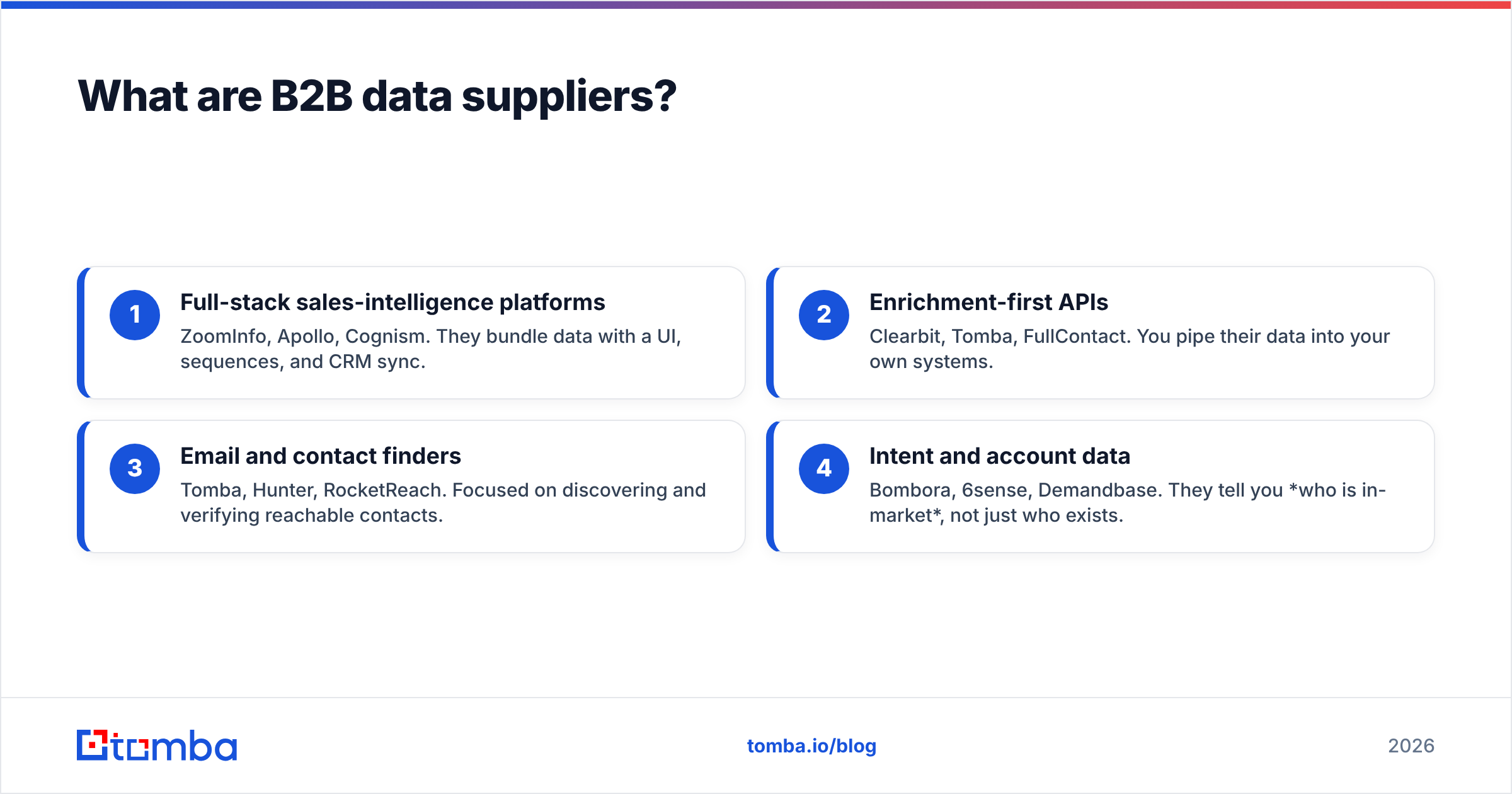
They generally fall into a few buckets:
- Full-stack sales-intelligence platforms — ZoomInfo, Apollo, Cognism. They bundle data with a UI, sequences, and CRM sync.
- Enrichment-first APIs — Clearbit, Tomba, FullContact. You pipe their data into your own systems.
- Email and contact finders — Tomba, Hunter, RocketReach. Focused on discovering and verifying reachable contacts.
- Intent and account data — Bombora, 6sense, Demandbase. They tell you who is in-market, not just who exists.
Most teams end up using two or three of these together. The mistake is paying enterprise prices for a category you only need lightly. If you mainly need to find email addresses and enrich them, a full-stack platform is overkill.

How do you judge a B2B data supplier?#
Ignore the headline "250 million contacts" number. Coverage is table stakes; the differentiators are quieter. Score every vendor on these six dimensions:
- Accuracy — What percentage of records are correct today? Demand a verified-email bounce rate, not a "claimed" accuracy figure.
- Recency — How often is each record re-verified? Monthly is good; "at acquisition" is a red flag.
- Coverage depth — Not just total count, but coverage of your ICP regions and seniority levels.
- Compliance — Documented GDPR lawful basis, CCPA opt-out handling, and a real DPA. See the email deliverability implications too — bad data tanks sender reputation.
- Delivery model — UI, CSV export, API, native CRM sync, or all four.
- Pricing model — Seat-based, credit-based, or pay-per-result. This decides your real cost more than the sticker price.
Which are the best B2B data suppliers in 2026?#
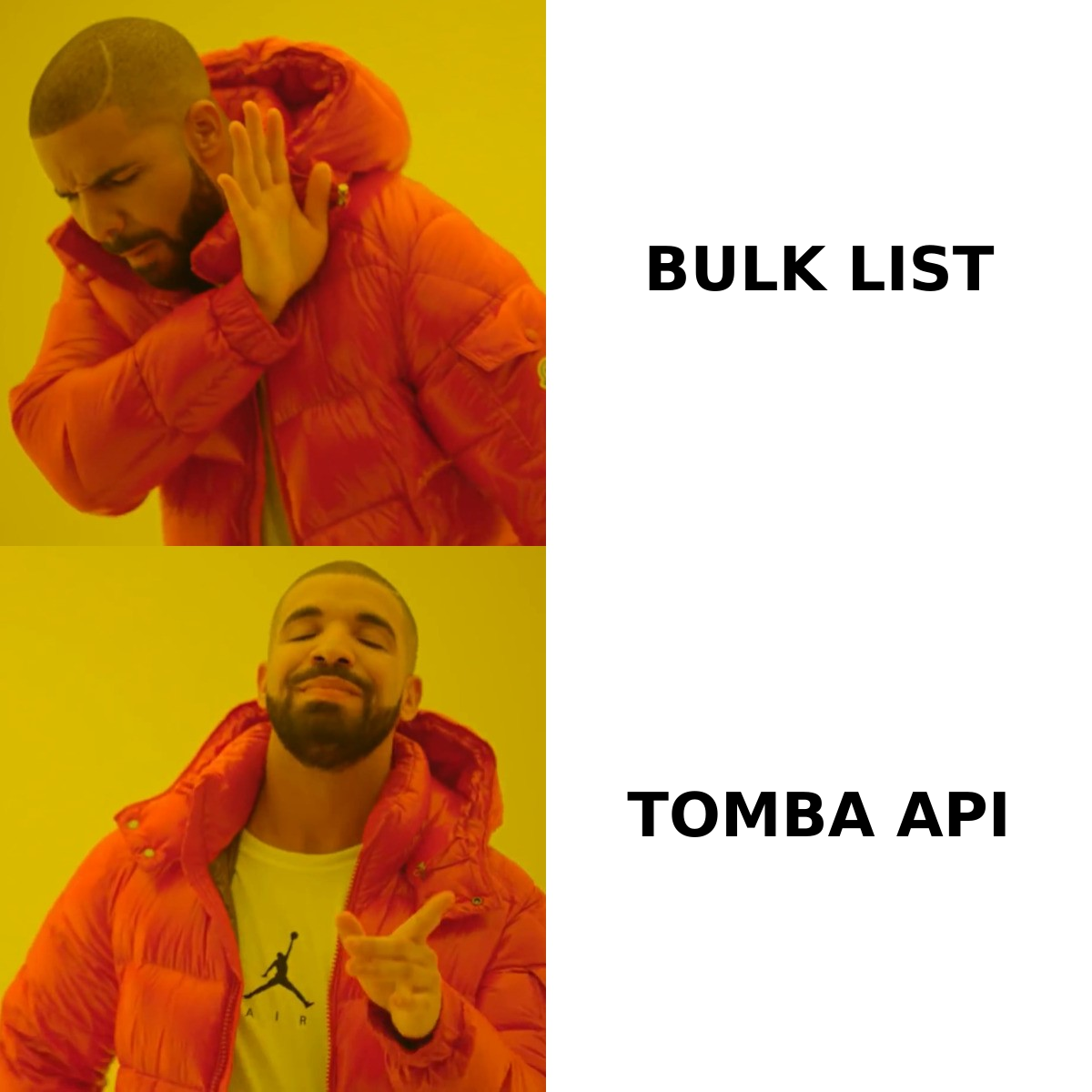
Here is the honest landscape. No single supplier wins every category — match the tool to the job.
| Supplier | Best for | Coverage focus | Pricing model | Notable strength |
|---|---|---|---|---|
| ZoomInfo | Enterprise GTM | Global, deep firmographics | Seat + platform | Intent + org charts |
| Apollo | All-in-one outbound | Broad, US-heavy | Credit + seat | Sequences built in |
| Cognism | EU/UK compliance | EMEA direct dials | Seat-based | Phone-verified mobiles |
| Clearbit (HubSpot) | Web enrichment | Company firmographics | Volume-based | Native HubSpot fit |
| Tomba | Email + enrichment | Domain-level contacts | Pay-per-use | Verified email accuracy |
| RocketReach | Recruiter/SMB lookup | Broad professional | Credit-based | Personal email coverage |
| Lusha | Quick contact grabs | US + EU mobiles | Credit-based | Chrome simplicity |
| 6sense | Intent + ABM | Account-level signals | Platform | Predictive scoring |
| Seamless.AI | High-volume SMB | US contacts | Seat-based | Real-time search |
A few honest notes the vendor sites won't tell you:
- ZoomInfo is the most complete dataset for enterprise, but it is also the most expensive and locks you into annual seats. If you have a 40-person SDR org, it's justified. If you have four reps, it is not.
- Apollo gives you the most for the money as a starter platform, but accuracy on direct dials drops sharply outside the US.
- Cognism is the strongest pick if EMEA mobile numbers and GDPR documentation are your priority.
- Tomba wins when your real need is "find and verify the right work email, then enrich it" without paying for a full platform. Its data enrichment and email verifier run on a pay-per-use model, so unused credits don't evaporate.
For third-party validation rather than my word, cross-check live reviews on G2 and Gartner Peer Insights before committing.
How much should B2B data cost?#
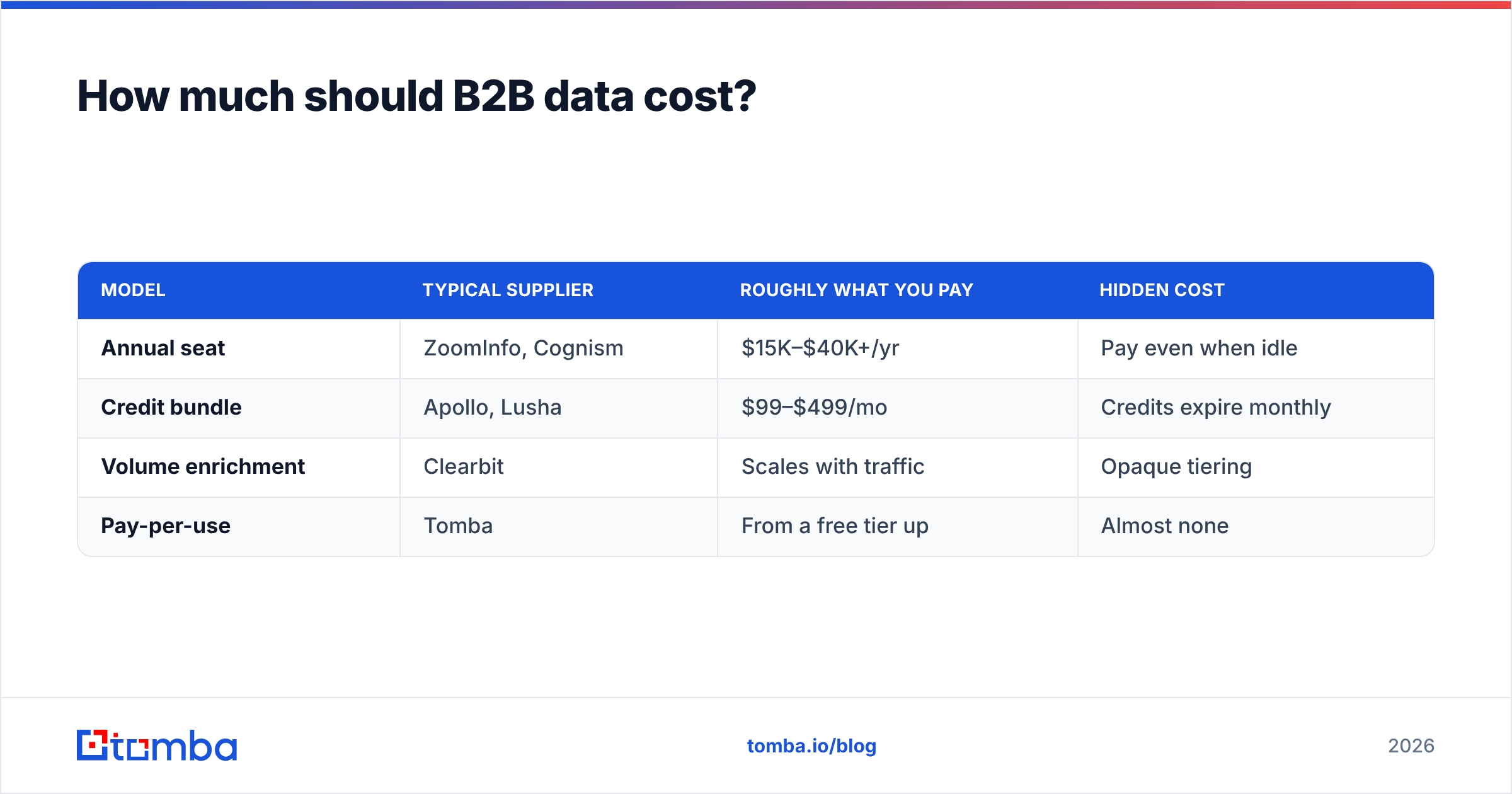
Conclusion first: most teams overpay by anchoring on enterprise seat pricing when a usage-based supplier would cost a fraction. The right question is cost per usable record, not cost per seat.
Here is how the common pricing models actually shake out for a team enriching ~5,000 contacts a month:
| Model | Typical supplier | Roughly what you pay | Hidden cost |
|---|---|---|---|
| Annual seat | ZoomInfo, Cognism | $15K–$40K+/yr | Pay even when idle |
| Credit bundle | Apollo, Lusha | $99–$499/mo | Credits expire monthly |
| Volume enrichment | Clearbit | Scales with traffic | Opaque tiering |
| Pay-per-use | Tomba | From a free tier up | Almost none |
For reference, Tomba's published pricing starts with a free tier of 25 searches/month, then Starter at $49/mo, Growth at $99/mo, and Pro at $249/mo, with Enterprise custom. That structure matters: you can validate accuracy on the free tier before paying a cent, then scale credits to actual usage instead of locking into seats you won't fill.
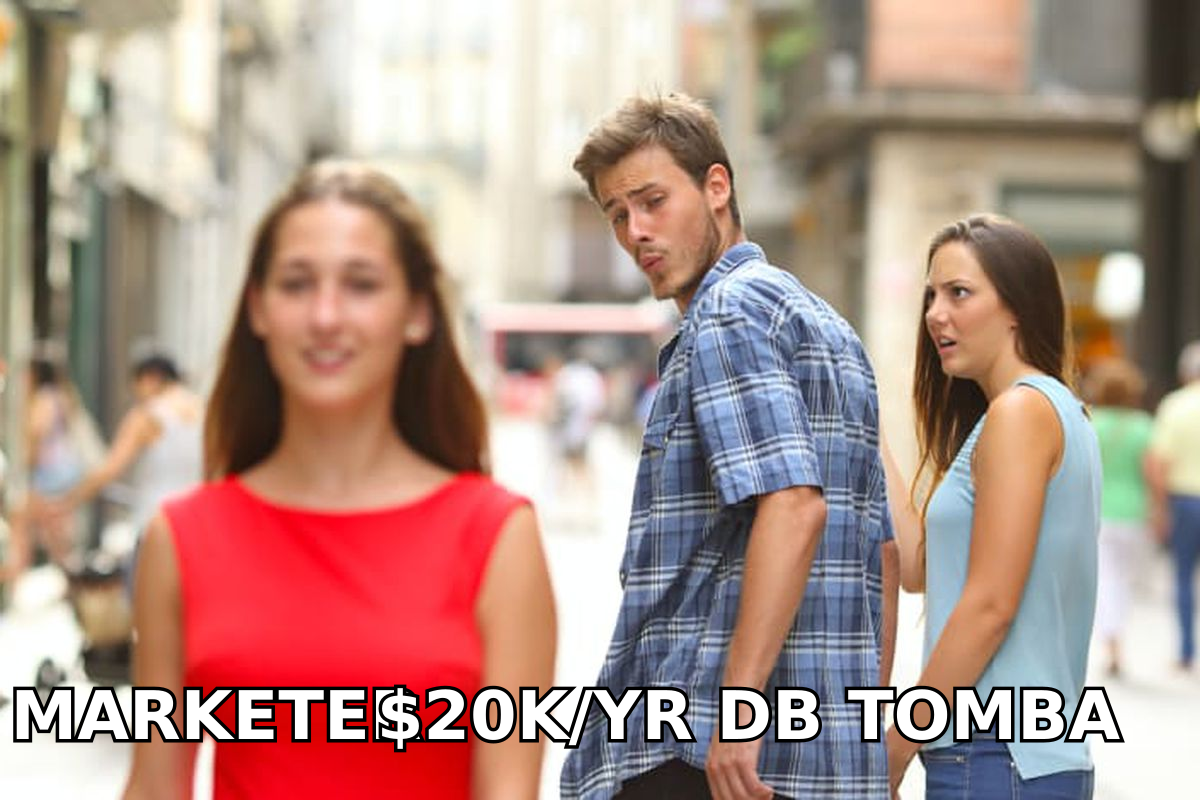
The buying mistake I see most often: a team signs a $24K annual contract, uses it heavily for the first quarter's list build, then barely touches it for the next nine months. They paid $24K for roughly $4K of value. Usage-based suppliers eliminate that waste.
Is more data always better?#
No — and this is the most expensive misconception in the category. A supplier advertising "300 million contacts" is telling you about volume, not value. The metric that hits your revenue is deliverable, accurate, in-ICP records.
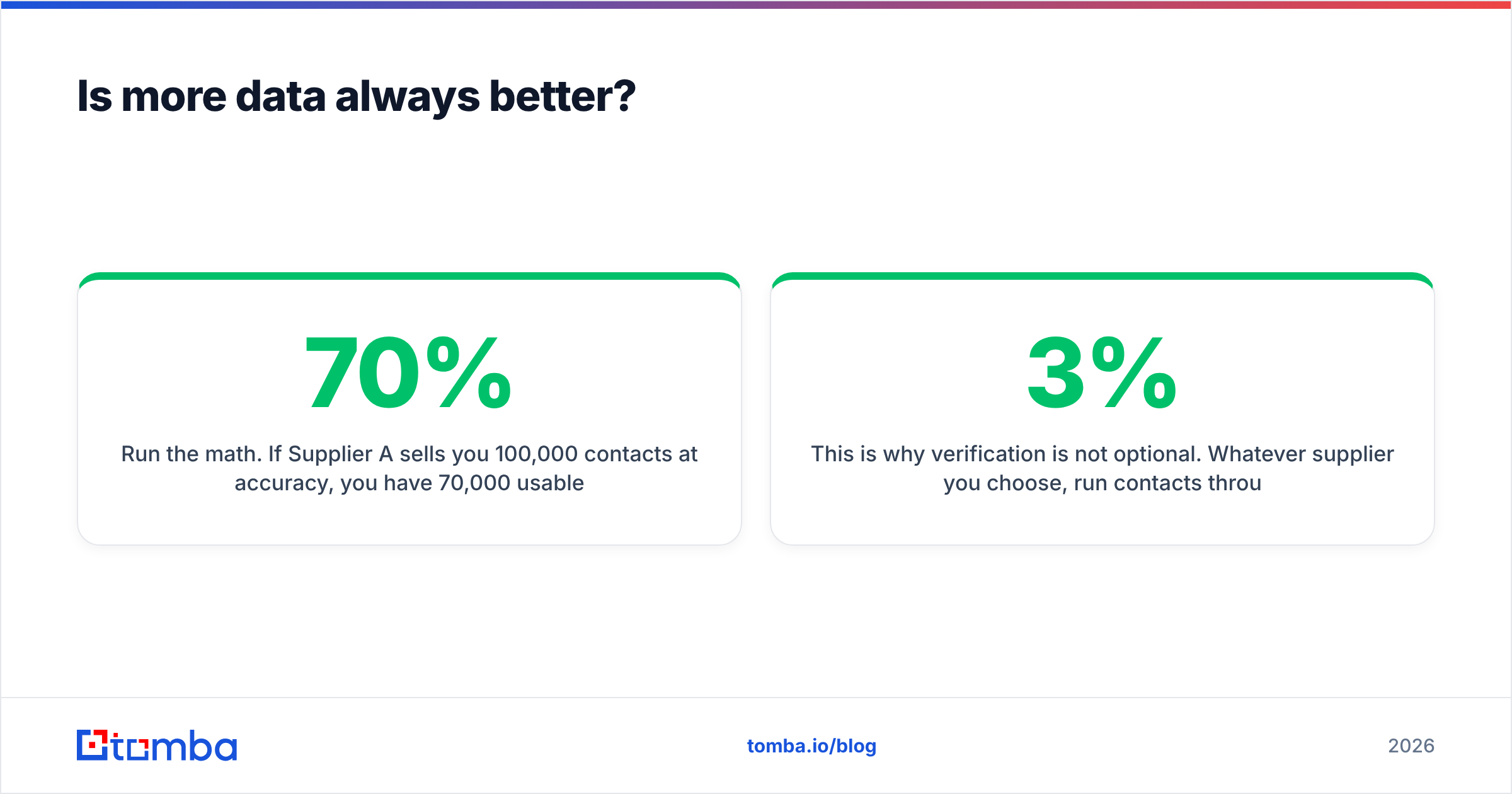
Run the math. If Supplier A sells you 100,000 contacts at 70% accuracy, you have 70,000 usable records and 30,000 that will bounce, mismatch, or burn your domain reputation. Supplier B sells 60,000 contacts at 95% accuracy — that's 57,000 usable records and a clean sender reputation. Supplier B is the better buy despite the smaller number.
Bad data compounds in three ways:
- Bounces push your domain toward spam folders, hurting every campaign.
- Wrong titles route your outreach to people who can't buy.
- Stale firmographics make your segmentation lie to you.
This is why verification is not optional. Whatever supplier you choose, run contacts through an independent email verifier before they enter a sequence — even data from premium suppliers decays at roughly 2–3% per month as people change jobs.

What about compliance and data sourcing?#
In 2026, where a supplier gets its data is a legal question, not a technical one. Regulators across the EU and several US states have made it clear that "we scraped it publicly" is not a complete lawful basis for processing personal data in outbound sales.
Before you sign, get written answers to these:
- What is your lawful basis for processing EU personal data (legitimate interest, consent)?
- How do you handle opt-outs and suppression requests across your dataset?
- Will you sign a DPA, and where is the data stored?
- Are direct dials and mobiles sourced and verified compliantly in each region?
- How transparent are your data sources? Suppliers like Tomba publish where their data comes from — vague answers here are a warning sign.
The official guidance from data-protection authorities (for example, the principles summarized on the UK ICO and equivalent EU resources) is worth a read, and most reputable suppliers will point you to their own compliance pages — for instance, ZoomInfo's privacy center documents its approach. If a vendor can't produce comparable documentation, treat that as a disqualifier, not a negotiation point.
How do you choose without getting burned?#
Run a structured bake-off. It takes a day and saves you a year of regret.
- Pick 100 real target accounts from your ICP — same list for every vendor.
- Request a trial or use the free tier from your three finalists. Tomba's free tier and Apollo's credits both make this possible at zero cost.
- Pull the same fields (work email, direct dial, title, headcount) for all 100.
- Verify independently — run every returned email through a neutral checker and call a sample of phone numbers.
- Score deliverable accuracy and coverage, then divide by price. The winner is rarely the biggest brand.
For teams whose primary need is reachable, verified contacts rather than a full platform, fold Tomba into that test directly. You can find emails by domain for your 100 accounts, enrich them, and verify in one flow — then compare the bounce rate head-to-head against the incumbents. If you work in spreadsheets, the Google Sheets add-on and the Tomba API make the bake-off easy to automate.
Common B2B data supplier mistakes#
- Buying on record count. Coverage is a vanity metric; deliverable accuracy is the real one.
- Skipping verification. Even premium data decays monthly — always re-verify before sequencing.
- Locking into annual seats prematurely. Start usage-based, prove the value, then upgrade if volume justifies it.
- Ignoring compliance until legal asks. Get the DPA and lawful basis up front.
- Using one supplier for everything. The best stacks blend a coverage provider, an enrichment/email API, and an intent source.
The bottom line#
The best B2B data suppliers in 2026 are the ones that give you verified, recent, compliant records at a price that matches how much you actually use them. Big brands win on enterprise depth; usage-based providers win on efficiency and accuracy-per-dollar. Test, don't trust — the accuracy gap between suppliers is wider than any pitch deck admits.
If your real need is finding and verifying the right contacts without an enterprise contract, start with the Tomba Email Finder. Run your 100-account bake-off on the free tier, check the bounce rate yourself, and let the data — not the sales rep — decide. When the numbers hold up, scale credits to your actual volume instead of paying for seats you'll never fill.
// get started
Find, verify and enrich your first contacts today
Start on the free plan with 25 searches a month, then scale when your team is ready.
Free plan · No credit card required · GDPR & CCPA
// about the author