B2B Data UK 2026: GDPR-Safe Sourcing, Accuracy & Buyer's Guide
How to buy, verify, and use B2B data in the UK in 2026 without breaking PECR or GDPR — sourcing, accuracy benchmarks, and a vendor comparison table.
B2B Data UK 2026: GDPR-Safe Sourcing, Accuracy & Buyer's Guide
Buying B2B data in the UK is not like buying it in the US. The same list that powers a compliant outbound campaign in Texas can land you a PECR complaint and an ICO query in London. If you sell into UK accounts, your data strategy has to clear two bars at once: it has to be accurate, and it has to be lawful.
This guide is the practical version — what UK B2B data actually is, where it comes from, how to stay on the right side of GDPR and PECR, and how to pick a provider in 2026 without overpaying for stale records.
TL;DR#
- B2B data UK means business contact and firmographic records for UK-registered companies and their employees — names, roles, work emails, direct dials, and company attributes.
- UK law treats personal data the same in B2B as B2C under UK GDPR, but PECR governs electronic marketing and changes how you can email and call.
- Corporate email to a named individual at a registered company is generally permissible under legitimate interest — but you still owe transparency and an opt-out.
- Accuracy decays fast: roughly 2.5–3% of B2B records go stale every month, so verification matters more than raw volume.
- Pick a provider on verification quality, UK coverage, and refresh cadence, not headline contact counts. Always re-verify before you send.
What counts as B2B data in the UK?#
B2B data is the structured information you use to identify, reach, and qualify business buyers. In a UK context it usually breaks into three layers:
- Firmographic data — company name, Companies House number, registered address, SIC code, headcount band, turnover, and sector. Much of this is public via Companies House.
- Contact data — a named person's job title, work email, direct dial or mobile, and LinkedIn profile.
- Intent and technographic data — which tools a company runs, hiring signals, funding events, and topics they're researching.
The contact layer is where compliance gets real. A work email like jane.doe@acme.co.uk is personal data under UK GDPR because it identifies a living individual — even though it sits at a business domain. That single fact drives most of the rules below.
)
Is buying B2B data legal in the UK?#
Yes — buying and using UK B2B data is legal, but how you contact people is constrained by PECR on top of UK GDPR. The two laws answer different questions.
UK GDPR governs processing personal data: you need a lawful basis, you must be transparent, and people can object. For B2B prospecting, the usual lawful basis is legitimate interest, which requires a documented Legitimate Interests Assessment (LIA) balancing your commercial interest against the individual's rights.
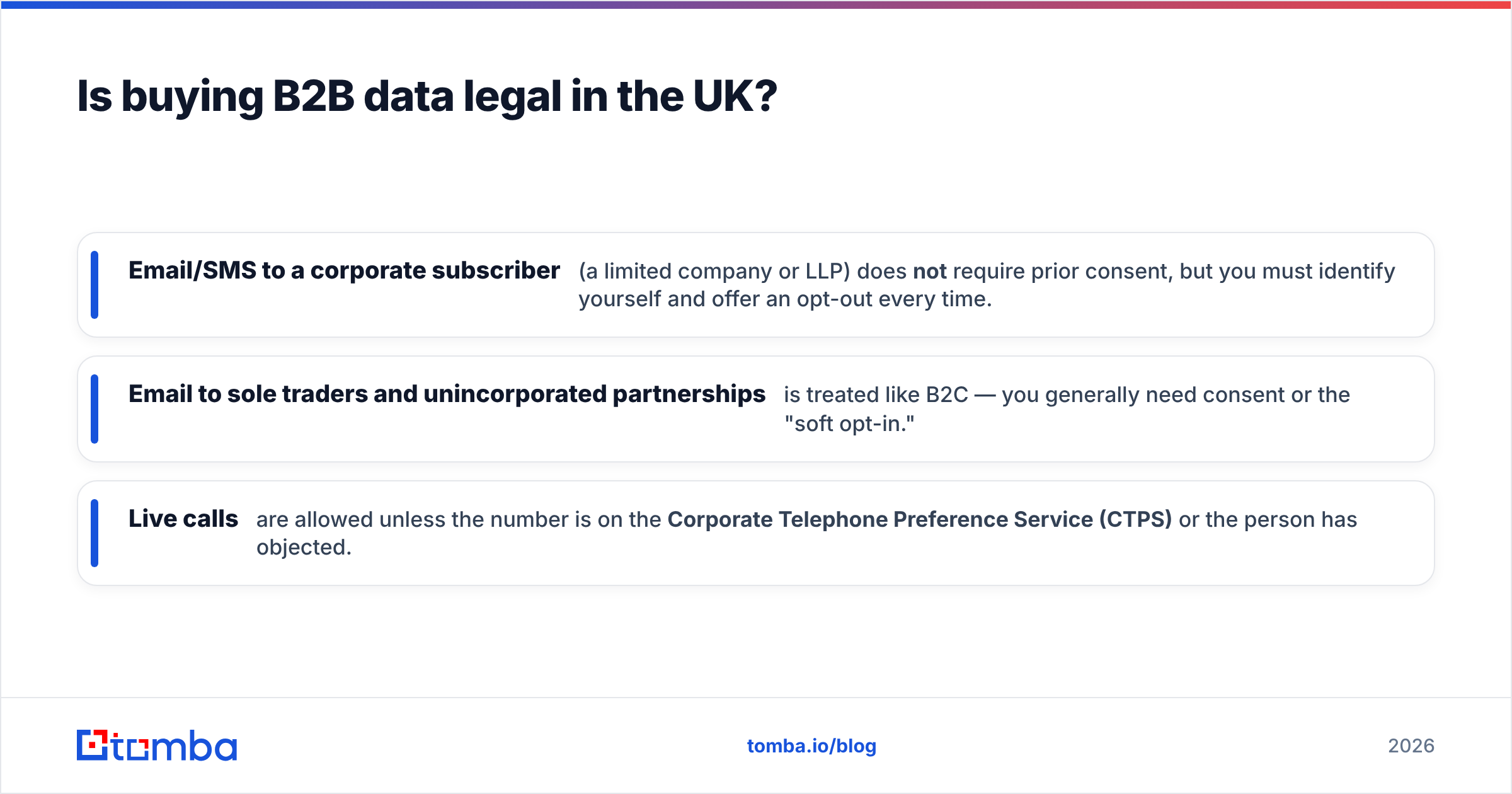
PECR (the Privacy and Electronic Communications Regulations) governs the channel — email, calls, and texts. The headline rules for 2026:
- Email/SMS to a corporate subscriber (a limited company or LLP) does not require prior consent, but you must identify yourself and offer an opt-out every time.
- Email to sole traders and unincorporated partnerships is treated like B2C — you generally need consent or the "soft opt-in."
- Live calls are allowed unless the number is on the Corporate Telephone Preference Service (CTPS) or the person has objected.
The ICO's direct marketing guidance is the authoritative source — read it before you build a UK sequence. None of this is legal advice; when in doubt, get a DPO or solicitor to sign off your LIA.
Where does UK B2B data come from?#
Good data is sourced from layered, refreshable signals — not a single scraped dump. The cleaner providers blend:
- Public registers — Companies House filings for firmographics and director records.
- Web and domain crawling — published staff pages, press releases, and contact pages.
- Email pattern inference — deducing
first.last@domainformats and validating them with SMTP checks. - User-contributed and partner data — opt-in networks and licensed datasets.
- Continuous verification — re-checking deliverability and employment status on a cadence.
This is why a domain search against a UK company returns more reliable results than a years-old purchased CSV: it reflects the live state of that company's email infrastructure rather than a frozen snapshot. For deeper context on provenance, see how Tomba documents its data sources.
How accurate is UK B2B data, really?#
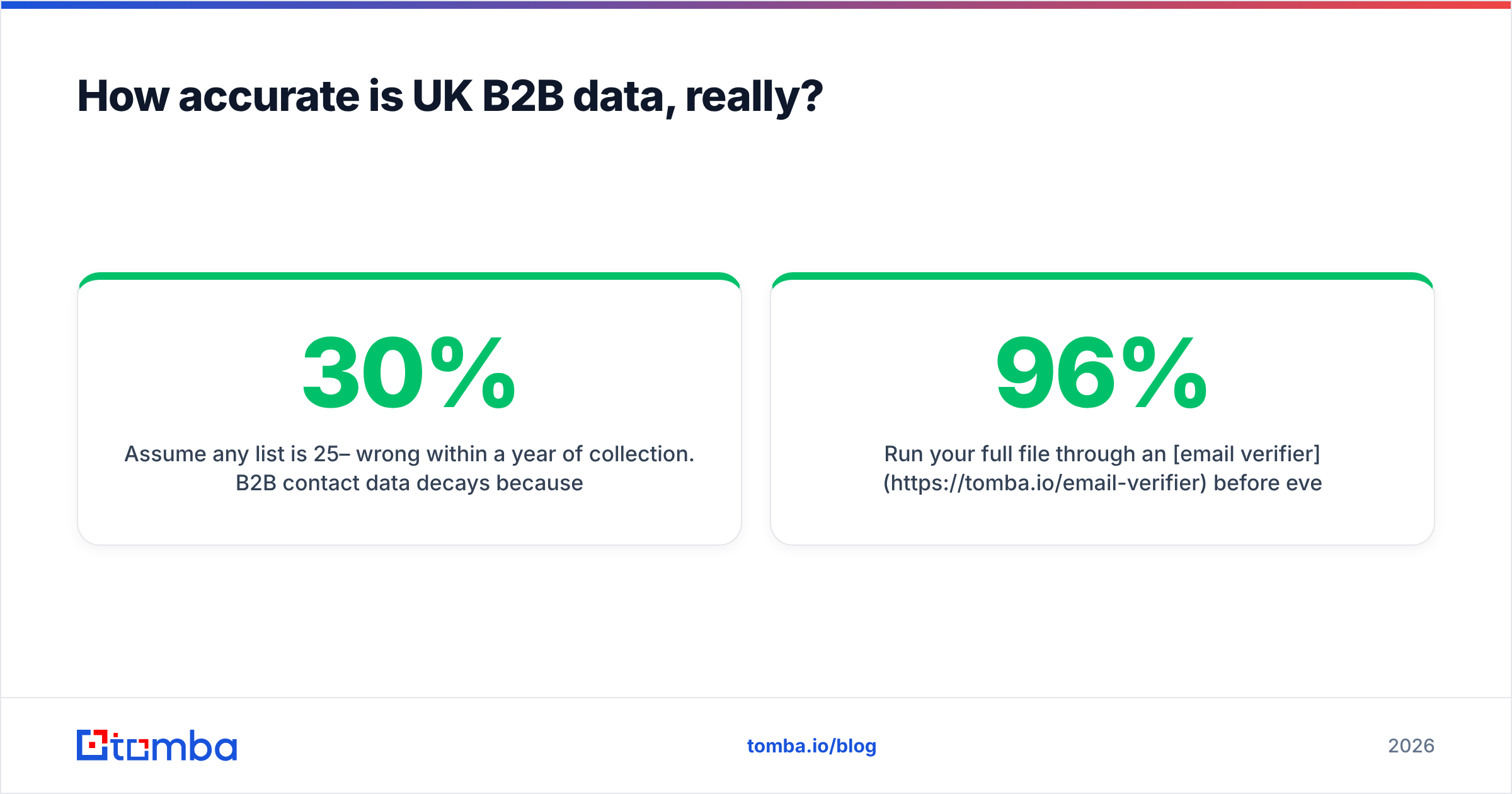
Assume any list is 25–30% wrong within a year of collection. B2B contact data decays because people change jobs, companies rebrand, and mailboxes get retired. Industry estimates put monthly decay around 2.5–3% of records, which compounds fast.
That decay is why verification is the single highest-leverage step in your workflow. A two-stage approach works best:
- Syntax + domain + MX check to drop obviously dead addresses.
- SMTP-level deliverability check to confirm the mailbox accepts mail, plus a catch-all verifier pass for domains that accept everything.
Run your full file through an email verifier before every campaign, not just at purchase. A 96% list that you bought six months ago is not a 96% list today.
)
How do UK B2B data providers compare?#
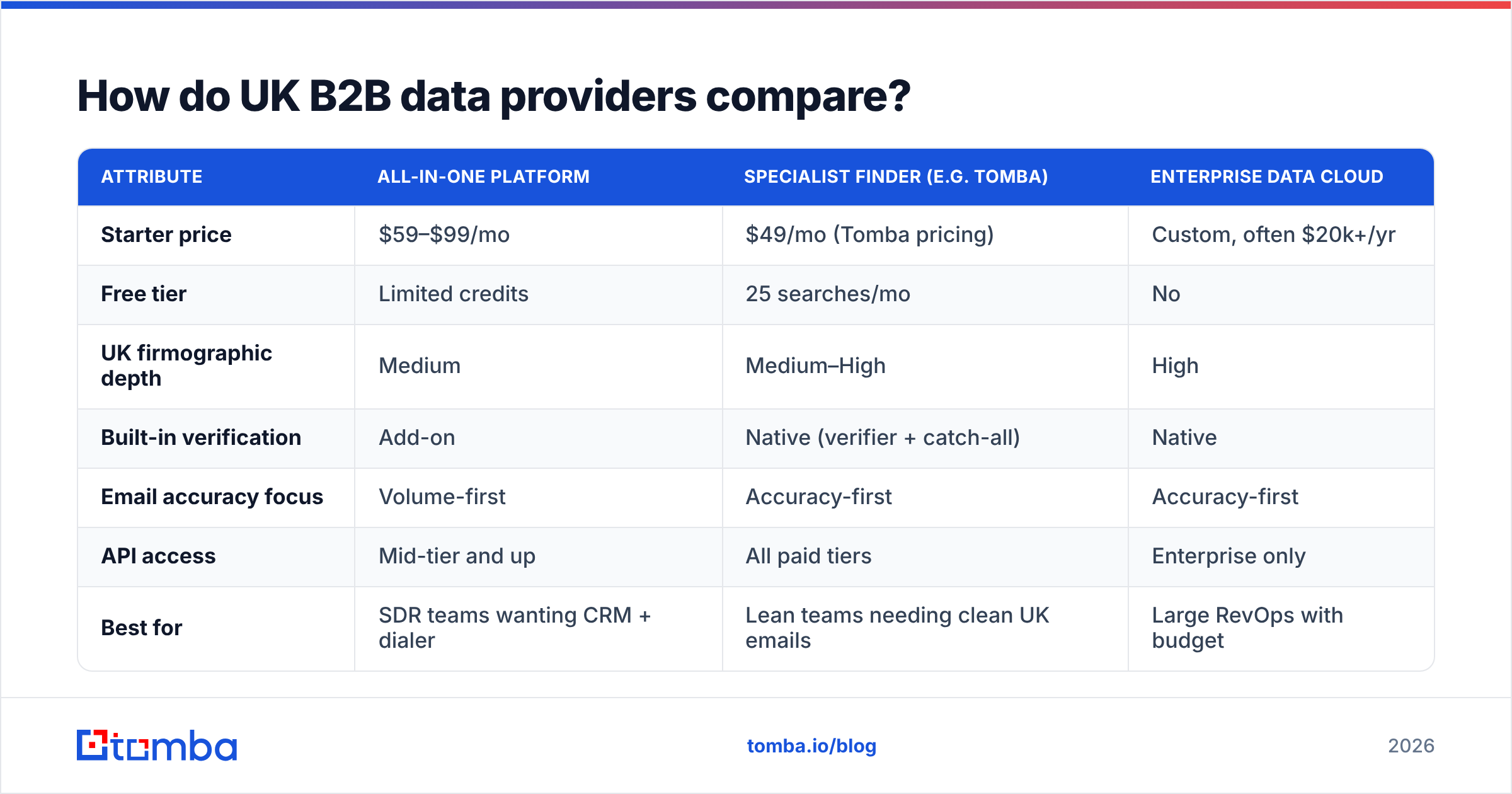
Most providers fall into one of three categories: all-in-one sales platforms, specialist email-finding tools, and enterprise data warehouses. They differ sharply on UK coverage, verification rigour, and price. Here's a representative comparison:
| Attribute | All-in-one platform | Specialist finder (e.g. Tomba) | Enterprise data cloud |
|---|---|---|---|
| Starter price | $59–$99/mo | $49/mo (Tomba pricing) | Custom, often $20k+/yr |
| Free tier | Limited credits | 25 searches/mo | No |
| UK firmographic depth | Medium | Medium–High | High |
| Built-in verification | Add-on | Native (verifier + catch-all) | Native |
| Email accuracy focus | Volume-first | Accuracy-first | Accuracy-first |
| API access | Mid-tier and up | All paid tiers | Enterprise only |
| Best for | SDR teams wanting CRM + dialer | Lean teams needing clean UK emails | Large RevOps with budget |
The takeaway: if your priority is deliverable UK work emails at a sane price, a specialist finder with native verification usually beats paying enterprise rates for firmographic breadth you won't use. If you need account-level intent and a 200-person SDR motion, the enterprise clouds earn their cost.
For independent buyer signal, cross-check vendors on G2 before committing — look at the UK-specific reviews, not just the global average.
What should you look for in a UK B2B data provider?#
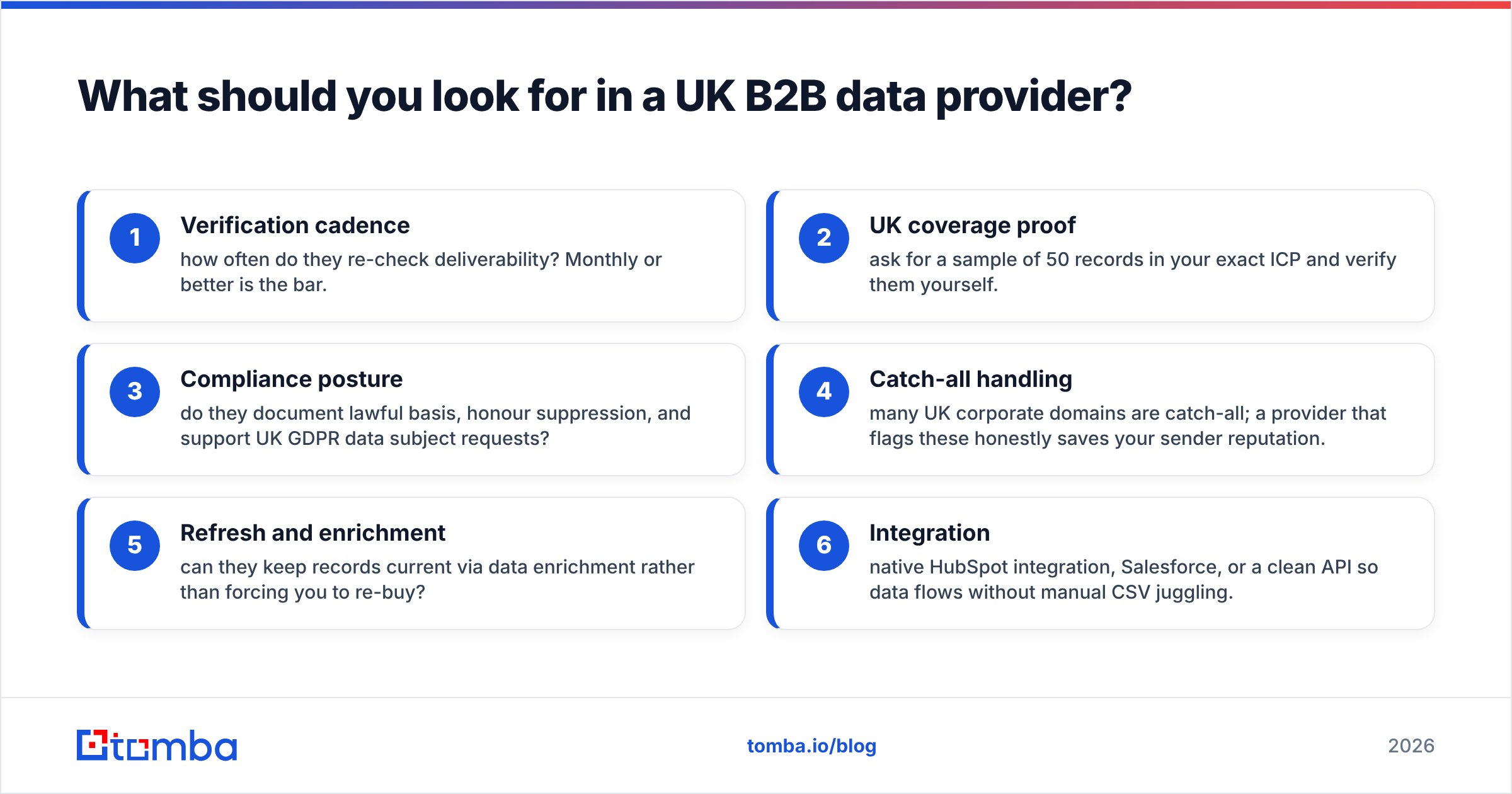
Use this checklist when you evaluate. Each item maps to a real failure mode:
- Verification cadence — how often do they re-check deliverability? Monthly or better is the bar.
- UK coverage proof — ask for a sample of 50 records in your exact ICP and verify them yourself.
- Compliance posture — do they document lawful basis, honour suppression, and support UK GDPR data subject requests?
- Catch-all handling — many UK corporate domains are catch-all; a provider that flags these honestly saves your sender reputation.
- Refresh and enrichment — can they keep records current via data enrichment rather than forcing you to re-buy?
- Integration — native HubSpot integration, Salesforce, or a clean API so data flows without manual CSV juggling.
The cheapest list with no verification is the most expensive option once you price in bounced sends, damaged sender reputation, and wasted SDR hours.
How do you keep UK B2B data compliant and clean over time?#
Compliance and data hygiene are the same discipline viewed from two angles. A maintainable UK B2B data process looks like this:
- Document your lawful basis once. Write the LIA, store it, and reference it in your privacy notice.
- Suppress on request, immediately. Maintain a do-not-contact list and check every send against it.
- Honour CTPS for calls. Screen numbers before dialling.
- Re-verify on a schedule. Treat verification as a recurring job, not a one-off — automate it through the Tomba API or a bulk verify run.
- Log provenance. Keep a record of where each contact came from so you can answer an ICO query or a data subject access request in minutes, not weeks.
Done well, this is mostly automated. The manual part is the policy decision up front; the ongoing work is verification and suppression, both of which tooling handles.
Common mistakes UK teams make with B2B data#
- Treating B2B like consent-free spam. PECR still requires identification and opt-out on every corporate email. Skipping it invites complaints.
- Buying volume over verified deliverability. A 500k-record dump with 30% bounces will torch your domain reputation faster than it generates pipeline.
- Emailing sole traders as if they were limited companies. Sole traders get B2C-level protection — segment them out or get consent.
- Never re-verifying. Decay is relentless. A list is a liability the moment it stops being maintained.
- Ignoring catch-all domains. Sending blind to catch-all addresses inflates your "valid" count while quietly hurting deliverability.
Avoiding these five covers most of the risk for a typical UK outbound team.
Frequently asked questions#
Is scraping LinkedIn for UK B2B data legal? Scraping itself sits in a legal grey area and likely breaches LinkedIn's terms; more importantly, the resulting personal data is still subject to UK GDPR. Prefer compliant sourcing — for example, finding work emails for known contacts via a LinkedIn finder tied to a documented lawful basis — over bulk profile scraping.
Do I need consent to email a UK business contact? For a named individual at a limited company, you can generally rely on legitimate interest under UK GDPR plus the corporate-subscriber rules in PECR — no prior consent, but always identify yourself and include an opt-out. Sole traders and partnerships need consent or the soft opt-in.
How often should I clean my UK B2B list? Before every campaign, and at least monthly for active databases. Decay of ~2.5–3% per month means a quarterly-only cadence leaves nearly 10% rot between cleans.
What's the difference between B2B data and a B2B database? Data is the individual records; a B2B database is the maintained, queryable store with refresh and enrichment built in. The database is what keeps the data from going stale.
Conclusion: start with clean, verified UK emails#
The winning move for UK B2B data in 2026 is boring and effective: source from live, layered signals; verify before every send; document your lawful basis once; and suppress on request. Volume is not the metric — deliverable, lawful, current contacts are.
If you want clean UK work emails without an enterprise contract, start with the Tomba Email Finder. Find email addresses by domain, name, or company, run them through the built-in verifier and catch-all checks, and push the results straight into your CRM. The free tier gives you 25 searches a month to test UK coverage on your own ICP before you spend a pound — and the $49/mo Starter plan scales it once the data proves out.
// get started
Find, verify and enrich your first contacts today
Start on the free plan with 25 searches a month, then scale when your team is ready.
Free plan · No credit card required · GDPR & CCPA
Get the Tomba newsletter
Product and data updates
// about the author