Best B2B Database Providers in India (2026 Comparison Guide)
Comparing the top B2B database providers in India for 2026 — pricing, data accuracy, compliance, and which one actually fits your outbound motion.
Buying a B2B contact list in India used to mean a dodgy Excel file from a vendor on a WhatsApp group. In 2026, the market is more professional — but the gap between a good provider and a list-broker dressed up as a SaaS is wider than ever. This guide compares the real options so you stop paying for bounced emails.
TL;DR#
- The best B2B database providers in India fall into three buckets: global platforms with India coverage (ZoomInfo, Apollo, Tomba), India-first list vendors (EasyLeadz, Lusha resellers, JustDial-style scrapers), and self-serve verification tools you pair with your own sourcing.
- Data accuracy matters more than database size. A "60 million Indian contacts" claim is worthless if 40% bounce. Verified, freshly-checked emails beat raw volume every time.
- DPDP Act 2023 changed the rules. Indian buyers now need providers that can show lawful sourcing and consent posture, not just a download button.
- For most SMBs and outbound teams, a verify-first finder like Tomba plus a focused India source beats one giant, stale database — and costs far less than ZoomInfo.
- Test before you commit. Run 50 sample contacts through an email verifier before signing any annual contract.
What is a B2B database provider, and why does India need its own list?#
A B2B database provider sells (or licenses) structured contact and company data: names, job titles, work emails, phone numbers, company size, industry, and tech stack. You use it to build target lists for cold email, calling, and account-based marketing.
Think of it like a phone book that updates itself — except a bad one is a phone book from 2019 with half the numbers disconnected.
India deserves its own evaluation for three concrete reasons:
- Email patterns differ. Indian SMBs lean heavily on Gmail and regional hosting, while enterprises use predictable corporate formats. A provider tuned only for US
firstname.lastname@patterns misses a lot. - Phone is still king. In India, a verified mobile number often converts better than email. Phone coverage and a working phone validator are not optional.
- Compliance is local. The Digital Personal Data Protection (DPDP) Act 2023 governs how personal data is processed. Global tools that ignore it create real risk for Indian buyers.
What separates a good India B2B database from a bad one?#
Size is the vanity metric vendors love to quote. Ignore it. Here is what actually predicts ROI.
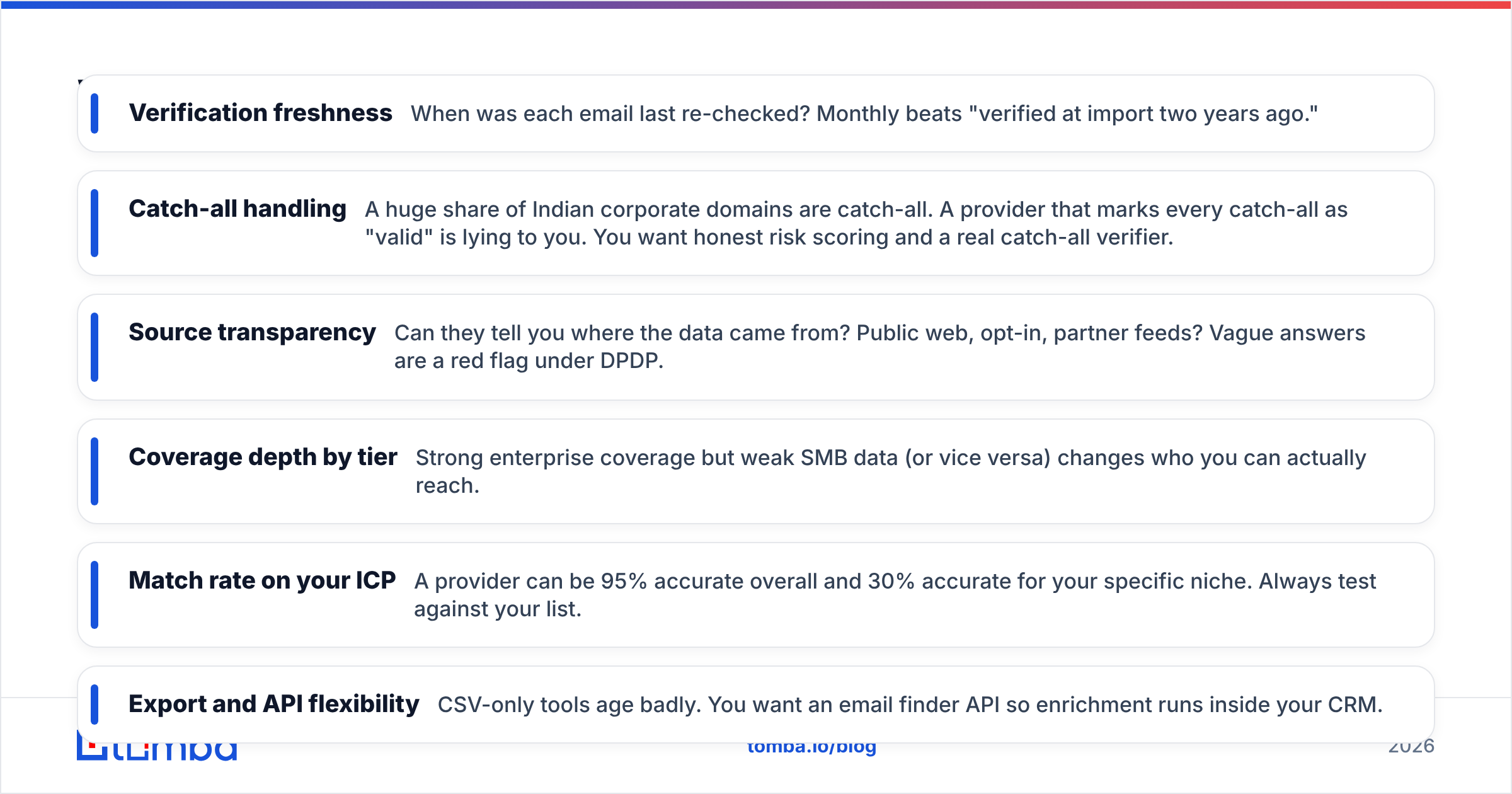
- Verification freshness — When was each email last re-checked? Monthly beats "verified at import two years ago."
- Catch-all handling — A huge share of Indian corporate domains are catch-all. A provider that marks every catch-all as "valid" is lying to you. You want honest risk scoring and a real catch-all verifier.
- Source transparency — Can they tell you where the data came from? Public web, opt-in, partner feeds? Vague answers are a red flag under DPDP.
- Coverage depth by tier — Strong enterprise coverage but weak SMB data (or vice versa) changes who you can actually reach.
- Match rate on your ICP — A provider can be 95% accurate overall and 30% accurate for your specific niche. Always test against your list.
- Export and API flexibility — CSV-only tools age badly. You want an email finder API so enrichment runs inside your CRM.
If a provider won't let you run a free sample, that tells you everything about how confident they are in the data.
Which are the best B2B database providers in India in 2026?#
Below is a neutral comparison of the categories of providers you'll evaluate. Prices are list prices for entry paid tiers as of 2026 and move around — treat them as directional.
| Provider | Type | Entry price | India coverage | Free tier | Best for |
|---|---|---|---|---|---|
| Tomba | Email finder + verifier | $49/mo | Strong (domain + pattern based) | 25 searches/mo | Verify-first outbound, SMB to mid-market |
| ** |
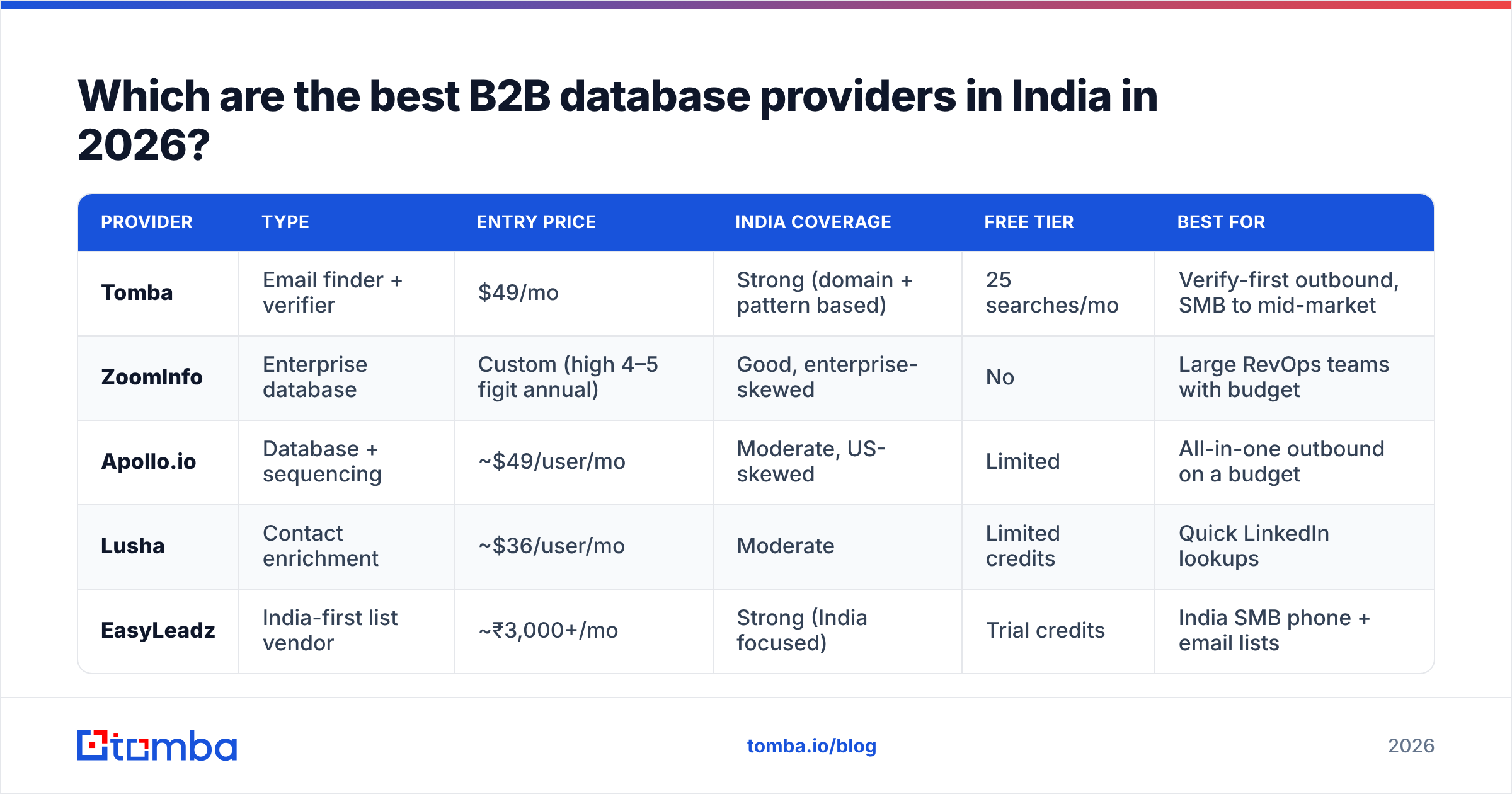
ZoomInfo** | Enterprise database | Custom (high 4–5 figit annual) | Good, enterprise-skewed | No | Large RevOps teams with budget | | Apollo.io | Database + sequencing | ~$49/user/mo | Moderate, US-skewed | Limited | All-in-one outbound on a budget | | Lusha | Contact enrichment | ~$36/user/mo | Moderate | Limited credits | Quick LinkedIn lookups | | EasyLeadz | India-first list vendor | ~₹3,000+/mo | Strong (India focused) | Trial credits | India SMB phone + email lists |
A few honest takeaways from the table:
- ZoomInfo has the deepest enterprise data but pricing puts it out of reach for most Indian SMBs and early-stage teams. You're buying coverage you may never use.
- Apollo is the popular "everything app," but its India data is thinner than its US data, and deliverability suffers if you blast its built-in sequencer without warmup.
- Lusha is fast for one-off lookups but gets expensive at volume and is credit-gated.
- EasyLeadz and similar India-first vendors win on local phone coverage but vary wildly on email freshness — verify everything they hand you.
- Tomba sits in the sweet spot for teams that would rather find and verify on demand than rent a giant stale database. The free tier and $49 Tomba pricing entry point make it easy to test before scaling.
How accurate is the data, really?#
Accuracy is where most "millions of contacts" claims fall apart. Here's the mental model: a database is a photograph, and people change jobs every day, so the photo is blurring the moment it's taken.
The defense is continuous verification, not a one-time scrub. When you evaluate any provider, ask three questions:
- What's the SMTP-level verification rate on a fresh sample of your ICP — not their cherry-picked demo list?
- How do they score catch-all domains? Honest providers separate "valid," "catch-all/risky," and "invalid." Dishonest ones lump catch-all into "valid" to inflate match rates.
- Can I re-verify on demand through an API before I send?
This is why a verify-first workflow beats a buy-the-list workflow. Even with a great India source, run the contacts through verification at send time. Tomba's approach — find via domain search, confirm each address with the email verifier, and flag catch-alls honestly — is the pattern you want regardless of which vendor you ultimately pick. For more on where contact data originates, providers should be transparent about their data sources.
Independent review platforms help here. Cross-check vendor claims against real user reviews on G2 and Capterra before you trust a sales rep's accuracy number.

What about DPDP Act compliance for Indian B2B data?#
Short answer: it's now a buying criterion, not a footnote.
India's Digital Personal Data Protection Act, 2023 regulates processing of personal data of individuals in India. Business contact data isn't automatically exempt the way it sometimes is under other regimes, so "it's just work emails" is not a free pass. You can read the framework summary on Wikipedia and you should confirm specifics with your own counsel.
What this means practically when choosing among b2b database providers in India:
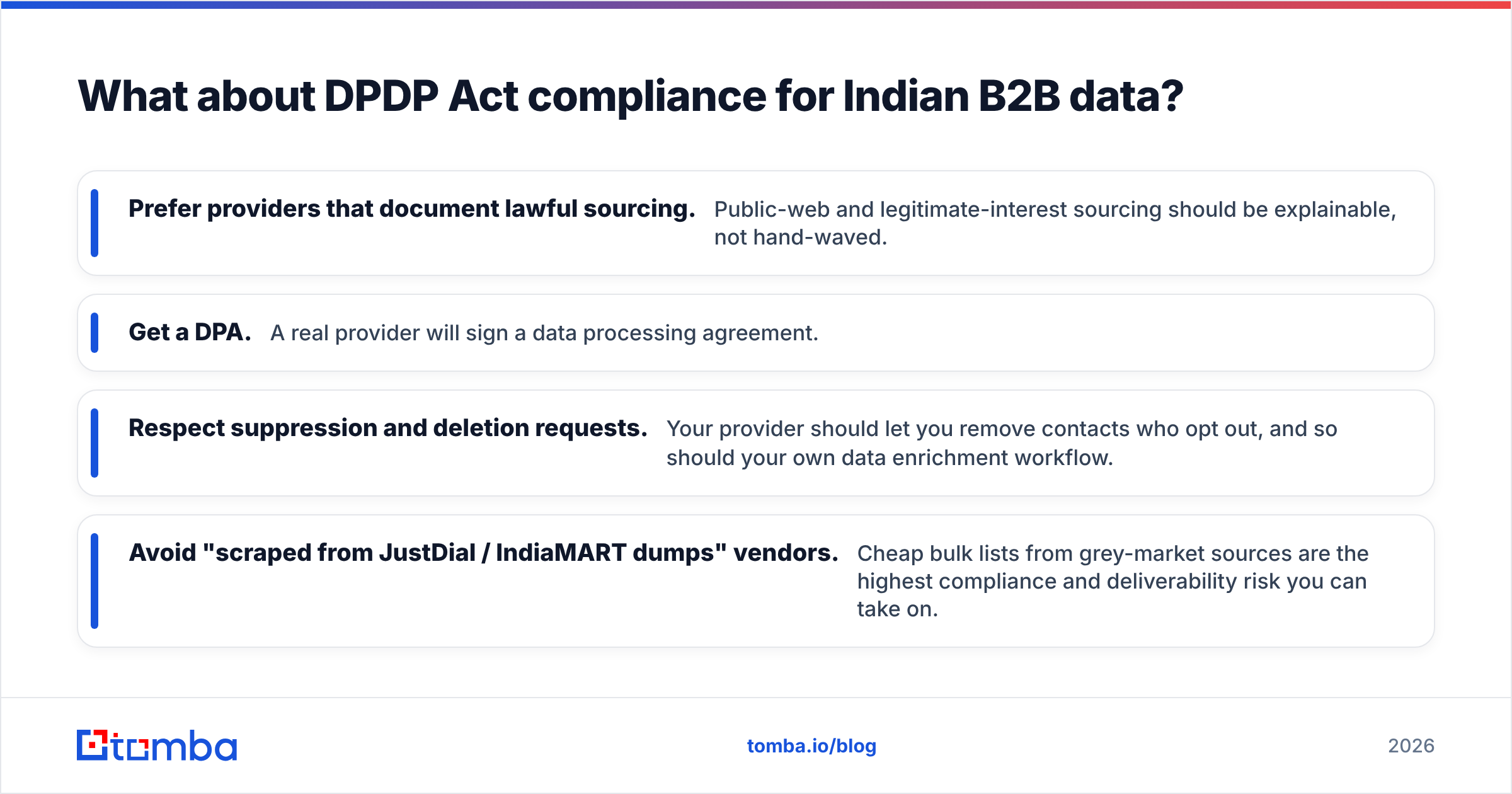
- Prefer providers that document lawful sourcing. Public-web and legitimate-interest sourcing should be explainable, not hand-waved.
- Get a DPA. A real provider will sign a data processing agreement.
- Respect suppression and deletion requests. Your provider should let you remove contacts who opt out, and so should your own data enrichment workflow.
- Avoid "scraped from JustDial / IndiaMART dumps" vendors. Cheap bulk lists from grey-market sources are the highest compliance and deliverability risk you can take on.
Compliance and deliverability actually pull in the same direction: clean, consented, verified data both keeps you lawful and keeps you out of the spam folder. Pair good sourcing with sound email deliverability habits and you protect your domain reputation.
Global platform vs India-first vendor: which should you pick?#
This is the core decision, and the honest answer is "it depends on your motion."
Pick a global platform (ZoomInfo, Apollo) if:
- You sell to large Indian enterprises and need org charts, intent data, and deep firmographics.
- You have RevOps budget and a team to maintain the data.
- Your outbound is multi-region and you want one tool for everything.
Pick an India-first list vendor (EasyLeadz and peers) if:
- You sell to Indian SMBs and local phone numbers are your primary channel.
- You want region-specific coverage that global tools under-serve.
- You're prepared to verify their emails yourself before sending.
Pick a verify-first finder (Tomba) if:
- You'd rather find and confirm contacts on demand than rent a static database.
- Deliverability is your top concern and you refuse to send to unverified addresses.
- You want predictable, low pricing and an API/CLI that drops into your stack.
- You operate lean — SMB, agency, or a focused outbound team.
Many of the best-run teams in India do a hybrid: a focused source for raw coverage, then a finder-plus-verifier layer on top so nothing leaves the building unverified. You can also enrich your existing CRM records rather than re-buying data you already own — that's often the cheapest win available.
How do you test a provider before committing?#
Never sign an annual contract on a demo. Run this 30-minute test instead:
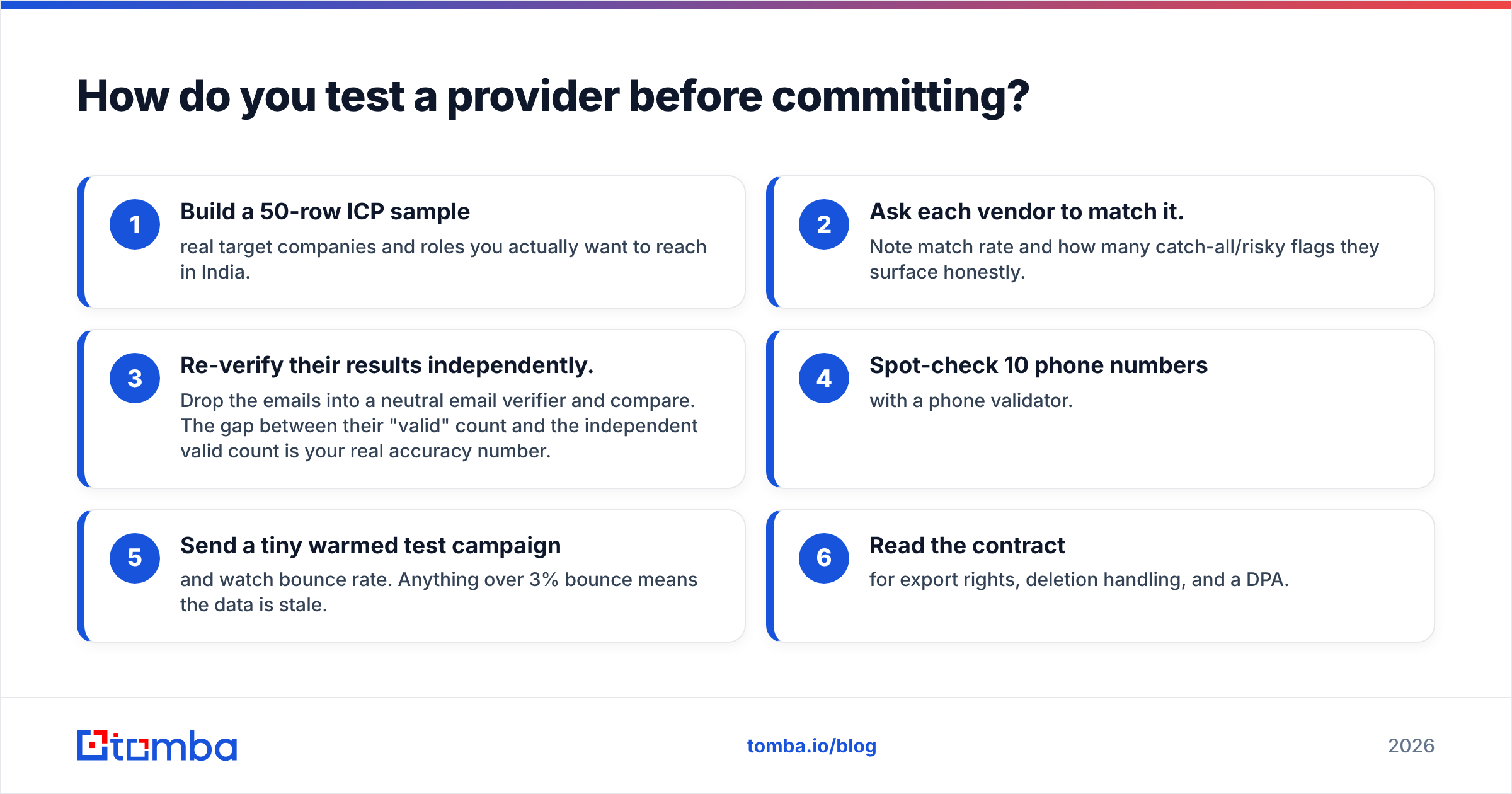
- Build a 50-row ICP sample — real target companies and roles you actually want to reach in India.
- Ask each vendor to match it. Note match rate and how many catch-all/risky flags they surface honestly.
- Re-verify their results independently. Drop the emails into a neutral email verifier and compare. The gap between their "valid" count and the independent valid count is your real accuracy number.
- Spot-check 10 phone numbers with a phone validator.
- Send a tiny warmed test campaign and watch bounce rate. Anything over 3% bounce means the data is stale.
- Read the contract for export rights, deletion handling, and a DPA.
The provider that wins this test — not the one with the biggest logo or the loudest "10 crore contacts" banner — is the one to buy.
Frequently asked questions#
What is the most accurate B2B database provider in India? There's no single winner for every niche. Accuracy is ICP-specific, so the most accurate provider is the one that scores highest on your 50-row sample test. Verify-first tools like Tomba tend to win on email accuracy because they re-check at the point of use rather than relying on a stale snapshot.
Are free B2B databases in India worth it? Free or ultra-cheap bulk lists are usually scraped, stale, and a compliance liability under the DPDP Act. A free tier of a real tool (like Tomba's 25 free searches a month) is different and genuinely useful for testing.
Can I use a global tool like ZoomInfo for India? Yes, with caveats. Coverage skews toward large enterprises and US-style email patterns, and pricing is steep for Indian SMBs. For local SMB and phone-heavy outreach, pair it with an India source or a verify-first finder.
How do I stay DPDP-compliant when buying B2B data? Buy from providers who document lawful sourcing, sign a DPA, honor deletion requests, and avoid grey-market scraped lists. Verify and suppress opt-outs in your own workflow too.
The bottom line#
The best B2B database providers in India in 2026 aren't the ones with the biggest contact counts — they're the ones that hand you fresh, verified, lawfully-sourced data that actually lands in the inbox. For most teams, that means skipping the bloated enterprise contract and running a leaner, verify-first stack.
If you want to test that approach today, start with the Tomba Email Finder. Find professional emails by domain, name, or company, confirm each one with the built-in verifier, get honest catch-all flags, and scale through the API when you're ready — all from a free tier and a $49/mo starting plan. Build your India target list, verify before you send, and let your bounce rate stay where it belongs: near zero.
// get started
Find, verify and enrich your first contacts today
Start on the free plan with 25 searches a month, then scale when your team is ready.
Free plan · No credit card required · GDPR & CCPA
// about the author