B2B Digital Lead Generation in 2026: The Complete Playbook
A no-fluff 2026 guide to B2B digital lead generation: the channels that convert, the funnel math, the tools that scale, and the mistakes that quietly kill pipeline.
TL;DR
- B2B digital lead generation is the system you build to turn online attention into named, contactable, qualified buyers — not a single tactic or one-off campaign.
- The winners in 2026 combine inbound (content, SEO, communities) with outbound (targeted lists, cold email, LinkedIn) instead of betting everything on one channel.
- Data quality beats data quantity. A 500-contact list with verified emails outperforms a 50,000-row scraped dump every single time.
- Track the funnel as math: traffic → MQL → SQL → opportunity → close. If you can't name your conversion rate at each step, you're guessing.
- Tooling should compress three jobs: find the right people, verify they're reachable, and enrich them enough to personalize. That's where an accurate email finder pays for itself.
What is B2B digital lead generation?#
B2B digital lead generation is the process of attracting business buyers online and capturing enough information to start a sales conversation. Think of it like fishing with both a net and a spear: the net (inbound content, SEO, ads) pulls in people who are already looking, and the spear (outbound prospecting) goes after specific accounts you've decided are worth landing.
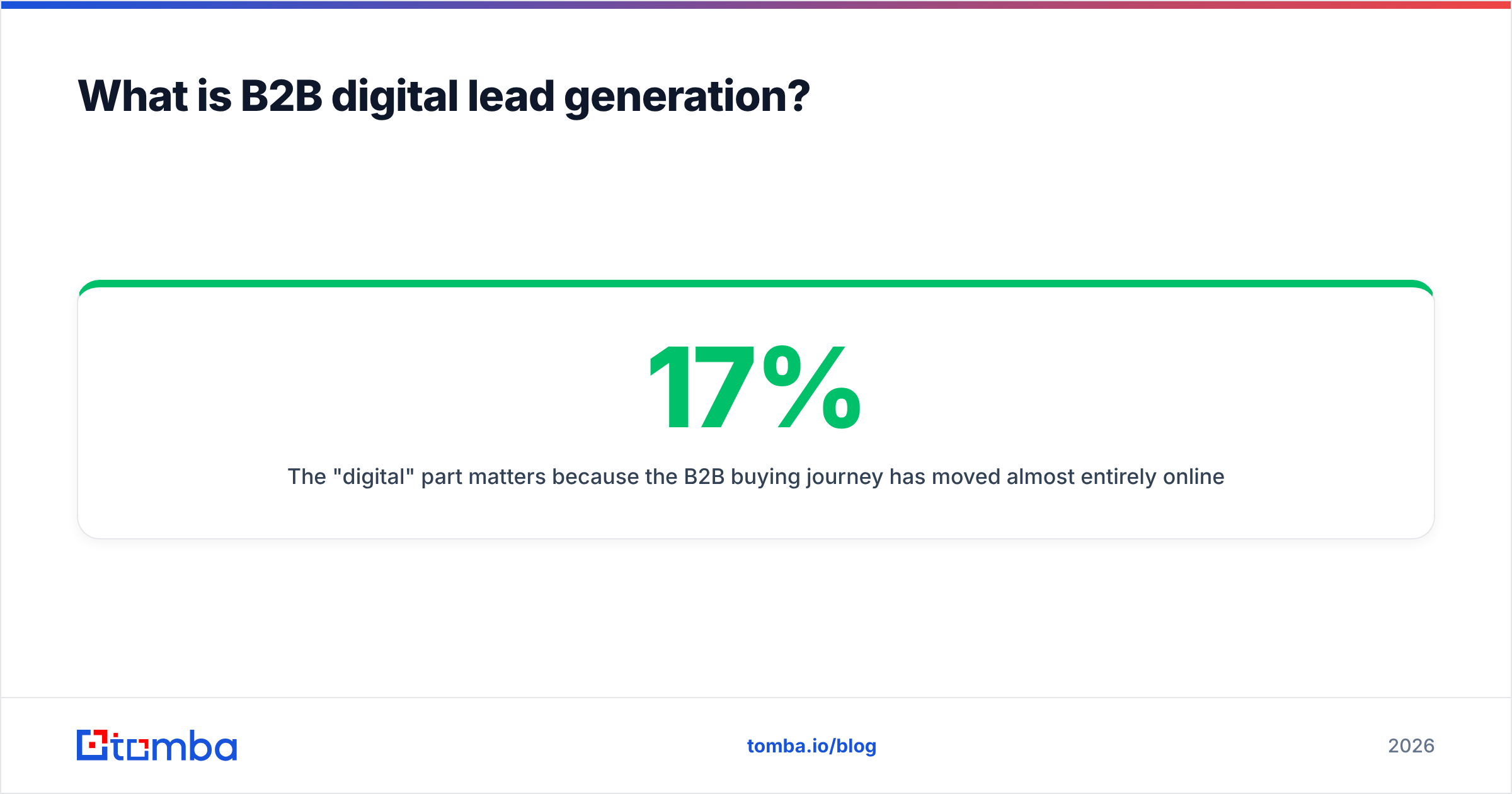
The "digital" part matters because the B2B buying journey has moved almost entirely online. According to Gartner research, buyers spend only about 17% of their total purchase journey actually talking to sales reps — and when comparing multiple vendors, any single rep may get just 5–6% of a buyer's attention. The rest happens in search results, peer communities, review sites, and your competitors' content. If you're not generating demand and capturing intent digitally, you're invisible during 80%+ of the decision.
A real lead is more than an email address. It's a person, at a company that fits your ideal customer profile (ICP), with a role that touches the buying decision, and a reason to care right now. Generating those is the whole game.
Why does B2B lead generation feel harder in 2026?#
Three forces collided. First, inbox and ad saturation — buyers get more outreach than ever and filter aggressively. Second, AI-generated content flooded search, so generic blog posts no longer rank or convert. Third, privacy changes and deliverability crackdowns (Google and Yahoo's bulk-sender rules) punish sloppy senders fast.
The net effect: spray-and-pray is dead. You can't buy a giant list, blast it, and expect results — you'll torch your sender reputation before lunch. The teams winning now run tighter motions: smaller, better-targeted lists; verified contact data; genuinely useful content; and personalization that proves you did your homework.
The upside is that the bar for "good" is higher, which means precision is a moat. If your competitor is still buying stale lists while you're building clean, verified, enriched pipelines, you win on cost per opportunity even if they outspend you.
What are the main B2B digital lead generation channels?#
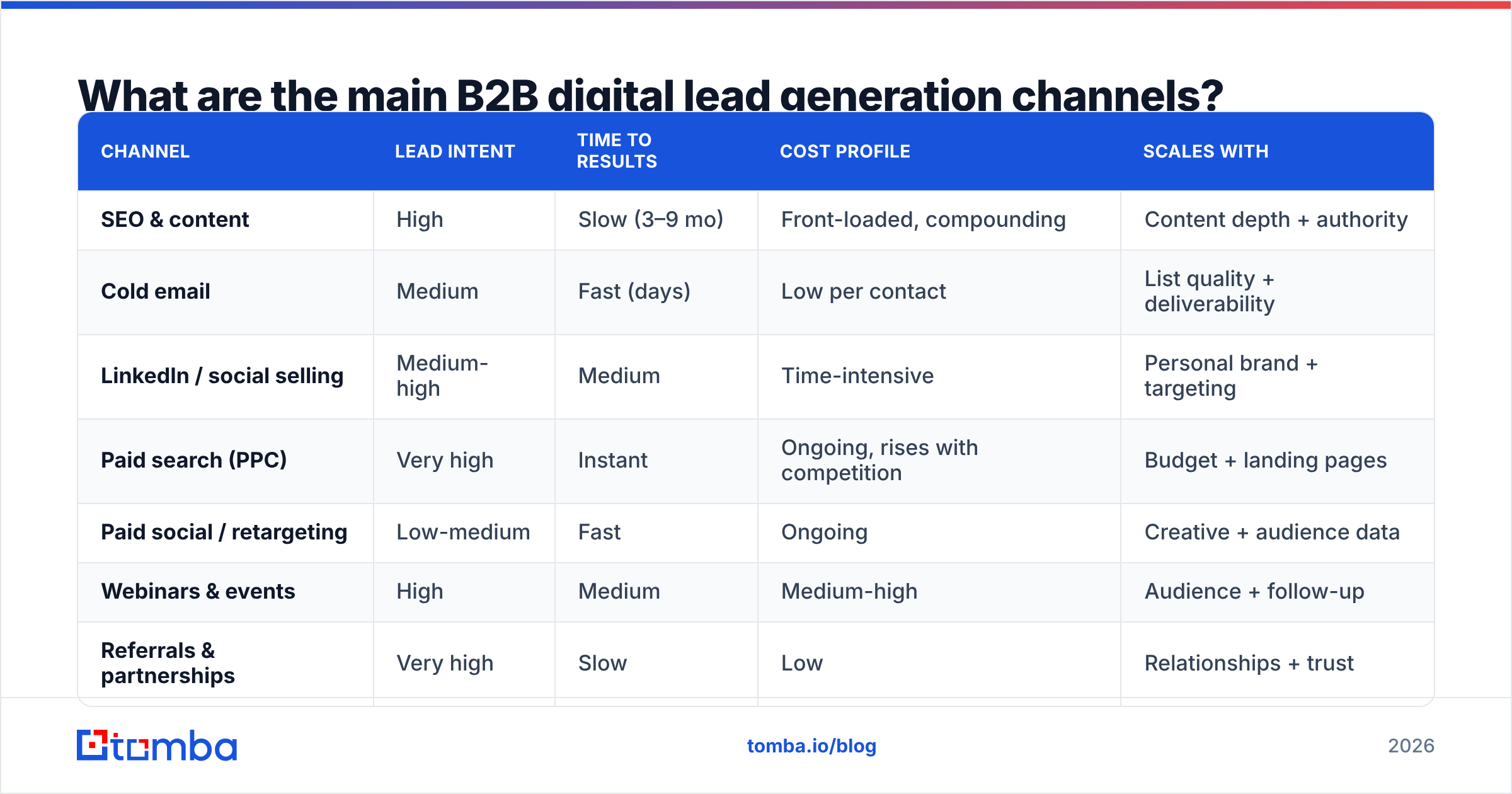
There's no single best channel — there's the right mix for your motion, price point, and sales cycle. Here's how the major channels compare on the attributes that actually decide where to spend.
| Channel | Lead intent | Time to results | Cost profile | Scales with |
|---|---|---|---|---|
| SEO & content | High | Slow (3–9 mo) | Front-loaded, compounding | Content depth + authority |
| Cold email | Medium | Fast (days) | Low per contact | List quality + deliverability |
| LinkedIn / social selling | Medium-high | Medium | Time-intensive | Personal brand + targeting |
| Paid search (PPC) | Very high | Instant | Ongoing, rises with competition | Budget + landing pages |
| Paid social / retargeting | Low-medium | Fast | Ongoing | Creative + audience data |
| Webinars & events | High | Medium | Medium-high | Audience + follow-up |
| Referrals & partnerships | Very high | Slow | Low | Relationships + trust |
A practical 2026 rule: pick one inbound engine (usually SEO/content) and one outbound engine (usually cold email or LinkedIn) and get both genuinely good before adding a third. Most teams spread themselves across six channels and do all of them at 30%.
How do inbound and outbound work together?#
Inbound captures demand that already exists; outbound creates demand among accounts that don't know they need you yet. They feed each other. Your best blog post becomes the "soft touch" that warms a cold-email prospect. Your outbound conversations reveal the exact pain language that makes your next piece of content rank and resonate.
The connective tissue is data. When someone downloads a guide or visits your pricing page, you want to know who they are — not just that "an anonymous visitor from Acme Corp" stopped by. Tools that handle website visitor reveal and contact enrichment turn faceless traffic into named accounts your reps can actually pursue.
How do you build a B2B lead generation funnel that converts?#
Treat the funnel as a series of conversion rates you can measure and improve, not a vibe. Here's the operating model in six steps.
Define the ICP and buying committee. Write down firmographics (industry, size, geography, tech stack) and the 3–5 roles that influence the deal. Everything downstream filters against this. A vague ICP is the root cause of most "leads don't convert" complaints.
Generate traffic and identify accounts. Run your inbound and outbound channels to drive the right companies to your orbit. Use intent signals — content downloads, pricing visits, repeat sessions — to flag who's leaning in.
Capture and find contacts. Turn interest and target accounts into named, reachable people. This is where a domain search for a target company, or an email finder for a specific name, converts "I know the account" into "I can reach the decision-maker."
Verify before you send. Validate every address with an email verifier so bounces don't wreck your deliverability. One bad send list can suppress an entire domain's inbox placement for weeks.
Qualify into MQL → SQL. Score leads against fit and behavior. A marketing qualified lead signals interest; a sales-qualified lead has been vetted as worth a rep's time. Don't pass everything to sales — protect their hours.
Hand off and close. Route qualified leads into your CRM with full context (source, enrichment, engagement history) so the first sales touch feels informed, not cold.
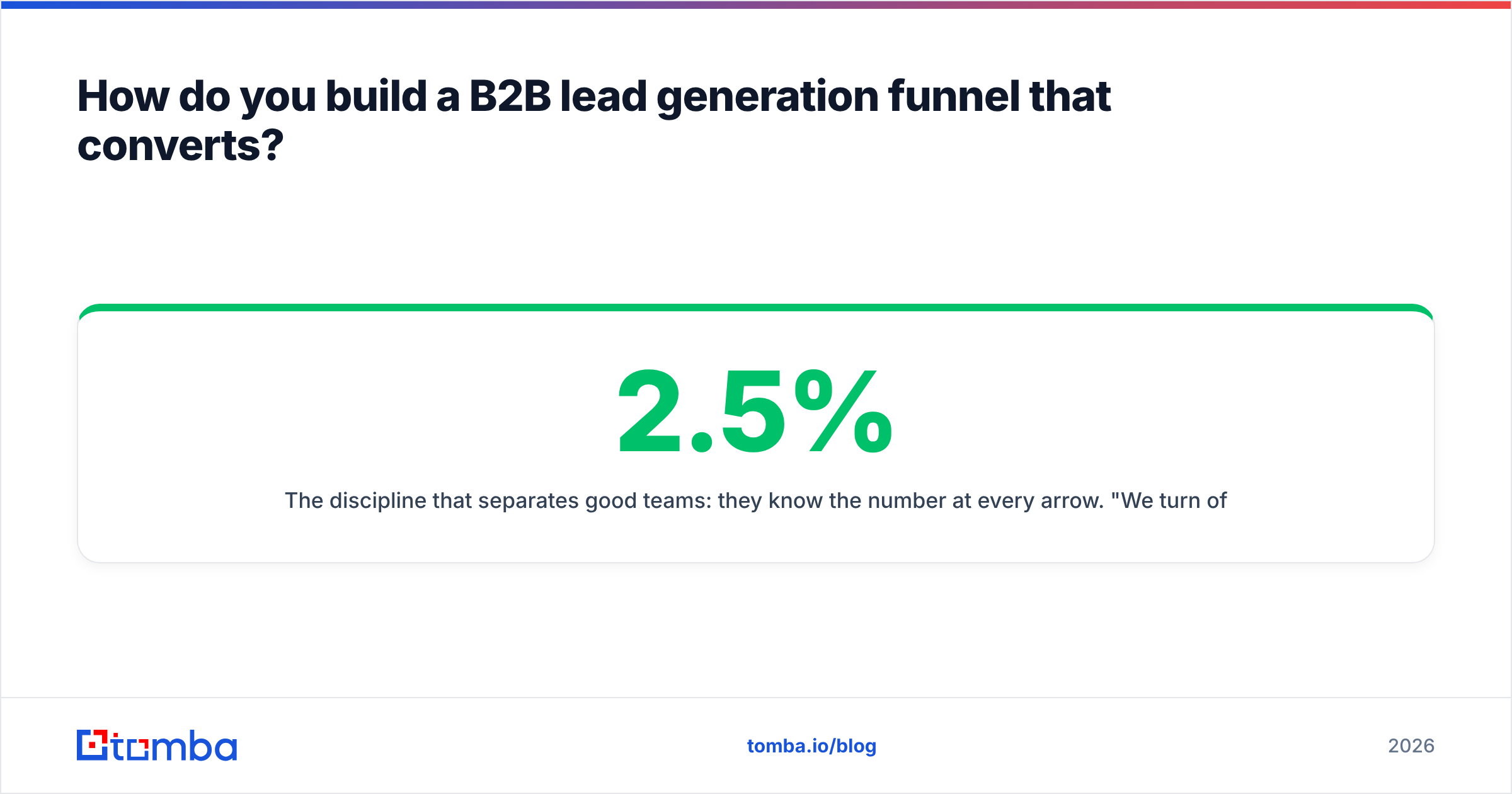
The discipline that separates good teams: they know the number at every arrow. "We turn 2.5% of organic visitors into MQLs, 30% of MQLs into SQLs, and close 22% of opportunities." When you have those numbers, fixing pipeline becomes engineering, not prayer.

What does good lead data actually look like?#
Good lead data is accurate, complete, and current — in that order. An email that bounces is worse than no email because it costs you reputation. A contact with a title but no email is a dead end. A perfect record from 2023 may be a job-changer who left the company 14 months ago.
Here's a simple quality rubric to grade any list before you use it:
- Accuracy — Does the email resolve to a real, deliverable mailbox? Run it through verification; treat catch-all domains with extra care.
- Fit — Does the person match the ICP and sit on the buying committee, or are they a random employee who happens to be findable?
- Freshness — When was the record last confirmed? B2B data decays roughly 2–3% per month as people change roles.
- Completeness — Beyond email, do you have the company, role, and a personalization hook? Enrichment fills these gaps so your outreach earns a reply.
- Compliance — Do you have a lawful basis to contact them (legitimate interest, opt-in) under GDPR/CAN-SPAM?
The cheapest way to improve every downstream metric — open rate, reply rate, cost per opportunity — is to fix the data at the source. You can read more about where accurate B2B data comes from and why verified-at-collection beats scraped-and-hope.
Which tools power modern B2B lead generation?#
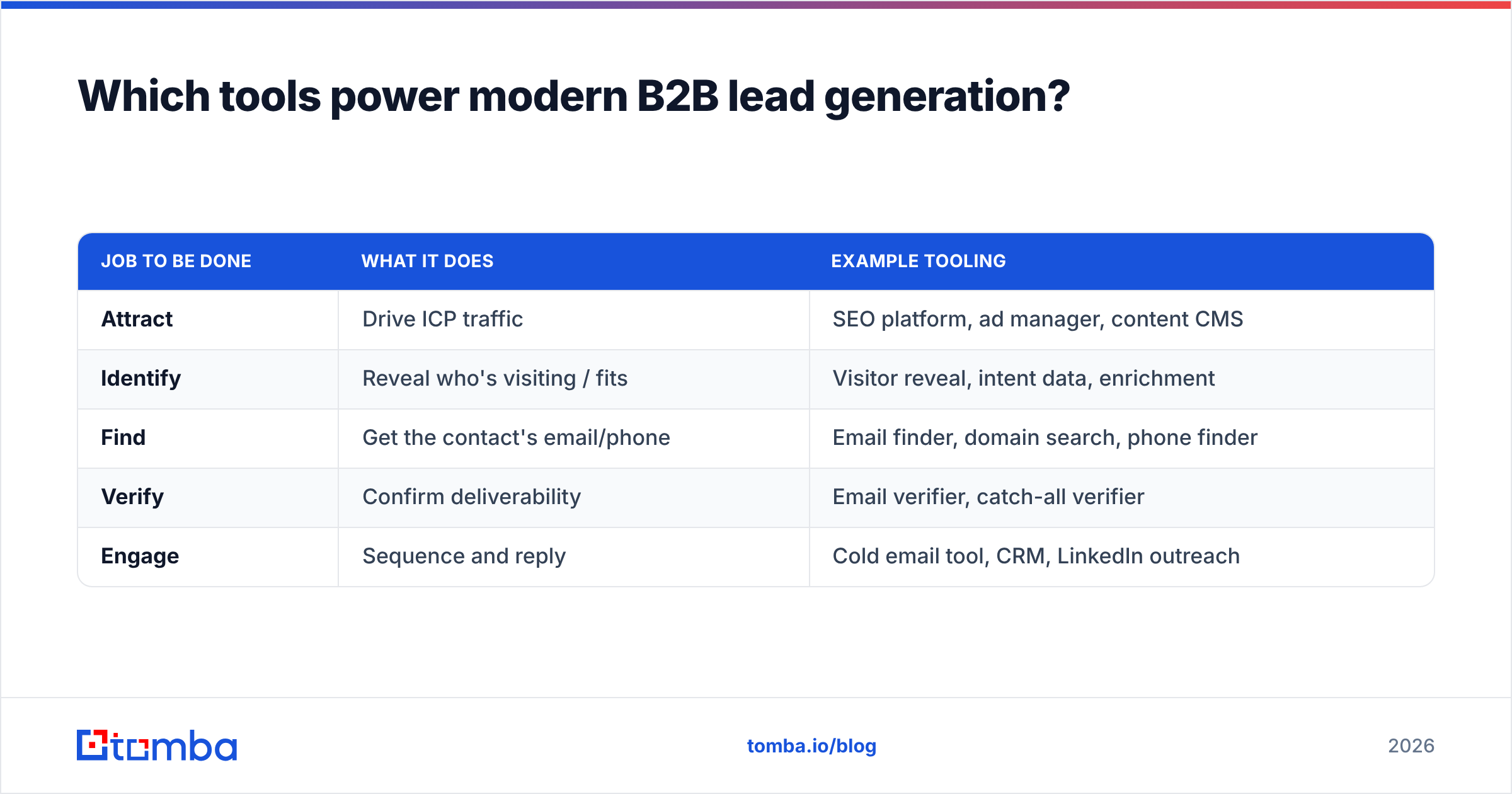
Your stack should cover five jobs: attract, identify, find, verify, and engage. You don't need 15 tools — you need one strong option per job that integrates cleanly. Here's how the categories break down and where overlap is wasteful.
| Job to be done | What it does | Example tooling |
|---|---|---|
| Attract | Drive ICP traffic | SEO platform, ad manager, content CMS |
| Identify | Reveal who's visiting / fits | Visitor reveal, intent data, enrichment |
| Find | Get the contact's email/phone | Email finder, domain search, phone finder |
| Verify | Confirm deliverability | Email verifier, catch-all verifier |
| Engage | Sequence and reply | Cold email tool, CRM, LinkedIn outreach |
The "find" and "verify" jobs are where pipeline quietly leaks. If your email finder returns guesses instead of verified addresses, your engage tool inherits the damage. That's the case for using a finder with built-in verification and transparent sourcing rather than a scraper that hands you raw permutations. Tools like Tomba's bulk email finder let you process a target account list and get verified contacts back in one pass, which collapses two steps into one.
For teams that live in spreadsheets or a specific CRM, the integration surface matters as much as the core engine. Native connections to HubSpot, Google Sheets, and Zapier mean enrichment happens where your workflow already is — no CSV ping-pong.
How do you compare lead-gen tools without getting lost?#
Evaluate on five axes and ignore the marketing copy: data accuracy (ask for a verified-rate guarantee), coverage (regions and industries you actually sell into), price-per-result (not price-per-month — a cheap plan with low match rates is expensive), integrations, and compliance posture. Run a free trial against a sample of your target accounts, not the vendor's demo list. Real ICP, real verdict.
You can sanity-check Tomba's pricing against this framework: a Free tier (25 searches/mo) to test match rates on your own accounts, Starter at $49/mo, Growth at $99/mo, and Pro at $249/mo as volume scales. The point of a free tier isn't free credits — it's de-risking the buying decision by letting you measure accuracy before you commit.
What are the most common B2B lead generation mistakes?#
Most pipeline problems trace back to a short list of avoidable errors:
- Buying giant unverified lists. Cheap upfront, expensive forever. Bounces tank deliverability and you end up in spam folders for the prospects you could have reached.
- Skipping verification. Even good finders occasionally surface stale addresses. Verifying before sending is a five-minute insurance policy against weeks of reputation damage.
- Personalizing nothing — or faking it. "Hi {FirstName}, I loved your work at {Company}" fools no one in 2026. Real personalization uses an enrichment hook the prospect can tell took effort.
- Treating every lead as sales-ready. Dumping raw MQLs on reps burns their time and trust. Score and qualify first.
- No feedback loop. If sales never tells marketing which leads closed, you optimize for volume instead of revenue. Close the loop with shared definitions and a single source of truth.
- Ignoring deliverability hygiene. Authenticate your domain (SPF, DKIM, DMARC), warm up new sending domains, and monitor email deliverability like the revenue lever it is.
Fix these and you'll often double output without adding a single new channel — because you stop leaking the leads you already generate.
How do you measure B2B lead generation success?#
Measure leading and lagging indicators together. Leading: traffic by channel, MQLs, reply rate, meetings booked. Lagging: opportunities created, pipeline value, cost per opportunity, and closed-won revenue attributed to each source. The metric that matters most is cost per opportunity, because it normalizes across channels — a "cheap" channel that produces leads who never buy is the most expensive one you have.
Set a quarterly review where you cut the bottom channel and double down on the top two. Most teams keep underperformers alive out of sentiment. Be ruthless: pipeline math doesn't care how much you liked the webinar.
Where should you start this week?#
Start narrow and prove the loop. Pick 50 dream accounts that fit your ICP exactly. Use a domain search to map the buying committee, find and verify the right contacts, enrich each with one personalization hook, and run a small, sharp outreach sequence. Measure reply rate and meetings. If the loop works at 50 accounts, you scale it to 500 with bulk lead generation — the mechanics are identical, just bigger.
That sequence — find, verify, enrich, engage, measure — is the entire discipline of B2B digital lead generation compressed into one week. Everything else is volume.
If the bottleneck is getting accurate, verified contacts for the accounts you've already targeted, that's exactly what the Tomba Email Finder is built for: search by domain, name, or company, get verified professional emails back, and push them straight into your CRM or sheet. Start on the free tier, run it against your real target list, and let the match rate make the case. Clean data in means qualified pipeline out — and in 2026, that's the whole edge.
// get started
Find, verify and enrich your first contacts today
Start on the free plan with 25 searches a month, then scale when your team is ready.
Free plan · No credit card required · GDPR & CCPA
// about the author