B2B Digital Sales in 2026: The Complete Playbook & Tools
B2B digital sales has moved from a nice-to-have to the core of how modern revenue teams sell. Here's the 2026 playbook: channels, the digital sales funnel, the tech stack, and the metrics that actually move pipeline.
placeholder
TL;DR
- B2B digital sales is the practice of moving buyers through research, evaluation, and purchase using digital channels — email, LinkedIn, web, video, and self-serve — instead of relying only on field reps and cold calls.
- In 2026, most B2B buying happens before a seller is ever contacted, so your digital funnel, content, and data quality decide whether you make the shortlist.
- A working digital sales motion has four layers: clean contact data, multi-channel outreach, a measurable funnel, and a connected tech stack.
- The biggest lever most teams ignore is data accuracy — bad emails and stale contacts quietly kill every downstream metric.
- Tools like an accurate email finder and data enrichment sit at the front of the stack and feed everything that follows.
Cold calling 200 dials a day and hoping for three conversations is no longer a strategy — it's a tax on your reps' time. Buyers research, compare, and shortlist vendors digitally long before they answer a call. This guide breaks down what B2B digital sales actually looks like in 2026, how to build the funnel, which channels still convert, and the stack that holds it together.
What is B2B digital sales?#
B2B digital sales is selling to businesses primarily through digital channels and data, rather than through in-person meetings and phone-first prospecting. Think of it like the shift from a corner store to e-commerce: the product didn't change, but where the buyer discovers, evaluates, and commits did. The seller's job moved from "be in the room" to "be present, useful, and findable across every digital touchpoint the buyer already uses."
That doesn't mean salespeople disappear. It means the rep's leverage comes from digital signals — who visited the pricing page, who opened the third follow-up, who engaged with a LinkedIn post — and from acting on those signals faster than competitors. According to Gartner, B2B buyers spend the majority of their buying journey researching independently and only a small slice of it talking to any single vendor's reps. If you're not influencing the independent-research phase, you're competing for the leftovers.
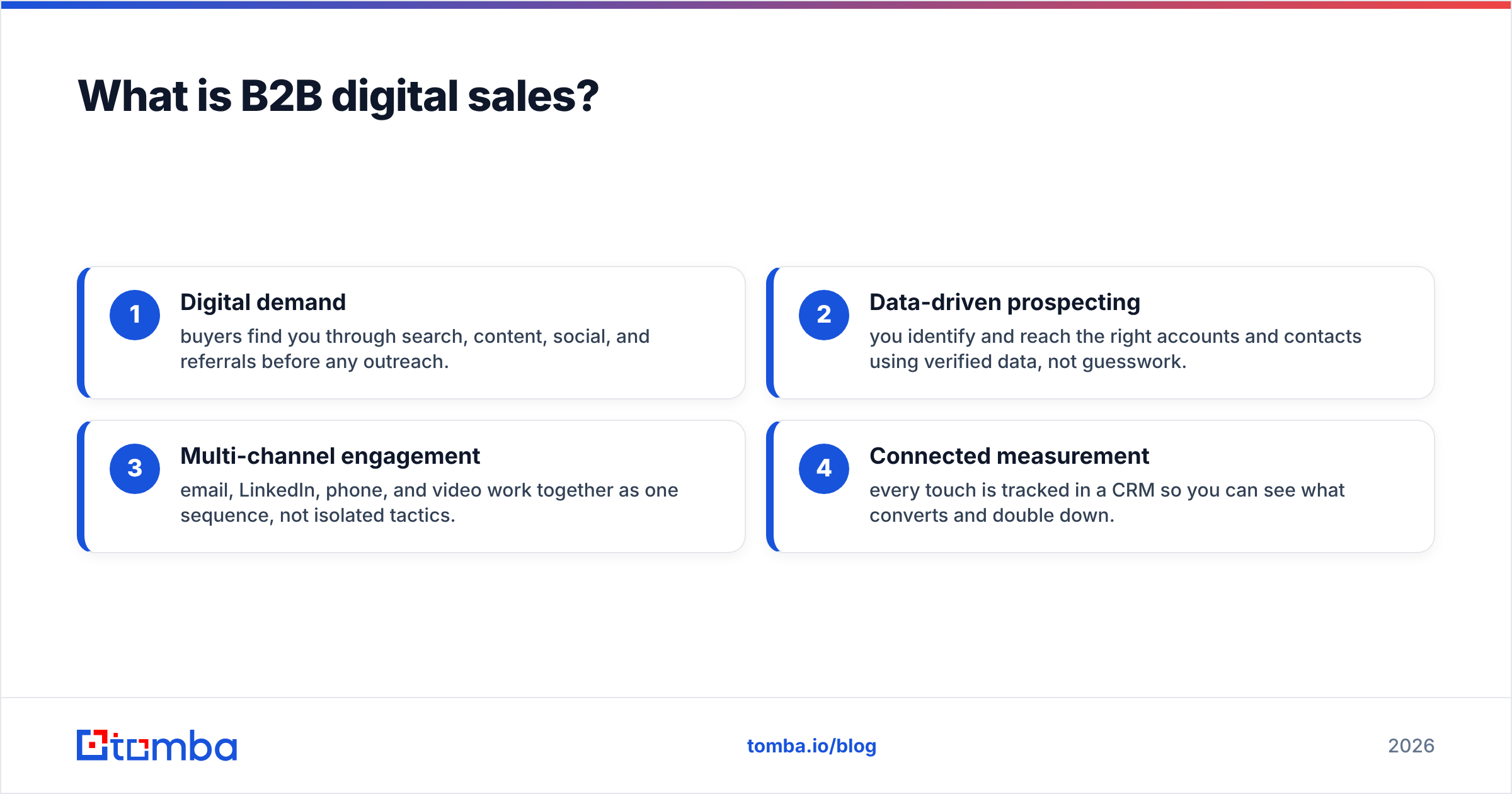
The practical definition has four moving parts:
- Digital demand — buyers find you through search, content, social, and referrals before any outreach.
- Data-driven prospecting — you identify and reach the right accounts and contacts using verified data, not guesswork.
- Multi-channel engagement — email, LinkedIn, phone, and video work together as one sequence, not isolated tactics.
- Connected measurement — every touch is tracked in a CRM so you can see what converts and double down.
Why does B2B digital sales matter more in 2026?#
Because the buyer changed, and the seller who adapts wins the deal. Three shifts make digital sales non-negotiable this year.
First, buying committees grew. A typical B2B purchase now involves six to ten stakeholders, each doing their own digital research. You can't cold-call your way to consensus across that many people — you reach them through coordinated digital touches.
Second, self-serve expectations carried over from B2C. Buyers want to evaluate, price, and sometimes purchase without a forced demo. Vendors who add product-led and self-serve motions on top of sales-led ones capture buyers who'd otherwise bounce.
Third, data decay accelerated. People change jobs constantly, and every job change rots your CRM. A contact list that was 95% accurate last quarter can drift to 75% in a year. Digital sales lives or dies on reachability, which is why email verification and enrichment became front-of-funnel work, not cleanup chores.
What does the B2B digital sales funnel look like?#
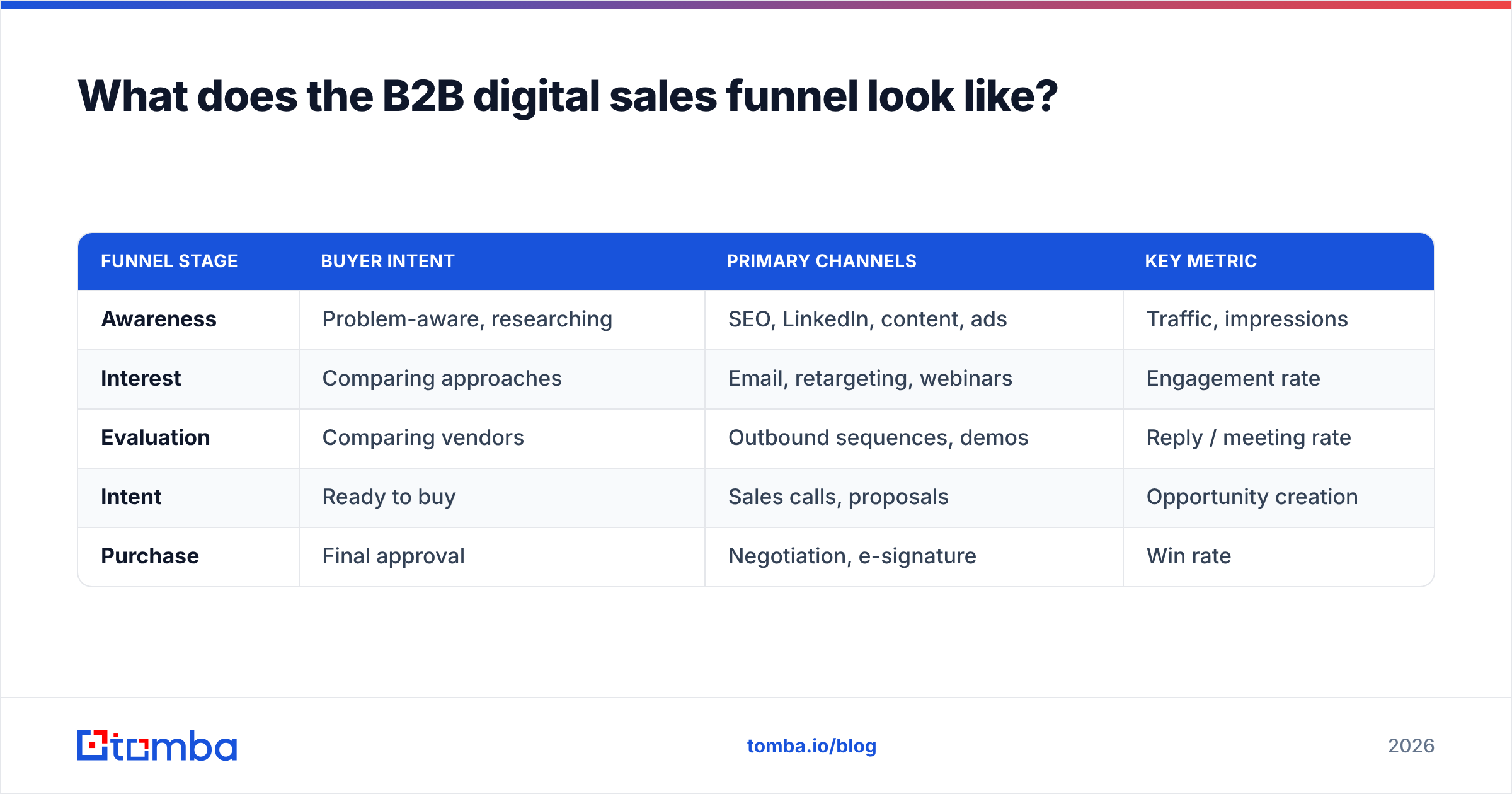
The digital funnel mirrors the buyer's journey, and each stage needs a different motion and metric. Here's the structure most high-performing teams run in 2026.
| Funnel stage | Buyer intent | Primary channels | Key metric |
|---|---|---|---|
| Awareness | Problem-aware, researching | SEO, LinkedIn, content, ads | Traffic, impressions |
| Interest | Comparing approaches | Email, retargeting, webinars | Engagement rate |
| Evaluation | Comparing vendors | Outbound sequences, demos | Reply / meeting rate |
| Intent | Ready to buy | Sales calls, proposals | Opportunity creation |
| Purchase | Final approval | Negotiation, e-signature | Win rate |
The mistake teams make is optimizing one stage in isolation — pouring budget into ads while the evaluation-stage email sequence quietly bounces 30% of the time. Treat the funnel as a system. A leak at the evaluation stage caused by bad contact data wastes every dollar spent on awareness.
Which channels actually convert in B2B digital sales?#
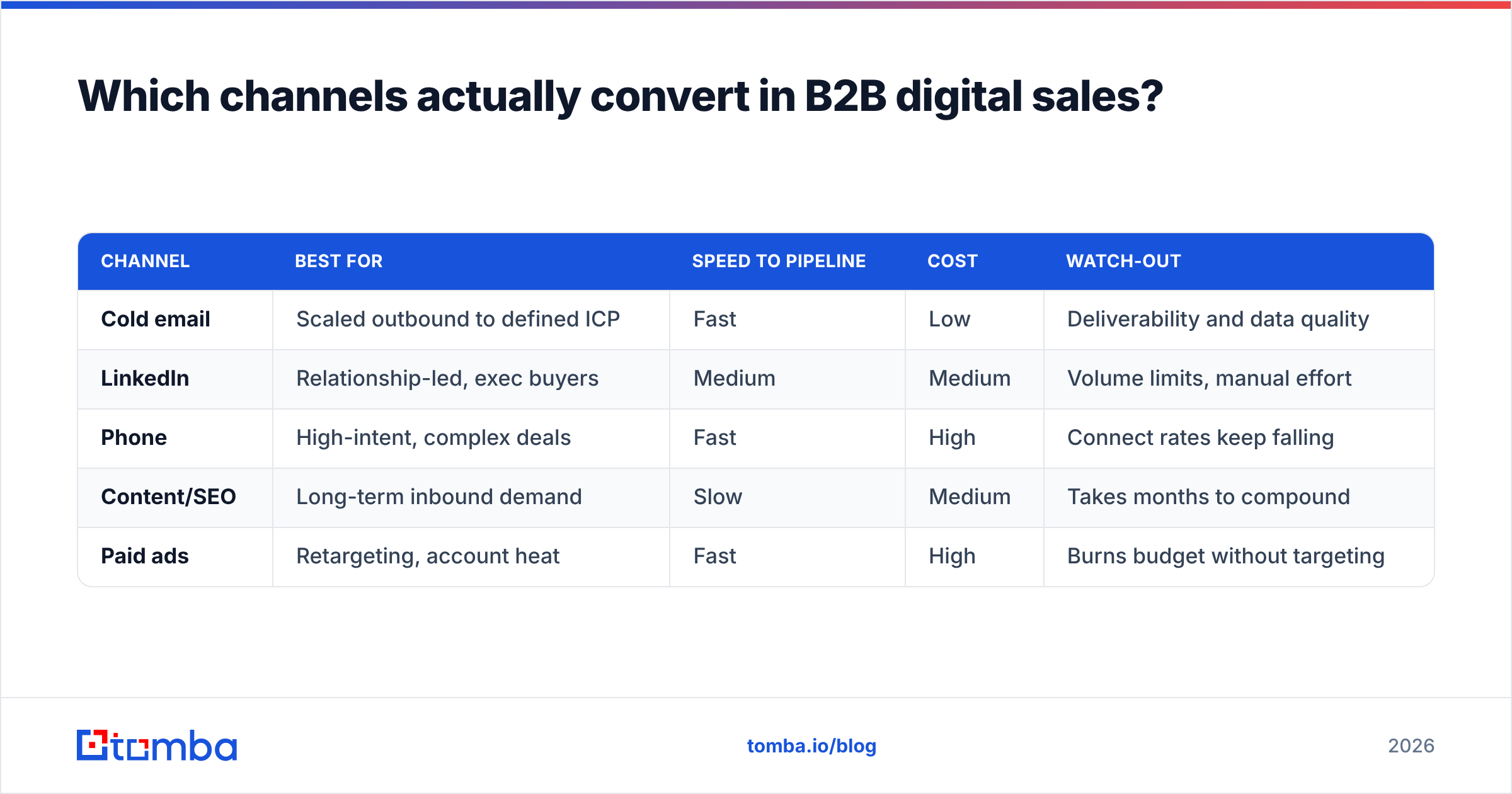
No single channel wins — combinations do. But the channels are not equal in cost, speed, or fit. Here's how the main options stack up.
| Channel | Best for | Speed to pipeline | Cost | Watch-out |
|---|---|---|---|---|
| Cold email | Scaled outbound to defined ICP | Fast | Low | Deliverability and data quality |
| Relationship-led, exec buyers | Medium | Medium | Volume limits, manual effort | |
| Phone | High-intent, complex deals | Fast | High | Connect rates keep falling |
| Content/SEO | Long-term inbound demand | Slow | Medium | Takes months to compound |
| Paid ads | Retargeting, account heat | Fast | High | Burns budget without targeting |
The teams that win combine a slow-but-compounding inbound engine (content and SEO) with a fast, precise outbound engine (email plus LinkedIn plus selective calling). The outbound engine is only as good as its inputs: a verified email, the right phone number, and accurate company context. Garbage in, ignored out.
Cold email remains the highest-leverage outbound channel for most B2B teams because it scales without proportional headcount — but only when deliverability holds. That means warming domains, keeping bounce rates low, and verifying every address before send. A single dirty list can tank your sender reputation and drag down every campaign that follows.
How do you build a B2B digital sales tech stack?#
Start from the front of the funnel and work back — data first, because everything downstream inherits its quality. A lean, effective 2026 stack has five layers:
- Data and enrichment — find and verify contacts. An accurate email finder, a verifier, and contact enrichment feed clean records into everything else.
- CRM — the single source of truth. Salesforce, HubSpot, or Pipedrive; the brand matters less than discipline using it.
- Outreach and sequencing — email-plus-LinkedIn cadence tools that automate follow-up without removing personalization.
- Intent and signals — website visitor identification and engagement scoring to prioritize who's actually in-market.
- Analytics — dashboards that tie touches to revenue, not just activity.
You don't need 15 tools. You need five layers that talk to each other. Over-tooling is its own failure mode: reps spend more time in software than selling, data fragments across systems, and nobody trusts the numbers. Pick tools with real integrations — a stack where data flows automatically beats a "best of breed" pile of disconnected logins every time.
For data, evaluate vendors on accuracy and coverage, not just price. Cross-reference review platforms like G2 and check how each provider sources and validates data before you commit a budget.
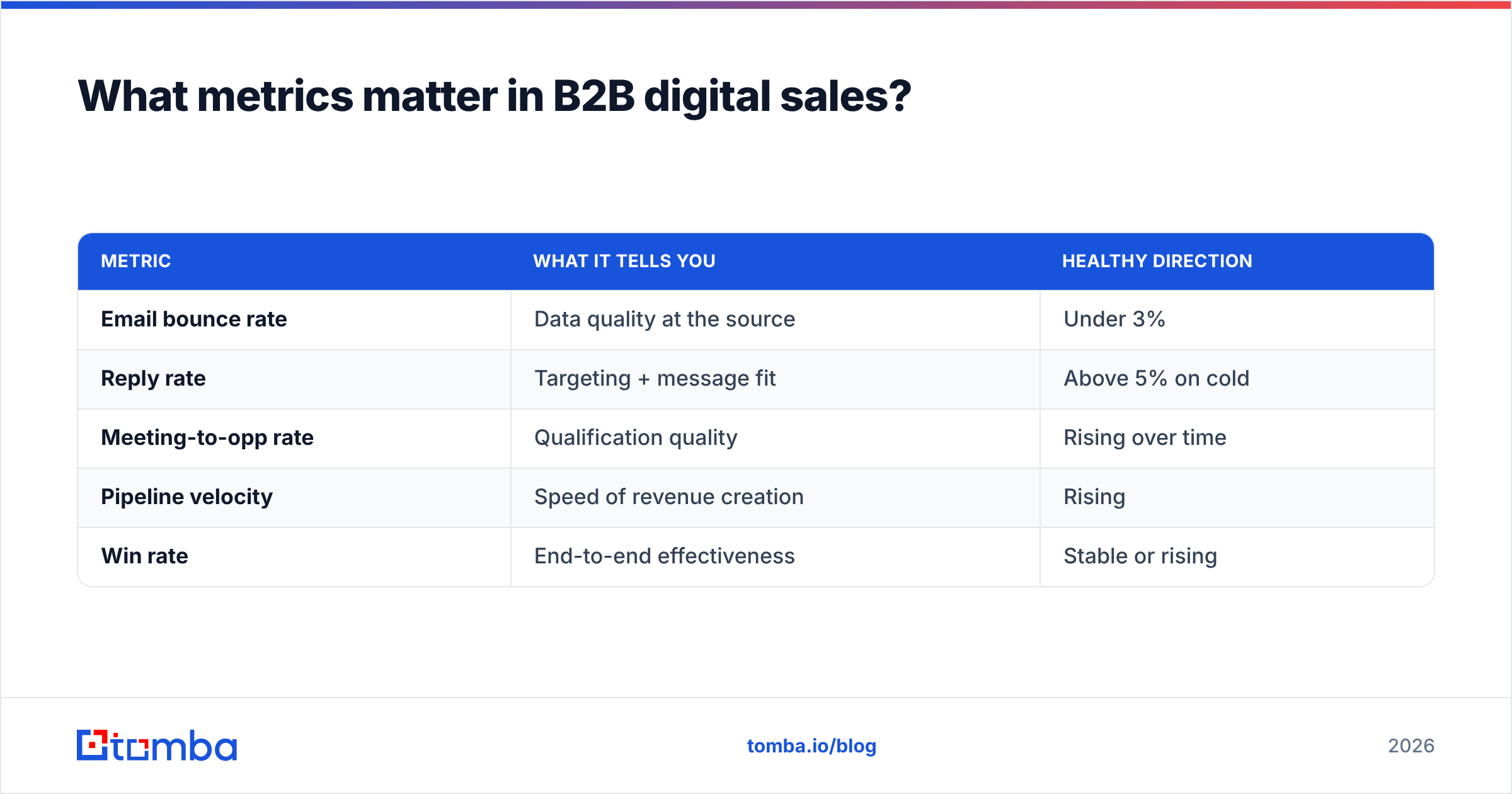
What metrics matter in B2B digital sales?#
Activity metrics feel productive but lie. The metrics that matter tie effort to revenue and expose leaks early.
| Metric | What it tells you | Healthy direction |
|---|---|---|
| Email bounce rate | Data quality at the source | Under 3% |
| Reply rate | Targeting + message fit | Above 5% on cold |
| Meeting-to-opp rate | Qualification quality | Rising over time |
| Pipeline velocity | Speed of revenue creation | Rising |
| Win rate | End-to-end effectiveness | Stable or rising |
Notice bounce rate at the top. It's the earliest warning that your digital sales engine is misfiring. High bounces mean stale data, which means wasted sends, damaged sender reputation, and inflated activity numbers that hide a shrinking funnel. Fix the data and watch response rate and downstream metrics improve without changing anything else.
Track these weekly, not quarterly. Digital sales gives you fast feedback loops — use them. If a sequence's reply rate drops, you'll see it in days, not at the end-of-quarter review when the pipeline gap is already locked in.
How is AI changing B2B digital sales?#
AI moved from novelty to infrastructure. In 2026, it shows up in three high-value places: research, personalization, and prioritization.
For research, AI compresses account and contact prep from 20 minutes to two — summarizing a company's recent news, tech stack, and likely pain points. For personalization, it drafts first-pass outreach that reps edit rather than write from scratch, raising volume without flattening quality. For prioritization, scoring models rank leads by fit and intent so reps work the hottest accounts first.
What AI doesn't fix is bad data. An AI-personalized email sent to a wrong or dead address is still a bounce — just a more expensive one. The teams getting real lift from AI pair it with a clean, verified data foundation. That's why sales automation and data accuracy are complementary investments, not competing ones. Automate on top of clean data and you scale results; automate on top of dirty data and you scale waste.
Tools like HubSpot have baked AI into their CRMs, but the principle holds across every platform: AI amplifies whatever you feed it. Feed it precision.
What are common B2B digital sales mistakes to avoid?#
The failures are predictable, which makes them avoidable.
- Skipping verification. Sending to unverified lists is the fastest way to wreck deliverability and trust. Verify before every campaign.
- Confusing activity with progress. A thousand emails that bounce is worse than a hundred that land. Measure outcomes.
- Single-channel dependence. Email-only or LinkedIn-only motions cap out. Layer channels around the same accounts.
- Over-personalizing the wrong leads. Spending an hour personalizing outreach to a poor-fit account is a loss even if they reply. Qualify first.
- Letting the CRM rot. A neglected CRM becomes a liability. Enrich and clean it on a schedule, not after the numbers collapse.
Most of these trace back to a single root cause: weak data discipline. Solve that and the rest of the digital sales motion gets dramatically easier.
Getting started with B2B digital sales#
Start where the leverage is highest: your data. Before you buy another outreach tool or launch another campaign, make sure the contacts you're reaching are real, reachable, and relevant. That single fix lifts deliverability, reply rates, and pipeline at once.
Tomba's Email Finder gives you verified professional email addresses by name, domain, or company — the clean front-of-funnel input that every downstream digital sales metric depends on. Pair it with the built-in verifier and enrichment, connect it to your CRM, and you've got the data layer your whole digital sales motion stands on. The Free tier includes 25 searches a month so you can test accuracy on your own list before committing; paid plans start at $49/mo (Starter) and scale to Growth at $99/mo as your outbound volume grows.
Build the funnel, pick your channels, and connect the stack — but get the data right first. In B2B digital sales, accuracy isn't a detail. It's the foundation everything else is built on.
// get started
Find, verify and enrich your first contacts today
Start on the free plan with 25 searches a month, then scale when your team is ready.
Free plan · No credit card required · GDPR & CCPA
// about the author