B2B Email Click-Through Rates: Benchmarks & Fixes for 2026
What counts as a good B2B email click-through rate in 2026? See real benchmarks by industry, the math behind CTR, and seven fixes that actually move the number.
TL;DR
- A "good" B2B email click-through rate (CTR) in 2026 lands between 2% and 5% for marketing email and 1% to 3% for cold outbound — anything above 5% is top-decile.
- CTR and click-to-open rate (CTOR) are different metrics. Confusing them is the most common reporting mistake B2B teams make.
- Most low-CTR problems are not copy problems — they are list problems. Bad data caps your ceiling before the first word is read.
- The biggest levers are list quality, a single clear call-to-action, segmentation, and plain-text-style formatting. Design polish matters least.
- Clean, verified contact data is the cheapest CTR upgrade available — you fix the denominator instead of fighting the numerator.
What is a B2B email click-through rate?#
Your B2B email click-through rate is the percentage of delivered emails where at least one recipient clicked a link. It is the clearest signal that your message did its job: it earned attention and an action, not just an open.
Think of CTR like a storefront. Opens are people glancing at your window display. Clicks are people actually walking through the door. You can have a busy sidewalk (high open rate) and an empty shop (low CTR) — and the second number is the one that pays the bills.
The formula is simple:
CTR = (Unique clicks ÷ Emails delivered) × 100
So if you deliver 1,000 emails and 30 people click, your CTR is 3%. Note the word delivered. If you calculate against emails sent instead of delivered, bounces drag your number down and you end up optimizing the wrong thing.
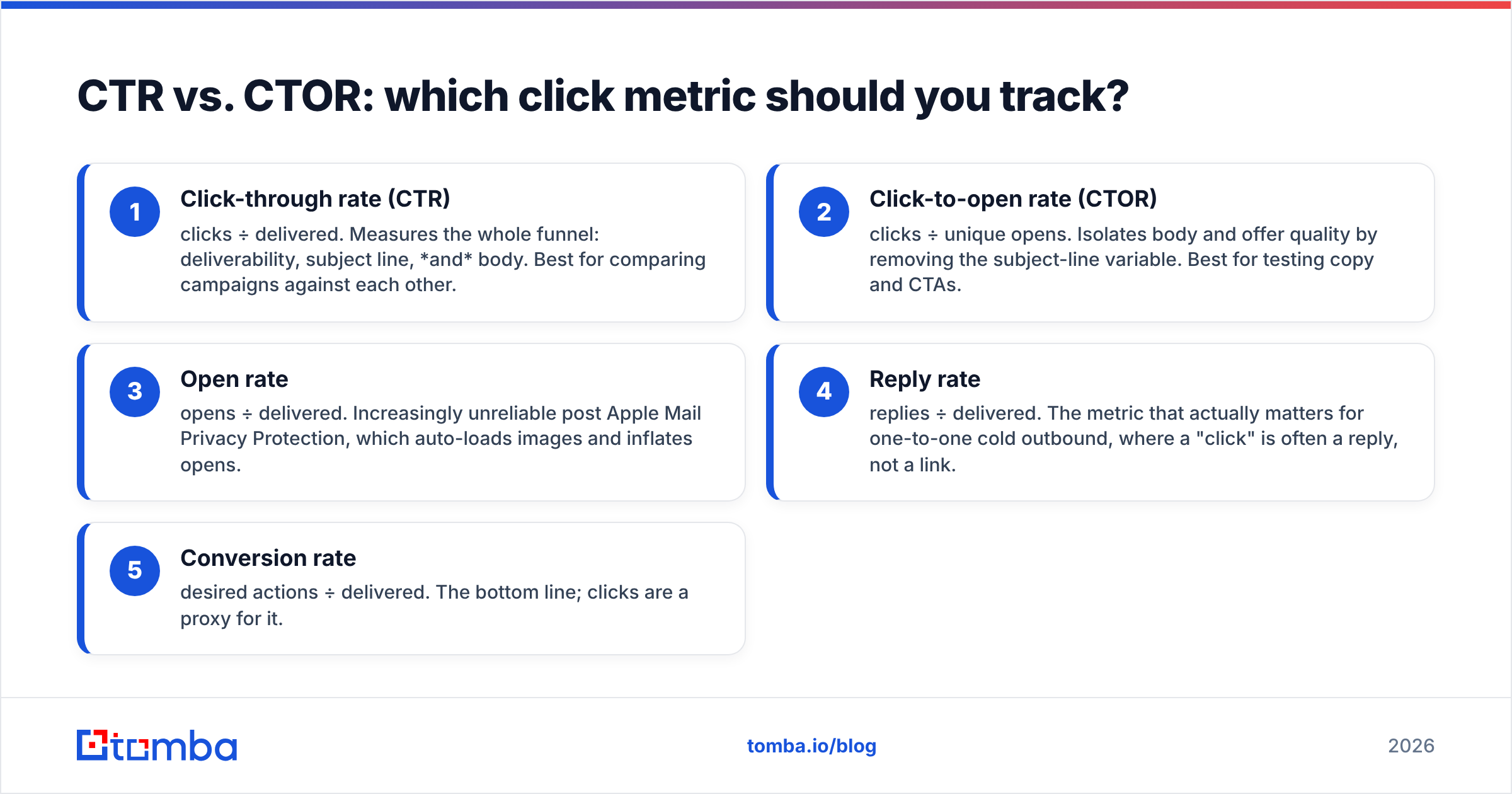
CTR vs. CTOR: which click metric should you track?#
Both, but for different reasons. Here is how the two click metrics — plus their cousins — relate:
- Click-through rate (CTR) — clicks ÷ delivered. Measures the whole funnel: deliverability, subject line, and body. Best for comparing campaigns against each other.
- Click-to-open rate (CTOR) — clicks ÷ unique opens. Isolates body and offer quality by removing the subject-line variable. Best for testing copy and CTAs.
- Open rate — opens ÷ delivered. Increasingly unreliable post Apple Mail Privacy Protection, which auto-loads images and inflates opens.
- Reply rate — replies ÷ delivered. The metric that actually matters for one-to-one cold outbound, where a "click" is often a reply, not a link.
- Conversion rate — desired actions ÷ delivered. The bottom line; clicks are a proxy for it.
If open tracking has gotten noisy in your account, lean on CTOR and response rate as your honest signals. They are harder to fake and closer to revenue.
What is a good B2B email click-through rate in 2026?#
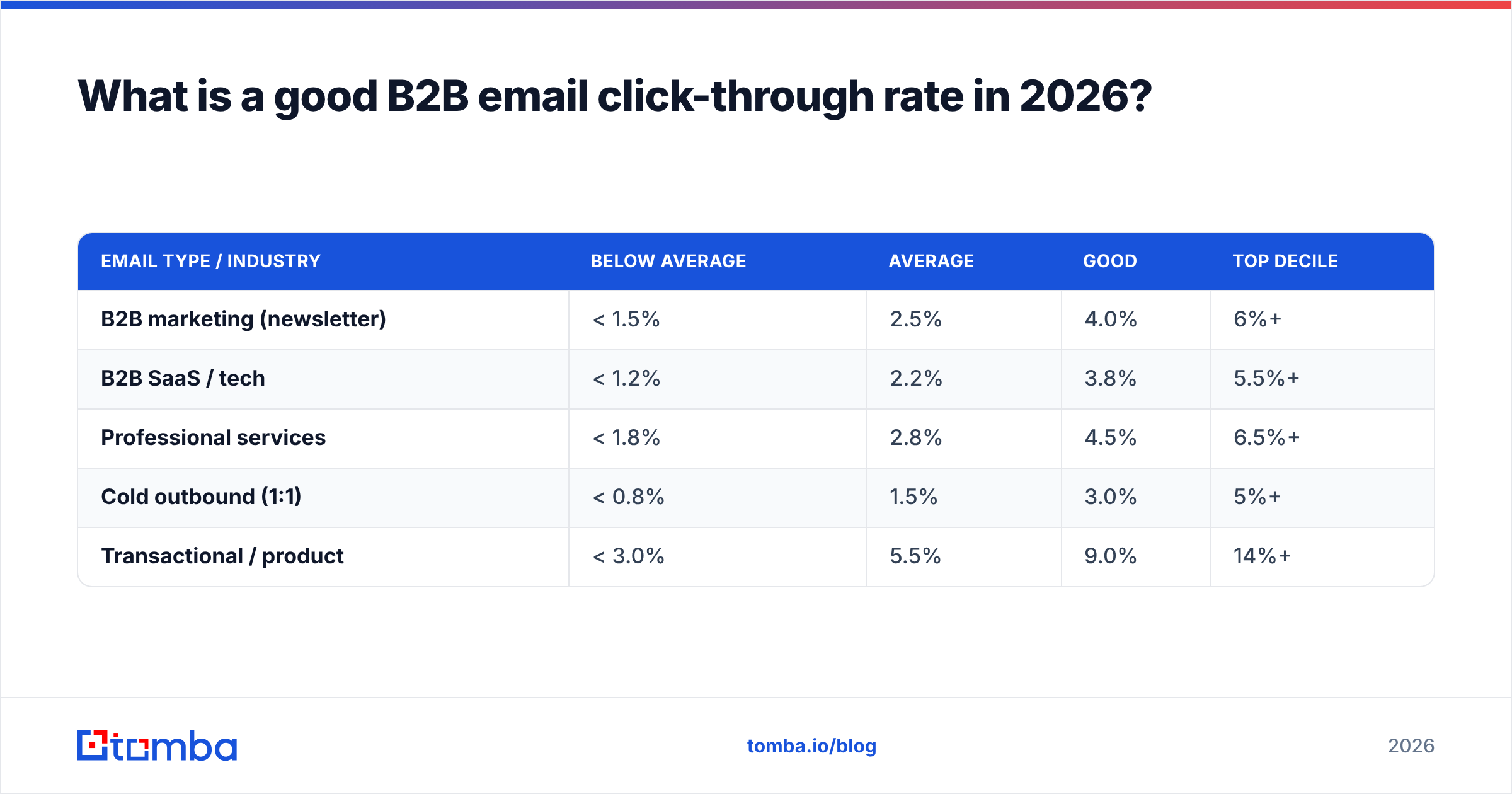
A good B2B marketing CTR is roughly 2.5%, and a good cold-outbound CTR is roughly 1.5% — but the spread by industry and email type is wide enough that a single number lies to you. Use the ranges below as a starting frame, then build your own baseline.
| Email type / industry | Below average | Average | Good | Top decile |
|---|---|---|---|---|
| B2B marketing (newsletter) | < 1.5% | 2.5% | 4.0% | 6%+ |
| B2B SaaS / tech | < 1.2% | 2.2% | 3.8% | 5.5%+ |
| Professional services | < 1.8% | 2.8% | 4.5% | 6.5%+ |
| Cold outbound (1:1) | < 0.8% | 1.5% | 3.0% | 5%+ |
| Transactional / product | < 3.0% | 5.5% | 9.0% | 14%+ |
These align with the public benchmark ranges that vendors like HubSpot and Mailchimp publish, adjusted for the post-MPP reality where opens are inflated and clicks are the steadier signal. Two rules of thumb:
- Transactional beats marketing beats cold. Expectation drives clicks. A password reset gets clicked because the reader asked for it.
- Your own trend beats any benchmark. A campaign at 1.9% in an industry that averages 2.5% can still be your best performer if it converts. Track month-over-month against yourself first.
Why are your B2B email click-through rates low?#
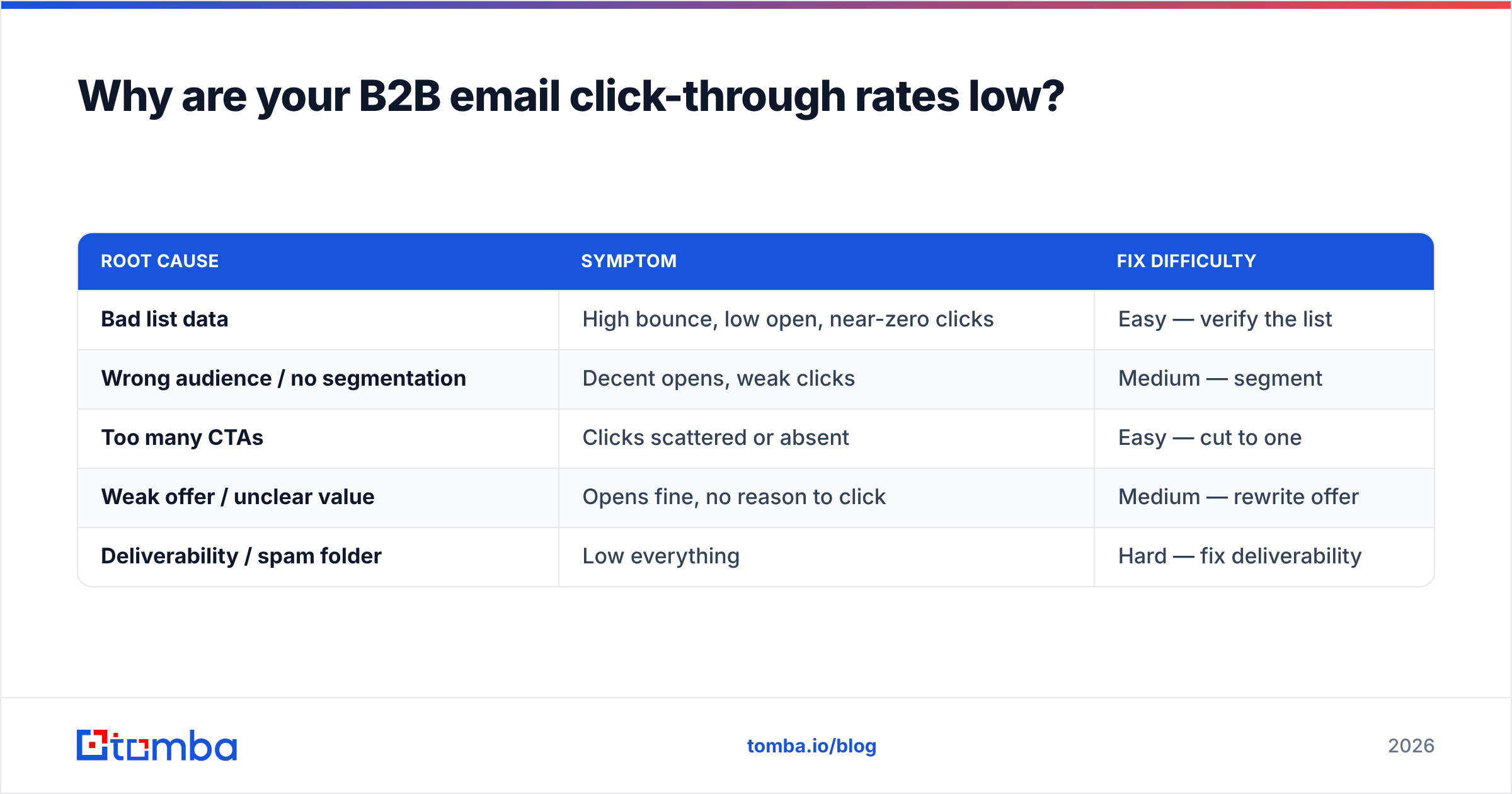
Nine times out of ten, low CTR traces back to one of five root causes — and only one of them is the copy. Here is the diagnostic order, cheapest fix first:
| Root cause | Symptom | Fix difficulty |
|---|---|---|
| Bad list data | High bounce, low open, near-zero clicks | Easy — verify the list |
| Wrong audience / no segmentation | Decent opens, weak clicks | Medium — segment |
| Too many CTAs | Clicks scattered or absent | Easy — cut to one |
| Weak offer / unclear value | Opens fine, no reason to click | Medium — rewrite offer |
| Deliverability / spam folder | Low everything | Hard — fix deliverability |
Start at the top. If your data is wrong, no subject-line test will save you — you are dividing real clicks by a denominator stuffed with dead addresses, role accounts, and catch-all guesses. A list that is 30% invalid means your real CTR is roughly 1.4× higher than your dashboard shows, but you are also burning sender reputation on bounces, which then suppresses the clicks you should have earned. Fix the data and two metrics improve at once.
This is why we tell teams to run every list through an email verifier before the send, and to source contacts from a tool that returns deliverable addresses in the first place rather than scraping and hoping.

How do you improve B2B email click-through rates?#
Pull these seven levers, roughly in order of impact-to-effort. The first three move CTR more than any subject-line tweak ever will.
1. Clean and verify your list first#
You cannot out-write bad data. Removing invalid, role-based, and catch-all addresses lifts your true CTR immediately and protects sender reputation so future sends land in the inbox. This is the single highest-ROI move because it fixes the denominator and the deliverability at the same time. Verify before every send, not once a quarter.
2. Use one clear call-to-action#
Every additional link splits attention and dilutes intent. The classic pattern is one primary CTA repeated two or three times (top, middle, signature) pointing to the same destination. Pick the single action you want and cut everything else. Multi-CTA emails reliably underperform single-CTA emails in head-to-head tests.
3. Segment before you send#
A relevant email to 500 people beats a generic blast to 5,000. Segment by role, industry, company size, or lifecycle stage, then tailor the offer. Segmented campaigns consistently post higher CTR because the link finally points to something the reader cares about. Enriching your contacts with firmographic data makes this practical at scale — you can route the right CTA to the right segment automatically.
4. Write a CTA that describes the reward, not the action#
"Get my free pricing breakdown" beats "Click here." Lead with what the reader receives. Buttons usually outperform raw text links for marketing email; in 1:1 cold email, a plain question that invites a reply often beats any button at all.
5. Strip the design down#
For cold and one-to-one B2B, plain-text or near-plain-text formatting reads as a personal message, not a broadcast, and frequently lifts clicks and replies. Heavy templates with image headers can look like marketing and trip spam filters. Match the format to the relationship.
6. Nail the subject line and preview text#
CTR starts upstream: no open, no click. The subject sets expectation, and the body has to deliver on it. Test subject lines against a real audience rather than guessing — a free tool like Tomba's subject line tester gives you a fast read before you commit a whole list.
7. Send at the right time and cadence#
Tuesday through Thursday mornings remain the safe default for B2B, but your audience has its own rhythm — sales ops opens at 7 a.m., founders at 9 p.m. Test send times, and respect frequency. Over-mailing fatigues a list and clicks decay fast.
How does contact data quality change your CTR math?#
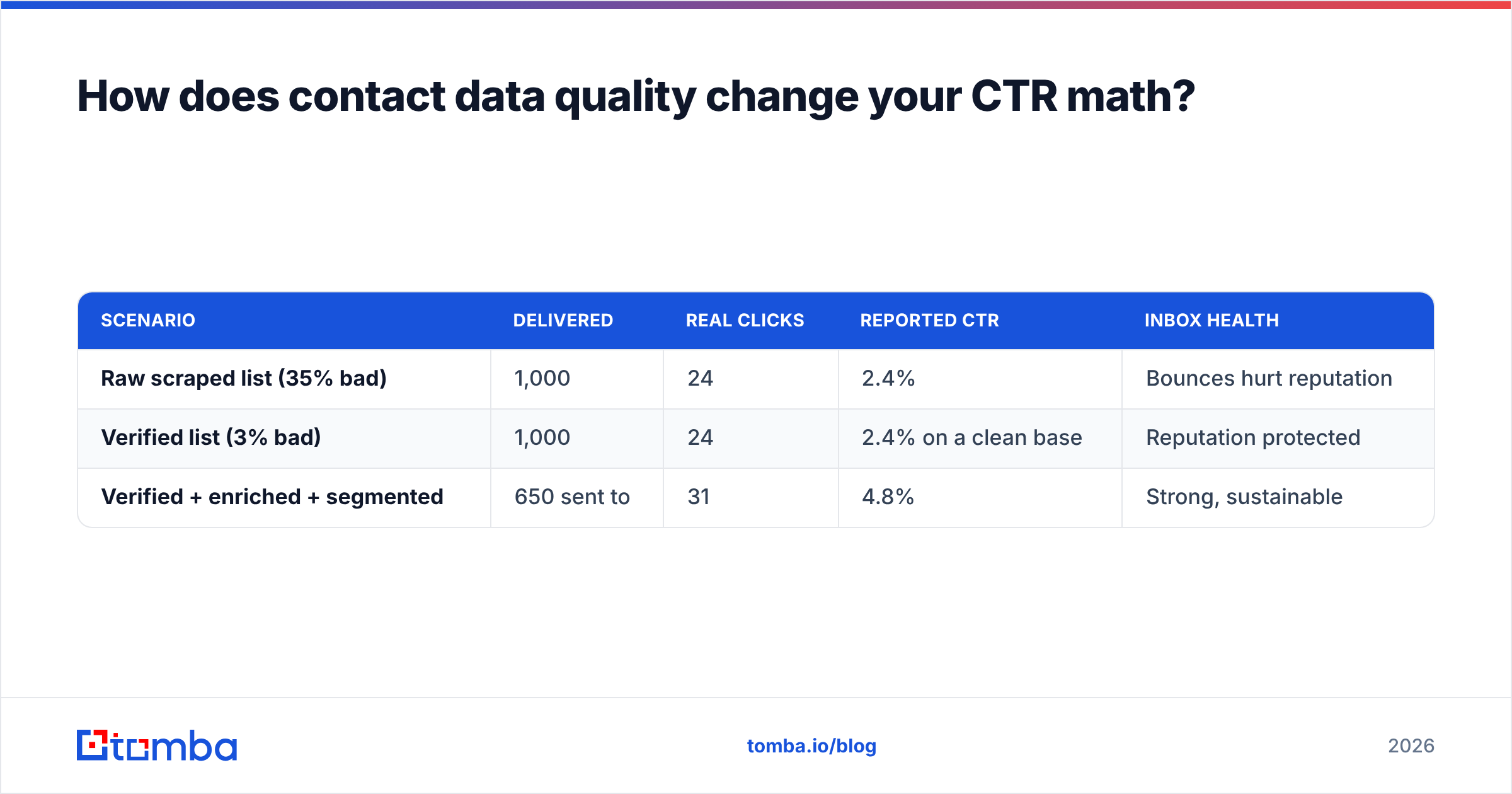
Data quality changes the denominator, which is why it is the most underrated CTR lever. Walk through the arithmetic:
| Scenario | Delivered | Real clicks | Reported CTR | Inbox health |
|---|---|---|---|---|
| Raw scraped list (35% bad) | 1,000 | 24 | 2.4% | Bounces hurt reputation |
| Verified list (3% bad) | 1,000 | 24 | 2.4% on a clean base | Reputation protected |
| Verified + enriched + segmented | 650 sent to | 31 | 4.8% | Strong, sustainable |
Same 24–31 clicks, very different stories. In the first row, you delivered to 1,000 but a third never existed, so you torched sender reputation and your future sends get throttled. In the third row, you mailed fewer, better-matched people — fewer bounces, higher relevance, and a CTR that compounds instead of decaying.
The takeaway: improving CTR is often a sourcing problem, not a copywriting problem. Start with deliverable, accurate contacts. A reliable email finder that returns verified professional addresses — rather than permutated guesses — means your clean list is large and accurate, so you never have to choose between volume and quality. You can compare what each tier includes on the Tomba pricing page; the free tier is enough to test the data quality on your own segment before you commit.
How should you benchmark and report CTR going forward?#
Build a baseline, then beat yourself. Concretely:
- Pick one definition and freeze it. Decide CTR = unique clicks ÷ delivered, and never silently switch to sent or to total clicks. Inconsistent denominators are how teams fool themselves into thinking a campaign improved.
- Report CTR and CTOR side by side. CTR tells you campaign-over-campaign performance; CTOR isolates whether your body copy or your subject line is the weak link.
- Segment your reporting. A blended CTR across newsletters, product emails, and cold outbound is meaningless. Break it out by type.
- Track a 90-day rolling average. Single campaigns are noisy. Trends are signal. Watch the direction, not the spike.
- Tie clicks to pipeline. A 6% CTR that produces zero meetings is a vanity number. Connect clicks to replies, demos, and revenue so you optimize for the action that pays.
Compare your own numbers against third-party aggregators like G2's email software benchmarks once a quarter for a sanity check, but treat your internal trend as the source of truth.
The bottom line#
A strong B2B email click-through rate in 2026 — roughly 2.5% for marketing and 1.5% for cold — is mostly downstream of two things you control before you write a word: who you send to, and whether those addresses are real. Clean the list, segment it, give every email one clear reason to click, and your CTR rises on its own.
If your clicks are stuck, start where the leverage is highest. Use the Tomba Email Finder to source verified, deliverable professional emails by domain, name, or company, then verify the full list before every send. You will be dividing real clicks by a real denominator — and that is the fastest way to make your click-through rate tell the truth and then climb. Start free with 25 searches a month and test it on a single segment before you scale.
// get started
Find, verify and enrich your first contacts today
Start on the free plan with 25 searches a month, then scale when your team is ready.
Free plan · No credit card required · GDPR & CCPA
// about the author