B2B Email Data in 2026: Accuracy, Sources & Compliance
B2B email data decays fast, and bad records quietly wreck deliverability and pipeline. Here's how to source, verify, and maintain accurate B2B email data in 2026.
B2B email data is the quiet engine behind every outbound campaign, ABM play, and CRM enrichment job you run. When it's clean, your sequences land and your reps talk to real people. When it's stale, your sender reputation erodes, your reports lie to you, and your pipeline forecast becomes fiction.
This guide breaks down where B2B email data actually comes from, how to judge its accuracy, why it rots so quickly, what the compliance rules require in 2026, and how to build a maintenance loop that keeps your records usable instead of toxic.
TL;DR#
- B2B email data decays roughly 22–30% per year as people change jobs, companies rebrand, and domains get retired. A list you bought 18 months ago is mostly fiction now.
- Source quality beats list size. Verified, frequently-refreshed data from a live finder-and-verifier pipeline outperforms a million-row static CSV every time.
- Accuracy is measurable. Track bounce rate, valid-rate, catch-all share, and match rate — not vanity record counts.
- Compliance is non-negotiable. GDPR, CAN-SPAM, and CASL all touch B2B email data; legitimate interest is a defensible basis, but only with documentation and easy opt-out.
- Continuous verification is the moat. Verify at capture, re-verify before send, and re-enrich quarterly so your database ages gracefully.
What is B2B email data?#
B2B email data is the set of professional contact records you use to reach decision-makers at companies — typically a work email address joined to a name, job title, company domain, and often a phone number, LinkedIn URL, and firmographic fields like industry, headcount, and revenue band.
Think of it like a fresh-produce supply chain. A tomato (an email address) is only worth buying when it's ripe and traceable to a real farm (a verifiable source). The moment it's been sitting in a warehouse for a year, it looks fine on the label but it's spoiled inside. B2B email data behaves exactly the same way: the record can look perfectly formatted while the person behind it left the company eight months ago.
Technically, a usable B2B email record has three layers:
- Identity — who the person is (name, title, seniority, department).
- Reachability — the work email, its deliverability status, and a fallback like a direct phone or LinkedIn profile.
- Context — the firmographics and intent signals that tell you why and when to reach out.
A record missing any of those layers is a lead you can't act on with confidence.
Where does B2B email data come from?#
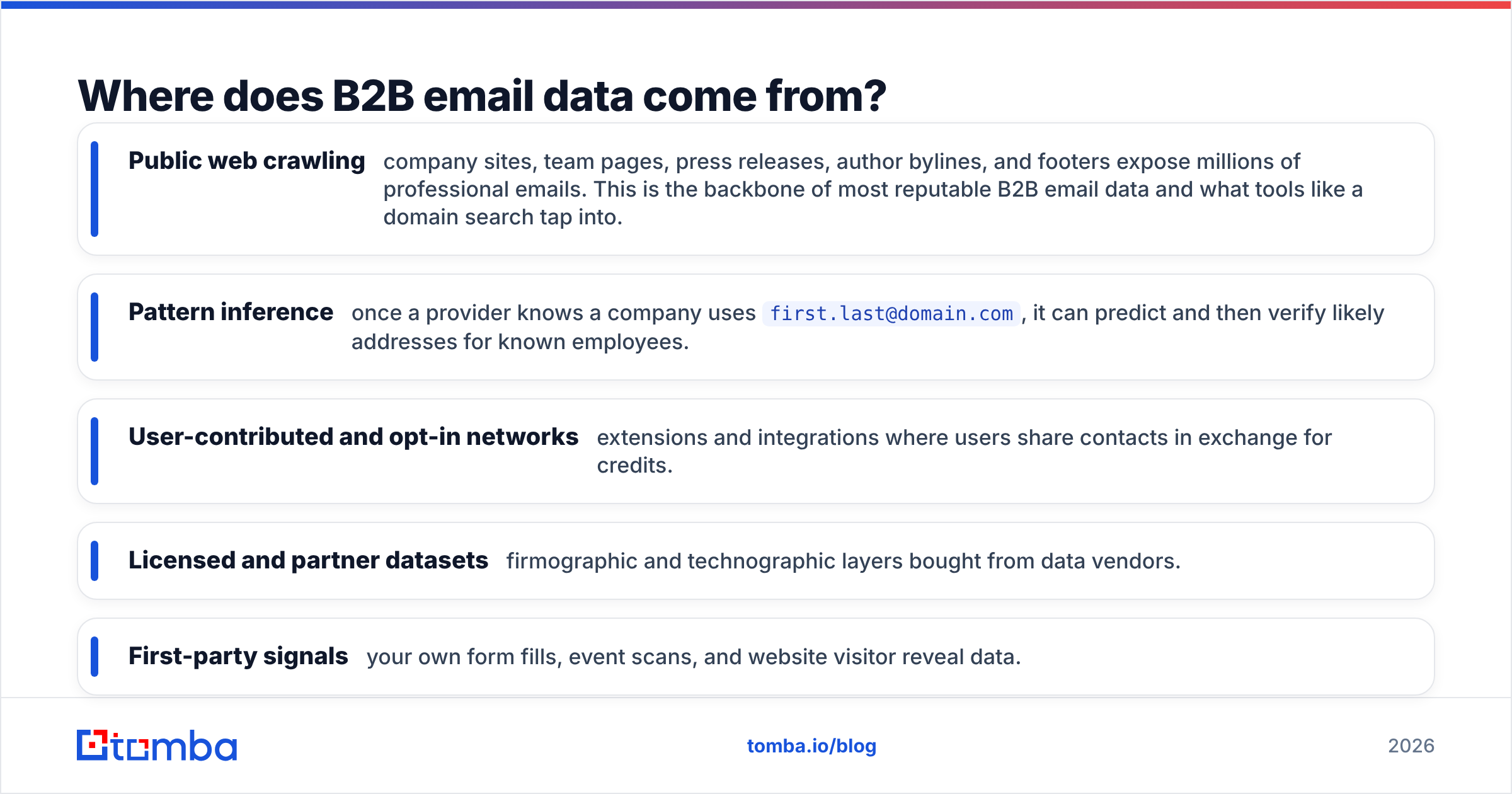
There's no single magic database. Every provider blends sources, and the blend is what determines quality. The main origins:
- Public web crawling — company sites, team pages, press releases, author bylines, and footers expose millions of professional emails. This is the backbone of most reputable B2B email data and what tools like a domain search tap into.
- Pattern inference — once a provider knows a company uses
first.last@domain.com, it can predict and then verify likely addresses for known employees. - User-contributed and opt-in networks — extensions and integrations where users share contacts in exchange for credits.
- Licensed and partner datasets — firmographic and technographic layers bought from data vendors.
- First-party signals — your own form fills, event scans, and website visitor reveal data.
The transparency of those sources matters. Before you trust a vendor, look at how they document where their data comes from. A provider that won't explain its sourcing is a provider you can't audit when a compliance request lands.
How is B2B email data accuracy measured?#
Accuracy is the single number most teams get wrong, because they confuse format validity with deliverability. An address can be perfectly formatted and still bounce. Measure these instead:
- Valid rate — share of addresses confirmed deliverable by SMTP-level checks.
- Bounce rate — what actually happened after you hit send (the ground truth).
- Catch-all share — domains that accept everything, where you can't confirm a specific mailbox without deeper checks.
- Match rate — for enrichment, the percentage of your input rows that returned a usable email.
- Freshness — the average age of each record since last verification.
A healthy program keeps hard bounces under 2% and pushes valid rate above 95% on the records it actually sends to. You get there with a dedicated email verifier running before every campaign, not with hope.
Industry analysts have warned for years that poor data quality carries a real cost. Gartner has repeatedly estimated that bad data costs organizations millions annually in wasted effort and missed revenue — and in outbound, that cost shows up first as deliverability damage.
Why does B2B email data decay so fast?#
Because people move. The average B2B contact record loses a meaningful slice of its accuracy every single year, driven by:
- Job changes — professionals switch roles every few years, and each move kills their old work email.
- Company events — mergers, rebrands, and domain migrations retire entire email patterns overnight.
- Org restructuring — titles and departments shift, so even a deliverable email points to the wrong buying role.
- Mailbox retirement — IT deprovisions accounts months after someone leaves, turning a "valid" address into a hard bounce.
Here's the uncomfortable math: if your data decays at 25% per year, a 10,000-record list is only ~5,600 accurate records after 24 months — and you have no idea which 4,400 are the dead ones unless you re-verify. That's why a "bought once" list is a depreciating asset, while a continuously refreshed B2B database holds its value.
Static lists vs. live B2B email data: which is better?#
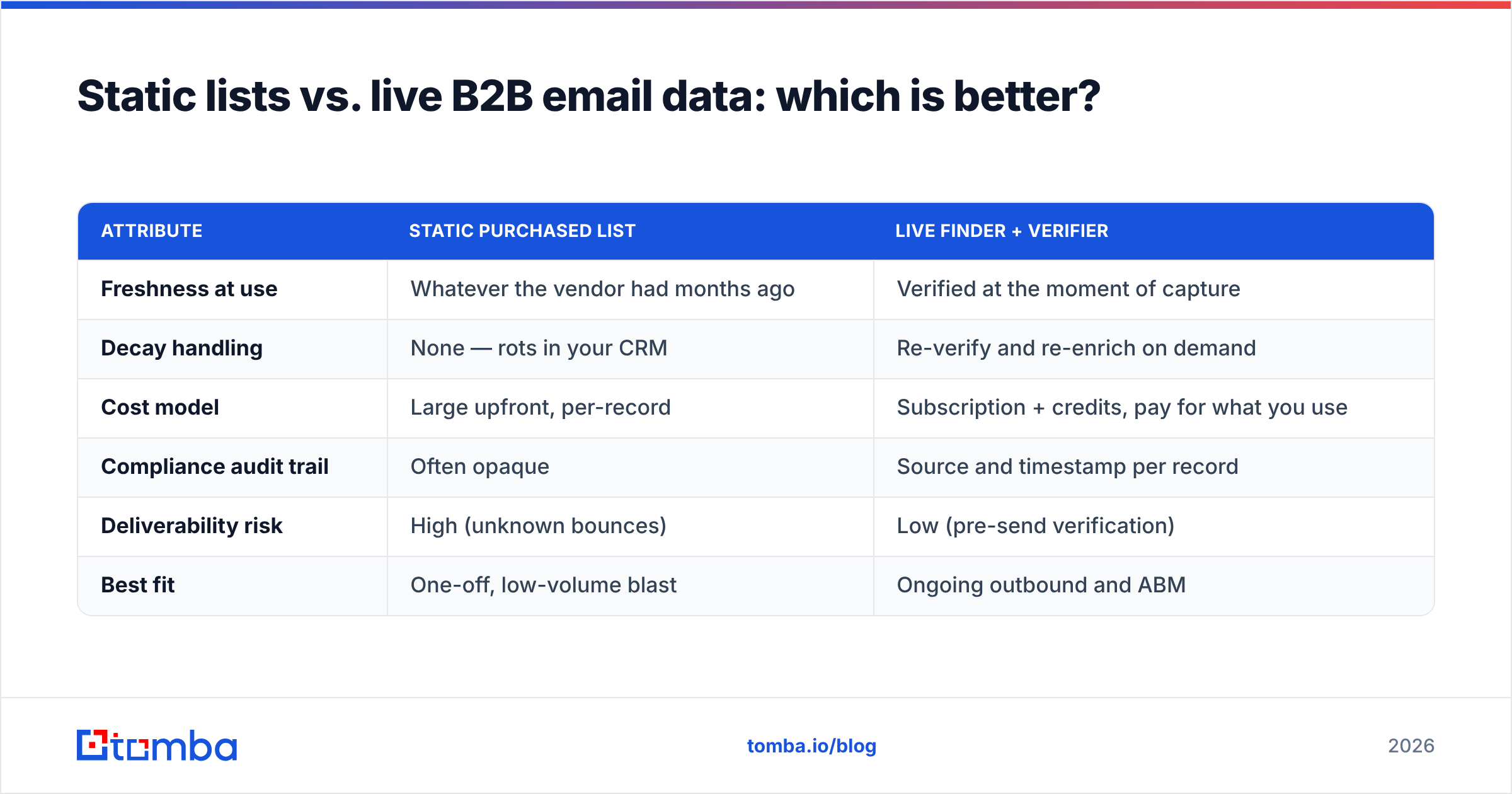
Live data wins for almost every use case, but the trade-offs are worth seeing side by side.
| Attribute | Static purchased list | Live finder + verifier |
|---|---|---|
| Freshness at use | Whatever the vendor had months ago | Verified at the moment of capture |
| Decay handling | None — rots in your CRM | Re-verify and re-enrich on demand |
| Cost model | Large upfront, per-record | Subscription + credits, pay for what you use |
| Compliance audit trail | Often opaque | Source and timestamp per record |
| Deliverability risk | High (unknown bounces) | Low (pre-send verification) |
| Best fit | One-off, low-volume blast | Ongoing outbound and ABM |
Static lists feel cheaper because the cost is visible and upfront. The hidden cost — burned domains, spam complaints, and reps chasing ghosts — shows up later and is far larger.
How much does B2B email data cost?#
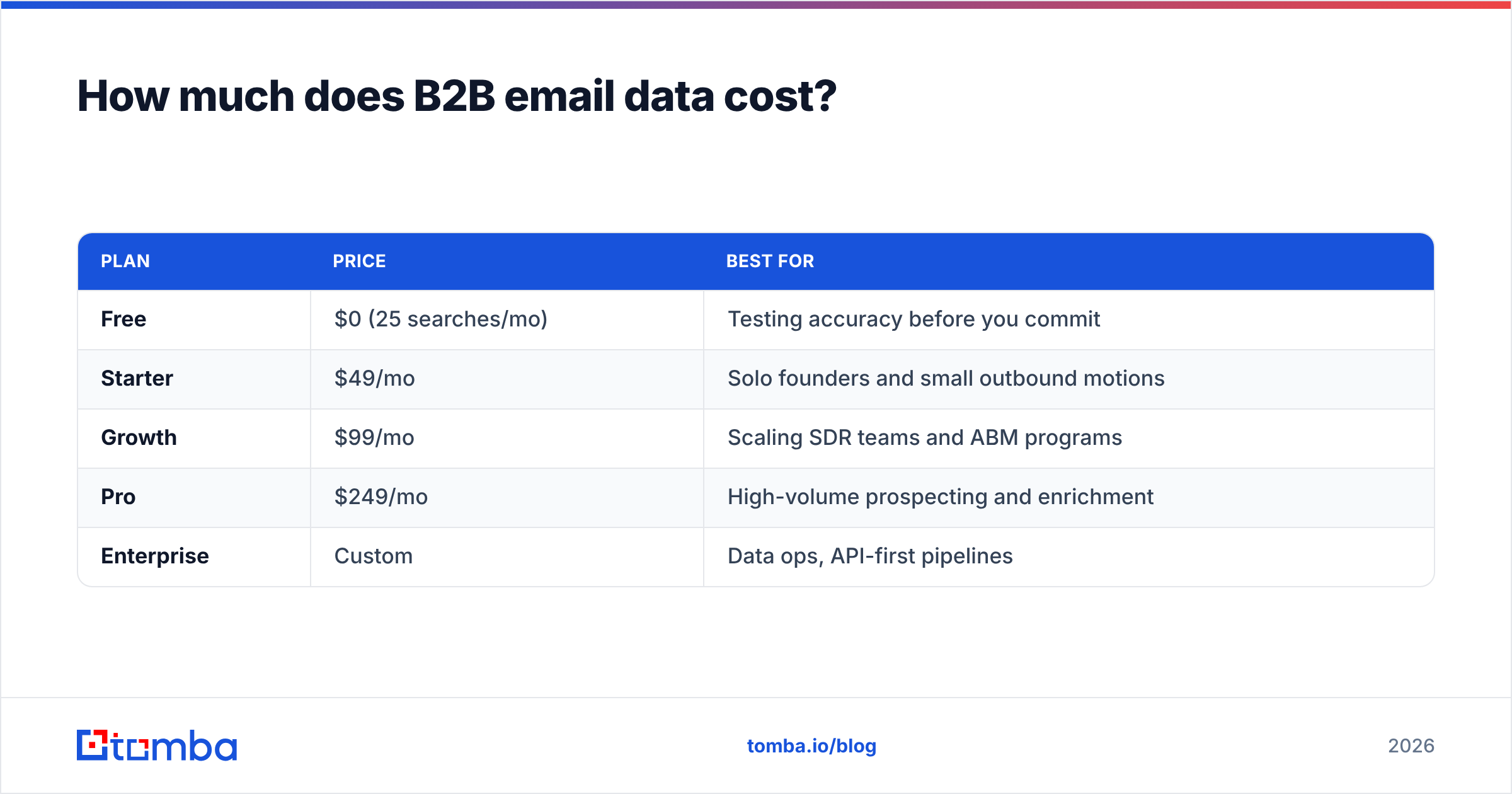
Pricing varies by model, but most reputable providers fall into a few tiers. Credit-based, verify-as-you-go pricing is now the dominant model because it aligns spend with value. For reference, here's how Tomba structures it:
| Plan | Price | Best for |
|---|---|---|
| Free | $0 (25 searches/mo) | Testing accuracy before you commit |
| Starter | $49/mo | Solo founders and small outbound motions |
| Growth | $99/mo | Scaling SDR teams and ABM programs |
| Pro | $249/mo | High-volume prospecting and enrichment |
| Enterprise | Custom | Data ops, API-first pipelines |
You can compare the full Tomba pricing breakdown, but the principle holds across vendors: pay for verified results, not for the size of a database you'll never fully use. When you evaluate options, peer reviews on G2 are a better signal of real-world accuracy than any vendor's own marketing number.
What are the compliance rules for B2B email data in 2026?#
Compliance is where careless teams get burned, and the rules differ by region. The big three:
- GDPR (EU/UK) — B2B email outreach is generally permissible under legitimate interest, but you must document the assessment, honor opt-outs immediately, and be able to show where each record came from. Read the basics on GDPR before you scale EU outreach.
- CAN-SPAM (US) — requires accurate headers, a real physical address, and a working unsubscribe in every commercial email. It's permissive on consent but strict on transparency.
- CASL (Canada) — one of the toughest regimes; implied consent for B2B exists but is narrow and time-limited.
The practical takeaway: keep a per-record source and timestamp, make unsubscribing trivial, and suppress anyone who opts out across every campaign. A vendor that documents its data sources makes this dramatically easier, because you can answer a data-subject request without guessing.
How do you keep B2B email data clean over time?#
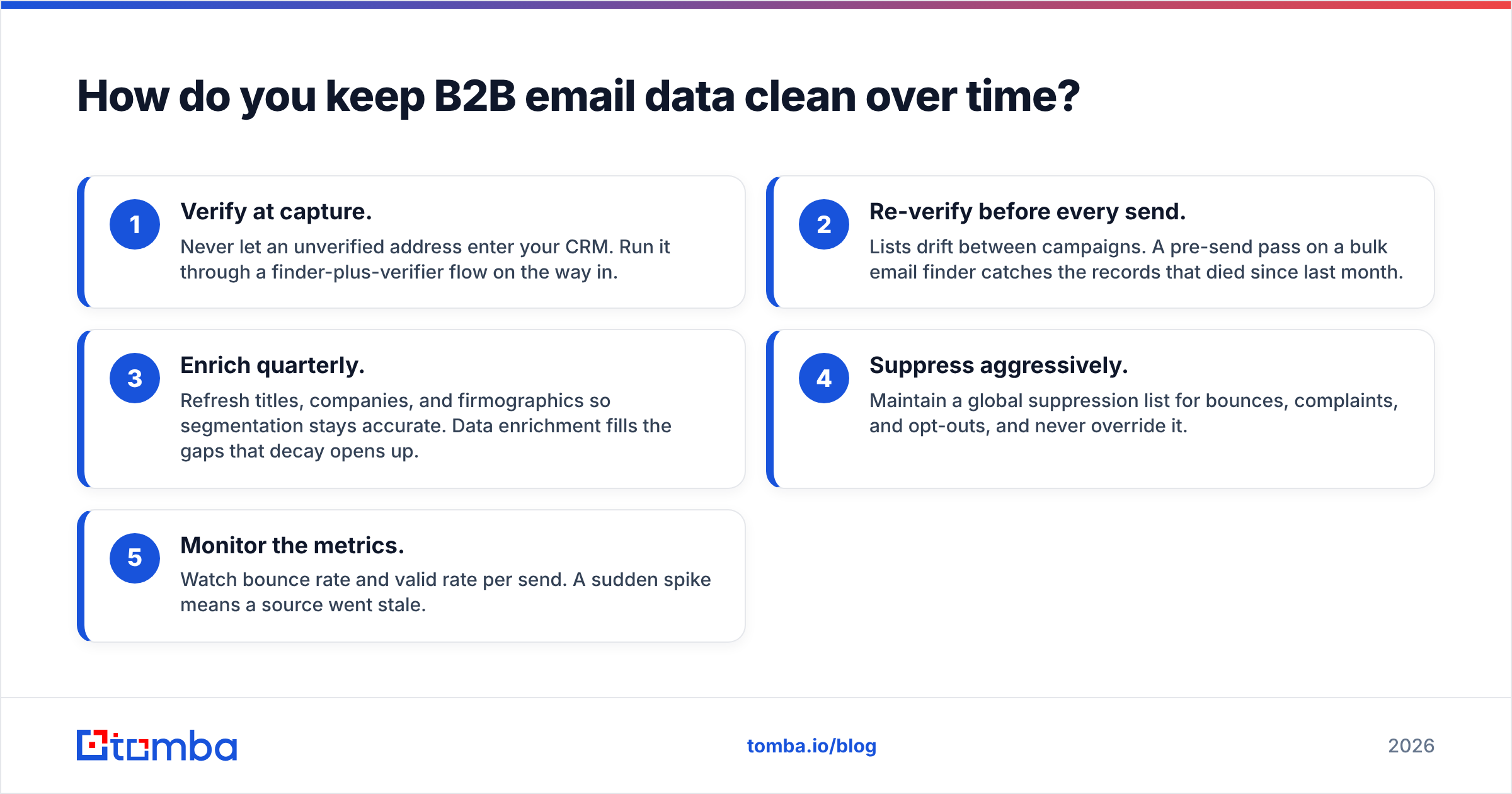
Treat data hygiene as a recurring process, not a one-time cleanup. The loop that works:
- Verify at capture. Never let an unverified address enter your CRM. Run it through a finder-plus-verifier flow on the way in.
- Re-verify before every send. Lists drift between campaigns. A pre-send pass on a bulk email finder catches the records that died since last month.
- Enrich quarterly. Refresh titles, companies, and firmographics so segmentation stays accurate. Data enrichment fills the gaps that decay opens up.
- Suppress aggressively. Maintain a global suppression list for bounces, complaints, and opt-outs, and never override it.
- Monitor the metrics. Watch bounce rate and valid rate per send. A sudden spike means a source went stale.
This loop is the difference between a database that compounds in value and one that quietly poisons your sender reputation. HubSpot's research on email engagement has long shown that list quality drives deliverability far more than send volume — clean data is the cheapest deliverability upgrade you can buy.
What's the best way to source B2B email data going forward?#
Build a pipeline, not a purchase. The teams winning in 2026 have stopped buying static lists and started treating data sourcing as a continuous service: find the right contact, verify it on the spot, enrich the context, and re-check it on a schedule.
That means choosing tools that expose an API and integrate with your stack rather than dumping a CSV in your lap. Whether you pull through a Tomba API call inside your enrichment workflow or trigger a domain search when a new account enters your CRM, the goal is the same — data that's verified at the moment you use it, with a traceable source behind every record.
The mindset shift is simple: stop asking "how many records do I have?" and start asking "how many of my records would survive a send tomorrow?" That second number is the only one that drives revenue.
Get accurate B2B email data with Tomba#
If your outbound is running on a list you can't trust, the fix isn't a bigger list — it's a live source you can verify. The Tomba Email Finder finds professional emails by name, company, or domain, confirms them through a built-in verification layer, and plugs into your CRM, Sheets, or API so every record enters your pipeline already validated. Start on the free tier with 25 searches, measure the valid rate against whatever you're using now, and scale up only when the accuracy proves itself. Clean B2B email data is the cheapest pipeline insurance you'll ever buy — start building it the right way today.
// get started
Find, verify and enrich your first contacts today
Start on the free plan with 25 searches a month, then scale when your team is ready.
Free plan · No credit card required · GDPR & CCPA
Get the Tomba newsletter
Product and data updates
// about the author