How to Get B2B Email Leads That Actually Convert in 2026
Buying a 50,000-row list feels productive until 40% bounces. Here's how to build B2B email leads that are accurate, compliant, and actually reply in 2026.
TL;DR
- B2B email leads are only as valuable as their accuracy — a "10,000-contact list" with a 35% bounce rate is worth less than 2,000 verified contacts.
- The four reliable sourcing methods are: targeted email finders, opt-in inbound capture, enrichment of existing CRM records, and vetted database access. Bought spreadsheet lists are the worst of the four.
- Always verify before you send. Bounces above 3% put your sender reputation — and your whole domain — at risk.
- Compliance (GDPR, CAN-SPAM) is not optional in 2026. Legitimate interest plus a clear opt-out is the baseline.
- A repeatable workflow beats a one-time list purchase every time: find → verify → enrich → segment → send → measure.
What Are B2B Email Leads, Exactly?#
A B2B email lead is a verified business contact — a real person, at a real company, with a role that maps to your offer, reachable at a working email address. That last clause does most of the work. Plenty of "leads" fail it.
Think of it like a guest list for a dinner party. You can write down 500 names, but the party only works if those people exist, want to come, and got the invitation. A spreadsheet of 500 unverified addresses is a guest list scribbled from memory — impressive on paper, mostly fiction in practice.
The distinction that matters in 2026:
- Raw contact — a name and a guessed email. No verification, no context. Often scraped or purchased in bulk.
- Verified lead — the address has passed SMTP and syntax checks and is confirmed deliverable.
- Qualified lead — verified and matched to your ICP (industry, company size, role, intent signals).
- Engaged lead — a qualified lead who has opened, clicked, or replied at least once.
Most teams chase volume at level 1 and wonder why campaigns underperform. The money is in moving leads to levels 2 through 4 systematically.
Where Do You Actually Get B2B Email Leads?#
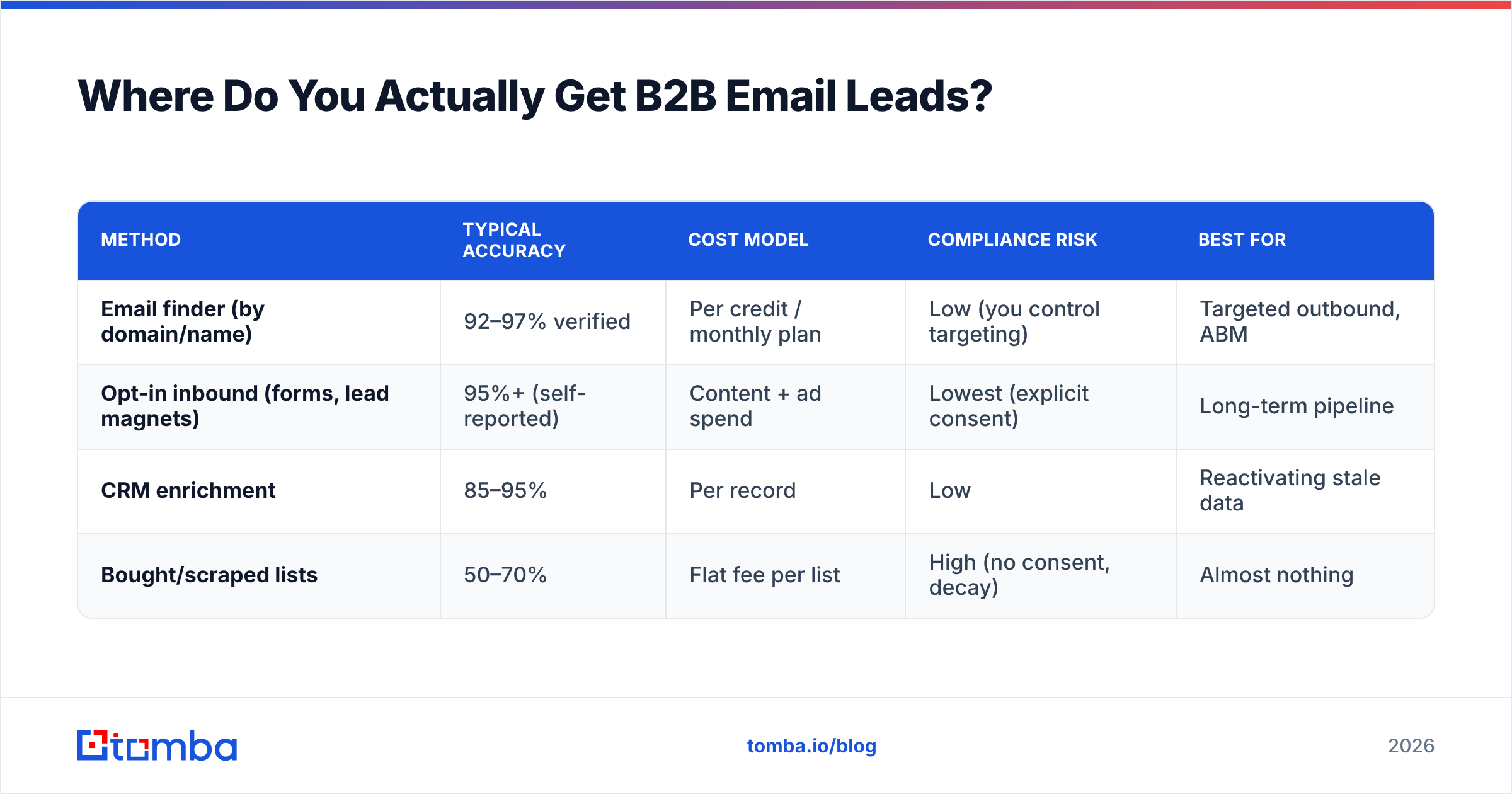
There are four legitimate sources, and they are not equal. Here is how they stack up.
| Method | Typical accuracy | Cost model | Compliance risk | Best for |
|---|---|---|---|---|
| Email finder (by domain/name) | 92–97% verified | Per credit / monthly plan | Low (you control targeting) | Targeted outbound, ABM |
| Opt-in inbound (forms, lead magnets) | 95%+ (self-reported) | Content + ad spend | Lowest (explicit consent) | Long-term pipeline |
| CRM enrichment | 85–95% | Per record | Low | Reactivating stale data |
| Bought/scraped lists | 50–70% | Flat fee per list | High (no consent, decay) | Almost nothing |
Bought lists are the trap. They look cheap per contact, but you pay for the dead weight twice: once at purchase, and again when 30–40% bounce and torch your sender reputation. According to HubSpot's research on email decay, B2B marketing databases degrade by roughly 22.5% per year as people change jobs — so a list is rotting the moment it's compiled.
The first three methods give you control. A good email finder lets you target a specific company, role, or domain instead of buying whatever a vendor scraped last quarter. Pair it with data enrichment to fill in title, company size, and LinkedIn, and you've built a lead instead of bought a name.
How Do You Find B2B Email Leads by Domain?#
Domain search is the fastest way to turn a company you want into a list of contacts you can reach. Here's the workflow, start to finish.
- Start with the company, not the person. You know you want to sell to Acme Corp. Run their domain (
acme.com) through a domain search to pull every discoverable address and the company's email pattern (e.g.,first.last@acme.com). - Filter by role. Don't email
info@. Narrow to the department and seniority that owns the buying decision — VP of Sales, Head of RevOps, whoever signs off. - Find named contacts. Use a name + domain lookup to get the specific decision-maker's address. The pattern from step 1 makes this far more reliable.
- Verify every address. Run the results through an email verifier before they ever touch your sending tool. This is the step most people skip and most regret.
- Enrich for context. Add the data you'll use to personalize: role, recent funding, tech stack, mutual connections.
- Segment and stage. Group by persona and intent so your sequencing matches the lead, not the lowest common denominator.
The whole point is that each step compounds. Skipping verification doesn't save time — it just moves the cost to your bounce rate and, eventually, your domain's ability to reach the inbox at all.
Why Does Verification Matter So Much for B2B Email Leads?#
Because mailbox providers judge you by your bounces, and the penalty is collective. One bad campaign doesn't just lose you a few sends — it can drag down deliverability for every email your domain sends afterward.
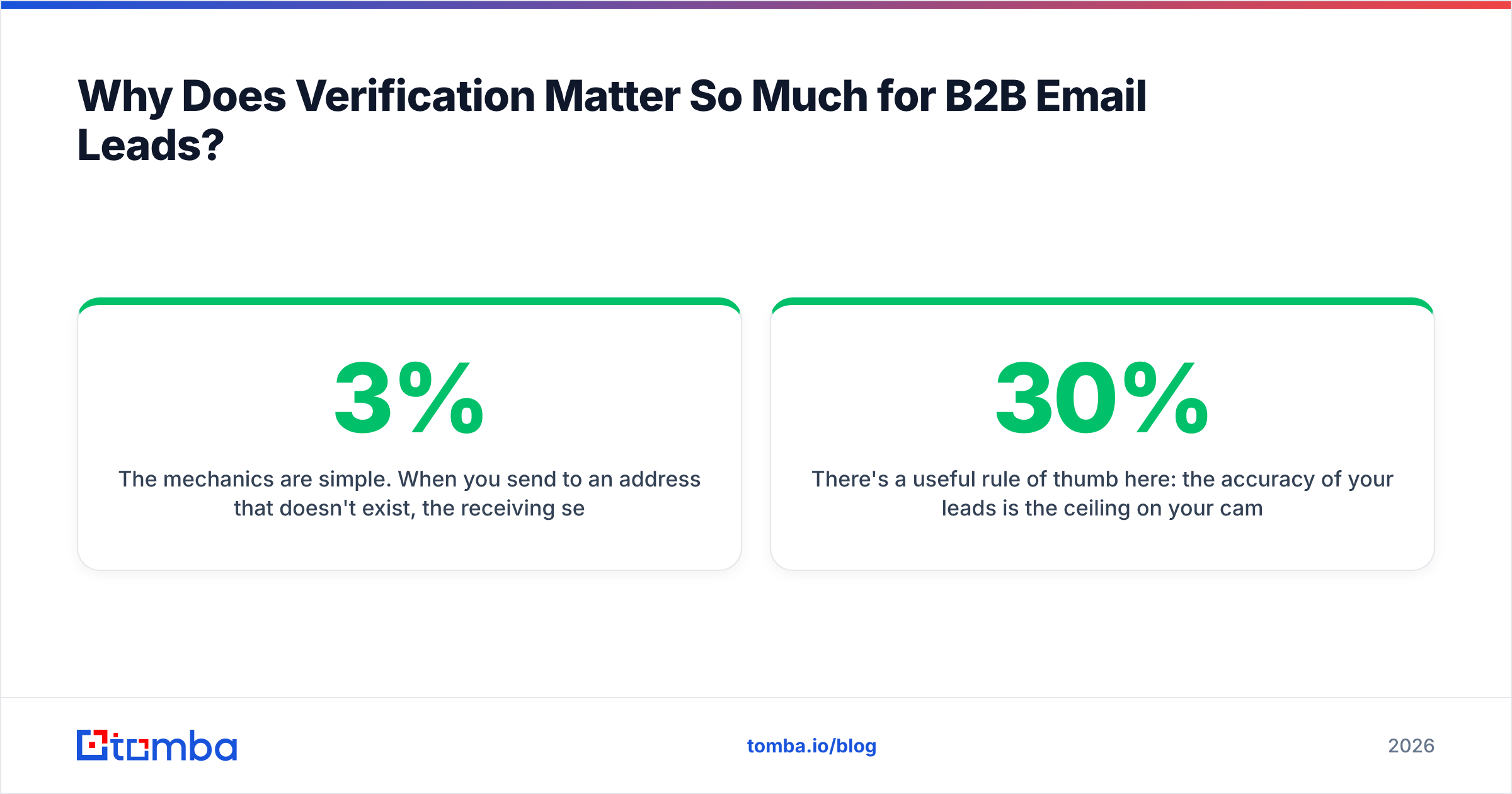
The mechanics are simple. When you send to an address that doesn't exist, the receiving server records a hard bounce. Gmail, Outlook, and Yahoo treat a high hard-bounce rate as a signal that you're either careless or a spammer (they can't tell the difference, and they don't try). Per most deliverability guidance, you want to keep hard bounces under 2–3%. Buy a 60% list, send to all of it, and you've blown past that on day one.
Verification catches:
- Syntax errors — malformed addresses that never had a chance.
- Non-existent mailboxes — the address that bounces.
- Disposable domains — throwaway addresses that won't convert.
- Catch-all domains — servers that accept everything, which need a catch-all verifier to assess risk rather than a simple yes/no.
- Role accounts —
sales@,support@, which inflate volume but rarely reply.
There's a useful rule of thumb here: the accuracy of your leads is the ceiling on your campaign's performance. You can write perfect copy and time it perfectly, but if 30% of the list is dead, 30% of your effort is wasted before the first send. Industry buyer reviews on platforms like G2 consistently rank verification accuracy as the top differentiator between lead-gen tools — ahead of price.
What Makes a B2B Email Lead "Qualified"?#
A verified address tells you the email works. Qualification tells you it's worth sending to. The gap between the two is where most pipeline is won or lost.
Use a simple scoring frame. A lead earns points for each ICP match and loses relevance without them:
- Firmographic fit — industry, company size, revenue, geography. Is this the kind of company that buys what you sell?
- Role fit — does this person influence or own the purchase? A junior analyst and a VP are not the same lead.
- Intent signals — recent funding, a new hire in a relevant role, technology they've adopted, content they've engaged with.
- Timing — is there a trigger event (expansion, a competitor switch, a compliance deadline) that makes now the moment?
This is the difference between a marketing qualified lead and a random verified address. A list of 500 qualified leads will almost always outperform 5,000 unqualified ones — fewer sends, higher reply rates, cleaner reputation, and a sales team that doesn't waste hours on bad-fit conversations.
The practical move: enrich first, then score, then send. Don't reverse it. Sending to everyone and "letting the data tell you" who's interested is just spam with a feedback loop.
Is Buying a B2B Email List Ever Worth It?#
Short answer: almost never, and here's the honest reasoning rather than a sales pitch.
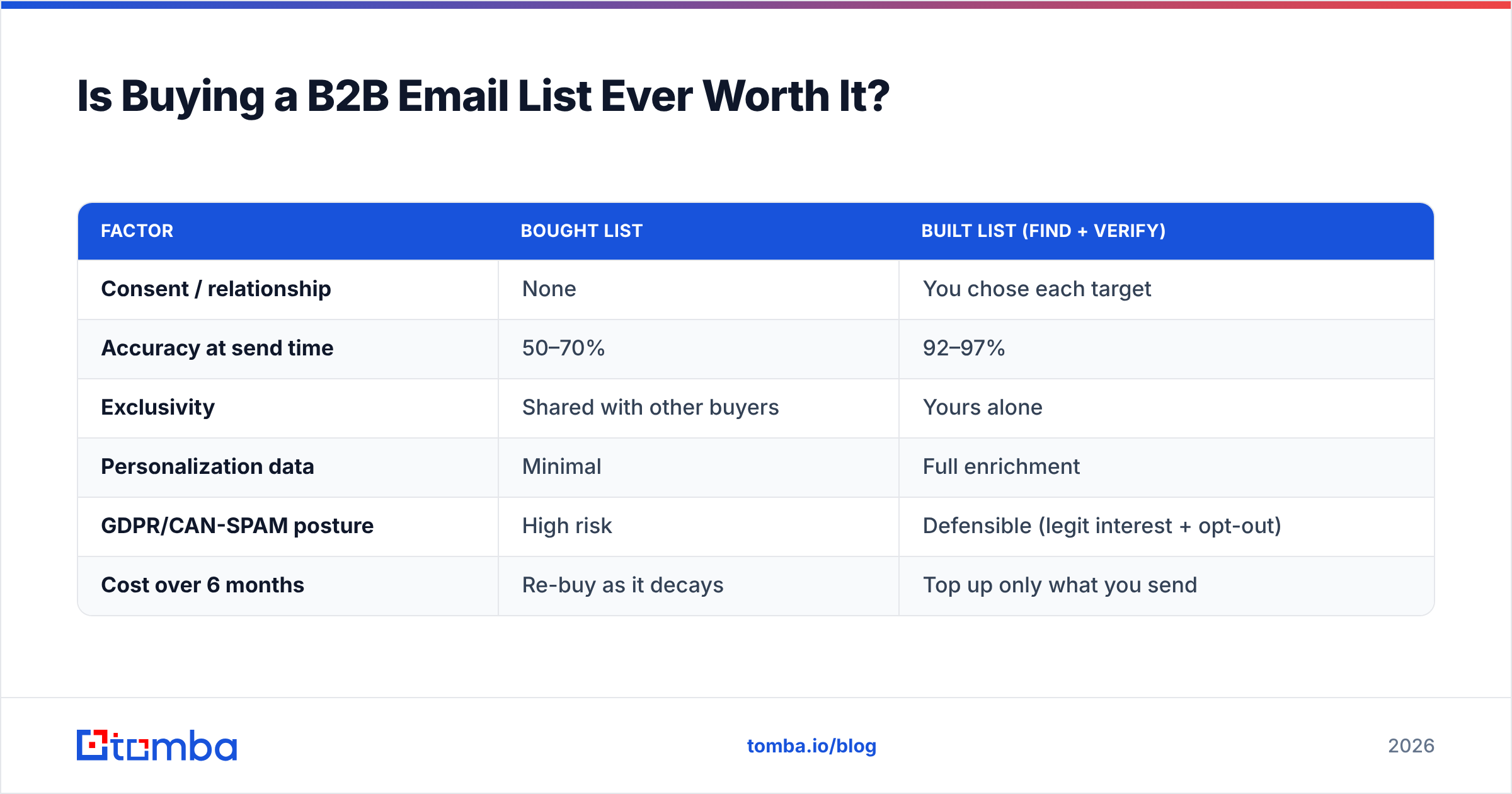
Bought lists fail on three axes at once. They decay (people leave jobs), they're non-consensual (you have no relationship with anyone on them), and they're shared (you're rarely the only buyer, so recipients are already fatigued by cold blasts). The combination is toxic for both deliverability and conversion.
| Factor | Bought list | Built list (find + verify) |
|---|---|---|
| Consent / relationship | None | You chose each target |
| Accuracy at send time | 50–70% | 92–97% |
| Exclusivity | Shared with other buyers | Yours alone |
| Personalization data | Minimal | Full enrichment |
| GDPR/CAN-SPAM posture | High risk | Defensible (legit interest + opt-out) |
| Cost over 6 months | Re-buy as it decays | Top up only what you send |
The "built" column wins on every line that affects revenue. The only thing the bought list wins on is the illusion of speed — and even that disappears the first time your domain gets throttled.
If you need volume fast, the right answer isn't a bought spreadsheet. It's a vetted B2B database with verification built in, plus a bulk email finder to process target accounts at scale while keeping accuracy high. Same speed, none of the reputation damage.
How Do You Stay Compliant When Sourcing B2B Email Leads?#
Compliance in 2026 is straightforward if you stop treating it as an afterthought. The two regimes most B2B senders care about:
- GDPR (EU/UK): For B2B cold outreach, "legitimate interest" is a valid legal basis — but it requires that your offer is genuinely relevant to the recipient's professional role, that you document your reasoning, and that you honor opt-outs immediately. Blasting unrelated personas does not qualify.
- CAN-SPAM (US): You must include a valid physical address, a clear and working unsubscribe mechanism, accurate "from" and subject lines, and you must process opt-outs within 10 business days.
Practical guardrails that keep you on the right side of both:
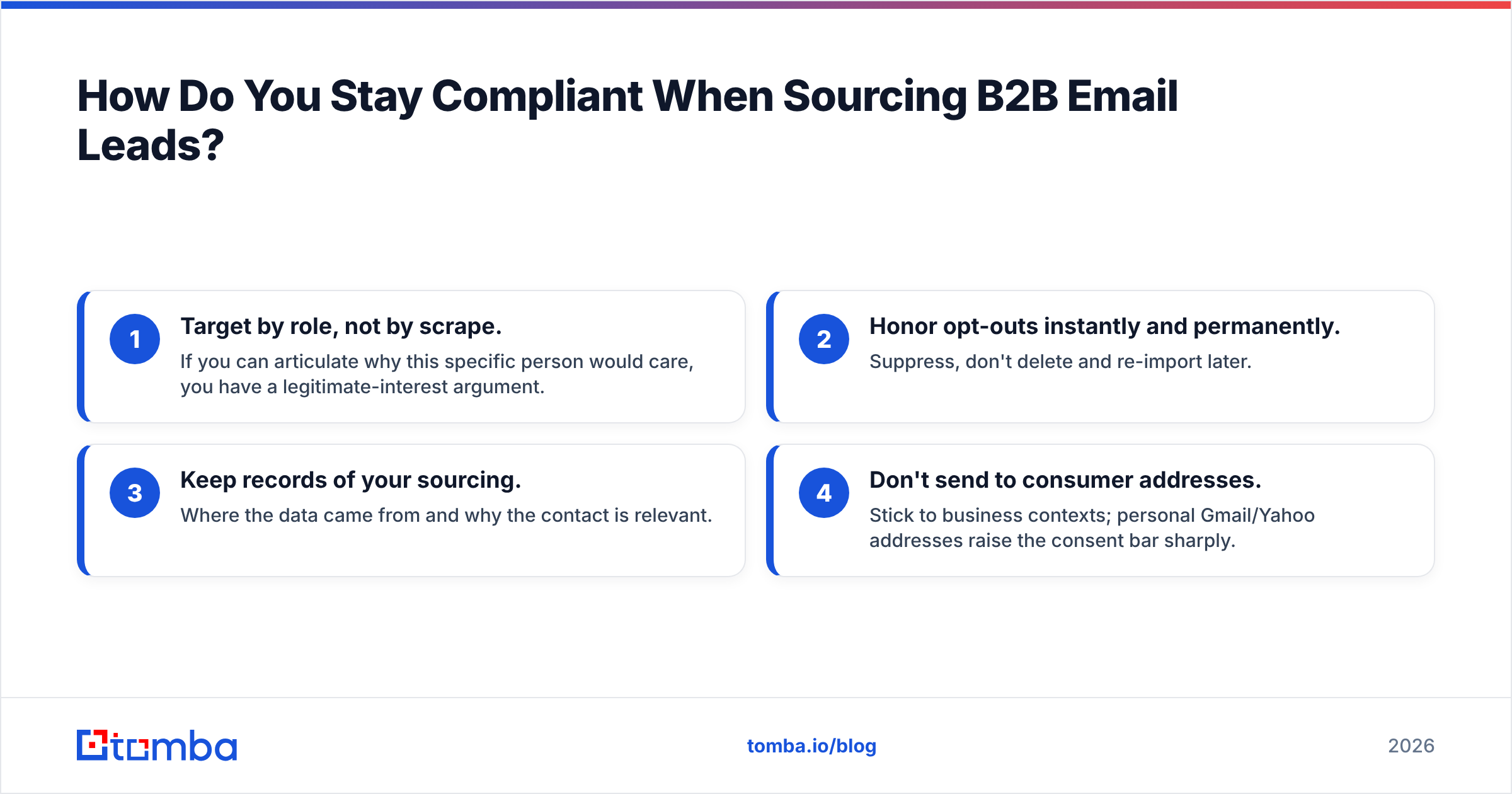
- Target by role, not by scrape. If you can articulate why this specific person would care, you have a legitimate-interest argument.
- Honor opt-outs instantly and permanently. Suppress, don't delete and re-import later.
- Keep records of your sourcing. Where the data came from and why the contact is relevant.
- Don't send to consumer addresses. Stick to business contexts; personal Gmail/Yahoo addresses raise the consent bar sharply.
None of this is exotic. It's the difference between a defensible outbound program and one that collects spam complaints. The official guidance from the European Commission on GDPR is worth bookmarking if you sell into the EU.
What Does a Repeatable Lead-Gen Workflow Look Like?#
Stop thinking in terms of "getting a list." Think in terms of a pipeline you run weekly. Here's a workflow that scales without burning your domain:
- Define the account list. Pick 50–200 target companies that match your ICP.
- Run domain search on each to map contacts and email patterns.
- Find named decision-makers by role.
- Verify in bulk — one pass, before anything enters your sending tool.
- Enrich with role, company, and intent data for personalization.
- Segment into 3–5 persona-based tracks.
- Send in small, warmed batches and watch bounce and reply rates.
- Feed results back — promote engaged leads, suppress bounces, refine the ICP.
Run that loop every week and your list quality improves over time instead of decaying. You can wire most of it together through the Tomba API or integrations with your CRM, so the find-verify-enrich steps happen automatically as new accounts enter your pipeline.
The teams that win at outbound in 2026 aren't the ones with the biggest lists. They're the ones with the cleanest, most current, best-targeted ones — and a system that keeps them that way.
Find B2B Email Leads That Reply, Not Bounce#
If you're tired of paying for lists that bounce and burn your domain, build your leads instead of buying them. The Tomba Email Finder lets you target by company, domain, name, or role, returns verified addresses with confidence scoring, and connects to verification, enrichment, and bulk processing in one workflow. Start on the free tier (25 searches/month) to test accuracy against your own targets, then scale on the Starter plan at $49/mo or Growth at $99/mo as your pipeline grows — see full Tomba pricing for details. Accurate leads in, clean reputation maintained, more replies out.
// get started
Find, verify and enrich your first contacts today
Start on the free plan with 25 searches a month, then scale when your team is ready.
Free plan · No credit card required · GDPR & CCPA
// about the author