B2B Email Lists for Sale in 2026: Buy, Build, or Skip?
B2B email lists for sale look like a shortcut to pipeline. Here's what they really cost in deliverability, deals, and legal risk — and a smarter 2026 alternative.
Search "B2B email lists for sale" and you'll find dozens of vendors promising 50 million verified contacts for the price of a dinner. The pitch is seductive: skip the prospecting, buy the spreadsheet, start emailing tomorrow. The reality is messier, more expensive, and far riskier than the landing pages admit.
This guide breaks down what you actually get when you buy a B2B email list in 2026, what it costs you downstream, where the legal landmines are, and why building a targeted list with a tool like an email finder almost always beats buying a static dump.
TL;DR#
- Bought B2B lists decay fast — 22–30% of contacts go stale per year, so a "fresh" purchased list is partly dead on arrival.
- The real cost isn't the list price — it's burned domains, spam complaints, and a wrecked sender reputation that can take months to repair.
- Legal exposure is real — GDPR, CAN-SPAM, and CASL treat purchased consent very differently from earned consent.
- Built lists outperform bought lists on reply rate, deliverability, and cost-per-meeting almost every time.
- A self-serve finder + verifier (like Tomba) gets you accurate, targeted contacts without buying someone else's recycled data.
What does "B2B email lists for sale" actually mean?#
When a vendor sells you a B2B email list, you're buying a static export of contact records — names, job titles, company, and email addresses — scraped, aggregated, or licensed from various sources. There are three flavors, and they are not equal.
- Pre-packaged lists — A generic database segmented by industry or title ("all SaaS CMOs in North America"). Cheapest, lowest quality, sold to everyone.
- Custom-built lists — A vendor builds to your ICP spec. More expensive, somewhat fresher, but still a one-time static file.
- Database subscriptions — Platforms like ZoomInfo or Apollo where you pay for ongoing access and pull contacts yourself. Pricier, but the data is maintained.
The phrase "for sale" usually refers to the first two. And those are exactly the ones that get marketers into trouble. A list is a photograph of reality on the day it was compiled. People change jobs, companies fold, and domains get retired — your photograph ages whether you use it or not.
How accurate are purchased B2B email lists?#
Short answer: less accurate than the invoice suggests, and worse every month. B2B data decays at roughly 22–30% per year, driven by job changes alone. According to HubSpot, marketing databases naturally degrade as contacts move roles, which means a list compiled even six months ago has meaningful rot baked in.
Here's the cascade that hits you when you email a stale list:
- Hard bounces from dead mailboxes signal to inbox providers that you don't manage your list.
- Spam traps — recycled or pristine trap addresses sprinkled into cheap lists — quietly torch your reputation.
- Spam complaints from people who never opted in pile up fast.
- Low engagement tells Gmail and Outlook your mail is unwanted, so even your good contacts stop seeing you.
Before any list touches your sending domain, it needs scrubbing. Running purchased data through an email verifier is the bare minimum — and if you have to verify every record anyway, you've already lost much of the "time saved" that made buying attractive. Catch-all domains add another layer of doubt; a catch-all verifier helps, but catch-alls never give you full certainty.
Buy vs. build: which is better for B2B email lists?#
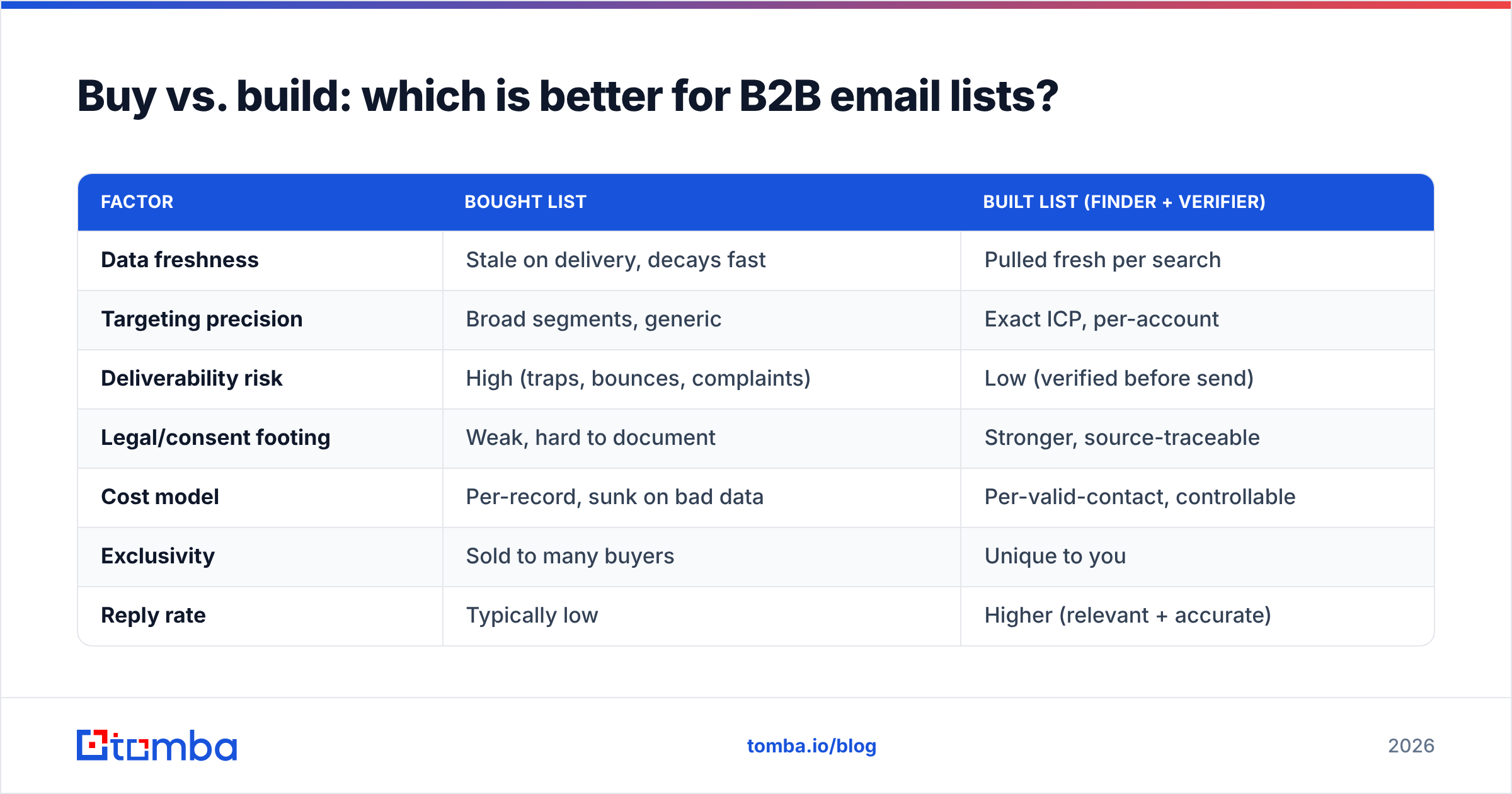
The honest answer depends on your goals, but for most teams running real outbound, building wins on every metric that matters. Here's the side-by-side.
| Factor | Bought list | Built list (finder + verifier) |
|---|---|---|
| Data freshness | Stale on delivery, decays fast | Pulled fresh per search |
| Targeting precision | Broad segments, generic | Exact ICP, per-account |
| Deliverability risk | High (traps, bounces, complaints) | Low (verified before send) |
| Legal/consent footing | Weak, hard to document | Stronger, source-traceable |
| Cost model | Per-record, sunk on bad data | Per-valid-contact, controllable |
| Exclusivity | Sold to many buyers | Unique to you |
| Reply rate | Typically low | Higher (relevant + accurate) |
The exclusivity row is the quiet killer. That "exclusive premium list" was likely sold to a hundred other senders, all hammering the same inboxes. By the time your email lands, the prospect has already deleted five identical pitches this week.
Building, by contrast, means you decide the accounts, find the right person, verify the address, and own the result. Tools like the domain search let you pull every public email pattern for a target company, while bulk lead generation scales the same process across hundreds of accounts without buying a recycled file.
What does it cost — really?#
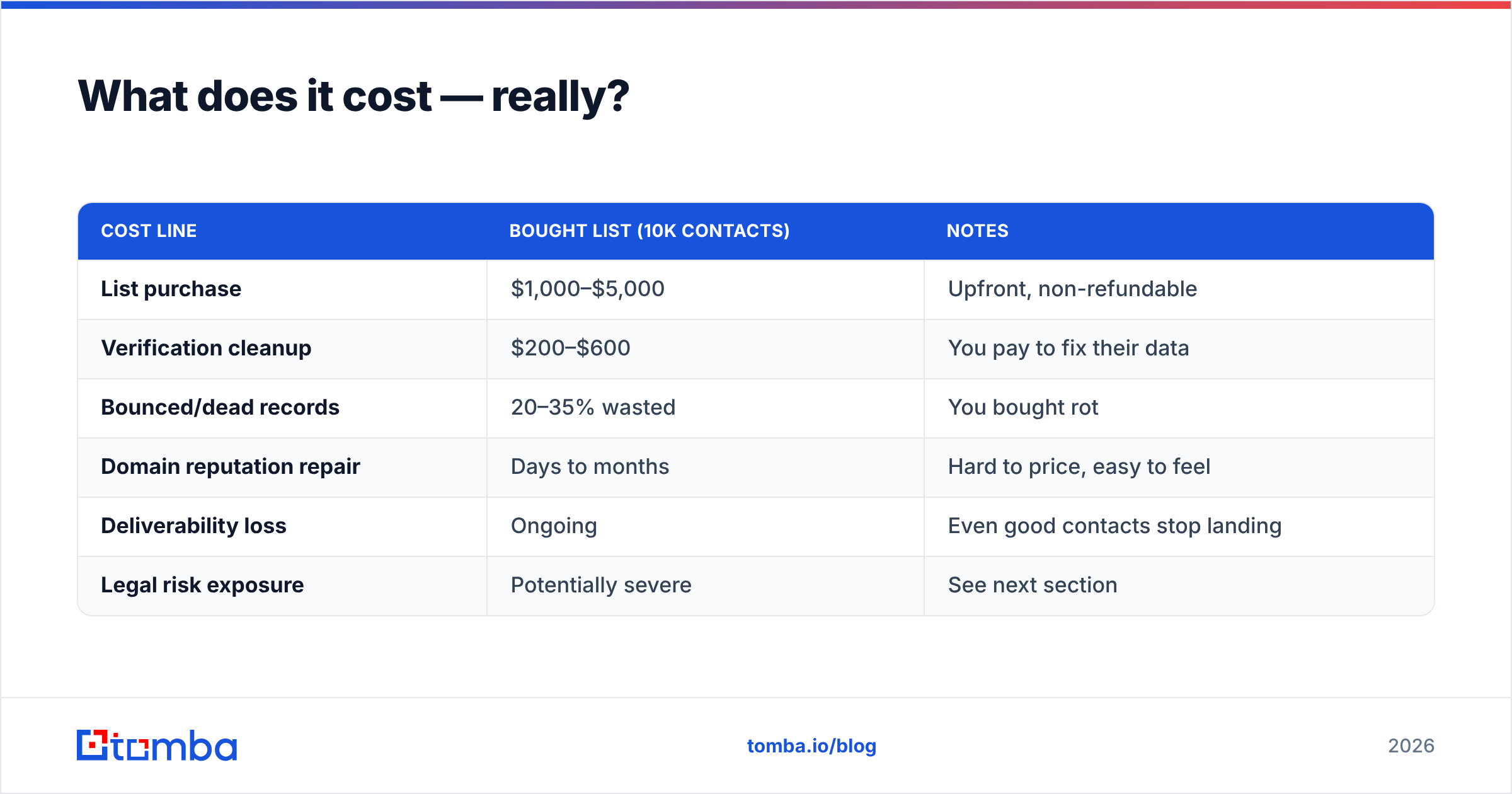
The sticker price is the smallest number in the equation. A cheap list might run $0.10–$0.50 per contact; a "premium" custom build can hit $1–$3. But the total cost of ownership includes everything the vendor doesn't mention.
| Cost line | Bought list (10k contacts) | Notes |
|---|---|---|
| List purchase | $1,000–$5,000 | Upfront, non-refundable |
| Verification cleanup | $200–$600 | You pay to fix their data |
| Bounced/dead records | 20–35% wasted | You bought rot |
| Domain reputation repair | Days to months | Hard to price, easy to feel |
| Deliverability loss | Ongoing | Even good contacts stop landing |
| Legal risk exposure | Potentially severe | See next section |
Compare that to a focused tool subscription. Tomba pricing starts with a free tier (25 searches/month), then Starter at $49/mo, Growth at $99/mo, and Pro at $249/mo — and every contact you pull is one you targeted and can verify before sending. You're paying for precision, not a haystack with a few needles in it.
Is it legal to buy and email B2B lists?#
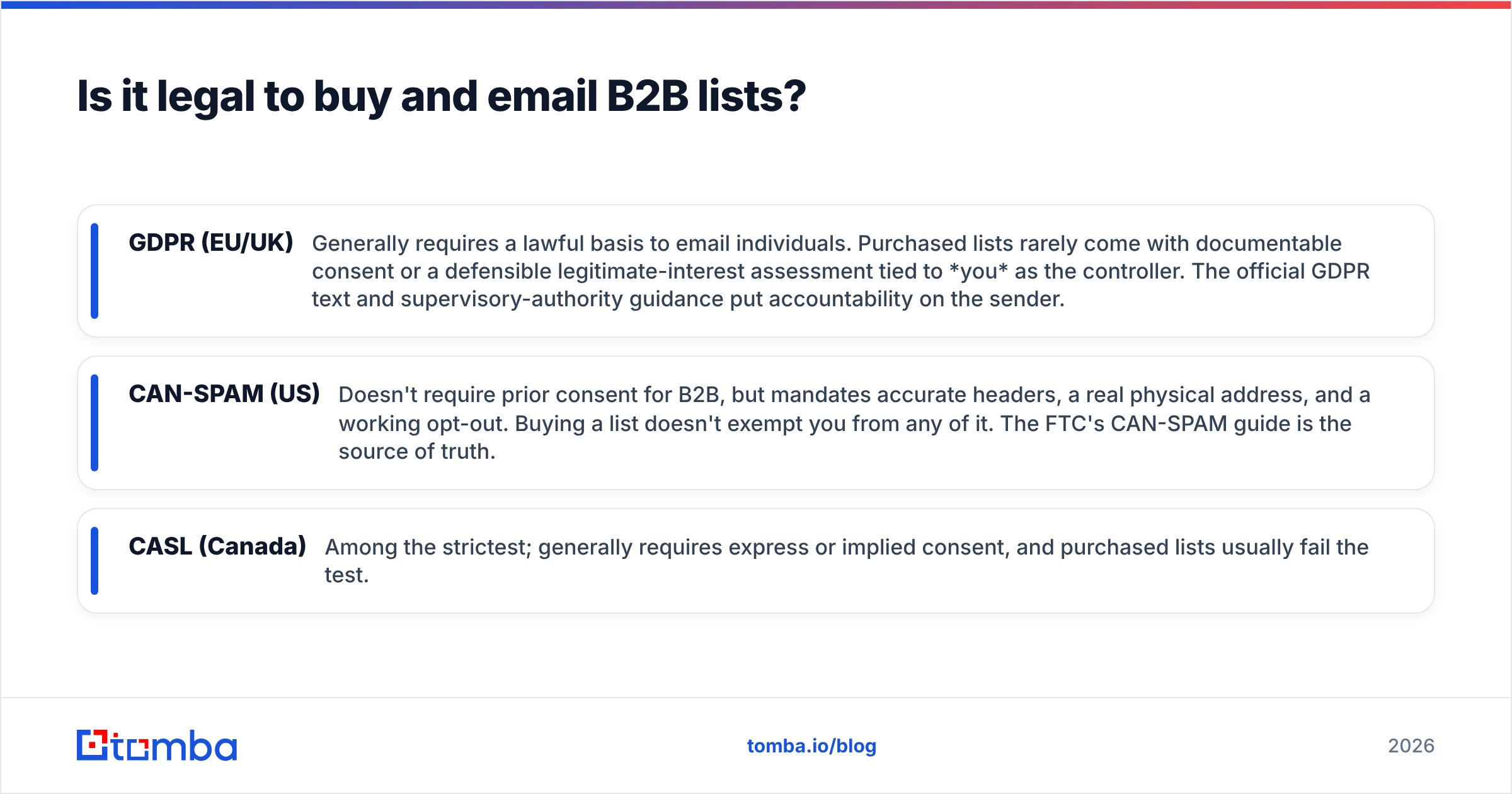
It's complicated, jurisdiction-dependent, and the burden of proof is on you — not the vendor. A vendor saying "100% GDPR compliant" on a checkout page is marketing, not legal cover. Here's the landscape at a glance.
- GDPR (EU/UK) — Generally requires a lawful basis to email individuals. Purchased lists rarely come with documentable consent or a defensible legitimate-interest assessment tied to you as the controller. The official GDPR text and supervisory-authority guidance put accountability on the sender.
- CAN-SPAM (US) — Doesn't require prior consent for B2B, but mandates accurate headers, a real physical address, and a working opt-out. Buying a list doesn't exempt you from any of it. The FTC's CAN-SPAM guide is the source of truth.
- CASL (Canada) — Among the strictest; generally requires express or implied consent, and purchased lists usually fail the test.
The practical takeaway: emailing a bought list isn't automatically illegal in the US, but it raises your risk surface everywhere, and in stricter regions it can expose you to real penalties. Building your own list from public business data, with clear sourcing, puts you on much firmer ground. If you ever need to show where a contact came from, your own data sources and search logs are far easier to defend than "we bought it from someone."
How do you build a better list instead of buying one?#
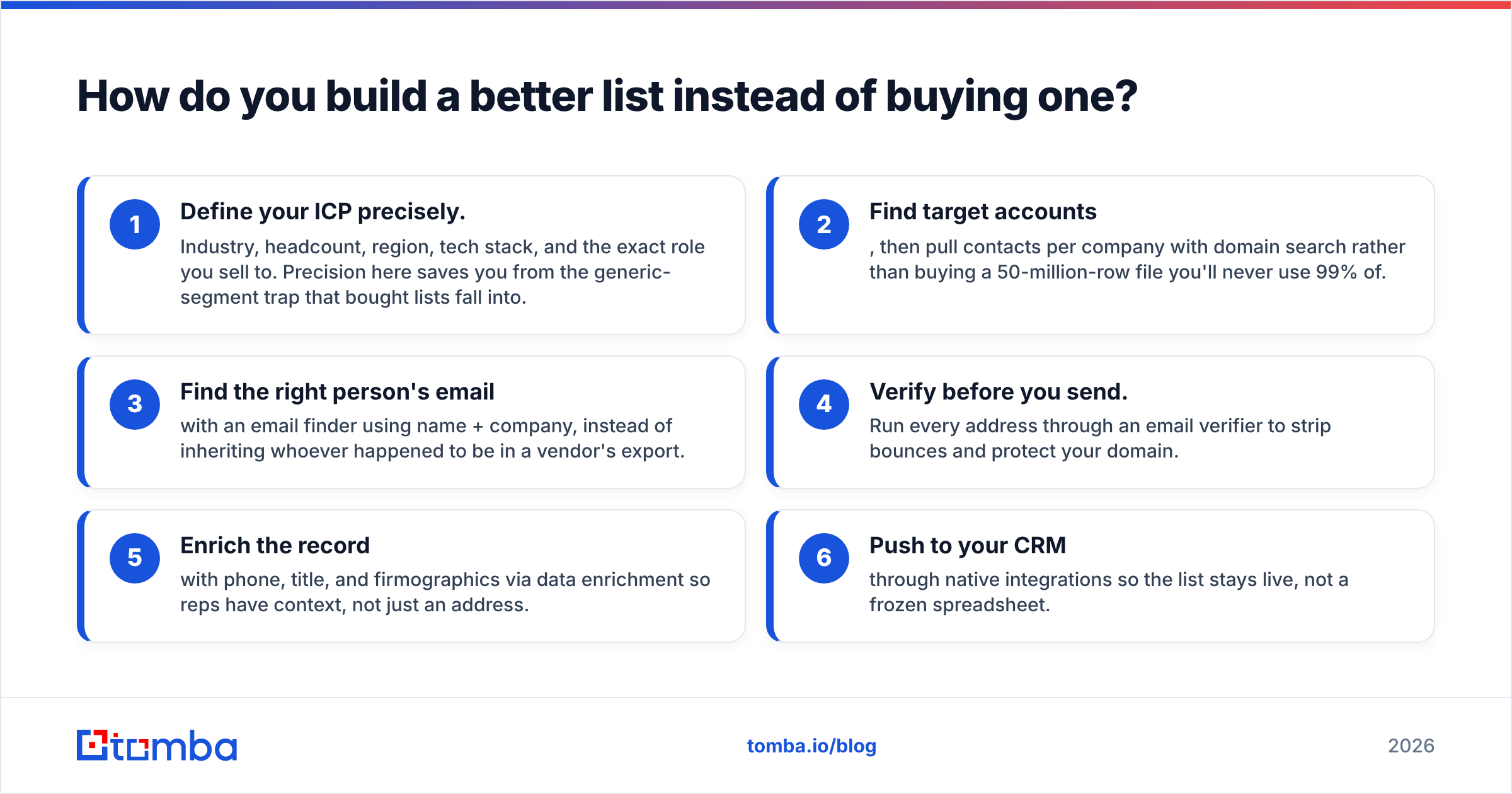
Build it the way the best outbound teams do: define the account, find the person, verify the address, enrich the record. It's faster than it sounds when the tooling does the heavy lifting.
- Define your ICP precisely. Industry, headcount, region, tech stack, and the exact role you sell to. Precision here saves you from the generic-segment trap that bought lists fall into.
- Find target accounts, then pull contacts per company with domain search rather than buying a 50-million-row file you'll never use 99% of.
- Find the right person's email with an email finder using name + company, instead of inheriting whoever happened to be in a vendor's export.
- Verify before you send. Run every address through an email verifier to strip bounces and protect your domain.
- Enrich the record with phone, title, and firmographics via data enrichment so reps have context, not just an address.
- Push to your CRM through native integrations so the list stays live, not a frozen spreadsheet.
This flow gives you a list that's targeted, verified, exclusive, and traceable — the four things a purchased list can't offer at once. For high-volume teams, the Tomba API automates the whole sequence, and the Chrome extension handles one-off lookups while you're already on a prospect's site.
When does buying a list ever make sense?#
Rarely, but not never. If you need a quick market-sizing snapshot, a one-time event audience you'll fully re-permission, or directional firmographic data for analysis (not cold emailing), a purchased dataset can be a reasonable input. The key distinction: using bought data for research is lower-risk than blasting it with cold outreach.
If your end goal is replies and meetings, though, the math rarely favors buying. You'll spend the "saved" time cleaning data, nursing your domain back to health, and apologizing for emails nobody asked for. The teams winning at outbound in 2026 treat list-building as a precision craft, not a bulk purchase — and they back it with data enrichment so every record earns its place in the sequence.
The bottom line#
B2B email lists for sale promise a shortcut and deliver a liability. The list price is the cheapest part; stale data, deliverability damage, and legal exposure are where the real bill lands. Building a targeted, verified list costs less in total, performs better, and keeps you on defensible legal footing.
Skip the recycled spreadsheet. Use the Tomba Email Finder to find professional email addresses by domain, name, or company, verify them before you send, and build a list that's actually yours. Start free with 25 searches a month — no purchased rot, no shared inboxes, just accurate contacts you targeted on purpose.
// get started
Find, verify and enrich your first contacts today
Start on the free plan with 25 searches a month, then scale when your team is ready.
Free plan · No credit card required · GDPR & CCPA
// about the author