B2B Email Template to Introduce Yourself: 9 Picks (2026)
Nine proven B2B email templates to introduce yourself in 2026 — copy-paste scripts, subject lines, and the data that makes them actually get replies.
(title rendered separately)
Introducing yourself over email is the hardest 120 words in B2B. You have no relationship, no context, and a reader who decides in under three seconds whether you are worth a reply. A good b2b email template to introduce yourself removes the guesswork: it gives you a repeatable structure, then leaves room for the one personalized line that earns the open.
This guide gives you nine templates you can paste today, the structure behind why they work, and the benchmarks that tell you whether yours is good or just busy.
TL;DR#
- A strong intro email follows one shape: relevant hook → who you are → why now → one clear ask. Everything else is noise.
- Keep it under 125 words. Reply rates drop sharply past 150 words, according to multiple cold-outreach studies.
- The subject line and the first sentence do 80% of the work — personalize both, not just the greeting.
- Templates below cover cold prospecting, warm referrals, post-event, LinkedIn-to-email, new-role, and re-introductions.
- None of it matters if the email bounces. Verify addresses before you send so your domain reputation survives.
What makes a B2B introduction email actually work?#
The conclusion first: an intro email works when the reader feels it was written for them, not blasted at them. Everything in the structure serves that feeling.
Think of a cold intro like knocking on a stranger's door. Lead with "I noticed your team just opened a second warehouse" and they listen. Lead with "I'm reaching out to tell you about our award-winning platform" and the door closes. Same product, opposite outcome.
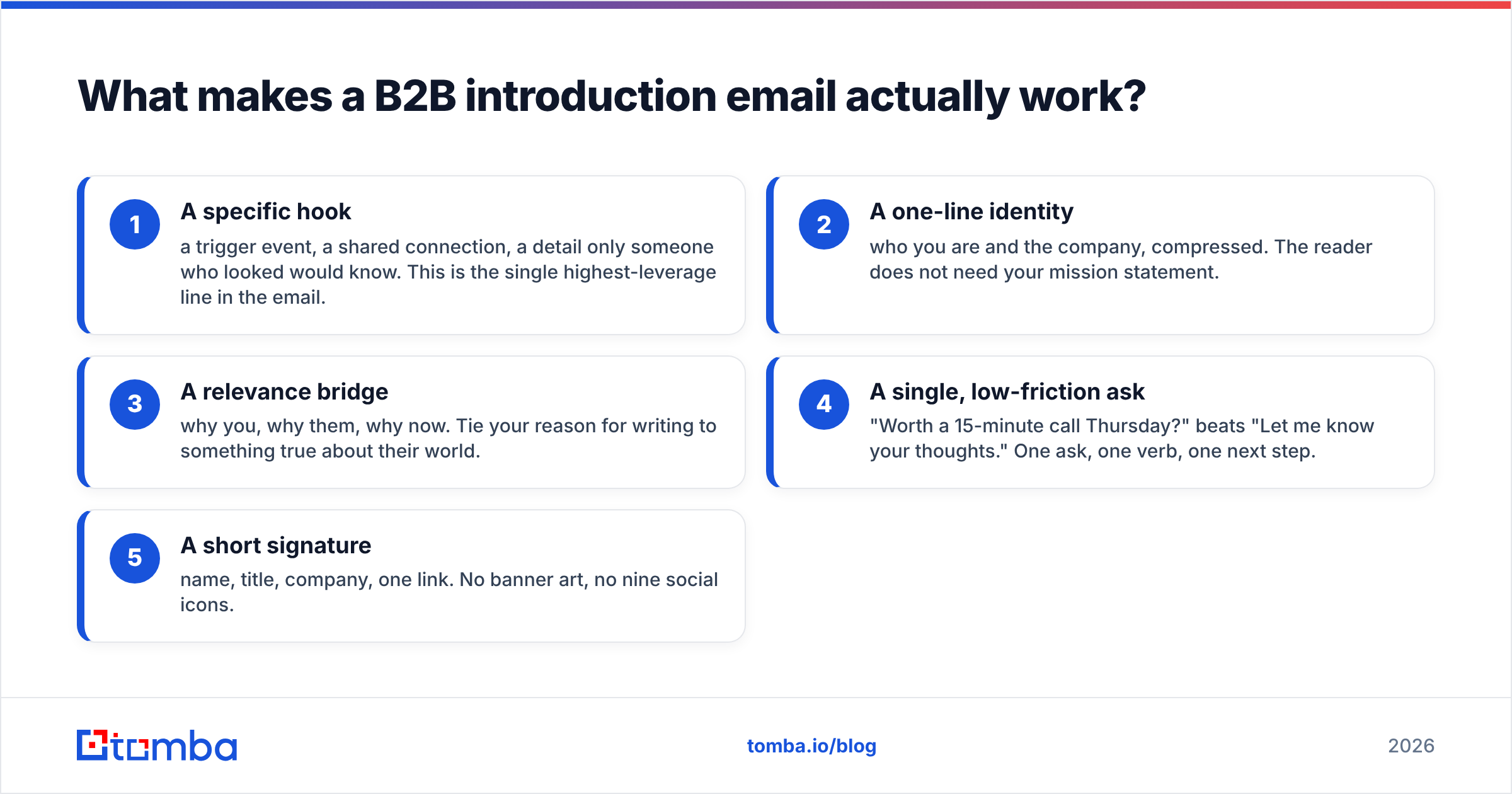
Here is the anatomy every template below shares:
- A specific hook — a trigger event, a shared connection, a detail only someone who looked would know. This is the single highest-leverage line in the email.
- A one-line identity — who you are and the company, compressed. The reader does not need your mission statement.
- A relevance bridge — why you, why them, why now. Tie your reason for writing to something true about their world.
- A single, low-friction ask — "Worth a 15-minute call Thursday?" beats "Let me know your thoughts." One ask, one verb, one next step.
- A short signature — name, title, company, one link. No banner art, no nine social icons.
)
The fastest way to wreck this structure is to make the email about you. Count the "I" and "we" openings versus "you" openings. If your first two sentences both start with "I," rewrite them.
How long should a B2B intro email be?#
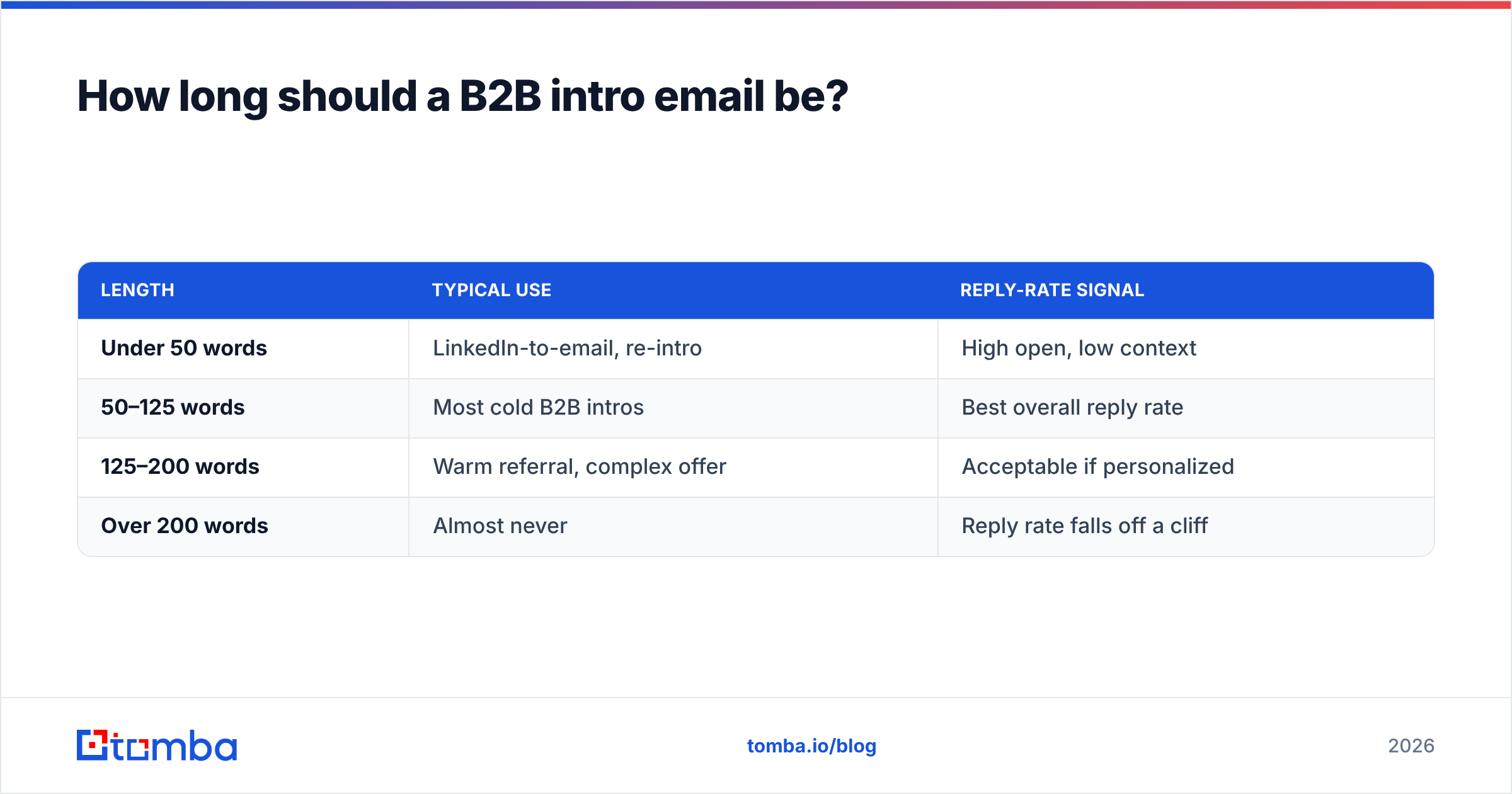
Short. Aim for 50–125 words in the body. The data is consistent across vendors: brevity correlates with replies because busy buyers skim on mobile, and a wall of text reads as work.
| Length | Typical use | Reply-rate signal |
|---|---|---|
| Under 50 words | LinkedIn-to-email, re-intro | High open, low context |
| 50–125 words | Most cold B2B intros | Best overall reply rate |
| 125–200 words | Warm referral, complex offer | Acceptable if personalized |
| Over 200 words | Almost never | Reply rate falls off a cliff |
When you are unsure, cut. The goal of the first email is not to close — it is to earn the reply that starts the conversation.
The 9 best B2B email templates to introduce yourself#
Each template uses brackets [like this] for variables. Swap them, keep the structure.
1. The cold prospecting intro (trigger-based)#
Subject: Quick question about [company]'s [recent trigger]
Hi [First name],
Saw that [company] just [trigger event — funding, new hire, product launch]. Congrats. Teams hitting that milestone usually run into [specific problem].
I'm [your name] at [your company] — we help [similar companies] [outcome] without [common pain]. [One-line proof: "We did this for [peer company], cutting X by Y%."]
Worth a 15-minute call next Thursday to see if it fits?
[Name]
2. The mutual-connection referral#
Subject: [Mutual contact] suggested I reach out
Hi [First name],
[Mutual contact] mentioned you're leading [initiative] at [company] and thought we should talk. I run [function] at [your company], and we recently helped [their team type] with exactly that.
Open to a quick intro call? Happy to share what worked for [peer company] first.
[Name]
A warm referral is the single most powerful intro you can send. If you can earn one, send it before any cold sequence.
3. The post-event follow-up#
Subject: Following up from [event name]
Hi [First name],
Great session at [event] — your point about [specific thing they said] stuck with me. I'm [name] at [company]; we work on [related area].
You mentioned [challenge]. We've solved that for [peer company]. Worth comparing notes over coffee or a quick call?
[Name]
4. The LinkedIn-to-email handoff#
Subject: Continuing our LinkedIn chat
Hi [First name],
We connected on LinkedIn around [topic] — moving here since email is easier for sharing detail. Short version: [your company] helps [their role] [outcome].
Would a 15-minute walkthrough be useful next week?
[Name]
5. The new-role introduction#
Subject: New point of contact at [your company]
Hi [First name],
I've just taken over [account/region] at [your company], so I wanted to introduce myself directly. My job is to make sure [their company] gets [value]. Anything currently on your wish list I should know about?
[Name]
6. The problem-first cold intro#
Subject: [Specific metric] at [company]
Hi [First name],
Most [their role]s I talk to are fighting [problem] this quarter. If that's you, I have a 2-minute idea that helped [peer] improve [metric] by [number].
I'm [name] at [company]. Want me to send it over?
[Name]
7. The value-add (no ask) intro#
Subject: Thought this would help [company]
Hi [First name],
Came across [resource/insight] and immediately thought of [company]'s work on [area]. Sharing it, no strings: [link].
I'm [name] at [company] — we go deep on this. If it's useful, happy to talk more whenever.
[Name]
8. The re-introduction (gone quiet)#
Subject: Circling back, [First name]
Hi [First name],
We spoke a while ago about [topic] and timing wasn't right. Things have changed on our side — [new feature / new proof point]. Worth a fresh look?
[Name]
9. The executive cold intro (short and direct)#
Subject: [Outcome] for [company]
Hi [First name],
I'll be brief — I know your inbox. [Your company] helps companies like yours [outcome] in [timeframe]. [Peer] saw [result].
Worth 15 minutes? I'll come with specifics.
[Name]
For more reusable scripts beyond introductions, our library of cold email templates covers follow-ups, breakups, and re-engagement sequences.
)
How do you personalize a template without spending an hour per email?#
Personalize the hook and subject line, templatize the rest. That split is the whole game — it is how top reps send 50 genuinely relevant intros a day instead of five.
Your personalization budget is one or two lines: the trigger event, a detail from their LinkedIn, a stat about their company. Pull those from a quick source-of-truth, drop them into bracket variables, and let the proven body carry the rest. The mistake is rewriting the entire email each time; the body that already converts does not need reinventing.
A practical workflow:
- Build a hook bank. Keep a doc of 10–15 trigger types (funding, hiring, expansion, leadership change, product launch). For each prospect, match one.
- Standardize the body. Pick your two best templates above and stop fiddling with them.
- Verify the address before sending. A perfect intro to a dead inbox is wasted effort — and bounces hurt your sender reputation. Run your list through an email verifier first.
Why does verification matter more than the copy?#
Because a bounced email never gets read, and a high bounce rate poisons every email after it. You can write the best b2b email template to introduce yourself ever drafted and still land in spam if your domain looks careless to mailbox providers.
Mailbox providers track how many of your sends bounce. Cross a threshold and your future emails — even to valid addresses — start skipping the inbox. As HubSpot's deliverability guidance and most ESP documentation note, list hygiene is a direct input to inbox placement, not an afterthought.
So the order of operations is: find the right contact, confirm the address resolves, then send your beautifully personalized intro. If you are sourcing contacts from scratch, an email finder turns a name and company domain into a verified work email, and a domain search maps every reachable contact at a target account so you introduce yourself to the right person, not just any person.
What are the most common intro-email mistakes?#
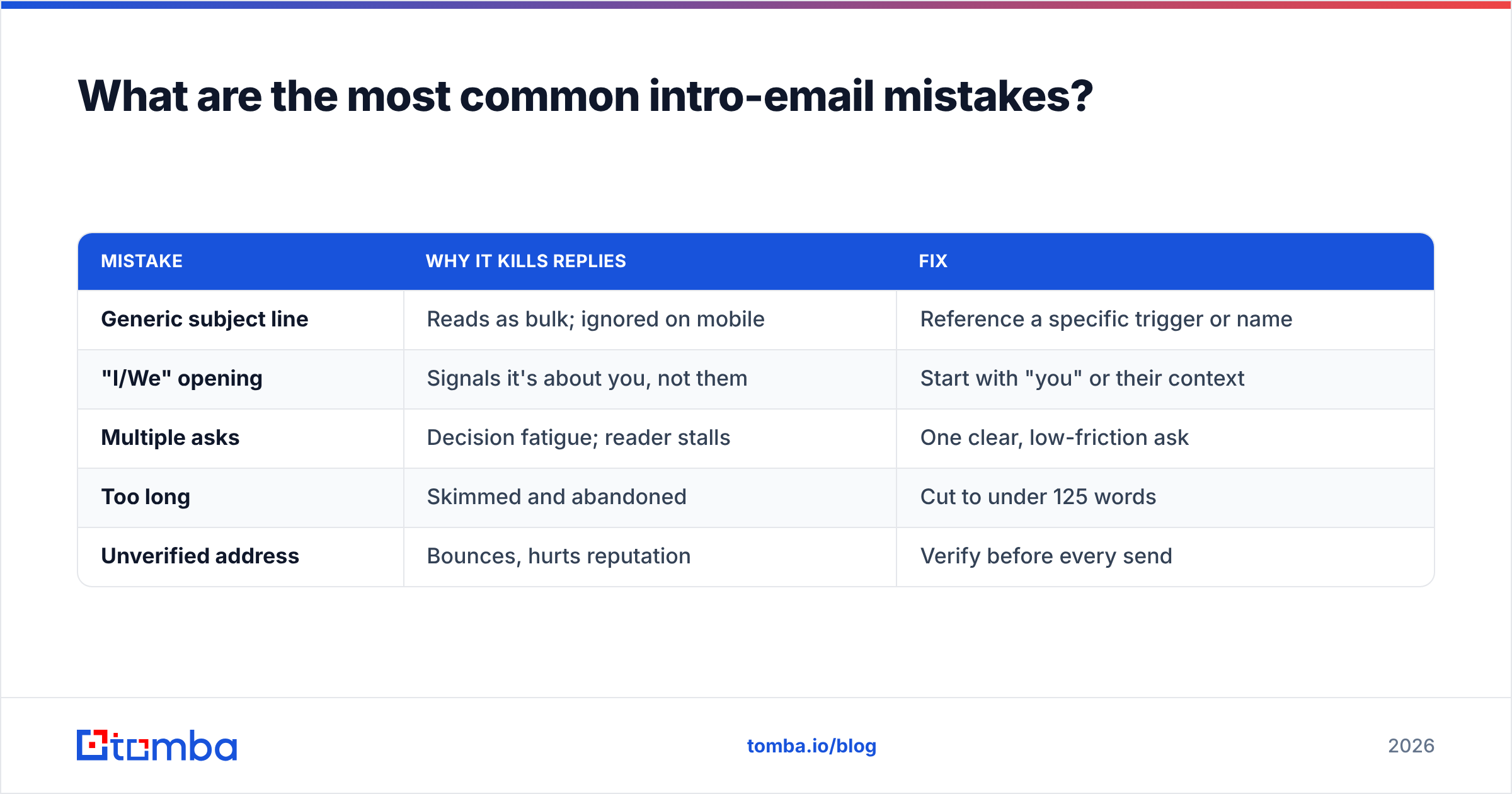
The conclusion: most failed intros die from one of five predictable errors. Fix these before you optimize anything else.
| Mistake | Why it kills replies | Fix |
|---|---|---|
| Generic subject line | Reads as bulk; ignored on mobile | Reference a specific trigger or name |
| "I/We" opening | Signals it's about you, not them | Start with "you" or their context |
| Multiple asks | Decision fatigue; reader stalls | One clear, low-friction ask |
| Too long | Skimmed and abandoned | Cut to under 125 words |
| Unverified address | Bounces, hurts reputation | Verify before every send |
The pattern is the same across all five: respect the reader's time and attention, and prove you did your homework. To pressure-test your subject lines specifically, run them through a subject line tester before you commit a whole sequence to them.
How do you measure if your intro emails are working?#
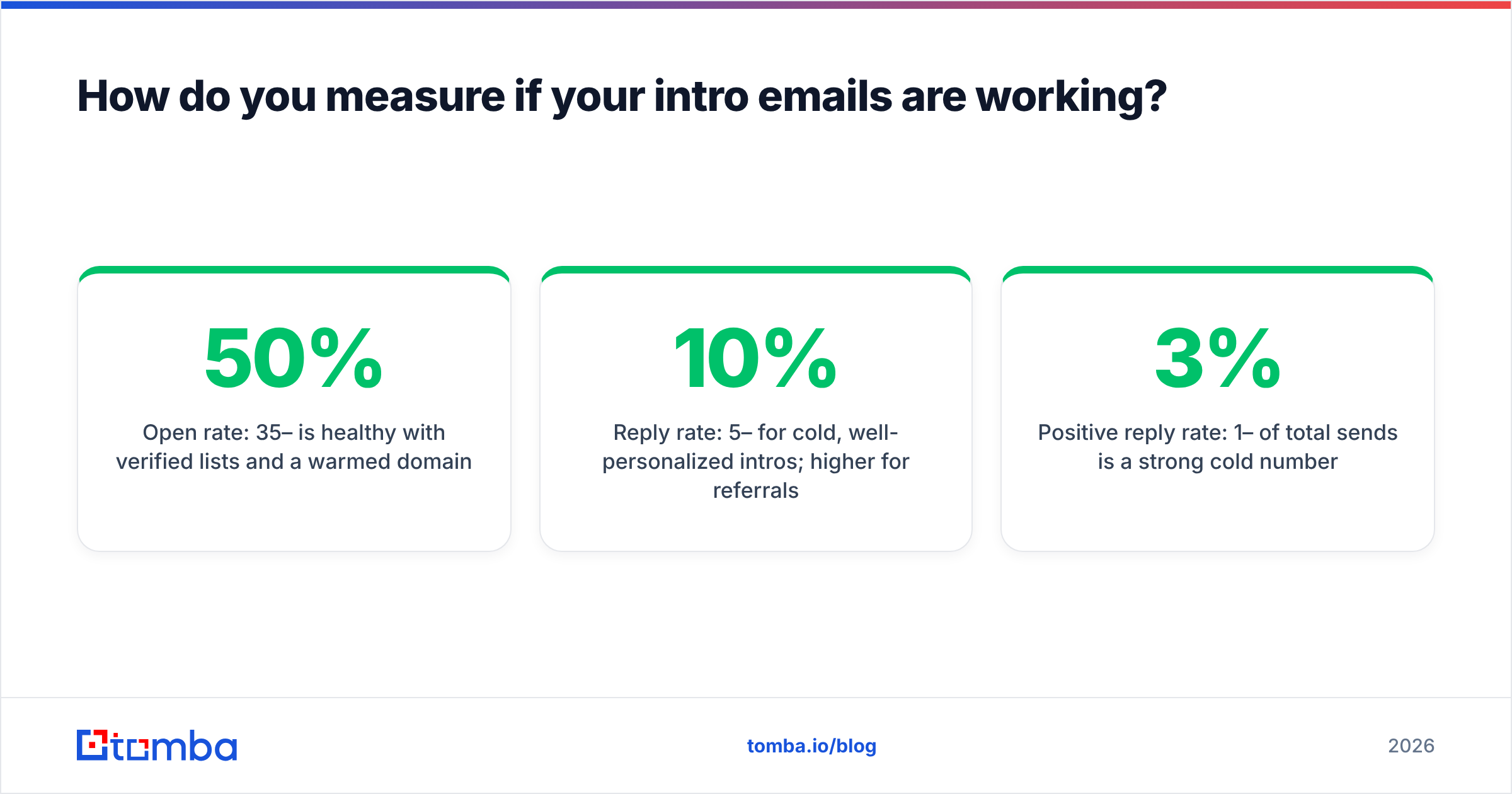
Track three numbers and ignore vanity metrics. Open rate tells you if your subject line and sender reputation are healthy. Reply rate tells you if the email itself works. Positive reply rate — replies that move toward a meeting — tells you if you targeted the right people with the right offer.
A useful rough benchmark for cold B2B intros in 2026:
- Open rate: 35–50% is healthy with verified lists and a warmed domain.
- Reply rate: 5–10% for cold, well-personalized intros; higher for referrals.
- Positive reply rate: 1–3% of total sends is a strong cold number.
If opens are low, fix deliverability and subject lines. If opens are fine but replies are not, fix the body and targeting. You can read more on what a healthy response rate looks like across channels in our glossary. For independent tooling comparisons, sites like G2 aggregate verified user reviews of outreach and data platforms worth checking before you commit budget.
Treat every template above as a starting hypothesis, not scripture. A/B test the subject line first, then the hook, then the ask. Change one variable at a time so you actually learn what moved the number.
Which template should you start with?#
If you can get a warm referral (Template 2), use it — nothing else converts as well. No referral? Start with the trigger-based cold intro (Template 1) for prospecting, the problem-first intro (Template 6) when you know the pain, and the executive intro (Template 9) for senior buyers who reward brevity.
Whatever you choose, the multiplier is the same: relevance up front, brevity throughout, one ask at the end, and a verified address so it actually arrives.
Put your intro emails in front of real people#
Great copy is wasted on a bad address. Before you send a single introduction, source the right contact and confirm it resolves: use the Tomba Email Finder to turn any name and company domain into a verified, ready-to-send work email — then pair it with Tomba's verifier to keep your bounce rate low and your sender reputation intact. Start free with 25 searches a month, and scale up on the Starter plan at $49/mo when your outreach takes off. Write the intro once; let Tomba make sure it lands.
// get started
Find, verify and enrich your first contacts today
Start on the free plan with 25 searches a month, then scale when your team is ready.
Free plan · No credit card required · GDPR & CCPA
// about the author