B2B Follow Up Email: Templates and Cadence That Win in 2026
Most B2B deals are won in the follow-up, not the first email. Here's the cadence, timing, and templates that actually get replies in 2026.
B2B Follow Up Email: Templates and Cadence That Win in 2026
Most of your pipeline is sitting in unanswered threads right now. The first cold email is the part everyone obsesses over, but the b2b follow up email is where deals actually get made. Buyers are busy, your message lands at the wrong moment, and a single touch almost never converts. The reps who win are the ones who follow up more, smarter, and without sounding desperate.
This guide breaks down exactly how many follow-ups to send, when to send them, what to write, and the mistakes that quietly kill your reply rate.
TL;DR#
- The money is in the follow-up. Roughly 80% of B2B conversions need five or more touches, yet most reps quit after one or two.
- Cadence beats volume. A 4–6 step sequence spread over 2–3 weeks, mixing value and ask, outperforms blasting the same "just bumping this" line.
- Timing matters. Wait 2–4 business days between touches; Tuesday–Thursday mornings still pull the best open and reply rates.
- Every follow-up needs a reason to exist — a new angle, resource, or trigger — not "just checking in."
- Deliverability is the silent killer. If your domain is unwarmed or your list is dirty, no template will save you. Verify before you send.
Why do B2B follow up emails matter so much?#
Because one email is a coin flip you usually lose. Think of cold outreach like knocking on an office door: the prospect might be on a call, in a meeting, or staring at 200 unread messages when yours arrives. A single knock gets ignored. A polite, well-spaced series of knocks gets answered.
The data backs this up. Industry analyses from teams like HubSpot consistently show that the majority of replies come after the first message, and that reply rates climb meaningfully with each of the first four to five touches before tapering off. The takeaway is simple: stopping early leaves most of your potential pipeline on the table.
There's also a psychological reason. Persistence — done respectfully — signals competence and conviction. A buyer reading your third thoughtful follow-up subconsciously concludes that you believe in what you're selling. Give up after one email and you signal the opposite.
How many follow up emails should you send?#
Send four to six total touches for most B2B sequences, then stop or move the contact to a long-term nurture. More than that and you risk annoyance and spam complaints; fewer and you leave replies uncollected.
Here's a structure that works across SDR and founder-led outreach:
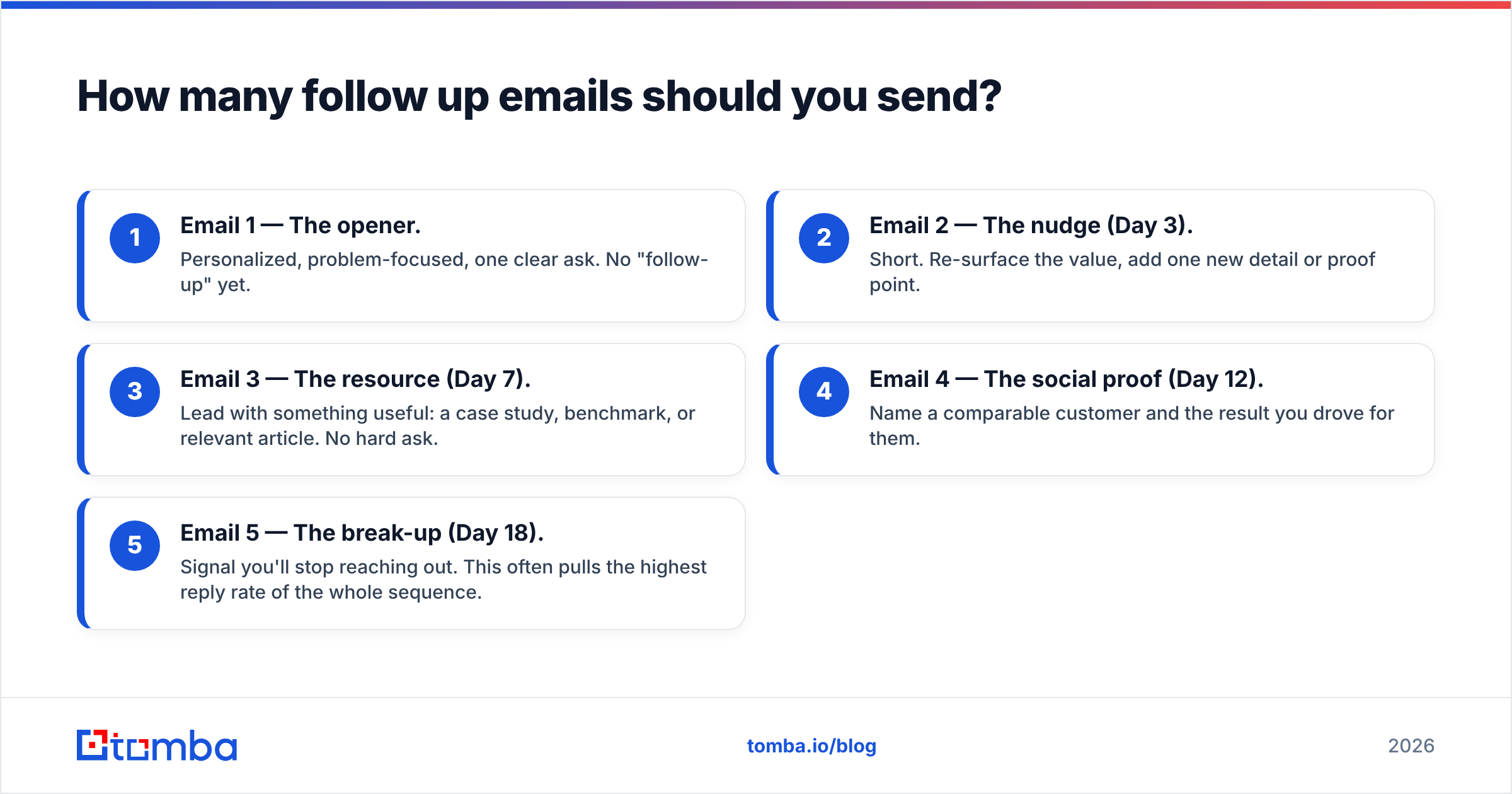
- Email 1 — The opener. Personalized, problem-focused, one clear ask. No "follow-up" yet.
- Email 2 — The nudge (Day 3). Short. Re-surface the value, add one new detail or proof point.
- Email 3 — The resource (Day 7). Lead with something useful: a case study, benchmark, or relevant article. No hard ask.
- Email 4 — The social proof (Day 12). Name a comparable customer and the result you drove for them.
- Email 5 — The break-up (Day 18). Signal you'll stop reaching out. This often pulls the highest reply rate of the whole sequence.
Each step should be sendable in under 30 seconds of reading time. Long follow-ups get skimmed and archived.
What's the right follow up cadence and timing?#
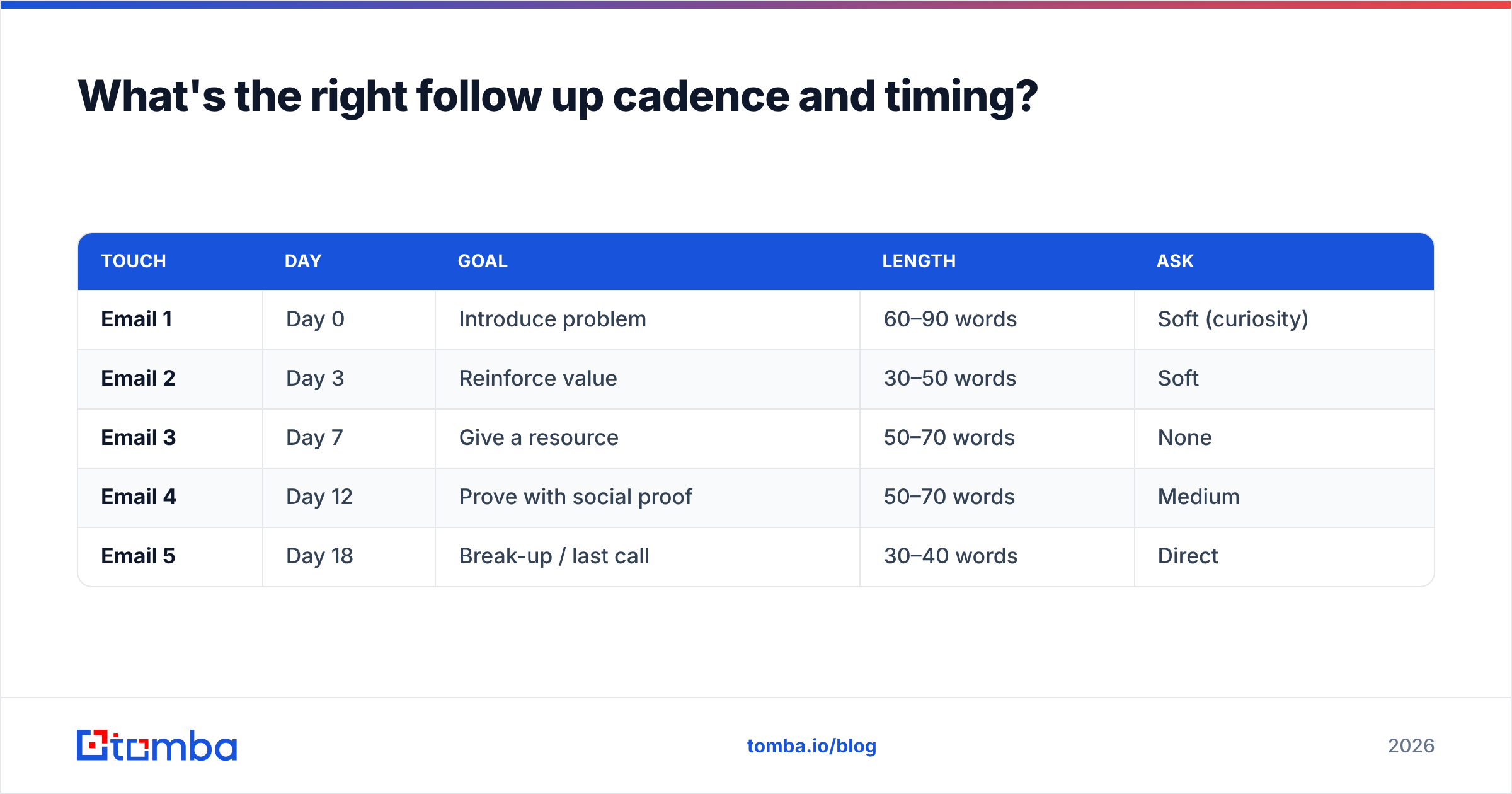
Space touches 2–4 business days apart and concentrate sends on Tuesday through Thursday, mid-morning in the prospect's timezone. Monday inboxes are chaos and Friday afternoons are checked out.
| Touch | Day | Goal | Length | Ask |
|---|---|---|---|---|
| Email 1 | Day 0 | Introduce problem | 60–90 words | Soft (curiosity) |
| Email 2 | Day 3 | Reinforce value | 30–50 words | Soft |
| Email 3 | Day 7 | Give a resource | 50–70 words | None |
| Email 4 | Day 12 | Prove with social proof | 50–70 words | Medium |
| Email 5 | Day 18 | Break-up / last call | 30–40 words | Direct |
A few rules that keep this cadence healthy:
- Reply in-thread for the first two follow-ups, then consider a fresh subject line for touch 3+ to re-trigger attention.
- Never send two days in a row. It reads as automated and desperate.
- Stop immediately on any negative signal — an unsubscribe, a hard "no," or an out-of-office that names a replacement contact (go find that person instead).
What should each follow up email actually say?#
Give every email a reason to exist. The fastest way to get ignored is "Just bumping this to the top of your inbox." Below are five copy-paste templates mapped to the cadence above. Swap the brackets for real details.
Template 1 — The opener
Subject: quick idea for {{Company}}'s {{team}}
Hi {{First name}},
Noticed {{specific trigger — hiring, funding, launch}}. Teams hitting that stage usually struggle with {{problem}}.
We helped {{similar company}} fix that and {{quantified result}}. Worth a quick look for {{Company}}?
{{Your name}}
Template 2 — The nudge
Subject: re: quick idea for {{Company}}'s {{team}}
Hi {{First name}} — floating this back up. One number that might matter: {{stat}}. Open to a 15-minute call next week?
Template 3 — The resource
Subject: thought this might help {{Company}}
Hi {{First name}}, regardless of timing, here's a {{case study / benchmark}} on how {{peer company}} solved {{problem}}. No ask — just useful. Happy to walk you through it if helpful.
Template 4 — The social proof
Subject: how {{peer company}} cut {{metric}} by {{X%}}
Hi {{First name}}, {{peer company}} was dealing with the same {{problem}} until {{outcome}}. I can map the same playbook to {{Company}} in 15 minutes. Does Thursday work?
Template 5 — The break-up
Subject: should I close your file?
Hi {{First name}}, I haven't heard back, so I'll assume the timing isn't right and stop reaching out. If {{problem}} ever becomes a priority, just reply and I'll jump back in.
These templates lean on three levers: relevance (a real trigger), brevity, and a single clear next step. If you want a head start, Tomba's library of cold email templates and the AI cold email writer can generate variations you can edit instead of writing from scratch.
What kills B2B follow up reply rates?#
The copy is rarely the real problem. Deliverability and data quality decide whether your follow-up even reaches the inbox. Here's where sequences quietly die:
- Bad email data. If 20% of your list bounces, your sender reputation tanks and every email — including your good ones — starts landing in spam. Run addresses through an email verifier before the first send.
- Cold, unwarmed domains. A brand-new sending domain firing 200 emails a day looks exactly like a spammer to mailbox providers. Warm up gradually and watch your sender reputation.
- Missing authentication. No SPF, DKIM, or DMARC records means Gmail and Outlook can't trust you. Check your SPF record before scaling.
- One-size-fits-all copy. A follow-up that ignores the prospect's industry, role, or trigger reads as spam even if it's technically deliverable.
- Following up the wrong person. If the contact left the company, no cadence will work. Re-verify your contacts and re-find decision-makers with a domain search.
Fixing these is cheaper than rewriting your templates for the tenth time. For a deeper baseline, Google's own Postmaster Tools and sending guidelines spell out exactly what reputation thresholds you need to clear.
How do tools and automation fit into follow-ups?#
Automation should handle the mechanics — timing, sending, tracking — while you keep the judgment. The goal isn't to remove the human; it's to remove the busywork so a rep can run 300 thoughtful sequences instead of 30 manual ones.
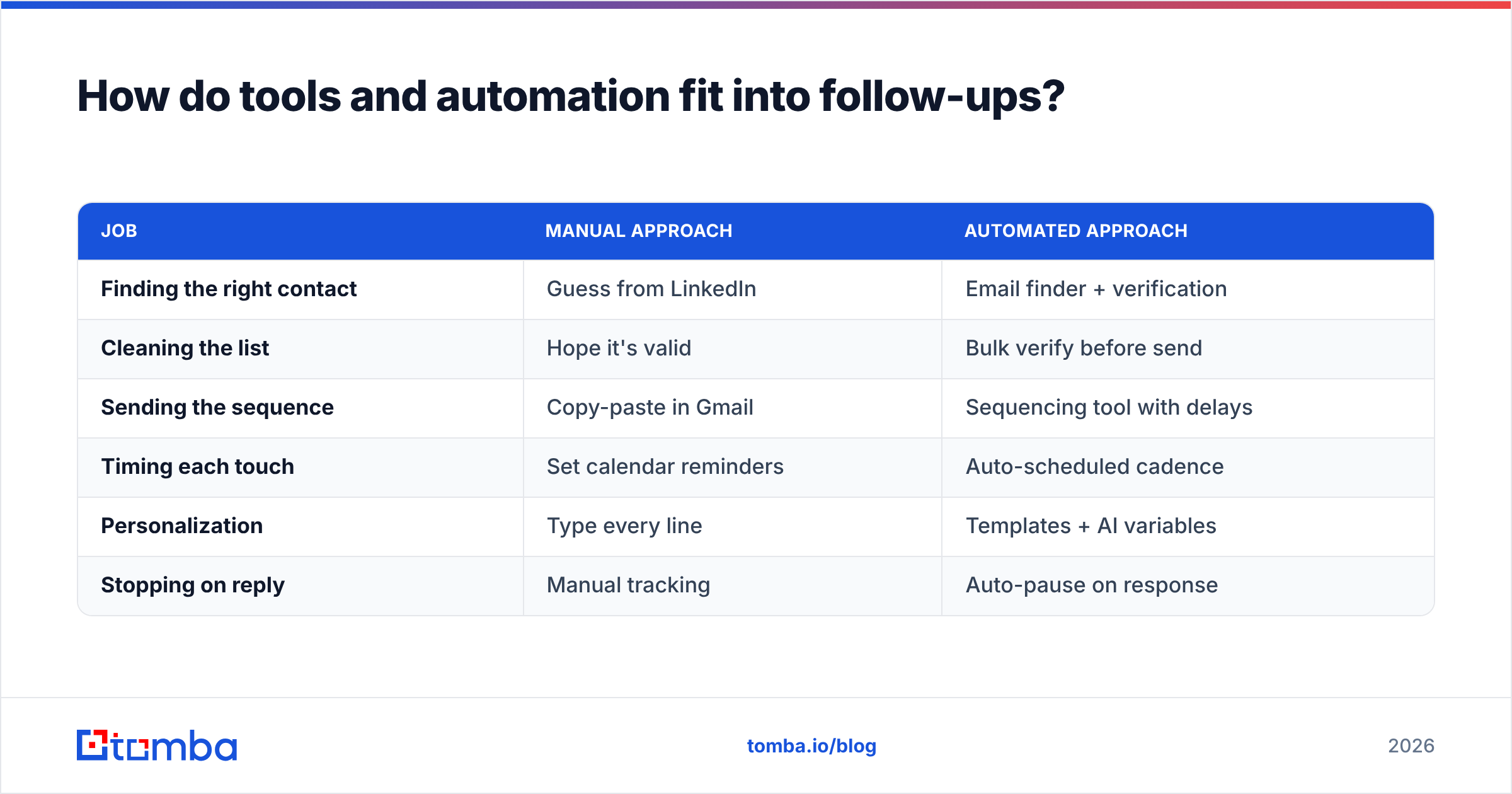
Here's how a clean stack splits the work:
| Job | Manual approach | Automated approach |
|---|---|---|
| Finding the right contact | Guess from LinkedIn | Email finder + verification |
| Cleaning the list | Hope it's valid | Bulk verify before send |
| Sending the sequence | Copy-paste in Gmail | Sequencing tool with delays |
| Timing each touch | Set calendar reminders | Auto-scheduled cadence |
| Personalization | Type every line | Templates + AI variables |
| Stopping on reply | Manual tracking | Auto-pause on response |
The non-negotiable first step is contact accuracy. A perfectly timed five-touch cadence sent to a stale or guessed address is wasted effort. That's why the highest-performing teams enrich and verify before they sequence — they want every follow-up landing on a real, current inbox. Tools like Tomba sit at that top-of-funnel data layer, while a dedicated sequencer handles the sending rhythm.
If you're comparing platforms, look at honest third-party reviews on G2 rather than vendor claims, and weigh accuracy and price together — see Tomba pricing for where a verification-first stack lands.
What does a healthy follow up sequence look like end to end?#
Pull it together and a winning B2B follow-up motion looks like this:
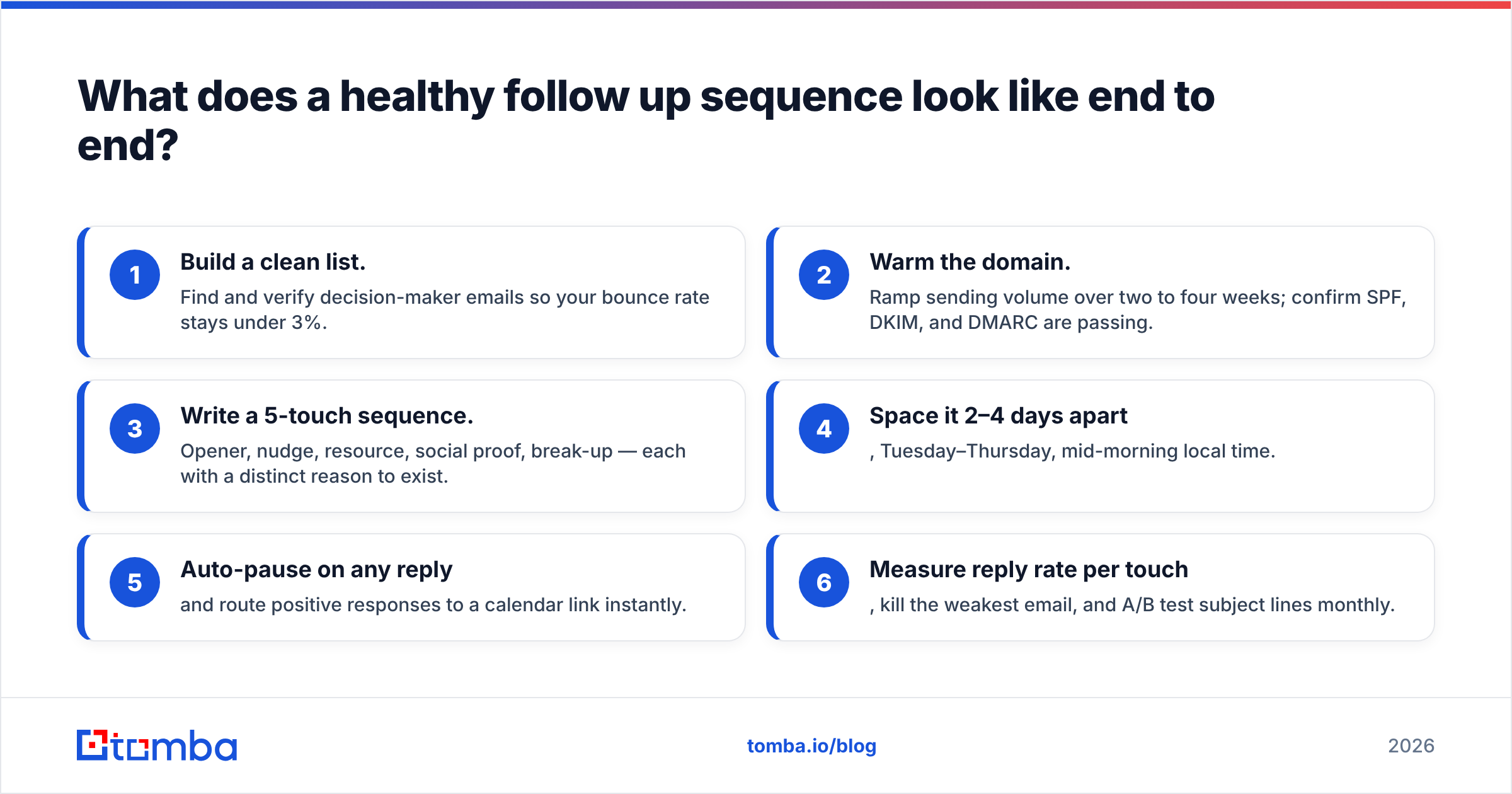
- Build a clean list. Find and verify decision-maker emails so your bounce rate stays under 3%.
- Warm the domain. Ramp sending volume over two to four weeks; confirm SPF, DKIM, and DMARC are passing.
- Write a 5-touch sequence. Opener, nudge, resource, social proof, break-up — each with a distinct reason to exist.
- Space it 2–4 days apart, Tuesday–Thursday, mid-morning local time.
- Auto-pause on any reply and route positive responses to a calendar link instantly.
- Measure reply rate per touch, kill the weakest email, and A/B test subject lines monthly.
Do this consistently and your follow-ups stop feeling like nagging and start feeling like a system. The reps who treat follow-up as a discipline — not an afterthought — are the ones quietly hitting quota while everyone else complains that "cold email is dead."
Start with the data layer#
The fastest reply-rate gain isn't a cleverer template — it's making sure every follow-up reaches a real, verified inbox. Start with the Tomba Email Finder to source accurate, decision-maker emails by name, company, or domain, then verify them before your first send. Clean data plus a disciplined five-touch cadence is the combination that turns ignored threads into booked meetings. Find your prospects, verify them, and let your follow-ups do the closing.
// get started
Find, verify and enrich your first contacts today
Start on the free plan with 25 searches a month, then scale when your team is ready.
Free plan · No credit card required · GDPR & CCPA
// about the author