B2B Go-To-Market Plan: A Step-by-Step Framework for 2026
A practical, no-fluff framework for building a B2B go-to-market plan in 2026 — ICP, channels, messaging, data, and the metrics that prove it works.
A B2B go-to-market plan is the difference between a launch that compounds and one that burns cash. Most teams skip the boring parts — the ICP math, the data hygiene, the channel sequencing — and pay for it later with low reply rates and a pipeline that never converts. This guide gives you a framework you can actually execute in 2026.
TL;DR#
- A B2B go-to-market plan is your documented strategy for who you sell to, how you reach them, what you say, and how you measure whether it works.
- The five load-bearing pillars are ICP, segmentation, channel mix, messaging, and a measurement loop — skip one and the others wobble.
- Bad contact data quietly kills GTM plans: 20–30% of B2B data decays per year, so verified emails and enrichment are infrastructure, not a nice-to-have.
- Pick a primary motion (product-led, sales-led, or community-led) instead of trying to run all three at once with a small team.
- Track leading indicators (reply rate, meetings booked, SQL conversion) weekly — not just revenue, which lags by a quarter or more.
What is a B2B go-to-market plan?#
A B2B go-to-market (GTM) plan is the operating manual for taking a product to market and winning customers profitably. Think of it like a flight plan: the destination (revenue) matters, but so does the route, the fuel, the weather, and the instruments you watch on the way. Without it, you're flying by vibes.
Formally, a GTM plan answers five questions in order:
- Who is the ideal customer? (ICP and segments)
- Where do they buy and learn? (channels)
- Why should they switch to you? (positioning and messaging)
- How do you reach them at scale and accuracy? (data and tooling)
- What tells you it's working? (metrics and feedback loop)
A GTM plan is not the same as a marketing plan or a sales playbook. It sits above both — it's the revenue operations layer that aligns product, marketing, sales, and customer success around one definition of the customer and one set of numbers. When those teams disagree on who the customer is, you don't have a GTM problem; you have a GTM plan that was never written down.
Why do most B2B go-to-market plans fail?#
Most plans fail for unglamorous reasons. According to HubSpot research on sales and marketing alignment, misaligned teams consistently underperform aligned ones on revenue growth — and misalignment almost always traces back to a fuzzy ICP and inconsistent data.
Here are the recurring failure modes:
- No real ICP. "Mid-market SaaS companies" is a category, not an ICP. A usable ICP has firmographics, technographics, triggers, and the specific persona who feels the pain.
- Spray-and-pray outbound. Blasting an unverified list torches your domain reputation and your reply rate at the same time.
- Channel sprawl. Running paid, outbound, content, events, and partnerships simultaneously with four people means none of them get enough reps to learn.
- Messaging written for the company, not the buyer. Buyers care about their problem, not your feature list.
- Lagging-only metrics. If revenue is the only number you watch, you find out you were wrong 90 days too late.
)
What are the core components of a B2B GTM plan?#
Five components carry the weight. Build them in this order, because each one feeds the next.
- Ideal Customer Profile (ICP). The firmographic, technographic, and behavioral definition of the accounts most likely to buy, stay, and expand. This is the foundation — every later decision references it.
- Segmentation and tiering. Split the ICP into A/B/C tiers so you can spend more effort on accounts with more upside. Tier A gets 1:1 outreach; Tier C gets scaled, automated touches.
- Channel mix and motion. Decide your primary motion (product-led, sales-led, or community-led) and the two or three channels that match where your buyers actually are.
- Positioning and messaging. A crisp value proposition, three to five proof points, and channel-specific copy. The message stays consistent; the format changes per channel.
- Data and tooling layer. Verified contact data, enrichment, a CRM, and an outreach/automation stack. This is the plumbing that makes the other four executable at scale.
Notice that data sits underneath everything. You can have a perfect ICP and brilliant messaging, but if the email addresses bounce, none of it reaches a human. That's why serious GTM teams treat data enrichment and verification as core infrastructure.
How do you build your ICP and segments?#
Start with your best existing customers, not your aspirations. Pull the top 20% by retention and expansion revenue, then find what they share. You're reverse-engineering a pattern, not inventing one.
Look for four signal types:
- Firmographic — industry, employee count, revenue, geography, funding stage.
- Technographic — the tools they already run (a CRM, a specific cloud, a marketing stack) that imply readiness for your product.
- Behavioral / trigger — recent hiring, a funding round, a leadership change, or a competitor switch.
- Persona — the individual who owns the problem, plus the economic buyer who signs.
Once the ICP is defined, build the account list. This is where most plans stall, because manually finding decision-maker contacts across hundreds of accounts is slow. A domain search lets you pull every relevant email at a target company, and a bulk email finder turns a list of companies into a list of verified contacts in minutes rather than weeks.
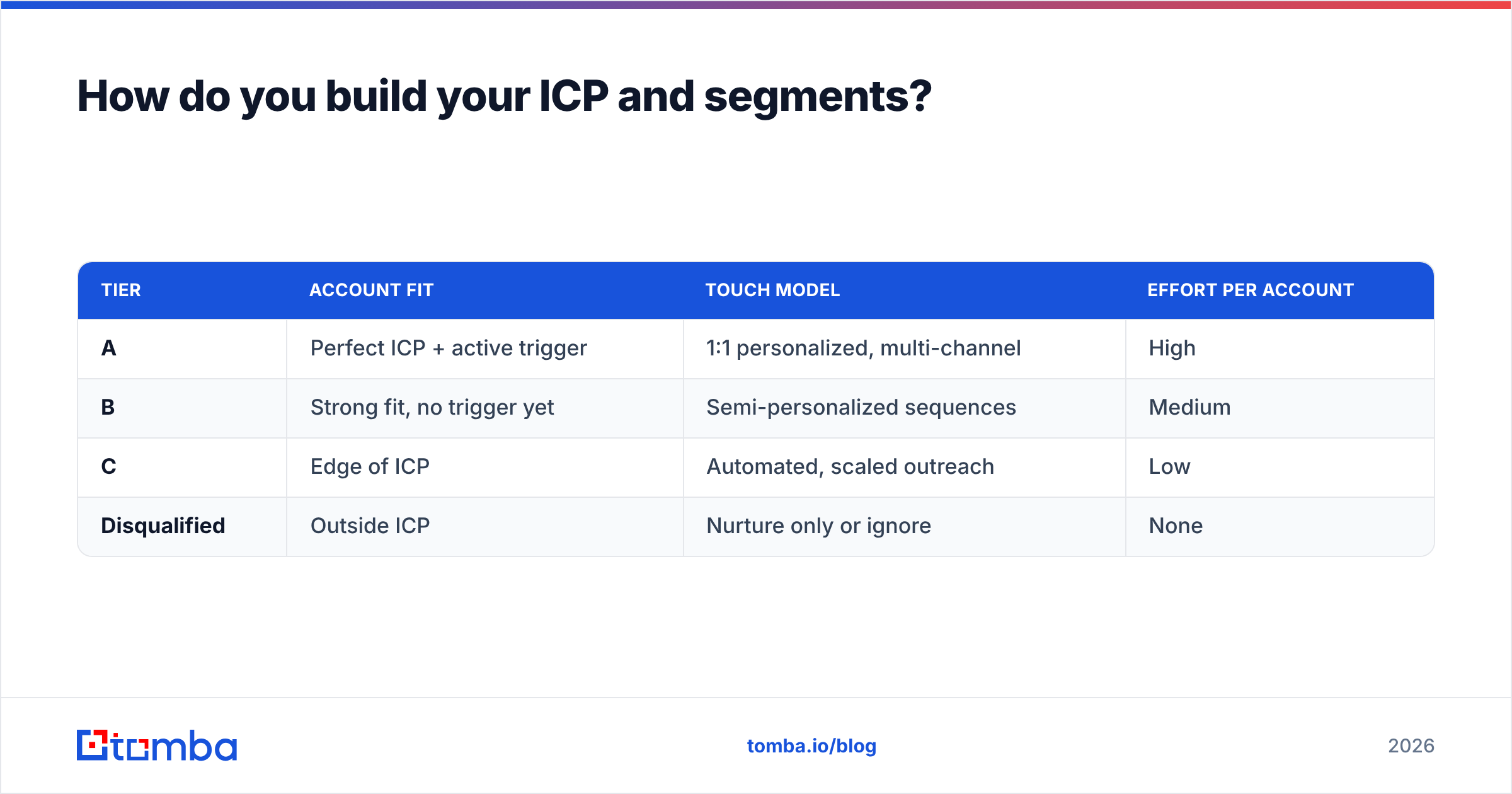
Then tier the accounts:
| Tier | Account fit | Touch model | Effort per account |
|---|---|---|---|
| A | Perfect ICP + active trigger | 1:1 personalized, multi-channel | High |
| B | Strong fit, no trigger yet | Semi-personalized sequences | Medium |
| C | Edge of ICP | Automated, scaled outreach | Low |
| Disqualified | Outside ICP | Nurture only or ignore | None |
This tiering is the single highest-leverage move in a GTM plan. It stops your team from spending Tier-A effort on Tier-C accounts.
Which go-to-market motion should you choose?#
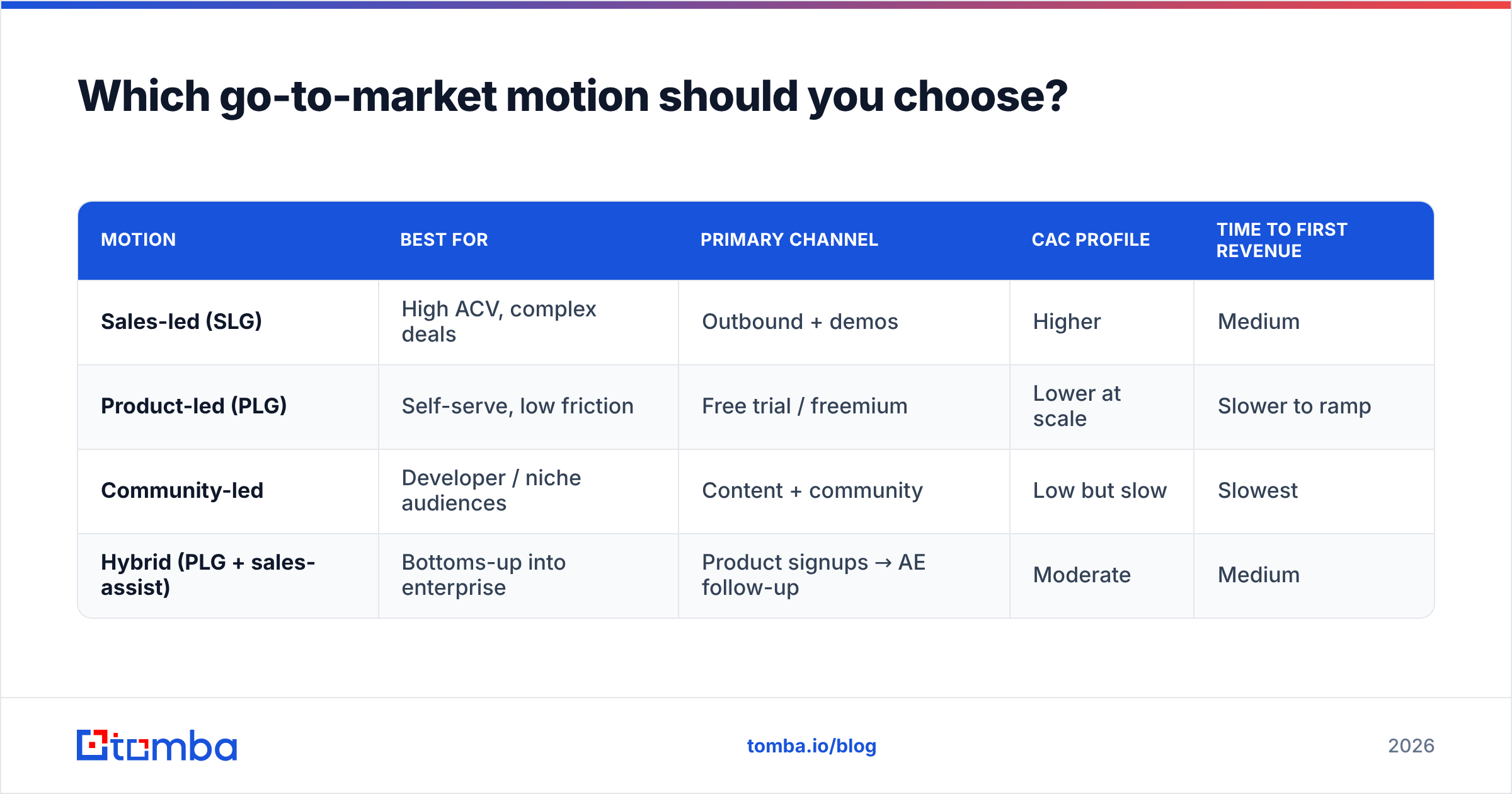
Pick one primary motion and let the others support it. Trying to run three coequal motions with a small team is how you get three mediocre channels instead of one great one.
| Motion | Best for | Primary channel | CAC profile | Time to first revenue |
|---|---|---|---|---|
| Sales-led (SLG) | High ACV, complex deals | Outbound + demos | Higher | Medium |
| Product-led (PLG) | Self-serve, low friction | Free trial / freemium | Lower at scale | Slower to ramp |
| Community-led | Developer / niche audiences | Content + community | Low but slow | Slowest |
| Hybrid (PLG + sales-assist) | Bottoms-up into enterprise | Product signups → AE follow-up | Moderate | Medium |
For most B2B products with a deal size above roughly $10K ACV, a sales-led or hybrid motion wins because the buying committee needs human guidance. Below that, product-led tends to be more efficient. The honest answer is that your pricing and deal complexity choose the motion for you — don't fight it.
Whatever motion you pick, your outbound layer still needs accurate contact data. Even a product-led plan relies on sales-assist follow-up to the right person, which means you need their verified work email and ideally a direct line via a phone finder for high-intent signups.
How do you build messaging that converts?#
Write the message from the buyer's chair. The structure that works across B2B is problem → consequence → solution → proof → ask. Lead with the pain they already feel, not the feature you're proud of.
A few rules that hold up in 2026:
- One core message, many formats. The value proposition is fixed; a LinkedIn post, a cold email, and an ad just express it differently.
- Specificity beats adjectives. "Cut list-building time from 3 days to 2 hours" outperforms "save time and boost productivity."
- Proof per claim. Every benefit needs a number, a customer name, or a screenshot behind it.
- Match message to tier. Tier A gets account-specific references; Tier C gets a sharp, general pain-point hook.
Test subject lines and opening lines relentlessly — they decide whether the rest of your copy is ever read. A free subject line tester helps you avoid spam triggers and weak hooks before you send to a real list.
)
What tools and data does your GTM plan need?#
Your stack has four layers, and the bottom one is the one teams underinvest in: data quality.
- Data layer — email finding, verification, enrichment, and contact discovery. This is where reply rates are won or lost.
- CRM — the single source of truth for accounts, contacts, and stages. Salesforce, HubSpot, and Pipedrive are common choices.
- Outreach / automation — sequencing, cadence, and follow-up.
- Analytics — dashboards for the leading and lagging metrics below.
Why obsess over the data layer? Because B2B contact data decays fast — industry estimates and platforms like G2 consistently cite 20–30% annual decay as people change jobs, titles, and companies. A plan built on a list you bought last year is already a quarter rotten. That's why an email verifier belongs in the pipeline before every send, and why catch-all domains need their own handling via a dedicated check rather than a guess.
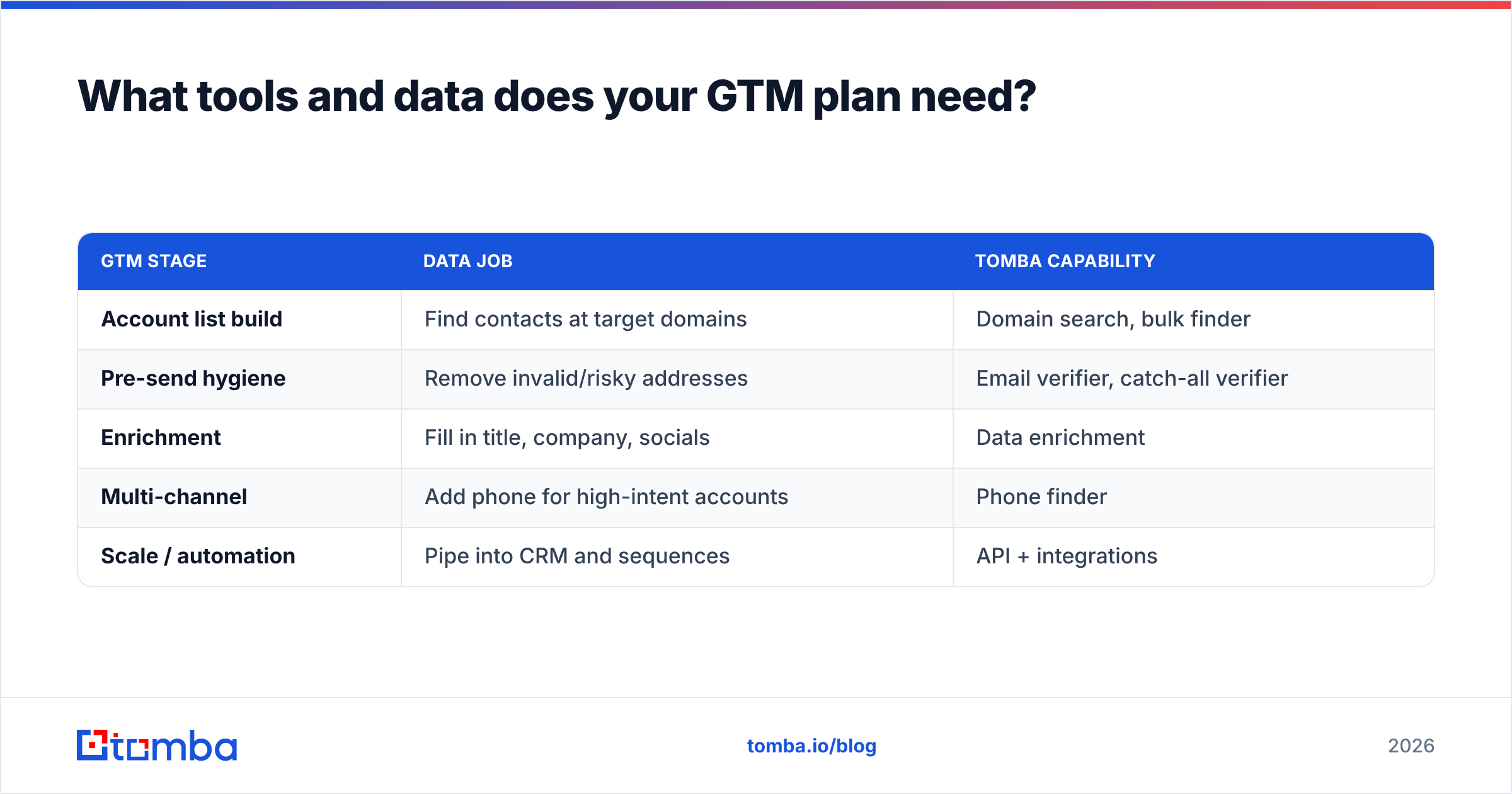
Here's how an email-data layer maps to GTM stages:
| GTM stage | Data job | Tomba capability |
|---|---|---|
| Account list build | Find contacts at target domains | Domain search, bulk finder |
| Pre-send hygiene | Remove invalid/risky addresses | Email verifier, catch-all verifier |
| Enrichment | Fill in title, company, socials | Data enrichment |
| Multi-channel | Add phone for high-intent accounts | Phone finder |
| Scale / automation | Pipe into CRM and sequences | API + integrations |
Compare the cost of getting this wrong against the price of doing it right. A verification step costs cents per contact; a damaged sending domain costs you months of deliverability. You can see current Tomba pricing to size the data layer against your account volume — the free tier covers 25 searches a month, Starter is $49/mo, and Growth at $99/mo covers most early GTM teams.
How do you launch and sequence the rollout?#
Don't launch all motions and segments on day one. Sequence the rollout so you learn before you scale.
- Weeks 1–2: Foundation. Lock the ICP, build the Tier-A list, verify it, and load the CRM. No outreach yet.
- Weeks 3–4: Pilot. Run one channel against Tier A only. Aim for signal, not volume — 50 well-researched accounts beats 5,000 cold ones.
- Weeks 5–8: Iterate. Double down on the messaging and channel that produced replies. Kill what didn't.
- Weeks 9–12: Scale. Add Tier B, layer in a second channel, and automate the repeatable parts.
This crawl-walk-run cadence keeps your domain reputation intact and gives you data to make decisions instead of bets. If you scale a broken sequence, you just scale the failure.
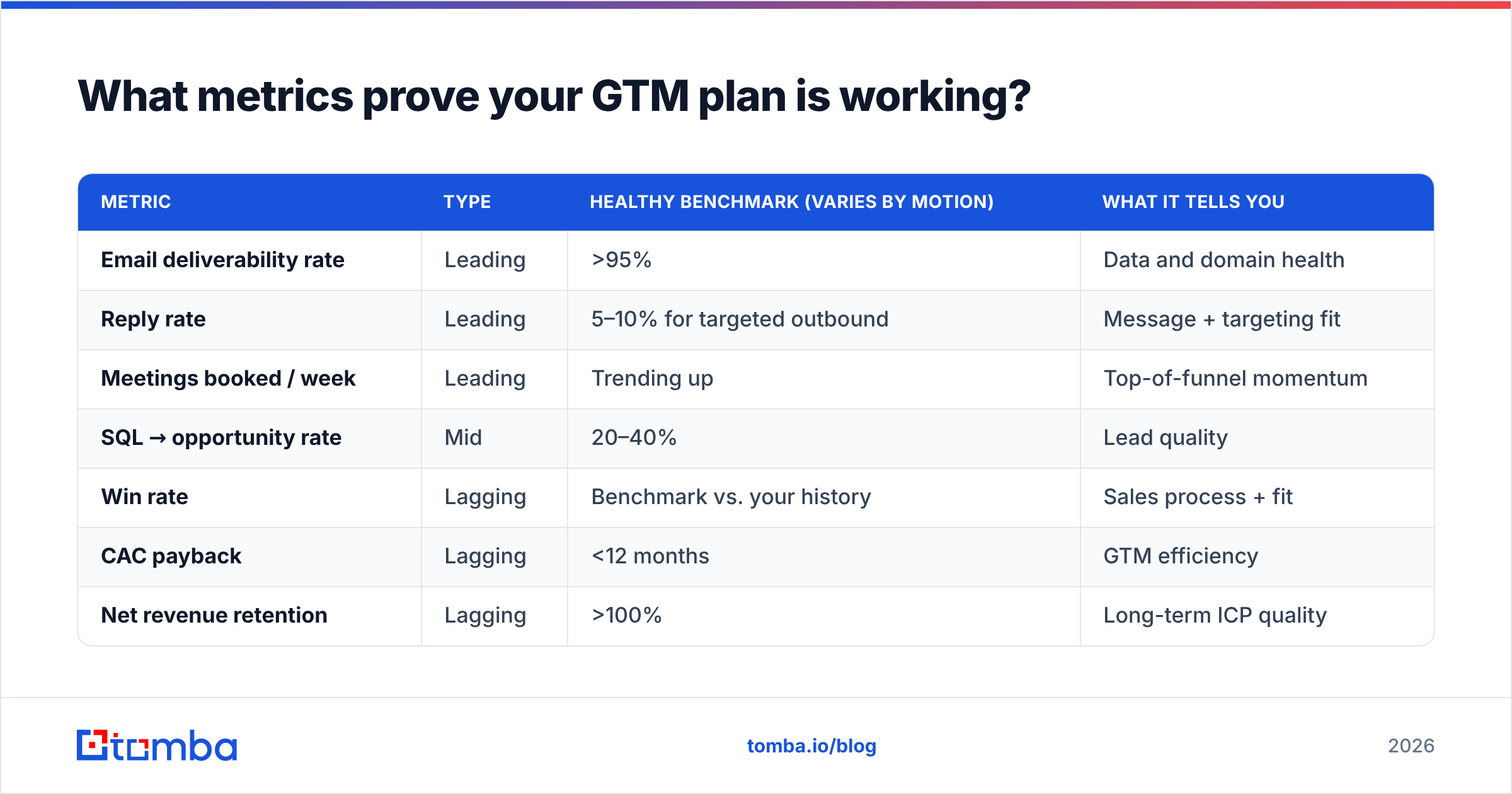
What metrics prove your GTM plan is working?#
Watch leading indicators weekly and lagging indicators monthly. The leading ones tell you what's about to happen; the lagging ones confirm it did.
| Metric | Type | Healthy benchmark (varies by motion) | What it tells you |
|---|---|---|---|
| Email deliverability rate | Leading | >95% | Data and domain health |
| Reply rate | Leading | 5–10% for targeted outbound | Message + targeting fit |
| Meetings booked / week | Leading | Trending up | Top-of-funnel momentum |
| SQL → opportunity rate | Mid | 20–40% | Lead quality |
| Win rate | Lagging | Benchmark vs. your history | Sales process + fit |
| CAC payback | Lagging | <12 months | GTM efficiency |
| Net revenue retention | Lagging | >100% | Long-term ICP quality |
If your deliverability or reply rate is weak, the problem is almost always upstream in data or targeting — not in your closers. Fix the data layer first; coaching reps to work a bad list is treating a symptom. For context on the upstream chain, our note on email deliverability explains how verification protects sender reputation.
How is B2B GTM changing in 2026?#
Three shifts are reshaping plans this year. First, AI-assisted research compresses account prep — but it also floods inboxes with generic AI outreach, which makes verified data and genuine personalization more valuable, not less. Second, buying committees keep growing; analysts like Gartner have long noted that a typical B2B purchase now involves six to ten stakeholders, so multi-threading across a buying group is mandatory. Third, signal-based selling — acting on hiring, funding, and product triggers — is replacing static list-blasting.
The throughline across all three: precision beats volume. The teams winning in 2026 send fewer, better-targeted, verified touches to the right people on the buying committee. That only works if your data is clean enough to trust.
Frequently asked questions#
How long does it take to build a B2B GTM plan? A workable v1 takes one to two weeks of focused effort — most of that is defining the ICP and building a verified account list. The plan then improves continuously as data comes in.
Do I need a GTM plan for an early-stage startup? Yes, but keep it lightweight. Even a one-page plan with a sharp ICP, one channel, and three metrics beats no plan. You can formalize it as you scale.
What's the most common GTM mistake? Skipping data hygiene. Teams pour effort into messaging and channels while sending to lists that bounce 15% of the time, which caps results no matter how good the copy is.
Put your GTM plan into motion with Tomba#
A go-to-market plan is only as strong as the contacts it runs on. Once you've defined your ICP and tiers, you need verified, decision-maker emails to actually reach them — and that's exactly what the Tomba Email Finder is built for. Find professional email addresses by domain, name, or company, verify them before you send, and pipe clean data straight into your CRM and sequences. Start on the free tier with 25 searches, prove the motion against your Tier-A list, and scale the rollout once the reply rate confirms your plan works. Build the plan, verify the data, and launch with confidence.
// get started
Find, verify and enrich your first contacts today
Start on the free plan with 25 searches a month, then scale when your team is ready.
Free plan · No credit card required · GDPR & CCPA
// about the author