B2B GTM Strategy in 2026: A Practical Go-To-Market Guide
A no-fluff guide to building a B2B GTM motion that actually converts in 2026 — segmentation, data, channels, and the metrics that prove it works.
Most B2B go-to-market plans fail in the same boring way: the deck looks great, the spreadsheet math checks out, and then the actual motion stalls because nobody can reach the right buyers with the right message at the right time. GTM is not a slide. It is an operating system that connects your data, your channels, and your revenue teams into one repeatable loop.
This guide breaks down how a modern B2B GTM strategy works in 2026 — the models you can choose from, the data layer that makes or breaks every motion, and the metrics that tell you whether it is working before you have burned a quarter of runway.
TL;DR#
- B2B GTM is a system, not a launch. It aligns product, marketing, sales, and RevOps around a single ideal customer profile (ICP) and a measurable revenue loop.
- Three core models dominate in 2026: sales-led, product-led (PLG), and hybrid. Most scaling companies end up hybrid because no single motion covers every segment.
- Your data layer is the bottleneck. Bad contact data quietly taxes every downstream channel — cold email, ads, SDR dials, and enrichment all degrade together.
- Track leading indicators, not just closed revenue: ICP coverage, contact accuracy, reply rate, pipeline velocity, and CAC payback.
- Start narrow. Pick one segment, one message, one channel, prove the loop, then expand. Broad launches hide which lever actually moved the number.
What is a B2B GTM strategy?#
A B2B go-to-market strategy is the plan for how you take a product to a defined set of business buyers and turn attention into revenue — repeatably. Think of it like a delivery route, not a single shipment. A one-time delivery just needs an address. A route needs to know every stop, the fastest order to hit them, and how to adjust when traffic changes. GTM is the route.
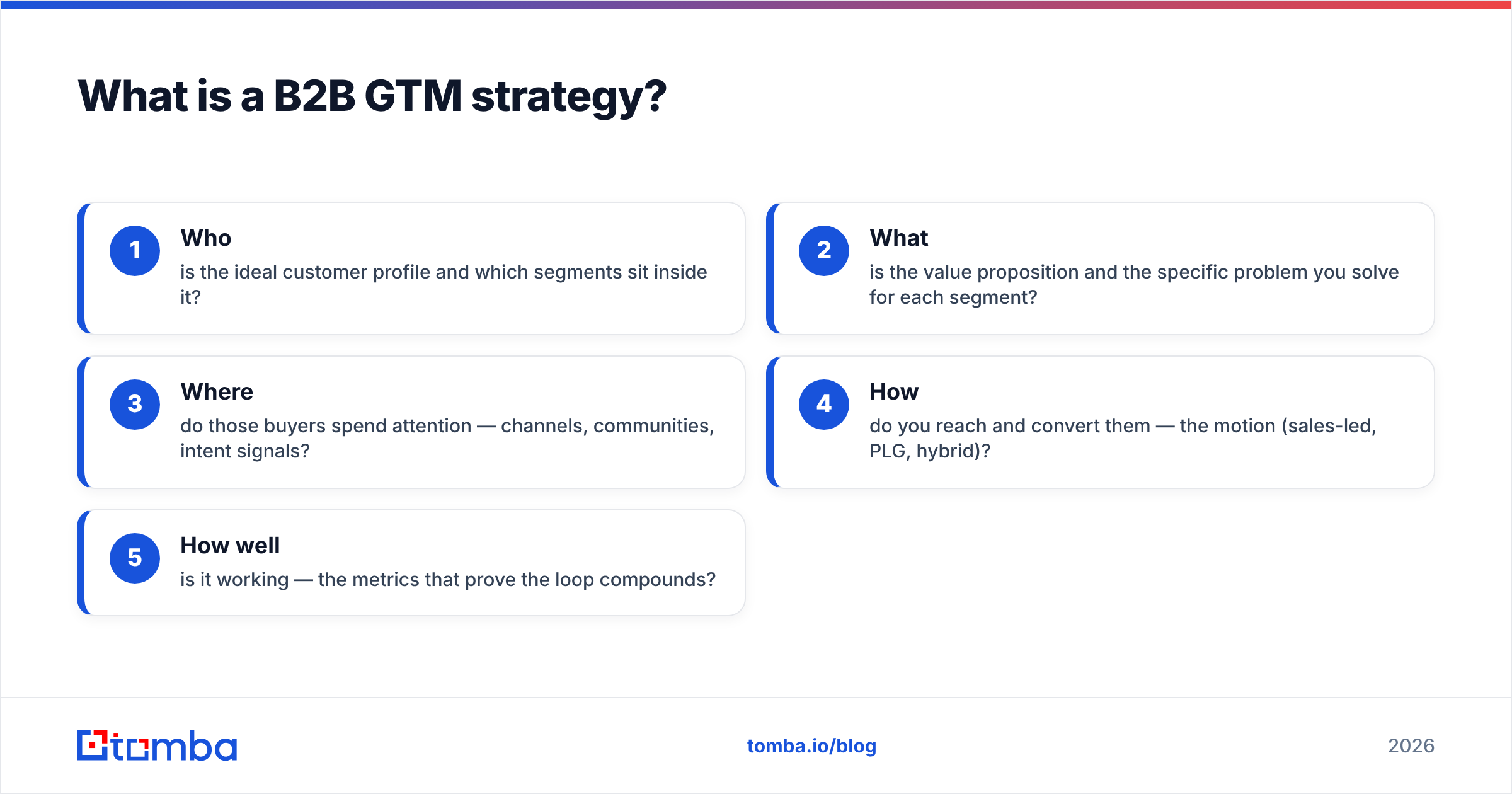
Technically, a complete B2B GTM strategy answers five questions:
- Who is the ideal customer profile and which segments sit inside it?
- What is the value proposition and the specific problem you solve for each segment?
- Where do those buyers spend attention — channels, communities, intent signals?
- How do you reach and convert them — the motion (sales-led, PLG, hybrid)?
- How well is it working — the metrics that prove the loop compounds?
If your plan cannot answer all five with evidence, it is a launch plan, not a GTM strategy. The discipline that ties these together is revenue operations — the function that keeps data, process, and tooling aligned so the motion does not drift.
What are the main B2B GTM motions in 2026?#
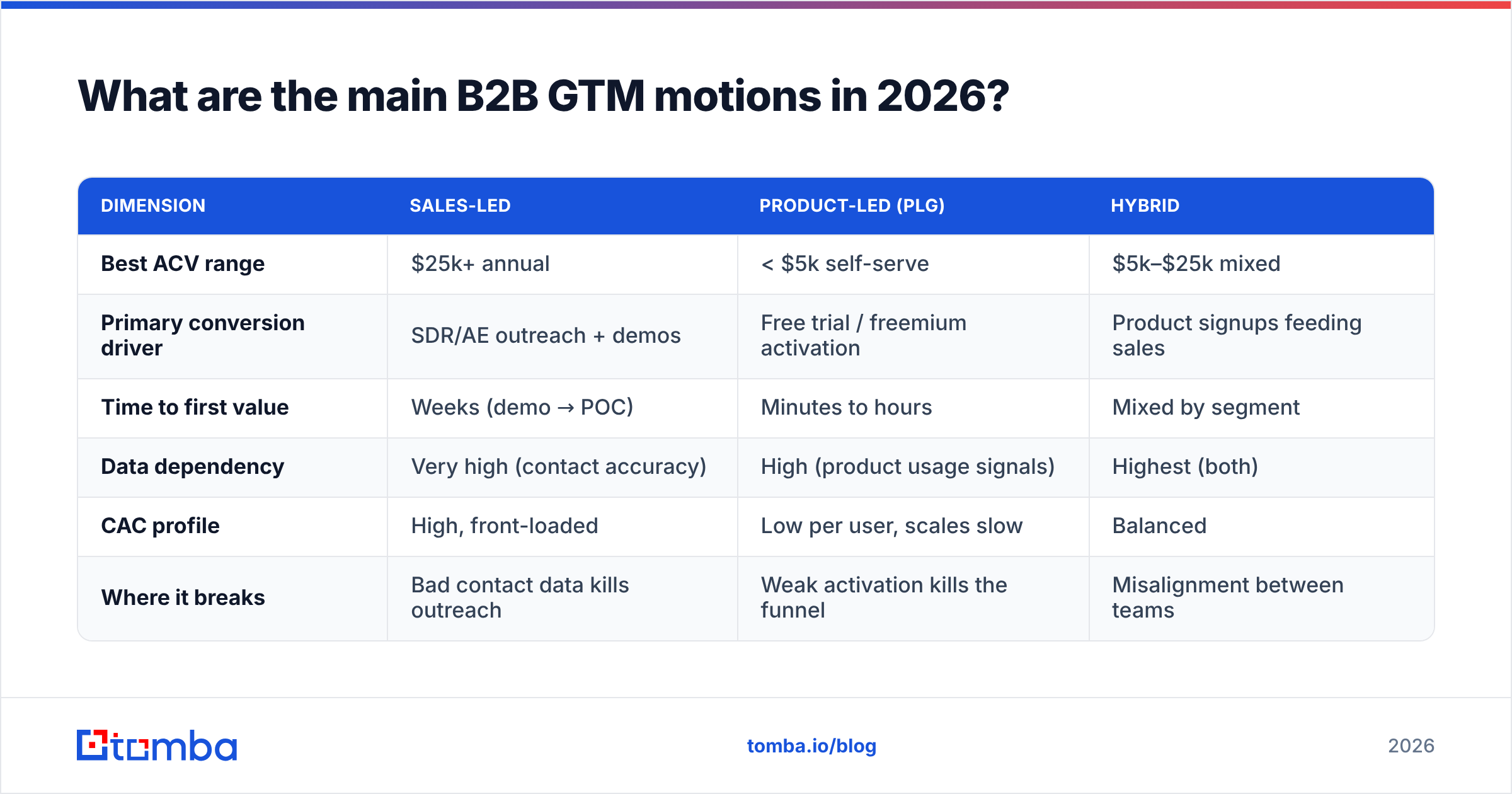
There is no single "best" motion — there is the motion that fits your price point, sales cycle, and buyer. Here is how the three dominant models compare on the dimensions that actually decide which one you run.
| Dimension | Sales-led | Product-led (PLG) | Hybrid |
|---|---|---|---|
| Best ACV range | $25k+ annual | < $5k self-serve | $5k–$25k mixed |
| Primary conversion driver | SDR/AE outreach + demos | Free trial / freemium activation | Product signups feeding sales |
| Time to first value | Weeks (demo → POC) | Minutes to hours | Mixed by segment |
| Data dependency | Very high (contact accuracy) | High (product usage signals) | Highest (both) |
| CAC profile | High, front-loaded | Low per user, scales slow | Balanced |
| Where it breaks | Bad contact data kills outreach | Weak activation kills the funnel | Misalignment between teams |
Sales-led works when deals are large and complex enough to justify a human. The whole motion lives or dies on reaching the right person, which is why a B2B database and accurate contact data sit at its center.
Product-led growth lets the product do the selling through a free tier or trial. It scales beautifully at low ACV but needs ruthless activation design and usage instrumentation.
Hybrid is where most companies that cross $10M ARR land. Self-serve handles the long tail while a sales team chases the high-value accounts that signup data surfaces. According to Gartner research on B2B buying, buyers spend only about 17% of their journey with sales reps — which is exactly why a single motion rarely covers the full buying group.
Why does the data layer decide whether your GTM works?#
Your GTM is only as strong as the contact data underneath it. This is the part teams underinvest in and then quietly pay for in every channel.
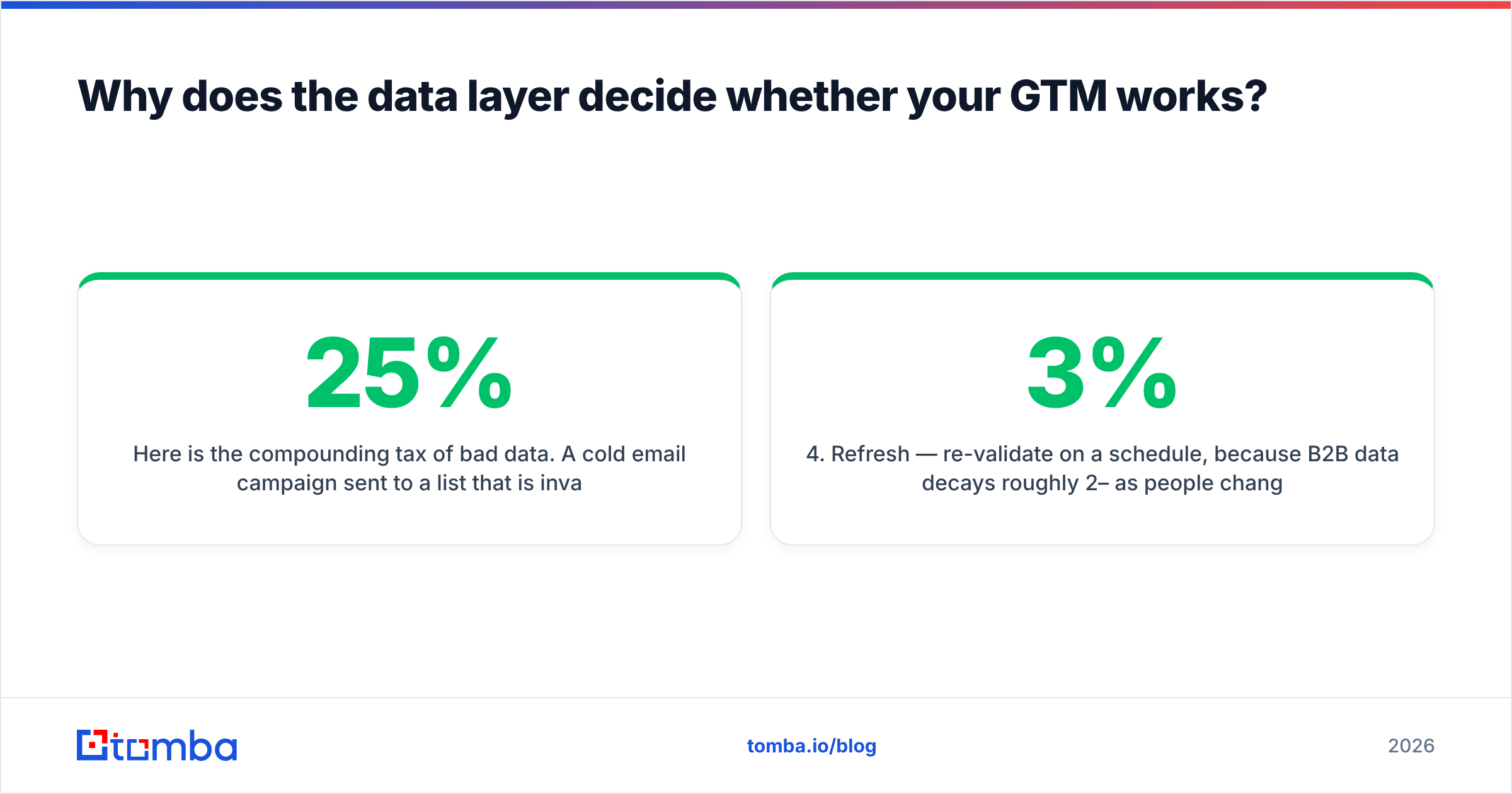
Here is the compounding tax of bad data. A cold email campaign sent to a list that is 25% invalid does not just waste 25% of sends — it damages your sender reputation, which suppresses deliverability for the 75% of addresses that were good. The same rot spreads to paid social audiences, CRM hygiene, and SDR productivity. One weak input degrades the entire system.
A healthy GTM data layer has four jobs:
- Find — locate the right buyers at target accounts. An accurate email finder turns a company and a name into a reachable contact.
- Verify — confirm those addresses are deliverable before you send, using an email verifier to strip invalids and catch-alls.
- Enrich — add the firmographic and role context that lets you segment and personalize, through data enrichment.
- Refresh — re-validate on a schedule, because B2B data decays roughly 2–3% per month as people change jobs.
Skip any of these and you are building your GTM on sand. The teams that win in 2026 treat data quality as a first-class GTM metric, not an IT chore.

How do you build a B2B GTM strategy step by step?#
Build it as a narrow, provable loop — then widen it. A broad launch hides which lever moved the number; a narrow one tells you exactly what works.
Step 1 — Define one ICP segment. Not "mid-market SaaS." Something like "Series B SaaS companies, 50–200 employees, with a 5+ person SDR team, in North America." Specific enough that you can build a finite list of accounts.
Step 2 — Build the target account list. Use firmographic filters and intent signals to assemble the accounts inside that segment. This is finite and countable, which is what makes the rest measurable.
Step 3 — Source and verify contacts. For each account, find the buying-group roles (champion, economic buyer, blocker) and verify every address. A bulk email finder handles this at list scale without one-by-one lookups.
Step 4 — Pick one channel and one message. Cold email, LinkedIn, calls, or ads — pick the single channel where your buyer is most reachable and commit. Test message-market fit before adding channels.
Step 5 — Instrument the loop. Wire your tools so every touch, reply, meeting, and deal is tracked. If you cannot see where prospects drop, you cannot fix the motion.
Step 6 — Measure, then expand. Once one segment-channel-message combination converts predictably, clone it into the next segment. Compounding beats sprawl.
For teams running this through a CRM, HubSpot's go-to-market guidance is a solid reference for mapping the funnel stages to lifecycle properties.
Which metrics prove a B2B GTM motion is working?#
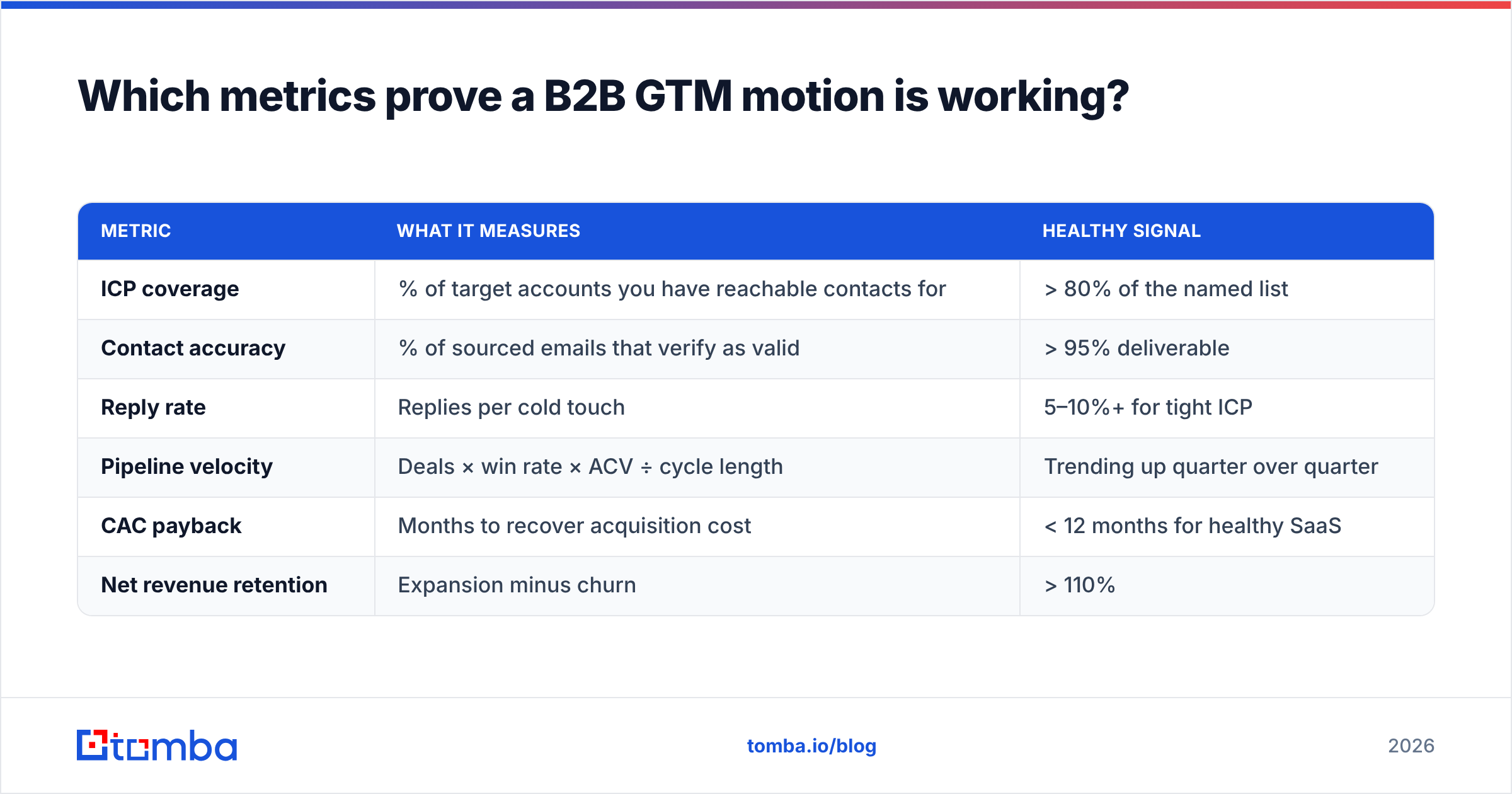
Closed revenue is a lagging metric — by the time it moves, the decisions that caused it are a quarter old. Watch leading indicators that tell you sooner.
| Metric | What it measures | Healthy signal |
|---|---|---|
| ICP coverage | % of target accounts you have reachable contacts for | > 80% of the named list |
| Contact accuracy | % of sourced emails that verify as valid | > 95% deliverable |
| Reply rate | Replies per cold touch | 5–10%+ for tight ICP |
| Pipeline velocity | Deals × win rate × ACV ÷ cycle length | Trending up quarter over quarter |
| CAC payback | Months to recover acquisition cost | < 12 months for healthy SaaS |
| Net revenue retention | Expansion minus churn | > 110% |
Two of these — ICP coverage and contact accuracy — are pure data-layer metrics, and they are upstream of everything else. Fix them first. You can have the best response rate copy in your category, but if you only have verified contacts for 40% of your target accounts, the motion is capped before it starts.
How is AI changing B2B GTM in 2026?#
AI has shifted GTM from "more volume" to "more precision," and that shift rewards clean data even more than before.
The blunt-instrument era of GTM — buy a giant list, blast it, hope — is dead. Inboxes and ad platforms now penalize low-quality sending hard, and buyers ignore generic outreach reflexively. AI raises the floor on personalization, which means the differentiator is no longer "can you write a custom email" (everyone can now) but "do you have the accurate data to personalize against."
Three concrete shifts:
- Signal-based selling replaces calendar-based cadences. AI watches for job changes, funding, tech-stack moves, and triggers outreach on the signal — but only if your enrichment data is current.
- Automated research and drafting compresses SDR prep from 20 minutes per account to seconds, so reps spend time on conversations, not data entry.
- Programmatic enrichment via API lets you keep records fresh automatically. Wiring an email finder API into your CRM means contacts are sourced and verified the moment an account enters your pipeline, not in a monthly batch job.
The pattern is consistent: AI multiplies whatever data you feed it. Feed it accurate, verified contacts and it compounds your motion. Feed it stale data and it scales your mistakes faster than you can catch them. For a deeper background on the discipline, G2's category for GTM platforms is a useful map of how the tooling landscape is consolidating.
What are the most common B2B GTM mistakes?#
The failure modes are predictable, which means they are avoidable.
- Launching too broad. Chasing five segments at once means you learn nothing about any of them. Narrow first.
- Treating data as an afterthought. Teams budget for ads and tooling but not for the contact accuracy that determines whether any of it lands.
- Misaligned teams. Marketing optimizes for MQLs, sales optimizes for closed deals, and nobody owns the handoff. RevOps exists to fix exactly this.
- No feedback loop. Running the same cadence for six months without measuring drop-off points is not a strategy, it is a habit.
- Confusing activity with progress. 500 emails sent feels productive; 500 emails sent to a 30%-invalid list is negative progress because it harms deliverability for the good contacts.
Avoid these five and you are already ahead of most of your competitors, who are quietly making at least two of them right now.
Build your GTM on data you can trust#
Every B2B GTM motion — sales-led, product-led, or hybrid — runs on one shared dependency: accurate, verified contact data. You can pick the perfect segment and write the sharpest message, but if you cannot reliably reach the buying group, the loop never closes.
That is where Tomba's Email Finder fits. It turns a company domain and a name into a verified, deliverable email address, so your ICP coverage and contact accuracy — the two upstream metrics that cap everything else — stay high. Start free with 25 searches a month, then scale on the Starter plan at $49/mo when your motion is ready to grow. Build the data layer first, and the rest of your go-to-market compounds on top of it.
// get started
Find, verify and enrich your first contacts today
Start on the free plan with 25 searches a month, then scale when your team is ready.
Free plan · No credit card required · GDPR & CCPA
// about the author