How to Choose a B2B Lead Company in 2026: A Buyer's Guide
Not all B2B lead companies sell the same thing. Learn how to vet data accuracy, pricing models, and delivery methods before you sign a contract in 2026.
How to Choose a B2B Lead Company in 2026: A Buyer's Guide
Picking a B2B lead company is less like buying software and more like hiring a research team you never meet. You pay upfront, you get a spreadsheet, and only weeks later — after the bounces, the disconnected numbers, and the "please remove me" replies — do you learn whether the data was any good. This guide is about avoiding that gap.
TL;DR#
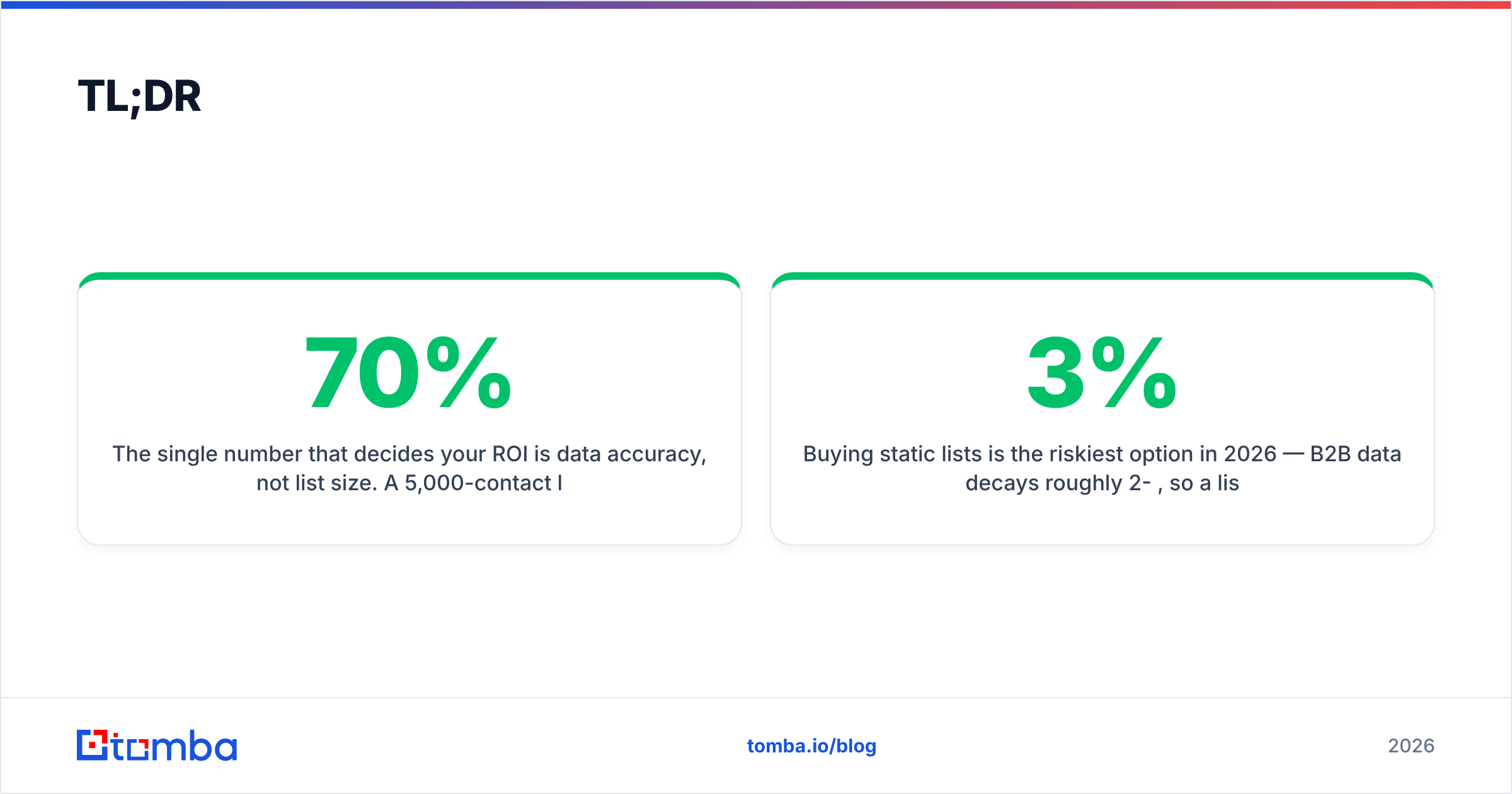
- A B2B lead company sells contact data, intent signals, or done-for-you prospecting — and the three are priced and delivered very differently.
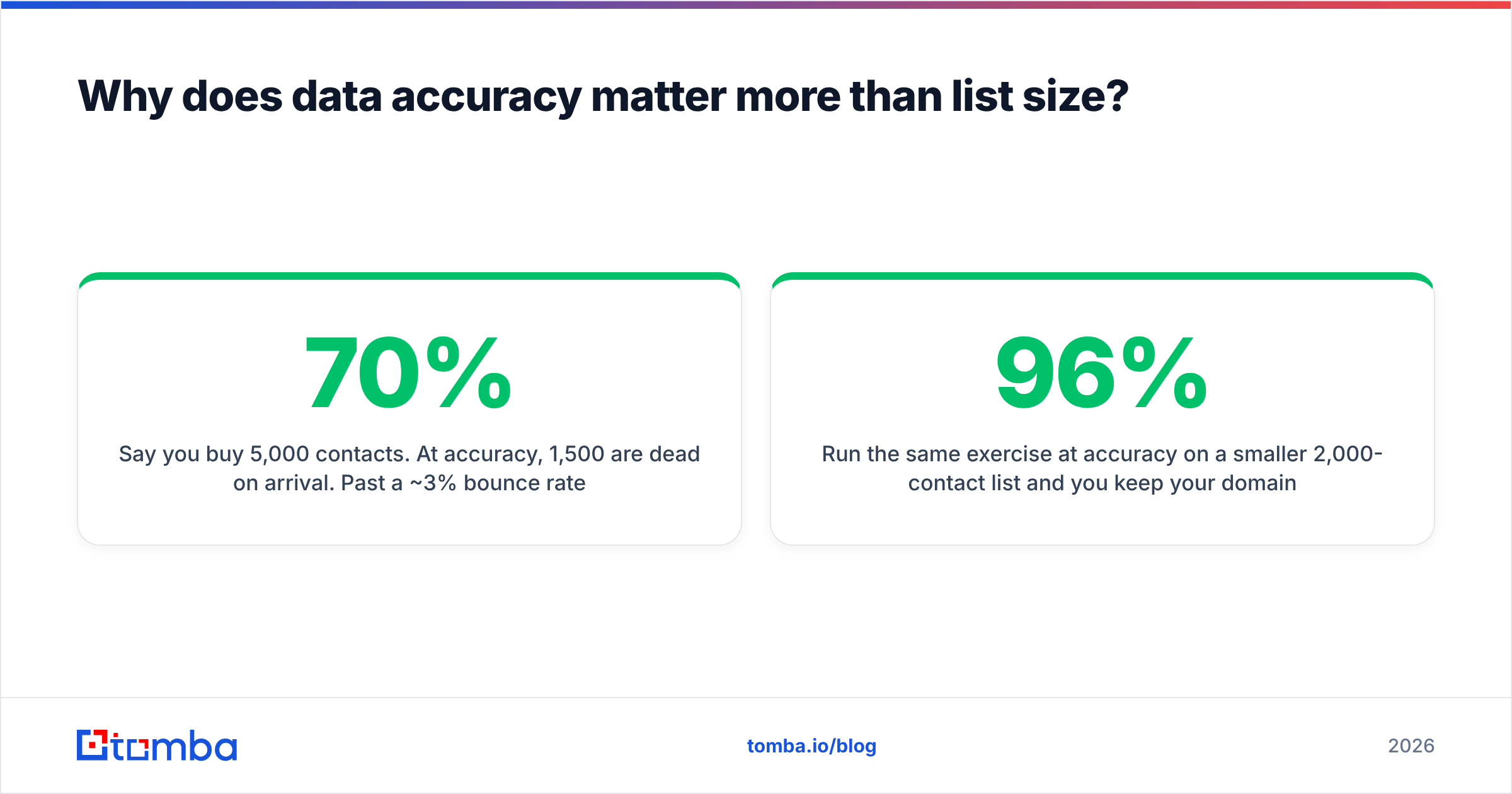
- The single number that decides your ROI is data accuracy, not list size. A 5,000-contact list at 70% deliverability is worse than 2,000 contacts at 96%.
- Watch the pricing model: per-credit, per-seat, and flat-rate database access each punish a different usage pattern.
- Buying static lists is the riskiest option in 2026 — B2B data decays roughly 2-3% per month, so a list is stale before you finish importing it.
- A self-serve tool that finds and verifies emails on demand (like the Tomba Email Finder) usually beats a one-time list purchase on both cost and freshness.
What is a B2B lead company?#
A B2B lead company is any vendor whose product is other businesses' contact and account data — the raw material your sales and marketing teams turn into pipeline. Think of it like a grocery supplier for a restaurant: you can buy pre-made meals (managed lead-gen), individual fresh ingredients on demand (self-serve data tools), or a bulk pantry order delivered once (a static list). All three feed the same kitchen, but they spoil at different rates and cost wildly different amounts.
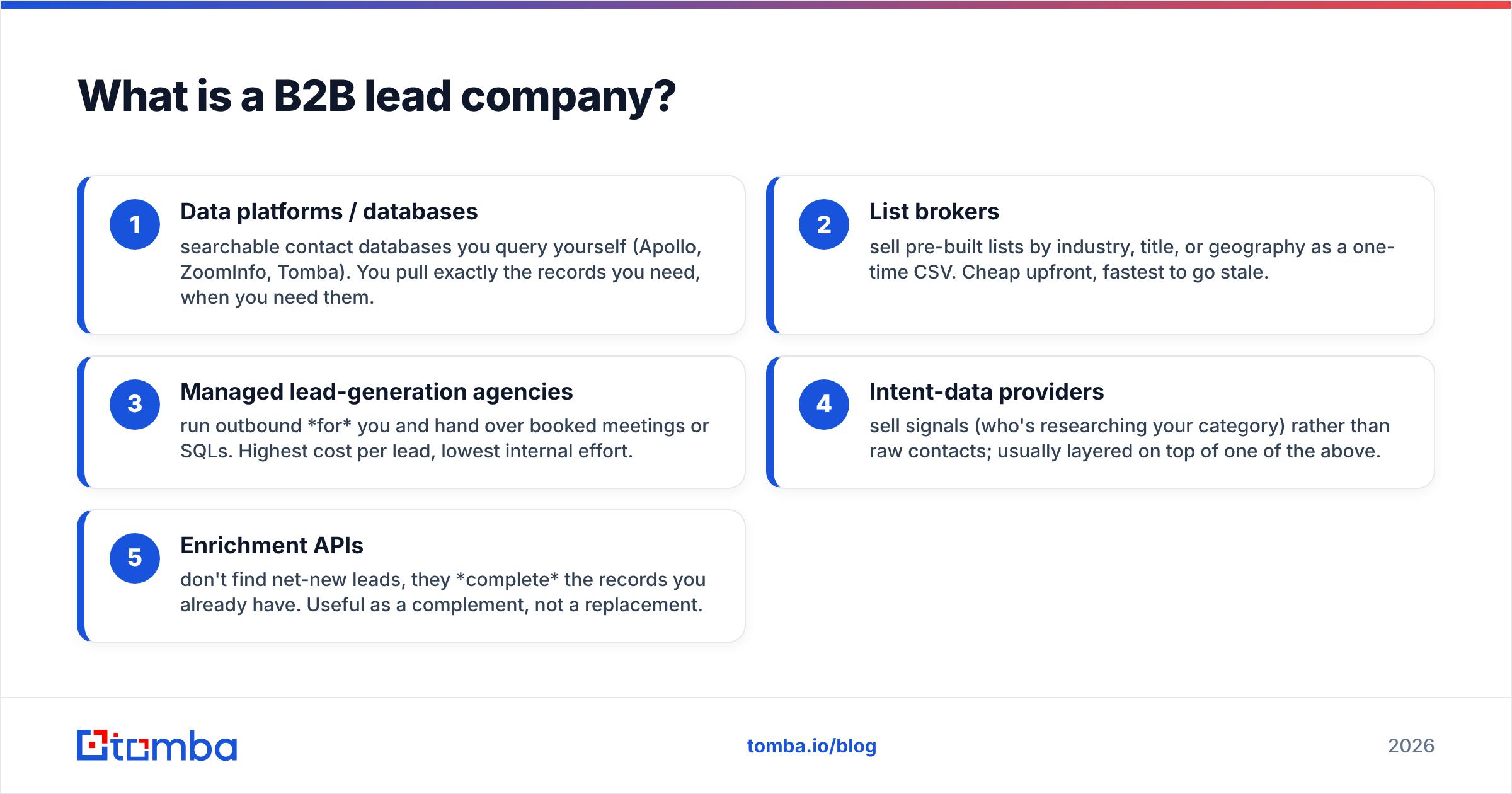
The category splits into a few recognizable types:
- Data platforms / databases — searchable contact databases you query yourself (Apollo, ZoomInfo, Tomba). You pull exactly the records you need, when you need them.
- List brokers — sell pre-built lists by industry, title, or geography as a one-time CSV. Cheap upfront, fastest to go stale.
- Managed lead-generation agencies — run outbound for you and hand over booked meetings or SQLs. Highest cost per lead, lowest internal effort.
- Intent-data providers — sell signals (who's researching your category) rather than raw contacts; usually layered on top of one of the above.
- Enrichment APIs — don't find net-new leads, they complete the records you already have. Useful as a complement, not a replacement.
Most teams end up combining two of these. The mistake is treating them as interchangeable when they solve different problems.
How do B2B lead companies actually get their data?#
Conclusion first: the sourcing method predicts the accuracy, so ask about it before you ask about price.
The honest vendors will tell you they blend sources. The three main ones:
- Public web + verification — crawling company sites, public profiles, and registries, then SMTP-verifying every address. This produces the freshest professional emails because verification happens at query time. Tomba documents its approach on its data sources page.
- Contributory / community networks — users install an extension and contribute the contacts they see in exchange for credits. Huge volume, but coverage skews toward whoever the contributors happen to email, and consent gets murky.
- Licensed third-party panels — data bought wholesale from other aggregators. Cheapest to assemble, oldest on average, and you often can't trace where a record originated.
If a B2B lead company can't explain its sourcing in plain language, that's your answer. Vague sourcing almost always correlates with high bounce rates, which torch your sender reputation faster than any subject line ever could.
Why does data accuracy matter more than list size?#
Because you pay for the whole list but only profit from the part that's deliverable and reachable. The math is unforgiving.
Say you buy 5,000 contacts. At 70% accuracy, 1,500 are dead on arrival. Past a ~3% bounce rate, mailbox providers start throttling your domain, so the good 3,500 contacts now land in spam too. You didn't buy 5,000 leads — you bought a deliverability problem with a 3,500-lead consolation prize.
Run the same exercise at 96% accuracy on a smaller 2,000-contact list and you keep your domain healthy and reach more real humans. Smaller, cleaner, verified data wins almost every time. This is exactly why pairing any list with an independent email verifier is non-negotiable before the first send — even data you paid a premium for.
A practical accuracy checklist before you buy:
- Ask for the verification timestamp. "When was this record last confirmed?" Anything older than 90 days is suspect.
- Request a free sample. Verify the sample yourself. Reputable vendors expect this.
- Check catch-all handling. Catch-all domains accept everything at the SMTP layer, so they need a dedicated catch-all verifier — not a blanket "valid" stamp.
- Confirm the bounce guarantee. The best vendors credit back invalid records. List brokers rarely do.
How are B2B lead companies priced in 2026?#
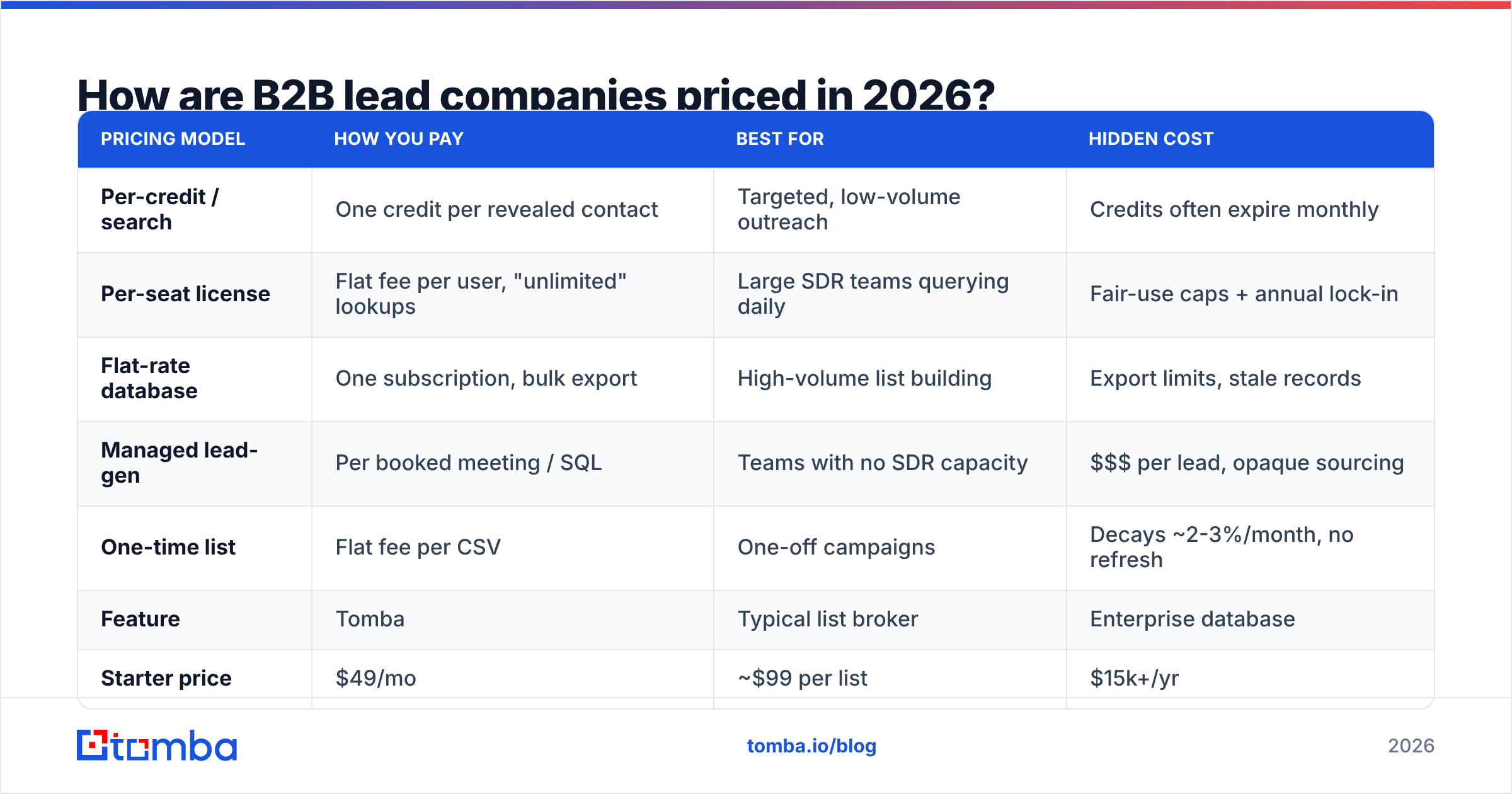
Three dominant models, each optimized to make a different buyer overpay. Match the model to how your team actually works.
| Pricing model | How you pay | Best for | Hidden cost |
|---|---|---|---|
| Per-credit / search | One credit per revealed contact | Targeted, low-volume outreach | Credits often expire monthly |
| Per-seat license | Flat fee per user, "unlimited" lookups | Large SDR teams querying daily | Fair-use caps + annual lock-in |
| Flat-rate database | One subscription, bulk export | High-volume list building | Export limits, stale records |
| Managed lead-gen | Per booked meeting / SQL | Teams with no SDR capacity | $$$ per lead, opaque sourcing |
| One-time list | Flat fee per CSV | One-off campaigns | Decays ~2-3%/month, no refresh |
A concrete comparison of the self-serve end of the market, where most growing teams land:
| Feature | Tomba | Typical list broker | Enterprise database |
|---|---|---|---|
| Starter price | $49/mo | ~$99 per list | $15k+/yr |
| Free tier | 25 searches/mo | None | Rarely |
| Data freshness | Verified at query time | Decays from day one | Quarterly refresh |
| Email verification | Built in | Add-on or none | Built in |
| API access | Yes (Tomba API) | No | Enterprise tier only |
| Bulk processing | Yes (bulk finder) | CSV only | Yes |
| Best fit | SMB to mid-market | One-off campaigns | Large enterprise |
You can see the full breakdown on the Tomba pricing page. The headline: a $49/mo self-serve plan with on-demand verification almost always beats a $99 static list that's decaying before you open it.
Should you buy a list or use a self-serve data tool?#
Use a self-serve tool. Buying static lists made sense when data decayed slowly and verification was expensive — neither is true in 2026.
The case against one-time lists:
- Decay. People change jobs every ~2-3 years on average, which means B2B contact data rots at roughly 2-3% per month. The list you bought in January is meaningfully wrong by April.
- No targeting iteration. You're locked into the segment you specified at purchase. Want to test a different title or industry? Buy another list.
- Shared distribution. That "exclusive" list was often sold to your competitors too, so prospects get the same pitch five times.
- Compliance exposure. You inherit consent problems you can't audit.
The case for a self-serve B2B lead company:
- You query exactly the accounts you're working today via domain search or name-based lookup.
- Records are verified at the moment you pull them.
- You can layer in phone numbers, LinkedIn data, and enrichment on the same record.
- It plugs into your CRM — see the HubSpot and Salesforce integrations — so leads flow straight into your sequences.
The only scenario where a managed agency still wins is when you have budget but zero internal outbound capacity. Even then, ask the agency which B2B lead company they source from — you may be paying a 5x markup on data you could pull yourself.
How do you evaluate a B2B lead company before signing?#
Run every candidate through the same gate. If a vendor resists any of these, that resistance is information.
- Sample test, not demo theater. Pull 50 real contacts in your ICP and verify them independently. Compare claimed vs. actual deliverability.
- Coverage in your niche. A vendor strong in US SaaS may be thin in EU manufacturing. Test your segment, not their flagship one.
- Refresh cadence. How often is the database re-verified? Query-time verification beats quarterly batch refreshes.
- Export and ownership rights. Do you own the data after export, or is it licensed and revocable? Read the contract.
- Integration fit. Native CRM and Zapier connections save hours versus manual CSV juggling.
- Support for compliance. GDPR/CAN-SPAM posture, opt-out handling, and a clear data-removal process.
Cross-checking vendors on a third-party review site like G2 or Capterra helps, but weight recent reviews heavily — data quality changes quarter to quarter as sourcing deals shift.
What does a healthy lead-buying workflow look like?#
Conclusion first: treat purchased data as a starting point that you verify, enrich, and route — never as a finished asset you blast.
A workflow that protects your domain and your conversion rate:
- Source net-new contacts from a self-serve B2B lead company using account-based domain search.
- Verify the full batch with a bulk verify pass and quarantine anything risky.
- Enrich the survivors with firmographics and direct dials so reps have context before they reach out.
- Route clean records into your CRM and sequence them in small, warmed batches rather than one giant send.
- Recycle non-responders back through verification monthly, since their details drift over time.
This is the difference between teams that complain "bought leads never convert" and teams that quietly hit quota. The data was rarely the whole problem — the missing verification and routing steps were.
For the deliverability side of this equation, brush up on email deliverability fundamentals before you scale sends. The cleanest list in the world won't help if your authentication records aren't in order.
Common mistakes when working with B2B lead companies#
- Optimizing for volume. "How many contacts do I get?" is the wrong first question. "What's your verified deliverability in my segment?" is the right one.
- Skipping the sample. Trusting a vendor's accuracy claim without testing it yourself.
- Ignoring decay. Buying once and reusing the same list for a year.
- Blasting on day one. Sending to a fresh 5,000-contact import without warming up, then blaming the data when the domain tanks.
- Treating phone and email as separate buys. Multi-channel records from one source — email, phone, and social — convert better than stitched-together fragments.
Frequently asked questions#
Is it legal to buy B2B leads? In most jurisdictions, yes, for legitimate-interest B2B outreach — but rules vary. CAN-SPAM (US) requires accurate headers and a working opt-out; GDPR (EU) is stricter on consent and legitimate interest. Always honor removal requests immediately.
How much should a B2B lead company cost? Self-serve tools start around $49/mo (see Tomba plans). Managed agencies charge per booked meeting and run far higher. Cost-per-verified-lead is the only fair comparison.
Can I verify purchased lists myself? Yes, and you should. Run any list through an email verifier before the first send, regardless of vendor promises.
What's the single biggest predictor of ROI? Data accuracy at query time. Everything else is secondary.
The bottom line#
Choosing a B2B lead company in 2026 comes down to one trade-off: freshness versus convenience. Static lists are convenient and stale; managed agencies are convenient and expensive; self-serve, verified data is the workflow that keeps your domain healthy and your reps reaching real people.
If you want to test that for yourself, the Tomba Email Finder lets you pull and verify professional emails on demand — 25 free searches a month, no list-broker contract, and verification baked into every result. Start with your top 20 target accounts, verify what you get, and compare the deliverability against whatever list you were about to buy. The numbers will make the decision for you.
// get started
Find, verify and enrich your first contacts today
Start on the free plan with 25 searches a month, then scale when your team is ready.
Free plan · No credit card required · GDPR & CCPA
// about the author