B2B Lead Gen in 2026: Strategies, Channels & Tools
A practical 2026 playbook for B2B lead gen: which channels still convert, how to build a funnel that fills itself, and the tools that turn raw traffic into booked meetings.
B2B lead gen in 2026 is no longer about volume. It is about getting the right contact, with the right context, in front of the right rep before your competitor does. The teams winning right now run fewer plays, but they run them with cleaner data and tighter measurement.
This guide breaks down what actually fills a B2B pipeline today: the channels worth your budget, the funnel that turns strangers into meetings, the tooling stack, and the metrics that tell you whether any of it is working.
TL;DR#
- B2B lead gen is the system for attracting, identifying, and qualifying companies and decision-makers who fit your ICP — then handing sales a contact they can actually reach.
- Inbound builds compounding pipeline; outbound builds predictable pipeline. Most strong programs run both, weighted by deal size and sales-cycle length.
- Data quality is the real bottleneck. Bounced emails and stale records quietly kill more campaigns than bad copy does.
- A tight stack beats a big stack: one source of contact data, one verifier, one sequencer, one CRM — wired together and measured end to end.
- Track cost per qualified lead and lead-to-opportunity rate, not raw lead counts. Vanity volume hides a leaky funnel.
What is B2B lead gen?#
B2B lead generation is the process of finding businesses and the people inside them who are likely to buy, capturing their interest, and qualifying them until a salesperson can take over. Think of it like fishing with a guide instead of a net: you are not trying to catch everything in the lake, you are targeting a specific species in a specific spot at a specific time.
A "lead" only counts if you can act on it. A company name with no reachable contact is trivia. That is why modern B2B lead gen blends three jobs that used to live in separate teams:
- Demand creation — content, ads, events, and social that make your market aware a problem is worth solving.
- Lead capture and identification — turning anonymous interest into a named company and a named person, ideally with a verified work email and role.
- Qualification — scoring fit (does this match your ICP?) and intent (are they showing buying signals?) so reps spend time on the right accounts.
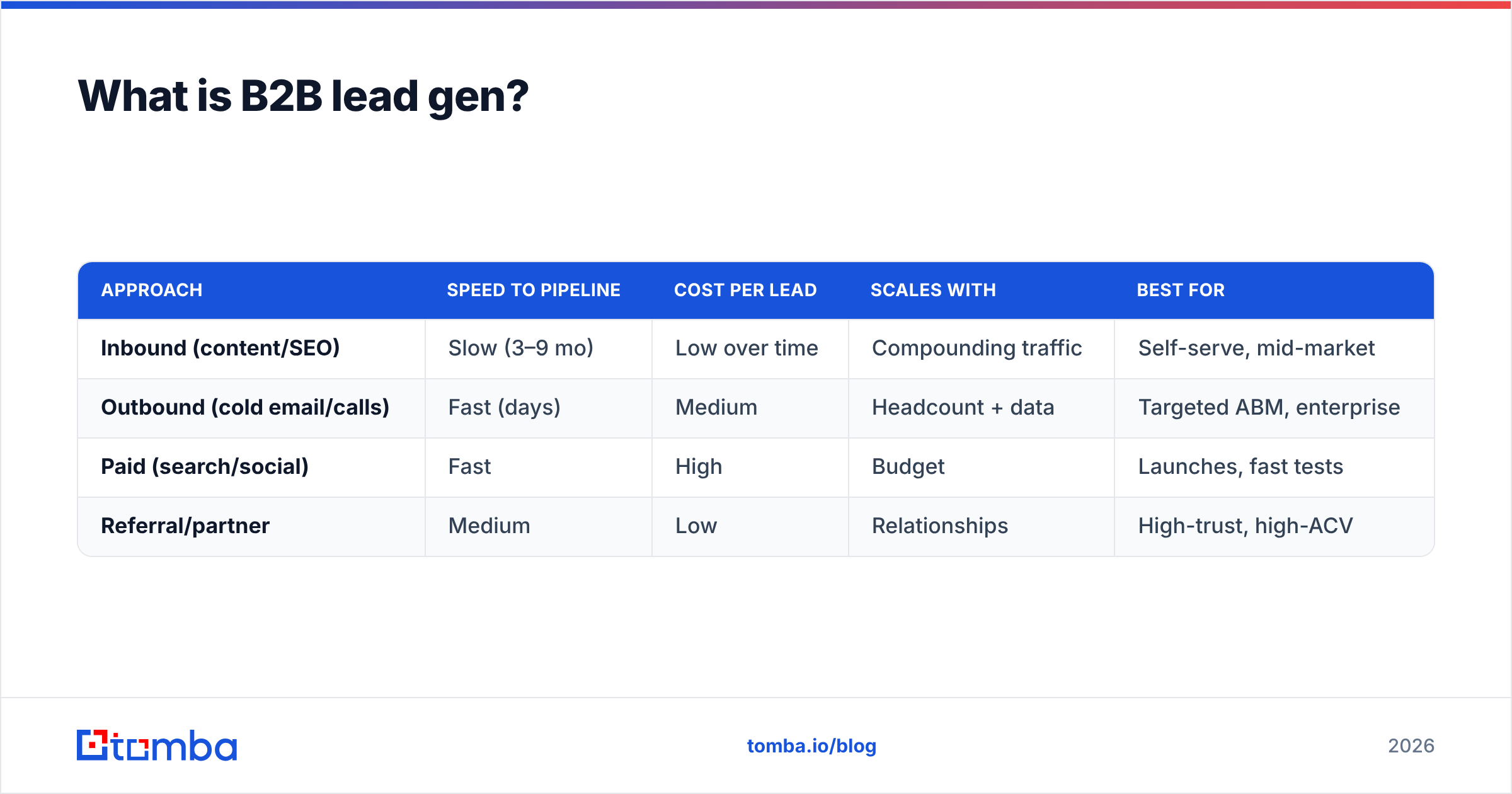
Here is how the main approaches compare on the dimensions that decide your strategy:
| Approach | Speed to pipeline | Cost per lead | Scales with | Best for |
|---|---|---|---|---|
| Inbound (content/SEO) | Slow (3–9 mo) | Low over time | Compounding traffic | Self-serve, mid-market |
| Outbound (cold email/calls) | Fast (days) | Medium | Headcount + data | Targeted ABM, enterprise |
| Paid (search/social) | Fast | High | Budget | Launches, fast tests |
| Referral/partner | Medium | Low | Relationships | High-trust, high-ACV |
Most teams over-index on one column. The fix is rarely "do more of the thing that is already tired" — it is balancing a slow compounding channel against a fast predictable one.
Why is B2B lead gen harder in 2026?#
Three shifts changed the math. First, buyers self-educate. By the time a prospect talks to sales, Gartner research has long shown most of the buying journey already happened without you. Second, inboxes are stricter — Google and Yahoo's bulk-sender rules mean sloppy lists get throttled or blocked before your copy is ever read. Third, AI flooded every channel with generic outreach, so mediocre messaging now performs worse than silence.
The practical consequence: your edge is data and relevance, not effort. Sending 5,000 unverified emails in 2026 gets you a damaged domain, not a full calendar. Sending 300 verified, well-segmented emails to a sharp ICP gets you meetings.

What channels drive the best B2B leads?#
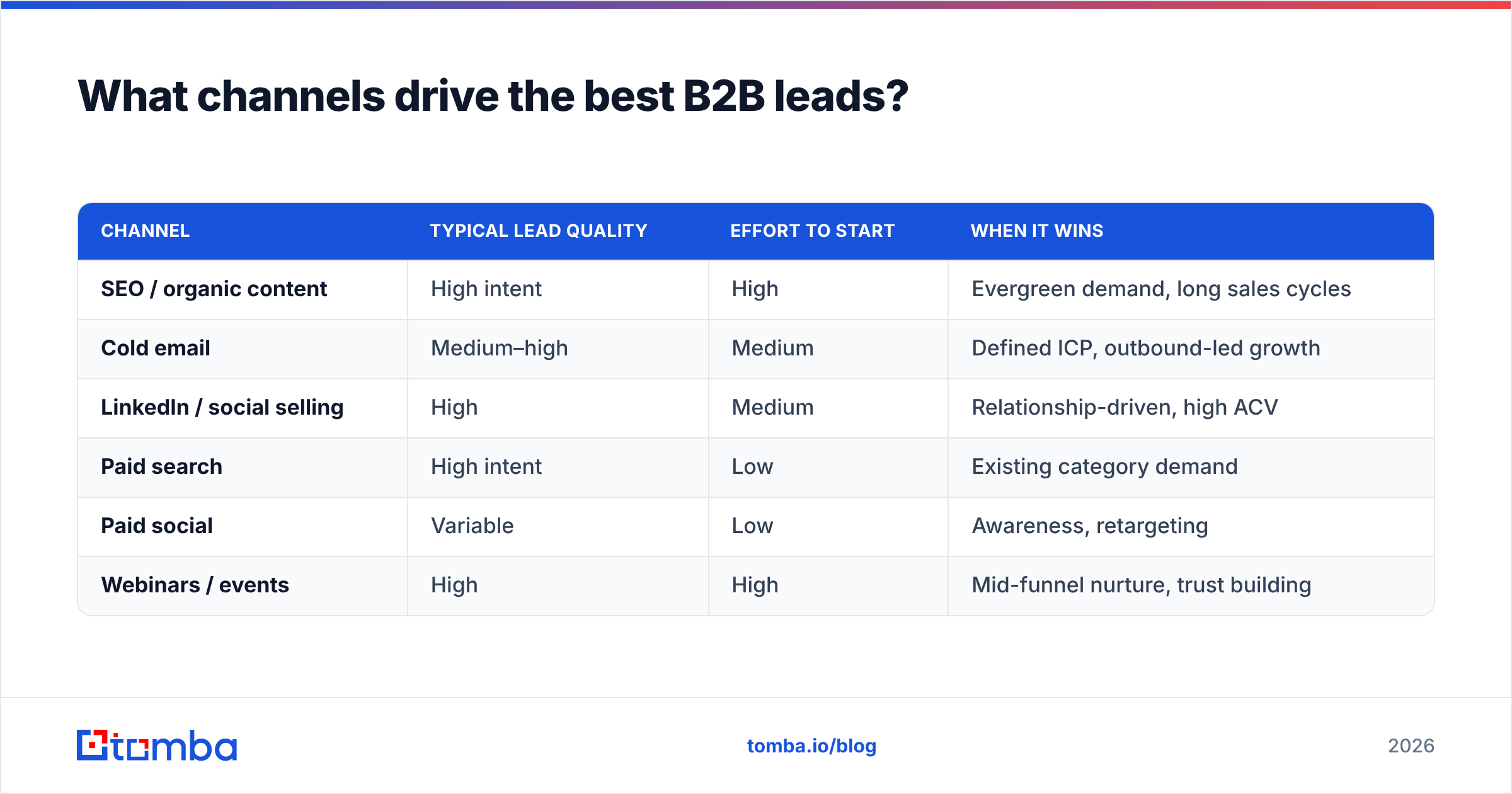
There is no universal "best channel" — there is the best channel for your deal size and motion. Use this as a starting allocation, then let your own conversion data reweight it.
| Channel | Typical lead quality | Effort to start | When it wins |
|---|---|---|---|
| SEO / organic content | High intent | High | Evergreen demand, long sales cycles |
| Cold email | Medium–high | Medium | Defined ICP, outbound-led growth |
| LinkedIn / social selling | High | Medium | Relationship-driven, high ACV |
| Paid search | High intent | Low | Existing category demand |
| Paid social | Variable | Low | Awareness, retargeting |
| Webinars / events | High | High | Mid-funnel nurture, trust building |
Two channels deserve a closer look in 2026.
Cold email still works — but only on verified, targeted lists. The difference between a 1% reply rate and a 12% reply rate is rarely the subject line. It is whether the email reached a real human at a company that has the problem you solve. That starts with finding accurate addresses (a job for an email finder) and cleaning them before send (a job for an email verifier).
Social selling compounds. Consistent, useful posting on LinkedIn plus targeted connection requests turns your team into a distribution channel. Pair it with contact enrichment so a profile view becomes a routable lead in your CRM, not a dead-end like.
For deeper benchmarks on channel performance, HubSpot's State of Marketing report is a reliable annual reference, and peer reviews on G2 help you sanity-check tool claims before you buy.
How do you build a B2B lead gen funnel that fills itself?#
A funnel is just a sequence of small commitments. Each stage should make the next one easier. Build it in this order:
- Define the ICP and trigger events. Write down firmographics (industry, size, geography) and the events that signal a need — new funding, a relevant hire, a tech-stack change. Without this, every later step leaks.
- Create a relevant entry offer. A guide, calculator, benchmark, or free tool that solves one narrow problem. The offer should be useful enough to trade an email for.
- Identify and enrich the lead. Turn the captured email or anonymous visit into a full record — name, role, company, verified work email, phone. This is where data enrichment earns its cost: a complete record routes itself; a thin one stalls.
- Score for fit and intent. Combine ICP match with behavior (pages viewed, emails opened, demos requested). Pass only qualified leads to sales; nurture the rest.
- Hand off with context. The rep should see why this lead matters and how to reach them. A verified email and a one-line "why now" beat a 20-field form nobody reads.
- Close the loop. Feed won/lost outcomes back into scoring so the model gets smarter every quarter.
The self-filling part comes from steps 2 and 6: a genuinely useful entry offer keeps attracting the right people, and outcome data keeps sharpening who you chase.
What tools do you need for B2B lead gen?#
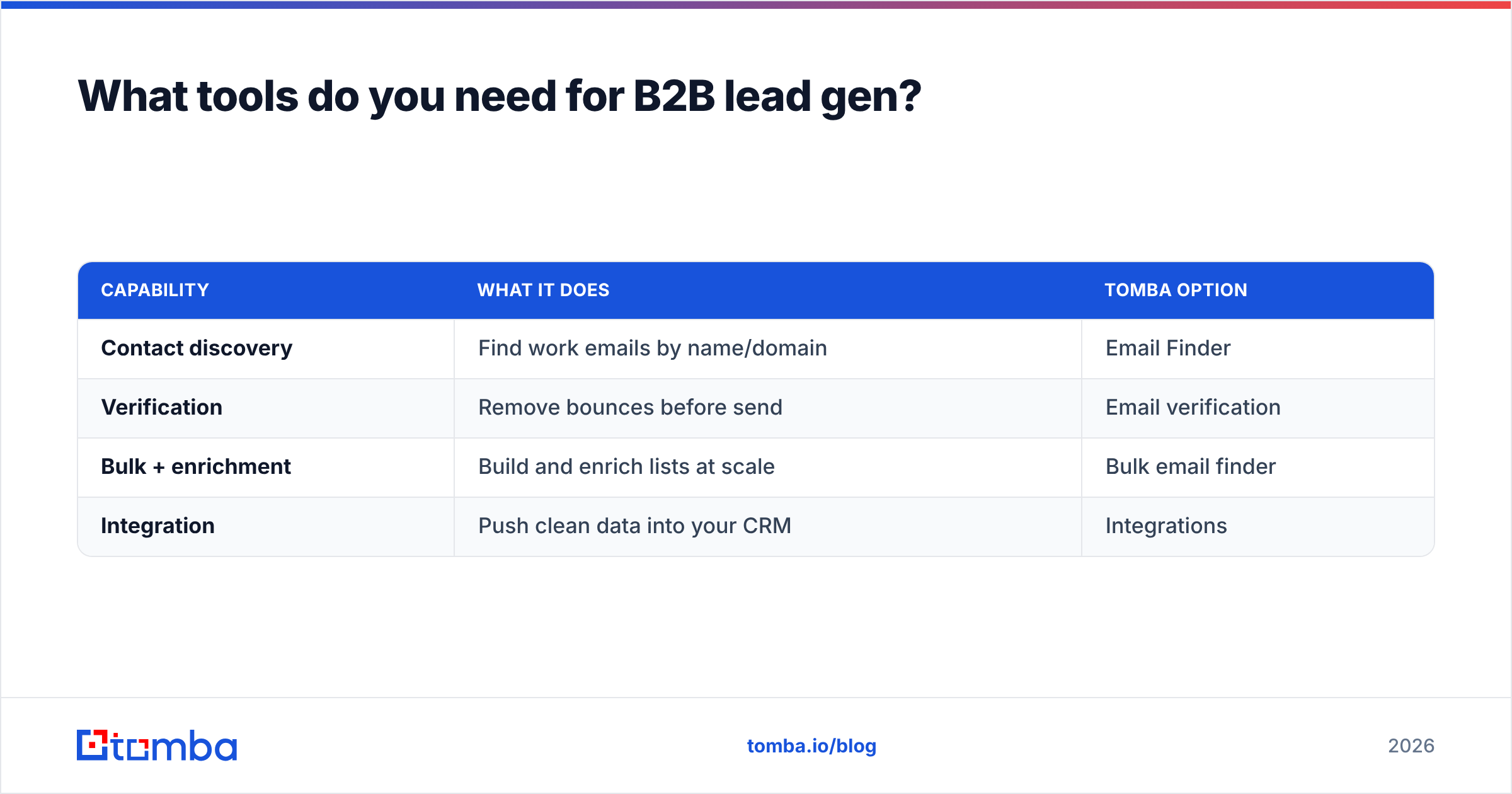
You need four capabilities, not forty tools. Many platforms bundle several. The trap is paying for overlap — three tools that all "find emails" while none of them verify well.
| Capability | What it does | Tomba option |
|---|---|---|
| Contact discovery | Find work emails by name/domain | Email Finder |
| Verification | Remove bounces before send | Email verification |
| Bulk + enrichment | Build and enrich lists at scale | Bulk email finder |
| Integration | Push clean data into your CRM | Integrations |
A few principles for choosing:
- One source of truth for contact data. Pick a finder with strong coverage and verification built in, so you are not stitching accuracy together from three vendors. Check where the data comes from before you trust it.
- Verify before every send, not just at import. Emails decay roughly 2–3% per month as people change jobs. A list clean in January is dirty by April.
- Make integration non-negotiable. Data that sits in a spreadsheet is data that rots. Wire your finder and verifier straight into HubSpot, Salesforce, or your sequencer.
- Watch the unit economics. Compare pricing on cost per verified contact, not cost per credit. A cheap credit that returns a bounce is the most expensive thing you can buy.
How do you measure B2B lead gen success?#
Stop reporting raw lead counts. They reward volume and hide leaks. Track the chain instead, because a problem at any link upstream poisons everything downstream.
The metrics that matter:
- Cost per qualified lead (CPQL) — total spend divided by leads that actually match your ICP. This exposes channels that look cheap but deliver junk.
- Lead-to-opportunity rate — the percentage of leads that become real sales conversations. If this is low, your targeting or data is off, not your closers.
- Bounce rate — over ~3% means your list is unverified and your sender reputation is bleeding. This is the single fastest fix for most underperforming programs.
- Sales-accepted rate — how often sales agrees a lead is worth their time. A gap between "marketing qualified" and "sales accepted" is a definition problem worth a meeting.
- Pipeline velocity — how fast qualified leads move to closed-won. Faster velocity usually traces back to better context at handoff.
A useful gut check: if your reply and meeting rates are low but your copy is solid, the culprit is almost always data. Run a sample of your list through a verifier and look at how many addresses come back risky or invalid. The answer is often uncomfortable — and immediately actionable.
Is inbound or outbound better for B2B lead gen?#
Neither, alone. The right question is sequencing. If you have a defined market and need pipeline this quarter, lead with outbound — it is predictable and you control the volume. If you are playing a longer game and want leads that cost less over time, invest in inbound knowing it compounds slowly. Most teams that scale cleanly run a "blended" motion: outbound to create immediate meetings while content and SEO build the compounding base that eventually lowers blended CAC.
What both motions share is the dependency on accurate contact data. Inbound captures an email through a form; outbound has to find it. Either way, an unverified address is a dead lead — which is why a reliable email finder and verifier sit at the center of every serious program, regardless of channel mix.
Where should you start?#
If you are rebuilding your B2B lead gen engine, start with the boring, high-leverage layer: clean, reachable contact data. Pick your two highest-intent channels, define a sharp ICP, and make sure every contact you act on is verified before it touches a sequence.
Tomba's Email Finder is built for exactly this layer — find verified professional emails by name, domain, or company, then push them straight into your CRM. The free tier gives you 25 searches a month to test coverage on your own ICP, and paid plans start at $49/mo (Starter), $99/mo (Growth), and $249/mo (Pro) when you are ready to scale. Start by finding and verifying the 100 contacts that matter most this quarter — then build the funnel around data you can actually trust.
// get started
Find, verify and enrich your first contacts today
Start on the free plan with 25 searches a month, then scale when your team is ready.
Free plan · No credit card required · GDPR & CCPA
// about the author